Simply Scandinavian by Trine Hahnemann

Simply Scandinavian
In 2004, chefs from the Scandinavian countries of Norway, Sweden and Denmark assembled alongside other Nordic chefs from Finland, Iceland, the Faroe Islands, Greenland, and Åland. After days gathered around what surely must have been an immaculately crafted solid oak table, bathed in natural light pouring in from floor to ceiling windows and set in the middle of a minimalist, yet tasteful, room of bare concrete walls, they emerged with The New Nordic Food Manifesto. The manifesto outlines ten aims of what food from the Nordic regions should be. One states that food should be reflective of the seasons, made with ingredients that are able to be sourced locally while another seeks to provide basic standards for animal welfare and responsible fishing. Noma’s live prawns topped with black ants, could be seen as an extreme example of an aim for purity, freshness and simplicity.

Gravlax, smørrebrød and IKEA meatballs aside, it’s likely that when we think of Scandinavian food, it looks something like the manifesto envisioned: conscious and graceful food, using few ingredients and cooked well. As a young budget traveller many moons ago, my idea of Scandinavian dishes used to be cheap newsagents hotdogs, the ones that pirouette in their own swill for hours before being decanted into a sweet, bleached bun and lathered with sauce from a hand pump.

Simply Scandinavian is thankfully lacking in hotdog recipes and instead, presents the fresh, seasonal and straightforward food Scandinavian cookery is synonymous with. It’s the latest in a line of Scandinavian cookbooks from chef and food writer Trine Hahnemann, with others focusing on comfort food, baking and entirely vegetable-based recipes.

It’s an easy book to drop into, not requiring any special ingredients than what you might already have lurking in the fridge. They’re predominantly vegetable-based and with chapters arranged by a “what do you fancy?” approach like Daily Comfort Food, Feeling Green or Light Dinners it makes selecting what to cook even more accessible.

Most recipes require little investment of time or energy. A meal of Chilled Pea Soup, a creamy Curry with Grapes accompanied by a Black and White Salad of lentils and rice came together within the hour. Most take less than thirty minutes, like a Roast Tomato Soup, featuring a tickle of coriander seeds or the Hot Smoked Salmon, Spinach and Fennel Salad.

There are some that require more involvement, the Roast Pork Loin or most dishes in the slightly misleading ‘Baking on a Whim’ chapter which to me suggests cinnamon rolls in a jiffy but tends to entail a fair amount of effort. Some are definitely whimmy, a Creamy Filo Vegetable Pie can be made in under an hour as can the Beautiful Cauliflower Trees on Filo, whereas the Buttery Leek Tart takes a little over. Rhubarb Sticky Buns are a morning’s work though happen to be entirely worth the effort and everything you’d want from a title like that.

Simple food is hard to get right both for cooks and, I imagine, cookbook authors. In a dish with few parts, so much will rely on the quality of those ingredients and the skill to prepare them well, especially with a cuisine like this, which doesn’t rely heavily on strong flavoured ingredients or spices. And while I don’t judge a book by its cover, I do judge it on how straightforward it claims to be on that cover. Can I make multiple dishes from it simultaneously? Does it inspire me to cook well when time is short? Is it easy to adapt to ingredients I have available?

Resoundingly, yes. The writing is clear, concise and easy to follow and dietary adaptations are made with simple instructions though for my tastes, some dishes would be better with a little more complication. I’d sacrifice the ease of some recipes if it meant not having to eat raw asparagus or cauliflower again.

Simply Scandinavian is ultimately a collection of intentionally unshowy recipes featuring fresh food that’s occasionally hearty, often delicate and almost always as easy as a cycle around Copenhagen.

Cuisine: Scandinavian
Suitable For: Beginners/Confident home cooks
Cookbook Review Rating: four stars
Buy this book: Simply Scandinavian
£27, Quadrille Publishing Ltd

Review written by Nick Dodd a Leeds-based pianist, teacher and writer. Contact him at www.yorkshirepiano.co.uk

SORREL HOISIN FRIED ‘CHICKEN’ BURGER by Denai Moore

ChickenSando_066
Every now and then you need a good burger in your life, and this one satisfies that craving. This is the kind of dish I make for my non-vegan friends. The sorrel hoisin glaze is quietly delicious and adds a fruity twist. Lettuce and pickles are non-negotiable here. There’s just something about the hot, crispy, sticky glazed oyster mushrooms and the ice-cold lettuce.

SERVES 6
PREP TIME 20 MINUTES, PLUS 20 MINUTES MARINATING TIME
COOK TIME 30 MINUTES

250 g (9 oz) oyster mushrooms
2 tablespoons Green Seasoning (see below)
1 tablespoon soy sauce
1 tablespoon ground allspice
vegetable oil, for deep-frying
1 x quantity Sorrel Hoisin Glaze (see below)
salt and freshly ground black pepper

FOR THE WET DREDGE
400 ml (13 fl oz/generous 1½ cups) soya milk
1 tablespoon lemon juice
2 tablespoons hot sauce of your choice

FOR THE CRISPY COATING
200 g (7 oz/1⅔ cups) plain (all-purpose) flour
50 g (2 oz/scant ½ cup) cornflour (cornstarch)
1 tablespoon all-purpose seasoning
1 teaspoon dried sage
1 teaspoon ground allspice
1½ teaspoons onion powder
1½ teaspoons garlic granules

TO SERVE
6 vegan-friendly brioche burger buns
knob of vegan block butter
vegan mayonnaise
½ iceberg lettuce
gherkins (pickles)

In a bowl, toss the mushrooms with the green seasoning, soy sauce, allspice and some salt and pepper. Set aside to marinate for 20 minutes. Combine the wet dredge ingredients in one bowl and the crispy coating ingredients in another, seasoning the coating mix with plenty of salt and pepper.

Add a little of the wet dredge to the dry coating and mix in – this will create small lumps, which will become crispy pockets. Dip the mushrooms in the wet dredge, then into the coating mix and then repeat for a double coating. Tap off any excess coating mix and set aside on a baking sheet, ready to fry.

Pour enough vegetable oil into a high-sided heavy-bottomed frying pan (skillet) or saucepan to fill to halfway and gently bring to heat. Test the temperature by using a wooden spoon – if lots of bubbles appear around it immediately, it’s ready to go.

Add 4–5 mushrooms to the pan, taking care not to overcrowd. Fry for 5–6 minutes until crisp and golden. Drain off any excess oil on a wire rack. Repeat until all the mushrooms are cooked. Brush the sorrel hoisin glaze on the mushrooms and set aside.

Toast the brioche buns with a touch of vegan butter. On the base of each bun spread a tablespoon of vegan mayonnaise and add a couple of lettuce leaves. Now add the glazed mushrooms and pickles. And another dollop of vegan mayo on the top bun. Serve and enjoy!

GREEN SEASONING
SERVES 10–12
PREP TIME 3 MINUTES

This flavour bomb is great to add to stews, soups and marinades.

bunch of coriander (cilantro)
bunch of flat-leaf parsley
10 springs of thyme, leaves picked
5 spring onions (scallions), roughly chopped
2 celery stalks, roughly chopped
1 bulb of garlic, cloves peeled
1 onion, roughly chopped
1 green (bell) pepper, roughly chopped
1 Scotch bonnet
sea salt and freshly ground black pepper

Put all the ingredients in a food processor and blend for 2–3 minutes to your desired consistency. I like mine quite fine, but you might like yours more coarse. Store in a clean jar and refrigerate for up to 2 weeks.

SORREL HOISIN GLAZE
SERVES 3–4 PREP TIME 5 MINUTES
COOK TIME 10 MINUTES

Sorrel is a hibiscus drink. The floral notes really work with the sweetness of the hoisin sauce. This would work well in various dishes, especially anything crispy and fried.

400 ml (13 fl oz/generous 1½ cups) sorrel soft drink
1 Scotch bonnet
4 allspice berries
100 ml (3/2 fl oz/scant ½ cup) hoisin sauce

Combine the sorrel, whole Scotch bonnet and allspice in a saucepan, bring to the boil, then reduce by half – it should hold on the back of a spoon and be sticky. Add the hoisin sauce, then transfer to a clean jar and store for up to 2 weeks in the refrigerator.

Cook more from this book

Buy this book: Plentiful by Denai Moore

Read the review   

Steve The Bartender’s Cocktail Guide by Steven Roennfeldt

Steve The Bartender Cocktail Guide

Who is Steve the Bartender? You’ll know Steve Roennfeldt from his hugely popular YouTube channel, launched in 2015 and which at the time of writing boasts 600 videos and 713k subscribers. He has more than two decades experience working in the hospitality industry in Australia and is founder of Threefold Distilling.

What’s the USP? A complete guide to cocktails at home, from stocking up your bar, what barware you’ll need, how to make your own syrups and mixers and 125 cocktail recipes. It’s the perfect introduction for cocktail newbies or more experienced amateur enthusiasts who want to up their game. What more could you ask for?

What will I love?
The book is beautifully laid out and leads you gradually into the subject, like a mini-cocktail masterclass. First there’s a short history of cocktails (Roennfeldt suggests they are a British invention – hurrah for us – with roots in the bowls of sprits and fruits served in 18th century punch houses) and cocktail timeline that tracks the development of mixed drinks from those simple punches through prohibition, tiki bars, disco drinks and modern technique driven cocktail bars that emerged from he early 90s until today. You’ll then learn about the various cocktail families such sours and highballs.

Now you’re an instant expert on cocktails, you’re ready to get hands on and start stocking up your own home bar. From my own experience, this can be a daunting task; read a random sample of half a dozen modern cocktails online and you might well believe you’re going to need a small fortune and ton of storage for all those obscure premium spirits and random liqueurs. Roennfeldt has the solution, advising his readers to ‘pick a few favourite cocktails, purchase the select bottles needed and expand your bottle collection gradually’. Wise words. Roennfeldt then offers recommendations for spirits, liqueurs, amaros, aromatised wines including vermouths and sherry bitters.

Recipes for making your own syrups and mixers are followed by a primer on types of ice (cubed, crushed and clear) and garnishes like olives and cucumber. Now you’re ready to buy some essential kit like a shaker and a muddler and purchase your glassware. Roennfeldt lists three essentials including highball and six secondary including a hurricane, the tulip shaped glass you serve a pina colada in, all handily illustrated  so you know exactly what you need to get and for what purpose.

Finally, Roennfeldt outlines how to execute the essential techniques you’ll need including shaking (10-12 seconds is enough apparently, any longer and you’re wasting everyone’s time) and stirring (it takes longer to achieve the correct serving temperature than you might think, up to 30 seconds. More advanced techniques include ‘fat-washing’; infusing things like bacon and coconut oil into spirits.

Roennfeldt offers some cocktail menus to simplify to job of hosting a cocktail party for friends and then it’s into the recipes. These are grouped in to aperitivo, whiskey, gin, rum, tequilas/mezcal, brandy/cognac/vodka, fortified wine and liqueurs, so something for everyone.

How easy are the recipes to follow? Every recipe is illustrated with a full page colour photograph which looks great and you can see exactly how your drink should look. Every recipe is headed by the main ingredient written in large type at the top of the page which makes it simple to flick through the book and find the category of drinks you are interested in making. Roennfeldt also lists where the drink originated, the type of drink (e.g. tropical), the method of making, the glassware you’ll need and the required garnish so you can quickly decide if you have everything to hand to make the drink or if you need to go shopping or maybe choose another recipe.

Instructions are clear and comprehensive with both ounce and ml measurements,  so you won’t put a foot wrong. How complicated can mixing a drink be? Well, there are more variables than you might expect and Roennfeldt covers them all. For example, in his recipe for Port-au-Prince, a rum-based tropical drink, named after the Haitian capital, that originated circa 1930 by Don the Beachcomber and that’s served in a footed pilsner glass with a lime wedge (I learned all that in seconds just by reading the recipe), Roennfeldt recommends ‘flashblending’ the drink in a milkshake maker, but offers the alternative method of ‘whip shaking’ – a short shake with a small amount of pebble ice that will chill, combine and aerate the drink. He also offers an alternative recipe by increasing the quantity of rum and splitting it between two types, aged Haitian and demerara rum.

Should I buy the book? If you are new to cocktail making, or want to kick your home bartending skills up a notch, this is the book for you. Like any great educator, Roennfeldt has seen his subject from his reader/pupil’s point of view ensuring they have all the information they need. There is no assumption of knowledge or expertise on the reader’s part so you won’t find yourself having to Google jargon related to techniques or equipment or ingredients. It’s an extremely well thought-through book that look great too. What are you waiting for? Order the book, get your shake (or stir) on and take your drinking (of the responsible kind of course).

Cuisine: Cocktails
Suitable for: Beginners/Confident home bartenders
Cookbook Review Rating: Five stars

Buy this book: Steve The Bartender’s Cocktail Guide
£20, Alpha

Plentiful by Denai Moore

Plentiful by Denai Moore

The multi-talented Denai Moore is an acclaimed soul singer as well as the vegan chef behind Dee’s Table pop up restaurant and has developed recipes for Leon and Tesco among others. With her debut cookbook, Moore wants to smash preconceptions about Jamaican food which she says is ‘often misrepresented, stripped of its complexity and reduced to being a meat-heavy cuisine’. Instead, Plentiful is a collection of vegan recipes that celebrates the vibrancy and diversity of Jamaican cooking which Moore says is a ‘melting pot of different cultures’ that uses spices in a unique way. 

Moore mixes the food of her childhood growing up in Jamaica with influences from East and Southeast Asia. Her take on the Thai salad larb incorporates Jamaican-style ‘green seasoning’ (made with blended coriander, parsley, thyme, green pepper and scotch bonnet) and as well as vegan fish sauce and tofu. Moore’s version of ramen uses the traditional base of Jamaican ‘brown stew’, caramelised brown sugar, then adds a kombu broth flavoured with allspice, another typically Jamaican ingredient. Topped with pak choi, tofu and noodles, the finished dish looks like ramen but it’s a creation all of Moore’s own.

Moore has gone off-piste with the book’s format too. Forget starters, mains and desserts, instead there’s chapters entitled ‘Food That I Dream About Before Going To Bed’ (i.e. breakfasts including a hominy corn porridge inspired by her grandmother’s recipe), ‘Salads That Aren’t Lame’ (beetroot with olive and scotch bonnet jam) and ‘Comfort Grub’ (squash and butter bean curry with spinners, a type of dumpling).

Although Moore says the book is intended to include ‘all the greatest Jamaican hits’, she has included many recognisable elements of the cuisine, albeit in her inimitable way. Callaloo, a leafy green, is turned into pesto for pasta, ackee fruit replaces eggs in a carbonara and there’s vegan versions of Jamaican classics like patties and red pea (kidney bean) soup. From rice and peas arancini to a Jamaican ginger and marzipan loaf, Moore brings individuality and creativity to every dish, ensuring that Plentiful will provide inspiration to any inquiring chef.     

Cuisine: Jamaican
Suitable for: Beginners/Confident home cooks
Cookbook Review Rating: Four stars

Buy this book: Plentiful by Denai Moore

Introducing: Ideas for legs by Stephen Rötzsch Thomas 

Profile Picture

Here’s how I eat: first with my mind, and then with my body.

I’m the sort of person who is thinking about what’s for dinner while they’re still munching on their breakfast. A planner who plots a big shop at the beginning of the week, and an improviser, who then adapts those plans as the days unfurl around him.

I am also – whisper this – not exactly rolling in cash. I don’t know if anyone’s told you, but shit is expensive right now. And so a lot of my cooking is based around the food that will offer me the most value. Affordable ingredients are a key part of my eating at the moment, and this is what led me to launch a new recipe newsletter called Ideas with Legs.

Chicken legs are easily the best bit of the bird. Full of flavour, the perfect size for an individual portion and, above all else, really affordable. Even Waitrose and Ocado will sell you a pair of the bad boys for less than £1.50. 

Annoyingly, though, the leg doesn’t get a whole lot of attention in cookbooks. Plenty of room for skinned, boned thighs, yes. Not so much for the simple, cost-effective full leg. 

Ideas with Legs has been born out of my ongoing quest to find fun, varied recipes that make the most of this underappreciated ingredient. As I toy around with different dishes from all around the world, I’ll be sharing what I find and, hopefully, offering up some new ideas that will help you to enjoy affordable, flavour-filled dinners.

Each month, subscribers will receive a new recipe centred on chicken legs. Last month I opened the Ideas with Legs account by sharing a recipe for a Filipino chicken adobo. Later this week, I’ll spin the globe and explore a Brazilian rice dish called galinhada that I’m enjoying so much I keep forgetting I’m supposed to be working on other recipes too. 

If you want to delve into food a little deeper with me, I’m also offering a cheeky subscription version of Ideas with Legs. You’ll get extra recipes that go beyond the leg: I’ll share Offally Good Ideas that make the most of some of the most overlooked cuts of meat. Occasionally I might offer up Ideas with Veg(etables) too. Oh, and everything I share will be gluten free. Mainly because I don’t get a choice in the matter.

I don’t expect to make much money from the paid part of Ideas with Legs, and I’m not really doing it for that reason anyway, so subscriber fees have been set at the minimum Substack will let me get away with. I know this because I tried to make it cheaper and they told me off. 

Having spent three years reviewing cookbooks here, it’s probably about time I put my best (chicken) leg forward and offer something up myself. Hopefully some of you will join me. I’ve plenty of delicious ideas in the works, and have even managed to get some gorgeous artwork for the newsletter by the Observer newspaper’s political cartoonist and former Children’s laureate Chris Riddell. Now, I suppose, I just need to get cooking. 

You can sign up to receive Ideas with Legs here.

as cooked on Tik Tok

As Cooked on Tik Tok

What’s the USP? Here’s a book guaranteed to stir up some sort of response in anyone over, say, thirty years of age. as cooked on TikTok is a collection of ‘fan favourites and recipe exclusives’ from over 40 of the social network’s food influencers.

And look, we’re coming into this one with serious trepidation, yes? The front cover promises a foreword by ‘Gordon + Tilly Ramsay’, and the pictures on the back include ‘Cloud Bread’, part of a trend of ‘fluffy’ foods that also included whipped coffee and ‘cloud eggs’, which are both featured inside as well.

In case you were wondering, Cloud Bread looks atrocious. Dyed blue (like… clouds?), and made using only egg whites, sugar, cornstarch and vanilla extract, it looks less like a cumulonimbus, and more like a failed soap that’s been dumped unceremoniously on the Lush factory floor. A good start, then. 

Who wrote it? Primarily referred to by their TikTok handles, the names of the 40 influencers here won’t mean much to anyone not actively following foodtok (you’ve got this, really, I’m right here with you, offering my love and support – foodtok is just the corner of TikTok focussed on cooking and eating). 

There’s a real sense of variety, though. Most of the featured creators are based in North America, but many are immigrants who are bringing the dishes of their home country to a wider audience. There are students and young professionals who love to share their homemade concoctions, professionals who have found a new way to expand their brand, and retired grandmothers with a penchant for cosplay amongst the contributors. And @newt who, according to his bio, ‘really likes parsley’. Good for @newt.  

Is it good bedtime reading? Gordon Ramsay and his daughter Tilly do their best to convince you otherwise with a painful foreword that is meant to read like an improvised dialogue but instead feels like the pained patter of morning television presenters pulled in to replace the usual hosts. 

Beyond the foreword, though, there’s more to engage with here than you might expect. as cooked on TikTok could have easily chosen to share nothing but the easiest and most attention-grabbing dishes. Instead, it serves as a pretty decent beginner’s guide to cookery. One that doesn’t assume the worst of its readers, and seeks to teach them some useful skills beyond the basics. 

Admittedly, these lessons tend to come in relatively grating formats – recurring segments with TikTok-themed titles like ‘#lifehack’ or ‘I was today years old’. But the information within is usually a cut above keeping your knives sharp, or maintaining different chopping boards for different foods. Instead we get introductions to asafoetida and Chinkiang vinegar, piping bag tips and recommendations of kitchen gear that include sesame grinders. 

How annoyingly vague are the recipes? Editorial consistency is always the key in a compilation cookbook. It’s a big part of why I couldn’t get on with the Andre Simon-award nominated Eat, Share, Love – but it’s not an issue here. Ebury Press have reigned in the wildly different styles of their contributors; recipes are simple to follow, with measurements in both imperial and metric. For anyone still unsure, each recipe has a QR code that will take you to the creator’s corresponding TikTok video. Admittedly these vary greatly – @auntieloren’s video for Biscuit Pot Pie is almost meditative, soundtracked by a Janet Jackson slowjam. Aforementioned grandmother @cookingwithlynja, on the other hand, offers up an intense and chaotic video for Ramen Carbonara in which she is mostly yelling, and dressed as anime icon Naruto. Sure, why not? 

What’s the faff factor? Dishes here are, as you might expect from a format where most videos come in under three minutes, pretty simple. The #lifehack suggestions often help cut your work down further, too. 

How often will I cook from the book? Let’s be very clear here: the target audience for this title skews young. My best guess is that this will mostly be used by students and those in their early twenties – the sort of people who are just starting out on their road of culinary discovery and are looking for quick and exciting meals that they can throw together after a shitty 9-5:30 job with an hour’s commute at either end. And for those people: actually, this could see them through a decent part of the week. 

Cookbooks for students in particular remain a sad and uninspired little corner of the market in which the same clichéd dishes are trotted out in drab titles that haven’t evolved that much in the past twenty years. as cooked on TikTok is an excellent alternative to these. Recipes are playful, and really varied – almost every recipe here stands out as unique amongst my entire cookbook collection. Where else would I turn for a Korean/Mexican fusion like Kkanpoong Tofu Tacos, or unexpected twists on classics like Cookies and Cream Kulfi?

As easy as it was for me to approach this book with an entitled sense of superiority over what could easily have been a zeitgeisty money-grab, as cooked on TikTok has a legitimately interesting range of meals that could happily feed mind and stomach alike.

Killer recipes: Marinated Riblets with Guajillo Salsa, Chilaquiles Rojos, Hot Crab and Spinach Dip with Garlicky Toasts, Butter Chicken Pasta, Ramen Lasagne, Sweet Chile-smashed Sprouts, Mini Burnt Basque Cheesecakes 

Should I buy it? It won’t be for everyone – and it misses out on input from my favourite foodtok creator, @goodboy.noah, whose recipes are dictated by a rapping cheetah. But ultimately, as cooked on TikTok is delivering much more than it needed to. With dishes that are happy to subvert expectations, and draw on influences from around the world with irreverent joy, it’s a great introduction for those looking to step up their cooking from basic self-preservation to actually enjoying oneself. 

Cuisine: International
Suitable for: Beginner home cooks
Cookbook Review Rating: Four stars

Buy this book: as cooked on Tik Tok
£20,  Ebury Press

Review written by Stephen Rötzsch Thomas a Nottingham-based writer. Follow him on Twitter and Instagram at @srotzschthomas

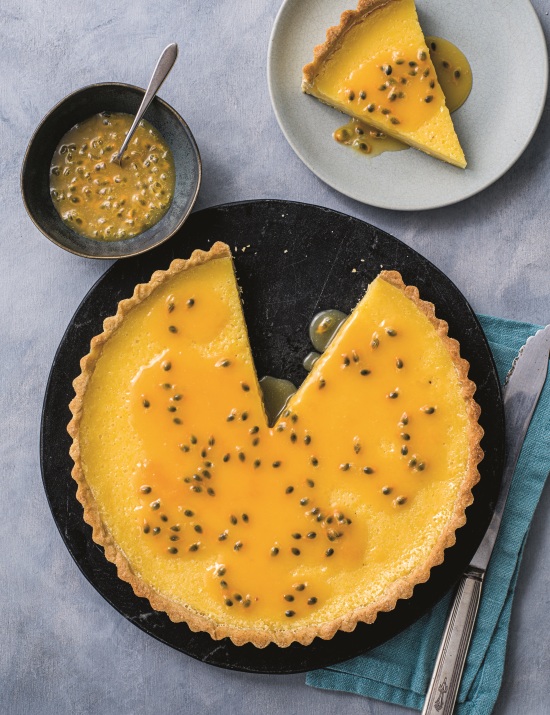
Lemon tart with lemon passion fruit curd by Mary Berry

260_Lemon_passion_fruit_tart_V1

Another lovely tart with a crisp sweet pastry case and a sharp lemon filling.

SERVES 8

For the pâte sucrée
175g (6oz) plain flour, plus extra for dusting
75g (3oz) butter, softened
75g (3oz) caster sugar
3 large egg yolks

For the filling
5 large eggs
225g (8oz) caster sugar
125ml (4fl oz) pouring double cream
3 large lemons

To finish
6 tablespoons lemon curd
2 passion fruits

First make the pâte sucrée (sweet pastry). Measure the flour and butter into a bowl. Rub in the butter with your fingertips until the mixture resembles fine breadcrumbs. Stir in the sugar, then add the egg yolks. Mix until the ingredients come together to form a firm dough. Roll out the pastry on a lightly floured work surface and use to line a 23cm (9in) loose-bottomed flan tin. Prick the pastry all over with a fork. Chill in the fridge for 30 minutes.

Preheat the oven to 200°C/Fan 180°C/Gas 6.

Line the flan tin with non-stick baking paper and baking beans. Bake blind in the preheated oven for 15 minutes, then remove the paper and beans and bake for another 5 minutes until golden and crisp.

Reduce the oven temperature to 160°C/Fan 140°C/Gas 2.

To make the filling, mix the eggs, sugar and cream together in a large bowl. Zest the lemons and add to the mixture. Squeeze the juice from the lemons and add 150ml (¼ pint) to the bowl.

Pour the mixture into the tin and carefully slide back into the oven. Bake for about 30–35 minutes until the filling is set, but with a slight wobble. Leave to cool.

Meanwhile, mix the lemon curd and passion fruit pulp together in a bowl. Serve alongside the tart, or drizzle over the top.

Cook more from this book
Banoffee Pie by Mary Berry
Large All-In-One Victoria Sandwich by Mary Berry

Read the review
Coming soon

Buy this book: Mary Berry’s Baking Bible
£28, BBC Books

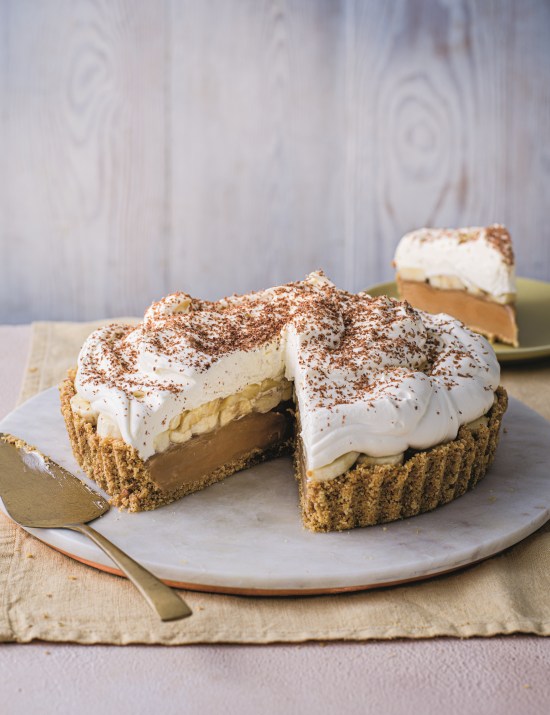
Banoffee Pie by Mary Berry

356_Banoffee_pie

The combination of toffee, bananas and cream makes this one of the most popular desserts around. Make sure you use a non-stick pan for the toffee and watch it very closely as you are making it, as it can burn easily.

BANOFFEE PIE

SERVES 6

For the base
175g (6oz) digestive biscuits
65g (2½oz) butter

For the toffee filling
115g (4oz) butter
115g (4oz) light muscovado sugar
2 x 397g cans full-fat condensed milk

For the topping
3 bananas, sliced
a little fresh lemon juice
300ml (½ pint) double cream
a little grated Belgian milk or dark chocolate, for sprinkling

You will need a 23cm (9in) deep loose-bottomed fluted flan tin.

To make the base, put the biscuits into a polythene bag and crush them to crumbs with a rolling pin. Melt the butter in a small pan, remove from the heat and stir in the crushed biscuits. Mix well.

Spread the mixture over the base and sides of the flan tin. Press the mixture with the back of a metal spoon.

To make the toffee filling, measure the butter and sugar into a large non-stick pan. Heat gently until the butter has melted and the sugar has dissolved. Add the condensed milk and stir continuously and evenly with a flat-ended wooden spoon for about 5 minutes, or until the mixture is thick and has turned a golden toffee colour – take care, as it burns easily. Turn it into the prepared crumb crust and leave to cool and set.

To make the topping, toss the bananas in lemon juice and arrange the slices over the toffee in a neat layer. Lightly whip the double cream until it forms soft peaks and spread evenly over the bananas. Sprinkle the whole pie with grated chocolate.

Remove the ring and transfer to a flat plate.

Serve well chilled.

TIP

Most condensed milk cans now have ring pulls, so the old method of simmering the can in a pan of water for 4 hours to caramelise the condensed milk is not advised.

Cook more from this book
Lemon tart with lemon passion fruit curd by Mary Berry
Large All-In-One Victoria Sandwich by Mary Berry

Read the review
Coming soon

Buy this book: Mary Berry’s Baking Bible
£28, BBC Books

Large All-In-One Victoria Sandwich by Mary Berry

033_Large_allinone_Victoria_Sandwich

This must be the best known and loved of all family cakes. The all-in-one method takes away the hassle of creaming, and ensures success every time. Baking spreads give an excellent result, but the cake won’t keep as long.

CUTS IN TO 6 GENEROUS SLICES

225g (8oz) baking spread, straight from the fridge
225g (8oz) caster sugar
4 large eggs
225g (8oz) self-raising flour
1 level teaspoon baking powder

For the filling and topping
about 4 tablespoons strawberry jam
150ml (5fl oz) pouring double cream, whipped
a little caster sugar, for sprinkling

Preheat the oven to 180°C/Fan 160°C/Gas 4. Lightly grease two deep 20cm (8in) loose-bottomed sandwich tins and line the base of each with non-stick baking paper.

Measure all the cake ingredients into a large bowl and beat for about 2 minutes with an electric mixer until beautifully smooth and lighter in colour. The time will vary depending on the efficiency of the mixer. Divide the mixture evenly between the tins and level the surfaces.

Bake in the preheated oven for about 25 minutes, or until well risen, golden and the cakes are shrinking away from the sides of the tin. Leave to cool in the tins for a few minutes then turn out, peel off the baking paper and finish cooling on a wire rack.

When completely cold, sandwich the cakes together with the jam and whipped cream. Sprinkle with caster sugar to serve.

TIP

Here are the ingredients and baking times for smaller cakes so that you don’t have to calculate the quantities. Follow the instructions for the Large All-in-one Victoria Sandwich.

For an 18cm (7in) Victoria Sandwich, use 175g (6oz) baking spread, 175g (6oz) caster sugar, 3 large eggs, 175g (6oz) self-raising flour and ¾ teaspoon baking powder. Bake in two 18cm (7in) greased and lined sandwich tins for about 25 minutes.

For a 15cm (6in) Victoria Sandwich, use 115g (4oz) baking spread, 115g (4oz) caster sugar, 2 large eggs, 115g (4oz) self-raising flour and ½ teaspoon baking powder. Bake in two 15cm (6in) greased and lined sandwich tins for about 20 minutes.

Cook more from this book
Lemon tart with lemon passion fruit curd by Mary Berry
Banoffee Pie by Mary Berry

Read the review
Coming soon

Buy this book: Mary Berry’s Baking Bible
£28, BBC Books

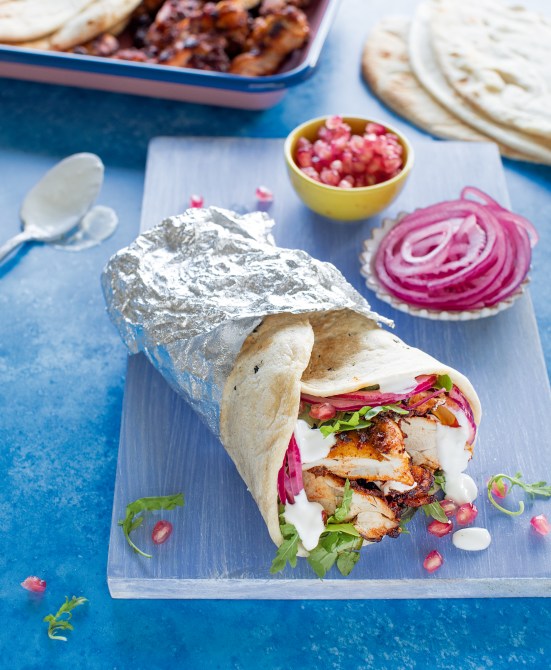
HARISSA CHICKEN GYROS by Nathan Anthony (Bored of Lunch)

055_harissachickengyros

These are stunning and make lunchtime extra special, inspired by a version I had at a street food festival. They’re so quick to make that they also work really well for dinner, especially if you’re having friends round. They look so good that people will think you’ve spent ages cooking but the reality is, it’s all done in 15 minutes.

SERVES 3 (331 calories each)

2 tbsp harissa paste
juice of 1 lemon
1 tsp paprika
1 tsp Cajun seasoning
1 tsp ground cumin
500g skinless, boneless chicken thighs
salt and pepper, to taste
3 supermarket gyros, flatbreads or pittas
handful of rocket
3 tbsp pomegranate seeds
small handful of pickled red onions (I use shop-bought – who has time to pickle
stuff?)

Sauce
5 heaped tbsp Greek yogurt
juice of 1 lemon
2 garlic cloves, crushed

1 Combine the harissa, lemon juice, paprika, Cajun seasoning, cumin and salt and pepper in a bowl. Coat the chicken with this mixture – if you can, preheat the air fryer for 2–3 minutes because adding the chicken to the hot drawer will give it an extra bit of char. Air-fry at 200°C for 12 minutes.

2 While the chicken is cooking, combine the yogurt with the lemon juice and garlic.

3 Heat the gyros or flatbreads and assemble, stuffing with the chicken and rocket and drizzling over the yogurt sauce, then top with the pomegranate seeds and pickled red onions.

Cook more from this book
Fish Tacos by Nathan Anthony (Bored of Lunch)
’NDUJA-STUFFEDARANCINI BALLS by Nathan Anthony (Bored of Lunch)

Read the review
coming soon

But the book: Bored of Lunch: The Healthy Air Fryer Book by Nathan Anthony
£18.99, Ebury Press

BoredofLunch_Airfryer_FRONT