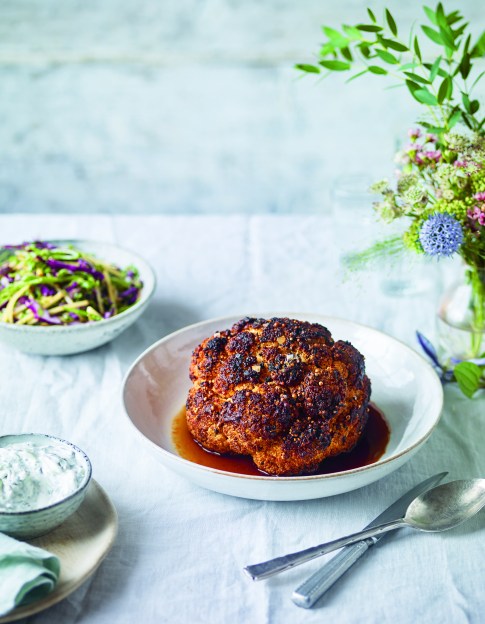
Whole Barbecued Spiced Cauliflower, Tarragon Tzatziki, Summer Slaw by Chantelle Nicholson

08.30.17_KB_Planted_D5_Cauli_019

Barbecued Cauliflower is not normally thought of, but give it a try as it is absolutely delicious. Brining it ensures it is seasoned all the way through.
The spice mix does not have too much heat in it, so up the chilli flakes if
you prefer. Using the cauliflower leaves in the slaw also minimises waste.

Serves 4

For the cauliflower brine
7g table salt
2 bay leaves
1 teaspoon coriander seeds
1 large cauliflower, leaves removed
and reserved for the slaw

For the spice mix
25g non-dairy butter
1 tablespoon soft brown sugar
½ teaspoon table salt
1 teaspoon cumin seeds, toasted
1 teaspoon yellow mustard seeds
½ teaspoon chilli flakes
1 teaspoon coriander seeds
½ teaspoon mustard powder
1 teaspoon smoked paprika

For the tzatziki
½ cucumber, grated
½ teaspoon cumin seeds, toasted
125g coconut yogurt
¼ bunch of mint, leaves chopped
¼ bunch of tarragon, leaves chopped
sea salt and freshly milled black pepper

For the summer slaw
¼ red cabbage, finely sliced
1 nectarine, halved, stoned and julienned
100g sugar snap peas, finely sliced
100g rocket, finely chopped
2 tablespoons sesame seeds, toasted
¼ bunch of coriander, leaves finely chopped
50ml Sesame Vinaigrette (see page 186)

First make the cauliflower brine. Bring 100ml of water to the boil with the
salt, bay leaves and coriander seeds. When the salt has dissolved, add
900ml of cold water and submerge the cauliflower in it for 2 hours.

Preheat a barbecue or griddle pan until hot. Combine all the spice mix
ingredients, then remove the cauliflower from the brine, pat dry, and brush
all over with half the spiced butter.

Place on the hot barbecue or griddle pan. Cook all over until a deep golden, then brush with the remaining spiced butter and wrap in foil and put back on the barbecue or pan. Cook in the foil for 20–25 minutes until a skewer inserted into the centre meets no resistance. Remove the cauliflower from the foil and place back on the barbecue, drizzling the cooking juices from the foil over the top.

For the tzatziki, mix all the ingredients together and season to taste.
for the summer slaw, mix all the ingredients together, including the sliced
cauliflower leaves, then season well and dress with the vinaigrette.
Slice the spiced cauliflower and serve drizzled with the tzatziki and the slaw
on the side.

Cook more from this book
Seeded Granola and Chai-spiced Poached Plums
Peanut Butter Pudding, Peanut Caramel, Dark Chocolate Sorbet

Read the review

Buy the book
Planted: A chef’s show-stopping vegan recipes
£25, Kyle Books

Recipes taken from Planted by Chantelle Nicholson. Published by Kyle Books. Photography by Nassima Rothacker
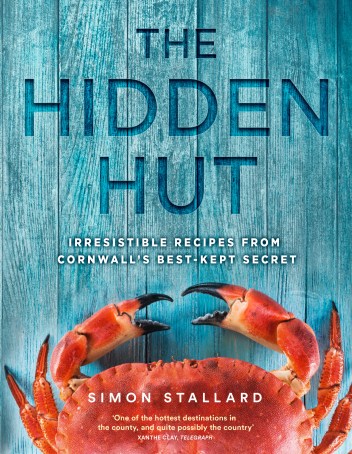
The Hidden Hut by Simon Stallard

The Hidden Hut jacket

What’s the USP? Recipes from one of Cornwall’s best-loved beach restaurants, famous for its open-air feast nights.

Who’s the author? Simon Stallard is the chef and owner of The Hidden Hut, a casual beachside restaurant set in ‘an old wooden shed’ on a coastal path near Truro. Stallard worked around the globe from ‘New York to New Delhi’ before settling in Cornwall and opening the Hut in 2010.

What does it look like? The numerous scene-setting photographs mean that you can almost feel the sand between your toes and smell the salty tang of the sea. Reading the Hidden Hut will make you want to jump in the car and immediately head for the south Cornish coast. The colourfully rustic food looks very appealing, the sort of pleasingly unpretentious stuff you just want to get stuck into.

Is it good bedtime reading? Not so much, just a short introduction and a ‘How to cook over fire section’ (cooking over a wood fire in the open air is what Hidden Hut feast nights are all about and Stallard shares his expertise over a 10-page section of the book).

Will I have trouble finding ingredients? You will be at an advantage if you live by the coast and can get your hands on spider crabs, octopus and gurnard, but as long as you can get to a good fishmonger you’ll be fine.

What’s the faff factor? Dishes range from a straightforward mid-week meal of lamb cutlets with butter bean mash and fresh mint sauce to a special-occasion-only slow roasted goat in preserved lemons, but overall the food is about as far from overwrought, tweezered complex restaurant food as you can get.

How often will I cook from the book? With recipes for breakfast (smokey bacon pastries), lunch (chicken and wild garlic soup), picnics (green pea scotch eggs) and parties (seafood paella for 40) as well as lots of delicious dinner ideas, it’s difficult to say when you won’t be cooking from the book.

Killer recipes? Despite the crab on the cover, this is not just a seafood cookbook. In addition to dishes like red-hot mullet with sticky rice balls and cucumber salad and Summer sardines with saffron potatoes and oregano dressing, there’s plenty of meat and veg in the form of 12-hour lamb with smoky aubergine, and samphire frittata with warm lemony courgette salad.

What will I love? There’s a real feel-good factor about the book, open it at any page and you’ll be inspired to get in the kitchen and cook.

What won’t I like? If you want super serious, complex cheffy cooking, this is not the book for you.

Should I buy it? The Hidden Hut is the sort of book with recipes that will become perennial favourites that you’ll find yourself going back to time and time again. So that’s a yes.

Cuisine: Modern British
Suitable for: Confident home cooks
Cookbook Review Rating: 4 stars

Buy this book
The Hidden Hut
£20, HarperCollins

Cook from this book
Buttermilk drop cakes with lemon curd
Chicken and wild garlic soup
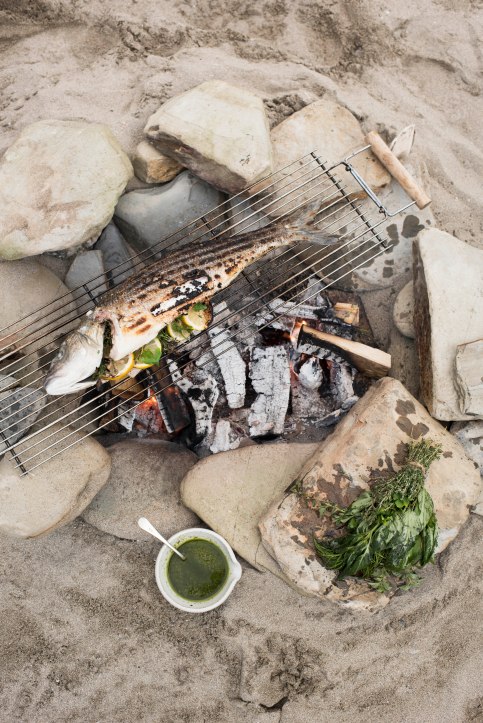
Fire-pit wild sea bass with verde sauce

Fire-pit wild sea bass with verde sauce by Simon Stallard

THH_FirepitRecipe-6108-Edit

A real crowd pleaser, this chargrilled whole fish is just beautiful in its simplicity. Stuffed with soft herbs and slices of lemon and garlic, the fish is cooked until the skin turns crisp, with striking grill lines. It comes with a slightly sharp herby sauce, which adds a burst of greenness as well as lots of flavour.

Serves 4–6

1 × 2kg wild sea bass, gutted and scaled
olive oil, for coating
2 handfuls of flat-leaf parsley leaves
leaves from a handful of lemon thyme sprigs
1 large lemon, sliced
1 large garlic clove, thinly sliced
5 bay leaves
½ onion
extra-virgin olive oil, for drizzling
lemon wedges and crusty bread, to serve

FOR THE VERDE SAUCE
7 anchovy fillets in vinegar, or 4 if using salted
10g wild garlic leaves or 1 garlic clove, peeled 2 tbsp capers
20g basil leaves
15g flat-leaf parsley leaves
1 heaped tbsp lemon thyme leaves
juice of ½ lemon
125ml extra-virgin olive oil sea salt and freshly ground
black pepper

To make the verde sauce, rinse the anchovies if using salted, then put them and the remaining ingredients, apart from the olive oil, into a mini food processor and blitz until finely chopped. Gradually pour in the olive oil and blend to a fairly smooth sauce, then season with salt and pepper. (Alternatively, if you prefer a chunkier sauce, finely chop the anchovies, garlic, capers and herbs, or use

a pestle and mortar, then add the lemon juice. Gradually stir in the oil.) Spoon the sauce into a bowl and set aside.

Light the fire pit (or you could use a wood-fired grill or a barbecue) about 30 minutes before cooking, following the instructions on page 76. You want a medium-high heat on one half of the fire-pit grill (check out the method for two-zone cooking on page 78). The rack should be about 20cm above the heat source.

Rinse the sea bass in cold running water, then pat dry inside and out with kitchen paper. You could cut a slash behind the head to enable heat to reach the collar, but I don’t tend to slash the sides – the skill is in creating bass crackling.

Rub the fish all over with a good coating of olive oil. Stuff the parsley, thyme, lemon slices and garlic into the fish cavity, then top with the bay leaves. Season with salt and pepper.

Rub the grill rack with the cut side of the onion to stop the fish sticking to it, then put the sea bass directly on the hot side of the fire-pit grill. Grill the sea bass for 4 minutes on each side, carefully turning/rolling it over using two fish slices. Move the fish over to the cooler side of the grill and cook for 3 minutes on each side or until the skin is crisp and the flesh starts to flake away from the bone, especially around the base of the head.

Serve the sea bass with a splash of olive oil and the lemon wedges, verde sauce and chunky slices of crusty bread.

The Hidden Hut by Simon Stallard (HarperCollins) £20, is out now

Cook more from this book
Chicken and wild garlic soup
Buttermilk drop cakes with lemon curd

Read the review

Buy the book 
The Hidden Hut
£20, HarperCollins

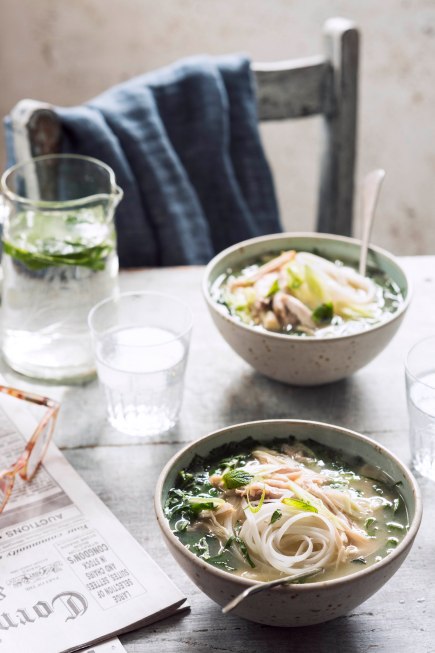
Chicken and wild garlic soup by Simon Stallard

THH_Chicken_Garlic_Soup-885-Edit.jpg

Wild garlic is abundant in local woodlands. They are small ground- covering plants with broad leaves and a little cluster of white flowers during the spring, and they are often found alongside bluebells. If you come across any wild garlic when you are out and about, this recipe is a lovely way to make the best of it. This is an enriching dish full of the flavours of spring.

Homemade stock really is better made with the whole bird, so buy a whole chicken and joint it. Use the carcass and legs for this recipe and freeze the breasts (or use them in the Charred Chicken and Squash Salad on page 104). To make the soup more substantial, cook 200g dried rice noodles and put them in the bowl before adding the soup, if you like.

Serves 4–6

3 tbsp sunflower oil, plus extra for roasting
1 large chicken, jointed (you can ask your butcher to do this) and breasts reserved for another recipe
3 celery sticks, roughly diced
1 onion, roughly diced
1  leek,  roughly  chopped
1  large  garlic  bulb, cloves peeled
100g wild garlic leaves, roughly sliced (keep the flowers if you have them)
4 spring onions, finely sliced on the diagonal
a small handful of mint leaves, ripped
a small handful of coriander leaves, ripped
sea salt and freshly ground black pepper

Preheat the oven to 220°C (200°C fan oven) gas mark 7. Heat the sunflower oil in a large saucepan over a high heat and add the chicken legs, skin side down, along with the wings and the carcass (you may need to do this in batches, depending on the size of your pan). Fry over a very high heat, to brown all over. Transfer to a roasting tin and coat in a little more oil and a pinch of salt. Roast for 15–18 minutes until a deep golden brown.

Add the vegetables to the same pan (there should still be some oil in there) and put it back over a medium heat. Sweat the veg for 2 minutes or until starting to soften but not colour.

Once roasted, return the chicken to the pan and pour over 2 litres cold water. Season with salt and pepper. Bring to the boil, then reduce the heat and simmer for 1½ hours. Strain the soup and return the broth to the pan. Take the chicken from the sieve, remove the skin and shred the meat from the bones, discarding the bones and skin. Leave the meat to one side.

Divide the wild garlic among serving bowls and top with the spring onions. Divide the shredded chicken between the bowls and add the herbs.

Taste the broth and check for seasoning, adding more salt and pepper if needed. Ladle it over the chicken and greens in the bowl, and sprinkle over the garlic flowers, if you have them.

The Hidden Hut by Simon Stallard (HarperCollins) £20, is out now

Cook more from this book 

Buttermilk drop cakes with lemon curd
Fire-pit wild sea bass with verde sauce

Read the review

Buy the book 
The Hidden Hut
£20, HarperCollins
 

Gunpowder by Harneet Baweja, Devina Seth and Nirmal Save

Gunpowder

What’s the USP? ‘Explosive flavours from modern India’ runs the subtitle. In reality, this is a collection of recipes from Gunpowder, a ‘home-style Indian kitchen restaurant’ in Spitalfields London.

Who’s the author? Husband and wife team Harneet Baweja and Devina Seth opened the 20-cover Gunpowder restaurant close to Brick Lane in 2015 with head chef Nirmal Save. This is their debut cookbook.

What does it look like? Mouthwateringly good. Recipes collected from family in Kolkata and Mumbai and inspired by Indian street food have been given a makeover with attractive modern plating. There’s some moody black and white scene-setting shots of the restaurant and its kitchen and some boldly colourful shots of the subcontinent.

Is it good bedtime reading? There is very little additional text aside from a two page introduction and a spice glossary. Chapter and recipe introductions are concise and to the point.

Will I have trouble finding ingredients?  Unless you can shoot it yourself, you’ll need a good butcher to find you some wild rabbit to make the pulao recipe and you may have trouble finding pomfret (but you can just substitute John Dory the recipe says) but otherwise it’s pretty mainstream stuff.

What’s the faff factor? There are the long ingredient lists of numerous spices that you’d normally associate with Indian cooking which make the recipes look more complicated than they actually are. In reality, most of the dishes are striaghtforward and well within the capability of any confident home cook.

How often will I cook from the book? If you love Indian food, you might well find yourself taking the book from your shelf on a regular basis.

Killer recipes? Chutney cheese sandwich; mustard broccoli with makhana sauce; Maa’s Kashmiri lamb chops; wild rabbit pulao; blue crab Malabar curry.

What will I love? The small plates chapter is full of inspiration for something a little bit different for breakfast (chickpea pancakes with fried eggs and tomato and coriander chutney) lunch (kale and corn cakes) or beer snacks (kadai paneer parcel; a spicy cheese and puff pastry roll) while the list of alcoholic and non-alcoholic drinks will put a spicy spring in your step.

What won’t I like? At under 200 pages, this is not the most comprehensive cookbook in the world.

Should I buy it? A diverse collection of delicious sounding, attractive looking dishes that are not too demanding to cook and suitable for any number of occasions and times of the day. If you like Indian food, you are going to love this book.

Cuisine: Indian
Suitable for: Confident home cooks
Cookbook Review Rating: 4 stars

Buy this book
Gunpowder: Explosive flavours from modern India
£25, Kyle Books

Cook from this book
Mustard Broccoli

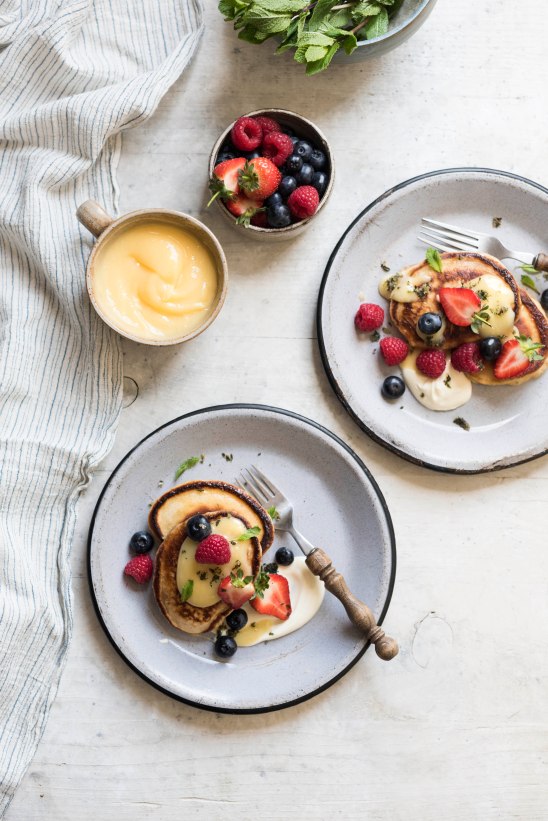
Buttermilk drop cakes with lemon curd by Simon Stallard

THH_Buttermilk_Pancakes-1862-Edit.jpg

Topped with warm lemon curd and served straight from the stove, these drop cakes are a sure-fire way to draw everyone to the breakfast table. Serve with berries and crème fraîche.

Serves 4

320g plain flour
1 tsp baking powder
a good pinch of sea salt
50g caster sugar
2 large eggs
290ml buttermilk
60g butter, plus extra for frying
crème fraîche and berries, to serve

FOR THE LEMON CURD
90g butter, cubed
140g caster sugar
a pinch of sea salt
120ml lemon juice (about 3 lemons)
3 large egg yolks
1 large egg

FOR THE MINT SUGAR
4 tbsp caster sugar
a good handful of mint leaves

First, make the lemon curd. Put the butter in a heatproof bowl over a saucepan of gently simmering water, making sure the base of the bowl doesn’t touch the water. Add the sugar, salt and lemon juice. Stir until well combined and the butter has melted. Remove the bowl from the heat and set to one side.

In a separate bowl, whisk together the egg yolks and egg. Add this to the lemon and butter mixture and whisk to combine. Return the bowl to the simmering saucepan and heat for 10 minutes or until the mixture thickens. Remove from the heat and leave to cool a little.

To make the mint sugar, simply either blitz the sugar and mint leaves in a food processor or bash them together using a mortar and pestle. Leave to one side.

Preheat the oven to 110°C (90°C fan oven) gas mark ¼. Sift the flour, baking powder and salt into a large mixing bowl and stir in the sugar. Add the eggs and buttermilk, and whisk everything together to make a smooth batter.

Put half the butter in a non-stick frying pan and melt it over a medium-low heat. Mix the melted butter into the batter.

Put the frying pan back over the heat and add tablespoonfuls of the mixture in small pools around the pan – you should be able to do 4–5 at a time. Cook for 1 minute on the first side, or until bubbles form on the surface. Flip them over and cook for 1 minute.

Remove from the pan and keep warm on a plate wrapped up in a tea towel in the oven while you cook the remaining batter in the same way, adding a little more of the remaining butter to the pan each time.

Serve the drop cakes warm with the lemon curd drizzled over, some crème fraîche and fresh berries and a sprinkle of the mint sugar.

The Hidden Hut by Simon Stallard (HarperCollins) £20, is out now

Cook more from this book 
Chicken and wild garlic soup
Fire-pit wild sea bass with verde sauce

Read the review

Buy the book 
The Hidden Hut
£20, HarperCollins

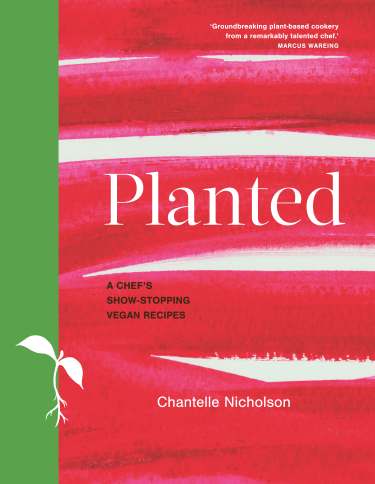
Planted by Chantelle Nicholson

Planted final front cover (1)

What’s the USP? Sophisticated, appealing and delicious vegan recipes from a top London chef

Who’s the author? Chantelle Nicholson is a New Zealand-born lawyer turned chef whose CV includes The Savoy Grill and Petrus. She came to prominence as Marcus Wareing’s right-hand woman, opening The Gilbert Scott as general manager and is currently back in the kitchen as head chef of Tredwells in Coven Garden. She has worked on a number of Marcus Wareing’s cookbooks including The Gilbert Scott cookbook; Planted is her debut solo outing. Nicholson has also emerged as a leading figure on the vegan dining scene with her Vegwells plant-based tasting menus at Tredwells and currently has a plant-based cafe concept in development.

What does it look like? There’s a stripped back, vaguely Nordic feel to the styling of the food photography – think distressed wood backgrounds and rough-hewn blue and grey ceramics – that gives the book an elegant look. Bright washes of colour come in the form of illustrator Lucy Gowans’s charming and colourful double-page painted spreads for each of the chapters headings – a slice of watermelon for breakfast and brunch; corn on the cob for snacks and starters.

Is it good bedtime reading? Only if you drop off to sleep very quickly, the three-page intro won’t keep you occupied for long.

Will I have trouble finding ingredients?  You’ll find nearly everything you need, including xantham gum, coconut yoghurt and dairy-free butter at the supermarket.

What’s the faff factor? This is a chef’s book so expect a fair amount of fine slicing, dicing and chopping and recipes made up of a number of different elements, but overall the recipes are very approachable.

How often will I cook from the book? Although a vegan recipe book might seem like something you might only pick up once in a while (unless you are committed vegan of course),  many of the dishes are so enticingly different that you might well find it transforms your cooking repertoire.

Killer recipes? Who knew vegan food could sound (and look) so tempting? Potato, celeriac, onion seed and thyme rostis with HP gravy; crispy globe artichokes with spelt and tarragon stuffing and salsa verde, and peanut butter pudding with peanut caramel and dark chocolate sorbet will have you wondering why you ever bothered with meat and fish.

What will I love? If you’ve ever struggled with the idea of vegan food, this is the book you’ve been waiting for with dozens of imaginative, exciting and appealing ideas.

What won’t I like? At less than 200 pages, you might be left wanting more.

Should I buy it? If you are a confident cook who is yet to explore the possibilities of vegan cooking, Planted will open your eyes and expand your mind. Not a bad deal for twenty-five quid.

Cuisine: Vegan
Suitable for: Confident home cooks and professional chefs
Cookbook Review Rating: 4 stars

Buy this book 
Planted: A chef’s show-stopping vegan recipes
£25, Kyle Books

Cook from this book
Seeded granola with chai spiced poached plums
Whole barbecued spiced cauliflower
Peanut butter pudding

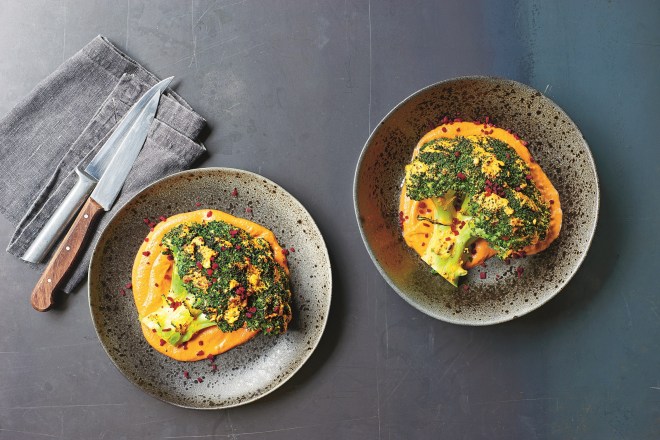
Mustard Broccoli by Herneet Baweja, Devina Seth and Nirmal Save

MUSTARD GRILL BROCCOLI

SERVES 2 AS A MAIN, 4 AS A STARTER OR SIDE

We use mustard a lot in the east of India and here we pair it with broccoli, which is in the same family. In India, you often see this dish made with cauliflower, so you could easily interchange them. We prefer broccoli for the restaurant, as it really soaks in all the flavours and gets even crisper when flashed under the grill. It’s one of the most popular vegetarian dishes at Gunpowder. We think it’ll become a favourite in your home, too.

1 head of broccoli, halved
100g Greek yogurt
50g full-fat cream cheese
2 tablespoons wholegrain mustard
½ teaspoon chilli powder
1 teaspoon chaat masala
1 teaspoon ground turmeric
½ teaspoon ground coriander
¼ teaspoon ground cumin
2 tablespoons mustard or rapeseed oil, plus 1 teaspoon
1 tablespoon chickpea flour
2–3 tablespoons ghee, melted
sea salt
Makhani Sauce (see below) and pickled beetroot, to serve

1 Bring a pan of salted water to the boil and cook the broccoli for 3 minutes, then drain and rinse under ice-cold water to prevent it from cooking further. Shake off any excess water and set aside.

2 In a large dish, mix together the yogurt, cream cheese, mustard, chilli powder, chaat masala, turmeric, coriander, cumin and the 2 tablespoons of mustard or rapeseed oil.

3 Set a frying pan over a medium heat and toast the chickpea flour for 30 seconds. Add the remaining 1 teaspoon of oil, mix, and toast for a further 30 seconds, making a fragrant paste. Whisk this into the yogurt mix, then thoroughly coat the broccoli in the creamy spice paste and set aside to marinate for 30 minutes.

4 Set your oven grill to high and grill the broccoli, cut-side down, for 10–15 minutes, basting it with the melted ghee. When golden on top, turn over and grill 5 minutes on the other side, or until nicely coloured.

5 Serve on a base of Makhani Sauce with pickled beetroot sprinkled on top.

MAKHANI SAUCE

MAKES 250ML

2 tablespoons unsalted butter
2 garlic cloves, very finely chopped
2 teaspoons grated fresh ginger
500g tomatoes, diced
½ teaspoon ground fenugreek seeds
½ teaspoon cumin seeds
3 cloves
3 green cardamom pods
¼ teaspoon freshly ground black pepper
a pinch of chilli powder
¼ teaspoon freshly grated nutmeg
2–3 tablespoons double cream
1 teaspoon honey, or to taste (optional)
sea salt

1 Set a frying pan over a high heat and add 1 tablespoon of the butter. Once melted, add the garlic, ginger and a pinch of salt and cook for a minute.

2 Fold the tomatoes and all the spices through. Cook over a medium heat for 5–10 minutes until the tomatoes have broken down and darkened in a colour a little.

3 Spoon the mixture into a food processor or blender and blend until fairly smooth. Press through a sieve, giving you a smooth sauce. Warm the sauce gently in a saucepan with the remaining tablespoon of butter. Once the butter is melted, swirl in the cream.

4 Let the sauce gently bubble away over medium-low heat for about 5 minutes until it has thickened and darkened further. Season with salt and the honey, if needed, to taste. Serve warm.

Recipes taken from Gunpowder: Explosive Flavours from Modern India by Herneet Baweja, Devina Seth and Nirmal Save. Kyle Books. Photography: Pete Cassidy

Read the review 

Buy this book
Gunpowder: Explosive flavours from modern India
£25, Kyle Books

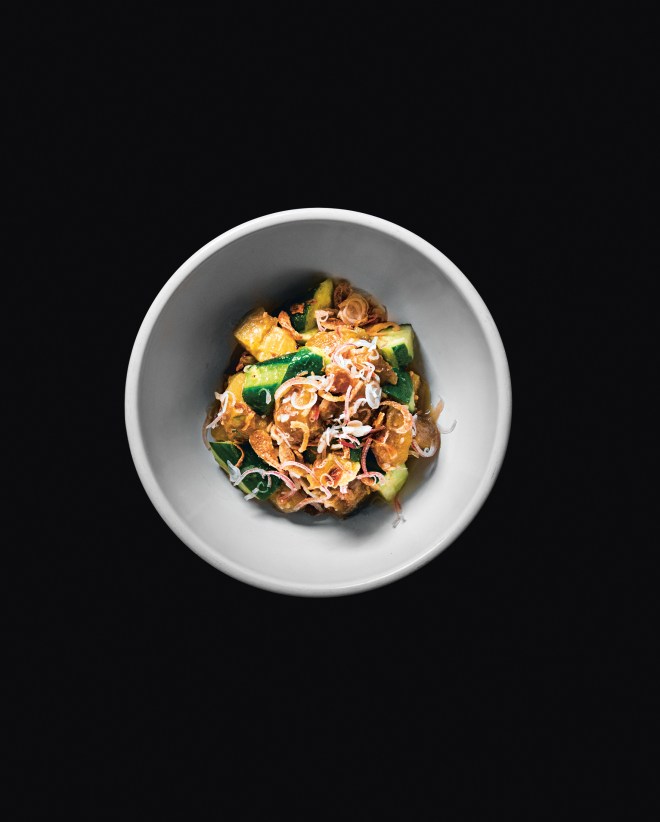
Eggplant Salad with Pickled Garlic and Ginger Tosazu by Matt Abergel

139 eggplant salad


Ingredients:

Japanese eggplant (aubergine) ……………………………….  1 piece
Pickled Garlic and Ginger Tosazu (see below) …………  25g
Cucumber ……………………………………………………………….  50g
Myoga, sliced ………………………………………………………….  12g
Vietnamese crispy shallots………………………………………  14g
Olive oil …………………………………………………………….…….  4g. plus extra to dress
Salt ………………………………………………………………………….  1g

For the Pickled Garlic and Ginger

Tosazu Tosazu (page 186) ……………………………………….  1 quantity
Bonito pickled garlic ………………………………………………..  300g
Ginger …………………………………………………………….……….  75g


Yield: 2 servings

Method:

  1. First, make the Pickled Garlic and Ginger Tosazu. Combine all ingredients in a food processor and blend until smooth. This is a lot more than you need, but will keep well chilled for 1 month.
  2. Using a cook’s blowtorch, evenly sear the skin of the Japanese eggplants (aubergines). Only move from each spot that is burning when the skin glows like the end of a lit cigarette.
  3. As you burn each eggplant, place in a metal bowl covered in plastic wrap so that they steam gently.
  4. When ready to peel, place the eggplant on a paper towel and gently scrape away the skin.
  5. Place the eggplant flesh into a vacuum bag or an airtight container, cover with the Pickled Garlic and Ginger Tosazu, then seal and leave to marinate until ready to use (a minimum of 2 hours.)
  6. To cut the cucumber refer to page 127. Lightly salt the cucumber, then leave to sit in the refrigerator for 10–15 minutes until water is released. Gently squeeze any excess water out of the cucumber batons and return to the refrigerator until ready to use.
  7. Combine 65 g of the marinated eggplant with the cucumber, half of the sliced myoga, 11 g of the fried shallots, the olive oil, and salt.
  8. To serve, put the salad in a chilled bowl, layering everything neatly. Garnish with the reserved shallots and myoga, then dress with olive oil.

Recipe extracted from Chicken and Charcoal by Matt Abergel, published by Phaidon

Cook more from this book

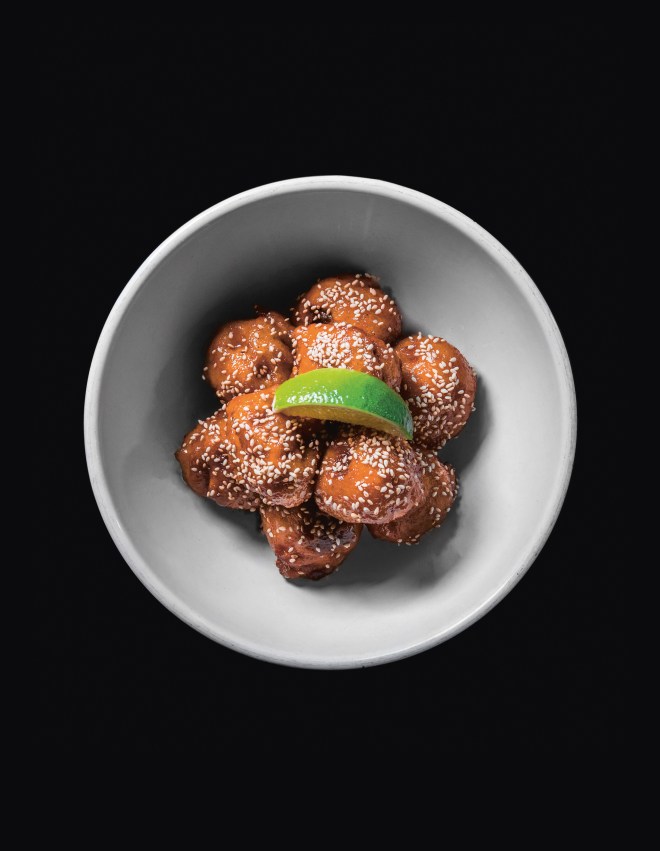
KFC (Korean Fried Cauliflower) by Matt Abergel


KFC (Korean Fried Cauliflower) by Matt Abergel

157 KFC


Ingredients:                                                        Amounts:
Cauliflower, cut into 25g florets ___________ 12 florets
Salt __________________________________ 20g
Vegetable oil, for deep-frying _____________ 3 litres
White sesame seeds, to garnish ___________ 3g
Lime wedge (1⁄8 of a lime), to serve ________ 1

For the KFC batter
Yardbird Chicken Flour Mix (page 191) _____ 400g
Tempura Batter (page 192) _______________ 400g

For the KFC sauce
Garlic cloves __________________________ 100g
Sugar
_______________________________ 500g
Mirin ________________________________ 50g
Korean chili paste ______________________ 150g
Red yuzu kosho ________________________ 250g

Yield: 4 servings

Method:

  • First, make the KFC batter. Whisk all the ingredients with 480 ml ice- cold water until smooth. Chill in the refrigerator until ready to use.
  • To make the KFC sauce, blend the garlic with 1.5 liters almost boiling water until smooth. Place the garlic paste in a pan with the sugar, mirin, Korean chili paste, and red yuzu kosho, then mix well. Reduce over a low heat for 1–3 hours, stirring frequently, until the mixture has the consistency of a thick barbecue sauce.
  • Soak the cauliflower florets in 2 liters water and the salt for 1 hour. Just before cooking, remove the cauliflower from the saltwater solution and put in the batter, completely coating each floret.
  • Heat the vegetable oil in a deep fryer, or a deep saucepan, to 350°F/180°C. One by one, carefully drop the battered cauliflower florets into the hot oil, making sure that the pieces don’t stick to the bottom of the fryer or to each other. Once all the florets are in the fryer, fish out any stray bits of batter. Fry the florets until they are deep brown in color, about 3 minutes.
  • Remove with a slotted spoon and drain on a wire rack, then on a paper towel. Transfer the cauliflower to a bowl. Immediately cover with a generous amount of room- temperature KFC sauce.
  • To serve, stack the sauce-smothered cauliflower florets in a serving bowl. Garnish liberally with the white sesame seeds and a lime wedge. Eat while hot.

Recipe extracted from ‘Chicken and Charcoal by Matt Abergel, published by Phaidon

Cook more recipes from this book

Eggplant Salad with Pickled Garlic and Ginger Tosazu by Matt Abergel