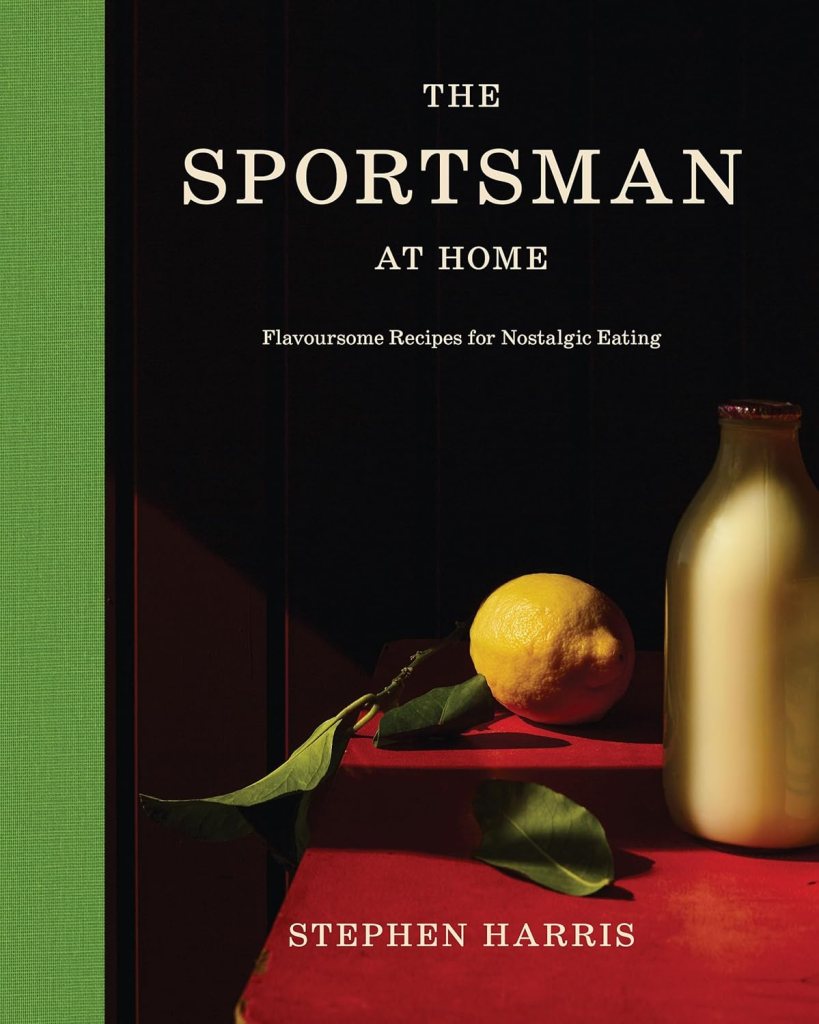
The Sportsman at Home by Stephen Harris – Cookbook Review

Who is Stephen Harris?
There are some cooks whose influence is loud and declarative, and others whose impact seeps in slowly, shaping how we think about food without ever demanding attention. Stephen Harris belongs firmly to the latter camp. Self-taught, thoughtful and resolutely grounded, he took over The Sportsman — a salt-scrubbed pub on the Kent coast — in the late 1990s and, over time, turned it into one of Britain’s most quietly revered Michelin-starred restaurants. Awards followed, inevitably, but Harris has always seemed more interested in flavour than fuss, in the pleasures of eating well rather than the performance of it. His cooking is rooted in British food history and in the landscape that surrounds him, shaped by curiosity rather than trends. He writes much as he cooks: with clarity, restraint and an unshowy assurance earned over decades.  The Sportsman at Home is his second cookbook (read our review of his first here). 

What is The Sportsman at Home’s USP?
This is not restaurant cooking repackaged for domestic use, but home cooking approached with seriousness and care. Harris structures the book around ideas rather than courses, with chapters that reflect mood, memory and appetite: Assemblies, Tea, Dinner and Christmas sit alongside more reflective sections such as An Ode to Cream, Baking and Making, and Nostalgia. The effect is quietly immersive. Rather than prescribing how or when to cook, Harris invites you to respond to moments — a table of friends, an afternoon pause, a craving for something soothing or celebratory. Recipes are underpinned by personal anecdotes and food history, reinforcing his belief that the dishes we return to most often are those that carry meaning as well as flavour. It is a book that honours simplicity, not as restraint, but as a form of generosity.

What will I love?
The sense of ease that runs through the book. Harris’s recipes are deliberately simple, but never simplistic, and written in an informal, approachable voice that feels deeply personal. There is a relaxed generosity in the way he cooks and writes: dishes are offered as starting points rather than fixed ideas, with room to adapt, adjust and make them your own. He gives you the confidence to trust your instincts, to serve things when they feel right, to linger or pare back as you choose, encouraging a way of cooking that is intuitive rather than prescriptive. It’s this freedom, and the pleasure it brings, that makes The Sportsman at Home feel less like a set of instructions and more like an invitation to fall back in love with cooking for yourself and others.

Is it good bedtime reading?
Very much so. Harris writes with calm authority and reflective warmth, weaving in memories, observations and small details that linger. Like the best Diana Henry books, this is as much about atmosphere and appetite as it is about instruction. It is a book to enjoy reading slowly, dipping in and out at leisure, making notes of your favourite recipes to try. 

Will I have trouble finding the ingredients?
Overall, no. This is a book firmly rooted in the British kitchen. Good butter, seasonal vegetables, decent cheese, and meat and fish from trusted sources form the backbone of the recipes. Quality matters, but rarity does not. Harris is clear-eyed about what makes ingredients worthwhile, describing them as “a rare upgrade in a world of plunging standards”, yet he is never showy or dogmatic. His emphasis is on care rather than perfection, and there is a reassuring absence of anything that feels overly cheffy or inaccessible. There is the odd mention of ingredients like truffle oil and hazelnut oil, but these are easy to find nowadays in large supermarkets or online.

How easy are the recipes to follow?
The recipes are thoughtfully written, with Harris explaining not just how to do things, but why, which makes even the more complex dishes feel approachable. His tone is quietly companionable, as if he’s beside you in the kitchen, attentive to every detail, guiding rather than instructing, and encouraging you to cook with confidence. There is an emphasis on care and attention over speed, so nothing feels intimidating or inaccessible.

Stand out recipes?
There are many, for this is a book full of recipes you will want to return to again and again, but a few favourites include:

  • Baked Potato Fish Pie: comfort cooking at its finest. Familiar, deeply savoury and cleverly constructed, it marries the pleasures of a jacket potato with the generosity of a proper pie.
  • Ratatouille: a celebration of seasonal vegetables. Harris’s suggestion of adding beans makes it more substantial (I recommend splashing out on the jars from Bold Bean Co.), and smoky chorizo is a welcome optional flourish if you enjoy smoky flavours.
  • Cheese Soufflé: a classic, made all the more appealing by its rarebit-inspired sauce, which brings warmth and savoury depth without unnecessary complexity.
  • Vincisgrassi: an indulgent, layered Italian bake — often described as a cousin of lasagne — unapologetically rich and entirely worth the effort.
  • Chocolate Marquise: luxuriously intense, made even better by the inclusion of Harris’s cheat’s orange custard. A perfect dinner-party pudding.
  • Digestive Biscuits: it may seem like a faff, but these crisp, buttery biscuits are dangerously moreish. Be warned: shop-bought versions will never quite satisfy again.

How often will I cook from the book?
Often. This is a book for real life: Sunday lunches, midweek suppers, quiet baking afternoons and celebrations that don’t require spectacle. It rewards repetition and quietly becomes a companion in the kitchen, rather than just a reference on the shelf

Any negatives?
If you enjoy fast, highly stylised cooking or bold, adventurous global flavours, this book may feel restrained. Harris values subtlety, balance and tradition, which means it won’t appeal to everyone. But for those who enjoy thoughtful, approachable recipes that celebrate ingredients and seasonality, this is very much a strength rather than a limitation.

Should I buy the book?
Absolutely. The Sportsman at Home is a quietly confident, beautifully judged cookbook that rewards attention and repetition. It’s the kind of book that shapes how you cook, not just what you cook.

Cuisine: British – with European influences
Suitable for: Home cooks of all abilities 
Great for fans of: Jane Grigson, Diana Henry and Nigel Slater
Cookbook review rating: five stars

Buy the book: The Sportsman at Home: Flavoursome Recipes for Nostalgic Eating, Quadrille, £30.00 

This review was written by Freelance Food Writer and Recipe Developer Sophie Knox Richmond. Follow her on Instagram on @sophie_kr_food.  

Eating to Extinction by Dan Saladino

Eating to Extinction

What’s the USP? A global investigation into some of the world’s rarest foods in danger of disappearing from our diets, and how saving them could be part of the solution to fixing what the author says is a ‘food system that is contributing to the destruction of our planet’.

Who wrote it? Journalist and broadcaster Dan Saladino will be a familiar name to regular listeners of Radio 4’s The Food Programme  for which he is a producer and presenter. Eating to Extinction is his first book.

Why should I read it? By relating the history of and telling the stories behind 34 foods in danger of extinction (a small sample of what Saladino says are one million plant and animal species under threat)  including Kavilca Wheat from Anatolia; Geechee Red Pea from Georgia, USA;  Middle White Pig from the Wye Valley and Kyinja Banana from Uganda), Saladino amply demonstrates his point that the current monoculture and resultant lack of biodiversity that defines the current global food system is unsustainable as it means, among many other things, crops are ‘at greater risk of succumbing to diseases, pests and climate extremes’. Saladino also considers the cultural impact of losing the heritage behind these foods, what he calls the ‘wisdom of generations of unknown cooks and farmers’.

Is it just going to leave me feeling depressed and anxious about food security? It’s unquestionably an eye opening read, but it’s not all bad news. In Australia for example, murnong, ‘a radish-like root with a crisp bite and the taste of sweet coconut’ that has been in sharp decline since the mid-19th century as the aboriginal population who farmed it has been decimated, is making a slow comeback. It is being grown in aboriginal  community gardens and influential chef Ben Shewry has put it on his menu.

Should I buy it? Eating to Extinction is an important book that documents a turning point in our global food systems. Although Eating to Extinction is a work of some substance and heft (it runs to 450 pages including detailed notes), it’s not written in an academic style and is highly readable. Each chapter is a discreet entity making the book ideal for dipping in and out of, consuming it all in one go might be a little too alarming.

As an individual, the astonishing stats dotted throughout (did you know for example that more than half of all seafood consumed by humans is provided by aquaculture i.e. farmed fish?) might well inspire you to do your bit to help battle monoculture and adopt a more diverse diet that incorporates rare breed meat, wild seafood and heritage varieties of vegetables and grains and even for age for wild foods like seaweed, plants, herbs and flowers.

The good news is that, according to Saladino, it seems the major food producers appear to have begun to recognise how destructive the monoculture they’ve propagated really is. The then head of diary giant Danone told the 2019 Climate Action Summit that, ‘We thought with science we could change the cycle of life and it’s rules…We’ve been killing life and now we need to restore it’.

Cookbook Review Rating: Five stars

Buy this book: 
Eating to Extinction: The World’s Rarest Foods and Why We Need to Save Them
£25, Johnathan Cape

This book has been shortlisted for the Andre Simon Food Award. Read more here.

andre simon logo

First Catch Your Gingerbread by Sam Bilton

First Catch Your Gingerbread

What’s the USP? Everything you always wanted to know about gingerbread, but were afraid to ask, including the history of gingerbread from ancient times to present day, plus gingerbread and ginger cake recipes. It is part of Prospect Books’ series ‘The English Kitchen’ that looks at dishes and their place in history and which has previously included books on quince, soup and trifle.

Who’s the author? Sam Bilton is a food historian and writer and is probably best known for her historically-themed supper club Repast. She’s also worked on projects with English Hertiage and the National Trust. This is her debut book.

Is it good bedtime reading? The first 80 pages are given over to the scholarly ‘The Story of Gingerbread’ that begins with its pre-history in the ‘reverence given by ancient civilisations to the medicinal properties of spices’ and continues with it’s medieval incarnation (including an appearance in The Canterbury Tales as ‘gyngebreed’) and includes the importance of treacle in the history of gingerbread, how the recipe migrated from England to America and the difference between the two varieties, historical gingerbread moulds and other related creations, and it’s more modern incarnations and enduring appeal.

Will I have trouble finding ingredients? You will find virtually everything you need in the supermarket. However, you will probably need an online supplier for grains of paradise (a West African spice that looks like black peppercorns but is in fact a member of the ginger family) if you want to make Små Pepparkakor, the ‘intensly crisp, aramatic small gingerbreads’ from Sweden, and for long pepper to make Dulcia Piperata (Roman Peppered Honey Cake). There are savoury recipes in the book too so you’ll want to visit your fishmonger for the langoustine and crayfish for an unusual stew that includes gingerbread crumbs.

What’s the faff factor? Some recipes will take a little bit of planning, for example a game terrine or chocolate stuffed lebkuchen (a spiced shocolate cake), both of which are two-day processes, although neither are particularly complicated. But generally speaking, the recipes are very approachable, especially for home bakers with some experience.

How often will I cook from the book? If you have a sweet tooth and are a keen baker, the book is a treasure trove of interesting, unusual and, most importantly, delicious recipes that you’ll want to work your way through. The inclusion of savoury recipes makes it useful for when you want something just a little bit different for a dinner party or even just a family meal.

Killer recipes? Ormskirk gingerbread; Elisenlebkuchen (chocolate-glazed spice and nut biscuits from Germany); Indian gingerbread; Ginger scotch rabbit; baked Camembert with gingerbread; carrot and ginger roulade with honeyed ricotta;

What will I love? This is quite obviously a labour of love. Bilton has unearthed a fascinating history behind an everyday cake shop favourite and curated a selection of appealing recipes that you’d struggle to find anywhere else.

Should I buy it? For keen bakers and lovers of food history, it’s a no-brainer.

Cuisine: International
Suitable for: Bakers/beginners/confident cooks
Cookbook Review Rating: Four stars

Buy this book
First Catch Your Gingerbread By Sam Bilton
£15, Prospect Books

Also available at Amazon
First Catch Your Gingerbread (English Kitchen)