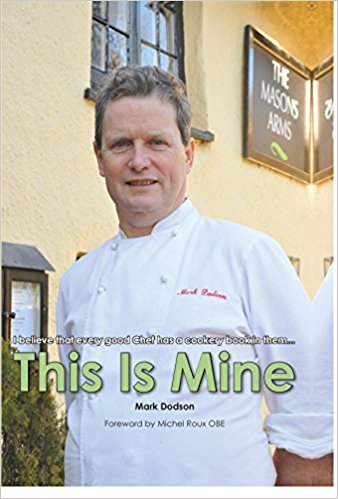
The Road to Mexico by Rick Stein

The Road to Mexico by Rick Stein

Restaurateur and seafood expert Rick Stein has been absolutely bloody everywhere. He’s written numerous cookbooks (many of them with an accompanying TV series) covering France, Spain, India, the Med, the Far East, most of Europe and the UK. Now he’s turned his attention to Mexico and California with The Road to Mexico. The book, and TV series, retraces Steins steps from nearly 50 years ago when, as he explains in the introduction, he ‘crossed the border from the USA at Neuvo Laredo and headed for the city of Monterrey’ and ordered some tacos in a bar.

His recent experience of Mexico was undoubtedly more luxurious than his original trip, swapping hitch-hiking, Greyhound buses and German cargo ships for a pale blue convertible Mustang, but the food probably hasn’t changed all that much in intervening half-a-century. Tortillas, tacos, enchiladas, corn, chilies and avocado abound. Recipes include ‘the original Caesar salad’ from Caesar Hotel in Tijuana made with salted white anchovies; refried beans, guacamole and roasted red tomato and chilli salsa. A short section on staples like guacatillo sauce made with tomatillos, avocado and chilies and a list of essential Mexican larder ingredients make the book a perfect primer for the first-time Mexican cook.

Each of the seven chapters that cover breakfasts and brunch, street food, vegetables and sides, fish and shellfish, poultry, meat and desserts and drinks is prefaced by a short essay by Stein, which, combined with the comprehensive and informative recipe introductions and the vividly colourful location photography makes for a satisfying travelogue.

Because the recipes are arranged into categories rather than place of origin, you’ll need to watch the series to get a proper sense of the regional variations of Mexican cuisine, and to understand why California has been included. Stein avers that ‘there is so much Mexican influence in Californian food’, and while that is true, recipes like Italian cioppino (monkfish, mussel and prawn stew) from Tadich Grill, chicken noodle soup with yellow bean sauce from chef Martin Yan’s M.Y China and Alice Waters’ rhubarb galette Chez Panisse (all in San Francisco) don’t reflect that influence.

So, the book’s premise might be a bit shaky and the recipe selection scattershot, but that shouldn’t prevent you from cooking from it. Recipes are well written, easy to follow and for the most part straightforward to prepare. Stein has an unerring nose for a great dish and The Road to Mexico has enough of them to make it a must buy for Stein’s many fans and anyone who wants to find out more about one of the world’s greatest, and most fashionable, cuisines.

Cuisine: Mexican/American
Suitable for: Confident home cooks
Cookbook Review Rating: 4 stars

Buy this book
Rick Stein: The Road to Mexico (TV Tie in)
£26 BBC Books

Cook from this book
Ensenada fish tacos
Turkey breast with pasilla chipotle chilli butter sauce
Mexican rice pudding with honeycomb

Roasted ratatouille with orzo by Nadine Levy Redzepi

Roasted Ratatouille with Orzo

It’s embarrassing to admit, but I had never seen ratatouille cooked and served this way until I saw the animated film of the same name. It inspired me to revisit this dish, and I’m glad I did because when it’s not cooked to a mush and the vegetables still have a bit of bite, it has the comfort and flavour of rustic food – even though it’s dressed up a bit. It takes a bit of time to assemble, but it has real wow factor when you bring it to the table; everyone always remarks how beautiful this is. For the prettiest presentation,pick tomatoes, aubergines and courgettes that all have a similar diameter.

Serves 6 to 8

Aubergines 2 narrow, about 680 g (1½ lb total)
Courgettes 2 large, about 450 g (1 lb total)
Beefsteak tomatoes 6
Salted butter 45 g (1½ oz), at room temperature
Extra-virgin olive oil 60 ml (2 fl oz)
Garlic cloves 4
Fresh thyme sprigs 8
Fresh basil leaves 3 tablespoons
Cherry tomatoes 450 g (1 lb)
Fine sea salt
Orzo 450 g (1 lb)

  1. Preheat the oven to 190°C (170°C Fan).
  1. Trim the aubergines and courgettes and slice off the stem ends of the beefsteak tomatoes. Cut the vegetables into thin slices, about 6 mm (¼ inch) for the aubergines and courgettes, and a bit thicker for the tomatoes. Keep the vegetables separate. If you have a mandolin or V-slicer, use it for the aubergines and courgettes.
  1. Butter a 23 to 25-cm (9 to 10-inch) round shallow casserole dish or a frying pan with a lid with 15 g (½ oz) of the butter. Drizzle in 2 tablespoons of the oil. Crush the garlic with the flat side of your knife, then peel the garlic (discard the papery skins) and add it to the casserole along with the thyme sprigs and basil leaves. Halve the cherry tomatoes and gently squeeze them over the baking dish to release their juices and seeds into the pan. Reserve the cherry tomatoes for another use (see below). Using your fingertip, poke out the seed clusters from the sliced beefsteak tomatoes and add them to the baking dish. (I use an enameled cast-iron casserole for this dish because it is heavy and distributes the heat so well. You can also use a heavy frying pan, as long as the handles are ovenproof).
  1. Alternate the tomato, aubergine and courgette slices in the baking dish in rows, filling the dish all the way to the centre. Drizzle with the remaining 2 tablespoons oil and season with salt.
  1. Bake uncovered for 20 minutes. Cover the casserole and continue baking until the aubergine is a few shades darker, like a strong café latte, and the courgette is an almost translucent, pale and glossy yellowish colour, 20 to 30 minutes more. If your baking dish doesn’t have a lid, place a baking sheet or even a pie tin on top.
  1. While the ratatouille is baking, bring a large pan of water to a boil over high heat for the orzo. When the water boils, add a tablespoon or so of salt. Stir in the pasta and cook, stirring every 2 minutes to ensure that it does not stick to the bottom, according to the packet directions until al dente, about 8 minutes, depending on the brand.
  1. To warm the pasta serving bowl, place it in the sink and set a colander inside. Drain the pasta in the colander and return it to the cooking pan, letting the hot pasta water stand in the serving bowl for about 30 seconds to warm it. Empty and dry the serving bowl and add the pasta. Stir in the remaining 30 g (1 oz) of butter.
  1. To serve, bring the ratatouille to the table in its baking dish. Spoon the orzo into bowls and top each serving with the ratatouille and some of its juices.

R E D U C I N G K I T C H E N W A S T E

I hate to throw anything usable and edible away, and instead think of these odds and ends as a head start on future meals. The squeezed-out cherry tomatoes can be mixed with some diced onion, fresh chilli, coriander, olive oil and lime juice for a quick salsa to put on cooked fish or a cheese omelette, or you can chop and combine them with basil, garlic, salt and chilli flakes for an uncooked sauce to toss with hot pasta and cubes of mozzarella.

Extracted from Downtime by Nadine Levy Redzepi
(Ebury Press, £27)
Photography by Ditte Isager

Cook more from this book
Lasagne with sausage meatballs
Danish apple dessert

Read the review

Buy this book
Downtime: Deliciousness at Home
£26 Ebury

Downtime by Nadine Levy Redzepi

Downtime

What is it?  An enticing collection of sophisticated recipes for the home cook by a new name in food writing

Redzepi – why does that sound familiar? Nadine Levy Redzepi is the wife of world-famous Danish chef Rene Redzepi of Noma fame.  This is her debut book.

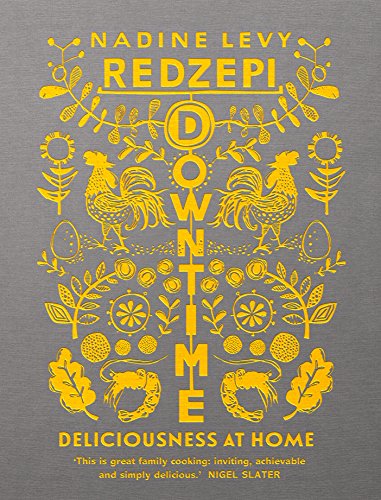
What does it look like? The book’s design has all the Nordic stripped back chic you might hope for. The mostly overhead food photography by Ditte Isager is simple and uncluttered, allowing the dishes to speak for themselves. High-quality glossy paper means the reproduction of the images is so lifelike that you almost want to plunge a fork into the pages.

Is it good bedtime reading? A forward by hubby, plus an introduction and comprehensive autobiographical ‘A Life in the Home Kitchen’ section by the author that covers her Portuguese and Scandinavian food roots, along with chapter introductions and chunky recipe introductions means Downtime won’t just live in your kitchen.    

Killer recipes? Beef glazed celeriac with buttermilk sauce; cheese ravioli with brown butter egg yolks, parmesan and sage; kale and mushroom carbonara; quinoa salad with spiced onions; brownies with flaky salt and white chocolate chunks.

Will I have trouble finding ingredients?  It seems that great care has been taken to make these recipes as accessible as possible so you should be able to find everything you need at your local supermarket.

What’s the faff factor?  Minimal. The recipes are all about making delicious food for your family rather than exercising your cheffy inclinations. That said, three Michelin-starred chef Thomas Keller’s elegant recipe for ratatouille (from the film of the same name) is included in the book.

How often will I cook from the book?  With everything from soups to pasta dishes and roasts to desserts (including a twist on tiramisu with a cheesecake-like crust), you could easily find yourself reaching for the book on a daily basis.

What will I love?  The book’s luxurious look and feel and the accessible and well-written recipes.

What won’t I like?  I’ll get back to you on that.

Should I buy it? If you feel that your repertoire of daily dishes has become somewhat stale, then this book will give your home cooking that inventive boost you’ve been searching for.

Cuisine: Nordic/international
Suitable for: Beginners and confident home cooks
Cookbook Review rating: 4 Stars

Buy this book
Downtime: Deliciousness at Home
£26 Ebury

Cook from this book
Roasted ratatouille with orzo
Lasagne with sausage meatballs
Danish apple dessert

Danish apple dessert by Nadine Levy Redzepi

Danish Apple Dessert

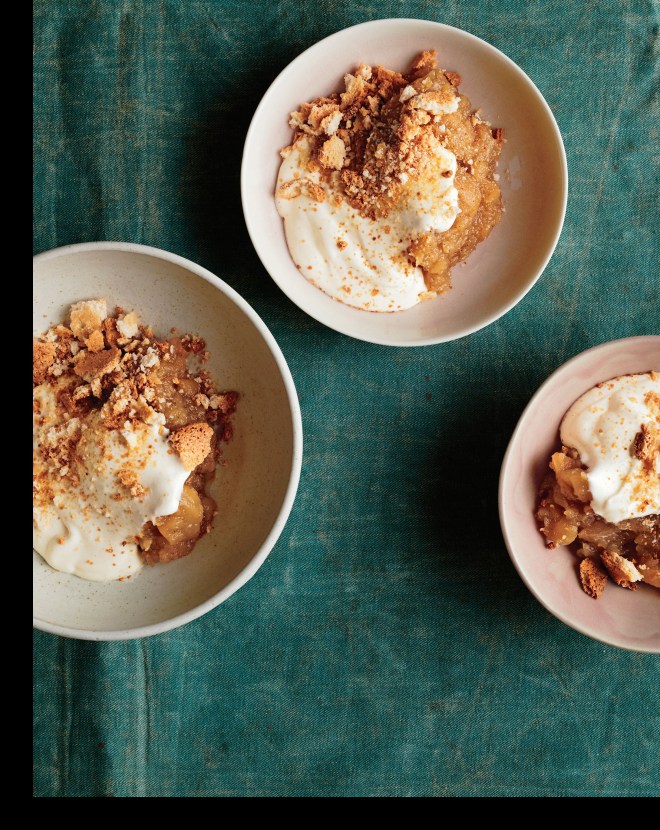
In Denmark this is called a cake, but it’s really more like a trifle, with layers of whipped cream and crushed cookies on a base of caramelised apple purée. Whatever you call it, it’s light and delicious and easy to make. You can also double the recipe and make it in a large bowl, trifle-style, but don’t assemble it until just before serving, as the cookies will lose their crunch. This recipe makes about 20 large cookies and you won’t need them all for the topping, so you’ll have some left over for snacking and lunch boxes. If you have been saving your scraped vanilla bean pods this is the perfect way to use them up. Otherwise, just use a whole fresh one, slitting it and scraping the seeds over the apples.

Serves 6

APPLE SAUCE
Dessert apples 1.8 kg (4 lb), firm and not too sweet
Scraped vanilla pods 2

ALMOND COOKIES
Marzipan 200 g (7 oz)
Sugar 400 g (14 oz)
Large egg whites 3
Plain flour 12 g (. oz)
Baking powder . teaspoon
Double cream 360 ml (12. fl oz)

  1. The filling needs to chill, so make it first: Peel, quarter and core the apples. Put the apples in a large, heavy pan. Place the vanilla pods on top. Cover the pan and cook over medium-high heat, without stirring, until the apples are lightly browned on the bottom, about 3 minutes. Caramelising the apples brings out their sweetness without any added sugar. It’s okay if some of them scorch a tiny bit.
  1. Stir the apples, scraping the browned surfaces from the bottom of the pan. Reduce the heat to very low, cover the pan and cook, stirring occasionally, until the apples have softened into a chunky purée, 45 to 60 minutes. If the apples start to stick or scorch, add a few tablespoons of water to the pan and stir to loosen them. Let the apples cool a bit, then cover and refrigerate until chilled, at least 2 hours or up to 1 day.
  1. Make the cookies: Preheat the oven to 180°C (160°C Fan) with the racks in the top third and centre of the oven. Line two large, rimmed baking sheets with baking paper.
  1. Crumble the marzipan into a food processor. Add the sugar and process until well combined. Transfer to a medium bowl. Using an electric mixer on medium speed, beat in the egg whites one at a time, making sure each white is incorporated before adding another. Beat until smooth. With the mixer on low speed, mix in the flour and baking powder just until combined. If you don’t have a food processor, grate the marzipan into a medium bowl using the large holes of a box grater and stir in the sugar.
  1. Scrape the cookie batter into a pastry bag fitted with a plain 12 mm (½ inch)tip or a large zip-top plastic bag with the corner snipped off. Pipe out 5 cm (2 inch) mounds of the batter, leaving about 7.5 cm (3 inches) between them. The cookies will spread in the oven. Bake until golden brown and crackly, about 15 minutes. Let the cookies cool completely on the baking sheets. They will fall and crack, but that’s okay, as they will be crumbled later. Don’t try to remove the cookies from the baking paper until they have cooled completely or they will stick and break.
  1. Whip the cream in a large bowl with an electric mixer on high speed just until it thickens and begins to form soft peaks. It should be slightly fluid, not stiff and fluffy.
  1. Divide the apple sauce among 6 serving bowls and top with the whipped cream on the opposite side. Coarsely crumble 1 or 2 cookies over each serving. Serve immediately. Leftover cookies can be stored in an airtight container at room temperature for up to 5 days.

Extracted from Downtime by Nadine Levy Redzepi
(Ebury Press, £27)
Photography by Ditte Isager

Cook more from this book
Roasted ratatouille with orzo
Lasagne with sausage meatballs

Read the review

Buy this book
Downtime: Deliciousness at Home
£26 Ebury

Lasagne with sausage meatballs by Nadine Levy Redzepi

Lasagne with Sausage Meatballs

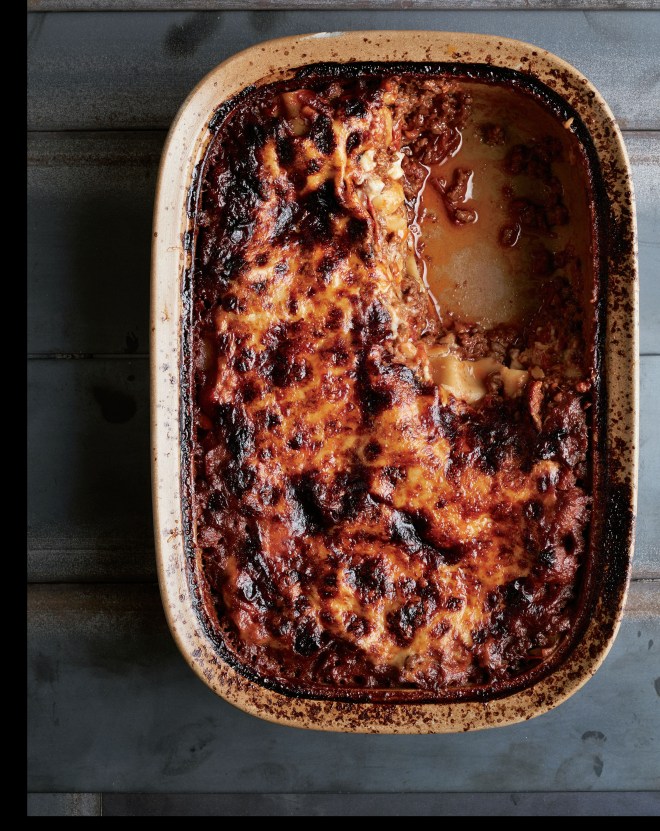
When it was our oldest daughter’s turn to have her school playgroup over for dinner, I asked her what she wanted me to make and she requested lasagne. I’ve never been a huge fan of lasagne, which is usually a bit bland and stuffed with too much melted cheese for my taste, so I challenged myself to create a version that was full of flavour and a bit surprising. I added a lot of garlic and little balls of sausage in addition to the minced beef, and layered it with a lightly cheesy béchamel sauce, and it really took it to the next level for me. This requires a bit of work, but it serves a big crowd.

Serves 9-12

MEAT SAUCE
Extra-virgin olive oil 90 ml (3 fl oz)
Onions 2
Garlic cloves 8
Minced beef 800 g (1. lb)
Whole peeled tomatoes in juice 3 400g (14 oz) tins
Fine sea salt
Freshly ground black pepper

BECHAMEL
Salted butter 110 g (4 oz)
Plain flour 70 g (2. oz)
Whole milk 950 ml (1. pints)
Fine sea salt
Sweet Italian pork sausage 450 g (1 lb)
Pre-cooked pasta sheets 450 g (1 lb)
Parmigiano-Reggiano cheese 225 g (8 oz), freshly grated

1. Make the meat sauce: Heat 2 tablespoons of the oil in a large casserole dish over medium-high heat. Chop the onions, adding them to the pan as you go. Do not stir until the onions are beginning to brown, about 2 minutes. Cook, stirring occasionally, until they turn a deep golden brown, about 3 minutes more. Crush the garlic cloves with the flat side of your knife and discard the papery skins. Coarsely chop the garlic and stir it into the pan.

2. Push the onion mixture to one side of the pan and add 2 more tablespoons of the oil. Crumble the minced beef into the pan, avoiding the onions. Let the meat cook for 2 minutes to lightly brown on the bottom. Using a wooden spatula, break up the meat and stir it into the onions. Cook, stirring occasionally, until the meat is browned, about 8 minutes. Add the tomatoes with their juices and stir to combine, crushing the tomatoes with the spatula.

3. Bring the sauce to a boil, then reduce the heat to medium-low and simmer until it has thickened slightly, about 40 minutes, stirring occasionally. Stir in the remaining oil. Season to taste. Stirring in a bit of extra oil will help emulsify the sauce and give it more body.

4. Preheat the oven to 180°C (160°C Fan).

5. Make the béchamel: Melt the butter in a large saucepan over medium-low heat. Gradually whisk in the flour to make a thick, paste-like roux. Let it bubble for about a minute but don’t let it brown. Raise the heat to medium. Gradually whisk in the milk. Simmer over medium-low heat, whisking often and making sure the bottom doesn’t scorch, until it is lightly thickened and smooth, about 10 minutes. Remove from the heat and season with salt.

6. Place a large frying pan over medium-high heat. Squeeze the sausage meat out of the casings, forming it into small balls. Add them to the pan and cook until they are lightly browned and their fat has rendered. Use a slotted spoon to transfer the sausage balls to the sauce and combine gently.

7. Spread about 240 ml (8½ fl oz) of the meat sauce in a 23 x 33-cm (9 x 13-inch) baking dish. Top with a layer of lasagne sheets. Cover with about a quarter of the remaining meat sauce, a quarter of the béchamel, and sprinke with 60 g (2 oz) of the Parmigiano. Repeat to make 3 more layers. (You may have lasagne sheets left over.) Sprinkle with the remaining Parmigiano.

8. Bake the lasagne until it is bubbling and browned, about 50 minutes. Remove from the oven and let stand for at least 20 minutes before serving. Don’t cut into the lasagne too soon or it will fall apart when you serve it. Even 20 minutes isn’t too long a resting period, and it will still be hot.

Extracted from Downtime by Nadine Levy Redzepi
(Ebury Press, £27)
Photography by Ditte Isager

Cook more from this book
Roasted ratatouille with orzo
Danish apple dessert

Read the review

Buy this book
Downtime: Deliciousness at Home
£26 Ebury

The Sportsman by Stephen Harris

The Sportman

The Sportsman is a remarkable book about a remarkable place run by a remarkable man. Stephen Harris is a former punk rocker, turned history student, turned financial advisor, turned (mostly) self-taught cook, turned publican, turned Michelin starred chef. He runs what he once called ‘a grotty rundown pub by the sea’ in Seasalter on the Kent coast, but which to many is a place of serious culinary pilgrimage.

If you haven’t heard of Harris or The Sportsman, or come to that Seasalter, this is a wonderful introduction to all three. If you’re a fan, you’ll be especially delighted by the effort Harris has put into this, his first book, with a series of insightful and fascinating essays about his own personal history, the story of the pub, his approach to cooking and the heritage and produce of the region, making it so much more than simply a collection of recipes.

Not that you’d be disappointed with a collection of recipes from the Sportsman. There are 55 of them here, arranged under headings reflecting what Harris calls the ‘Kentish terroir’ that drives his menus. The signature slip sole in seaweed butter (‘I liked the idea of serving the fish alone on a plate. It was a statement of intent’ says Harris in the recipe’s introduction) appears in the The Sea: The Kent coast and North Sea and salmagundi – an English mixed salad that’s presented as more of an essay than an actual recipe with specific ingredients and a method – in a chapter titled The Gardens: The Sportsman Allotment and Isle of Thanet.

Harris takes inspiration from chefs around the world including David Kinch from California whose ‘Tidal Pool’ prompted Harris to create Rockpool, a collection of local sea vegetables and seafood served in a fish stock and seaweed broth; and Michel Bras in Laguiole in Southern France whose multi-ingredient gargouillou salad is the inspiration for salmagundi. But dishes such as baked cod with chestnuts, parsley and bacon; pheasant with bread sauce and rose hip juice and greengage soufflé with greengage ripple ice cream are unmistakeably English; the food is so specific to Kent that to call it British would be too much of a generalisation.

But you don’t have to live in the same county as Harris to cook his food. Unless you live by the sea, his recipe for salt is going to be tricky to pull off (transporting buckets of sea water any distance is always going to be a challenge) but the majority of the dishes can be easily adapted to produce more easily available near to where you live. They’re mostly straightforward to prepare, although he’s not adverse to a few long ingredient lists (his roast lamb gravy has 17 of them, including home-made chicken stock) or cheffy flourishes; smoked mackerel with cream cheese, apple jelly and soda bread with mackerel velouté is a properly complex restaurant dish.

There are many pearls of wisdom, from Harris’s treatise on what he calls Total Cooking (‘we are constantly questioning our processes and trying new ideas’) to his analogy of music and cooking (‘When I am finishing a sauce or soup, I can’t help thinking like I would if I had a graphic equaliser and was balancing something in a song. The treble is like acidity’) to detailed descriptions of his preferred ingredients (thornback rays are superior to the blond variety because ‘rather than the texture being open and woolly when cooked, the flesh of the thornback was denser and stickier on the teeth).

Even if you never prepare one dish (trust me, you will), you’ll be a better cook for reading The Sportsman. How many cookbooks can you say that about?

Cuisine: British
Suitable for: Confident home cooks
Cookbook Review Rating: 5 stars

Buy this book
The Sportsman by Stephen Harris
£29 Phaidon

Cook from this book
Salmagundi
Slip sole in seaweed butter
Warm chocolate mousse

Read the author interview

Veal shin slow cooked with Barolo and sage by Ruth Rogers

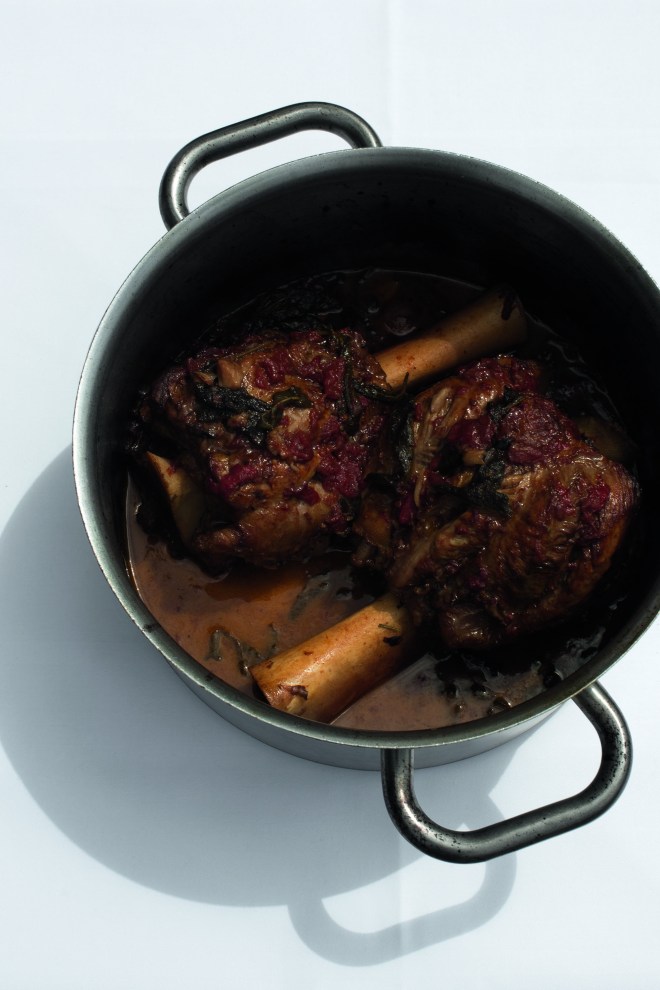
veal shin with barolo and sage
Veal shin photographed by Matthew Donaldson

The longer this cooks the better – in the River Cafe we often serve this simply with bruschetta.

Serves 6-8

2 veal shins,  about  1.5kg each,  trimmed of excess fat extra virgin olive oil
a bunch  of fresh  sage leaves
4 bay leaves
4 garlic cloves, peeled
1 bottle  Barolo
250g peeled plum tomatoes from a jar, drained  of their juices

Preheat the oven to 200°C.

Heat an ovenproof pot or flameproof casserole (that has a lid) over a high heat. Meanwhile, season the shins generously with sea salt and black pepper. Carefully add 5 tablespoons of extra virgin olive oil and the shins to the hot pot and fry until golden brown all over, turning the shins every few minutes.

Add the sage leaves, bay leaves and garlic. Sizzle for a few seconds, then pour
in the wine. Arrange the shins so the exposed bone side is facing down. Add the tomatoes, broken up a little. Cover with a sheet of greaseproof paper and then the lid. Transfer the pot to the oven.

After 1 hour, turn the shins over and reduce the oven temperature to 150°C. Cover the pot again and cook for a further 2 hours, basting the shins with the roasting liquid a couple of times to keep the meat moist. The veal shins are ready when the meat threatens to fall away from the bone. Serve with the marrow from the bone and some of the roasting liquid.

Extracted from
River Cafe 30 by Ruth Rogers, Sian Wyn Owen, Joseph Trivelli and Rose Gray
£28 Ebury Press

Cook more from this book
Mezze paccheri, black pepper and langoustine
Risotto al Amarone di Valpolicella

Read the review

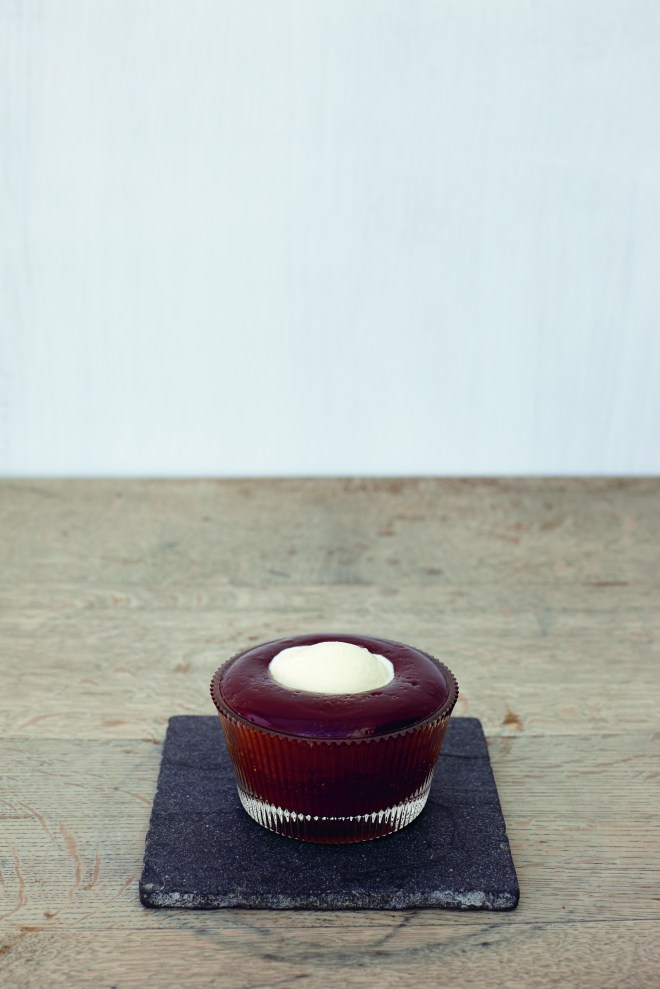
Warm chocolate mousse by Stephen Harris

161 warm mousse.jpg
Warm chocolate mousse photographed by Toby Glanville

I had always wanted to serve a warm mousse, and I found further inspiration for the idea back in 2005, when I was flicking through the elBulli cookbook one day. In my version, I began by spooning salted caramel into a coupe glass, then topped it, elBulli-style, with foaming warm chocolate from an iSi whipper. Because
I always like to serve contrasting tastes, the dark chocolate demanded a milky flavoured ice cream. I put a scoop on top and it slowly sank into the warm mousse as it arrived at the table. This was perfect: both delicious and theatrical.

Serves 6-8

Caramel
175 ml/ oz (¾ cup) double (heavy) cream
125 g/4 oz (2⁄3 cup) caster (super fine) sugar
sea salt

Milk sorbet
500 ml/17 oz (generous 2 cups) double (heavy) cream
700 ml/24 oz (scant 3 cups) full-fat (whole) milk
400 ml/14 oz (1 2⁄3 cups) Sugar Syrup [pp. 241]
1 teaspoon rosewater

Chocolate mousse 
225 ml/8 oz (1 cup) double (heavy) cream
380 g/13 oz 70% chocolate, roughly chopped
225 g/8 oz (1 cup) egg whites

Start by making the caramel. Heat the cream to just below boiling, then remove from the heat. In another pan, heat the sugar until it melts and turns dark brown. Take off the heat and pour in the hot cream. Be careful as it may spit. Return to the heat and warm gently to ensure the caramel is completely dissolved. Allow to cool then cover and refrigerate for up to a week.

For the milk sorbet, combine all the ingredients in a blender and blitz at high speed. Transfer to the refrigerator and chill for at least 30 minutes. Pour into an ice cream machine and churn according to the manufacturer’s directions. Transfer to a plastic container and freeze for at least 2 hours before serving.

To make the chocolate mousse, heat the cream in a pan until it starts to simmer. Add the chocolate to the hot cream, take off the heat and whisk gently to amalgamate. Add the egg whites to the chocolate cream mixture and whisk by hand again to incorporate.

Pour into an iSi whipper and t with two N20 cream chargers. Sit in a 65oC/150oF water bath for 1 hour before using, shaking every now and then to equalise the temperature.

We serve this dessert in glass ice cream coupes. Start by putting a tablespoon of caramel in the bottom of each coupe and add a pinch of salt. Shake the iSi whipper, lower the nozzle to just above the caramel and squirt in the chocolate mousse, keeping the nozzle beneath the mousse as it emerges. Fill to 2 cm/ inch below the top of the coupe. Leave for 1 minute, then carefully sit a scoop of sorbet on top. It will stay in place for a few minutes before slowly slipping in, so serve it straight away.

Sugar syrup
Makes 350 ml/12 fl oz (1½ cups)

200 ml/7 fl oz (scant 1 cup) water
200 g/7 oz (1 cup caster (superfine) sugar

Combine the water and sugar in a pan and boil for 10 minutes. Remove from the heat and leave to cool completely.

Extracted from The Sportsman by Stephen Harris
£29.95 Phaidon
Buy the book

Cook more from this book
Salmagundi
Slip sole in seaweed butter

Read the review

Read an interview with Stephen Harris

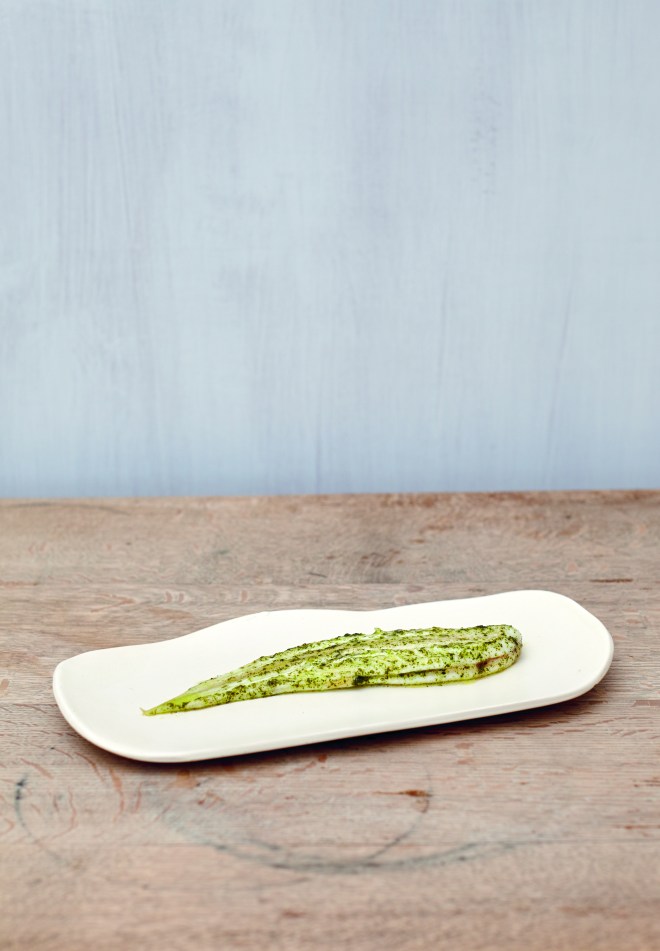
Slip sole in seaweed butter by Stephen Harris

105 slip sole.jpg
Slip sole photographed by Toby Glanville

I liked the idea of serving the fish alone on a plate. It was a statement of intent. And it was provocative – I knew I would get people saying it needs some vegetables or potatoes. But I disagreed, people just needed to concentrate on the fish, reunited with seaweed on a plate with the help of a bit of butter.

Serves 4

Oil, for greasing
4 x 250 g/9 oz slip soles, skinned and heads removed
8 x 15 g/ ½ oz discs Seaweed Butter [see below]
sea salt

When ready to cook, preheat an overhead grill (broiler) and arrange the slip soles on an oiled and lightly seasoned griddle pan. Cut thin slices of the seaweed butter and arrange a couple of slices on each fish. Place under the grill for 3–4 minutes. Baste at least once to ensure each fish is completely covered with the butter. You should see some signs of shrinkage at the bones.

Remove the fish from the grill (broiler) and leave to finish cooking on the hot pan for a further 3–4 minutes. Season very lightly and serve straight away.

Seaweed butter
This is the amount of butter we make at the restaurant. It keeps well in the refrigerator for up to a week and freezes very well, but you can also scale down the recipe to your needs.

Makes about 1.5kg/ 3 lb 5 oz

100 g/3½ oz fresh gutweed or sea lettuce (enough for 20 g/ ¾ oz dried seaweed)
2.5 kg/ 5 lb 8 oz (10 cups) crème fraiche, chilled
22.5 g/ ¾ oz (4½ teaspoons) sea salt

After gathering the seaweed, wash it very carefully and then dehydrate for 3 hours at 80oC/175oF. Check carefully for any shells or foreign objects, then put into a food processor and pulse to small, rough flakes. Store in an air-tight container.

Put the bowl of a stand mixer into the refrigerator to chill. Put the cream or crème fraîche into the cold bowl and beat at high speed with the paddle attachment. After about 5 minutes the cream will really stiffen up and you will hear a splashing sound as the buttermilk separates out from the buttermilk.

At this stage I turn down the speed and cover the bowl loosely to prevent liquid spraying everywhere. Continue beating until the buttermilk and butterfat separate completely. Be patient as it may take another 5 minutes or so.

Turn off the machine and strain off the buttermilk. Rinse under cold running water and strain again. With the machine on its lowest setting, mix in the salt and dried seaweed until fully incorporated.

Knead the butter between two pieces of wax (greaseproof) paper to squeeze out the last of the buttermilk. Finally, shape into a cylinder or a round pat, wrap in wax (greaseproof) paper and store in the refrigerator.

Extracted from The Sportsman by Stephen Harris
£29.95 Phaidon
Buy the book

Cook more from this book
Salmagundi
Warm chocolate mousse

Read the review

Read an interview with Stephen Harris

Salmagundi by Stephen Harris

191 salmagundi.jpg
Salmagundi photographed by Toby Glanville

I’ve always been drawn to the idea of a salmagundi. I love the word itself – it’s the seventeenth century name for an English mixed salad – and of course I’m very keen on dishes that are truly seasonal, as it means I can focus my efforts on selecting produce at its very best, ideally straight from my own garden, instead of having to source ingredients from a supplier, which might not be up to the same standard.

Back in the early days of The Sportsman, while I was still dreaming of the perfect salmagundi, I visited Michel Bras’ restaurant in the Aubrac plateau of France. One of his most famous dishes is the gargouillou – a salad that contains up to twenty different vegetables, all prepared separately. The waiter explained that the name comes from a traditional peasant soup, which can contain many different ingredients, depending on the season. I knew immediately that this would be the blueprint and inspiration for my own Sportsman salmagundi.

Back in the restaurant kitchen I gathered together as many ingredients from the restaurant kitchen garden as I could find, all in their prime. It was early July, which meant I was spoilt for choice: there were baby peas, broad beans, French beans, courgettes (zucchini), tomatoes and many other things, as well. And then it was a question of playing around with bits and bobs from the different sections of the kitchen. I selected some vegetable purées, a handful of fresh herbs and flowers, crunchy soda breadcrumbs, a buttery sauce, and I started to have some fun!

I began by decorating the plate with some artful smears of purée and topped them with a cooked baby carrot and a few cubes of roasted summer squash. Next, I flavoured the buttery liaison with a pinch of curry powder and warmed through my freshly picked vegetables: my aim was to maintain their intrinsic ‘snappiness’ – they didn’t need to be cooked, just barely warmed through – and I wanted their sweetness to be enhanced by the earthy flavour of the curry. I arranged a poached egg on the plate, spooned over the warm vegetables and finished the dish with some leaves and flowers and a scattering of breadcrumbs, to represent soil from the garden. The end result was a visual delight, as well as being utterly delicious.

The joy of a dish such as this is the way it can be adapted to what’s best during each season. Summer’s glut provides a bounty, of course, but in the winter it works just as brilliantly with root vegetables and a smoked egg yolk. I thought about writing a recipe for this, but in the end, realised that it would be impossible. The best version will come from using this as a rough guide to create your own version from what you have available.

Extracted from The Sportsman by Stephen Harris
£29.95 Phaidon
Buy the book

Cook more from this book
Slip sole in seaweed butter
Warm chocolate mousse

Read the review

Read an interview with Stephen Harris