Hook Line Sinker by Galton Blackiston

Hook Line Sinker

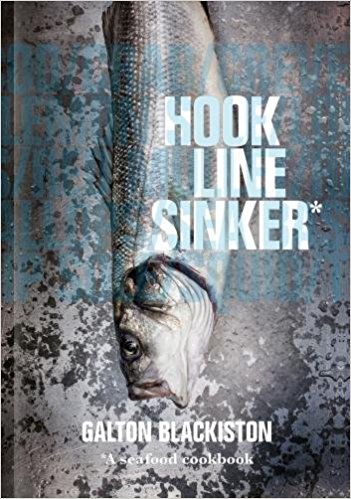
The silver-edged pages of Hook Line Sinker glint in the light, like the skin of the fresh sea bass featured on the cover of this strikingly designed book – it’s even wrapped in a transparent PVC dust jacket. It looks just as good on the inside too (not surprising; it’s from the company that published Sat Bains’s sumptuous Too Many Chiefs Only One Indian) with bold typography and images of not just the food but also the Norfolk coast that is the book’s inspiration.
Galton Blackiston is ideally qualified to write a seafood cookbook.  A keen fisherman from childhood, he’s been chef patron of Michelin-starred Morston Hall for 25 years where seafood is an important part of the menu, and more recently opened No 1, a modern fish and chip restaurant in Cromer.

Blackiston’s approach to seafood is simple; ‘it has to be fresh, needs to be cooked with precision, and there’s little room for error. You just need to have a good seafood supplier and cook it well’. He’s applied a similar ethos to compiling the recipes, not attempting to write a definitive seafood guide, simply gathering some of his favourite restaurant dishes from over the years that also work for the home cook.

Although there is a chapter dedicated to main courses, Blackiston eschews the traditional starter category (there’s no desserts, no one wants a fishy pudding after all), instead organising the remaining recipes into ‘quick and easy’, ‘small plates’, ‘stress free’ and ‘spicy seafood’ allowing readers to dip in according to mood and time available.

The thorny, complex issue of sustainability isn’t addressed (a bluefin tuna dish is included, a fish that has suffered from plummeting stocks) and the recipes stick to better-known varieties like salmon, prawns, scallops and crab. But the dishes are nevertheless delicious, ranging from a classic fillet of sea trout with samphire and beurre blanc to lager, soy and ginger-fried whitebait with wasabi aioli.

What comes across loud and clear from this collection is that Blackiston has a singular culinary mind; yes, he’s included crowd pleasers like salt and pepper squid, but dishes like crab jelly with pea panna cotta set the inventive tone. Hook Line Sinker has been 25 years in the making. Let’s hope we don’t have to wait a quarter of a century for the follow up.

This review was originally published in The Caterer magazine

Cuisine: Modern European
Suitable for: Confident home cooks and chefs
Cookbook Review Rating: 4 stars

Buy this book
Hook Line Sinker: A Seafood Cookbook
£25 Face Publications

This is Mine by Mark Dodson

This is Mine

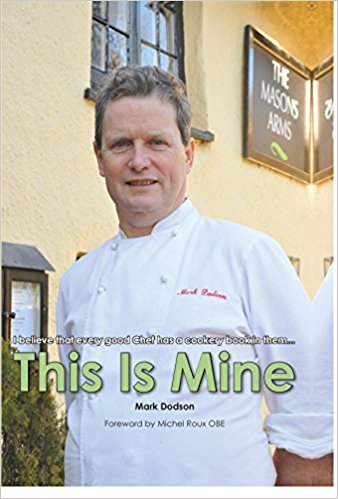
You may know that Mark Dodson has held a Michelin star at The Mason’s Arms, his Devon pub, since 2006. You’ll probably also know that he’s a former head chef of The Waterside Inn. But you may not realise that he’s the only Brit ever to hold that position or that he spent a total of 18 years at the restaurant. And you almost certainly won’t have a clue that his favourite film director is Quentin Tarantino and that he has a huge collection of vinyl and gig ticket stubs.

You’ll discover all this and more reading his debut cookbook (the obscure title is explained by the cover strapline ‘I believe that every good chef has a cookery book in them…this is mine) which includes a glowing introduction by Michel Roux Snr (‘I look upon Mark as I look upon my son’) and a brief but illuminating biographical section.

Dodson describes his cooking style as ‘good honest food, featuring local ingredients wherever possible presented with style and taste’, neatly summing up the 70 recipes that are categorised into soups, starters, mains and desserts. In addition, there’s a section dedicated to game, a passion of Dodson’s with preparations ranging from classic roasted grouse with bread sauce and a crouton spread with farce au gratin (a sort of pate made from grouse and chicken livers) to wood pigeon with curried brussels sprouts.

Dodson has been cooking since the 70’s and his classical background is reflected in garnishes like turned and Parisienne-balled vegetables, fanned duck breasts and chicken cooked in a brick. There’s also a fair amount of 90’s-style stacking of food, but there’s a nod to modernism with dragged purees and pickled and smoked elements. Dodson also looks far beyond Britain and France for inspiration; smoked chicken comes with Thai-style salad and salmon is marinated in soy, mirin and yuzu.

The book won’t win any prizes for design with a dated and unimaginative layout and oddly lit photography that makes some dishes look washed out and unappetising. The editing could have been improved too with recipe introductions not delineated from the method and no instructions on how to prepare some ingredients in some recipes, making for a frustrating read at times. However, the book does offer an invaluable opportunity to tap into the wealth of knowledge accrued by one of the UK’s most respected and experienced chefs. This is Mine should also be yours.

This review was originally published in The Caterer magazine.

Cuisine: Modern European/French
Suitable for: Confident home cooks and chefs
Cookbook Review Rating: 3 stars

Buy this book
This Is Mine
£25 A Way with Media

The Sportsman by Stephen Harris

The Sportman

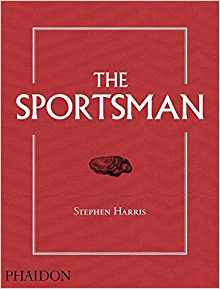
The Sportsman is a remarkable book about a remarkable place run by a remarkable man. Stephen Harris is a former punk rocker, turned history student, turned financial advisor, turned (mostly) self-taught cook, turned publican, turned Michelin starred chef. He runs what he once called ‘a grotty rundown pub by the sea’ in Seasalter on the Kent coast, but which to many is a place of serious culinary pilgrimage.

If you haven’t heard of Harris or The Sportsman, or come to that Seasalter, this is a wonderful introduction to all three. If you’re a fan, you’ll be especially delighted by the effort Harris has put into this, his first book, with a series of insightful and fascinating essays about his own personal history, the story of the pub, his approach to cooking and the heritage and produce of the region, making it so much more than simply a collection of recipes.

Not that you’d be disappointed with a collection of recipes from the Sportsman. There are 55 of them here, arranged under headings reflecting what Harris calls the ‘Kentish terroir’ that drives his menus. The signature slip sole in seaweed butter (‘I liked the idea of serving the fish alone on a plate. It was a statement of intent’ says Harris in the recipe’s introduction) appears in the The Sea: The Kent coast and North Sea and salmagundi – an English mixed salad that’s presented as more of an essay than an actual recipe with specific ingredients and a method – in a chapter titled The Gardens: The Sportsman Allotment and Isle of Thanet.

Harris takes inspiration from chefs around the world including David Kinch from California whose ‘Tidal Pool’ prompted Harris to create Rockpool, a collection of local sea vegetables and seafood served in a fish stock and seaweed broth; and Michel Bras in Laguiole in Southern France whose multi-ingredient gargouillou salad is the inspiration for salmagundi. But dishes such as baked cod with chestnuts, parsley and bacon; pheasant with bread sauce and rose hip juice and greengage soufflé with greengage ripple ice cream are unmistakeably English; the food is so specific to Kent that to call it British would be too much of a generalisation.

But you don’t have to live in the same county as Harris to cook his food. Unless you live by the sea, his recipe for salt is going to be tricky to pull off (transporting buckets of sea water any distance is always going to be a challenge) but the majority of the dishes can be easily adapted to produce more easily available near to where you live. They’re mostly straightforward to prepare, although he’s not adverse to a few long ingredient lists (his roast lamb gravy has 17 of them, including home-made chicken stock) or cheffy flourishes; smoked mackerel with cream cheese, apple jelly and soda bread with mackerel velouté is a properly complex restaurant dish.

There are many pearls of wisdom, from Harris’s treatise on what he calls Total Cooking (‘we are constantly questioning our processes and trying new ideas’) to his analogy of music and cooking (‘When I am finishing a sauce or soup, I can’t help thinking like I would if I had a graphic equaliser and was balancing something in a song. The treble is like acidity’) to detailed descriptions of his preferred ingredients (thornback rays are superior to the blond variety because ‘rather than the texture being open and woolly when cooked, the flesh of the thornback was denser and stickier on the teeth).

Even if you never prepare one dish (trust me, you will), you’ll be a better cook for reading The Sportsman. How many cookbooks can you say that about?

Cuisine: British
Suitable for: Confident home cooks
Cookbook Review Rating: 5 stars

Buy this book
The Sportsman by Stephen Harris
£29 Phaidon

Cook from this book
Salmagundi
Slip sole in seaweed butter
Warm chocolate mousse

Read the author interview

River Cafe 30 by Ruth Rogers, Sian Wyn Owen, Joseph Trivelli and Rose Gray
River Cafe 30

River Cafe 30 commemorates the thirtieth anniversary of one of the most influential restaurants in London. Before Ruth Rogers and Rose Gray opened what was a nine table lunchtime-only canteen for the architects and designers who work in the converted Thames Wharf warehouse in Hammersmith that houses the restaurant, there were only fake trattorias serving generic Italian fare. The River Cafe introduced the notion of regional Italian cooking to the UK; of new season’s olive oil, cavalo nero, Tuscan bread soups, hand made pasta and the infamous flour-less Chocolate Nemesis cake, a recipe that no home cook it seemed could master, me included.

Taken purely as a collection of recipes, there is much to recommend River Cafe 30. This is simple, delicious, ingredient-led food requiring, in most cases, minimal skill from the home cook. If you can’t afford the premier league Italian produce that the restaurant’s reputation stands and falls by, then you’ll still derive a huge amount of pleasure from knocking up dishes like linguine with crab; spinach and ricotta gnocchi and pork cooked in milk. The ‘salsa’ chapter alone could transform your repertoire with killer sauces like bagnet made with capers, anchovies, bread, parsley, garlic, eggs, vinegar and oil.

However, this is not a book for the faint of wallet. The basic pasta recipe requires 13 eggs and that chocolate cake, one of a number of recipes recycled from the restaurant’s famous ‘blue’ cookbook from 1995, calls for well over half a kilo of ‘best quality’ dark chocolate. Follow River Cafe 30 to the letter and you’ll be bankrupt and homeless, although you will have a bit of extra fat to live off before you have to sell your extra virgin olive-oiled body to the night.

River Cafe 30 is a beautiful object with a vivid colour scheme inspired by the restaurant’s bright pink wood-fired oven, yellow pass and blue carpet. There are reproductions of menus drawn or painted on by artist fans that include Cy Twombly, Peter Doig, Damien Hirst and Michael Craig Martin along with evocative black and white photography depicting life in River Cafe’s open kitchen (one of the first in the country) and a moving tribute to the late Rose Gray by Ruth Rogers.

But where is the celebration of the countless chefs that have passed through The River Cafe’s kitchen? Not one word about Jamie Oliver, Hugh Fearnley Whittingstall or Theo Randall, to name but three of the most high profile alumni. Three decades of culinary history are condensed into two brief pages of text plus some architectural drawings, a sample of one of the first menus and an article published in the New Yorker magazine in 1996.

Recipe introductions are sparse with little information about why dishes have been singled out for inclusion, their regional derivation or how they fit into the restaurant’s history. There isn’t even so much as a hint of how to use all those salsas.

Despite high production values, there is more than a whiff of cash-in about River Cafe 30. No doubt it will sell by the bucket load, especially to special occasion diners in search of a memento (River Cafe remains an exceptional place in which to eat your tea), but I can’t help but feel that this is a missed opportunity to properly celebrate one of Britain’s true culinary landmarks.

Cuisine: Italian
Suitable for: Beginners and confident home cooks
Cookbook Review Rating: 3 stars

Buy this book
River Cafe 30 by Ruth Rogers, Sian Wyn Owen, Joseph Trivelli and Rose Gray
Food Photography by Matthew Donaldson
£28 Ebury Press

Cook from this book
Mezze paccheri, black pepper and langoustine
Risotto al Amarone di Valpolicella
Veal shin slow cooked with Barolo and sage

Cooking At The Merchant House by Shaun Hill

Merchant House

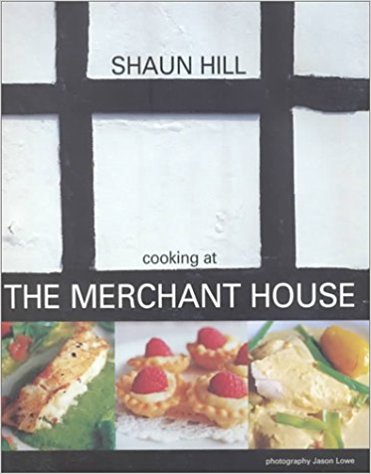
There had been a ten year gap between The Shaun Hill Cookery Book (also known as The Gidliegh Park Cookbook) and Cooking At The Merchant House when it finally arrived in 2000. In between, Hill had knocked out a vegetable cook booklet for the BBC, contributed recipes to “A Spoon At Every Course by Mirabel Osler, and apparently spent the advance for a book called Masterclass which eventually surfaced as How to Cook Better.

Of course, he was also busy doing other things, such as running a restaurant, consulting for BA and Tescos and the odd bit of broadcasting on Radio 4. But I’m extremely glad he took the time to record the recipes that formed the menus at his wonderful and late lamented Ludlow restaurant.

Dishes such as Warm Artichoke Heart with Peas and Mint Hollandaise; Fresh Goats Cheese Gnocchi and Lobster with Chickpea, Corinander and Olive Oil Sauce bring back fond memories of numerous meals eaten at The Merchant House.

In addition to the excellent recipes, Cooking At The Merchant House goes some way to telling the story of the life of the restaurant.  Hill is a gifted writer of prose and it’s a great shame that there is not more of it. I am told by ‘sources close to the author’ that a great deal more was written and submitted, but was sacrificed to photos and general design considerations. Nevertheless Cooking From the Merchant House remains an essential purchase for any serious cook, professional or amateur.

Cuisine: modern British
Suitable for: Confident home cooks and professionals
Cookbook Review rating: 4 stars

Buy this book
Cooking at the Merchant House
Shaun Hill
£0.01 Conran Octopus

L’Atelier of Alain Ducasse

Ducasse

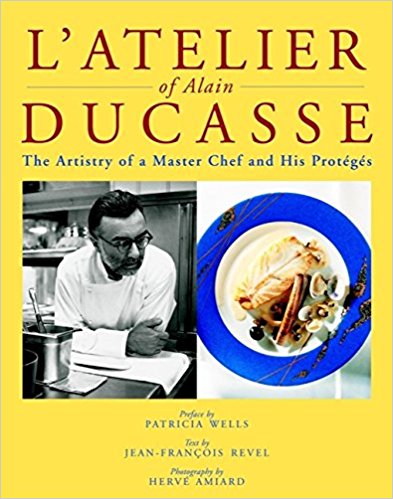
L’Atelier of Alain Ducasse sets out to provide an insight into the working methods and philosophy of prehaps the most successful chef currently working anywhere in the World today. The book contrasts signature Ducasse recipes with those of his current and former Head Chefs in order to illustrate his influence on the men who work for him.

The book begins with a look behind the scenes of the Ducasse empire and attempts to contextualise it in terms of the last 300 years or so of French gastronomy. This rather dry and pretentious exercise is greatly enlivened by the beautiful black and white portraiture of Herve Amiard. Some amusing non-secquiturs from Ducasse lighten the tone, such as “It is better to have turbot without genius than genius without turbot”. Probably the definitive statement in the fish versus intelligence debate, if not the only one.

Things liven up with profiles of Ducasses favoured suppliers and their produce, and again it’s the full colour photographs that impress. These range from dramatic shots of turbot and bass being landed, to a lemon grower in quite contemplation amongst his trees. They communicate beautifully the powerful connection between man and sea and land.

The book contains recipes for just 8 of Ducasse’s signature dishes. Each is based around a characteristic ingredient of his cuisine, and is followed by further recipes from five of his pupils. Hence, under the heading “Sea Bass” you find Ducasse’s “Sea Bass Steaks with Leeks, Potatoes and Truffles”, along with “Fried Mediterranean Bass” by Le Louis XV head chef Franck Cerutti. Notes on each recipe assist the reader in comparing and contrasting the different approaches taken. Although this is all very enlightening, I personally would have settled for a few more of the great man’s recipes.

Having said that, it is highly unlikely that I would ever attempt to produce a dish such as “Semi Dried Pasta with Cream Sauce, Truffles, and a Ragout of Cockscombs and Chicken Kidney” at home. If invested wisely, the small fortune required to purchase the ingredients (including lobster, sweetbreads, 4 1/2 pounds of veal and chanterelle mushrooms), would see my kids through university.

Although all the main recipes are supported by step by step photographs, preparation is dauntingly complex. You could probably write your first novel in the time that it would take to cook some of the dishes featured. The book is best approached as an inspiration to get into the kitchen, rather than something to be slavishly followed once you are there. Some individual garnishes are achievable however. I particularly liked the thinly sliced potatoes sandwiched together with slivers of olive, which were then baked and served with spider crab.

Illustrations of the food itself are refreshingly clear, and avoid the current and annoying fad of everything being out of focus except for a square centimetre in the centre of the picture. Although the overhead style used for every shot gets a little wearing, it does show the unusually relaxed presentation style Ducasse employs. Elements of each dish seem to be casually strewn across the plate, but still somehow create a pleasing and cohesive whole.

Having read the book, I now have a greater understanding of what M Ducasse food is all about, but didn’t really learn much about the man himself. The book provides a diverting enough read, some stunning photography and a few usable recipes, but can only be recommended to fans M Ducasse who already have his other books.

Cuisine: French
Suitable for: Professional chefs
Cookbook Review rating: 3 stars

Buy this book
Atelier of Alain Ducasse: The Artistry of a Master Chef and His Proteges (Masters of Gastronomy)
Alain Ducasse
£20.05 John Wiley & Sons

Éric Frechon by Éric Frechon

Eric Frechon

Éric Frechon is old-school French culinary royalty. You may have heard his name in connection with London’s Lanesborough Hotel where he is consultant chef to the one Michelin-starred Céleste restaurant, opened in 2015. But his heart belongs to Paris where he worked at Taillevent, La Tour d’Argent and Hotel de Crillon before heading up the kitchen of Le Bristol where he has held three Michelin stars since 2009 and where a starter of caviar with smoked haddock ratte potatoes fetches a cool €150.

The dish is included in this opulent tome as one of just 60 recipes. With a cover price of nearly fifty quid, that means you’re getting about half the usual amount for roughly twice the average price which cynics might say is business as usual for a three-star chef. But if you do shell out, be prepared to be delighted and frustrated by turns.

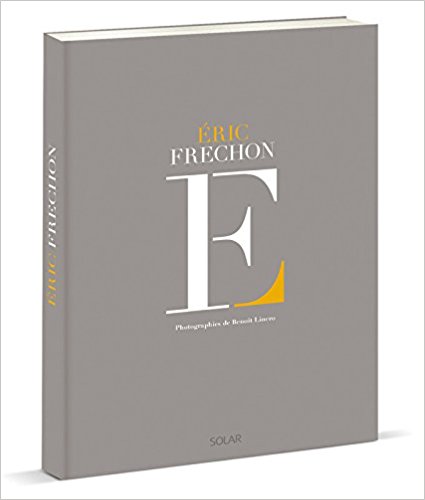
Benoît Linero’s dense, brooding images of Frechon’s dishes and favoured ingredients owe more to renaissance painting than modern food photography and are unquestionably breath-taking, but the decision not to show all the recipes as they are served in the restaurant is irksome, despite the inclusion of detailed plating instructions.

The recipes are inspiring (you’ll want to jump on the next Eurostar to Paris to eat the signature macaroni au gratin stuffed with truffle, artichoke and foie gras) but sometimes lack detail. If you want to know how Frechon makes truffle jus, chicken stock or vegetable nage then you’ll have to look elsewhere.

The rather florid forward by French food critics François-Régis Gaudry and Emmanuel Rubin provides some insight into the cuisine and creative process of a three-star chef. Frechon describing how he took the French classic of hare à la royale and developed it into a soup is particularly fascinating but ultimately you are left wanting to know more. It’s galling to read that the pair had ‘many meandering conversations’ with Frechon that could have provided much needed introductions to the recipes or a longer biographical section.

With a number of cookbooks already to his name, this self-titled volume is meant to constitute Frechon’s ‘culinary manifesto’.  At a skimpy 160 pages, it falls short of being that, but does paint a decent portrait of a French fine-dining chef at the top of his game.

(This review first appeared in The Caterer magazine)

Cuisine: French
Suitable for: Professional chefs
Cookbook Review rating: 3 stars

Buy this book
Eric Frechon
Éric Frechon
€59 Solar

The Five Seasons Kitchen by Pierre Gagnaire

Five Seaons

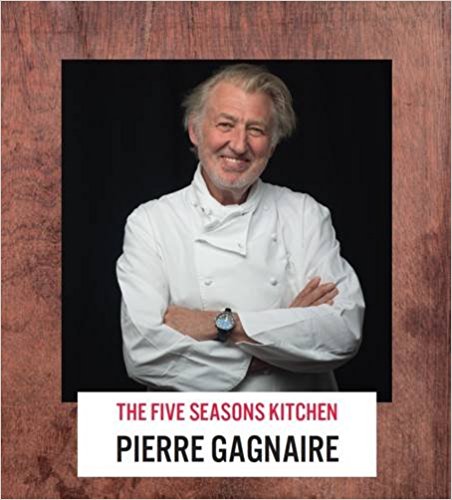
Pierre Gagnaire is the French godfather of modernist avant garde cuisine, winning Michelin stars for his adventurous food in the early 80’s when Ferran Adria was still washing dishes for a living. Now, he presides over a world-wide empire that includes restaurants in Hong Kong, Las Vegas, and Dubai as well as his native France. But if you’re hoping for a definitive tome of the chef’s culinary oeuvre in the style of the Noma or el Bulli books, then you’re in for a disappointment.

Instead, to mark his 50th year in cooking, Gagnaire has produced his first family cookbook. The book’s 90 recipes are organised into 30, three course menus which are divided between not four, but five seasons. Gagnaire claims the fifth season is ‘that moment after winter has ended but before  spring has truly begun’. Recipes in the ‘Almost Spring’ chapter designed to be cooked in March and April include a stunning sole terrine with leek (although perhaps more of a dish for the restaurant than the family table) and a more homely and traditional blanquette de veau.

As you might expect from the man who serves conger eel with green mango and grapefruit granita in his eponymous three star restaurant in Paris, dinner chez Gagnaire is no ordinary affair. Fresh oysters are garnished with sardine, ginger and slices of frozen banana. Yes, banana. Floating islands is re-imagined as starter of egg white quenelles in a coffee scented chestnut veloute, topped with mortadella; and financiers are flavoured with rocket chlorophyll and served as a dessert with mint syrup and vanilla ice cream.

Frustratingly, there are no introductions to the recipes so the reader is left none the wiser to where the inspiration for all this creativity comes from, or the derivation of the name of the spicy ‘6 rue de la Pepiniere sauce’ that’s served with roast beef and made from red and green peppers, strawberries, raspberries and beetroot among other things (Google the address and you’ll discover it’s a branch of M&S Food in Paris, but how the two are connected remains a mystery).

The lack of a ‘basics’ section means there are no recipes given for the stocks, jus, brioche and ice creams required to make some of the dishes, inferring that home cooks are expected to use ready made alternatives. But despite it’s shortcomings, cooks of all levels may well find inspiration lurking in the pages of this highly individual collection.

(This review first appeared in The Caterer magazine)

Cuisine: French
Suitable for: Confident home cooks and professionals
Cookbook Review rating: 3 stars

Buy this book
The Five Seasons Kitchen
Pierre Gagnaire
£25 Grub Street

Casa Marcial: The Cuisine of Nacho Manzano by Benjamin Lana

Casa Marcial

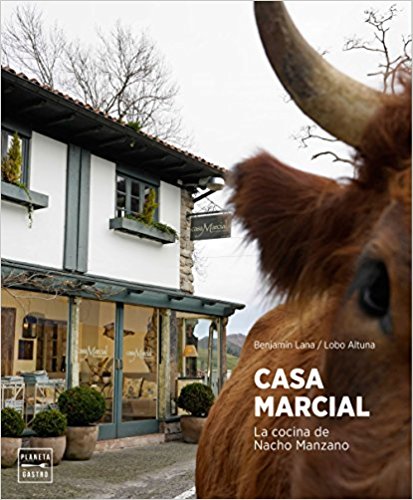
Nacho Manzano is best known in the UK as the executive head chef of Ibérica, the chain of stylish Spanish restaurants he helped launch in 2009 in London and which now has branches in Manchester, Leeds and Glasgow.  But this book focuses on the food at his two Michelin-starred restaurant Casa Marcial in the tiny hamlet of La Salgar and the surrounding region of Asturias in northwest Spain where Manzano was born and continues to live and work.

The rugged, mountainous landscape is beautifully captured in Lobo Altuna’s images, which are almost worth the price of the book alone, and illustrate the first half of the book that tells Manzano and his family’s story. What is now one of the leading modernist restaurants in Spain began life after the Spanish Civil War as a cider mill and shop selling traditional wooden clogs run by Manzano’s great grandmother. In the 60’s, Manzano’s father Marcial ran it as a bar with food until finally Manzano and his sister Esther opened Casa Marcial in 1993.

The second half of the book contains recipes for the restaurant’s ’60 best dishes’ organised into vegetables and rice, fish and seafood, poultry and meat and desserts and fruit. Signature dishes include ‘house scrambled eggs over torto’, a deep fried maize flour flat bread typical to the Asturias region that Manzano put his spin on at the tender age of 15 when he topped them with eggs flavoured with caramelised onions and local Cabrales blue cheese; and ‘rice with pitu de caleya’, a take on a traditional Asturian feasting dish made with the local free range pitu de caleya or village chicken, a formerly neglected ingredient that Manzano has championed to become the Spanish equivalent of poulet de Bresse.

Given that the Manzano family have their own fishing grounds (although La Salgar is in the Sierre del Sueve mountains, it’s just 6 kilometres from the Bay of Biscay) it’s no surprise that just under half the recipes in the book are dedicated to seafood. Manzano takes a fin to tail approach with refined and stunningly presented dishes such as cod tripe with red pepper consommé and pil, the classic gelatinous sauce made with the cod’s skin and bones.

Manzano is a truly individual culinary mind and Asturias is a fascinating and under reported gastronomic region; Casa Marcial makes a fine introduction to both.

(This review first appeared in The Caterer magazine)

Cuisine: Spanish
Suitable for: Professional chefs
Cookbook Review rating: 4 stars

Buy this book
Casa Marcial
Benjamin Lana
Photography by Lobo Altuna
€38, Planeta Gastro

Alfred Portale’s Gotham Bar and Grill Cookbook

Gotham

You may be forgiven for thinking that the Gotham Bar and Grill was Bruce Wayne’s favourite place for steak. In fact, it’s a very successful restaurant in Manhattan’s Greenwich Village. Alfred Portale has been it’s chef for well over three decades, during which time he has won the coveted New York Times award of 3 stars. Every successful restaurant must have at least one cookery book to display in it’s lobby and sell to wide eyed tourists, and the Gotham is no exception .

The Gotham Bar and Grill Cookbook is more than a souvenir for the travelling gastronome however. The book, with it’s 200 recipes and numerous sidebars containing information on techniques and ingredients provides a complete introduction to modern restaurant food.

The book is beautifully presented on high quality paper, with colour photographs throughout. All the food for the illustrations was prepared by Portale himself . Colour is also put to good use within the text, giving the book a distinctive and lively look.

Portale has an impeccable C V, with time spent working for Troisgros and Guerard. Unusually, he also studied flower arranging which has obviously had an influence on his style of presentation. His signature “Seafood Salad” would not look out of place on your mantelpiece.

Step by step photographic guides are included to demonstrate how these more complex presentations can be achieved. Alternative family style options are also included for those not disposed to attempt elaborate arrangements of food on plates.

Portales obvious passion for food and meticulous attention to detail is communicated throughout the book, despite being ghost written by Andrew Freidman. The extent of this passion is revealed when the reader is informed that about twenty different recipes for curry were tested before settling on the one finally included in the book.

Being an American publication, recipes refer to measurements in terms of cup”, and ingredients such as cilantro and fingerling potatoes. However, this does not prevent the book being highly desirable and very usable for Europeans, albeit with a little patience and care.

As well as the special occasion recipes, the book includes some excellent everyday dishes with a whole section dedicated to soups, snacks and sandwiches. The dessert section is comprehensive with “Warm Chocolate Cake with Toasted Almond Ice Cream” being particularly appealing.

The Gotham Bar and Grill Cookbook will be of interested to those of us who enjoy reading collections of recipes as much as the latest Harry Potter. It constitutes a very good introduction to readers beginning to explore and develop their culinary skills, as well as providing lots to excite accomplished cooks wanting to serve something a little bit different at their next dinner party. A recommended purchase.

Cuisine: American
Suitable for: Confident home cooks and professionals
Cookbook Review rating: 4 stars

Buy this book
Alfred Portale’s Gotham Bar and Grill Cookbook
Alfred Portale
$45 Bantam Doubleday Dell Publishing Group