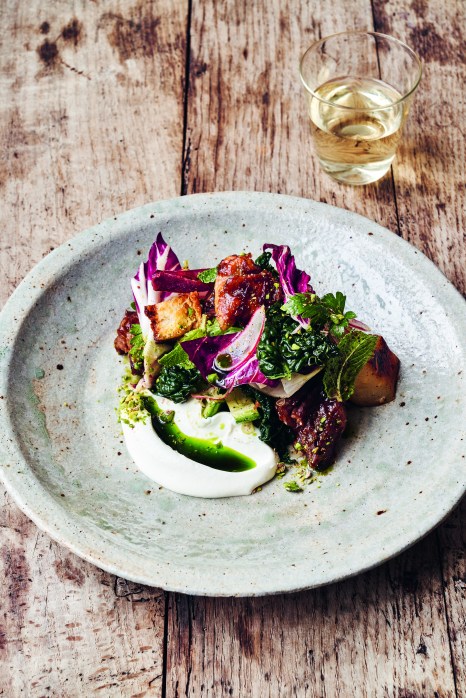
Winter Fattoush and Tamarind-Glazed Short Rib by Selin Kiazim

Selin_Kiazim-Three-419_Glazed_Short_Rib
This dish is a real feast of contrast. If you have time, cook the ribs low and slow on a barbecue for an extra level of smoky flavour. I first made this dish for Cook for Syria, to raise funds for Unicef, back in 2016. It is by no means a traditional fattoush, and I encourage you to go out and try the real thing if you get the chance (or prepare the original at home).

Serves 4

4–5 Tbsp sumac dressing (see below)
3–4 Tbsp parsley oil (see below)
4–5 Tbsp tamarind glaze (see below)
100g (3½oz) croutons (see below)
4 beef short ribs
4 Tbsp unsalted butter
2 pears, cut in half, core removed
80g (2¾oz) cavolo nero, stalks removed and the leaves torn into pieces
extra-virgin olive oil
½ cucumber, cut in half lengthwise and seeds removed, thinly sliced
8 breakfast radishes, finely sliced and placed into iced water
4 spring onions (scallions), sliced
¼ head radicchio, roughly chopped
8 leaves yellow chicory (endive), roughly chopped
1 small handful of flat-leaf parsley, leaves picked
4 Tbsp mint, leaves picked
sea salt flakes (kosher salt)
4 Tbsp thick yoghurt
4 Tbsp pistachios, toasted and chopped

Heat the oven to 190°C/170°C fan/375°F/gas mark 5. Prepare the sumac dressing (page 81), parsley oil (page 55), tamarind glaze (page 40) and croutons (page 46). Season the short ribs with fine salt, place into a roasting tin and into the oven for 3–4 hours or until the meat is falling away from the bone. Pick the meat off the bone into large chunks, once cool enough to handle.

Heat a large frying pan (skillet) over a medium heat, add the tamarind glaze and short rib pieces along with 2 Tbsp of the butter. Cook until all of the meat is coated in the glossy glaze. Keep warm. Put the remaining 2 Tbsp of the butter into a large, ovenproof frying pan, gently melt and add in the pears, cut-side down, and brown for 1 minute. Place into the oven for 10 minutes or until golden brown and cooked through. Allow to cool. Cut into large chunks.

Bring a large pan of water to the boil with a little fine salt. Add in the cavolo nero and boil for 3–4 minutes or until tender. Drain, and allow to cool slightly before dressing with a little salt and olive oil while still warm.

To assemble the salad, in a large bowl, mix together the cucumber, cavolo nero, radishes, spring onions (scallions), radicchio, chicory (endive), herbs, croutons and pears. Season with sea salt flakes (kosher salt) and sumac dressing, to your liking.

To serve, spoon a dollop of yoghurt on the plate and place a pile of salad to one side. Scatter over some pieces of short rib, drizzle around the parsley oil and sprinkle the pistachios over the top.

Sumac Dressing
Zingy and light, this dressing is perfect tossed through salad leaves but also works well with chilli-spiked dishes thanks to its almost cooling effect.

Makes 150ml (5fl oz) VG

125ml (4fl oz) extra-virgin olive oil
1 garlic, finely grated
1 lemon, juiced
1 Tbsp sumac

Whisk, blend or shake the whole lot in a jar. Season to taste. It will store well in the fridge for 2–3 weeks.

Parsley Oil
Basil and parsley, thanks to their full-on flavour, make my favourite herb oil. They also provide a sexy finish to a plate. If you want to make a straight parsley oil, then just use one big bunch of parsley and omit the basil. If you would prefer chive oil, then replace the basil with one big bunch of chives.

Makes 85ml (2¾fl oz) VG

25g (1oz) parsley, big stalks
removed, roughly chopped
200ml (7fl oz) grapeseed oil

Prepare a bowl of iced water. Bring a pan of water up to a rapid boil, add the herbs and cook for 15 seconds. Take the herbs out and immediately dunk them in the iced water. Squeeze all the excess water from the herbs and roughly chop (reserve the
iced water). Make sure you have really squeezed them and they are as dry as they can be.

Place the herbs into a high-speed blender with the oil and blitz, starting on the lowest setting for 30 seconds and then on to the fastest setting for 2–3 minutes, or until the herbs are as fine as they will go. Don’t worry if the oil heats up through blending – this is a normal part of the process and helps the colour of the herbs release into the oil.

At this point you need to decide on whether to leave herby bits in the oil or strain them off. If straining, line a fine sieve (strainer) with muslin (cheesecloth) and place over a bowl that fits within the iced water bowl. Pour the oil mix into the lined sieve and leave to drip for 1–2 hours. If you are leaving the bits in, then simply place the oil into a bowl over the iced water to cool. Store in a squeezy bottle or container in the fridge for up to 1 month.

Tamarind Glaze
Tamarind is one of my favourite ways to bring acidity to a dish. In fact, it is probably
more sour than acidic but acts in that same lip-puckering way a good acid does. Making your own tamarind pulp is very easy. Simply take 2 blocks (400g/14oz) of tamarind, break them up into a pan and cover with water. Place over a low–medium heat and cook for 30 minutes or until you see the seeds have all separated and the pulp is a purée consistency.

Makes 200g (7oz) VG

150g (5½oz) tamarind pulp
50g (1¾oz) dark brown sugar
2 Tbsp sherry vinegar

Place the ingredients in a pan over a medium–high heat and simmer for 10 minutes, stirring occasionally. While still hot, push the mix through a fine sieve (strainer) – this will take a bit of effort. Discard the seeds and scrape every last bit of the remaining pulp into a container. Store in the fridge (for up to six weeks), or pour into
ice-cube trays and freeze.

Croutons
The idea behind a crouton is to preserve stale bread – any bread for that matter, from sourdough, pitta and ciabatta, right through to focaccia and rye. Croutons that soak up the juices from a plate of food are the dream. There are two methods I like to use to make croutons:

1
Heat the oven to 180°C/160°C fan/350°F/gas mark 4. Take your stale bread and cut or tear into 2–3cm (1in) pieces, drizzle with a little olive oil and sea salt flakes (kosher salt) and scatter in one even layer over a baking sheet. Place into the oven for 15–20 minutes or until golden brown and crisp. Check the progress of the croutons every 5 minutes – the ones on the outside might be ready sooner than those in the centre.

2
Fill a large frying pan (skillet) around a quarter of the way up with fat (clarified butter, ghee, duck, beef or whatever you’d prefer) and place over a medium-low heat. Cut or tear the stale bread into 1–2cm (½–¾in) pieces and place into the hot fat, ensuring the bread is all in one layer. If you like, at this point you could add in a crushed clove of garlic and a sprig of rosemary or thyme. Cook the croutons for 10–15 minutes, stirring every so often, until they are golden and crisp. Drain through a sieve (strainer) and then onto paper towels to absorb excess fat. Season with sea salt flakes (kosher salt).

Cuisine: International
Suitable for: Beginner / confident home cooks
Cookbook Review Rating: Four stars

Buy this book
Three: Acid, Texture, Contrast – The Essential Foundations to Redefine Everyday Cooking
£25, Quadrille Publishing Ltd
Chicken pie by Ollie Dabbous


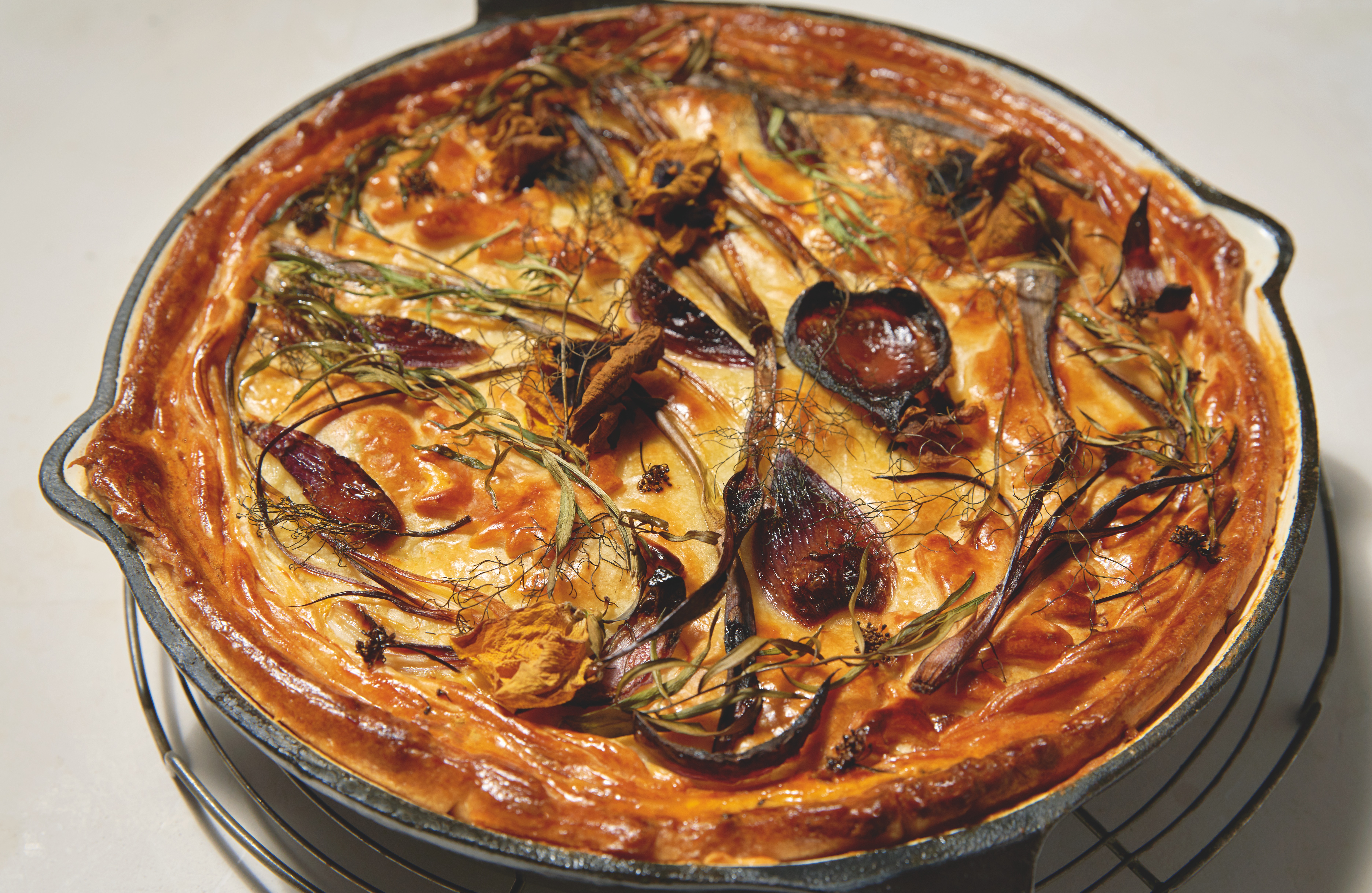
This recipe is a meal in itself, but can obviously be served alongside some mashed potato and gravy, if you like. The decoration on top is optional, but it is far easier than you think. Just scatter it on and you can’t go wrong.

Serves 5-6

Bechamel
500g whole milk
½ white onion, peeled and sliced
2 cloves
¼ teaspoon ground mace
pinch of cayenne pepper
1 teaspoon Dijon mustard
1 teaspoon fine sea salt
50g unsalted butter
25g plain flour

Pie filling
8 corn-fed chicken thighs
4 tablespoons garlic oil
2 carrots, peeled and quartered, then sliced across into 1cm pieces
25g salted butter
1 leek, quartered, then sliced across into 1cm pieces
1 celery stick, peeled, halved, then sliced across into 1cm pieces
100g shiitake mushrooms, halved
3 garlic cloves, crushed
200g canned sweetcorn, drained
100g frozen peas, defrosted
2 tablespoons chopped thyme leaves
2 tablespoons chopped tarragon leaves
finely grated zest of ½ lemon

Assemble
1 egg yolk
2 tablespoons milk or cream
2 sheets of frozen puff pastry, defrosted

To decorate (optional)
spring onions, shredded
red onions, cut into slim petals
fennel fronds
tarragon sprigs
pansies
——-
Bechamel
~ Bring the milk to the boil in a saucepan then add the onion, spices, mustard and salt, cover and leave to infuse for 20 minutes. Pass through a sieve.
~ Heat the butter in a large saucepan, stir in the flour and mix until smooth.
~ Add the hot infused milk a bit at a time and whisk to combine until smooth. Once all the milk has been added, bring to the boil, whisking continuously, then remove from the heat.

Pie filling
~ Preheat the oven to 180oC.
~ Season the chicken with salt and roll it in the garlic oil, then place on a roasting tray and cook for 40 minutes, skin side up, until the skin is crispy and the meat is tender.
~ Leave to rest for 20 minutes. Discard the bone and sinew and flake the meat, reserving any juices. You don’t need the skin here, but you can use it for an extra decoration of chicken crackling, if you like. (Or just eat it.)
~ Sweat the carrots in the butter in a saute pan for 5 minutes, lid on, then add the leek and celery, season lightly with salt, cover and cook for another 5 minutes. Add the mushrooms and garlic, cover and cook for a final 5 minutes.
~ Add the sweetcorn, peas, thyme and tarragon, then remove from the heat and mix in the chicken and bechamel with the lemon zest. Check the seasoning and leave to cool.

Assemble

~ Preheat the oven to 190 oC.
~ Mix the egg yolk and milk or cream in a small bowl to make an egg wash.
~ From the first sheet of pastry, cut out a circle using the top of an ovenproof frying  pan as a guide. This is the lid.
~ Cut a circle of greaseproof paper large enough to cover the base of the same ovenproof frying pan and come all the way up the sides. Use this as a guide to cut out a circle of pastry of the same size. This is the base. Place the circle of pastry in the pan, pushing it flat against the sides.
~ Fill with the cooled chicken pie mix, making sure it doesn’t cover the top of the pastry rim.
~ Top with the pastry lid, pinching the edges of both pastry circles together to crimp and join.
~ With some of the pastry trim, you may cut out some leaf shapes or make a simple lattice to garnish the pie.
~ Brush with egg wash and leave for 10 minutes, then brush again with egg wash and place in the oven.
~ Cook for 20 minutes, then reduce the oven temperature to 170 oC and cook for another 20 minutes.

To decorate
~ Scatter over the vegetables, herbs and flowers, if using, and return the pie to the oven for a final 5 minutes for the decorations to crisp up, then serve.

Cook more from this book
Grilled bream with pink grapefruit by Ollie Dabbous
Tartiflette by Ollie Dabbous

Read the review

Buy this book
Essential
£30, Bloomsbury Publishing

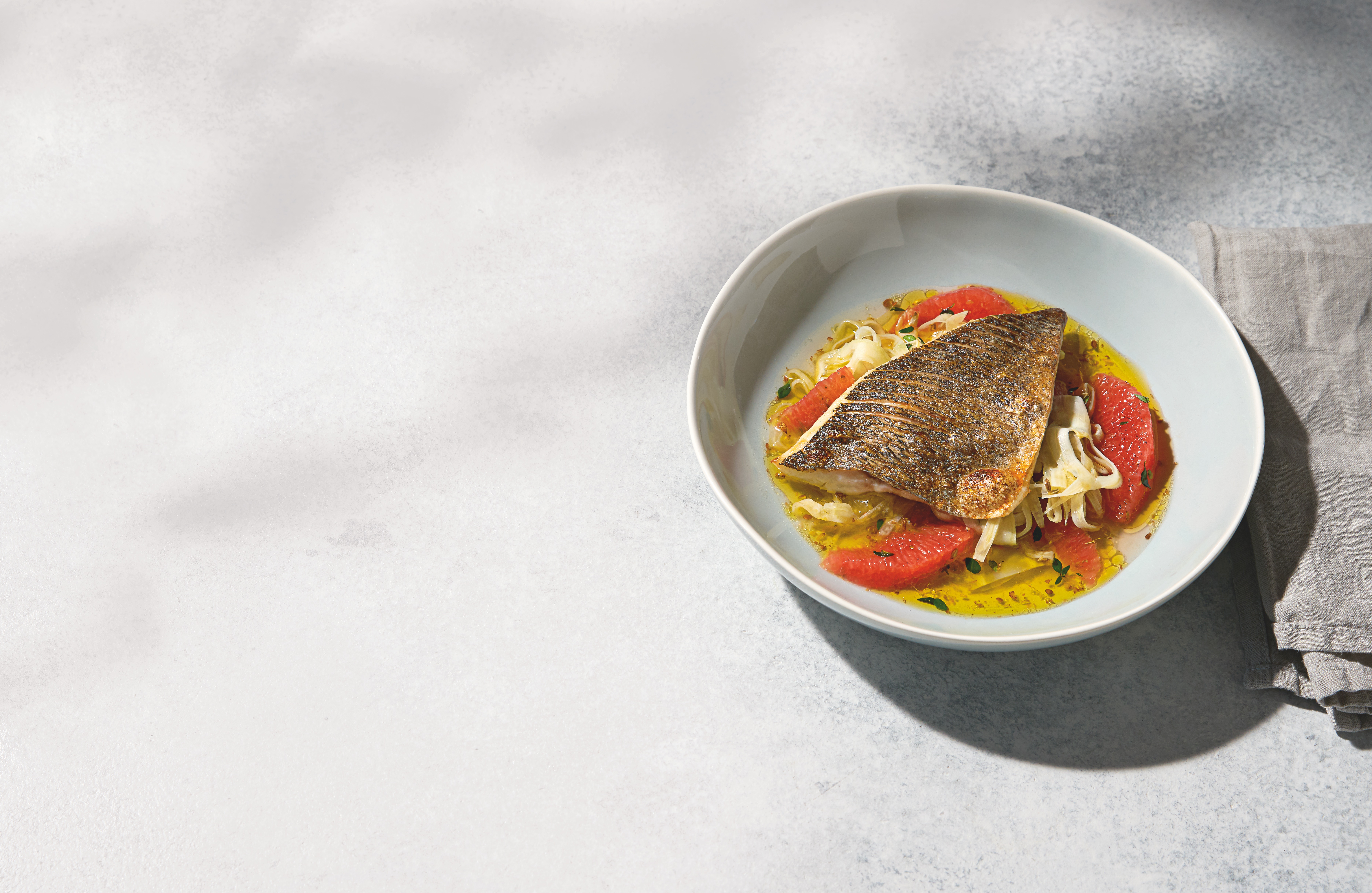
Grilled bream with pink grapefruit by Ollie Dabbous

ESSENTIAL_050820_BREAM_7543_AW

Gilthead bream is one of the best-quality farmed fish you can buy. It is always consistent in quality and very good value; not as meaty as sea bass, but with lovely oily flesh and crisp skin. It is great cooked over the barbecue or under a hot grill. This dressing is as delicious as it is simple. Feel free to chop and change as you wish: lemon and mint would work brilliantly, as would blood orange and sage.

Dressing
2 pink grapefruits, segmented with 6 tablespoons of their juice
6 tablespoons extra virgin olive oil
1 tablespoon Chardonnay vinegar
1 tablespoon clear honey
1 tablespoon thyme leaves
1 tablespoon coriander seeds, toasted and crushed

Bream & fennel
2 fennel bulbs
1 teaspoon fennel seeds
100ml white vermouth
2 gilthead bream, scaled, filleted and pin-boned by your fishmonger
4 tablespoons extra virgin olive oil
fine sea salt

DRESSING
– Mix everything together and warm through in a pan. Do not heat it too much, or the grapefruit segments will cook and collapse.

BREAM & FENNEL
~ Preheat the grill to its highest setting.
~ Slice the fennel lengthways as finely as possible on a mandolin or with a sharp knife, then mix in a roasting tray with the fennel seeds and vermouth. Season lightly with salt.
~ Lightly season the fish on both sides with fine salt, spoon 1 tablespoon of the oil over each fish fillet, then place skin-side up on top of the fennel, to cover the bulk of it.
~ Grill under the preheated grill for about 8 minutes, until the fennel has wilted but the fish is cooked through and has a crispy skin.

To serve
~ Divide the fennel and fish between 4 warmed bowls and spoon over the warm grapefruit dressing.

Cook more from this book
Chicken pie by Ollie Dabbous
Tartiflette by Ollie Dabbous

Read the review

Buy this book
Essential
£30, Bloomsbury Publishing

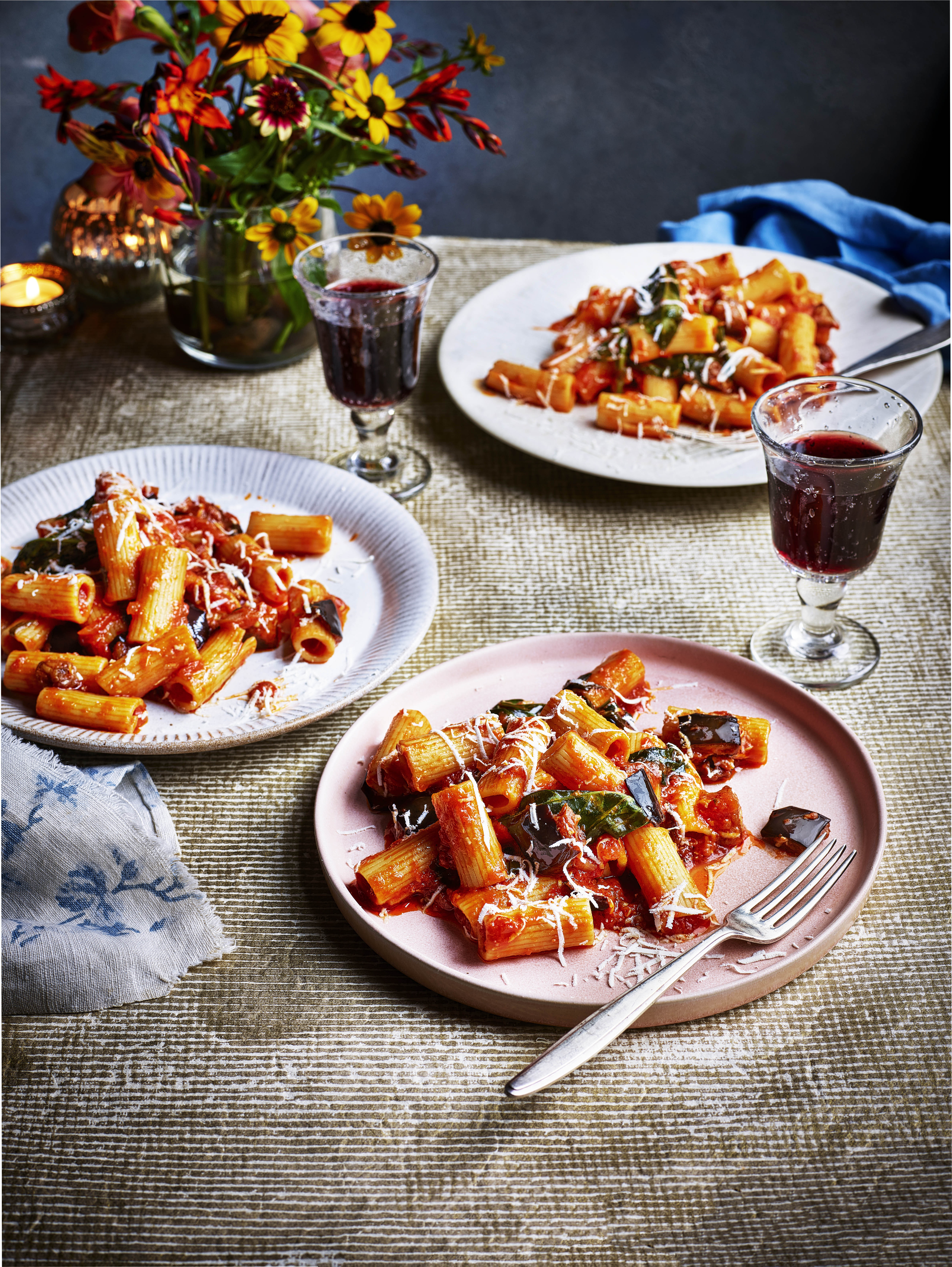
Pasta alla Norma by Ben Tish

1419_AbsolutePress_Ben_Tish_Sicilia_2020-09-14_Peter_Moffat
Pasta alla Norma has become the unofficial signature dish of Sicily. Originally created in the city of Catania around the same time as Vincenzo Bellini’s romantic opera ‘Norma’, it is said that the pasta was created as a homage to the composer and to the opera. Another story tells of a talented home cook who served her creation to a group of gourmands and was duly christened at the table via the classic Sicilian compliment of Chista e na vera Norma (‘this is a real Norma’). Whatever the truth, the dish became an instant classic and its fame spread around the world.

Serves 4

2 firm aubergines, trimmed and cut into 2cm dice
150ml extra virgin olive oil
½ onion, finely chopped
2 garlic cloves, finely chopped
a good handful of basil leaves
800g quality canned chopped tomatoes or passata
400g dried rigatoni
200g ricotta salata cheese, grated
sea salt

Put the diced aubergines in a colander in the sink and sprinkle with salt. Leave to drain for 30 minutes.

Preheat the oven to its highest temperature, around 250°C/230°C fan/Gas Mark 10.

Rinse the aubergine in cold water and pat dry with a kitchen towel, then toss in a bowl with half the oil. Spread out on a baking tray, place in the oven and cook for 15–20 minutes or until caramelised, turning occasionally to make sure the pieces don’t dry out.

Meanwhile, heat the remaining oil in a medium saucepan over a medium heat and add the onion and garlic. Sauté for a couple of minutes, then add half the basil and the tomatoes. Bring to a simmer. Turn down the heat and cook gently for 23–30 minutes or until thickened (the exact time will depend on your canned tomato brand).

When the sauce is almost ready, cook the pasta in plenty of boiling salted water according to the packet instructions to al dente. Add the aubergine to the sauce. Drain the pasta (reserving a little of the cooking water) and toss in the sauce. If the sauce seems too thick, add some cooking water to loosen.

Divide among the plates and sprinkle with the ricotta and remaining basil leaves, roughly torn over the top. It’s best to allow this to cool slightly before eating.

Cook more from this book
Aeolian-style Summer Salad by Ben Tish
Sicilian Lemon Cream by Ben Tish

Read the review
Coming soon

Buy the book
Sicilia: A love letter to the food of Sicily
£26, Bloomsbury Absolute

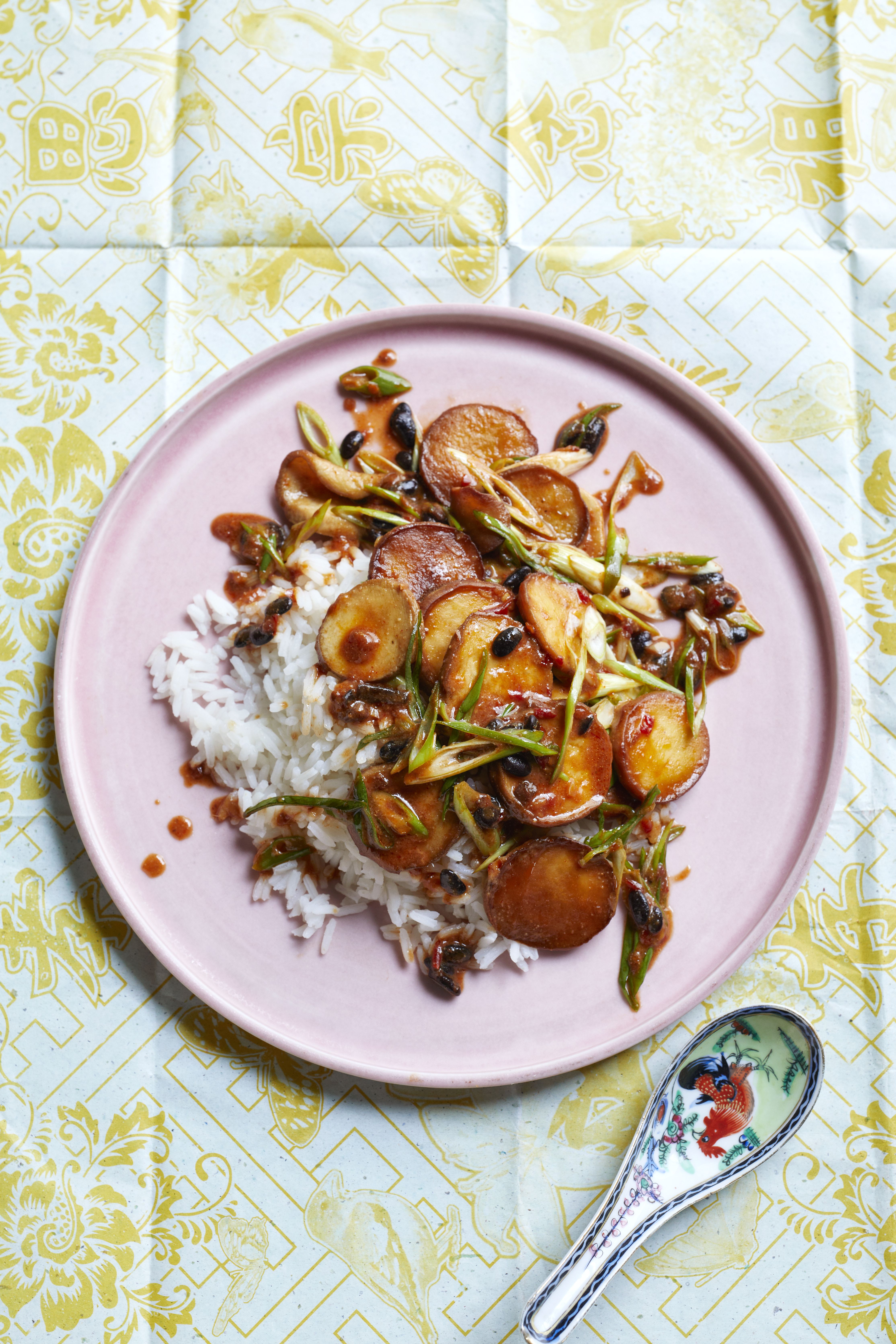
Spicy Sichuan King Trumpet Mushrooms by Ching-He Huang

20-02-17 - Crispy King Trumpet Mushrooms - 006
Serves 2

This is my vegan version of a famous Sichuan pork dish, Hui guo rou, where the meat is boiled in an aromatic stock, then sliced and fried until crisp, and finally stir-fried with chilli, fermented salted black beans and a host of Chinese seasonings. Instead of pork, I am using meaty king trumpet mushrooms. This dish is perfect served with jasmine rice.

kcal — 410
carbs — 80.3g
protein — 10.0g
fat — 7.6g

1 tbsp rapeseed oil
1 tbsp freshly grated root ginger
300g (10½oz) king trumpet mushrooms, sliced into 1cm (½in) rounds
1 tbsp Shaohsing rice wine or dry sherry
1 tbsp chilli bean paste
1 tbsp yellow bean paste
1 tbsp fermented salted black beans, rinsed and crushed
1 spring onion, trimmed and sliced on the angle into julienne strips (optional)
1 tsp dark soy sauce
1 tsp tamari or low-sodium light soy sauce
pinch of golden granulated or caster sugar
pinch of ground white pepper
cooked jasmine rice, to serve (see page 194)

Place a wok over a high heat until smoking, then add the rapeseed oil. Once hot, add the ginger and cook, tossing, for few seconds, then add the mushrooms. As they start to brown, add the rice wine or sherry, then stir in the chilli bean paste and the yellow bean paste, followed by the fermented salted black beans. Add the spring onions, if using, and stir-fry for less than a minute. Season with the dark soy sauce, tamari or light soy sauce, sugar and ground white pepper and give it all one final toss. Serve immediately with jasmine rice.

Cook more from this book
Smoked Tofu and Broccoli Korean- style Ram-don by Ching-He Huang
Chinese Sweetcorn Soup with Black Truffle by Ching-He Huang

Read the review  

Buy this book
Asian Green: Everyday plant-based recipes inspired by the East
£20, Kyle Books

Smoked Tofu and Broccoli Korean- style Ram-don by Ching-He Huang

Smoked Tofu & Broccoli Korean Ram-don - 029
Serves 4

kcal — 552
carbs — 57.9g
protein — 30.2g
fat — 21.9g

This is inspired by the beef ram-don in the Korean movie Parasite. I wanted to make a vegan version using chunky smoked tofu, mushrooms and long-stem broccoli. The result is a more-ish, umami-rich, addictively spicy noodle dish. To make the dish speedier, I place the aromatics (garlic, ginger, shallots and chilli) in a food processor and then just add them to the wok.

200g (7oz) dried ramen or udon noodles
1 tbsp toasted sesame oil
2 garlic cloves
2.5cm (1in) piece of fresh root ginger, peeled
3 shallots
2 red chillies, deseeded
1 tbsp cornflour
1 tbsp rapeseed oil
200g (7oz) smoked tofu, drained, rinsed in cold water and sliced into 2cm (¾in) cubes
400g (14oz) firm tofu, drained and sliced into 2cm (¾in) cubes
200g (7oz) fresh shiitake mushrooms
1 tbsp Shaohsing rice wine
2 tbsp dark soy sauce
150g (5½oz) long-stem broccoli, florets sliced lengthwise and stalks sliced into 0.5cm (¼in) rounds
2 tbsp vegetarian mushroom sauce
1 tbsp clear rice vinegar
1 tbsp tamari or low-sodium light soy sauce
2 spring onions, trimmed and finely sliced on the angle into 1cm (½in) slices

Noodle seasoning (per bowl)
1 tsp dark soy sauce and Chiu Chow chilli oil
1 tbsp each tahini and sweet chilli sauce
sprinkle of shichimi togarashi pepper flakes

Cook the noodles according to the packet instructions. Rinse under cold water and drain well, then drizzle over the toasted sesame oil to prevent them from sticking together. Set aside in the colander until needed.

Place the garlic, ginger, shallots and red chillies in a small food processor and blitz to form a paste. Mix the cornflour with 2 tbsp water in a small bowl or cup to make a slurry. Set aside until needed. Heat a wok over a high heat until smoking and add the rapeseed oil. Once hot, add the aromatic paste and cook, stirring, for a few seconds until fragrant. Add both kinds of tofu and the mushrooms. Season with the rice wine and dark soy sauce and toss together well for 1–2 minutes until all the ingredients are coated.

Add the broccoli and cook, tossing, for 1 minute. Stir in the mushroom sauce, rice vinegar and tamari or light soy sauce. Pour in the cornflour slurry to thicken the cooking juices in the wok, and toss to mix well.

Pour some boiling water over the noodles in the colander to reheat them, then divide them between four bowls.

Place a ladleful of the tofu, mushroom and broccoli mixture on one side of the noodles in each bowl, and top with the sliced spring onion. Dress the noodles by drizzling over the dark soy sauce, Chiu Chow chilli oil, tahini and sweet chilli sauce, followed by a generous sprinkle of shichimi togarashi pepper flakes. Serve immediately.

Cook more from this book
Chinese Sweetcorn Soup with Black Truffle by Ching-He Huang
Spicy Sichuan King Trumpet Mushrooms by Ching-He Huang

Read the review 

Buy this book
Asian Green: Everyday plant-based recipes inspired by the East
£20, Kyle Books

Slow-roasted shoulder of lamb, harissa by Raymond Blanc

SIMPLY RAYMOND by Raymond Blanc. Headline Home 2021
PREP 10 MINS / COOK ABOUT 4½ HOURS / MARINATE 1 HOUR (BUT NOT ESSENTIAL)

When I was about 12 years old, I was introduced to the food of Algeria, and by strange means. This was during the Algerian War, and in France there were camps for Algerian refugees. One such camp was close to my village and, with my friend René, I would go and visit these intriguing, kind and friendly people. They fed us well. I remember seeing whole lambs roasted on the spit and, as the meat was turned, it was also painted with the spicy juices. For my young palate, it was perhaps a bit too spicy. I was the stranger who was drawn in, and have never forgotten their kindness. This dish does not require a whole lamb. When it comes to slow cooking lamb, the shoulder is the best cut, meltingly tender and incredibly tasty. When harissa is added, this is a wonderful dish, and the chickpeas will only complement it. A shoulder of lamb varies in weight, becoming heavier as the year progresses. A 2.5kg shoulder, like the one in this recipe, will take about 4½ hours; one weighing 3kg will need 5½ hours. Aim to remove it from the fridge 4–5 hours before cooking to come to room temperature.

1 tablespoon sea salt
1 tablespoon ground cumin
100g rose harissa
100ml extra-virgin olive oil
2.5kg new season’s
shoulder of lamb
300ml water

For the chickpea salad
1 jar (230g) piquillo peppers
2 preserved beldi lemons
a large handful of curly or flat-leaf parsley
2 tins (400g) chickpeas
sea salt and black pepper

TO PREPARE Mix together the salt, cumin and harissa, and then add the extra-virgin olive oil. Place the lamb in a roasting tin. Lightly score the skin of the lamb and rub it all over with the salty harissa mixture. At this point, you can leave the lamb for an hour, allowing the harissa flavours to infuse, but this is not essential.

Preheat the oven to 180°C/160°C fan/gas 4. Roast the lamb for 20 minutes, and then reduce the temperature to 150°C/130°C fan/gas 2. Cover the lamb shoulder loosely with foil, and return it to the oven to roast for a further 2 hours. Now baste the lamb, add the water and return it to the oven for 2 hours, again loosely covered with foil.
While the lamb is roasting, chop the piquillo peppers, finely chop the preserved lemons (skin and pulp) and coarsely chop the parsley. Put them to one side; you will need them to finish the dish.

Remove the lamb from the oven. Spoon out most of the fat from the tin, leaving the roasting juices. To the warm roasting juices, add the chickpeas, peppers and lemon. Add the parsley too and season with the salt and pepper. Toss together and bring to the boil on the hob. Place the lamb shoulder on a platter with the chickpea salad. Bring the lamb to the table and invite your guests to help themselves. The lamb will be tender enough to fall from the bone with a spoon, though it can be carved if you prefer.

Cook from this book 
Mussel and saffron risotto by Raymond Blanc
Pear almondine by Raymond Blanc

Read the review

Buy this book
Simply Raymond: Recipes from Home – The Sunday Times Bestseller, includes recipes from the ITV series
£25 Headline Home

Mussel and saffron risotto by Raymond Blanc

SIMPLY RAYMOND by Raymond Blanc. Headline Home 2021
PREP 20 MINS / COOK 40 MINS

Mussels and saffron are united harmoniously in this classic risotto. There’s no need for that constant stirring. Instead, the rice is stirred towards the end of the cooking time to activate the starches, a trick you can use with any risotto you make.

SERVES 4

For the mussels
1kg fresh mussels
1 onion
2 bay leaves
2 thyme sprigs
1 tablespoon unsalted butter
100ml dry white wine

For the risotto
1 garlic clove
1 tablespoon unsalted butter
200g carnaroli rice (or arborio)
2 bay leaves
a couple of pinches of saffron powder or strands
pinch of cayenne pepper
2 pinches of sea salt flakes
100ml dry white wine
300ml water (or fish stock)

To finish
50g Parmigiano Reggiano cheese
2 teaspoons unsalted butter, at room temperature
a handful of coarsely chopped flat-leaf parsley
100g cooked peas (optional)
a handful of baby-leaf spinach (optional)
½ lemon, for squeezing

TO PREPARE First, the mussels. Ensure that all the mussels are tightly closed and not damaged before you begin to cook; any mussels that are damaged or open should be discarded. The preparation can be done in advance. Wash the mussels in a large bowl and under cold running water. Mussels that float at this stage are not very fresh, so discard them. Remove any barnacles and beards, but don’t scrub the shells as this can end up colouring the cooking juices. Drain.

Finely chop the onion and peeled garlic and grate the cheese. In a large saucepan over a medium heat, sweat half the onion, the bay leaves and thyme in the butter for 1 minute. Increase the heat to high, add the mussels, pour in the wine, cover with a lid and cook for 3 minutes. Drain in a sieve over a large bowl and discard any mussels that have not opened. Reserve the cooking juices, you will need about 200ml to make the risotto. Once the mussels have cooled, pick the mussels from their shells, leaving a few in their shells for decoration, and put them all aside.

Now, to the risotto … Melt the butter in a large saucepan on a medium heat. Add the remaining onion, cover with a lid and cook for 2–3 minutes, until the onion is translucent. Add the garlic and stir in the rice. Add the bay leaves, saffron and cayenne pepper and lightly season with salt. Stir and continue to cook on a medium heat for 2 minutes, until the grains of rice are shiny. Pour in the wine and let it boil for 30 seconds – bubble, bubble – and stir. Pour in the mussel cooking liquor and the water or fish stock and stir again. Now cook on the gentlest simmer, with just a single bubble breaking the surface. Cover with a lid and leave for 20 minutes, but it mustn’t boil. 4

Now it’s time for 5 minutes of some serious and fast stirring. At full speed, stir the risotto. The grains rub against each other, extracting the starch, and this gives the rice its creaminess. Yet every grain remains whole, unbroken. Taste – the rice should have a slight bite. Add the cheese, butter and parsley to the risotto, along with the cooked peas and spinach, if using, all the cooked mussels and a strong squeeze of lemon. Stir, taste and correct the seasoning just before serving. 

Cook more from this book
Slow-roasted shoulder of lamb, harissa by Raymond Blanc
Pear almondine by Raymond Blanc

Read the review

Buy this book
Simply Raymond: Recipes from Home – The Sunday Times Bestseller, includes recipes from the ITV series
£25 Headline Home

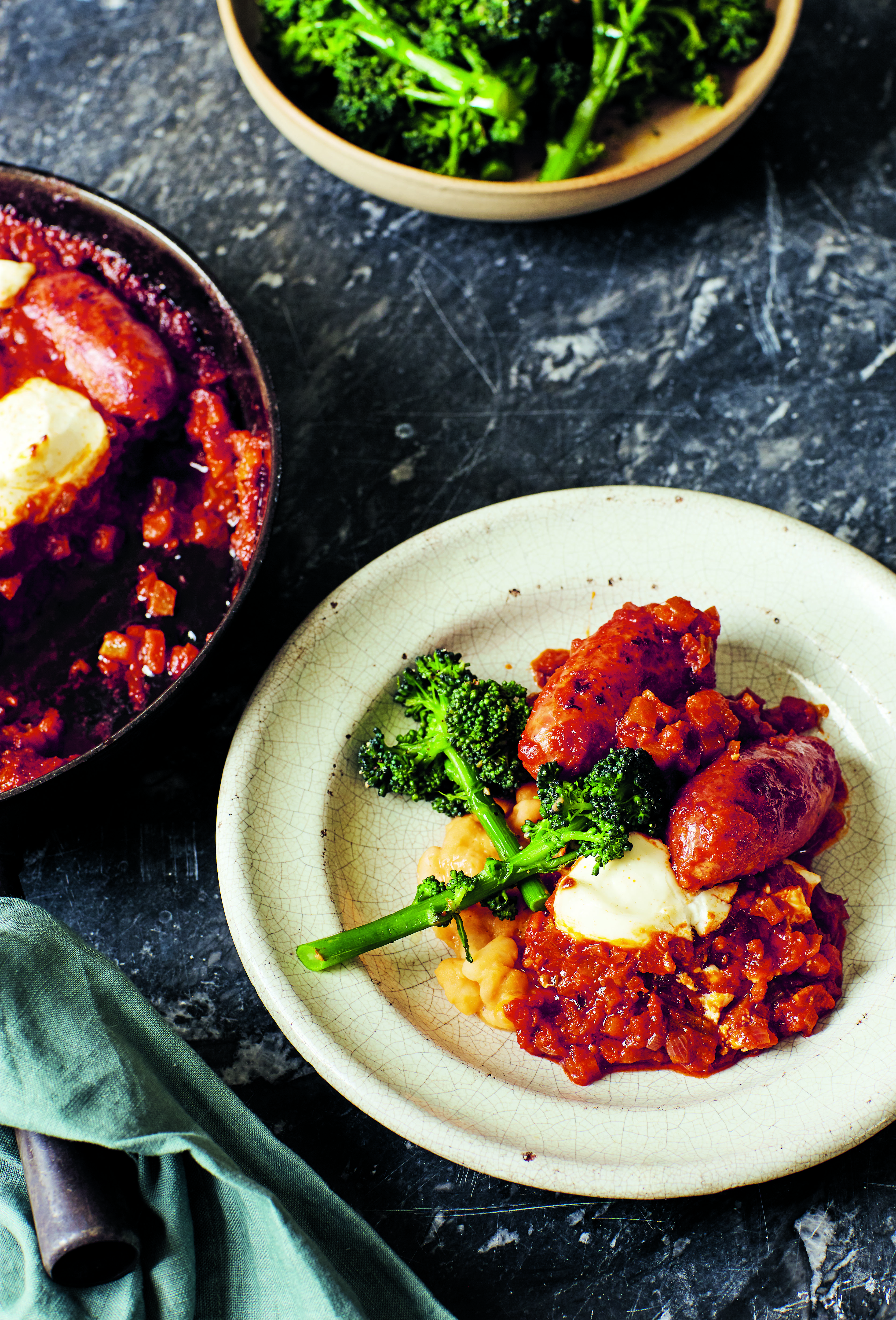
Roasted Italian sausages with borlotti beans and ’nduja sauce by Theo Randall

20200313_TheoRandall_W1_BorlottiBeansSausages_035
Dried borlotti beans from the protected area of Lamon, in the Veneto, are the finest dried borlottis available. You don’t have to use these specifically, of course, but if you are lucky enough to come across a packet, you are in for a treat. Combined with lovely, flavoursome sausage and the spiciness of ’nduja, they are heavenly. Make sure you have a good bottle of Chianti, or other super-Tuscan red wine to drink alongside – it’s essential.

Serves 2
250g (9oz) dried borlotti beans, soaked overnight in plenty of cold water
2 garlic cloves, 1 whole, 1 finely sliced
1 plum tomato
2–3 sage leaves
3 tbsp olive oil
4 Italian sausages
2 celery sticks, finely chopped
1 red onion, finely chopped
2 carrots, peeled and finely chopped
100ml (3½fl oz) red wine
400g (14oz) tomato passata
75g (2½oz) skinned ’nduja
2 tbsp mascarpone
sea salt and freshly ground black pepper
200g (7oz) purple-sprouting, calabrese or longstem broccoli, cooked and seasoned with olive oil and sea salt and freshly ground black pepper, to serve

Drain the soaked beans and rinse under cold, running water for a couple of minutes. Place the rinsed beans in a large saucepan and pour in cold water so that the water comes 10cm (4in) above the level of the beans. Add the whole clove of garlic, along with the plum tomato and sage leaves. Place over a high heat and bring to the boil. Reduce the heat to a simmer and cook gently for 40 minutes, skimming off the foam from time to time, until the beans are soft enough to crush to a mash with your thumb.

Drain the beans, reserving the cooking water. Remove the tomato, sage and garlic and place them in a bowl. Using a hand-held stick blender and a little of the bean cooking water, blend to a smooth paste. Add the paste back to the beans and check the seasoning. Set aside.

Preheat the oven to 160°C/140°C fan/315°F/Gas Mark 2–3.

Heat 2 tablespoons of the olive oil in an ovenproof frying pan on a medium heat. When hot, add the sausages and cook for 5 minutes, turning frequently, until brown all over. Remove them from the pan
and set aside, leaving the sausage fat and olive oil in the pan.

Add the celery, sliced garlic, onion and carrots to the pan and cook gently for 5 minutes, until the onion has softened. Add the red wine and cook for a further 2 minutes until the liquid has reduced by half. Add the passata, cook gently for a couple of minutes, then add the ’nduja and stir well. Place the sausages on top of the passata mixture and bake in the oven for 15 minutes, until the sausages are cooked through. Remove from the oven, dollop over the mascarpone and check the seasoning.

Warm the cooked borlotti beans and stir through the remaining olive oil. Place on the table for everyone to help themselves, with some steaming hot purple sprouting broccoli served alongside.

Cook more from this book
Twice-baked squash and fontina soufflé by Theo Randall
Chocolate, espresso and vin santo pots with cantuccini biscuits by Theo Randall

Read the review

Buy this book
The Italian Deli Cookbook: 100 Glorious Recipes Celebrating the Best of Italian Ingredients
£26, Quadrille Publishing

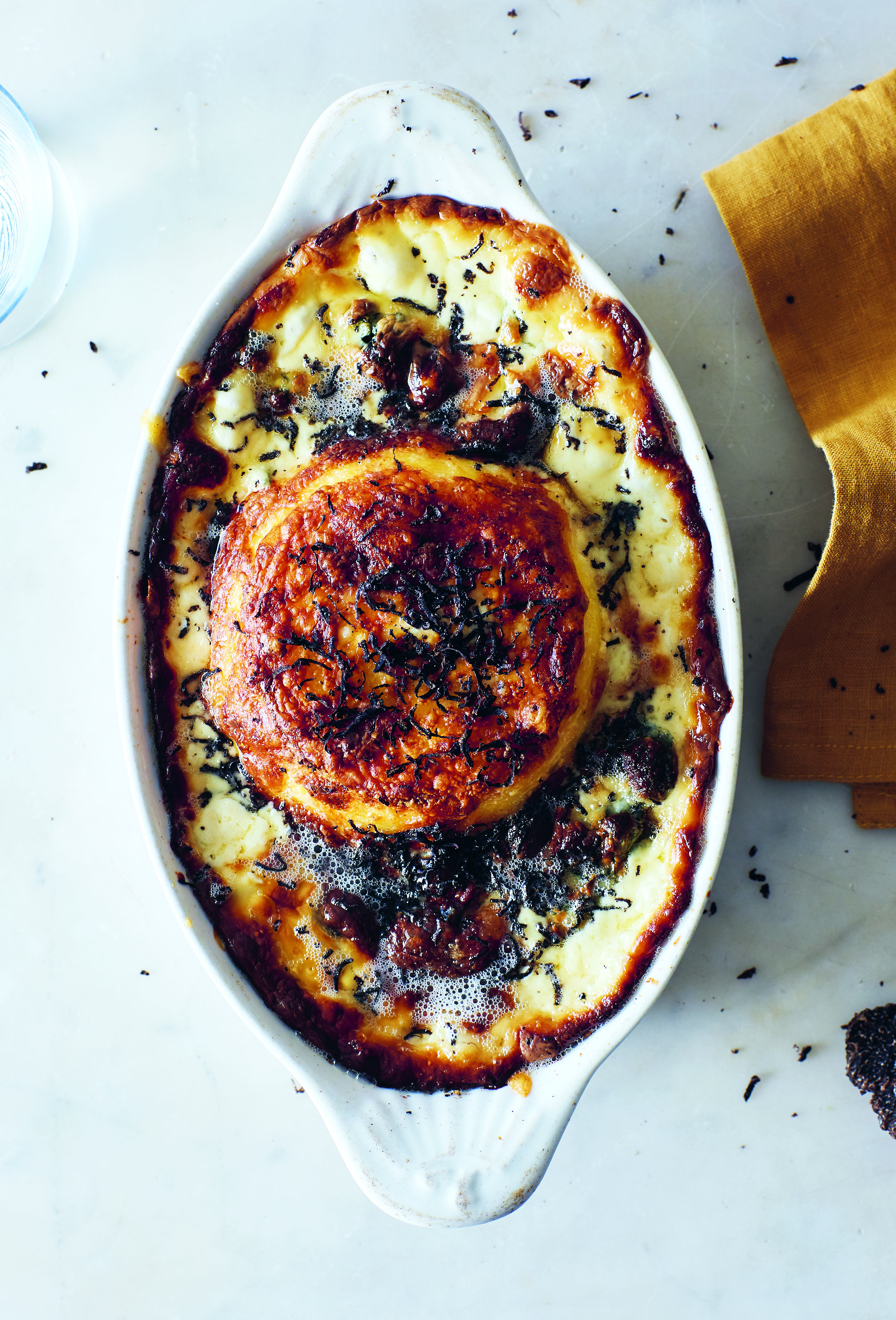
Twice-baked squash and fontina soufflé by Theo Randall

20200312_TheoRandall_W1_Souffle_033
Known in Italy as sformato di zucca, this dish was one of the first I mastered, more than 30 years ago, when I was an apprentice at Chez Max in Surbiton, just outside London, where the chef-owner Max Magarian became a huge influence on my approach to cooking. I must have made thousands of these delicious soufflés (the only difference in this one is the cheese choice) and I can still remember how excited I was when Max told me I had made them perfectly.  If you’re lucky to get hold of a black winter truffle, it will bring out the best in the soufflé. You will need ten moulds and ten gratin dishes to make this (just reduce the quantities if making fewer).

Makes 10
500g (1lb 2oz) butternut squash, peeled, deseeded and cut into 2cm (¾in) cubes
olive oil, for roasting
300g (10½oz) fresh spinach
90g (3¼oz) unsalted butter, plus extra for greasing
90g (3¼oz) plain (all-purpose) flour, plus extra for flouring
1 litre (35fl oz) whole milk, hot
300g (10½oz) fontina, grated
10 organic egg yolks
12 organic egg whites
sea salt and freshly ground black pepper

To finish
200g (7oz) fontina, grated
100g (3½oz) Parmesan, finely grated
500ml (17fl oz) double (heavy) cream
shavings of black truffle (optional), to serve

Preheat the oven to 180°C/160°C fan/350°F/Gas Mark 4. Butter and flour ten 180ml (6½fl oz) metal or ceramic moulds. Place the squash in a roasting tin, season with salt and pepper and drizzle with olive oil. Cover the tin with foil and bake for 40 minutes, or until soft. Remove the foil and continue baking for a further 15 minutes, so the squash dries out. Remove from the oven and leave to cool, then put through a mouli (or use a potato masher) until you have a fine purée. Set aside.

Meanwhile, bring a pan of salted water to the boil. Boil the spinach for 2 minutes, until the stalks are tender. Drain in a colander and push out any residual liquid with the back of a spoon. When the spinach has cooled, squeeze it with your hands until just damp. Set aside.

Melt the butter in a large pan over a medium heat. Add the flour and cook for 2 minutes, then add the hot milk. Stir with a whisk until there are no lumps and you have a smooth white sauce. Add the squash purée, along with the fontina and season with salt and pepper. Take off the heat and stir in the egg yolks.

Preheat the oven again to 180°C/160°C fan/350°F/Gas Mark 4. Transfer the mixture to a clean, large bowl. Whisk the egg whites until stiff peaks form, then gently fold them into the butternut squash mixture. Pour the mixture equally into the prepared moulds, filling all the way to the tops. Place the moulds into a roasting tin, then pour boiling water into the tin so that it comes half way up the sides of the moulds. Bake in the oven for 20 minutes, until the soufflé rises and goes a light golden colour. Remove the tin from the oven (but leave the oven on), then remove the moulds from the tin and leave to cool.

To finish, grease 10 small gratin dishes. Divide the cooked spinach between each dish in an even layer. Remove the soufflés from the moulds and place one in each dish on top of the spinach. Sprinkle over the grated fontina and Parmesan then gently pour some cream over each soufflé. Season each dish with salt and pepper and bake them all for 10 minutes, until puffed up and golden brown. Finish with shavings of fresh black truffle.

Cook more from this book
Roasted Italian sausages with borlotti beans and ’nduja sauce by Theo Randall
Chocolate, espresso and vin santo pots with cantuccini biscuits by Theo Randall

Read the review 

Buy this book
The Italian Deli Cookbook: 100 Glorious Recipes Celebrating the Best of Italian Ingredients
£26, Quadrille Publishing