
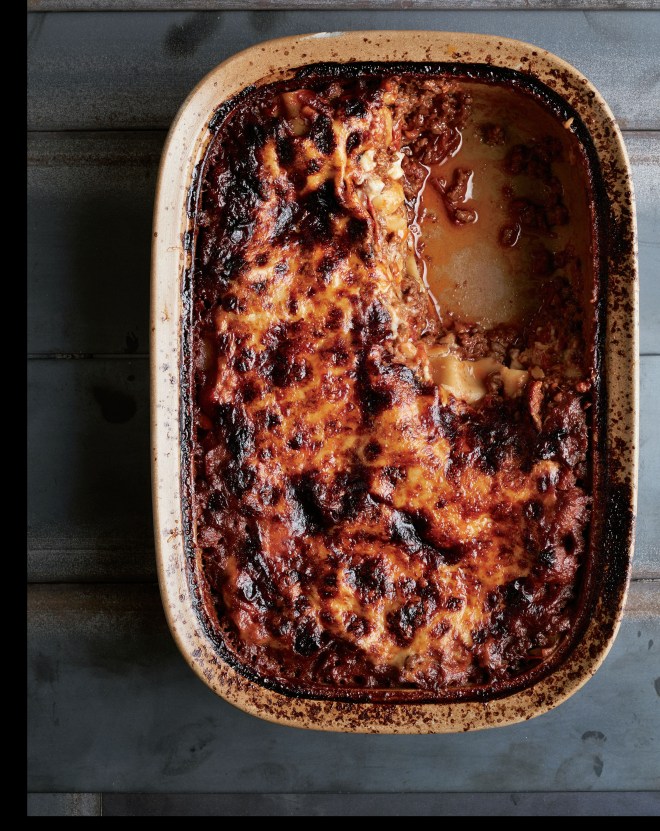
When it was our oldest daughter’s turn to have her school playgroup over for dinner, I asked her what she wanted me to make and she requested lasagne. I’ve never been a huge fan of lasagne, which is usually a bit bland and stuffed with too much melted cheese for my taste, so I challenged myself to create a version that was full of flavour and a bit surprising. I added a lot of garlic and little balls of sausage in addition to the minced beef, and layered it with a lightly cheesy béchamel sauce, and it really took it to the next level for me. This requires a bit of work, but it serves a big crowd.
Serves 9-12
MEAT SAUCE
Extra-virgin olive oil 90 ml (3 fl oz)
Onions 2
Garlic cloves 8
Minced beef 800 g (1. lb)
Whole peeled tomatoes in juice 3 400g (14 oz) tins
Fine sea salt
Freshly ground black pepper
BECHAMEL
Salted butter 110 g (4 oz)
Plain flour 70 g (2. oz)
Whole milk 950 ml (1. pints)
Fine sea salt
Sweet Italian pork sausage 450 g (1 lb)
Pre-cooked pasta sheets 450 g (1 lb)
Parmigiano-Reggiano cheese 225 g (8 oz), freshly grated
1. Make the meat sauce: Heat 2 tablespoons of the oil in a large casserole dish over medium-high heat. Chop the onions, adding them to the pan as you go. Do not stir until the onions are beginning to brown, about 2 minutes. Cook, stirring occasionally, until they turn a deep golden brown, about 3 minutes more. Crush the garlic cloves with the flat side of your knife and discard the papery skins. Coarsely chop the garlic and stir it into the pan.
2. Push the onion mixture to one side of the pan and add 2 more tablespoons of the oil. Crumble the minced beef into the pan, avoiding the onions. Let the meat cook for 2 minutes to lightly brown on the bottom. Using a wooden spatula, break up the meat and stir it into the onions. Cook, stirring occasionally, until the meat is browned, about 8 minutes. Add the tomatoes with their juices and stir to combine, crushing the tomatoes with the spatula.
3. Bring the sauce to a boil, then reduce the heat to medium-low and simmer until it has thickened slightly, about 40 minutes, stirring occasionally. Stir in the remaining oil. Season to taste. Stirring in a bit of extra oil will help emulsify the sauce and give it more body.
4. Preheat the oven to 180°C (160°C Fan).
5. Make the béchamel: Melt the butter in a large saucepan over medium-low heat. Gradually whisk in the flour to make a thick, paste-like roux. Let it bubble for about a minute but don’t let it brown. Raise the heat to medium. Gradually whisk in the milk. Simmer over medium-low heat, whisking often and making sure the bottom doesn’t scorch, until it is lightly thickened and smooth, about 10 minutes. Remove from the heat and season with salt.
6. Place a large frying pan over medium-high heat. Squeeze the sausage meat out of the casings, forming it into small balls. Add them to the pan and cook until they are lightly browned and their fat has rendered. Use a slotted spoon to transfer the sausage balls to the sauce and combine gently.
7. Spread about 240 ml (8½ fl oz) of the meat sauce in a 23 x 33-cm (9 x 13-inch) baking dish. Top with a layer of lasagne sheets. Cover with about a quarter of the remaining meat sauce, a quarter of the béchamel, and sprinke with 60 g (2 oz) of the Parmigiano. Repeat to make 3 more layers. (You may have lasagne sheets left over.) Sprinkle with the remaining Parmigiano.
8. Bake the lasagne until it is bubbling and browned, about 50 minutes. Remove from the oven and let stand for at least 20 minutes before serving. Don’t cut into the lasagne too soon or it will fall apart when you serve it. Even 20 minutes isn’t too long a resting period, and it will still be hot.
Extracted from Downtime by Nadine Levy Redzepi
(Ebury Press, £27)
Photography by Ditte Isager
Cook more from this book
Roasted ratatouille with orzo
Danish apple dessert
Buy this book
Downtime: Deliciousness at Home
£26 Ebury

 by Ruth Rogers, Sian Wyn Owen, Joseph Trivelli and Rose Gray

 cookbookreview.blog