Wild Duck with Hokkaido Squash and Arabica by Bo Bech

Wild Duck Pumpkin

For 4 people

Ingredients:
2 wild ducks
Hay
1 Hokkaido squash
1 lemon
1 orange
1 tablespoon Acacia honey
200 grams salted butter
100 grams espresso
2 tablespoons maple syrup
1 tablespoon coriander seeds

Method:
Remove the legs from the wild ducks (reserve these for another use), leaving as much skin on the breasts as possible. Remove the wishbone and innards.

Place hay in the bottom of a large high-sided pot and rest the wild ducks on the hay. Set the hay afire, so it burns the wild ducks. Let the hay almost finish burning, then cover the pot with a lid to suffocate the flames. Let the wild ducks smoke for 10 minutes, then keep chilled until use. The wild ducks may be smoked a couple of days prior to use.

Bake the Hokkaido squash in the oven at 200 degrees Celsius for an hour, then let rest for about 30 minutes.
Slice open the squash, remove the seeds and scrape out the flesh. Squeeze the lemon and orange and strain the juice. Blend the Hokkaido squash to a smooth pure, adding orange and lemon juice to taste. Sweeten with Acacia honey, if needed (we never add salt).

Brown the salted butter until foamy. Add espresso and maple syrup and keep the sauce warm.

Grill the skin of the wild ducks on all sides. Roast the wild ducks in the oven at 200 degrees Celsius for 8-10 minutes, depending on their size, and let rest for five minutes.

Slice off the breasts and lay them skin-side down on the grill for a few seconds, then slice thinly and season with salt and toasted crushed coriander seeds.

Fan out slices of wild duck on a plate. Place a spoonful of Hokkaido squash puree on the side and pour the brown butter-maple syrup-espresso sauce over the duck.

Cook more from this book
Baked white onion with tamari
Turbot with fennel ravioli

Read the review 

Buy this book
In My Blood

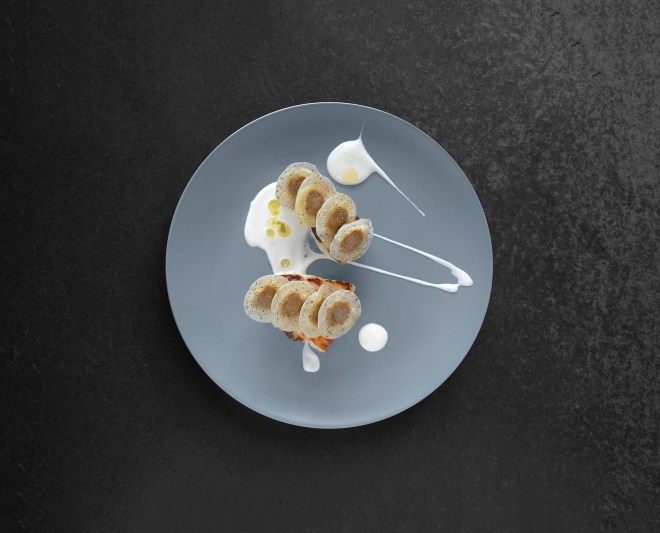
Turbot with Fennel Ravioli on Gruyere by Bo Bech

Turbot Gruyere Fennel.jpg

For 4 people

Ingredients:
1 turbot, 3 kilo
4 fennel bulbs
3 whole star anise
1 lemongrass stalk
2 tablespoons grapeseed oil
200 grams Gruyere cheese
200 grams salted butter
4 tablespoons yogurt Black pepper

Method:
Rinse and dry the fennel bulbs. Slice thinly on a mandoline and transfer to a pot, adding the grapeseed oil. Bruise the lemongrass stalk with the back side of knife, then transfer to a tea bag along with star anise. Add the tea bag to the pot. Place a piece of wet parchment paper over the fennel and roast at medium heat until tender and caramelised. It may stick a bit to the bottom of the pot.

Remove the pot from the heat and let stand for a few minutes. Stir the pot well so that the caramelised bits in the bottom dissolve. Return the pot to the heat. Let the fennel become tender and golden, then remove the tea bag. Blend the fennel smooth and add salt to taste. The consistency must be very thick. Transfer the puree to a piping bag.

Slice Gruyere cheese as thinly as possible, using a deli meat slicer if possible. Cut out circles of the cheese using a cutting ring about four centimetres in diameter. There should be 16 circles per dish. Place half the slices on a parchment-lined baking pan. Pipe a dot of fennel puree on the middle of each circle of Gruyere cheese and carefully place another circle on top, so that it floats on top of the puree.

Bake the raviolis at 90 degrees Celsius, until the top slice of cheese has melted over the fennel puree and touches the bottom slice. Remove the raviolis from the oven and let them cool slightly, then turn them over and season with black pepper. Blend the remaining cheese with 100 grams of melted butter and strain. Pour off the water from the cheese fat when cooled.

Melt the remaining 100 grams of salted butter slowly without boiling. Pour into a transparent bowl, so the clarified butter can be seen clearly on top and the whey rests on the bottom. Let stand for a few minutes while it separates completely. Use a strainer to separate the clarified butter.

Fillet the turbot from the bone, remove the skin and divide the fish into eight pieces of equal size. Cook the turbot in clarified butter on a hot pan. Cook the prettiest side first, so that it will face upward when serving.

Swirl a spoonful of yogurt onto a plate and add a few drops of cheese fat. Place two pieces of turbot on the plate and arrange four raviolis on each piece of turbot.

Cook more from this book
Wild duck with Hokkaido Squash
Baked white onion with tamari

Read the review

Buy this book
In My Blood

Baked white onion with tamari, ginger, lime and sesame by Bo Bech

White onion.jpg

For 4 people

Ingredients:
4-6 large white onions
1 lemon
4 tablespoons sesame seeds Sichuan pepper
50 grams ginger juice
50 grams lime juice
50 grams tamari
50 grams acacia honey
50 grams toasted sesame oil

Method:
Whisk together ginger juice, lime juice, tamari and acacia honey. Add toasted sesame oil to taste.

Bake the whole onions at 200 degrees Celsius for about 30 minutes until tender (the baking time will depend on the size of the onions). Slice off the bottom of the onions and split each in half lengthwise. Divide each onion half into wedges and sprinkle with grated lemon peel, salt, Sichuan peppercorns, salt and sesame seeds.

Arrange the onion wedges on a plate and pour sauce into each wedge. The dish can be eaten as finger food.

Cook more from this book
Turbot with fennel ravioli on Gruyere
Wild duck with Hokkaido Squash

Read the review

Buy this book
In My Blood by Bo Bech
 

Quince tart with gingerbread ice cream by Simon Rogan

Quince Tart

MAKES 8

Gingerbread
80g unsalted butter
50g molasses
400g plain flour
250g caster sugar
1 tsp baking powder
a pinch of salt
zest of 1 lemon
50ml whole milk
80g preserved stem ginger (from a jar)
½ tsp ground cinnamon
1 tsp ground ginger
50g fresh ginger
2 eggs

Gingerbread ice cream
500ml whole milk
2 egg yolks
25g caster sugar
½ tsp salt
125g gingerbread, from recipe above, roughly broken into chunks
Pastry
270g plain flour, plus extra for dusting
150g unsalted butter, softened
75g soft light brown sugar
1 tsp salt
1 egg

Poached quince
1 quince
350ml red wine
250g caster sugar
50g unsalted butter

Preheat the oven to 195°C/175°C Fan/Gas Mark 5, grease a 900g (2lb) loaf tin and line it with baking parchment.

To make the gingerbread, melt the butter and the molasses in a heavy-based saucepan over a medium heat. Once melted, remove from the heat and leave to one side. Mix the flour, caster sugar, baking powder, salt and lemon zest together in a large bowl. Blitz the milk, stem ginger, cinnamon, ground ginger and fresh ginger in a small food processor until smooth, then pass through a fine sieve. Beat the eggs in a bowl and mix with the ginger milk, then add the molasses mix. Whisk the wet ingredients into the dry ingredients little by little, until fully incorporated.

Transfer the mixture to the prepared tin and bake for 50 minutes. Once cooked (a skewer inserted into the middle of the cake should come out clean), remove from the oven and leave to cool. Remove from the tin and cut into suitable size 125g pieces, wrap each piece in cling film and freeze.

To make the ice cream, bring the milk to the boil in a heavy-based saucepan over a medium heat. Combine the egg yolks, sugar and salt in a heatproof bowl. Gradually pour the hot milk into the yolk and sugar mixture, whisking constantly to prevent the eggs from scrambling. Return to the pan and cook over a low heat until the temperature of the mixture reaches 80°C (check with a thermometer), stirring constantly. Remove from the heat and add the fresh or defrosted from frozen gingerbread, then allow to cool. Blitz in a blender until smooth then churn in an ice-cream maker until frozen. Transfer the ice cream to a piping bag fitted with a star nozzle and keep in the freezer.

While the ice cream is churning, make the tart bases. Mix the flour and the butter together by hand in a bowl until the mixture resembles breadcrumbs, then add the sugar, salt and egg and keep mixing until you have a smooth dough. Wrap the dough in cling film and put it in the fridge to rest for 1 hour. Once rested, dust a work surface with flour, unwrap the dough and roll it out to a thickness of 3mm.

Cut to size with a cutter or upside-down small bowl to fit eight 4cm small tart tins. Line the tins with the pastry, pushing the pastry all the way down the sides, lightly prick the base of the tartlets and line them with greaseproof paper and a few baking beans. Bake blind for 8 minutes. Remove from the oven and allow to cool in the tins, then transfer to a wire rack to cool completely. Store in an airtight container.

Peel and cut the core away from the quince. In a small, heavy-based saucepan bring the wine and 200g of the sugar to the boil. Reduce the heat to low, add the quince and simmer for 18–20 minutes, or until the quince are just tender but still have a little bite. Remove from the heat and leave the quince to cool in the wine.

Cut the cooled quince into 5mm dice. Make a caramel with the remaining sugar: heat the sugar in a heavy-based pan over a medium heat, without stirring, until it begins to melt, then start to stir and keep stirring until all the sugar crystals have dissolved. Cook for about 10 minutes until the sugar is a dark honey colour.

Remove from the heat and add the butter, whisking constantly. Add the diced quince to the pan and cook for a further 30 seconds. Remove the caramelised quince from the pan and allow to cool.

Place a small amount of the quince in each tart case then pipe a rosette of ice cream on top to cover and serve immediately.

Cook more from this book
Radish stew
Smoked lamb shoulder

Read the review

Buy this book 
Rogan

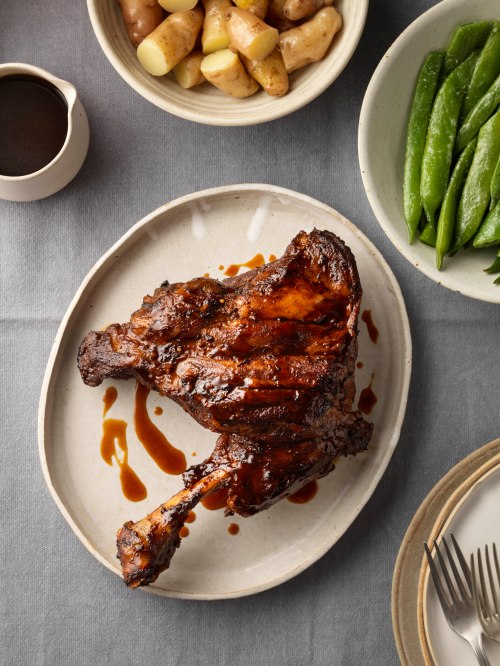
Smoked lamb shoulder by Simon Rogan

Smoked Lamb Shoulder

SERVES 6–8

Lamb shoulder
400g coarse sea salt
1 lamb shoulder (about 2.8–3kg)
100g soft light brown sugar
200g granulated sugar
20g garlic powder
50g smoked paprika
50g sweet paprika
6 star anise
1 tbsp yellow mustard seeds
1 tbsp juniper berries
1 tbsp cayenne pepper
1 tbsp ground cumin
1 tbsp ground black pepper
1 tbsp coriander seeds

Runner beans
500g young, tender runner beans, such as Tenderstar
40g unsalted butter
salt, for seasoning

enough wood smoking chips to create an even layer in the baking tray
Lamb Jus (SEE RECIPE AT END OF MAIN RECIPE), to serve

Dissolve 300g of the salt in 1.5 litres of water in a large bowl. Submerge the lamb shoulder in the brine and put it in the fridge for 24 hours. The next day, rinse the shoulder under cold running water and pat it dry with kitchen paper. Mix the remaining ingredients together in a bowl, including the 100g salt, and rub into the shoulder.

Put the smoking chips in a nice even layer in a large roasting tin lined with foil. Sit a wire rack on top, one that is a similar size to the roasting tin, making sure the wire isn’t touching the chips. Put the shoulder on the rack and cover the entire rack and tin with a tent of foil, so no smoke escapes. Sit the tin on the hob over a low–medium heat for 10 minutes. Remove the covered tin from the heat and allow the shoulder to smoke in the foil tent for 30 minutes.

Preheat the oven to 150°C/130°C Fan/Gas Mark 2. Transfer the smoked lamb shoulder to a clean baking tray, place in the oven and cook for 4 hours until tender.

Top and tail the runner beans and remove the stringy sides. Bring a large saucepan of salted water to the boil, add the butter and cook the beans for 3 minutes. Drain.

Serve the lamb in the middle of the table with a jug of sauce for guests to help themselves and with the runner beans and confit potatoes in a large bowl alongside.

LAMB JUS

2 tbsp sunflower oil
2 carrots, roughly chopped
2 onions, roughly chopped
2 celery sticks, roughly chopped
1 leek, roughly chopped
2 garlic cloves
1kg lamb bones
3 litres White Chicken Stock (RECIPE BELOW)

WHITE CHICKEN STOCK
3kg chicken wings

Roughly chop the chicken wings and put them in a large,heavy-based saucepan with 5 litres of water. Bring to the boil over a medium heat, then reduce the heat and simmer for 2–3 hours, skimming occasionally. Remove from the heat and leave to cool, the strain through a muslin-lined sieve. Keep the stock covered in the fridge and use within 3–4 days, or freeze and use within 3 months.

To make the lamb jus, warm the oil in a large, heavy-based saucepan over a low heat, add the vegetables and cook for 2–3 hours, stirring regularly, until completely soft and no moisture is left in the pan.

Preheat the oven to 220°C/200°C Fan/Gas Mark 7. Put the lamb bones in a roasting tin and roast for 40 minutes, or until deeply golden. Add the bones to the pan with the vegetables, reserving the fat for the potatoes. Deglaze the roasting tin with 200ml water and add it to the pan. Cover with the chicken stock and bring to the boil over a high heat. Reduce the heat and simmer for 2 hours over a low heat, skimming it regularly. Strain through a fine sieve into another heavy-based saucepan then reduce the stock over a medium heat to a sauce consistency.

Cook more from this book
Radish stew
Quince tart

Read the review

Buy this book 
Rogan

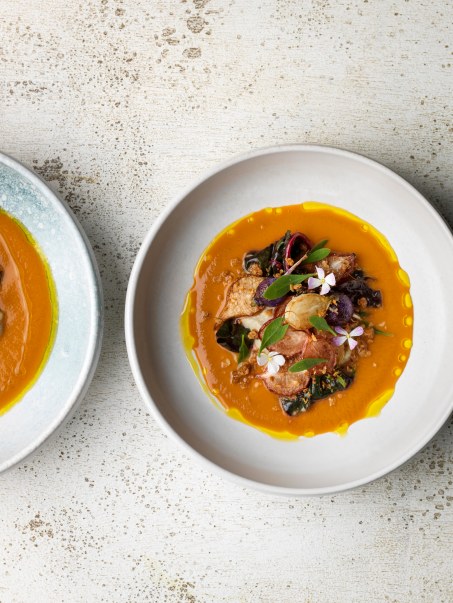
Radish stew by Simon Rogan

Radish Stew

SERVES 4, AS A STARTER

Aubergine purée
1 large aubergine (about 450g)
½ tbsp tahini paste
1 tbsp natural yoghurt
½ tsp roasted chopped garlic

Radish sauce
1 tbsp sunflower oil
1 shallot, sliced
40g button mushrooms, sliced
1½ tsp tomato purée
250g red radishes, thinly sliced
500ml Vegetable Stock (see recipe at end of main recipe)
sherry vinegar, for seasoning
5g unsalted butter

Truffle granola
135g honey
35g black truffle oil
35g chilli oil
150g porridge oats

Radishes
12 mixed radishes, such as Cherry Belle,
Albena and Viola
2 tbsp rapeseed oil
8 stalks of rhubarb chard (or Swiss chard),
stalks removed and cut in half

salt, for seasoning
rapeseed oil, for drizzling
assorted radish flowers and sea purslane, to serve

Preheat the oven to 200°C/180°C Fan/Gas Mark 6.

First, make the aubergine purée. Wrap the aubergine in foil and bake it in the oven for 35–40 minutes until completely soft, then halve it lengthways and scoop out the flesh. Put the flesh in a blender with the tahini, yoghurt and garlic and blitz until smooth. Pass through a fine sieve and season with a pinch of salt.

While the aubergine is cooking, make the radish sauce. Warm the oil in a medium, heavy-based saucepan over a medium heat, add the shallot and sweat for 5–6 minutes, or until translucent, stirring regularly. Add the mushrooms and sweat for a further 3 minutes, or until soft and tender. Stir in the tomato purée and cook for 3–4 minutes. Add the radishes and vegetable stock and bring to the boil. Reduce the heat and simmer for 8 minutes. Remove from the heat and blitz with a hand-held blender until smooth, then strain through a fine sieve. Finish the sauce by seasoning with sherry vinegar and salt and whisking in the butter.

Reduce the oven temperature to 160°C/140°C Fan/Gas Mark 2.

To make the granola, warm the honey, oils and 1 teaspoon of salt in a small saucepan over a low heat until the honey has melted and the salt dissolved. Mix in the oats.  Transfer to a baking tray, spread it out in an even layer and bake for 15 minutes, or until golden. Remove from the oven and leave to cool, then break into small pieces. Leave the oven at the same temperature.

Put the radishes on a baking tray, chopping any larger ones in half, season with a pinch of salt, drizzle over half the oil and roast for 10–12 minutes.

Heat the remaining oil in a medium, non-stick saucepan and add the rhubarb chard leaves along with a splash of water. Cook gently until the leaves have wilted and season with a little salt.

Warm the radish sauce. Put a spoon of the purée in the centre of four plates and place the roasted radishes on top. Add the chard, purslane leaves and flowers. Spoon the sauce around the outside and sprinkle with truffle granola. Drizzle with rapeseed oil.

VEGETABLE STOCK

3 onions, finely chopped
2 celery sticks, finely chopped
2 carrots, finely chopped
1 fennel bulb, finely chopped
1 leek, finely chopped
1 head of garlic, halved
15g chervil
15g tarragon
15g flat-leaf parsley

Put all the vegetables and the garlic halves in a large, heavy-based saucepan with 4 litres of water. Bring to the boil over a medium heat, then reduce the heat and simmer for 30 minutes. Take off the heat, add the herbs and leave to cool, then chill and infuse in the fridge overnight. The following day, strain it through a muslin-lined sieve. Keep the stock covered in the fridge and use within 3–4 days, or freeze and use within 3 months.

Cook more from this book
Smoked lamb shoulder
Quince tart

Read the review

Buy this book 
Rogan

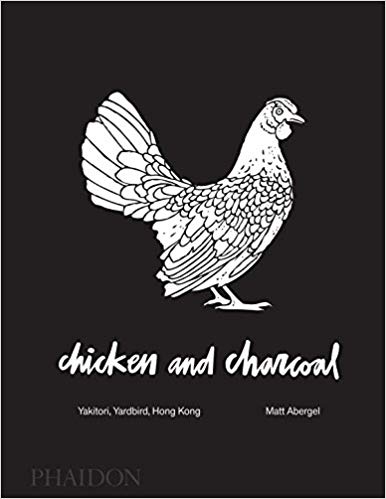
Chicken and Charcoal by Matt Abergel

Chicken and Charcoal

What’s the USP? Everything you every wanted to know about yakitori (Japanese-style skewered and grilled chicken) plus a whole lot more you didn’t even know you wanted to know.

Who’s the author? Matt Abergel is the skateboarding chef and owner of cult Hong Kong restaurant Yardbird that has helped put yakitori on the global culinary map. This is his first cookbook.

What does it look like? A crazy, but beautifully designed, mash-up of an art catalogue, lifestyle magazine and instruction manual. There’s artworks by Yardbird logo designer Evan Hecox; articles on the restaurant’s designer chairs and branded products that include Yardbird Vans skateboarding sneakers and a line of sake and a profile of Yardbird co-owner Lindsay Jang.

But the ‘meat’ (pun intended) of the book is a series of detailed step by step instructions and recipes for butchering a chicken ready for skewering (and that means really butchering the thing down to its last tiny constituent parts including the thyroid and gizzard) and every type of yakitori you can imagine from fillet and thigh to ventricle and soft knee bone.

Is it good bedtime reading? Settle in with a Horlicks and the 40-odd page introductory section with profiles, interviews and articles.

Will I have trouble finding ingredients? How good is your butcher? If you want to cook some of the more recherché recipes in the book like Thyroid skewers you’ll need to find one that will supply you whole chickens with head and organs intact. Good luck with that. You will also need to find a very good Asian grocer or specialist Japanese store for items such as Okinawan black sugar and Chinkiang black rice vinegar.

What’s the faff factor? Correctly butchering your whole chicken, should you be able to get hold of one, will take some practice and there’s a lot of fiddly skewering to be done. Some of the ‘smaller’ and ‘bigger’ dishes require a large number of ingredients and a fair amount of preparation.

How annoyingly vague are the recipes? Measurements are precise – no pinch of this or glug of that – and the methods are detailed and clear. The recipe for Chicken Katsu that is meant to appear on page 174 is however so vague that it has actually completely disappeared from the book.

How often will I cook from the book? Much of the food will be time-consuming to prepare so this is one for the weekend.

Killer recipes? Aside from the yakitori recipes, the chapter on ‘smaller’ snacking dishes includes mushroom salad with mizuna, watercress and wasabi and the ‘Yardbird Caesar’ that’s made with Chinese cabbage, mizuna and nori and a dressing that includes miso, roasted garlic and rice vinegar, while ‘bigger’ dishes include KFC (Korean fried cauliflower) and scotch egg with cabbage, tonkatsu sauce and Kewpie mayo.

What will I love? The sheer attention to detail, the elegant look and all the little extras like the cocktail and highball recipes and a staff Q&A profiling the people behind the restaurant. A lot of love, time and effort has obviously gone into the book making it a rewarding experience both to read and use in the kitchen.

What won’t I like? The full-page, black and white close-up photo of raw chicken skin on page 90 is both gnarly and vaguely obscene.

Should I buy it? If you are interested in Japanese cooking and want the definitive last word on yakitori or are just interested in what’s happening in the modern Hong Kong restaurant scene or just love a well put together cookbook then Chicken and Charcoal is well worth owning.

Cuisine: Japanese
Suitable for: Professional chefs/Confident home cooks
Cookbook Review Rating: 4 Stars

Buy this book
Chicken and Charcoal: Yakitori, Yardbird, Hong Kong
£24.95, Phaidon

Cook from this book
KFC (Korean Fried Cauliflower)
Eggplant Salad with Pickled Garlic and Ginger Tosazu

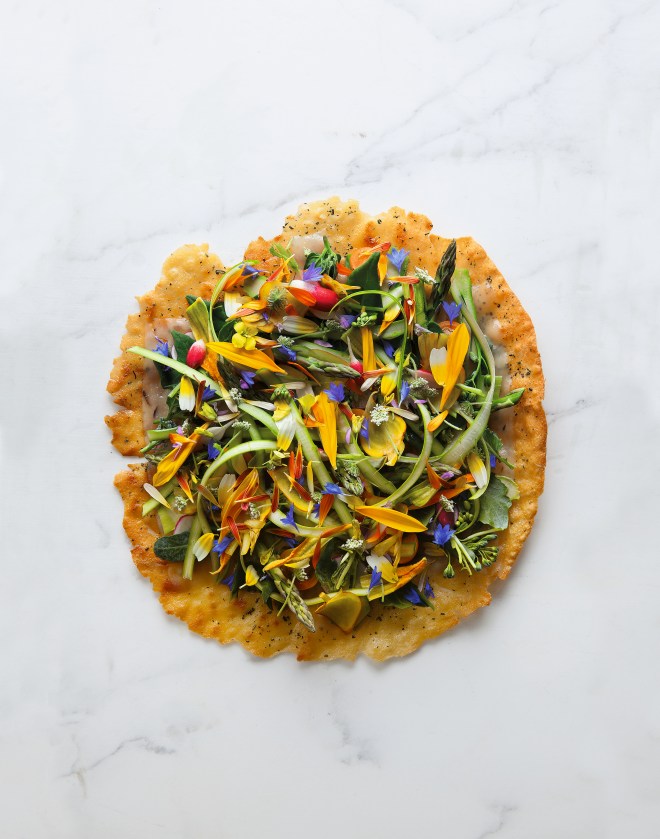
Carta da musica, leaves, things and truffled pecorino by Jeremy Fox

146 Carta da Musica

When I worked at Mumbo Jumbo in Atlanta, Georgia, we used to purchase ready-made Sardinian flatbread (also called carta da musica). On its own it’s not that tasty, but brushed with olive oil and toasted, it turns into something great. Whenever we had a VIP in the restaurant we would send it out topped with herbs and truffles—and the like—and I always dreamed that one day, if I had a pizza oven, I would start making these myself. When I opened Ubuntu I got to do just that, and as a result, this was probably my favorite dish on the menu. It is basically a vehicle for everything great that we happened to have on hand. Just for fun, and despite Ubuntu being a vegetarian restaurant, we always served it on a pig-shaped wooden board.

NOTE For the “leaves and things,” I like to use pea tendrils, nasturtiums, calendula, young beet (beetroot) greens, fava (broad bean) leaves, parsley, shaved carrots, and shaved radishes. But really whatever is seasonal, fresh, and sounds good to you will work great.

Once the carta da musica is dried out in the oven, it will keep for a very long time—so that step can be done very far in advance.

makes 8
carta da musica
1/2 teaspoon active dry (fast-action) yeast
1 3/4 cups (220 g) durum wheat flour
1 teaspoon kosher salt
extra-virgin olive oil for greasing the bowl
all-purpose (plain) flour, for dusting

to serve
assorted leaves, herbs, and shaved vegetables (see Note)
1 pound (455 g) boschetto al tartufo cheese (or aged pecorino or parmigiano-reggiano)
extra-virgin olive oil, for brushing
1 tablespoon chopped rosemary
1 1/2 teaspoons chili flakes
kosher salt
lemon wedges
flaky sea salt

Fill a 1-cup (240 ml) measuring cup (measuring jug) with 2⁄3 cup (160 ml) warm (105° to 115°F/40° to 46°C) water, sprinkle in the yeast, and stir it to blend. Let stand for about 10 minutes to activate the yeast.

In a stand mixer fitted with the paddle attachment, combine the flour and kosher salt and mix on low speed to blend.

With the mixer running, pour in the yeast/water mixture, increase the speed to
medium, and beat the dough until it is smooth and elastic, about 4 minutes. The dough will be slightly sticky to the touch.

Lightly coat a medium bowl with the olive oil. With your hands lightly oiled as well,
shape the dough into a ball and place in the bowl. Turn the dough ball over so that it is coated all over with the olive oil. Cover the bowl with plastic wrap (clingfilm) and let the dough proof in a warm area for around 2 hours—the dough will rise very slightly, but will not double in volume.

Once the dough is proofed, place a pizza stone on a rack positioned in the center of the oven and begin preheating the oven and stone to 500°F (260°C/Gas 10). Give the stone at least 1 hour to preheat so that the carta will cook evenly and consistently. (Although a pizza stone has much better heat retention and will create a superior product, you can also use an 18 x 13-inch/46 x 33 cm baking sheet. Stick it in the oven upside down; this gives you a flat surface with no lip, making it easier to lay down and remove the dough.)

While the oven and pizza stone are preheating, roll out the dough. Sprinkle some flour over a work surface. Divide the dough into quarters. Working with one piece at a time while keeping the others covered, use a rolling pin to roll out the dough to an 8-inch (20 cm) round, about 1⁄16 inch (1.5 mm) thick. The round doesn’t need to be perfect, but it does need to be of consistent thickness and of an appropriate size to fit on your stone. But most important, it needs to be totally flat. If the rolled-out dough has any tears or crimps, it will not inflate, and thus won’t cook properly.

Rest the rolled-out dough on a floured baking sheet or work surface for 30 to 45 minutes.

Dust flour over a pizza peel or an upside-down 8-inch (20 cm) tart pan—you’re going to use this to slide your dough rounds onto the stone, so the flour helps keep the dough from sticking to the peel. Transfer the dough round to the pizza peel or tart pan and give the peel a light shake to ensure that the dough can move around.

Open the oven door and bring the peel in flat, over to the far edge of the pizza stone.
Tilt it up slightly—but don’t let it bunch up—and jostle the peel gently until the edge of
the dough round hits the far end of the stone. The dough will immediately catch on the stone, so you should be able to pull the peel back at a flat angle, leaving the dough on the pizza stone with no wrinkles or crimps (that last part is, again, important to it cooking properly). Immediately close the oven door to maintain temperature.

The dough should puff up and fill with air in 2 to 3 minutes. The carta da musica is done when it is puffy, hollow, and dry to the touch. Remove it from the oven and let it cool for 5 minutes. Repeat the process with the remaining dough rounds.

After an initial 5-minute rest, use scissors to cut around the outer seam of the carta (like a pita), carefully peeling back the top layer from the bottom to remove the two layers into separate round sheets. The layers toward the center may want to stick a bit, so use extra care when peeling it apart. You should wind up with two disks of even thickness.

As the breads are baked and separated, stack the sheets cut-side down. Once the last piece of dough is baked, reduce the oven to its lowest setting, ideally below 200°F (95°C). Remove the pizza stone.

Once your oven has cooled down, place the cut rounds, cut-side down, directly on the oven racks in single layers (you can use multiple oven racks) and let the bread dry out until completely crispy, at least 2 hours.

Once dry, the breads can be stored indefinitely in an airtight container. Just continue to store them cut-side down, as the cut-side is not as pretty or even, and will be kept face down when you assemble the finished dish.

to serve
Preheat the oven to 500°F (260°C/Gas 10).

Prepare the leaves, herbs, and vegetables. These can be as rustic or precise as you like, but the real goal is to have things that will be delicious to eat raw, on top of crispy bread.

Place the carta da musica cut-side-down on an 18 x 13-inch (46 x 33 cm) rimmed baking sheet (tray)—it is rimmed to keep the olive oil from leaking onto the oven floor and burning.

Meanwhile, using a vegetable peeler, peel around the perimeter of the wheel of
Boschetto al Tartufo—the goal is to have as long of a peel as possible. Brush the bread disks evenly and generously with olive oil. Sprinkle with the rosemary, chili flakes, and kosher salt to taste. Bake the carta until they are golden brown and crisp, about 2 minutes.

As the disks come out of the oven, pour off any excess oil that has not been absorbed and immediately drape the cheese over the surface so it starts to melt from the residual heat. Place the carta da musica on a plate and dress it with the prepared herbs, greens, flowers, and vegetables. Finish it with a squeeze of fresh lemon juice and flaky sea salt.

Eat this immediately—and with your hands. Basically, just have fun.

Cook more from this book
Lima bean and sorrel cacio e pepe
Carrot juice cavatelli, tops salsa and spiced pulp crumble

Read the review

Buy this book
On Vegetables: Modern Recipes for the Home Kitchen

£29.95, Phaidon

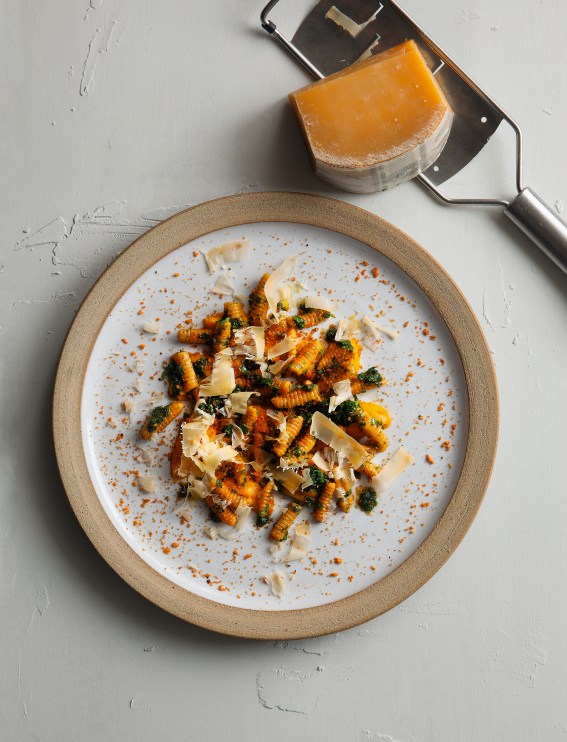
Carrot juice cavatelli, tops salsa and spiced pulp crumble by Jeremy Fox

102 Carrot Juice Cavatelli

This dish accomplishes two things: First, it’s the purest example of using every single part of a vegetable in one single dish. And second—and what I was really trying to accomplish—the cavatelli look like that bright orange Kraft macaroni and cheese from a box. If you are making this dish from the ground up, it is pretty exciting, as you can use the tops of your carrots to make the salsa, the juice to make the cavatelli, and the pulp (from juicing) to make the crumble. Note Start cooking the day before you intend to serve this. The carrot pulp and cavatelli dough will need overnight to dehydrate and rest, respectively.

serves 4
carrot juice cavatelli
41/4 cups (530 g) “00” flour, plus more for dusting
1 teaspoon kosher salt, plus more for the cooking water
1 cup (240 ml) fresh carrot juice (from orange carrots), pulp reserved to serve
3/4 cup (180 ml) Carrot Purée (see below)
4 tablespoons Salsa Verde using the leaves of young carrot tops (see below)
4 tablespoons Carrot Crumble (see below)
aged gouda cheese

Make the carrot juice cavatelli:
In a food processor, blend together the flour and salt. With the machine running, slowly add the carrot juice (you may not need all of it), until the dough comes together. Be careful not to overwork the dough in the food processor: The dough may well look crumbly, but if you press it together with your fingers it should very easily combine into dough. You are looking for a texture similar to Play-Doh: elastic, pliable, and not sticking to your fingers when you touch it. If the dough is too dry, add more juice; too wet, add more flour.

Transfer the dough to a lightly floured surface and knead it with the heels of your hands for about 1 minute, until you have a smooth dough.

Wrap the dough tightly with plastic wrap (clingfilm) and let it rest overnight in the refrigerator.

Place the carrot pulp on a dehydrator tray and dehydrate at 135°F (57°C) overnight.

About 1 hour before you plan to make the cavatelli, let the dough come to room temperature—this will make it much easier to work with. Divide the dough into 6 pieces. Lightly flour a work surface. Working with one piece at a time—and keeping the rest of the dough covered—roll the dough into a long, thin rope, about 1/8 inch (3 mm) in diameter. Cut the rope crosswise into 1/4-inch (6 mm) pieces.

Using a cavatelli board, or the tines of a fork, gently but confidently roll the dough pieces against it. The cavatelli may not come out perfect right away, but soon the motion will find its way into your muscle memory.

Once the cavatelli are shaped, lay them in a single layer (not touching) on a baking sheet lined with a tea towel. Repeat this process until all of the dough has been turned into cavatelli. These are best cooked when fresh, so if you are going to be cooking them the same day, you can just leave them out. Otherwise, cover and refrigerate for up to 2 days.

Bring a large pot of water to a boil. Season your water with salt so it tastes like the sea. I think it’s important to taste the pasta water to make sure it is seasoned properly. Once seasoned and boiling, add the cavatelli and cook until they float to the surface, about 3 minutes. If you’re not sure whether they are done, the best test is just to eat one.

To serve
While the pasta water heats up, gently warm the carrot purée in a small pan over low heat and keep covered (and warm) until serving.

Using a sieve, scoop the cavatelli out of the pasta water and into a wide bowl. Immediately dress them with the carrot top salsa verde and toss to combine. Ladle in some of the starchy, seasoned pasta water, a little at a time, to open up the flavors and create a very light sauce that will coat the cavatelli. Don’t add too much water or it will make for a thin, diluted sauce.

Place dollops of the carrot purée on 4 warmed plates. Spoon the cavatelli on top and sprinkle the carrot crumble over the pasta and the plate. I like being able to drag the cavatelli through more of the crumble as I’m eating it. Shave ribbons of Gouda over the top and serve immediately.

Carrot Purée
When raw ingredients are salted, it helps extract the water from them. By breaking down the carrots first, it increases the surface area and expedites the process even more. As a result, it’s possible to make a carrot purée with no extra water added, highlighting the pure flavor of carrot and nothing else. Serve as a side dish, or as a component of a larger dish, such as the Carrot Juice Cavatelli, Tops Salsa & Spiced Pulp Crumble.

Peel the carrots (the peels can be reserved for Vegetable Stock, page 312) and then cut the carrots into rough 1-inch (2.5 cm) cubes. These do not have to be perfect, as they will all eventually be puréed.

In a bowl, toss the carrots with 2 tablespoons of the grapeseed oil and the salt and set aside for about 10 minutes. Transfer the carrots to a food processor and blend until broken up.

Transfer the mixture to a saucepot or large sauté pan. Set the pan over medium-low heat, cover, and cook, undisturbed, for 40 to 45 minutes. You’ll know it’s ready when you can smear it with a spoon. (If you take it off the heat too early, you will find the texture of the purée to be somewhat grainy after you purée it.) Transfer the mixture to a blender and blend on low speed, then gradually increase to high speed while slowly drizzling in the remaining 4 tablespoons grapeseed oil. Blend the purée to the consistency of mayonnaise. Season to taste with salt; it should have a pure carrot flavor. Store in an airtight container refrigerated for up to 3 days.

Carrot crumble
Another dehydrated pulp (like beet soil), carrot crumble can basically function as a carrot-based breadcrumb. It is especially delicious sprinkled over dishes like the Carrot Juice Cavatelli, Tops Salsa & Spiced Pulp Crumble (page 103), but also works well sprinkled over any carrot preparation.

makes about 3/4 cup (100 g)
2 cups (480 g) carrot pulp (from 3 pounds/1.3 kg orange carrots that have been juiced)
2 teaspoons granulated sugar
11/2 teaspoons Fox Spice (page 263)
1 teaspoon kosher salt
2 tablespoons extra-virgin olive oil

Spread the pulp evenly on a dehydrator tray and dehydrate at 125°F to 135°F (52° to 57°C) for at least 8 hours, or until completely dry. You should get about 3/4 cup (53 g) of dehydrated pulp.

Transfer the pulp to a mortar and pestle and grind until you have the rustic texture of a fine breadcrumb. (A food processor will turn your breadcrumbs into more of a uniform powder.) Transfer to a bowl and add the sugar, spice, and salt and stir together.Store in an airtight container indefinitely at room temperature. Stir in the olive oil until combined.

Salsa verde
I like this salsa on everything—be it fish, a grilled piece of meat, or roasted vegetables. Thanks to the brine, this salsa is similar to chimichurri, and like with Pesto (page 270), you can swap the carrot tops for whatever herbaceous greens you have on hand: celery leaves, parsley leaves and stems, and so on. Additionally, this is a great way to use pickle brine, but if you don’t have any, feel free to use the juice of the lemons you’ve zested.

makes 3/4 cup (180 ml)
1/2 cup (25 grams) chopped carrot tops
1/2 cup (120 ml) extra-virgin olive oil
2 garlic cloves, germ removed, finely chopped
2 tablespoons pickled vegetable brine or lemon juice
finely grated zest of 2 lemons

In a bowl, combine the carrot tops, olive oil, garlic, pickle brine (withhold this ingredient if not using the salsa right away), and lemon zest and whisk thoroughly until combined. Use immediately or cover and refrigerate for up to 3 days. If storing to use later, don’t add the brine (or lemon juice) until right before serving. The sauce may separate a bit, so just give it a quick whisk again before using.

Cook more from this book
Lima bean and sorrel cacio e pepe
Carta da musica, leaves, things and truffled pecorino

Read the review

Buy this book
On Vegetables: Modern Recipes for the Home Kitchen

£29.95, Phaidon 


Lima bean and sorrel cacio e pepe by Jeremy Fox

070 Lima Bean and Sorrel Cacio e PepeLima beans, also known as butter beans, are probably my favorite shell bean. Fun fact: When I put this dish on the menu at Rustic Canyon with the name “lima bean,” nobody buys it, but when I list it as “butter bean,” it sells out and everybody loves it.

To me, one of the best things about eating beans is the broth, and when you can add butter, garlic, and pecorino to it, it becomes something really great. The only acidity in this dish comes from the sorrel, which brings a really nice tang.

serves 4
1 pound (455 g) shelled fresh lima (butter) beans
2 garlic cloves, germ removed, peeled and smashed
2 teaspoons fresh rosemary leaves
1/2 cup (2 oz/60 g) tightly packed torn sorrel leaves, plus 2 tablespoons fine chiffonade of sorrel leaves
1 tablespoon freshly ground black pepper kosher salt
2 tablespoons (30 g) unsalted butter, at room temperature
4 teaspoons Garlic Confit Purée, at room temperature (see below)
1/2 cup (30 g) finely grated pecorino romano cheese
2 tablespoons oil from Garlic Confit, at room temperature
1 tablespoon grated Cured Egg Yolk (see below)

Place the lima beans in a pot filled with 4 cups (1 liter) cold water. Place the garlic and rosemary in a single-layer square of cheesecloth, tie it into a sachet, and add it to the pot with the beans. Bring to a simmer over medium heat, then reduce the heat to low and cook, uncovered, at just below a simmer, until the beans are tender, 30 to 40 minutes.

Remove the pot from the heat, discard the sachet, and add the torn sorrel, black pepper, and salt to taste. (You will notice that the sorrel turns drab quickly, but that’s okay. It’s about the flavor more than the appearance, with tart sorrel standing in place of lemon to balance out the other ingredients.)

Right before serving, fold the butter into the beans.

To serve, warm the bowls and add 1 teaspoon of the garlic confit pureé to the bottom of each bowl. Spoon the beans and their broth into the bowls (since black pepper tends to settle to the bottom of the pot, make sure to re-stir the soup before each ladle).

Finish with the chiffonade of sorrel, grated pecorino, garlic confit oil, and cured egg yolk.

Garlic confit

Confiting is the process of slowly cooking something while it is submerged in fat. Duck confit is probably the most famous version of this method, and it is cooked in duck fat. Garlic confit is not cooked in garlic fat, because to my knowledge, garlic fat does not exist.

Confited ingredients are incredibly useful to keep in your larder. They add deep, slowly developed flavors to any dish, even if you don’t have the time to slow-cook something.
At Ubuntu, we’d often wind up with too many greens, so we would blanch and purée them with some of the confited garlic and its oil. The purée would look bright, fresh, and green, while also tasting of deep, slow cooking.

makes 2 cups (480 ml)
1 pound (455 g) whole garlic cloves, peeled
4 sprigs thyme
1 teaspoon kosher salt
1 cup (240 ml) extra-virgin olive oil
1 cup (240 ml) grapeseed oil

Preheat the oven to 250°F (120°C/Gas 1/2).

Place the garlic cloves in a pot or a baking dish with a lid. Add the thyme and salt and
pour over the olive and grapeseed oils. Cover and transfer to the oven. Bake until the
cloves are spreadable but not falling apart, 2 to 3 hours.

Let the garlic cool to room temperature. Store airtight in the refrigerator for up to 1 month.

Garlic confit purée

Here is yet another of the many great things you can do with garlic confit. This pureé has a garlicky, roasted flavor that functions as an excellent condiment for all sorts of things, like tomato salad or roast chicken.

makes 1 1/2 cups (360 ml)
1 cup (240 ml) Garlic Confit
11/2 tablespoons apple cider vinegar
1/2 teaspoon kosher salt

In a blender, combine the garlic confit, vinegar, 1/2 cup (120 ml) water, and the salt and purée until smooth. Store in an airtight container in the refrigerator for up to 1 week.

Cured egg yolk

This cured egg yolk functions as a great vegetarian replacement for the salty, briny taste of bottarga (cured fish roe). It is excellent grated over things like pasta, Caesar salad, or steak tartare. Try to find the freshest eggs from your local farmers market—with rich, orange yolks—and give the yolks six full days to cure.

makes 12 yolks
1 pound (455 g) kosher salt
1 pound (455 g) granulated sugar
12 large egg yolks

Combine the salt and sugar in a large bowl. Transfer three-fifths of the cure to an 18 x 13-inch (46 x 33 cm) rimmed baking sheet.

Using the pointy end of a whole egg, dig 12 evenly spaced divots in the cure, being careful not to burrow so deeply that you are exposing the bottom of the pan (you are going to be filling the divots with egg yolks and the yolks need to be entirely surrounded by the cure).

Place each yolk in its own divot. Using the remaining cure, cover each yolk so they are completely encased.

Cover the sheet with plastic wrap (clingfilm) and refrigerate for 2 days.

Remove the plastic wrap, flip the egg yolks over, and then cover again with the cure.
By this point, the yolks should be quite sturdy and shouldn’t break easily, making the flipping quite easy. Cover again with plastic wrap and refrigerate for 2 more days.

After curing the egg yolks for 4 days (total), remove the yolks from the cure and rinse them under a gentle stream of room-temperature running water. At this point, there is still an outer membrane, which you may not be able to see—but I swear it’s there. While running the yolks under water, carefully remove and discard that membrane, then set the yolks aside on paper towels.

Pat dry the yolks thoroughly (don’t worry about handling them, as they should be sturdy, and even if they become misshapen, you can usually reshape them into their original form).

Lay the egg yolks on a dehydrator tray (not on a pan or dehydrator sheet as you want as much air circulation as possible) and dehydrate at 135°F (57°C) for 2 days until fully dried. Wrap each yolk individually in paper towels and refrigerate for up to 1 month. (They may well last longer than a month, but they’re so damn tasty that I’ve never waited long enough to find out.)

Cook more from this book
Carta da musica, leaves, things and truffled pecorino
Carrot juice cavatelli, tops salsa and spiced pulp crumble

Read the review

Buy this book
On Vegetables: Modern Recipes for the Home Kitchen

£29.95, Phaidon