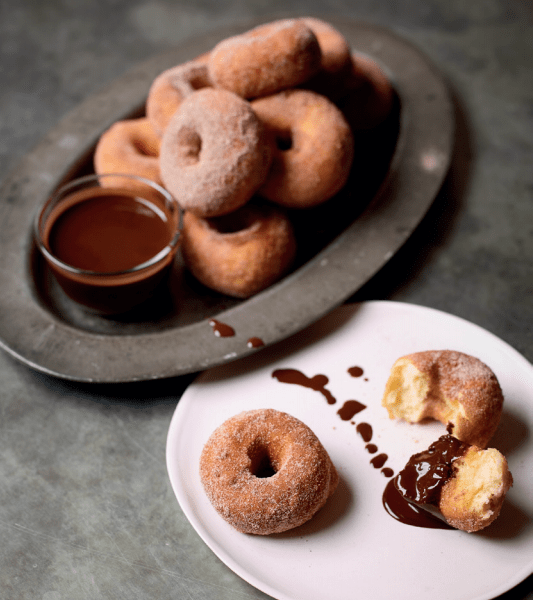
Doughnuts and hot chocolate sauce by Nieves Barragán Mohacho

Doughnuts and hot chocolate sauce from Sabor

This is like an easier version of churros with chocolate sauce. If you don’t have a mixer to make the dough, you can knead it by hand.

Ingredients

rapeseed or sunflower oil, enough to fill your pan to about 3cm

For the doughnuts
60g cold but malleable butter
450g plain flour
60g caster sugar
4 eggs
12g fresh yeast or 4g quick yeast
60ml whole milk

For the hot chocolate sauce
300ml water
150g caster sugar
160ml single cream
50g cocoa powder
300g dark chocolate (70%)

For the cinnamon sugar
150g caster sugar
50–60g ground cinnamon

Take the butter out of the fridge 15 minutes before starting and chop into small cubes. Put the flour and sugar into a large bowl and mix together with your hands. Heat the milk until almost steaming, then remove from the heat and leave to cool slightly. Mix into the yeast, stirring with a whisk to dissolve.

Put the flour and sugar into the bowl of a stand mixer and slowly add the butter – it will look like crumble. Add the eggs one by one, then dribble in the milk/yeast mixture until everything comes together into a sticky dough.

Slightly flour a large container or bowl, turn the dough out into it, and lightly flour the top. Cover and leave in the fridge overnight. In the morning, turn out the dough on to a floured surface – it will have almost doubled. Take a piece (approx. 30g) and roll it in your hands, then squeeze down until it’s about 2½cm thick. Use the top of a miniature bottle to press out the dough in the middle, leaving a hole. The doughnuts should be around 25g each. Repeat until you’ve used up all the dough.

Stick two fingers through the middle of each doughnut and roll them round to push out the dough a bit more and double the size of the hole – otherwise it will close up when the doughnut is fried and expands.

To make the hot chocolate sauce, put the water, sugar and cream into a pan on a low heat and dissolve the sugar. Put the cocoa powder and chocolate into a bowl and place over a pan of simmering water to melt the chocolate (this keeps it smooth). When the chocolate has all melted, add it to the cream with a spatula. Continue mixing until it becomes dense and thick and perfect for dipping. Keep warm.

Mix together the sugar and cinnamon. Put the oil into a shallow pan on a medium heat. When it’s hot, fry the doughnuts until golden brown, then remove and drain on kitchen paper. Dust with the cinnamon sugar while still warm and serve with the warm chocolate sauce for dipping.

This recipe appears in
Sabor: Flavours from a Spanish Kitchen
Nieves Barragan Mohacho
£25 Penguin Fig Tree

Cook more from this book
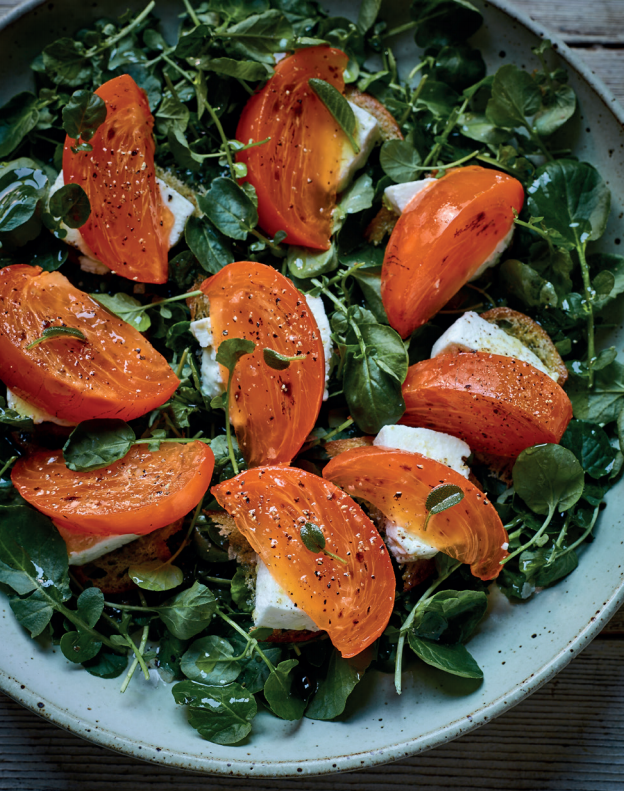
Persimmon, goat’s cheese and land cress salad
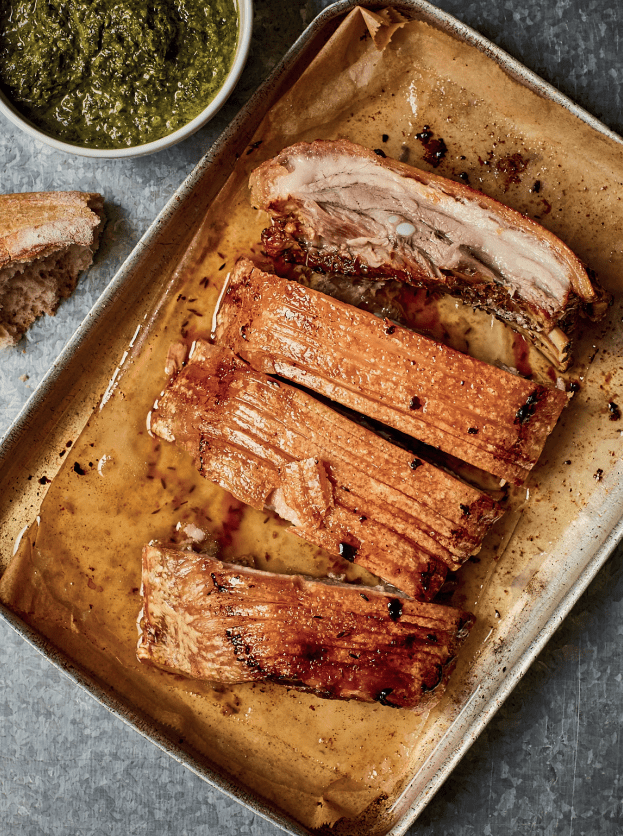
Pork belly and mojo verde
Read the review

Pork belly and mojo verde by Nieves Barragán Mohacho

Pork belly and mojo verde from Sabor
This recipe uses a pestle and mortar to make a lumpier mojo verde that’s good for serving alongside meat, but you could make a smoother, creamier sauce for marinating. Just put all the ingredients, except the coriander, into a blender. Whiz together, adding the coriander halfway through, then blend again until green and creamy with some small flecks of herb. Instead of pork belly, you could grill lamb cutlets and serve them with the mojo verde dotted around, or marinate chicken in the smoother version of the sauce.

Serves 6-8

1 x 4–5kg piece of pork belly, rib bones intact
sea salt and freshly ground black pepper
2 tablespoons cumin seeds
extra virgin olive oil, for drizzling

For the mojo verde

1 bunch of spring onions
4 cloves of garlic
2 big bunches of fresh coriander (equal to around 6–8 of the 40g supermarket packets)
2 teaspoons cumin seeds
200ml extra virgin olive oil
125ml Moscatel vinegar
2 dried chillies
sea salt and freshly ground black pepper, to taste

Preheat the oven to 180°C.

Line a roasting tray with greaseproof paper. Score the skin of the pork belly quite deeply (around 1cm), then place it skin side down on the paper-lined tray. Season the top of the pork belly with salt, pepper and cumin seeds and cook for 1½–2hrs. The skin should be very crispy and the meat must be tender – if it’s not quite there yet, turn it over and cook it for another 10 minutes.

Make the mojo verde while the pork belly is cooking: roughly chop the ingredients and add them slowly to a pestle and mortar, dribbling in the olive oil bit by bit and mashing together.

Spoon some mojo verde on to each plate, then top with 1cm–2cm thick pork belly slices and drizzle over a little olive oil to finish.

This recipe appears in
Sabor: Flavours from a Spanish Kitchen
Nieves Barragan Mohacho
£25 Penguin Fig Tree

Cook more from this book
Persimmon, goat’s cheese and land cress salad
Doughnuts and hot chocolate sauce

Read the review

Persimmon, goat’s cheese and land cress salad by Nieves Barragán Mohacho

Persimmon, goats cheese and landcress salad from Sabor

When persimmons are in season and ripe, this salad is so good and only takes five minutes. The best persimmons I’ve tried are from Sicily. Don’t try to make this with hard persimmons – it’s pointless. The goat’s cheese should be creamy and very soft – you should almost be able to spread it.

I always keep a large piece of bread in the freezer: if you take it out and leave it for 20 minutes to thaw slightly, you will be able to slice it very thinly (this works best with bread that’s not very wide).

This makes a great starter or light lunch or dinner.

Serves 4

8 sage leaves
60ml extra virgin olive oil
around ¼ of a loaf (15cm) of frozen baguette or thin white bread, left for 20 minutes to defrost slightly
100g land cress (or something peppery like watercress or rocket)
4 very ripe persimmons
200g soft creamy goat’s cheese
freshly ground black pepper

Preheat the oven to 160–170°C. Put the sage leaves into a saucepan and just cover with olive oil, then put on a very low heat. As soon as the oil is warm, turn the heat off and leave to infuse, stirring gently. Discard the leaves.

Cut the partially defrosted bread into 8 very thin slices. Place on a lined baking tray and drizzle with a little olive oil, then bake until the bread is crispy on both sides. Place the salad leaves on a plate and put the toasts on top.

Cut the persimmons in half – they should be deep orange and really juicy – then cut into wedges as well as you can. Cut the goat’s cheese to a similar size.

Lift the persimmon halves carefully on to the toast slices and top with a slice of goat’s cheese. Drizzle the sage-infused oil over the top and season with black pepper.

Extracted from
Sabor: Flavours from a Spanish Kitchen
Nieves Barragan Mohacho
£25 Penguin Fig Tree

Cook more from this book
Pork belly and mojo verde
Doughnuts and hot chocolate sauce

Read the review

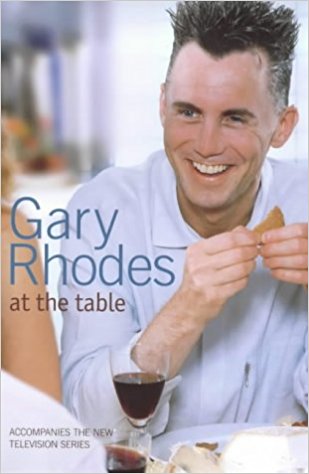
Gary Rhodes at the Table

Rhodes at the table

At the Table was the spiky-haired one’s seventh major cook book in about as many years and followed hot on the heels of the mammoth New British Classics. How on earth did he do it?

No doubt that sustaining a career like Rhodes’s is a team effort, and the many acknowledgements in the front of the book support that theory. However, all the food for the book was prepared by the chef himself, and his style is firmly imprinted in both the prose and recipes.

As always with Rhodes’s dishes, quotation marks abound in titles to indicate not all is as it seems, eg Pigeon and Red Onion “Pasty” turns out to be a pithivier. There are many more examples. It’s an annoying affectation and is indicative of Rhodes slightly overwrought approach.

However, the book design is excellent, with good use of colour. The photography is superb, and there are some real gems amongst the recipes, including a terrific crab salad, duck with spicy plums and a fantastic pear parfait.

Rhodes is a highly skilled and talented chef, and his food can be demanding of the home cook. Using this book may require a little more forethought and preparation, and you may need to adapt the recipes to your own abilities, but the results will be worth it.

Cuisine: modern British
Suitable for: Confident home cooks and professionals
Cookbook Review rating: 3 stars

Buy this book
Gary Rhodes at the Table
Gary Rhodes
£0.01 BBC Books

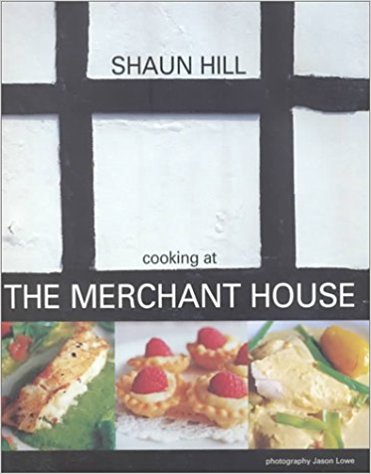
Cooking At The Merchant House by Shaun Hill

Merchant House

There had been a ten year gap between The Shaun Hill Cookery Book (also known as The Gidliegh Park Cookbook) and Cooking At The Merchant House when it finally arrived in 2000. In between, Hill had knocked out a vegetable cook booklet for the BBC, contributed recipes to “A Spoon At Every Course by Mirabel Osler, and apparently spent the advance for a book called Masterclass which eventually surfaced as How to Cook Better.

Of course, he was also busy doing other things, such as running a restaurant, consulting for BA and Tescos and the odd bit of broadcasting on Radio 4. But I’m extremely glad he took the time to record the recipes that formed the menus at his wonderful and late lamented Ludlow restaurant.

Dishes such as Warm Artichoke Heart with Peas and Mint Hollandaise; Fresh Goats Cheese Gnocchi and Lobster with Chickpea, Corinander and Olive Oil Sauce bring back fond memories of numerous meals eaten at The Merchant House.

In addition to the excellent recipes, Cooking At The Merchant House goes some way to telling the story of the life of the restaurant.  Hill is a gifted writer of prose and it’s a great shame that there is not more of it. I am told by ‘sources close to the author’ that a great deal more was written and submitted, but was sacrificed to photos and general design considerations. Nevertheless Cooking From the Merchant House remains an essential purchase for any serious cook, professional or amateur.

Cuisine: modern British
Suitable for: Confident home cooks and professionals
Cookbook Review rating: 4 stars

Buy this book
Cooking at the Merchant House
Shaun Hill
£0.01 Conran Octopus

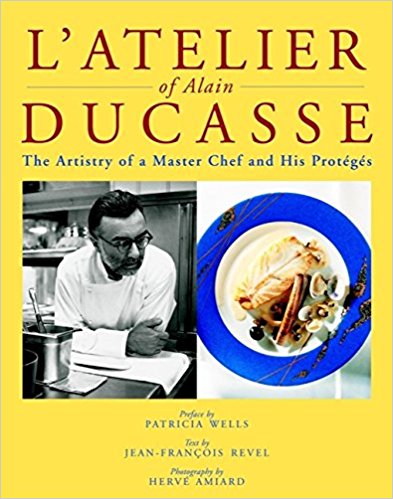
L’Atelier of Alain Ducasse

Ducasse

L’Atelier of Alain Ducasse sets out to provide an insight into the working methods and philosophy of prehaps the most successful chef currently working anywhere in the World today. The book contrasts signature Ducasse recipes with those of his current and former Head Chefs in order to illustrate his influence on the men who work for him.

The book begins with a look behind the scenes of the Ducasse empire and attempts to contextualise it in terms of the last 300 years or so of French gastronomy. This rather dry and pretentious exercise is greatly enlivened by the beautiful black and white portraiture of Herve Amiard. Some amusing non-secquiturs from Ducasse lighten the tone, such as “It is better to have turbot without genius than genius without turbot”. Probably the definitive statement in the fish versus intelligence debate, if not the only one.

Things liven up with profiles of Ducasses favoured suppliers and their produce, and again it’s the full colour photographs that impress. These range from dramatic shots of turbot and bass being landed, to a lemon grower in quite contemplation amongst his trees. They communicate beautifully the powerful connection between man and sea and land.

The book contains recipes for just 8 of Ducasse’s signature dishes. Each is based around a characteristic ingredient of his cuisine, and is followed by further recipes from five of his pupils. Hence, under the heading “Sea Bass” you find Ducasse’s “Sea Bass Steaks with Leeks, Potatoes and Truffles”, along with “Fried Mediterranean Bass” by Le Louis XV head chef Franck Cerutti. Notes on each recipe assist the reader in comparing and contrasting the different approaches taken. Although this is all very enlightening, I personally would have settled for a few more of the great man’s recipes.

Having said that, it is highly unlikely that I would ever attempt to produce a dish such as “Semi Dried Pasta with Cream Sauce, Truffles, and a Ragout of Cockscombs and Chicken Kidney” at home. If invested wisely, the small fortune required to purchase the ingredients (including lobster, sweetbreads, 4 1/2 pounds of veal and chanterelle mushrooms), would see my kids through university.

Although all the main recipes are supported by step by step photographs, preparation is dauntingly complex. You could probably write your first novel in the time that it would take to cook some of the dishes featured. The book is best approached as an inspiration to get into the kitchen, rather than something to be slavishly followed once you are there. Some individual garnishes are achievable however. I particularly liked the thinly sliced potatoes sandwiched together with slivers of olive, which were then baked and served with spider crab.

Illustrations of the food itself are refreshingly clear, and avoid the current and annoying fad of everything being out of focus except for a square centimetre in the centre of the picture. Although the overhead style used for every shot gets a little wearing, it does show the unusually relaxed presentation style Ducasse employs. Elements of each dish seem to be casually strewn across the plate, but still somehow create a pleasing and cohesive whole.

Having read the book, I now have a greater understanding of what M Ducasse food is all about, but didn’t really learn much about the man himself. The book provides a diverting enough read, some stunning photography and a few usable recipes, but can only be recommended to fans M Ducasse who already have his other books.

Cuisine: French
Suitable for: Professional chefs
Cookbook Review rating: 3 stars

Buy this book
Atelier of Alain Ducasse: The Artistry of a Master Chef and His Proteges (Masters of Gastronomy)
Alain Ducasse
£20.05 John Wiley & Sons

No Place Like Home by Rowley Leigh

No place like home

Rowley Leigh is the grand old man of the new wave of British cooking that sprang up in London in the late 80’s. Along with Alastair Little and Simon Hopkinson, Leigh dragged the capital’s restaurant world kicking and screaming into the modern age.

Although some very familiar recipes feature, such as Piedmontese Peppers or Nicoise Salad, Leigh brings a great deal of originality and excitement to the table in this, his first book and, as you might guess from the title, focuses on what works best at home, rather than fancy restaurant food. Roasts pepped up with some interesting side dishes, barbecues or a satisfying tart are the mainstay of the recipes you will find here.

If all that sounds a little dull, fear not. How about a Red Mullet, Aubergine and Potato Sandwich, Breast Of Veal with Pork, Spinach and Garlic Stuffing, or a sigature dish of Scallops with Minted Pea Puree?

The book is organised around seasonal, themed meals such as an autumnal “club dinner for the rich uncle” which includes oysters and grouse. The lovely line drawings of Lucinda Rogers make this a beautiful and original book but on that you will certainly want to cook from as well as look at.

Cuisine: modern British
Suitable for: Confident home cooks and professionals
Cookbook Review rating: 4 stars

Buy this book
No Place Like Home: Seasonal English Cooking (The Food Lovers’ Library)
Rowley Leigh
£9.99 Clearview

The Frenchman and the Farmer’s Daughters by Stéphane Borie

Frenchman

The title might sound like a bawdy joke, but this is a serious cookbook from Michelin-starred The Checkers at Montgomery. The Frenchman is Waterside Inn-trained chef Stéphane Borie and the farmer’s daughters are his wife Sarah (also a former Waterside Inn chef) and her sister Kathryn who together run the acclaimed restaurant with rooms in mid-Wales.

In the forward, Michel Roux says Borie is ‘among the top ten’ of all the chefs that have worked at the Waterside Inn during its 45 year history; praise indeed given that list includes the likes of Pierre Koffmann and Mark Dodson (now of the Michelin-starred Mason’s Arms in Devon) who Borie worked under for three years.

Borie’s recipes reflect his long and varied career and includes dishes he created at the Waterside Inn such as Dover Sole printaniére (the fish stuffed with broad bean mousse and served with spring vegetables and a luxurious lobster, Champagne and sorrel cream sauce) as well as a recipe for figs marinated in honey, cardamom, mustard and ginger he picked up while working as a private chef for the Bamford family and serves at breakfast at The Checkers.

Borie is at his most distinctive when he is marrying his French heritage (he was born and raised in Agen in south west France) with that of his adopted home. Sewin – Welsh sea trout – is served as a canape in a Feuille de Brick ‘cornetto’ with lemon cream and caviar, and France and Wales sit side by side in a checkboard-style terrine of foie gras and leek.

While Borie isn’t averse to a few modern flourishes – date bubbles made in an alginate bath accompany a roasted crown of pigeon de Bresse and sous vide and dehydration techniques are employed regularly throughout the book – his style is grounded firmly in the French classics. Methods are often complex and require a decent level of knowledge, skill and precision to pull off successfully, but the results are impressive. You’ll probably need to bone up on your butchery before attempting the saddle of farmed rabbit stuffed with its confit shoulder and served with the best end but it will look stunning on the plate.

By using a small independent publishing company, Borie will probably make more money from the enterprise than if he had approached a major publisher, but the end-product suffers from a clunky and sometimes confusing layout and repetitious use of images (the same shot of a smoked tomato soup appears on three successive pages). Nevertheless, Borie’s individual talent shines through making The Frenchman and the Farmer’s Daughters a worthy addition to any cookbook collection.

(This review first appeared in The Caterer magazine)

Cuisine: French
Suitable for: Confident home cooks and professionals
Cookbook Review rating: 3 stars

Buy this book
The Frenchman and the Farmer’s Daughters
Stéphane Borie
£25 A Way With Media

Éric Frechon by Éric Frechon

Eric Frechon

Éric Frechon is old-school French culinary royalty. You may have heard his name in connection with London’s Lanesborough Hotel where he is consultant chef to the one Michelin-starred Céleste restaurant, opened in 2015. But his heart belongs to Paris where he worked at Taillevent, La Tour d’Argent and Hotel de Crillon before heading up the kitchen of Le Bristol where he has held three Michelin stars since 2009 and where a starter of caviar with smoked haddock ratte potatoes fetches a cool €150.

The dish is included in this opulent tome as one of just 60 recipes. With a cover price of nearly fifty quid, that means you’re getting about half the usual amount for roughly twice the average price which cynics might say is business as usual for a three-star chef. But if you do shell out, be prepared to be delighted and frustrated by turns.

Benoît Linero’s dense, brooding images of Frechon’s dishes and favoured ingredients owe more to renaissance painting than modern food photography and are unquestionably breath-taking, but the decision not to show all the recipes as they are served in the restaurant is irksome, despite the inclusion of detailed plating instructions.

The recipes are inspiring (you’ll want to jump on the next Eurostar to Paris to eat the signature macaroni au gratin stuffed with truffle, artichoke and foie gras) but sometimes lack detail. If you want to know how Frechon makes truffle jus, chicken stock or vegetable nage then you’ll have to look elsewhere.

The rather florid forward by French food critics François-Régis Gaudry and Emmanuel Rubin provides some insight into the cuisine and creative process of a three-star chef. Frechon describing how he took the French classic of hare à la royale and developed it into a soup is particularly fascinating but ultimately you are left wanting to know more. It’s galling to read that the pair had ‘many meandering conversations’ with Frechon that could have provided much needed introductions to the recipes or a longer biographical section.

With a number of cookbooks already to his name, this self-titled volume is meant to constitute Frechon’s ‘culinary manifesto’.  At a skimpy 160 pages, it falls short of being that, but does paint a decent portrait of a French fine-dining chef at the top of his game.

(This review first appeared in The Caterer magazine)

Cuisine: French
Suitable for: Professional chefs
Cookbook Review rating: 3 stars

Buy this book
Eric Frechon
Éric Frechon
€59 Solar

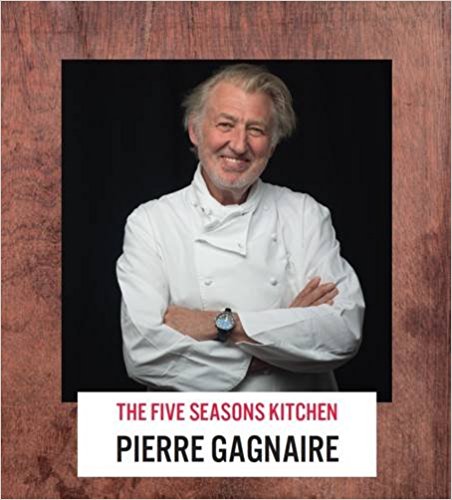
The Five Seasons Kitchen by Pierre Gagnaire

Five Seaons

Pierre Gagnaire is the French godfather of modernist avant garde cuisine, winning Michelin stars for his adventurous food in the early 80’s when Ferran Adria was still washing dishes for a living. Now, he presides over a world-wide empire that includes restaurants in Hong Kong, Las Vegas, and Dubai as well as his native France. But if you’re hoping for a definitive tome of the chef’s culinary oeuvre in the style of the Noma or el Bulli books, then you’re in for a disappointment.

Instead, to mark his 50th year in cooking, Gagnaire has produced his first family cookbook. The book’s 90 recipes are organised into 30, three course menus which are divided between not four, but five seasons. Gagnaire claims the fifth season is ‘that moment after winter has ended but before  spring has truly begun’. Recipes in the ‘Almost Spring’ chapter designed to be cooked in March and April include a stunning sole terrine with leek (although perhaps more of a dish for the restaurant than the family table) and a more homely and traditional blanquette de veau.

As you might expect from the man who serves conger eel with green mango and grapefruit granita in his eponymous three star restaurant in Paris, dinner chez Gagnaire is no ordinary affair. Fresh oysters are garnished with sardine, ginger and slices of frozen banana. Yes, banana. Floating islands is re-imagined as starter of egg white quenelles in a coffee scented chestnut veloute, topped with mortadella; and financiers are flavoured with rocket chlorophyll and served as a dessert with mint syrup and vanilla ice cream.

Frustratingly, there are no introductions to the recipes so the reader is left none the wiser to where the inspiration for all this creativity comes from, or the derivation of the name of the spicy ‘6 rue de la Pepiniere sauce’ that’s served with roast beef and made from red and green peppers, strawberries, raspberries and beetroot among other things (Google the address and you’ll discover it’s a branch of M&S Food in Paris, but how the two are connected remains a mystery).

The lack of a ‘basics’ section means there are no recipes given for the stocks, jus, brioche and ice creams required to make some of the dishes, inferring that home cooks are expected to use ready made alternatives. But despite it’s shortcomings, cooks of all levels may well find inspiration lurking in the pages of this highly individual collection.

(This review first appeared in The Caterer magazine)

Cuisine: French
Suitable for: Confident home cooks and professionals
Cookbook Review rating: 3 stars

Buy this book
The Five Seasons Kitchen
Pierre Gagnaire
£25 Grub Street