Mussel and saffron risotto by Raymond Blanc

SIMPLY RAYMOND by Raymond Blanc. Headline Home 2021
PREP 20 MINS / COOK 40 MINS

Mussels and saffron are united harmoniously in this classic risotto. There’s no need for that constant stirring. Instead, the rice is stirred towards the end of the cooking time to activate the starches, a trick you can use with any risotto you make.

SERVES 4

For the mussels
1kg fresh mussels
1 onion
2 bay leaves
2 thyme sprigs
1 tablespoon unsalted butter
100ml dry white wine

For the risotto
1 garlic clove
1 tablespoon unsalted butter
200g carnaroli rice (or arborio)
2 bay leaves
a couple of pinches of saffron powder or strands
pinch of cayenne pepper
2 pinches of sea salt flakes
100ml dry white wine
300ml water (or fish stock)

To finish
50g Parmigiano Reggiano cheese
2 teaspoons unsalted butter, at room temperature
a handful of coarsely chopped flat-leaf parsley
100g cooked peas (optional)
a handful of baby-leaf spinach (optional)
½ lemon, for squeezing

TO PREPARE First, the mussels. Ensure that all the mussels are tightly closed and not damaged before you begin to cook; any mussels that are damaged or open should be discarded. The preparation can be done in advance. Wash the mussels in a large bowl and under cold running water. Mussels that float at this stage are not very fresh, so discard them. Remove any barnacles and beards, but don’t scrub the shells as this can end up colouring the cooking juices. Drain.

Finely chop the onion and peeled garlic and grate the cheese. In a large saucepan over a medium heat, sweat half the onion, the bay leaves and thyme in the butter for 1 minute. Increase the heat to high, add the mussels, pour in the wine, cover with a lid and cook for 3 minutes. Drain in a sieve over a large bowl and discard any mussels that have not opened. Reserve the cooking juices, you will need about 200ml to make the risotto. Once the mussels have cooled, pick the mussels from their shells, leaving a few in their shells for decoration, and put them all aside.

Now, to the risotto … Melt the butter in a large saucepan on a medium heat. Add the remaining onion, cover with a lid and cook for 2–3 minutes, until the onion is translucent. Add the garlic and stir in the rice. Add the bay leaves, saffron and cayenne pepper and lightly season with salt. Stir and continue to cook on a medium heat for 2 minutes, until the grains of rice are shiny. Pour in the wine and let it boil for 30 seconds – bubble, bubble – and stir. Pour in the mussel cooking liquor and the water or fish stock and stir again. Now cook on the gentlest simmer, with just a single bubble breaking the surface. Cover with a lid and leave for 20 minutes, but it mustn’t boil. 4

Now it’s time for 5 minutes of some serious and fast stirring. At full speed, stir the risotto. The grains rub against each other, extracting the starch, and this gives the rice its creaminess. Yet every grain remains whole, unbroken. Taste – the rice should have a slight bite. Add the cheese, butter and parsley to the risotto, along with the cooked peas and spinach, if using, all the cooked mussels and a strong squeeze of lemon. Stir, taste and correct the seasoning just before serving. 

Cook more from this book
Slow-roasted shoulder of lamb, harissa by Raymond Blanc
Pear almondine by Raymond Blanc

Read the review

Buy this book
Simply Raymond: Recipes from Home – The Sunday Times Bestseller, includes recipes from the ITV series
£25 Headline Home

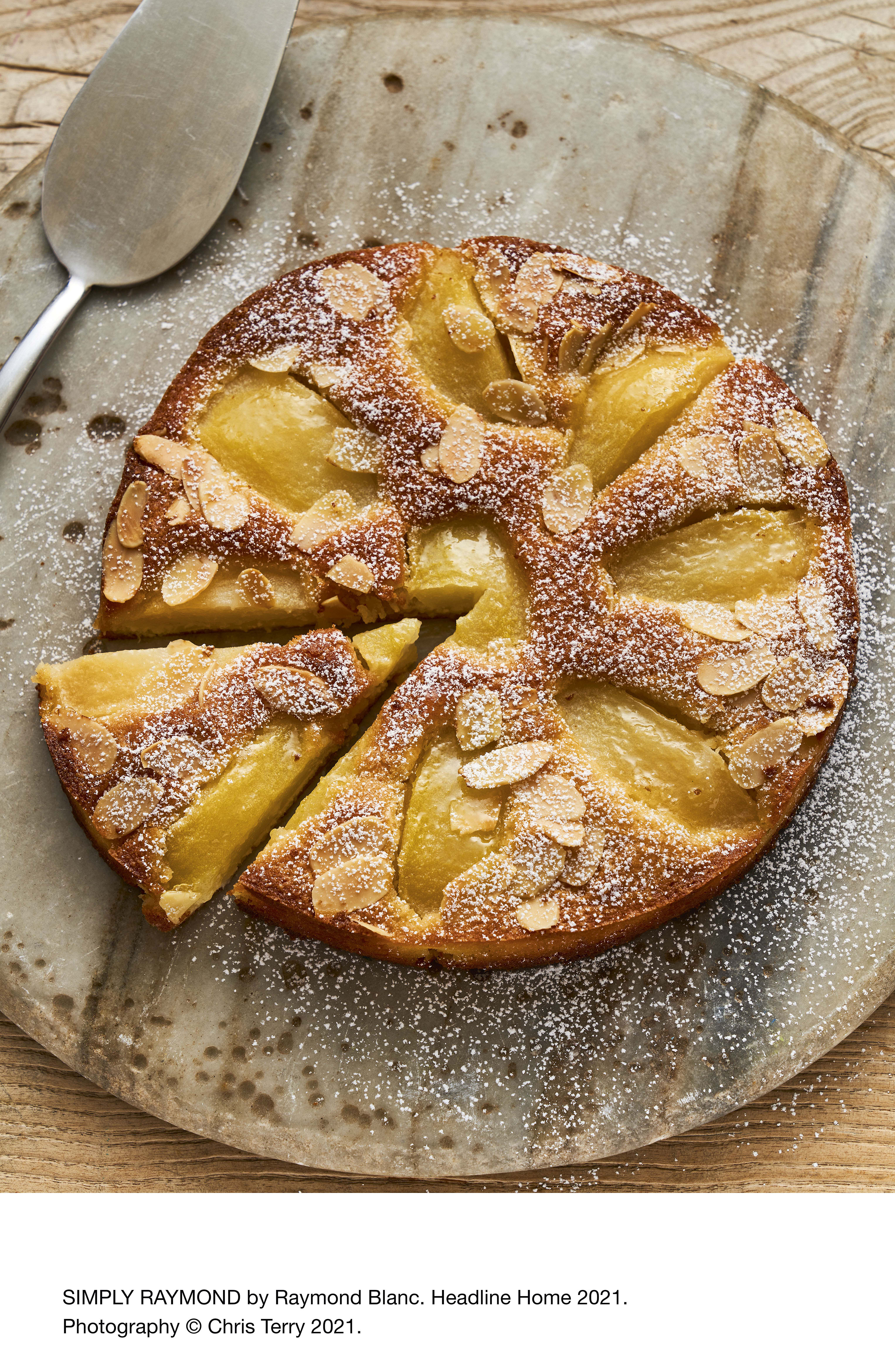
Pear almondine by Raymond Blanc

SIMPLY RAYMOND by Raymond Blanc. Headline Home 2021

It’s rare to find a dessert that is both simple and extraordinarily delicious. Pear Almondine is one of my favourites. You can find some excellent preserved Williams pears in jars or tins, ideal for this recipe. This dessert is a template to accommodate many other fruits and flavours. For baking like this, I like to use a baking stone. However, if you don’t have this, it will still be a winner.

SERVES 6
6 pear halves, tinned or jarred
100g unsalted butter, at room temperature, plus extra for brushing the tin
100g caster sugar
100g ground almonds
1 teaspoon cornflour
1 teaspoon vanilla extract
1 medium egg (preferably organic or free-range)

To serve
a handful of flaked
almonds (for extra flavour, first toast them in a dry pan)
icing sugar, for dusting

Preheat the oven to 200°C/180°C fan/gas 6. Butter (or oil) a tart ring, about 18cm x 2cm. Cut a long strip of greaseproof paper to stick to the inside. Place the lined tart ring on a lined baking tray or baking stone. Drain the pears and slice them in half again if they are large. In a large bowl, mix the softened butter and sugar. Then add ground almonds, cornflour, vanilla and egg, and mix well. Spoon the mixture into the cake tin, spreading it evenly.

Arrange the pear halves evenly around the outside of the tart, resting them on top of the almond sponge mixture, and with the tip of each half meeting in the middle. According to size of the pears, you may require the base of half a pear to fill a space in the centre. Scatter with almonds. Bake the tart on the middle shelf of the oven, on the preheated baking stone or baking tray, for 20–25 minutes, or until golden. Leave the cake to cool for a few minutes before removing it from the ring. Before serving, dust with icing sugar.

VARIATION
In a saucepan, reduce the syrup from the jar, let it cool and add a dash of Poire William, the pear liqueur. After baking, puncture the pears with a fork and pour over the syrup. It adds colour and flavour.

Cook more from this book
Mussel and saffron risotto by Raymond Blanc
Slow-roasted shoulder of lamb, harissa by Raymond Blanc

Read the review

Buy this book
Simply Raymond: Recipes from Home – The Sunday Times Bestseller, includes recipes from the ITV series
£25 Headline Home
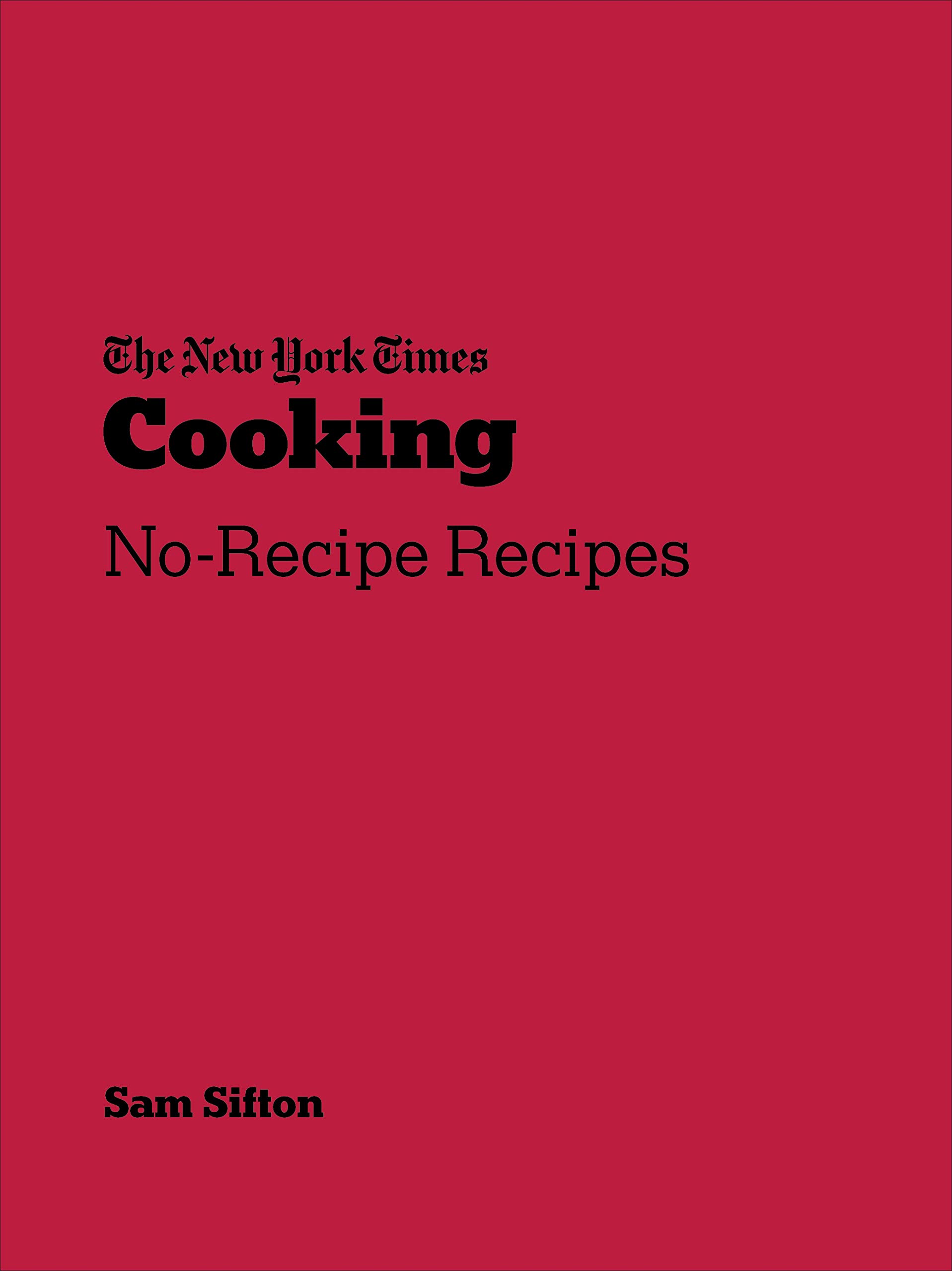
The New York Times Cooking: No-Recipe Recipes by Sam Sifton

New York Times Cooking No-Recipe Recipes by Sam Sifton

What’s the USP? Sometimes food doesn’t need to be put together using precise  measurements and exact times – No-Recipe Recipes is all about the big, flavourful ideas and less fussy about what you need to do and when. Every dish here is described in loose and accessible terms so that the home chef can amble carefree through the cooking process. 

Who wrote it? Sam Sifton, the founding editor of The New York Times’ cookery website. His weekly What To Cook This Week column on the site has, since 2015, always featured a No-Recipe Recipe of his own – an easy to throw together sort of a dish that might have been influenced by something he’s eaten in a restaurant, or the passing comment of a chef friend, or simply the desire to combine two flavours and gleefully eat them. 

Is it good bedtime reading? On the one hand, there isn’t an awful lot to read besides the short and enthusiastic introduction to each recipe. On the other hand, though, the recipes read so conversationally that they become a genuine pleasure to read in their own right. This is a book that can be taken to bed and flicked through with hungry eyes as you picture yourself breezily moving around the kitchen – a splash of fish sauce here, a generous pinch of oregano there. 

How annoyingly vague are the recipes? The entire book is annoyingly vague recipes. That’s sort of the point. Thankfully, Sifton’s bright and engaging writing – he clearly loves being in the kitchen almost as much as he loves food – enables the reader to confidently join him on his quest. 

The book’s brief introductory section convincingly champions Sifton’s approach. Cooking without recipes is a valuable kitchen skill, we are told: ‘It’s a proficiency to develop, a way to improve your confidence in the kitchen and makes the act of cooking fun when it sometimes seems like a chore’. 

The no-recipe recipes themselves certainly echo the ‘cooking is fun’ mentality. It’s impossible to resent vague instructions when they are written with as much relish as Sifton’s. The frankly obscene Cheese Ravioli with Duck Liver Mousse Sauce calls for a ‘huge amount of unsalted butter’, whilst his Roasted Shrimp Tacos with Cumin and Chile demands ‘a whole mess of peeled and deveined shrimp’. 

What’s the faff factor? It would be a bold move to expect readers to create lavish and complex dishes with only the loosest of instructions, so perhaps unsurprisingly the book is filled with nothing but the simplest dishes. The Tomato Sandwich recipe is four sentences long, and calls for only bread, butter, mayonnaise and tomato – but Sifton still manages to make it seem like an unmissable addition to a hot summer’s day. Even the most complex of dishes will come together in under half an hour and create only the most minimal of washing up. 

How often will I cook from the book? I have had this book for about a month now and can confidently say that I am cooking from it at least twice a week. It has already become the first book I pull from the shelf when I’m planning my weekly shop, despite being the title that arguably requires the least planning of the lot. 

Every one of Sifton’s No-Recipe Recipes is a temptation. They are easy to buy for and fun to cook. Above all else, the gentle thrill of cooking off-book, of trusting your own instincts and finishing, every time, with something genuinely delicious is a real confidence boost for new and old home cooks alike. 

What will I love? Though the book is designed to be minimalist and simple, it is still filled with useful information. Dishes frequently come with easy modifications that can be made – either to replace more obscure ingredients, or to offer a different flavour profile. Separate ‘Tips’ sections will help beginner cooks learn key kitchen lessons, or occasionally share Sifton’s own tasting notes (he recommends avoiding chicken or vegetable gyoza for his blasphemous yet irresistible Pot Stickers with Tomato Sauce). 

What won’t I love? It’s a small complaint, but the cloth-bound cover isn’t ideal for a book that will see as much use as this one. It picks up all sorts of filth, and thanks to some spilt flour and the eager attention of two cats, my copy already looks a fair bit older than it should one month in. 

Killer recipes: It would be impossible to make enough noise about the aforementioned Cheese Ravioli with Duck Liver Mousse Sauce, which must be the most outrageously indulgent dish it’s possible to compile in under twenty minutes. But pretty much every dish in here will inspire at least some level of food lust. 

Highlights include Crab Rangoon Burgers, Quick-Broiled Pork Chops with Peanuts and Gochujang, Ham and Radicchio Toast, and Asparagus and Boursin Tart. 

Should I buy it? Of course you should. Sam Sifton’s book is not a book about the joy of cooking – it’s an instruction manual that will help you discover it for yourself. This would be a brilliant gift for someone who is just discovering the world of cooking, with bright and easy recipes that feel like an accomplishment once finished. Student cookbooks are so often drab and patronising affairs that, at best, will help someone make a competent but uninspiring lasagne. From now on, let’s send our freshers off with No-Recipe Recipes tucked in their suitcase – I would have eaten a lot less £5 pizza delivery deals if I’d known how easy it was to knock-up Sifton’s Black Bean Tacos or Sloppy Joes. 

At the same time, confident cooks who have long since found their footing in the kitchen will still find a wealth of inspiration here – fresh new flavour combinations and easy dishes that can be pulled together quickly when you’re tired after work.

No-Recipe Recipes everything you want from a cookbook – it is simple, irresistible and innovative. But above all else, it reminds you exactly how fun cooking can be.

Cuisine: International
Suitable for: Beginner and confident home cooks
Cookbook Review Rating: Five stars

Buy this book
New York Times Cooking: No-Recipe Recipes
£20, Ebury Press

Review written by Stephen Rötzsch Thomas a Nottingham-based writer. Follow him on Twitter and Instagram at @srotzschthomas

Summer Kitchens by Olia Hercules

What’s the USP? A passionate love letter to Ukraine, written in everybody’s favourite love language: good food.

Who wrote it? Olia Hercules, who grew up in Ukraine before moving to Cyprus and eventually settling in the UK, has some chops in this field. Giving up her career in film business reporting after the 2008 financial crisis, she retrained at Leith’s and has worked as chef de partie at Ottolenghi. This is her third book – Mamushka and Kaukasis, her well-loved previous efforts, both drew on the traditions of a number of eastern European countries. Hercules tightens her vision to her homeland here, acknowledging throughout that the ever-shifting borders and populations of the region mean influences seep in from across the continent.

Is it good bedtime reading? The book is filled with evocative and fascinating prose, and is a little reminiscent of James Rebanks’ writing on shepherding – writing in such a way that even hardship is given a silver lining through the emergence of community spirit and creative solutions. The summer kitchens of the title are traditional outbuildings in Ukraine. When a young couple gets married, they share this single room kitchen/bedroom hybrid – often raising their families whilst they save to build a house. That home itself is built through a great community effort – Hercules’ descriptions reminded me of the barn building scene in Witness. Once the end result is completed, often many months later, the old structure becomes a ‘summer kitchen’ – a workshop-esque space for cooking and making the most of the produce grown in the garden. Stories like these permeate the book, making it as much a champion of Ukrainian culture as it is the recipes themselves.

Will I have trouble finding the ingredients? None at all – these are simple, homely recipes that create filling dinners from a range of ingredients you wouldn’t struggle to pick up from your local Aldi or Lidl. Classic staples make up the overwhelming majority of ingredients required here – vegetables, grains and plenty of eggs.  Occasionally you might need to visit a butcher for some goat, but most calls for meat are catered perfectly to what’s readily available in a supermarket – something that even our biggest celebrity chefs often fail to manage.

What’s the faff factor? Hercules is happy to devote a little time to her dishes, and you’ll need to do so as well. Noodles are made from scratch, and there are plenty of recipes that will require a leisurely afternoon in the kitchen. But nothing will test your skill as a chef – another benefit of the simple home cooking approach.

How often will I cook from the book? The time required for many of the dishes will relegate this to a weekend-only book for many, but there’s variety enough for at least a fortnightly visit.

Killer recipes: The chicken broth with bran kvas, noodles, mushrooms and lovage – a comforting Ukrainian take on the chicken noodle soup – looks set to cure any ailment you might present it with. The yeasted buns with slow-roast pork are irresistible too; crisp and soft rolls stuffed with unctuous belly, prunes and sauerkraut. Hercules also offers up some tempting fish ideas – be they deep-fried Odesan sprats or simple but delicious fishballs in tomato sauce.

Should I buy it? There’s a lot to love here, from the passionate celebration of Ukraine’s melting-pot culture to the extended section dedicated to pickling and fermenting. Olia Hercules has form, clearly, in the bottling of magic – and whether that’s in the form of fatty pork shoulder preserved for the winter months, or a love of her homeland, preserved for all to enjoy, it’s worth taking a bite of whatever she’s offering.

Cuisine: Ukrainian
Suitable for: Beginner and confident home cooks
Cookbook Review Rating: Five stars

Review written by Stephen Rötzsch Thomas a Nottingham-based writer. Follow him on Twitter and Instagram at @srotzschthomas

Buy this book
Summer Kitchens: Recipes and Reminiscences from Every Corner of Ukraine
£26, Bloomsbury Publishing

Shortlisted for the Andre Simon Food and Drink Book Awards 2020. See all the shortlisted books here.
andre simon logo

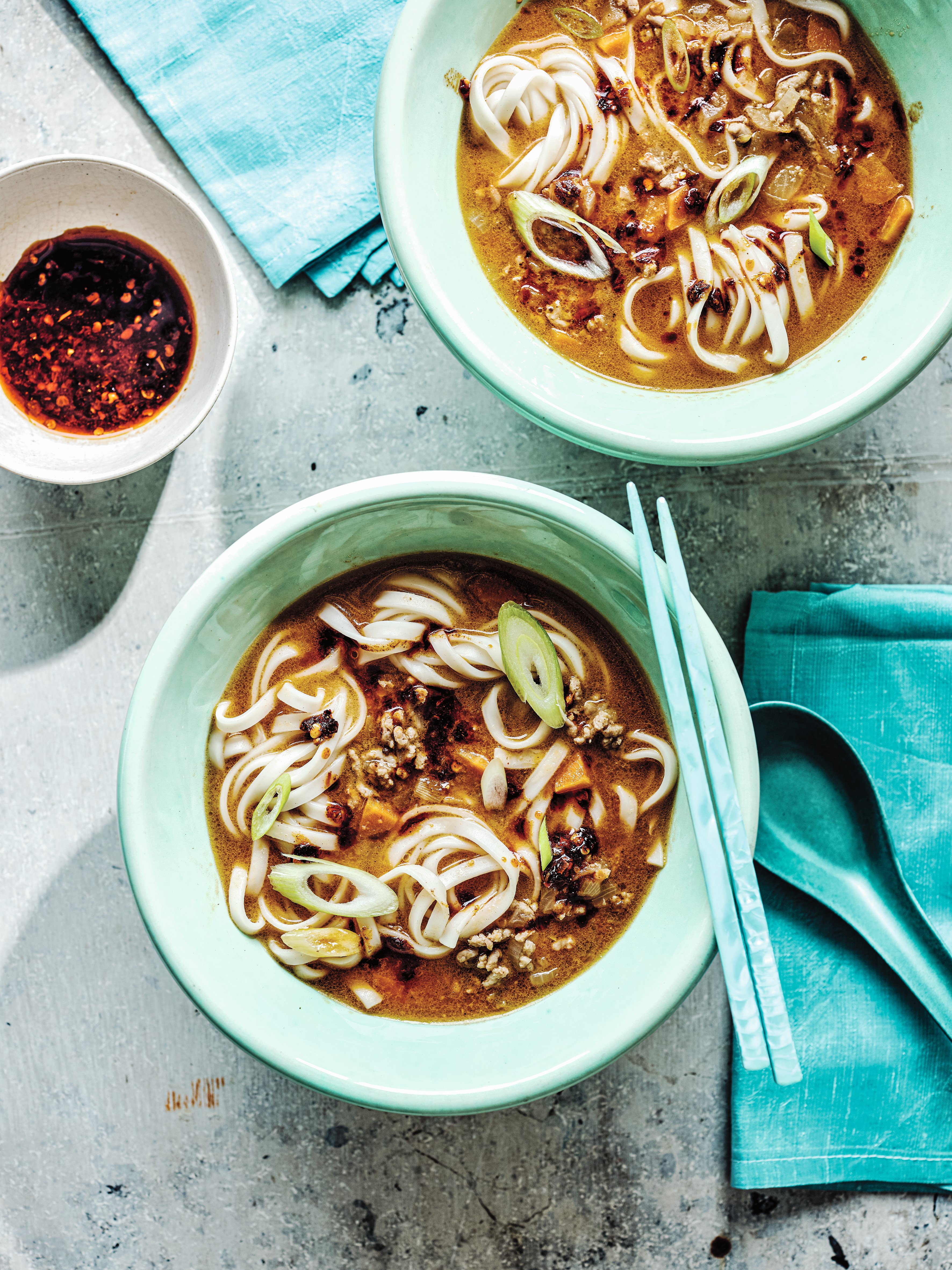
Dan Dan Noodle Soup with Lamb

071_Mr Lee's Dan Dan Noddle Soup with Lamb_Chinese

Serves 2
Wok to wonderful in 20 minutes
Showing Off /Vegan Option
Hero ingredients: garlic and ginger

A ‘dan dan’ is the pole that noodle sellers use to carry the baskets of fresh noodles and sauce, with one at either end. The star is Sichuan chilli bean paste, or toban djan (see page 17) but you can use other chilli pastes if you can’t get your hands on it. Combined with the Sichuan peppercorns, you get a lip-tingling intensity. You can also try it as a stir-fry dish by omitting the stock water, and using fresh noodles.

½ tablespoon vegetable oil
230g (8¼oz) minced (ground) lamb (or frozen vegan mince and 1/4 tsp yeast extract for a vegan alternative)
2 teaspoons garlic paste, or 3–4 garlic cloves, crushed and chopped
1 tablespoon ginger paste or 5cm (2in) piece of fresh root ginger, chopped
1 carrot, finely diced
1 large onion, finely diced
120g (4¼oz) dried wheat noodles
1 spring onion (scallion), finely sliced, to garnish

 FOR THE SOUP:
600ml (20fl oz) boiling water, or ready-made fresh vegetable stock
1 tablespoon crushed yellow bean sauce, or brown or red miso paste
1 tablespoon chilli bean paste, or 1 teaspoon any hot chilli paste
2 teaspoons crunchy peanut butter
½ teaspoon ground Sichuan peppercorns
1 tablespoon toasted sesame oil

Prepare the soup mixture by mixing all the ingredients together in a large bowl or jug, then set aside until needed. Heat the oil in a large wok over a high heat. Throw in the minced lamb (or vegan mince) and brown for a few seconds. Then add the garlic, ginger, carrot and onion and cook for another 2 minutes, stirring continuously. Your kitchen should smell amazing at this stage, so take a second, stop and breathe it in. But don’t take all day, we’re on a schedule!

Next pour the soup mixture into the pan and mix well, simmering for another 3 minutes. Now it’s noodle time. Put the noodles in a saucepan and cover with boiling water. Boil for 3 minutes, then drain. Divide your hot noodles between 2 serving bowls and pour over the soupy mixture. Sprinkle over the chopped spring onion (scallion). Strap in your taste buds: you’ll never forget your first Dan Dan Noodle Soup.

Cook more from this book
Hong Kong Street Beef
Seafood Ramyeon with Korean Red Pepper

Buy this book
The Noodle Cookbook: 101 healthy and delicious noodle recipes for happy eating
£15.99, Ebury Press

Read the review

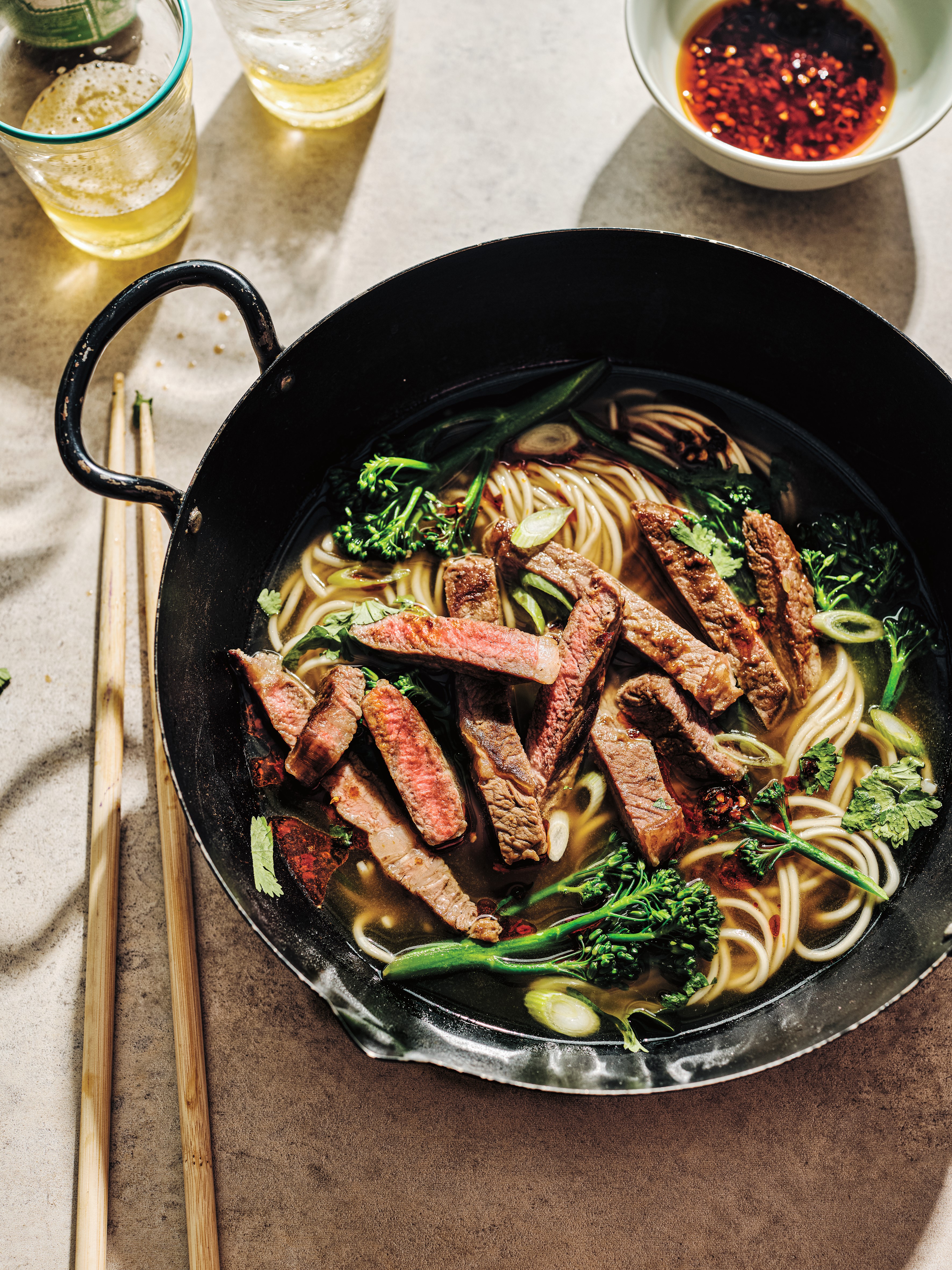
Hong Kong Street Beef

075_Mr Lee's Hongkong Street Beef_Chinese

Serves 2 Wok to wonderful in
30 minutes
Showing Off
Hero ingredients: ginger and broccoli

Mr Lee’s Hong Kong Street Beef noodle pot is a customer favourite, so we just had to adapt it for our very first cookbook. The richly flavoured and aromatic soup base, combined with the savoury hit of the steak, wraps you in a warm, beefy blanket of contentment. It’s the best kind of comfort food: Tastes like it took hours, but ready in minutes. Winner!

1 tablespoon crushed yellow bean sauce
1 teaspoon toasted sesame oil
½ tablespoon vegetable oil
250g (9oz) rib-eye steak, or use sirloin/
porterhouse if you prefer
85g (3oz) sprouting broccoli, or use regular
broccoli cut into bite-sized pieces
120g (4¼oz) dried thin wheat noodles (or use
thin rice noodles for a gluten-free alternative)

FOR THE SOUP:
230g (8¼oz) lean minced (ground) beef, or substitute
900ml (1½ pints) of ready-made fresh beef stock
2 small onions, finely diced
2 whole star anise
1 large black cardamom pod
½ teaspoon Chinese five-spice powder
1 teaspoon ginger paste, or 2.5cm (1 inch) piece of fresh root ginger, finely chopped
1 teaspoon garlic paste, or 2 garlic cloves, crushed and chopped
½ teaspoon sea salt, or to taste
½ teaspoon finely ground black pepper
1 tablespoon crushed yellow bean sauce
900ml (1½ pints) boiling water (if not using stock)

FOR THE GARNISH:
1 spring onion (scallion), finely sliced
handful of fresh coriander (cilantro), roughly torn (optional)
2 tablespoons chilli oil (optional)

Heat a medium saucepan over a medium–high heat and brown the minced beef (if using). Then add all the other soup ingredients except the water or stock.  Keep stirring for 2–3 minutes, then add the water (or stock, if using). Cover the pan with a lid and leave all those lovely flavours to simmer and intensify over a low heat for 20 minutes.

Meanwhile, mix together the yellow bean sauce and toasted sesame oil on a plate. Now it’s steak time! Put the steak on the plate and really rub the marinade all over, then set it aside for a few minutes. Heat a wok over a high heat and add the vegetable oil. Pan-fry the steak for about 3 minutes on each side. This will cook it medium – but it’s your steak, so cook it how you like. If you want it a bit pinker, then cook it for up to 2 minutes each side.

The super-high heat will seal the meat and keep it nice and succulent. As soon as the steak is cooked to your liking, put it on a chopping board, cover it with foil and let it rest for a bit. Place another medium saucepan on the hob and half-fill with boiling water. Add the broccoli and boil for 2 minutes, then add the dried noodles and simmer for another minute. Drain and divide the broccoli and noodles between two large, deep soup bowls.

Using a fine sieve, strain the soup broth as you pour it over the noodles in each bowl, discarding the aromatics. Slice the steak into strips, then layer on top of the noodle soup. Garnish with spring onion (scallion) and fresh coriander (cilantro). Serve with
a small pot of red chilli oil on the side for drizzling, and you’re good to go.

Cook more from this book
Dan Dan Noodle Soup with Lamb
Seafood Ramyeon with Korean Red Pepper

Buy this book
The Noodle Cookbook: 101 healthy and delicious noodle recipes for happy eating
£15.99, Ebury Press

Read the review

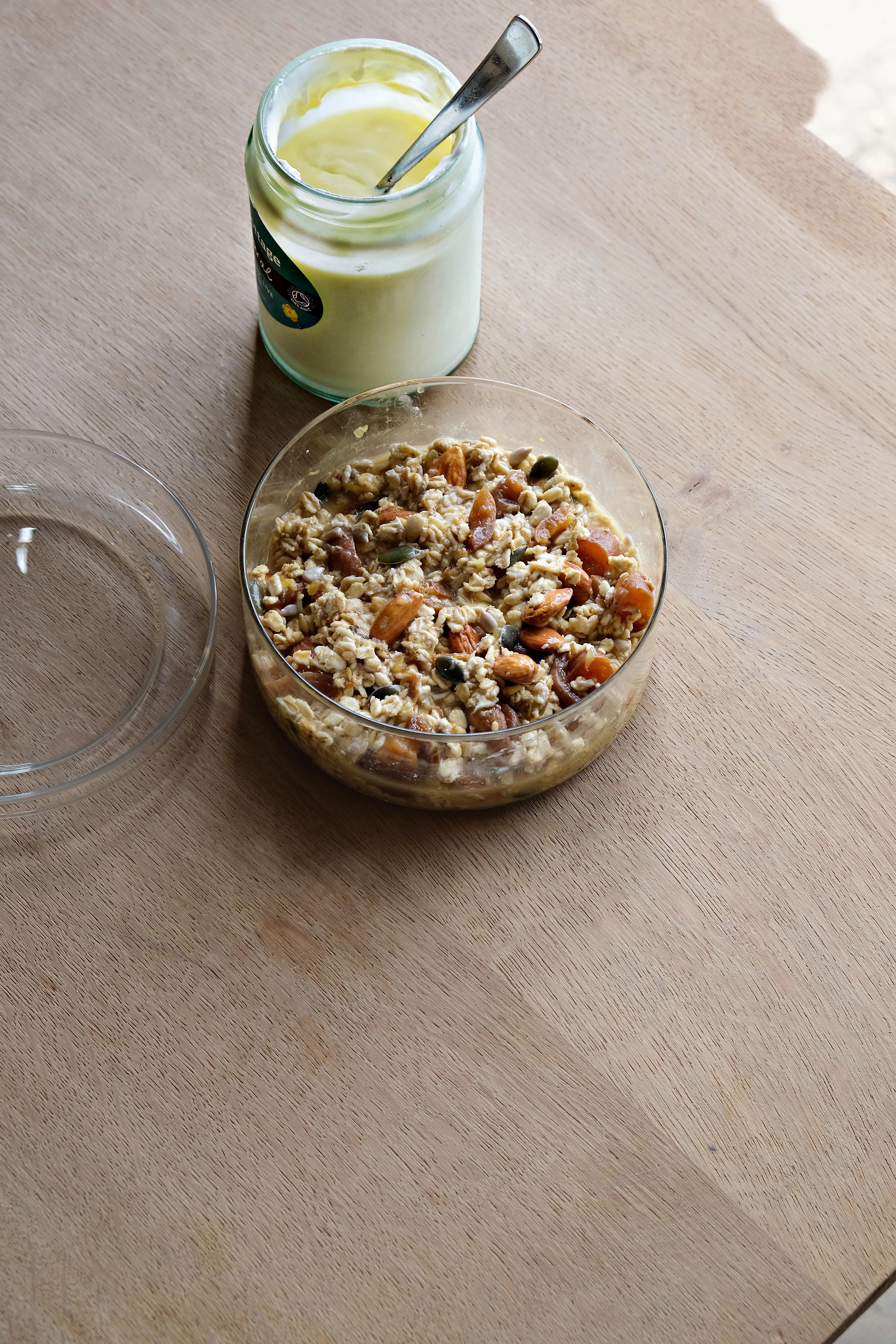
Overnight Oats by Hugh Fearnley Whittingstall

Overnight Oats

Soaking oats is a time-honoured route to a tender, tasty high-fibre breakfast – Bircher muesli is the classic example and ‘overnight oats’ the trendy interloper. This super-simple version uses jumbo oats, omega-rich seeds and skin-on almonds, which plump up and soften as they soak in orange juice and kombucha (or water). The result is juicy and mild, ready to be sweetened with a little fruit; I like a handful of raisins (which you can soak with the oats), or a grated apple – or both. If you include chia and/or flax seeds you’ll get that distinctive slippery texture, which not everyone loves but I do!

Serves 4
120g (7–8 tbsp) jumbo oats (or porridge oats)
A generous handful (30g) of mixed nuts and seeds (such as almonds and pumpkin, sunflower, poppy, flax and chia seeds)
Juice of 1 large or 2 small oranges
A small glass (about 150ml) kombucha (page 244) or water

To serve
A handful of raisins, chopped dried apricots or other dried fruit (soaked with the oats if you like), and/or a handful of berries, or a sliced small banana, or an apple, chopped or coarsely grated
1–2 generous tbsp natural yoghurt or kefir (page 246), optional
Toasted buckwheat groats (optional)

Combine the oats, nuts and seeds in a breakfast bowl (adding some dried fruit if you like). Add the orange juice and the kombucha or water. Mix well.

Cover the bowl and place in the fridge or a cool place for 6–8 hours or overnight. If possible, take the soaked oats out of the fridge half an hour before you want to eat them, so they’re not too chilly.

Serve with your chosen fruit. You could also add a spoonful or two of yoghurt or kefir and, to bring some crunch, a few toasted buckwheat groats.

Cook more from this book
Spicy roast parsnips
Seedy almond cake

Buy the book
Eat Better Forever: 7 Ways to Transform Your Diet
£26, Bloomsbury Publishing

Read the review 

First Catch Your Gingerbread by Sam Bilton

First Catch Your Gingerbread

What’s the USP? Everything you always wanted to know about gingerbread, but were afraid to ask, including the history of gingerbread from ancient times to present day, plus gingerbread and ginger cake recipes. It is part of Prospect Books’ series ‘The English Kitchen’ that looks at dishes and their place in history and which has previously included books on quince, soup and trifle.

Who’s the author? Sam Bilton is a food historian and writer and is probably best known for her historically-themed supper club Repast. She’s also worked on projects with English Hertiage and the National Trust. This is her debut book.

Is it good bedtime reading? The first 80 pages are given over to the scholarly ‘The Story of Gingerbread’ that begins with its pre-history in the ‘reverence given by ancient civilisations to the medicinal properties of spices’ and continues with it’s medieval incarnation (including an appearance in The Canterbury Tales as ‘gyngebreed’) and includes the importance of treacle in the history of gingerbread, how the recipe migrated from England to America and the difference between the two varieties, historical gingerbread moulds and other related creations, and it’s more modern incarnations and enduring appeal.

Will I have trouble finding ingredients? You will find virtually everything you need in the supermarket. However, you will probably need an online supplier for grains of paradise (a West African spice that looks like black peppercorns but is in fact a member of the ginger family) if you want to make Små Pepparkakor, the ‘intensly crisp, aramatic small gingerbreads’ from Sweden, and for long pepper to make Dulcia Piperata (Roman Peppered Honey Cake). There are savoury recipes in the book too so you’ll want to visit your fishmonger for the langoustine and crayfish for an unusual stew that includes gingerbread crumbs.

What’s the faff factor? Some recipes will take a little bit of planning, for example a game terrine or chocolate stuffed lebkuchen (a spiced shocolate cake), both of which are two-day processes, although neither are particularly complicated. But generally speaking, the recipes are very approachable, especially for home bakers with some experience.

How often will I cook from the book? If you have a sweet tooth and are a keen baker, the book is a treasure trove of interesting, unusual and, most importantly, delicious recipes that you’ll want to work your way through. The inclusion of savoury recipes makes it useful for when you want something just a little bit different for a dinner party or even just a family meal.

Killer recipes? Ormskirk gingerbread; Elisenlebkuchen (chocolate-glazed spice and nut biscuits from Germany); Indian gingerbread; Ginger scotch rabbit; baked Camembert with gingerbread; carrot and ginger roulade with honeyed ricotta;

What will I love? This is quite obviously a labour of love. Bilton has unearthed a fascinating history behind an everyday cake shop favourite and curated a selection of appealing recipes that you’d struggle to find anywhere else.

Should I buy it? For keen bakers and lovers of food history, it’s a no-brainer.

Cuisine: International
Suitable for: Bakers/beginners/confident cooks
Cookbook Review Rating: Four stars

Buy this book
First Catch Your Gingerbread By Sam Bilton
£15, Prospect Books

Also available at Amazon
First Catch Your Gingerbread (English Kitchen)

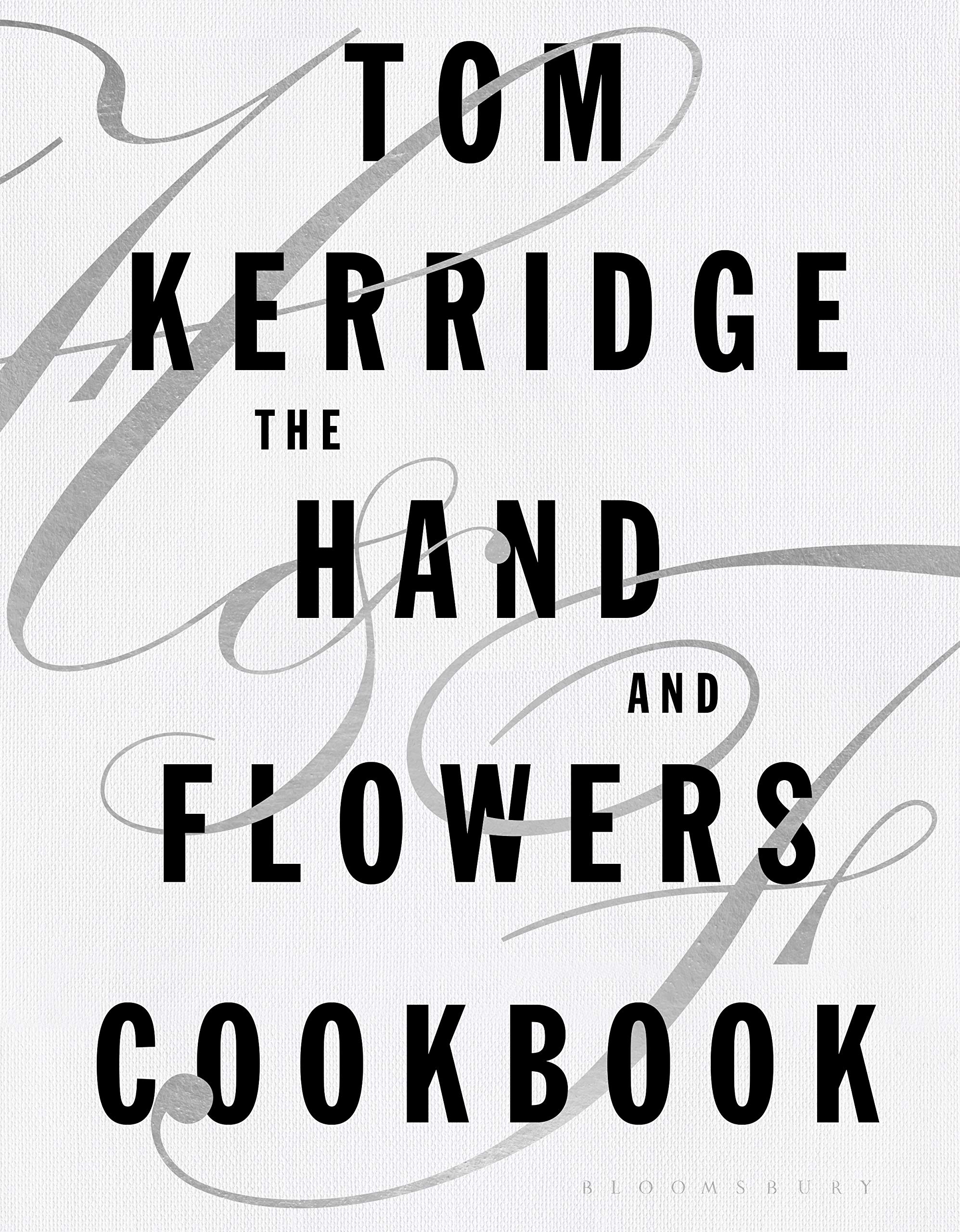
The Hand and Flowers Cookbook by Tom Kerridge

Hand and Flowers Cookbook by Tom Kerridge

What’s the USP? A brief history of and recipes from the world’s only two Michelin starred pub.

Who is the author? Chef Tom Kerridge has recently become known for his dramatic weight loss and series of diet-friendly TV shows and books including Dopamine Diet, Lose Weight and Get Fit, and Lose Weight For Good. His real claim to fame however is as proprietor of The Hand and Flowers pub in Marlow, Buckinghamshire, the only two Michelin starred restaurant in the world. He also runs The Coach, The Shed and The Butcher’s Tap in Marlow, Kerridge’s Bar and Grill in London and The Bull and Bear in Manchester. He is also the founder of the Pub in the Park, a touring food and music festival. Earlier in his career, he worked for such British restaurant luminaries as Gary Rhodes and Stephen Bull in London and David Adlard in Norwich.

Is it good bedtime reading? There’s a chunky introductory section telling the story of the pub, chapter introductions and full page introductions to all of the recipes, making the book a very enjoyable read. As a restaurant nerd, I would have loved to have read about Kerridge’s career before opening the Hand in 2005. As a good proportion of the book’s audience is bound to be professional chefs who would be equally interested to read about Kerridge’s rise through the ranks to stardom, it seems something of a missed opportunity. We can only hope there’s an autobiography in the works.

Will I have trouble finding the ingredients? Specialist ingredients in the book include Alba white truffle oil, agar agar, foie gras, squab pigeon, caul fat, veal tendons, Sosa Airbag Pork Granet, Sosa Antioxidant gel powder, meat glue, lamb sweetbreads, pig’s head and trotter and meadowsweet among others. There are plenty of far more mainstream ingredients too, although if you are going to go to the trouble of attempting these recipes you’ll want to head to your butcher, fishmonger and greengrocer rather than rely on standard supermarket gear.

What’s the faff factor? If you want to prepare a complete dish with all it’s  various elements – for example lemon sole grenobloise made up of stuffed lemon sole, brown butter hollandiase, brown bread croutons, confit lemon zest, crisp deep fried capers and anchovy fritters – then you need to be prepared to put in some serious kitchen time. For many home cooks, probably the best way to approach the book is to pick and choose between the constituent parts and either make a simplified version of the dish with just the key elements or take the recipe for a garnish, such as the famous Hand and Flowers carrot that’s braised in water, sugar, butter and star anise, and use it to accompany something simple like a roast, grill or stew. The good news is that many of the recipes for the individual parts are relatively straightforward and it’s the quantity of constituent elements that make cooking a complete Hand and Flowers dish daunting for non-professionals.

How annoyingly vague are the recipes?   There are the usual suspects such as a  squeeze of lemon, sprig of thyme or half an onion (how big is an onion? How long is a piece of string?) and one dish calls for meat glue but gives no quantity. However, you should have no problems with the vast majority of the recipes.

How often will I cook from the book? Will you be knocking up a torchon of quail with crispy quail leg and verjus everyday? Probably not. But you might well find yourself making the ‘Matson’s sauce’ (a ‘super-posh’ chip shop curry sauce named after Kerridge’s favourite fish and chips shop) that goes with it pretty regularly. Ambitious home cooks will find much to inspire them, and may well turn to the book  when planning a celebratory meal, a dinner party or just to indulge in a weekend of hobby cooking. But as previously noted, a close reading will reveal a treasure trove of sides and sauces, as well as some achievable main elements that will ensure the book won’t permanently reside on your coffee table and will get regular use in your kitchen.

Killer recipes: Smoked haddock omelette; crispy pigs head with black pussing, rhubarb and pork crackling; fish and chips with pea puree and tartare sauce; halbut poached in red wine with bourguignon garnish; slow cooked duck with duck fat chips and gravy; braised shin of beef with roasted bone marrow, parsnip puree and carrot; sweet malt gateau with malted milk ice cream and butterscotch sauce.

What will I love? If you know the pub, you’ll be glad to see all the classic dishes have been included and that the book’s claim to be a definitive collection of the pub’s recipe is an accurate one. At over 400 pages, the book has a pleasing heft, the design is colourful yet classic and elegant, and the food photography by Cristian Barnett is simply stunning.

What won’t I like so much?  If you’re after more of Kerridge’s diet friendly fare, you are definitely barking up the wrong butter, cream and foie gras-laden tree.

Should I buy it? If you are a fan of Tom Kerridge’s restaurants and want to challenge yourself in the kitchen, this is the book for you. It will also be of particular interest to professional chefs.  

Cuisine: British
Suitable for: Confident home cooks/Professional chefs
Cookbook Review Rating: Five stars

Buy this book
The Hand & Flowers Cookbook
£40, Bloomsbury Absolute

Cook from this book
Smoked haddock omelette
Slow cooked duck
Vanilla crème brûlée by Tom Kerridge

The Whole Chicken by Carl Clarke

The Whole Chicken Carl Clarke

What’s the USP? It’s nose-to-tail cooking, but for chickens! So beak-to-tail-feather, then. The Whole Chicken breaks down the bird both literally and metaphorically, with chapters dedicated to all our favourite cuts, as well as mince, offal, bones, skin and, in a move that technically fits the bill but feels a little too eager to get the chicken on the table, eggs.

Who wrote it? Author Carl Clarke has definite chicken-cred. I mean, I imagine his credibility is at rock bottom with actual chickens – he keeps eating them. But through Chick ‘n’ Sours and spin-off Chick’n he has two of the coolest bird-and-apostrophe-centric restaurants in London to his name.

Is it good bedtime reading? Though Clarke skips out on chapter introductions (who needs to be told that thighs are the best bit of the chicken for the umpteenth time?), he quickly makes up for it with passionate and practical introductions to each recipe. Forget about the bedtime reading though, it’s the kitchen dance-offs that you’ll be focused on: the book offers five brilliantly curated playlists to keep you entertained whilst you prepare, cook and eat the whole of your chicken.

How annoyingly vague are the recipes? Not even a little bit. Clarke goes into a decent amount of detail throughout. There’s a refreshing commitment to clarity, in fact. The book lists both metric and imperial measurements at every opportunity, and even features both British and American terms where necessary (cling film/plastic wrap, etc).

What’s the faff factor? Clearly marked at the side of the page. A small scale next to each recipe ranks the dish as either ‘easy peasy’, ‘almost breezy’, or ‘worth the effort’. That said, quite a lot of the dishes fall into that latter category. The scale isn’t particularly consistent either. The Next Level Breville grilled sandwich is listed as ‘worth the effort’, and whilst it’s certainly a lot more of a commitment than your usual toastie, it pales by comparison to the Chicken Nuggets with Kimchi Bacon Ranch Dip and Spicy Shake.

What will I love? The sheer range of dishes on offer here. Clarke draws on a number of different cuisines, though East Asia and the United States are perhaps the most obvious influences. Everything here looks absolutely delicious, and the design of the book itself only emphasises this. The Whole Chicken is intensely cool, and you’ll be a little surprised to find that it’s willing to hang out with you and your other cookbooks.

What won’t I love? There’s a disappointing amount of recipes representing the less commonly used pieces of the chicken. Given the title of the book is ‘The Whole Chicken’, you’d perhaps expect a little more attention to be paid to these areas. Instead, the overwhelming majority of the book is dedicated to those traditional cuts. The entire offal section comprises of just five recipes, meaning that those looking for inspired uses for chicken heart (a delicacy in several countries) will find just one stand-alone recipe. The same goes, inexplicably, for the liver, gizzards and feet – despite each of these having myriad uses in various global cuisines.

Killer recipes: My Friend Romy’s Butter Chicken Recipe, Doritos-Coated Schnitzel with Fried Eggs and Anchovies, Gunpowder Wings, Xian-Spiced Chicken Scratchings and Cherry Cola Chicken Legs.

Should I buy it? Despite not fully realising the promise of its title, The Whole Chicken does offer up an irresistible wealth of dishes drawn from genuinely global influences. It isn’t the first book to do a deep dive on the chicken, but it feels very much of its own space. I have Diana Henry’s lovely A Bird in the Hand on my shelves too, but comparing the two here feels a little like throwing Delia Smith in the ring with David Chang.

Cuisine: Global
Suitable for: Beginner to confident home cooks
Cookbook Review Rating: Four stars

Review written by Stephen Rötzsch Thomas a Brighton-based writer. Follow him on Twitter and Instagram at @srotzschthomas

Buy this book
The Whole Chicken: 100 easy but innovative ways to cook from beak to tail
£22, Hardie Grant