The Shore by Bruce Rennie

The Shore

I was very honoured to be asked to contribute an introduction, alongside Michelin-starred chefs Nathan Outlaw and Martin Wishart, to The Shore, the first cookbook by Bruce Rennie, chef proprietor of The Shore restaurant in Penzance. Although I do not benefit financially from my association with the book, it has proved impossible for me to write an entirely impartial review of The Shore, not least because I am a fan of Bruce and his cooking and have got to know him through visiting the restaurant and interviewing him. So instead of a review, here is my introduction from the book. I hope it will entice you to pick up a copy of the book, or even better, take a trip to Penzance to try Bruce’s food for yourself.

As soon as I heard about The Shore back in 2015, I knew it was going to be worth the 600-mile round trip from my home in Brighton to eat there. It wasn’t just that the restaurant was in Cornwall, a regular holiday destination for my family for over 25 years, or that I love Cornish seafood. It wasn’t even that the chef had worked in some impressive establishments including the Michelin-starred Restaurant Martin Wishart, one of my favourite places in Edinburgh.

The thing that really told me that The Shore was going to be something special was that it was a one-man operation. Because no one in their right mind runs a restaurant kitchen by themselves. At last count there were roughly a million easier ways to make a living, including being employed by someone else to run a restaurant. So, you only do it if you are driven to it; you have a culinary vision and a need to express yourself through food. In my experience, that always adds up to an exceptional experience for the customer. It was true of Shaun Hill at The Merchant House in Ludlow in the 90’s and early noughties, and its true of Bruce Rennie and The Shore.

From a starter of fillets of John Dory, cooked on the plancha with to-the-second precision and so perfectly triangular they looked like they’d been filleted with a scalpel, to a ‘plinth’ of Blackberry semifreddo with pistachio sponge and apple that was almost architectural in its design (Bruce studied architecture before deciding on a career in the professional kitchen), that first meal at The Shore was faultless. To top it all off, Bruce was not only cooking but helping to serve the food as well, moving nimbly between kitchen and dining room, engaging with the customers while ensuring he was never
away from the stove for too long.

I interviewed Bruce the day after that memorable dinner and discovered that not only can he cook, but also has a talent for storytelling and can talk the hind leg off a donkey. It was only when I found out that he is also very handy when it comes to DIY and carried out the refurbishment on the restaurant and kitchen himself that I began to deeply resent the breadth and depth of his Renaissance-man skills. No one is allowed to be that talented.

I was lucky enough to bag a seat at Bruce’s guest dinner at J Sheekey Atlantic Bar in London in 2018 as part of a series of pop ups to celebrate the restaurant’s 10th anniversary which also included Mark Sargeant of Rocksalt in Folkestone and Simon Hulstone of Michelin starred The Elephant in Torquay. Seemingly unconcerned by the unfamiliar surroundings, Bruce delivered food that was every bit as good as it had been in Cornwall; no mean achievement, and something he’d also pulled off at a guest night at The Gallivant in Rye in 2016.

You might expect someone so obviously focused and determined to be a somewhat straight-backed, tightly wound sort of personality, but Bruce is endearingly eccentric. After a long and very good lunch in London, I said goodbye to Bruce outside the Shepherd Market pub where we’d enjoyed one or two for the road and watched him remove his shoes and socks and walk off barefoot through the crowd (which is also his preferred state of dress for cooking in The Shore kitchen).

The publication of Bruce’s first cookbook means that I can at last attempt to recreate a little bit of The Shore’s seafood sorcery in my own kitchen. In reality, I know I’ll still have to make that 600-mile round trip to taste the real thing, but I also know that it will still be worth it.

Cuisine: Seafood
Suitable for: Professional chefs

Buy this book
The Shore
£25, A Way with Media

The Garden Chef with an introduction by Jeremy Fox

The Garden Chef

What’s the USP? The Garden Chef explores the growing (pun intended) worldwide phenomenon of top chefs cultivating their own produce for their restaurants in on-site kitchen gardens. The book includes ‘recipes and stories from plant to plate’.

Who is the author? The book has been created from the contributions of chefs from 40 high-end restaurants around the globe which most notably include Simon Rogan from L’enclume in England, Ben Shewry from Attica in Melbourne, Alice Waters from Chez Panisse in Berkeley and Michel and Cesar Troisgros from Trisgros in France. The introduction is by Jeremy Fox of Bridie G’s in Santa Monica who is also the author of the brilliant cookbook On Vegetables, also published by Phaidon and which is cookbookreview.blog five star-reviewed.

What does it look like? Expect a riot of raised beds, a plethora of polytunnels and a great deal of gathering in the fields. The accent is as much on ‘garden’ as it is ‘chef’. The majority of the 80 recipes are illustrated and the food does look great, but it’s rather overshadowed by all the greenery.

Is it good bedtime reading? The chef or chefs of each restaurant (some are run by duos including Michael and Iain Pennington at The Ethicurean just outside Bristol and Gaston Acurio and Juan David Ocampo of Astrid Y Gaston in Lima)  are given a full page to espouse their horticultural and culinary philosophies, earning The Garden Chef space on your bedside table.

Will I have trouble finding ingredients? You’ve seen the Indiana Jones movies, right? Unless you cultivate your own incredibly vast and comprehensive kitchen garden, be prepared for an amazing adventure where you’ll raid the lost ark, discover the temple of doom and embark on the last crusade to track down sangre de toro potatoes, kalanchoe blossfeldiana and Mexican pepperleaf, among many, many other obscure ingredients that you definitely won’t find at your local Asda.

What’s the faff factor? These are recipes aimed fair and square at the professional chef community. There are dishes achievable for the home cook, but really they are not the main reason you would buy this book; it exists primarily to document and give a window into a particular aspect of the modern restaurant scene.

How annoyingly vague are the recipes? If you are up for attempting them, the recipes are detailed enough to follow to successful completion.

How often will I cook from the book? That depends. How often are you in the mood for something like chef Ana Ros’s ‘Rabbit That Wants to be Mexican Chicken’ where you’ll need to wrap rabbit mousse in whole chicken skins and serve with rabbit sauce flavoured with star anise and chilli, roasted carrots, apricot gel, carrot top pesto and hibiscus flowers?

Killer recipes? Don’t get me wrong, the book is full of delicious things you’ll want to eat like The Quay’s Tennouji white turnip, blue swimmer crab and Jersey Wakefield cabbage with fermented cabbage juice and brown butter dressing, but you’ll probably want to go to the restaurant and try them rather than cook them yourself, even if that does mean flying half-way around the world. Doable recipes include white and green pizza from Roberta’s in Brooklyn and cream of vegetable soup from The Sportsman in Seasalter.

What will I love? If you’ve been looking for inspiration to create your own kitchen garden, be it for your restaurant or your home, then you couldn’t ask for a better book. There are even garden tips and the chefs favourite heritage varieties to give you a kick start, although if you want step by step guidance on how to actually get out there and do it you’ll need to look elsewhere.

What won’t I like? The decision has been taken not to include any images of the interior of any of the restaurants, which gives the book a feeling of incompleteness. This is partly understandable, given that the thrust of the book is on the chef’s activities outside their restaurants rather than in them. However, after reading the book, you might well be interested in planning a visit to one or more of the places included and wonder what you are letting yourself in for. Of course, you can google the restaurant’s website and reviews for images, but that’s sort of beside the point; you can google images of many of the restaurant’s gardens and dishes too if you are minded to.

Should I buy it? It’s a great book but may have niche appeal. If you are a keen gardener or aspire to be one, as well as a foodie, you will dig (pun intended) this book. If you want to know more about an influential trend that is helping to define to the current global high-end restaurant scene, this is also a must-read.

Cuisine: International
Suitable for: Professional chefs/Confident home cooks
Cookbook Review Rating:
Three stars

Buy this book
The Garden Chef: Recipes and Stories from Plant to Plate
£29.95, Phaidon

Cook from this book

Coming soon

A Cookbook by Matty Matheson

Matty Matheson

What’s the USP? The first book from Vice TV star and the most famous Canadian chef in the world Matty Matheson. Despite the title, this is a culinary memoir as well as a recipe book.

Who is the author? Matty Matheson is a Toronto-based chef and restaurateur and former roadie for heavy metal band At the Mercy of Inspiration. Until  2017, he was executive chef of Parts and Labour and sister restaurant P&L Burger. He is the curator of Matty Fest a new food and drink festival launching in September 2019.

Matheson’s career took off in 2013 when he recorded the Hangover Cures and Keep It Canada series of videos for the Munchies YouTube channel which led to the Vice TV channel series It’s Suppertime and Dead Set on Life (both of which are available to view for free in the UK on the ALL 4 website here and here). In early 2019, he announced the launch of his self produced web series Just a Dash which is due to air in autumn 2019.

At the age of 29, Matheson suffered a heart attack after a sustained period of alcohol and drug abuse but eventually became sober. His larger than life personality and post-modern approach to food television that simultaneously celebrates and undercuts the form can be seen in this video, recorded for Gozney ovens website where he demonstrates his mother’s broccoli-chicken cheddar curry casserole, the original recipe for which, he says in the book ‘was probably on the side of a can or a box’ (it’s also a glorious dish).

What does it look like? Part recipe book, part family photo album, part Canadian travelogue, the book is beautifully put together. Food photography by Quentin Bacon (excellent name for a food photographer by the way) is simple, unfussy and lets Matheson’s cooking speak for itself. Matheson grew up in the less than picturesque town of Fort Erie, Ontario but Pat O’Rourke’s urban landscapes have a bleak magnificence to them.

Is it good bedtime reading? Divided into two parts, Matheson tells first the story of his family life and the food cooked by his grandparents, parents and in-laws. In the second part, he recounts his career from culinary school through formative experiences at Le Select Bistro,  La Palette and Oddfellows (all in Toronto) to his appointment as head chef of Parts and Labour and his transition into a media figure, all told with unflinching candour and a healthy dose of salty language.

Will I have trouble finding ingredients? You’ll need an excellent butcher to track down things like a whole lobe of foie gras to make seared foie gras with rice pudding and warm date marmalade, veal sweetbreads to cook blanquette ris de veau and veal shank and ox tongue to recreate Matheson’s pot-au-feu, but unless you are in Canada, finding elk loin to serve with carrots, celeriac and pickled blueberries may prove very tricky.

What’s the faff factor? That depends largely on which part of the book you’re cooking from. The Family recipes are a little more straightforward than those in the Cooking School and Restaurants chapter, but many are quite time consuming to prepare.

How annoyingly vague are the recipes? There are the usual ‘bunches’ of herbs but apart from that there are no real issues and even the American cup measures come with precise ml equivalents.

How often will I cook from the book? Some of the more simple and approachable recipes could well become firm favourites such as baked rigatoni and blackberry coffee cake but you will probably have to plan well ahead to cook many of the dishes.

Killer recipes? In addition to those already mentioned, I would add lobster pie, molasses bread pudding, rabbit stew, pot roast, rappie pie (a crispy, layered grated potato and chicken bake), Italian wedding soup, Nashville hot chicken, pigtail tacos, lamb dan dan noodles and the P&L burger.

What will I love? Matheson is funny, entertaining and self-aware throughout. For example, in his introduction to the recipe for Sausage and Potatoes he says, ‘If you don’t want to make sausage, you don’t have to. Just buy good Italian sausage from a butcher like a normal human being. No one has time to do something like this, or who even has a sausage stuffer or meat grinder. Why is this even in this book? Do people even cook from cookbooks?’

What won’t I like? Some readers may not appreciate the bad language.

Should I buy it? Matty Matheson is the most interesting and exciting American food personality since Anthony Bourdain and his first book is as compelling as his on screen appearances. An absolute must buy.

Cuisine: American
Suitable for: Confident home cooks
Cookbook Review Rating:
Five stars

Buy this book
Matty Matheson: A Cookbook
£25, Mitchell Beazley

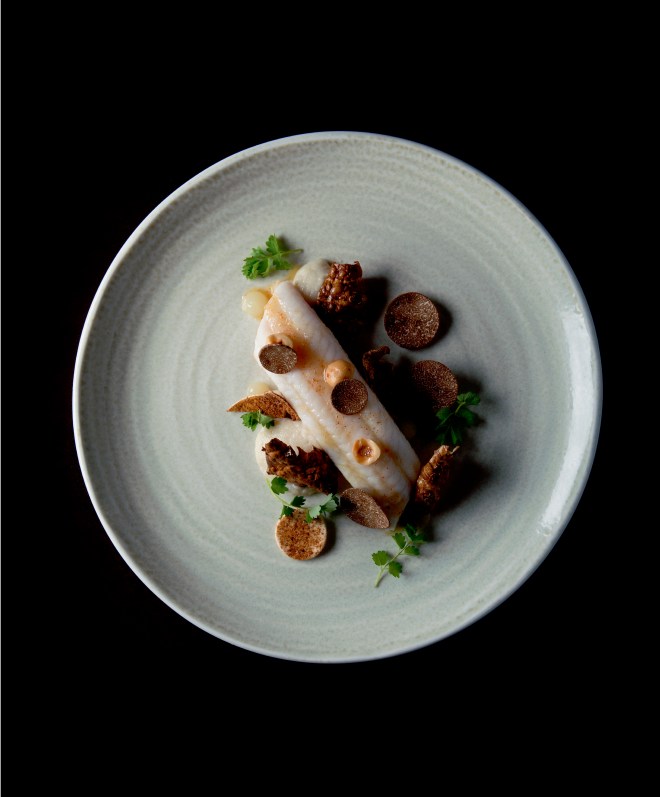
Sole, Jerusalem artichoke, black truffle by Mauro Colagreco

Sole Jerusalem artichoke Black truffle - Copyright Eduardo Torres

SERVES 4

FOR THE SOLE
Sole, 2 from 300-400 g
Jerusalem artichokes, 500 g
Sunflower oil, 500 cc
Dairy cream, 100 cc approx.
Shallot, 1
Chive, 10 g
Large mushrooms, 2
Extra virgin olive oil, 20 cc
Beurre noisette, 100 g
Hazelnuts, 50 g
Mushroom powder (dried and ground)
Black truffle (autumnal)
Pimpernel, 12 leaves
Sea salt

FOR THE LIME GEL
Lime juice, 250 cc
Agar-agar 3.5 g

PREPARATION

SOLE
Fillet the soles and set aside. Wrap the Jerusalem artichokes in aluminium foil and oven roast at 180°C for approximately 40 minutes, until done. Remove the foil, make a slit on top and squeeze to extract the pulp. Retain the peel and dry it at 60°C. Set aside. Transfer the pulp to the Thermomix, add 50 cc of cream for every 200 g of pulp, process, then strain. Transfer to a 1-charger siphon and reserve in a 50°C bain-marie.

Brunoise-cut the shallot. Mince the chives. Brunoise-cut the mushroom stems. Add the shallot to a heat hot suaté pan with olive oil, then add and brown the mushrooms. Remove from heat, season with salt and add the chives. Set aside.

Cut two slices of mushroom and dust with the mushroom powder. Dry at room temperature. Cook the sole for 5 minutes in a 70°C combi oven at 30% humidity. Matching up the edges, lay one dorsal fillet atop the lower fillet.
Toast the hazelnut in butter in a saucepan until the butter is browned (noisette).
Fry the Jerusalem artichoke in 180°C sunflower oil.

LIME GEL
Mix the lime juice and agar-agar in a saucepan, bring to a boil and whisk for 2 minutes. Once the mixture has cooled, process in a blender until it has a gel-like consistency. Transfer to a squeeze bottle.

PLATING
Set a base of sautéed mushrooms on a plate and, on top, arrange the sole, two dots of Jerusalem artichoke foam, some of the crisped Jerusalem artichoke, beurre noisette and hazelnuts atop the sole, mushroom slices and black truffle slices. Finish with two dots of lime gel and pimpernel leaves.

Cook more from this book
Turbot Celeriac Sorrel
Grouper rosemary sorrel

Read the review

Buy this book
Mirazur (English)
Catapulta, £70

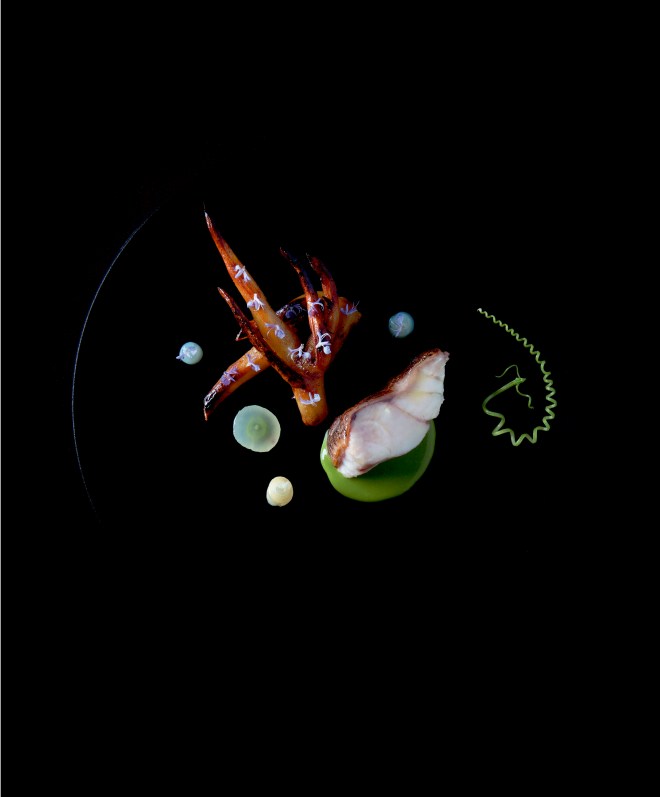
Grouper Rosemary Salsify by Mauro Colagreco

Grouper  Rosemary  Salsify - Copyright Eduardo Torres.jpg

SERVES 10

FOR THE GROUPER
Grouper (from 2.5 kg), 1
Extra virgin olive oil, 100 cc
Thyme, 1 sprig

FOR THE ROSEMARY SAUCE
Shallot, 20 g
Butter, 20 g
Dairy cream, 500 cc
Rosemary, 4 g
Spinach, 200 g
Leek greens, 25 g

FOR THE GRAPE GEL
White grape juice, 500 cc
Ascorbic acid, 1 g
Agar-agar, 11 g

FOR THE WILD SALSIFY
Wild salsify, 20
Milk, 1 l
Butter, 500 g
Star anise, 1
Cardamom, 2 grains
Black peppercorns, 3

FOR THE SPANISH SALSIFY
Spanish salsify, 1
Ascorbic acid
Shallot, 5 g
Butter, 1 knob

PREPARATION

GROUPER
Fillet the fish, remove the spines and cut into 80 g portions. Transfer to a vacuum bag with the olive oil and thyme, seal and cook in a steam oven at 65°C for for 4 to 5 minutes. Transfer the bag to an ice bath. Place the fish skin-side down into a hot sauté pan and cook until it takes on a good colour. Remove the fish and let it rest skin up for a minute and a half. Place skin down under a salamander to finish cooking.

ROSEMARY SAUCE
Sweat the minced shallot in a pot with a little butter, add the cream and reduce by half. Add the rosemary sprigs and allow to infuse for 5 minutes. Taste to check if the cream has the desired flavour, if so, discard the rosemary. Transfer the cream to a food
processor, add the spinach and leek greens and process. Pass through a fine strainer. Chill quickly so the sauce doesn’t oxidise and change colour. Reserve.

GRAPE GEL
Use a juicer to extract 500 cc of juice from white grapes. Heat 300 cc of the juice in a saucepan with ascorbic acid, add the agar-agar and, stirring constantly, boil for 2 minutes. Remove from heat, add the remaining grape juice, and chill.

WILD SALSIFY
Peel each wild salsify and, before peeling the next, place into the milk. Blanch them in boiling milk for 30 seconds, remove and transfer to a tray with the butter, star anise, cardamom and black pepper. Oven roast at 130°C, turning every 10 minutes, until
golden brown. Set aside.

SPANISH SALSIFY
Peel the Spanish salsify, use a Japanese mandoline to slice thinly and soak in the water with ascorbic acid. Glaze with the finely minced shallot and butter until the slices are pliable enough to roll.

PLATING
Arrange two wild salsify on each plate, two grape halves (previously blanched in boiling water for 10 seconds, shocked in ice water, peeled and seeded) and the grape gel. Brush the plate with rosemary sauce, add a salsify roll, rosemary flowers atop the salsify, one white grape per portion and then the grouper.

Cook more from this book
Turbot Celeriac Sorrel
Sole Jerusalem artichoke black truffle

Read the review

Buy this book
Mirazur (English)
Catapulta, £70

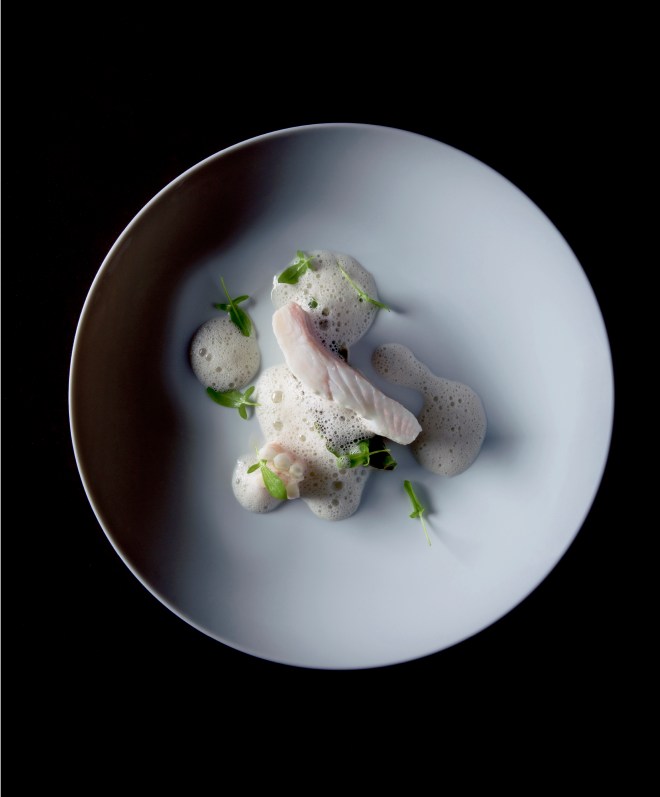
Turbot Celeriac Sorrel by Mauro Colagreco

Turbot Celeriac Sorrel - Copyright Eduardo Torres

SERVES 4

FOR THE CELERIAC PURÉE
Celeriac, 300 g
Butter, 100 g
Milk, 50 cc
Salt

FOR THE SMOKED SAUCE
Extra virgin olive oil
Garlic, 1 clove
Dog cockles (cleaned and drained), 1 kg
Water, 100 cc
Melted butter, 700 g

FOR THE TURBOT
Turbot fillet with skin (min. 700 g approximately), 1
Clarified butter

PREPARATION

CELERIAC PURÉE
Peel and cube the celeriac. Cook the cubes in butter, without allowing them to colour. Add the milk, then cover the pan with baking parchment. The celeriac must be cooked rapidly and needs to be soft. Process in a blender (such as Vitamix) until smooth. Season
with salt.

SMOKED SAUCE
Heat the olive oil in a saucepan, add the crushed clove of garlic, dog cockles and water, and cook for 15 minutes. Pass the cooking liquid through a fine strainer; the yield is approximately 700 cc. Add the 700 g of melted butter to the cooking liquid and transfer to a baking pan. Place the pan in a smoker using copper beechwood for 20 minutes. Reserve in a deep but not wide saucepan.

TURBOT
Bake the turbot for 8 minutes in a 75°C combi oven set at 10% humidity. When done, remove the skin and cut into approximately 90 g portions. Brush with clarified butter.

PLATING
Rapidly sauté 50 grams of sorrel in olive oil, then arrange it in the centre of the plates. Set a quenelle of the celeriac purée on the side of the sorrel and the fish atop. Use a hand blender (such as Bamix) to emulsify the very hot sauce and distribute it around the fish. Finish the plates with wild sorrel leaves and fleur de sel.

Cook more from this book
Sole, Jerusalem artichoke, black truffle
Grouper rosemary salsify

Read the review

Buy this book
Mirazur (English)
Catapulta, £70

Fare magazine

Fare Glasgow

What’s the USP? They say, ‘Fare is a bi-annual print publication exploring city culture through the intersection of food, history, and community.’ If I wanted to be profoundly annoying, I’d say it was a bookazine, but as I don’t want to be profoundly annoying, let’s just say, it’s its own thing. So, not a cookbook and there’s no recipes, but if you like Cook Book Review you are probably going to be interested in Fare.

Who’s the editor? Ben Mervis is a food writer who has previously worked at Noma restaurant in Copenhagen and has worked as a researcher and industry expert with the excellent Chef’s Table documentary series on Netflix. Contributors include some of the top names in food writing, including in the latest issue, Sunday Times restaurant critic Marina O’Loughlin.

Is it great bedtime reading? It’s nothing but great bedtime reading. Each edition of the magazine takes a city as its subject and delves deep into it’s culture through a series of essays, photo-stories and illustrations. Destinations covered so far are Istanbul, Helsinki, Charleston, Seoul and, in the latest edition published July 2019, Glasgow

What will I love? It’s a beautiful object. Printed on a mix of high quality matt and gloss paper and roughly the size of a hardback novel (although the magazine itself is soft cover) it just feels great to hold and read. The art direction by Ric Bell is top class, and with roughly equal space given to word and image, there’s room for both satisfyingly long form writing and aesthetically pleasing visuals.

What won’t I like? You’ve come to Cook Book Review for the food, so in that context it’s worth underlining that Fare is not a food magazine exclusively, but the subject is dealt with comprehensively. In the Seoul issue for example, there are articles about Buddhist nun and chef Jeong Kwan (featured in an episode of Chef’s Table), Mingles restaurant, Fritz Coffee Company, budae jjigae (or army base stew), the Korean dish of ‘cold noodles’ and a photo essay on Noryangjin fish market, among others.

Should I buy it? I don’t know of any publication quite like Fare. It’s fascinating, educational, a pleasure to read and looks cool. Surely worth twelve quid (plus shipping) of anyone’s money.

Buy this magazine: Fare


Restaurant Nathan Outlaw by Nathan Outlaw

Restaurant Nathan Outlaw

What’s the USP? At last, after a string of books aimed at the home cook, it’s Nathan Outlaw the full-on restaurant coffee table book.

Who’s the author? Cornwall’s ‘King of Fish’, a familiar face on TV, author of a series of fish cook books, serial restaurateur. No, not Rick Stein! It’s Nathan Outlaw, who admittedly trained with Rick Stein, but is easily told apart from the Steinmeister by the three Michelin stars he holds; one at Outlaw’s Fish Kitchen and no less than two at Restaurant Nathan Outlaw, both in the tiny Cornish village of Port Isaac. You certainly wouldn’t bet against Outlaw picking up a fourth star sometime soon at Siren, his new gaff at The Goring Hotel in London.

Is it great bedtime reading? A skimpy introduction that pays only lip service to Outlaw’s career doesn’t bode well, but the interesting and well written recipe introductions, along with a number of essays dotted throughout (mostly supplier profiles) adds some meat to the (fish) bones of the book. It is however frustrating to read in the ‘About the author’ section at the back of the book that Outlaw has worked for the likes of Peter Kromberg, Gary Rhodes, Eric Chavot and John Campbell and not get to read any anecdotes about those experiences.

How annoyingly vague are the recipes? Ingredients are assigned specific weights and measures so there’s no handful of this or splash of that and methods are detailed and clearly explained so that home cooks as well as chefs will be able to happily attempt Outlaw’s dishes.

Killer dishes? There are any number of delicious sounding seafood dishes in the book including gurnard with Outlaw’s signature Porthilly sauce made with tomatoes, fish stock, shore crab stock and butter, and bass with leeks and tartare hollandaise (another of the chef’s signature sauces), but Outlaw is also no mean baker and pastry chef and you are bound to be tempted to try his roasted onion and Cheddar straws, shortbread custard creams and apple and cinnamon doughnuts.

What will I love? The variety of seafood that’s imaginatively prepared by a master of the craft; the stunning photography by David Loftus, the eight chapters that break each season into early and late, highlighting the importance of time of year to Outlaw’s cooking style and helping the reader pick the right fish and shellfish for pretty much any week of the year.

What won’t I like? It’s galling, especially in a book that costs £45 (or £250 if you want the deluxe edition that’s ‘bound in fish leather, hand signed and beautifully slip cased’ according to the publisher) to have to wade through platitudinous articles about how wonderful the restaurant’s wine list or staff are, which read like little more than press releases. There is, as a general rule, far too much of this sort of thing in modern restaurant cookbooks and a firmer editorial hand or the involvement of an independent professional writer (think how improved Corbyn and King’s cookbooks such as The Ivy were by AA Gill’s work) would be extremely welcome.

Should I buy it? There are an awful lot of seafood cookbooks already on the market (including Nathan Outlaw’s Fish kitchen, Nathan Outlaw’s Home Kitchen and Nathan Outlaw’s British Seafood for a start) but Outlaw does bring his own style and a lot of expertise to the subject making Restaurant Nathan Outlaw a worthwhile purchase.

Cuisine: Seafood
Suitable for: Confident home cooks/chefs
Cookbook Review Rating: 4 stars

Buy this book: Restaurant Nathan Outlaw

Cook from this book

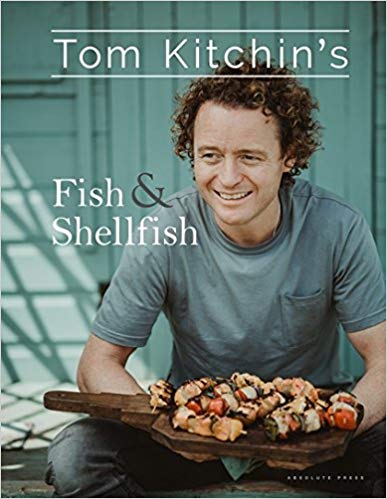
Tom Kitchin’s Fish and Shellfish

Tom Kitchin

What’s the USP? A celebration of the fruits of the sea by one of Scotland and the UK’s best-known chefs and restaurateurs.

Who’s the author? Tom Kitchin worked for the very best in the business including Alain Ducasse and Pierre Koffman before opening The Kitchin in Leith in 2006 with wife Michaela. He quickly notched up a Michelin star and went on to open the highly rated Castle Terrace and Scran and Scallie gastropub, both in Edinburgh. Later this year he launches the Bonnie Badger pub with room in the village of Gullane on the East Lothian coast as well as Southside Scran gastrpub in the Bruntsfield area of Edinburgh. Kitchin’s cherubic features and curl mop of hair can regularly be seen on the BBC in shows such as Saturday Kitchen, Masterchef the Professionals and The Chef’s Protege.

What does it look like? This is Tom Kitchin, Michelin-star chef creating recipes for the home cook so expect slightly more relaxed food presentation than you might find at his signature restaurant. Each recipe is headed with a hand drawn illustration of the main seafood element by Nathan Shellard which is a very nice touch and there are a few photographic portraits of Kitchin, en famille doing various seaside related activities.

Is it great bedtime reading? It’s not exactly a gastronomic War and Peace, but the brief introduction is bolstered by a useful chapter on seafood cooking techniques and each of the 100 recipes has a breezy, upbeat introductory paragraph, many of which contain tasty nuggets of culinary wisdom.

Killer recipes?  Octopus, mixed bean and black olive salad; squid and prawn stuffed courgette flowers; monkfish, salmon and scallop kebabs; roasted cod head with citrus dressing; smoked haddock and Mull cheddar souffles; clam and miso broth.

What will I love?  Kitchin covers his subject well with a good range of fish and shellfish with chapters on crustaceans, molluscs, cephalopods, flat fish, white fish, oily fish and mixed seafood dishes. Although this is aimed primarily at the home cook, there are plenty of ‘cheffy’ dishes like scallop and chicory with Spiced Sauternes sauce to interest Kitchin’s fellow professionals.

What won’t I like? There could be more guidance on how to make sure you’re cooking with sustainable seafood and Kitchin tends to stick with the more mainstream varieties and swerves things like black bream, grey mullet and gurnard, all wonderful fish that any decent fishmonger should be able to sell you.

Should I buy it? Kitchin has entered a crowded market and set himself up against some big names, not least of which is Rick Stein who published his own book called Fish and Shellfish in 2014; Tom Aiken’s excellent Fish, and the lesser known but still wonderful Feast of Fish by Ian McAndrew. But as a fresh take on the subject for 2019, Tom Kitchin’s Fish and Shellfish is well worth investigating.

Cuisine: Scottish/seafood
Suitable for: Confident home cooks/professional chefs
Cookbook Review Rating: Three stars

Buy this book
Tom Kitchin’s Fish and Shellfish
£26 , Absolute Press

Estela by Ignacio Mattos

Estela

Ignacio Mattos’s downtown Manhattan restaurant Estela has a cult following among British chefs. James Lowe invited Mattos to cook at his Shoreditch restaurant Lyles in 2017 and Matthew Young, formerly of Elroy and Mayfield’s, is a fan. Before opening Estela in 2013, Uruguay-born Mattos worked for Judy Rodgers at Zuni Café and Alice Water and David Tanis at Chez Panisse in San Francisco. In the book’s introduction, he sites Francis Mallmann, the godfather of elemental open fire cooking, as his ‘main mentor’ and with whom he cooked outdoors in New York during a snowstorm and on top of a mountain in Mendoza.

In the brief introduction, Mattos talks about his culinary travels that have allowed him to explore everything from Italy’s cucina povera to modernist cooking in Spain; from classical French cuisine to the Afro-Brazilian cooking of Bahia, Brazil. That global perspective is reflected in the ‘Estel Essentials’ chapter that lists Italian bottarga, Southeast Asian fish sauce and Japanese furikake seasoning among Mattos’s favoured pantry ingredients.

In less intuitive hands, such broad open-mindedness could result in fusion-confusion. Mattos however has an ace up his sleeve with his underlying ethos of ‘layering, tension and balance’ that brings harmony to disparate elements through the considered and subtle use of vinegars, citric acids, spicy heat and savoury items such as fish sauce or juiced green garlic that bring his dishes to a ‘happy place just at the borderline of too much’.

It’s an approach typified by a signature dish of sushi-grade fluke that’s cured in sugar and salt, diced and mixed with Arbequina olive oil and mandarin olive oil and served with sea urchin roe, yuzu kosho (a paste of chillies fermented with yuzu juice and zest and salt) and white grapefruit zest. Other stand outs from the collection of more than 133 recipes include lamb ribs with chermoula and honey; cured foie gras wrapped in grape leaves, grilled and served with chicken jus seasoned with soy and ponzu, and steak served with black sesame bearnaise and turnips.

Just when you think you’ve seen it all, along comes a book like Estela to prove you (delightfully) wrong. Mattos has a particular and distinctive take on what can make up the menu of a ‘neighbourhood restaurant’, a viewpoint that will provide a wealth of inspiration to chefs no matter what type of establishment they are cooking in.

Cuisine: American/progressive
Suitable for: Professional chefs/confident home cooks
Cookbook Review Rating: Four stars

Buy this book
Estela
$35, Artisan