You Can Cook Everything: A Contemporary Guide to Perfect Home Cooking Every Time by DK – Cookbook Review

What is the USP?
An encyclopaedic guide to everything you need to know to become a confident home cook, covering over 1,000 techniques, tips, and recipes in one lavishly photographed volume. There’s no particular cuisine or concept. The focus is on giving you the building blocks to master everything from stir-frying tofu and grilling steak, to baking focaccia and folding gyoza.

What will I love?
It’s all here — the classics, the comfort food, the global favourites — presented with generous step-by-step photography and precise instructions. Want to perfect a béchamel? Learn to butterfly a leg of lamb? Bake flawless cinnamon buns? You Can Cook Everything gives you the confidence to try it, with visual cues and no judgment. It demystifies the things many cookbooks gloss over, from how to make shortcrust pastry to when to season your steak.

There’s also a pleasing sense of reassurance. Although it feels more up-to-date than other ‘cookery bibles’ due to the inclusion of more modern ingredients, it isn’t trying to be trendy or edgy. It’s here to guide you towards better home cooking, at your own pace. Think of it as a contemporary kitchen manual designed for a generation who may not have learned to cook from family, but who are hungry to learn now.

Is it good bedtime reading?
Yes. It’s not a memoir-style book full of essays or storytelling, but it’s incredibly satisfying to flip through. Each page feels like a mini masterclass. If you love the rhythm of methodical, practical cookery, this is bedtime gold.

Will I have trouble finding the ingredients?
Unlikely. The book is global in scope, so you’ll find everything from curries to shakshuka, but recipes are tailored to what is realistically available in most UK supermarkets. There’s helpful advice on substitutions, and where a specialist ingredient is needed (e.g. tamarind paste, rice flour), it’s generally one that has become fairly mainstream. The book is about building confidence and teaching you flexibility, not sending you schlepping across town on a three-hour shop.

How easy are the recipes to follow?
Exceptionally easy. The hallmark of DK books is their visual clarity, and You Can Cook Everything delivers in spades. Recipes are structured, well-spaced, and meticulously illustrated. There are visual walk-throughs for everything from kneading bread to filleting a fish, and plenty of troubleshooting tips to keep you on track. It’s ideal for anyone who wants to see how something should look at each stage. If you are someone who enjoys the reassurance of watching YouTube videos before trying a recipe, the chances are you will find You Can Cook deeply satisfying. 

Stand-out recipes?
The ‘Spring Onion and Cheddar Soda Bread’ is a wonderfully comforting, cheesy twist on a classic, while the ‘Butternut Squash and Sage Gnocchi’ is perfect to make in autumn. On the sweet front, the ‘All‑In‑One Vegan Chocolate Cake’ is rich, fudgy and undetectable as a vegan bake, and the ‘Blueberry Streusel Muffins’ are a delicious way of elevating the fruity favourite with a sweet and crunchy topping. 

How often will I cook from this book?
All the time. It’s a book you will reach for when trying something new or troubleshooting something familiar. The tone is quietly empowering: you don’t feel patronised, but you are never left to flounder. It’s perfect for beginner cooks, but even seasoned home cooks will enjoy the clarity and breadth. You might not cook everything in it, few of us have that kind of ambition, but it’s incredibly satisfying to know it’s all there.

Any negatives?
Not for what it sets out to do. Of course, if you are looking for a cookbook with an evocative or emotional narrative or a strong authorial voice, this won’t fill that void. It’s a clear, clean, and comprehensive reference book at heart. It also isn’t heavy on dietary notes (you won’t find extensive gluten-free or vegan adaptations), though there are plenty of naturally plant-based dishes. 

Should I buy the book?
Absolutely, especially if you’re building or refreshing your cookbook shelf and want a reliable, go-to guide. You Can Cook Everything is a must-have modern-day cooking bible: practical, clear, and deeply satisfying to use. It will teach you to trust your instincts and become a better cook, one delicious step at a time.

Cuisine: International 
Suitable for: Cooks of all abilities – a great place for beginners to start, while also filling in gaps/offering new inspiration for keen cooks. 
Great for fans of: Delia Smith, Leiths and Samin Nosrat.
Cookbook review rating: Five stars
Buy this book: You Can Cook Everything: A Contemporary Guide to Perfect Home Cooking Every Time
£30.00, DK

This review was written by Freelance Food Writer and Recipe Developer Sophie Knox Richmond. Follow her on Instagram on @sophie_kr_food

Sohn-mat by Monica Lee and The Korean Cookbook by Junghyun Park and Jungyoon Choi

It doesn’t take a genius to work out that there is often a great void between the chef and the home cook. Though both are creating dishes for consumption, the context, methods, and sheer scale of their work differs tremendously. The same considerations should be made when a professional chef – particularly those operating in fine dining environments – write a cookbook.

It’s something I regrettably neglected to aptly reflect on when I reviewed Niklas Ekstedt’s ridiculously lavish entry into the canon a few years ago. How can I, a home cook in urban Britain, be expected to source reindeer hearts, I asked. I don’t even have an Ikea food hall near me.

But, of course, I wasn’t the intended audience. Ekstedt didn’t expect me, of all people, to knock up one of his many dishes that called for the cook to first gather their hay. Hell, he didn’t even expect most of the chefs who bought the book to build a fire from dried grass on his behalf. Most cookbooks by acclaimed chefs are about the theory of cooking as much as they are about the cooking itself. About sharing gastronomical philosophies, flavour combinations, and mutually revelling in what it means to get excited about presenting these bold, delicious ideas for others to taste.

Which is what makes two recent Korean cookbooks so interesting. Both Sohn-mat and The Korean Cookbook have been written by professional chefs with acclaimed restaurants to their name, and both books are aimed specifically at audiences looking to bring Korean flavours into their homes. The challenge here, then, is for the authors to translate their professional interest in cooking into a language that is relevant for domestic kitchens.

Monica Lee, the writer behind Sohn-mat, has a definite head start in this process. Lee was, before she opened her much-loved restaurant Beverly Soon Tofu in LA, a home cook with a small but very loyal fanbase of friends and family. Amongst the many Korean dishes she would recreate in her kitchen was the soon tofu chigae that she eventually became famous for.

Lee’s restaurant, opened in 1986, was entirely focused on this relatively low-key dish – a nutritious bowl normally associated with affordable diners in Korea. Beverly Soon Tofu closed in the midst of the pandemic, and Lee’s book is its legacy; her way of connecting with people one more time, and empowering them to create the food she served for over three decades.

In a move that feels spiritually aligned with the cookbooks of Michelin-starred chefs, most of the first eighty pages of Sohn-mat are dedicated wholly to recreating this dish. This means in-depth looks at the sourcing and handling of ttukbaegi – the clay pot Lee served her custardy tofu in. There are tips on ingredients and methodology, and no less than twenty-two recipes for components and variations so that the reader can recreate soon tofu chigae at home exactly the way they like it best.

Though Lee goes to lengths to make these recipes accessible, and considers almost every obstacle a home cook might come up against, the approach can feel a little overwhelming. To serve up a by-the-book version of the restaurant’s popular Combination Soon Tofu, home cooks will need to commit to making a beef broth from scratch, as well as preparing marinated short rib trimmings, and a seasoned red pepper paste that requires a day’s rest in the fridge before use. It’s not impossible by any means, but it does put the dish firmly into the ‘best saved for the weekend category’.

Beyond soon tofu chigae, Lee offers a wide ranging look at other Korean dishes. Starting with banchan – side dishes served alongside rice – we are presented with plenty of bright vegetable dishes and a select few for carnivores (who are given a much broader selection to choose from in a later section of sharing platters).

Lee’s recipes tend to be relatively wordy and this, combined with ingredients lists that feature those extra recipes to prepare in advance, can make the dishes look like a lot of work. And look, it’s a busy book – filled to the brim with tips and adjustments for different dietary needs – but the dishes are usually easier than they look. Those preparatory recipes only exist because Lee has offered DIY options for ingredients you can just buy off the shelf if you need. Save yourself the time and use standard soy sauce instead of Lee’s seasoned version, or any garlic you like, instead of her pre-blended take. If Sohn-mat has any real flaw, it is not that it is too difficult for home cooks – but rather that the writing and design makes everything look like a lot more effort than it really is.

Offering an even broader look at Korean cuisine is Phaidon’s The Korean Cookbook, written by Junghyun Park and Jungyoon Choi. Park is best known for Atomix, which was this year named the 8th best restaurant in the world by World’s 50 Best Restaurants. It’s one of four Korean-oriented restaurants he runs in New York, which puts him very much at the high-end of chefs-turned-writers. His co-author Choi is a research and development chef for Sempio Foods and – not that I’m claiming any foul play – Academy Vice Chair of Korea & China at World’s 50 Best Restaurants.

The Korean Cookbook is the latest entry in Phaidon’s ongoing mission to publish the definitive tome for any cuisine you care to imagine. The series always has its strengths and weaknesses, which we’ve covered over the years here. Historically, one of the series’ biggest issues has been a lack of context for the dishes presented. Here, thankfully, we see perhaps the most in-depth look at a cuisine that Phaidon have yet offered readers. Park and Choi offer an extensive forty-page introductory section exploring the concept of hansik, or Korean cuisine. There are also useful introduction to chapters on fermentation, and the different components that make up a meal in Korea. Perhaps most importantly – and frequently missing in older entries to the series, each recipe is given vital context.

The grand scope of the book means that there are over 350 recipes to choose from. Readers can be certain that any Korean dish they already know and want to recreate will be here – there are two options for the nation’s distinctive take on fried chicken, and three for bulgogi. But the joy is in discovering the unexpected, and there are plenty of exciting new ideas here for readers to explore, from Pan-Roasted Acorn Jelly to Ray with Bean Sprout Jjim and Yuja (Yuzu) Punch.

There are, as is often the case with Phaidon’s books, a large number of cases where audiences not actually based in Korea will struggle to source ingredients. Even the best stocked Asian supermarket is unlikely to provide stonecrop. Of course, this authenticity is what readers come to the series for. But sometimes it feels as though it goes too far – so much of this book is celebrating home cooking, but the authors make no effort to offer advice on substituting hard-to-find ingredients.

This is a particular shame for those looking to recreate those iconic dishes – both The Korean Cookbook and Sohn-Mat are all too keen to include pre-mixed cooking powders in their recipes. Park and Choi use a store-bought seasoned flour mix for both fried chicken recipes, but offer no DIY substitute. The jeon (pancake) recipes across the books almost all call for ‘Korean pancake mix’ but, again, offer no substitute. In offering an authentic view of Korean home cooking, The Korean Cookbook is a success. In making the dishes universally accessible, less so.

But then, do people come to cookbooks that explore other cuisines expecting the author to present every dish as a simple half-hour recipe? It takes millennia to form the way a nation eats – The Korean Cookbook offers a potted history that starts in the neolithic period. It shouldn’t be a matter of rocking up at the tail end of this evolution and demanding simple translations. And, frankly, if that is what you’re looking for, we’re probably only six months out from a six-part BBC2 series and accompanying book: Rick Stein’s Korea.

For now we should relish that we are being offered so many nuanced, informative takes on one of the most unique and flavour-filled cuisines in the world. Time to move beyond bulgogi, and get into the real heart of Korean cooking.

Cuisine: Korean
Suitable for: Confident home cooks
Cookbook Review Rating: Four stars/Four stars

Buy these books:
Sohn-mat by Monica Lee, £25, Hardie Grant US
The Korean Cookbook by Junghyun Park and Jungyoon Choi , £39.95, Phaidon Press

Cook from The Korean Cookbook

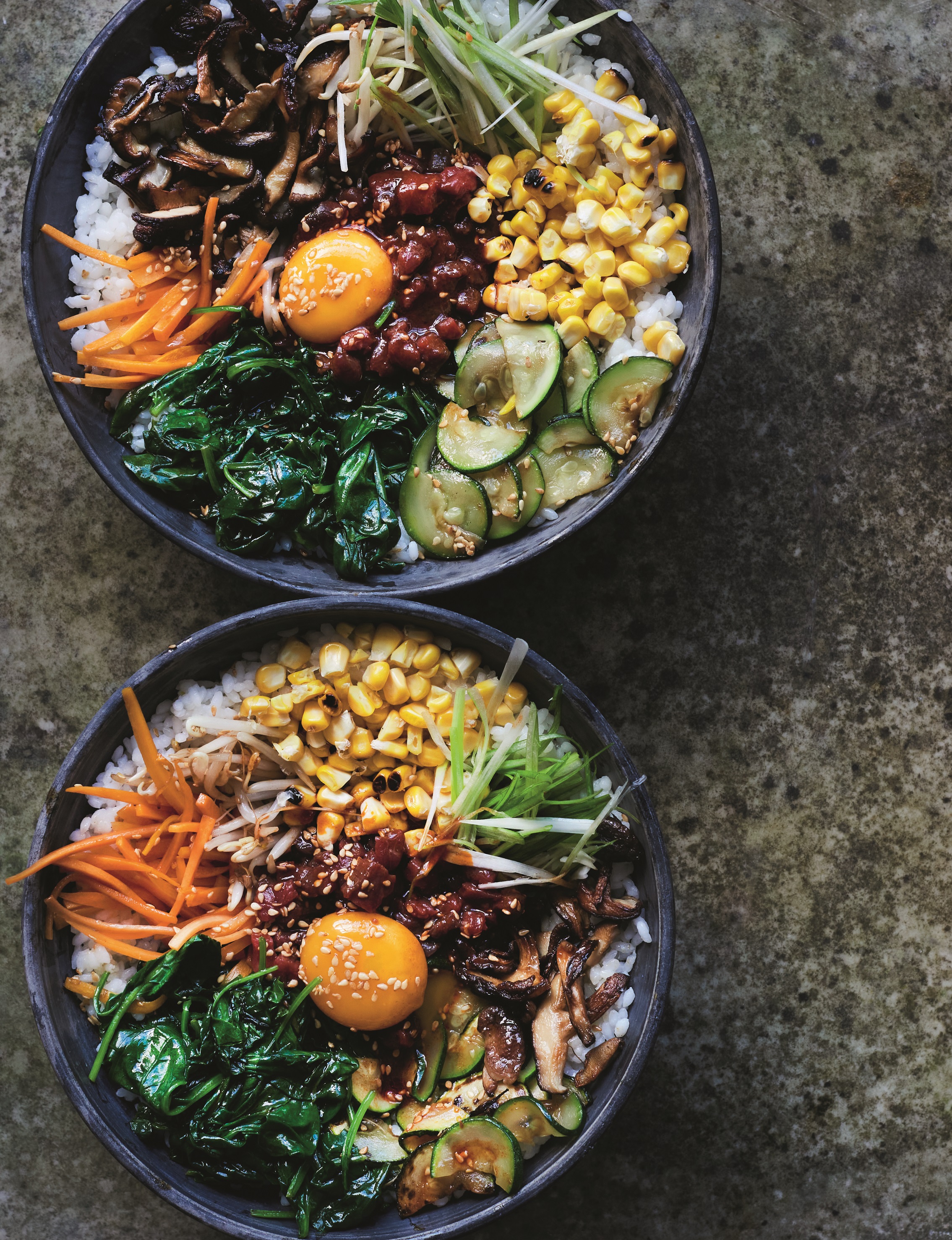
Bibimbap by Gizzi Erskine

Bibimbap c. Issy Croker

One of my breakthroughs was bringing attention to Korean food in the UK back in about 2007. While working as a chef in NYC, I’d hit Koreatown in my downtime with my mates, drink ice-cold beers and eat Korean fried chicken. Koreatown was open late, and you could go from restaurant to karaoke bar eating and drinking yourself into a stupor. I fell in love with Korean food there, and fell in love with the culture 5 years later when I first visited Korea, later moving there to film my TV show Seoul Food.

I’m certain that the popular ‘buddha bowl’ has Korean culinary heritage, as it’s similar to a dish called ‘bibimbap’. In a bibimbap bowl, rice is topped with vegetables, meat (optional), egg yolk and a spicy sauce. It is quite refined -you can’t say that about a lot of Korean food – and is cooked in a searing hot cast-iron pot which is oiled before adding the rice; the vegetables and egg (and meat, if using) are swiftly put on top. By the time the rice gets to the table it has a fantastic caramelised crust that you peel away from the pot and you stir-fry everything at the table. It’s real theatre. Fear not if you don’t have cast-iron pots -you can eat it like Hawaiian poke, in a bowl with hot rice. Bibimbap is delicious, healthy and a great way to tackle a fridge forage. I’ve used traditional toppings, but do play around with seafood, tofu and different veg: the only mainstays are the rice, egg yolk and sauce.

SERVES 2
Preparation time 45 minutes
Cooking time 15 minutes

200g sushi rice
400ml water
1 tbsp sesame oil
2 tbsp sunflower oil
150g spinach
1 courgette, thinly sliced
1 large carrot, finely julienned
100g beansprouts
6 spring onions, shredded
100g shiitake mushrooms, thinly sliced
1 corn on the cob
2 free-range egg yolks
300g rump steak, finely chopped sea salt and freshly ground black pepper
1 tbsp black or white toasted sesame seeds, to serve

FOR THE SAUCE
6 tbsp gochujang
2 tbsp Korean or Japanese soy sauce
1 tbsp rice wine vinegar
2 tbsp sesame oil
1½ tbsp caster sugar

Put the rice and water in a large saucepan with a good pinch of salt. Cover, bring to a simmer and cook for 12 minutes. Take off the heat and steam (lid on) for 10 minutes.

Gently heat the sauce ingredients in a small saucepan until emulsified. Set aside.

Mix  together the sesame and sunflower  oils. Heat a large wok or frying pan over a high heat, add 1 tablespoon  of the  oil mix and add  half the spinach with a pinch  of salt. Cook briefly until wilted, then remove and drain on kitchen paper, squeezing out any liquid. Repeat with the  remaining spinach. Add another  splash  of oil and briefly fry the courgette until golden. Remove and set aside. Repeat this process with the carrot, beansprouts, spring onions and shiitake mushrooms. Rub the sweetcorn cob with oil, salt and pepper, then brown in the pan until the kernels start to char.

Heat two stone bibimbap dishes or a wok on the hob until smoking hot. Place the stone dishes on a heatproof surface (if using). Brush the insides of the dishes (or hot wok) with the remaining oil and add the rice. Group vegetables around the edge, put the raw meat in the middle, then the egg yolks and 2 tablespoons of the sauce for each serving. Top with sesame seeds. Mix the sauce into the rice at the table with a spoon.

Recipe taken from Restore by Gizzi Erskine, available now (£25, HQ)’. Photography credit – c. Issy Croker

Restore

Cook more from this book
Green Shakshuka

Buy this book
Restore by Gizzi Erskine
£26, HQ

Read the review

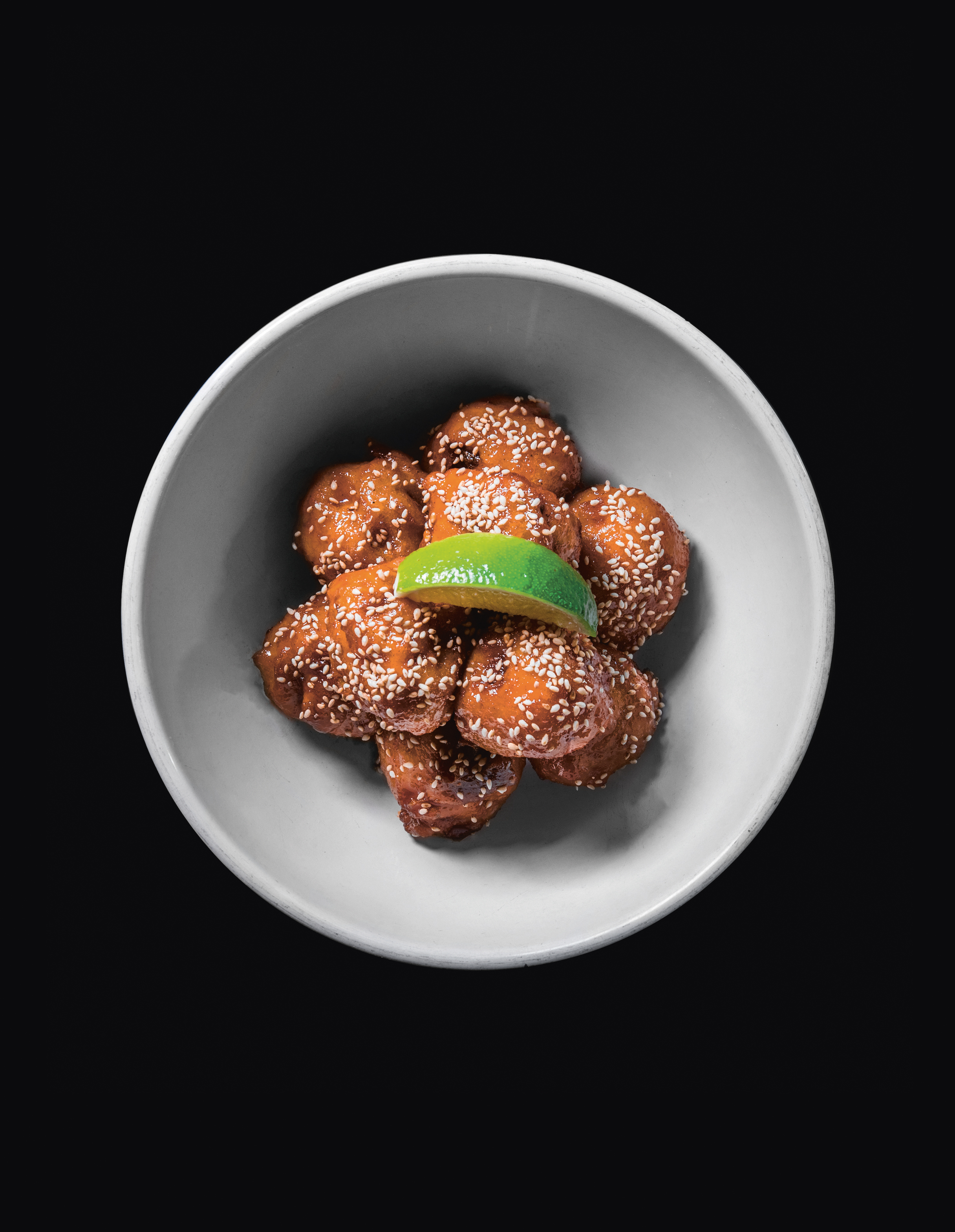
KFC (Korean Fried Cauliflower) by Matt Abergel

157 KFC


Ingredients:                                                        Amounts:
Cauliflower, cut into 25g florets ___________ 12 florets
Salt __________________________________ 20g
Vegetable oil, for deep-frying _____________ 3 litres
White sesame seeds, to garnish ___________ 3g
Lime wedge (1⁄8 of a lime), to serve ________ 1

For the KFC batter
Yardbird Chicken Flour Mix (page 191) _____ 400g
Tempura Batter (page 192) _______________ 400g

For the KFC sauce
Garlic cloves __________________________ 100g
Sugar
_______________________________ 500g
Mirin ________________________________ 50g
Korean chili paste ______________________ 150g
Red yuzu kosho ________________________ 250g

Yield: 4 servings

Method:

  • First, make the KFC batter. Whisk all the ingredients with 480 ml ice- cold water until smooth. Chill in the refrigerator until ready to use.
  • To make the KFC sauce, blend the garlic with 1.5 liters almost boiling water until smooth. Place the garlic paste in a pan with the sugar, mirin, Korean chili paste, and red yuzu kosho, then mix well. Reduce over a low heat for 1–3 hours, stirring frequently, until the mixture has the consistency of a thick barbecue sauce.
  • Soak the cauliflower florets in 2 liters water and the salt for 1 hour. Just before cooking, remove the cauliflower from the saltwater solution and put in the batter, completely coating each floret.
  • Heat the vegetable oil in a deep fryer, or a deep saucepan, to 350°F/180°C. One by one, carefully drop the battered cauliflower florets into the hot oil, making sure that the pieces don’t stick to the bottom of the fryer or to each other. Once all the florets are in the fryer, fish out any stray bits of batter. Fry the florets until they are deep brown in color, about 3 minutes.
  • Remove with a slotted spoon and drain on a wire rack, then on a paper towel. Transfer the cauliflower to a bowl. Immediately cover with a generous amount of room- temperature KFC sauce.
  • To serve, stack the sauce-smothered cauliflower florets in a serving bowl. Garnish liberally with the white sesame seeds and a lime wedge. Eat while hot.

Recipe extracted from ‘Chicken and Charcoal by Matt Abergel, published by Phaidon

Cook more recipes from this book

Eggplant Salad with Pickled Garlic and Ginger Tosazu by Matt Abergel