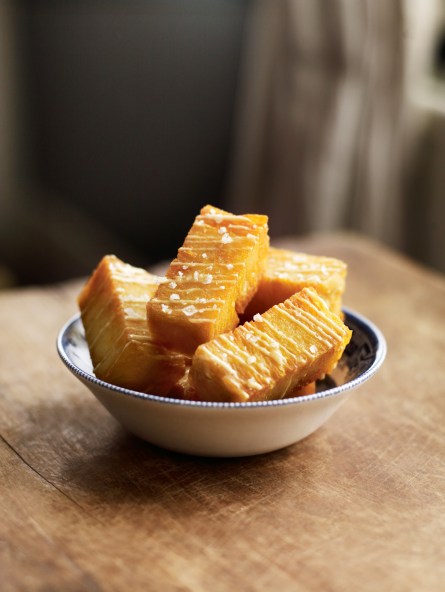
Quality Chop House’s famous Confit Potatoes by Shaun Searley

2

Our confit potatoes have become rather legendary. They are the only dish we haven’t once taken off the menu since their happy conception in spring 2013. We’d just opened the restaurant and needed to find something to serve with the chops. Shaun was adamant that QCH didn’t need chips – next thing you know we’d have squeezy ketchup on the tables – but we obviously needed something indulgent, and probably potato-based. We started making layered potatoes and after much trial and error and refrying leftovers, Shaun landed on these crispy golden nuggets. What with the slicing, layering and overnight chilling, these are something of a labour of love – but they’re worth it. Do use Maris Pipers: they have the perfect sugar-starch-water content to prevent collapse while cooking.

SERVES 6

1kg Maris Piper potatoes
125g duck fat
1 tbsp salt
oil, for frying
Maldon salt, to taste
mustard dressing (see below)

Preheat the oven to 120°C and line a standard 1.7l terrine mould with baking parchment. Peel and wash the potatoes, then use a mandoline to slice them as thinly as possible. In a large bowl, toss the slices thoroughly with the duck fat and salt. Layer the potatoes in the mould, one slice at a time, until you’ve built up multiple tiers. Once you’ve used up all the potato, cover the top with baking parchment and cook for about 3 hours until the potatoes are completely tender. Place a small baking tray or plate on top of the baking parchment covering the potatoes, along with a few heavy weights (we find tins work well) and leave to cool, then refrigerate overnight to compress. The next day, remove from the tray and cut the potato into 3x3cm pieces. Heat enough oil for deep-fat frying to 190°C, either in a deep fryer or a heavy-based saucepan. Fry the pieces for about 4 minutes until croissant-gold. Sprinkle over some Maldon salt, drizzle with mustard dressing and eat immediately.

Mustard Dressing

This may look fairly prosaic but it’s completely crucial in our kitchen. No confit potato leaves the pass until it has been dressed in this, so if you want yours to be the real deal you will need this dressing too.

425g Dijon mustard
Juice of ½ lemon
½ tsp cider vinegar
375ml vegetable oil

Mix the mustard, lemon juice and vinegar in a large bowl, then whisk in the vegetable oil until emulsified. Store in squeezy bottles in the fridge until you’re ready to use.

Buy the book
The Quality Chop House: Modern Recipes and Stories from a London Classic
£30, Hardie Grant
(Head to the restaurant’s website for a signed copy wrapped in their own branded  butcher’s paper)

Read the review

Black Axe Mangal by Lee Tiernan

Black Axe

It’s tempting to pigeon-hole Lee Tiernan, chef and proprietor of cult north London restaurant Black Axe Mangal as some sort of ‘rock ‘n’ roll chef’. His pizza oven is emblazoned with the faces of the rock group Kiss, he blasts a soundtrack of heavy metal into Black Axe Mangal’s intimate dining room (a converted kebab shop) and the flavours of dishes like the signature squid ink flatbread with smoked cod’s roe are turned up to 11.

But behind all the raucousness there is a considered, thoughtful and meticulous cook.  On the subject of bread, which he says is the ‘anchor’ of his cuisine, he quotes food writer Richard Olney and calls it a ‘symbol of sustenance’ and explains that his seven-page recipe for flatbread was perfected with the help of Chad Robertson of Tartine bakery in San Francisco.

Another influence on Tiernan’s cooking is Fergus Henderson for whom Tiernan worked for over a decade, including a stint as head chef of St John Bread and Wine. Dishes such as shrimp-encrusted pig’s tails with pickled chicory; braised hare, chocolate and pig’s blood with mash; and oxtail, bone marrow and anchovy wouldn’t look out of place on a St John menu (Tiernan has also included the famous St John rarebit recipe in the book). But Tiernan unquestionably has his own distinctive style. As Henderson notes in his introduction, ‘Lee has borrowed my bone marrow, my cod’s roe, my pig’s blood, but they are not what shape him’.

The autobiographical introduction is full of stories and anecdotes from Tiernan’s colourful past. As a child, he took fussy eating to such extremes (including hiding unwanted meals under a loose floorboard in the family home) that his mother consulted a doctor about his lack of appetite. Black Axe Mangal’s origins as a pop up in ‘a grimy, graffiti-smeared Copenhagen night club’ where Tiernan cooked thousands of kebabs in a ‘ramshackle shed’ makes for entertaining reading.

The liberal seasoning of salty language and peppering of softcore glamour shots (older readers may be reminded of the Rude Food books from the late 70’) may be off-putting to some, but the step by step instructions on the key skills of grilling, smoking and baking that help define Tiernan’s food, along with the story behind his success, provide an insight into one of the UK’s most exciting and original chefs and make Black Axe Mangal an essential purchase.

Cuisine: Modern British
Suitable for: Confident home cooks/professional chefs
Cookbook Review Rating:
Five stars

Buy this book
Black Axe Mangal
Phaidon, £24.95

Cook from this book
Vietnamese Scrambled Eggs With Sesame Bread
Pressed Octopus And Szechuan Vinaigrette
Crispy Fuckin’ Rabbit

This review was originally published by The Caterer 

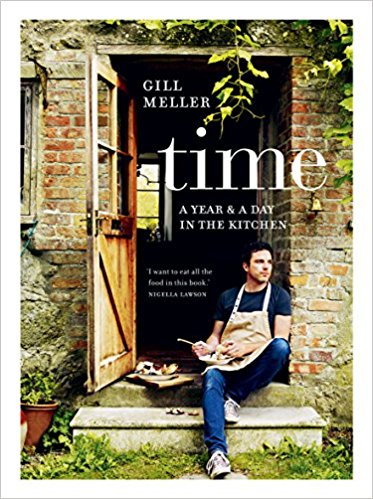
Time by Gill Meller

Gill Meller Time

What’s the USP? A cookbook extolling the virtues of time spent in the kitchen; if that’s not 320 hardbound pages of positive reinforcement for foodie obsession, then I don’t know what is. And to prove that not every single cookbook permutation has already been done, recipes are organized into chapters covering Morning, Day and Night, each sub divided into spring, summer, autumn and winter. A neat and useful device.

Who’s the author? Meller is an alumni of Hugh Fearnley Whittingstall’s River Cottage organization and is a chef, food writer and teacher. His first book Gather won the Fortnum and Mason award for Best Debut Food Book in 2017.

What does it look like? Hats off to photographer Andrew Montgomery who has brought a distinctive ‘heritage’ look to the book that is at once timeless and totally contemporary; the picture accompanying a recipe for cold-smoked trout (a timeless and contemporary dish itself) could double for a renaissance painting. Meller’s food is attractively presented in a way that wouldn’t look out of place in a restaurant but that would also be well within the reach of a confident home cook.

Is it great bedtime reading? That depends if your tastes extend to poetry. In addition to the triptych of verses that open the three chapters, Meller affects a poetic, literary tone in his introduction and, in a slightly subtler way, in the recipe introductions. But even if the style doesn’t quite do it for you, there’s a decent amount of food knowledge and kitchen sense to be enjoyed.

Killer recipes? Radishes with aioli and fried fish; homemade bacon; tomato and anchovy tart with goat’s cheese, marjoram and chilli; treacle tart with thyme and orange.

What will I love? With 120 recipes, there’s plenty to get your teeth into and the book has a real sense of personality to it. Geller’s enthusiasm for his subject is palpable and the book has been beautifully put together.

What won’t I like? You might well get the sense that Meller is reaching for something profound that is simply out of the grasp of a recipe book, which is fundamentally what Time is.

Should I buy it? Fearnley-Whittingstall calls the book ‘a timeless classic’ and food writer Diana Henry says Time is ‘A joy. The recipes are even better than in his first book. And that’s saying something.’ I say it’s a lovely object with some great recipes that may be of more interest to home cooks than professional chefs.

Cuisine: Modern British
Suitable for: Confident home cooks
Cookbook Review Rating: Four stars

Buy this book
Time: A Year and a Day in the Kitchen
£25, Quadrille

Quince tart with gingerbread ice cream by Simon Rogan

Quince Tart

MAKES 8

Gingerbread
80g unsalted butter
50g molasses
400g plain flour
250g caster sugar
1 tsp baking powder
a pinch of salt
zest of 1 lemon
50ml whole milk
80g preserved stem ginger (from a jar)
½ tsp ground cinnamon
1 tsp ground ginger
50g fresh ginger
2 eggs

Gingerbread ice cream
500ml whole milk
2 egg yolks
25g caster sugar
½ tsp salt
125g gingerbread, from recipe above, roughly broken into chunks
Pastry
270g plain flour, plus extra for dusting
150g unsalted butter, softened
75g soft light brown sugar
1 tsp salt
1 egg

Poached quince
1 quince
350ml red wine
250g caster sugar
50g unsalted butter

Preheat the oven to 195°C/175°C Fan/Gas Mark 5, grease a 900g (2lb) loaf tin and line it with baking parchment.

To make the gingerbread, melt the butter and the molasses in a heavy-based saucepan over a medium heat. Once melted, remove from the heat and leave to one side. Mix the flour, caster sugar, baking powder, salt and lemon zest together in a large bowl. Blitz the milk, stem ginger, cinnamon, ground ginger and fresh ginger in a small food processor until smooth, then pass through a fine sieve. Beat the eggs in a bowl and mix with the ginger milk, then add the molasses mix. Whisk the wet ingredients into the dry ingredients little by little, until fully incorporated.

Transfer the mixture to the prepared tin and bake for 50 minutes. Once cooked (a skewer inserted into the middle of the cake should come out clean), remove from the oven and leave to cool. Remove from the tin and cut into suitable size 125g pieces, wrap each piece in cling film and freeze.

To make the ice cream, bring the milk to the boil in a heavy-based saucepan over a medium heat. Combine the egg yolks, sugar and salt in a heatproof bowl. Gradually pour the hot milk into the yolk and sugar mixture, whisking constantly to prevent the eggs from scrambling. Return to the pan and cook over a low heat until the temperature of the mixture reaches 80°C (check with a thermometer), stirring constantly. Remove from the heat and add the fresh or defrosted from frozen gingerbread, then allow to cool. Blitz in a blender until smooth then churn in an ice-cream maker until frozen. Transfer the ice cream to a piping bag fitted with a star nozzle and keep in the freezer.

While the ice cream is churning, make the tart bases. Mix the flour and the butter together by hand in a bowl until the mixture resembles breadcrumbs, then add the sugar, salt and egg and keep mixing until you have a smooth dough. Wrap the dough in cling film and put it in the fridge to rest for 1 hour. Once rested, dust a work surface with flour, unwrap the dough and roll it out to a thickness of 3mm.

Cut to size with a cutter or upside-down small bowl to fit eight 4cm small tart tins. Line the tins with the pastry, pushing the pastry all the way down the sides, lightly prick the base of the tartlets and line them with greaseproof paper and a few baking beans. Bake blind for 8 minutes. Remove from the oven and allow to cool in the tins, then transfer to a wire rack to cool completely. Store in an airtight container.

Peel and cut the core away from the quince. In a small, heavy-based saucepan bring the wine and 200g of the sugar to the boil. Reduce the heat to low, add the quince and simmer for 18–20 minutes, or until the quince are just tender but still have a little bite. Remove from the heat and leave the quince to cool in the wine.

Cut the cooled quince into 5mm dice. Make a caramel with the remaining sugar: heat the sugar in a heavy-based pan over a medium heat, without stirring, until it begins to melt, then start to stir and keep stirring until all the sugar crystals have dissolved. Cook for about 10 minutes until the sugar is a dark honey colour.

Remove from the heat and add the butter, whisking constantly. Add the diced quince to the pan and cook for a further 30 seconds. Remove the caramelised quince from the pan and allow to cool.

Place a small amount of the quince in each tart case then pipe a rosette of ice cream on top to cover and serve immediately.

Cook more from this book
Radish stew
Smoked lamb shoulder

Read the review

Buy this book 
Rogan

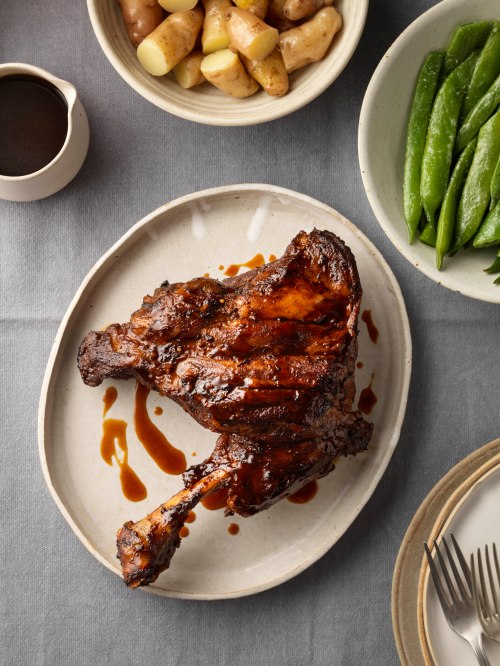
Smoked lamb shoulder by Simon Rogan

Smoked Lamb Shoulder

SERVES 6–8

Lamb shoulder
400g coarse sea salt
1 lamb shoulder (about 2.8–3kg)
100g soft light brown sugar
200g granulated sugar
20g garlic powder
50g smoked paprika
50g sweet paprika
6 star anise
1 tbsp yellow mustard seeds
1 tbsp juniper berries
1 tbsp cayenne pepper
1 tbsp ground cumin
1 tbsp ground black pepper
1 tbsp coriander seeds

Runner beans
500g young, tender runner beans, such as Tenderstar
40g unsalted butter
salt, for seasoning

enough wood smoking chips to create an even layer in the baking tray
Lamb Jus (SEE RECIPE AT END OF MAIN RECIPE), to serve

Dissolve 300g of the salt in 1.5 litres of water in a large bowl. Submerge the lamb shoulder in the brine and put it in the fridge for 24 hours. The next day, rinse the shoulder under cold running water and pat it dry with kitchen paper. Mix the remaining ingredients together in a bowl, including the 100g salt, and rub into the shoulder.

Put the smoking chips in a nice even layer in a large roasting tin lined with foil. Sit a wire rack on top, one that is a similar size to the roasting tin, making sure the wire isn’t touching the chips. Put the shoulder on the rack and cover the entire rack and tin with a tent of foil, so no smoke escapes. Sit the tin on the hob over a low–medium heat for 10 minutes. Remove the covered tin from the heat and allow the shoulder to smoke in the foil tent for 30 minutes.

Preheat the oven to 150°C/130°C Fan/Gas Mark 2. Transfer the smoked lamb shoulder to a clean baking tray, place in the oven and cook for 4 hours until tender.

Top and tail the runner beans and remove the stringy sides. Bring a large saucepan of salted water to the boil, add the butter and cook the beans for 3 minutes. Drain.

Serve the lamb in the middle of the table with a jug of sauce for guests to help themselves and with the runner beans and confit potatoes in a large bowl alongside.

LAMB JUS

2 tbsp sunflower oil
2 carrots, roughly chopped
2 onions, roughly chopped
2 celery sticks, roughly chopped
1 leek, roughly chopped
2 garlic cloves
1kg lamb bones
3 litres White Chicken Stock (RECIPE BELOW)

WHITE CHICKEN STOCK
3kg chicken wings

Roughly chop the chicken wings and put them in a large,heavy-based saucepan with 5 litres of water. Bring to the boil over a medium heat, then reduce the heat and simmer for 2–3 hours, skimming occasionally. Remove from the heat and leave to cool, the strain through a muslin-lined sieve. Keep the stock covered in the fridge and use within 3–4 days, or freeze and use within 3 months.

To make the lamb jus, warm the oil in a large, heavy-based saucepan over a low heat, add the vegetables and cook for 2–3 hours, stirring regularly, until completely soft and no moisture is left in the pan.

Preheat the oven to 220°C/200°C Fan/Gas Mark 7. Put the lamb bones in a roasting tin and roast for 40 minutes, or until deeply golden. Add the bones to the pan with the vegetables, reserving the fat for the potatoes. Deglaze the roasting tin with 200ml water and add it to the pan. Cover with the chicken stock and bring to the boil over a high heat. Reduce the heat and simmer for 2 hours over a low heat, skimming it regularly. Strain through a fine sieve into another heavy-based saucepan then reduce the stock over a medium heat to a sauce consistency.

Cook more from this book
Radish stew
Quince tart

Read the review

Buy this book 
Rogan

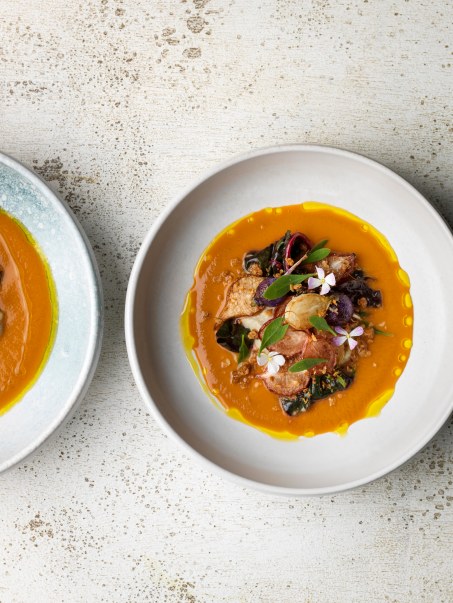
Radish stew by Simon Rogan

Radish Stew

SERVES 4, AS A STARTER

Aubergine purée
1 large aubergine (about 450g)
½ tbsp tahini paste
1 tbsp natural yoghurt
½ tsp roasted chopped garlic

Radish sauce
1 tbsp sunflower oil
1 shallot, sliced
40g button mushrooms, sliced
1½ tsp tomato purée
250g red radishes, thinly sliced
500ml Vegetable Stock (see recipe at end of main recipe)
sherry vinegar, for seasoning
5g unsalted butter

Truffle granola
135g honey
35g black truffle oil
35g chilli oil
150g porridge oats

Radishes
12 mixed radishes, such as Cherry Belle,
Albena and Viola
2 tbsp rapeseed oil
8 stalks of rhubarb chard (or Swiss chard),
stalks removed and cut in half

salt, for seasoning
rapeseed oil, for drizzling
assorted radish flowers and sea purslane, to serve

Preheat the oven to 200°C/180°C Fan/Gas Mark 6.

First, make the aubergine purée. Wrap the aubergine in foil and bake it in the oven for 35–40 minutes until completely soft, then halve it lengthways and scoop out the flesh. Put the flesh in a blender with the tahini, yoghurt and garlic and blitz until smooth. Pass through a fine sieve and season with a pinch of salt.

While the aubergine is cooking, make the radish sauce. Warm the oil in a medium, heavy-based saucepan over a medium heat, add the shallot and sweat for 5–6 minutes, or until translucent, stirring regularly. Add the mushrooms and sweat for a further 3 minutes, or until soft and tender. Stir in the tomato purée and cook for 3–4 minutes. Add the radishes and vegetable stock and bring to the boil. Reduce the heat and simmer for 8 minutes. Remove from the heat and blitz with a hand-held blender until smooth, then strain through a fine sieve. Finish the sauce by seasoning with sherry vinegar and salt and whisking in the butter.

Reduce the oven temperature to 160°C/140°C Fan/Gas Mark 2.

To make the granola, warm the honey, oils and 1 teaspoon of salt in a small saucepan over a low heat until the honey has melted and the salt dissolved. Mix in the oats.  Transfer to a baking tray, spread it out in an even layer and bake for 15 minutes, or until golden. Remove from the oven and leave to cool, then break into small pieces. Leave the oven at the same temperature.

Put the radishes on a baking tray, chopping any larger ones in half, season with a pinch of salt, drizzle over half the oil and roast for 10–12 minutes.

Heat the remaining oil in a medium, non-stick saucepan and add the rhubarb chard leaves along with a splash of water. Cook gently until the leaves have wilted and season with a little salt.

Warm the radish sauce. Put a spoon of the purée in the centre of four plates and place the roasted radishes on top. Add the chard, purslane leaves and flowers. Spoon the sauce around the outside and sprinkle with truffle granola. Drizzle with rapeseed oil.

VEGETABLE STOCK

3 onions, finely chopped
2 celery sticks, finely chopped
2 carrots, finely chopped
1 fennel bulb, finely chopped
1 leek, finely chopped
1 head of garlic, halved
15g chervil
15g tarragon
15g flat-leaf parsley

Put all the vegetables and the garlic halves in a large, heavy-based saucepan with 4 litres of water. Bring to the boil over a medium heat, then reduce the heat and simmer for 30 minutes. Take off the heat, add the herbs and leave to cool, then chill and infuse in the fridge overnight. The following day, strain it through a muslin-lined sieve. Keep the stock covered in the fridge and use within 3–4 days, or freeze and use within 3 months.

Cook more from this book
Smoked lamb shoulder
Quince tart

Read the review

Buy this book 
Rogan

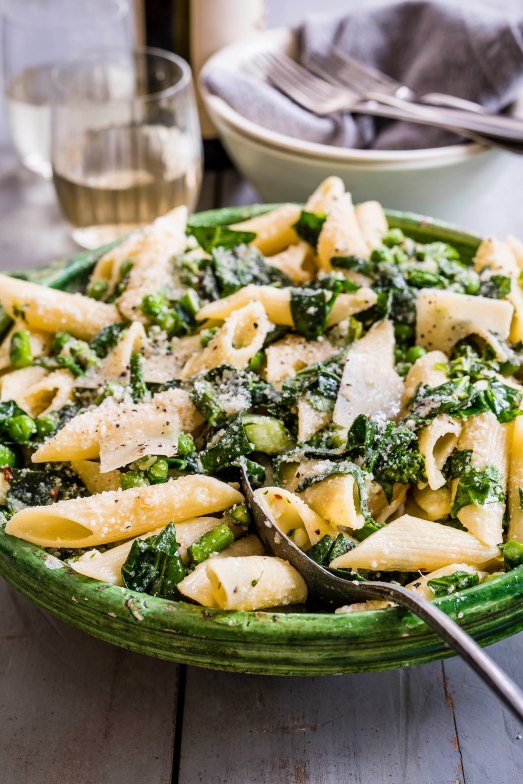
Green pasta bits by Jack Stein

Green Bits Pasta - 0781

This is a dish from my girlfriend, Lucy, who is from a Sicilian family. Lucy usually makes this on a Monday, when we have a ton of green vegetables left over from the Sunday roast. You can use virtually any green vegetable. Be sure to leave the Parmesan rind in the pasta to give it a lovely depth of flavour. If I have been busy at work and really want something comforting and healthy to eat, this is it.

Once when I was working at The Seafood Restaurant, an Italian woman was invited into the kitchen. While I was showing her around, she told me that the best way to cook pasta was her way. So here it is. Cook the pasta as usual, then, when it’s ready, drain it through a colander, being careful to collect the water in a pan. Add butter to the hot pasta, stir it through and pour the water back through the pasta again. This is the way I have cooked pasta ever since!

SERVES 4

3 tablespoons olive oil plus more if needed
1 onion, finely chopped
½ teaspoon chilli flakes
2 garlic cloves, finely chopped
100g grated Parmesan cheese and Parmesan rind
500g dried rigatoni or penne
400g mixed green vegetables, such as fresh tenderstem broccoli, asparagus and spinach, and frozen peas (used here)
1 tablespoon butter plus an extra knob for the pasta
juice of ½ lemon
salt and pepper

Fill a pan of water for the pasta. Salt generously and bring to the boil.

Heat the olive oil in a large pan over a medium heat, add the onion and chilli flakes and a pinch of salt, and cook slowly until soft but not coloured (about 5–10 minutes). Add the garlic and the Parmesan rind. Leave on the lowest possible heat while you prepare the rest of the dish.

Meanwhile add the pasta to the boiling water and cook until al dente, about 1 minute less than the packet instructions suggest.

Prepare the vegetables. Slice the broccoli stems and asparagus spears into 2cm pieces, keeping the heads intact. Add them to the pan containing the onion mixture, and turn up the heat, stirring so that they are covered with oil. Add 1 tablespoon butter and a pinch of salt. Cook for 5 minutes until they are softened but still have a bite.

Wash the frozen peas under warm water to defrost them; drain off the water and add the peas to the broccoli and asparagus and cook for 1 minute. Cut the spinach into strips and add to the pan; let it wilt down and add another pinch of salt. There should be enough oil to coat all the vegetables; if necessary, add a little more.

When the pasta is ready, drain it into a colander set over a large pan. Put the pasta back into the pan and stir through a knob of butter. Pour the collected water back into the pan to coat the pasta and drain over the large pan again.

Remove the Parmesan rind. Pour in the vegetable sauce and stir to make sure it is all combined. Add the lemon juice and a handful of Parmesan and stir these through, along with a final tablespoon or two of the pasta cooking water.

Plate up the pasta and vegetables and top with more Parmesan, black pepper and a drizzle of olive oil.

Cook more from this book
Cornish chilli crab
Pineapple tart tatin

Read the review

Buy this book
Jack Stein’s World on a Plate: Local produce, world flavours, exciting food
£26, Absolute Press

Extract taken from Jack Stein’s World on a Plate by Jack Stein (Absolute Press, £26)
Photography © Paul Winch-Furness

Jack Stein’s World on a Plate

Jack Stein

What’s the USP? A chef’s global travels recorded in recipes.

Who’s the author? If you think you recognize the surname, you’re right. Jack is the son of Rick and since 2017, Chef Director of the Stein restaurant empire, which under his direction has grown from its HQ in Padstow across Cornwall and the south of England. His CV also includes stints at notable restaurants around the globe including La Régalade in Paris and Testsuya in Sydney. World on a Plate is his first cookbook.

What does it look like? The fresh, colourful and appetising dishes (shot by top food photographer Paul Winch-Furness) are interspersed with shots of yer man walking his dog, with his surfboard and chatting to fishermen (any of this sounding familiar, fellow Rick Stein fans?). 

Is it good bedtime reading? The skimpy intro won’t keep you occupied for long but there’s plenty of anecdotes about Stein’s travels and useful cooking tips embedded into the individual recipe introductions.

Will I have trouble finding ingredients? You’ll find the vast majority in the supermarket, but you’ll want to do the Stein name justice by visiting your local fishmonger for some decent fish for langoustine with pastis and sea trout with samphire and beurre blanc.

What’s the faff factor? There’s a nice cross-section of dishes to rustle up when time is tight like crab omelette and more complicated, involved recipes such as guinea fowl terrine.

How often will I cook from the book? With everything from a fish finger sandwich to a Sunday lunch (‘My roast topside of beef), Jack Stein’s World on a Plate won’t be collecting dust on your bookshelf.

Killer recipes? Maple roasted pumpkin with rocket, dukkah and feta; Carl Clarke’s chicken clusters in laksa sauce; lamb shoulder with white miso cream and chicory; babi gulang (Balinese spicy pork with green bean and peanut salad); turbot on the bone roasted with bone marrow sauce.

What will I love? This is truly global cooking with recipes inspired by France, America, China, Australia, Thailand and of course Cornwall, which brings huge variety to the book.

What won’t I like? Stein wanton larder raiding of so many cuisines means you might bankrupt yourself buying all the different ingredients required to prepare the recipes. 

Should I buy it? If you’re looking for inspiration for something a bit different for a mid-week meal to cook at home, this hits the spot. Although you might notice some crossover between father and son’s cookbooks (Jack did a lot of his global travels on family research trips for The Seafood restaurant) Stein Jr has an individual enough voice to make the recipes his own.

Cuisine: Modern British
Suitable for: Confident home cooks
Cookbook Review Rating: 4 stars

Buy this book
Jack Stein’s World on a Plate: Local produce, world flavours, exciting food
£26, Absolute Press

Cook from this book
Cornish Chilli Crab
Green pasta bits
Pineapple tart tatin

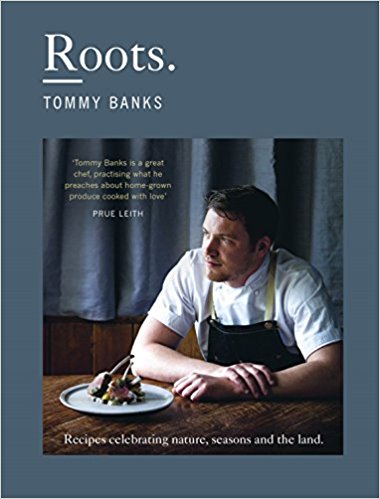
Roots by Tommy Banks

roots tommy banks

What’s the USP?  Fans of Kunta Kinte will be disappointed to learn that this is not another  update of Alex Haley’s famous slave saga. The title actually refers to the ‘root ingredients’ used fresh or preserved by acclaimed young chef Tommy Banks, who divides the year into three rather four seasons which he calls The Hunger Gap (January to May); Time of Abundance (June to September) and the Preserving Season (October to December) which reflects the way he cooks at his North Yorkshire restaurant The Black Swan at Oldstead.

Who’s the author? Tommy Banks has had something of a meteoric rise since taking over the kitchens of the family restaurant in 2013, aged just 24. He’s one of the youngest ever Michelin starred chefs in the UK and has become something of a TV personality, appearing on the Great British Menu where he cooked turbot with strawberries and cream (recipe included in the book) at the grand banquet at Wimbledon and was a featured chef on Masterchef the Professionals where he demonstrated his signature dishes including crapudine beetroot cooked slowly in beef fat with smoked cod’s roe and linseeds, also included in this, his debut book.

What does it look like? Bucolic. The North Yorkshire landscape looks stunning and there are plenty of shots of Banks posing in fields and on the family farm gathering his beloved ingredients. The food is colourful and attractive without being too tortured on the plate.

Is it good bedtime reading? The short autobiographical introduction is bolstered by chapter introductions and essays on favoured ingredients such as elderflower, summer berries and ‘hedgerow harvests’ making Roots more than simply a collection of recipes.

Will I have trouble finding ingredients? If you’re not a keen gardener then you might find it tricky to lay your hands on things like crapudine beetroot and courgette stalks, and you’ll need to follow Banks’s recipes for fermenting vegetables to make a number of dishes, plus you’ll need a good fishmonger if you’re planning on serving raw red mullet, and a decent butcher who can sell you sweetbreads and mince pork back fat for you, and you’ll need to get out picking elderflowers in June if you want to make elderflower drizzle cake, and…

What’s the faff factor? This is fundamentally a collection of restaurant dishes so expect to put in a fair amount of effort for your dinner.

How often will I cook from the book? This is more weekend project than mid-week supper cooking.

Killer recipes? See above, but also crab, elderflower and potato salad; scallops cured in rhubarb juice with Jerusalem artichoke, and potato skin and brassica broth with cheddar dumplings.

What will I love? All the recipes are rated either 1,2 or 3 for complexity which makes choosing what you want to cook from the book, depending on the time you have to hand easy. But this is more than just a collection of delicious sounding, interesting and characterful recipes, a real effort has been made to give a sense of Banks’s cooking ethos and life at The Black Swan.

What won’t I like? Some readers may feel they’ve been-there-and-done-that with the pickling, fermenting and foraging aspect of the book.

Should I buy it? Roots is a substantial debut effort from one of the UK’s highest profile young chefs with his own take on field to fork cookery which makes it well worth investigating.

Cuisine: Modern British
Suitable for: Professional chefs/Confident home cooks
Cookbook Review Rating: 4 stars

Buy this book
Roots
£25, Orion Books

The Hidden Hut by Simon Stallard

The Hidden Hut jacket

What’s the USP? Recipes from one of Cornwall’s best-loved beach restaurants, famous for its open-air feast nights.

Who’s the author? Simon Stallard is the chef and owner of The Hidden Hut, a casual beachside restaurant set in ‘an old wooden shed’ on a coastal path near Truro. Stallard worked around the globe from ‘New York to New Delhi’ before settling in Cornwall and opening the Hut in 2010.

What does it look like? The numerous scene-setting photographs mean that you can almost feel the sand between your toes and smell the salty tang of the sea. Reading the Hidden Hut will make you want to jump in the car and immediately head for the south Cornish coast. The colourfully rustic food looks very appealing, the sort of pleasingly unpretentious stuff you just want to get stuck into.

Is it good bedtime reading? Not so much, just a short introduction and a ‘How to cook over fire section’ (cooking over a wood fire in the open air is what Hidden Hut feast nights are all about and Stallard shares his expertise over a 10-page section of the book).

Will I have trouble finding ingredients? You will be at an advantage if you live by the coast and can get your hands on spider crabs, octopus and gurnard, but as long as you can get to a good fishmonger you’ll be fine.

What’s the faff factor? Dishes range from a straightforward mid-week meal of lamb cutlets with butter bean mash and fresh mint sauce to a special-occasion-only slow roasted goat in preserved lemons, but overall the food is about as far from overwrought, tweezered complex restaurant food as you can get.

How often will I cook from the book? With recipes for breakfast (smokey bacon pastries), lunch (chicken and wild garlic soup), picnics (green pea scotch eggs) and parties (seafood paella for 40) as well as lots of delicious dinner ideas, it’s difficult to say when you won’t be cooking from the book.

Killer recipes? Despite the crab on the cover, this is not just a seafood cookbook. In addition to dishes like red-hot mullet with sticky rice balls and cucumber salad and Summer sardines with saffron potatoes and oregano dressing, there’s plenty of meat and veg in the form of 12-hour lamb with smoky aubergine, and samphire frittata with warm lemony courgette salad.

What will I love? There’s a real feel-good factor about the book, open it at any page and you’ll be inspired to get in the kitchen and cook.

What won’t I like? If you want super serious, complex cheffy cooking, this is not the book for you.

Should I buy it? The Hidden Hut is the sort of book with recipes that will become perennial favourites that you’ll find yourself going back to time and time again. So that’s a yes.

Cuisine: Modern British
Suitable for: Confident home cooks
Cookbook Review Rating: 4 stars

Buy this book
The Hidden Hut
£20, HarperCollins

Cook from this book
Buttermilk drop cakes with lemon curd
Chicken and wild garlic soup
Fire-pit wild sea bass with verde sauce