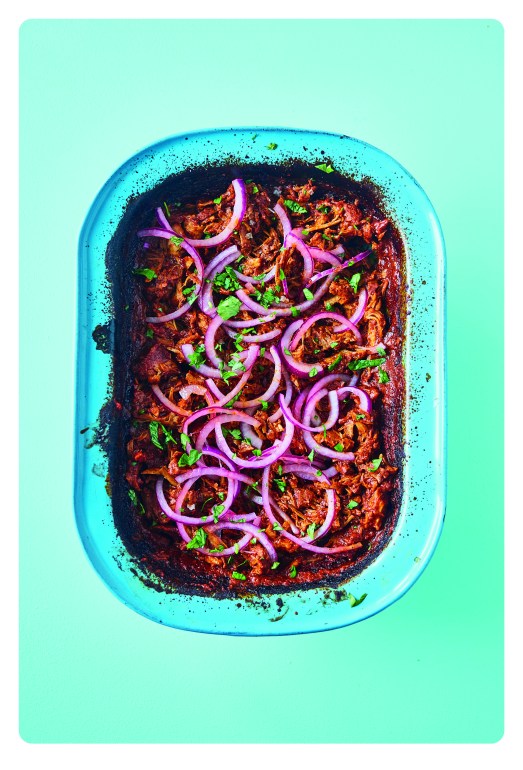
Slow-cooked pork pibil with pink pickled onions by Rukmini Iyer

Pork Pibil

SLOW-COOKED PORK PIBIL WITH PINK PICKLED ONIONS

You may have had pork pibil at your favourite Mexican restaurant: it’s a classic Yucatán dish of pork, slow-cooked in achiote, a paste made from annatto seeds, from which the dish gets its lovely colour. Achiote paste is easily available online, and once you have it, this dish will be a staple in your repertoire – it’s so easy to put together.

Serves: 4
Prep: 10 minutes
Cook: 3 hours

1 onion, roughly chopped
6 cloves of garlic, roughly chopped
1 teaspoon ground cumin
1 tablespoon dried oregano (Mexican if you have it)
8 cloves
250ml orange juice (ideally freshly squeezed)
2 limes, juice only
50g achiote paste
2 teaspoons sea salt
800g free-range pork shoulder, diced

PICKLED ONIONS
1⁄2 red onion, very thinly sliced
1 lime, juice only

TO SERVE
Chopped fresh coriander
Tortillas and sour cream

Preheat the oven to 140°C fan/160°C/gas 2.
Tip the onion, garlic, cumin, oregano, cloves, citrus juice, achiote paste and salt into a blender or food processor and blitz until smooth.
In a small deep roasting tin or lidded casserole dish, mix the pork shoulder with the spice paste. Cover tightly with foil or the lid, then transfer to the oven and cook for 3 hours.
Meanwhile, mix the very thinly sliced red onion with the lime juice and set aside for 3 hours, stirring occasionally. (The acid in the lime juice will turn the onions a beautiful bright pink by the time the pork is ready.)
Once cooked, remove the foil or lid and shred the pork while hot. Serve with the pink pickled onions, chopped coriander, warm tortillas and sour cream.
Note: This dish isn’t at all spicy, so it’s a good one for kids, and can be easily made ahead, frozen and defrosted in portions.

Extracted from: The Roasting Tin Around the World Global One Dish Dinners by Rukmini Iyer (Square Peg) 14th May, £16.99 HBK Photography by David Loftus. Follow Rukmini on instagram @missminifer

Cook more from this book
Peach & Dulce De Leche Cake With Meringues and Cream
Slow Roasted Peppers With Chilli, Lemon and Garlic Beans

Read the review

Buy this book
The Roasting Tin Around the World: Global One Dish Dinners
£16.99, Square Peg

Rye Crostata with Peas and Asparagus

235 rye crostada

Gluten-free
Preparation Time: 30 minutes plus resting time
Cooking Time: 1 hour
Serves: 6 to 8

To enhance the flavor of the sesame seeds, toast them, covered, in a heavy-bottomed frying pan over medium heat until they start to crackle, then transfer to a plate and let cool. For a vegan version of the recipe, replace the egg yolks with a heaping tablespoon of millet flakes.

  • 1¾ cups (220 g) farro (emmer) flour, plus more for sprinkling
  • Scant ½ cup (50 g) all-purpose (plain) flour
  • 3 tablespoons black sesame seeds
  • 1 tablespoon brown flaxseeds (linseeds)
  • ¼ cup (60 ml) plus 3½ tablespoons extra virgin olive oil
  • 4 spring onions, chopped
  • 1 bunch asparagus, thinly sliced
  • 11/3 cups (200 g) shelled fresh peas
  • Scant 1 cup (200 ml) soy milk
  • Grated zest of ½ lemon
  • 2 egg yolks
  • 2½ tablespoons sunflower seeds
  • Salt and black pepper

In a food processor, combine the farro flour, all-purpose (plain) flour, sesame seeds, flaxseeds (linseeds), 3½ tablespoons of the olive oil, and a pinch of salt and process the mixture until crumbly. With the motor running, drizzle in 1/3 cup (75 ml) cold water and process until the dough comes together and forms a ball. Wrap the dough in plastic wrap (cling film) and refrigerate for at least 30 minutes.

Preheat the oven to 350°F (180°C) with a rack in the lower third.

In the meantime, in a heavy-bottomed frying pan, heat the remaining ¼ cup (60 ml) oil over medium heat. Add the onions and asparagus and cook for 2 to 3 minutes. Add the peas and a scant ½ cup (100 ml) water and cook for 7 to 8 minutes, until the liquid has evaporated. Sprinkle the vegetables with farro flour, drizzle in the milk, and stir.

Reduce the heat to low and cook the sauce for 5 to 6 minutes. Season with salt and pepper, then stir in the lemon zest. Remove from the heat and let the sauce cool. Add the egg yolks and stir to combine.

On a lightly floured surface, roll out two-thirds of the dough into a 2 mm-thick sheet and transfer it to a 9-inch (22 cm) round baking pan. Fill the crust with the vegetable mixture. Roll the remaining dough into a thin sheet and cut it into ¾-inch-wide (1.5 cm) strips. Arrange the strips over the filling to form an open lattice. Press the lattice strips against the bottom crust to seal, then trim the excess dough around the edges.

Brush the lattice with a little water and sprinkle with the sunflower seeds. Bake the tart in the lower third of the oven for about 40 minutes. Serve warm.

Read the review

Buy this book
The Vegetarian Silver Spoon: Classic and Contemporary Italian Recipes (FOOD COOK)
£35, Phaidon

Chicken musakhan by Sami Tamimi and Tara Wigley

246_chicken_musakhan

Musakhan is the hugely popular national dish of Palestine: growing up, Sami ate it once a week, pulling a piece of chicken and sandwiching it between a piece of pita or latbread. It’s a dish to eat with your hands and with your friends, served from one pot or plate, for everyone to then tear at some of the bread and spoon over the chicken and topping for themselves.

Traditionally, musakhan was made around the olive oil pressing season in October or November to celebrate (and gauge the quality of) the freshly pressed oil. The taboon bread would be cooked in a hot taboon oven (see page 341) lined with smooth round stones, to create small craters in the bread in which the meat juices, onion and olive oil all happily pool. It’s cooked year round, nowadays, layered with shop-bought taboon or pita bread, and is a dish to suit all occasions: easy and comforting enough to be the perfect weeknight supper as it is, but also special enough to stand alongside other dishes
at a feast.

Playing around: The chicken can be replaced with thick slices of roasted aubergine or chunky cauliflower florets, if you like (or a mixture of both), for a vegetarian alternative. If you do this, toss the slices or florets in the oil and spices, as you do the chicken, and  roast at 200°C fan for about 25 minutes for the cauliflower and about 35 minutes for the aubergine.

Serves four
1 chicken (about 1.7kg), divided into 4 pieces (1.4kg) or 1kg chicken supremes (between 4 and 6, depending on size), skin on, if you prefer
120ml olive oil, plus 2–3
tbsp extra, to finish
1 tbsp ground cumin
3 tbsp sumac
½ tsp ground cinnamon
½ tsp ground allspice
30g pine nuts
3 large red onions, thinly sliced
2–3mm thick (500g)
4 taboon breads (see headnote),
or any flatbread (such as Arabic
flatbread or naan bread) (330g)
5g parsley leaves, roughly chopped
Salt and black pepper

To serve
300g Greek-style yoghurt
1 lemon, quartered
Preheat the oven to 200°C fan.

Place the chicken in a large mixing bowl with 2 tablespoons of oil, 1 teaspoon of cumin, 1½ teaspoons of sumac, the cinnamon, allspice, 1 teaspoon of salt and a good grind of black pepper. Mix well to combine, then spread out on a parchment-lined baking tray. Roast until the chicken is cooked through. This will take about 30 minutes if starting with supremes and up to 45 minutes if starting with the whole chicken, quartered. Remove from the oven and set aside. Don’t discard any juices which have collected in the tray.

Meanwhile, put 2 tablespoons of oil into a large sauté pan, about 24cm, and place on a medium heat. Add the pine nuts and cook for about 2–3 minutes, stirring constantly, until the nuts are golden brown. Transfer to a bowl lined with kitchen paper (leaving the oil behind in the pan) and set aside. Add the remaining 60ml of oil to the pan, along with the onions and ¾ teaspoon of salt. Return to a medium heat for about 15 minutes, stirring from time to time, until the onions are completely soft and pale golden but not caramelised. Add 2 tablespoons of sumac, the remaining 2 teaspoons of cumin and a grind of black pepper and mix through, until the onions are completely coated. Remove from the heat and set aside.

When ready to assemble the dish, set the oven to a grill setting and slice or tear the bread into quarters or sixths. Place them under the grill for about 2–3 minutes, to crisp up, then arrange them on a large platter. Top the bread with half the onions, followed by all the chicken and any chicken juices left in the tray. Either keep each piece of chicken as it is or else roughly shred it as you plate up, into two or three large chunks. Spoon the remaining onions the top and sprinkle with the pine nuts, parsley, 1½ teaspoons of sumac and a final drizzle of olive oil. Serve at once, with the yoghurt and a wedge of lemon alongside.

Extracted from FALASTIN: A COOKBOOK by Sami Tamimi and Tara Wigley (Ebury Press, £27) Photography by Jenny Zarins

Buy the book 
Falastin: A Cookbook
Ebury Press, £27

Cook more from this book
Labneh cheesecake
Chicken musakhan

Sweetcorn Curry Croquettes by Tim Anderson

09.30.19TimVegan_CroquettesPrep_007(Kare¯ Korokke)

Makes 16 croquettes, which is a lot
(enough for 4 servings as a main, 8 as a side), but they freeze well

In Japan, they have something called curry pan, or curry bread, which is essentially an oblong doughnut filled with Japanese curry, so you can have curry in a convenient hand-held format. That recipe is nice, but it’s a bit tricky for a book calledVegan JapanEasy (maybe my next book will be called Vegan Japanslightlymoredifficult), so here’s an alternative: curry croquettes, which are perhaps even better because they’re more crunchy on the outside. Win-win!

1 kg (2 lb 4 oz) floury potatoes, peeled and cut into 2.5 cm (1 in) chunks
2 tablespoons oil
1 onion, finely diced
1 hot red chilli, finely diced
150 g (5 oz) sweetcorn (from a tin is fine)
2 heaped tablespoons curry powder
1 heaped tablespoon garam masala
salt, to taste
vegan egg replacer, equivalent to 8 eggs, prepared according to the manufacturers’ instructions, or 2 x recipe quantity of Batter for Breadcrumbing (page 46)
about 80 g (3 oz/scant ⅔ cup) plain (all-purpose) flour, for dredging
about 150 g (5 oz/3½ cups) panko breadcrumbs
about 2 litres (70 fl oz/8 cups) oil, for deep-frying (or less for shallow-frying)

Boil the potatoes until fork-tender, 10–15 minutes, then drain and leave to cool slightly. Meanwhile, saute the onions and chilli in the oil over a medium-high heat until they soften, then add the corn and continue to cook for several minutes until everything starts to brown a bit. Add the spices and cook for another few minutes to make a thick paste, then remove from the heat. Mash the potatoes and stir in the onion-cornspice mixture, and add a generous amount of salt.

When the mash is cool enough to handle, divide itinto 16 equal balls and then squash each ball into a kind of oblong patty shape. Lay the potato patties out on baking sheets lined with foil and transfer to the freezer to firm up for about 30 minutes.

Meanwhile, prepare the egg replacer or batter. Dredge the patties in the flour, then dip in the eggreplacer or batter, and then the panko, ensuring they are all well-coated. At this point the croquettes can be frozen on the baking sheets, or cooked straight away. (The cooking process is the same from frozen or chilled.)

Preheat your oven to 100C (210F/Gas .). Heat the oil in a wide, deep saucepan to 180C (350F). Carefully lower the croquettes into the hot oil, in batches of 4–6, and fry until deep golden brown, about 8 minutes. Remove with a slotted spoon, drain on a wire rack and keep hot in the oven with the oven door slightly open, until ready to serve.

ALTERNATIVE METHOD
Preheat the oven to 200C (400F/Gas 7). Pour enough oil into a non-stick, flat-bottomed frying pan (skillet) to come up to a depth of 5 mm (. in) and place over a medium-high heat. Carefully lower in the croquettes and fry on each side for about 5 minutes, until golden brown. Transfer the par-fried croquettes to a baking sheet and bake in the oven for 15–20 minutes, until a thin knife inserted into the middle of a croquette comes out feeling hot to the touch.

Read the review

Buy this book
Vegan JapanEasy: Classic & modern vegan Japanese recipes to cook at home

Cook from this book
Japanese Mushroom Parcels with Garlic and Soy Sauce
French Onion Ramen

Japanese mushroom parcels with garlic and soy sauce by Tim Anderson

05.13.19_VeganJapaneasy_D4_MushParcels_024

SERVES 2 AS A SIDE OR 1 AS A MAIN

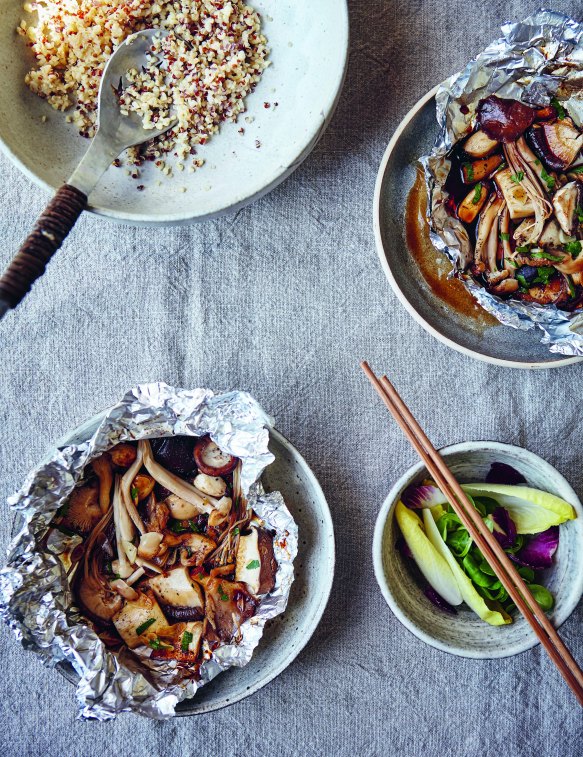
I always associate this preparation, or simple variations thereof, with izakaya – the wonderful Japanese drinkeries-cum-eateries where the food is highly varied but always conducive to drinking loads of good sake or beer – typically salty, snacky, shareable, crowd-pleasing dishes with bold but not over-the-top flavours. This is exactly that kind of dish, mushrooms simply steamed in a foil parcel with plenty of garlic and soy sauce – tearing open the foil is like opening a present on a particularly garlicky Christmas morning. It’s lovely on its own but I would strongly recommend enjoying this with sake – nothing too fancy, as the earthier flavours of cheaper sake are perfect for this mushroomy garlic umami funkbomb.

200 g (7 oz) Japanese mushrooms (such as enoki, shimeji (beech), shiitake and eringi (king oyster)– often supermarkets sell an ‘exotic’ mushroom pack containing a few of each of these, which are perfect)
2 tablespoons soy sauce
1½ teaspoons sake
1½ teaspoons olive oil
3–4 garlic cloves, crushed and thinly sliced
a few grinds of black pepper
a few sprigs of flat-leaf parsley, finely chopped
You will also need some sturdy kitchen foil

Preheat the oven to 220ºC (430°F/Gas 9). Prepare the mushrooms: for enoki or shimeji, cut off their bottoms and break up any large clusters; for shiitake, simply remove the stems; for eringi, cut them into roughly bite-size pieces.

Stir together the soy sauce, sake, olive oil, sliced garlic, black pepper and parsley. Toss the prepared mushrooms with the soy sauce mixture.

Set a wide piece of kitchen foil (about 40 cm/ 16 in long) into a shallow bowl or dish, and place the mushrooms and the sauce into the middle of the foil. Gather up the sides of the foil to cover the mushrooms, crimping them together to form a tight seal. Place the parcel on a baking sheet and bake for 20 minutes.

Transfer the parcel to a plate, taking care not to tear the foil. Serve with the parcel closed and open it at the table.

Buy this book
Vegan JapanEasy: Classic & modern vegan Japanese recipes to cook at home

Cook from this book
French Onion Ramen
Sweetcorn Curry Croquettes

French Onion Ramen by Tim Anderson

05.13.19_VeganJapaneasy_D4_FrenchRamen_022 3

FRENCH ONION RAMEN
SERVES 4

I can never figure out why French onion soup ever went out of style. It’s just so good. I had some that my great aunt Jean made a few years back at a family get-together in Wisconsin and it made me think, ‘I should eat French onion soup every day!’
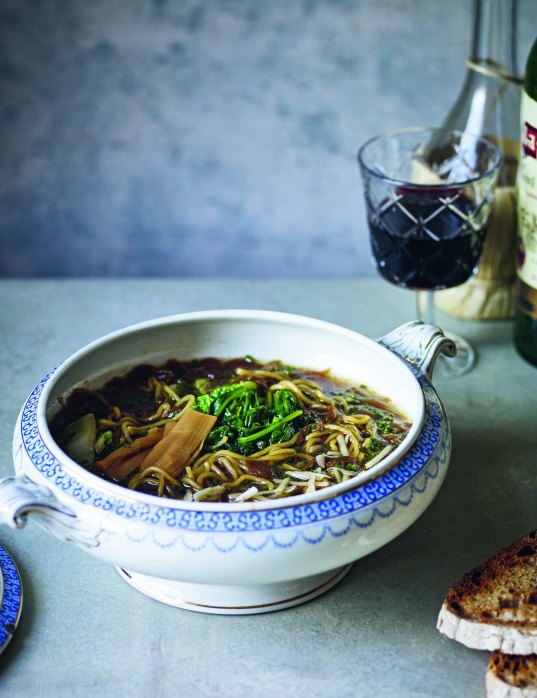
Suddenly fixated on French onion soup, my thoughts quickly turned to ramen. The molten onions mingle beautifully with the noodles so you get a lovely sweetness and silky texture in every bite, all bathed in a rich, beefy broth that just happens to contain no beef. The onions do take a while to caramelise properly, but for comfort food I think it’s worth the wait.

4 tablespoons olive oil
2 red onions, halved and thinly sliced
2 brown onions, halved and thinly sliced
pinch of salt, or more, to taste
1 teaspoon caster (superfine) or granulated (raw) sugar
2 garlic cloves, crushed and thinly sliced
4 tablespoons sake
2 tablespoons ruby port or red wine
1.2 litres (40 fl oz/4¾ cups) Mushroom or Triple Seaweed Dashi
2 bay leaves
4 sprigs of fresh thyme (optional)
a few grinds of black pepper, or more, to taste
4 tablespoons soy sauce, or more, to taste
1 tablespoon balsamic vinegar
1 tablespoon mirin, or more, to taste
1 tablespoon Marmite (yeast extract)
1½ teaspoons cornflour (cornstarch)
200 g (7 oz) fresh spinach, washed
¼ Savoy cabbage, cut into thin strips
4 portions of uncooked ramen noodles
4 spring onions (scallions), thinly sliced
80 g (3 oz) bamboo shoots (if you can, use Japanese menma – pickled bamboo shoots)
a few drops of sesame oil and/or truffle oil
60–80 g (2–3 oz) vegan cheese (‘Cheddar’ or ‘Italian-style’), grated (shredded)
4 slices of good-quality bread, toasted

Heat the oil in a deep saucepan or casserole (Dutch oven) and add the onions and the salt. Cook over a medium-high heat for 10 minutes or so, stirring frequently, until they soften, then reduce the heat to medium-low and cook for another 45–50 minutes, stirring every 10 minutes. After about 15 minutes, the onions will start to caramelise, so make sure you scrape the bottom of the pan when you stir to prevent them from catching and burning prematurely. When the onions are just starting to brown, stir in the sugar and add the garlic. During the last 10 minutes of cooking, you will have to stir and scrape often to ensure the onions don’t burn. (If it’s proving difficult to scrape up the stuck bits, add a splash of water, which should help them release nicely.)

Add the sake and the port or wine. Add the dashi, bay leaves, thyme and black pepper and bring to a simmer. Simmer for 30 minutes, then stir in the soy sauce, balsamic vinegar, mirin and Marmite. Taste and adjust the seasoning as you like it – it should be fairly salty and slightly sweet. Remove the bay leaves and thyme stems and discard. Spoon about 3 tablespoons of the broth into a small dish and leave to cool. Stir the cornflour into the cooled broth to make a thin slurry, then stir it back into the soup and bring to the boil to thicken the broth slightly.

Bring a large saucepan full of water to the boil and blanch the spinach for 15 seconds. Remove with a slotted spoon and rinse under cold water. Drain well, pressing out any excess water. In the same pan, boil the cabbage for 3–4 minutes until just tender, then remove with a slotted spoon and set aside. Let the water return to a rolling boil, then cook the ramen until al dente, according to the packet instructions. Drain well.

Divide the ramen among 4 deep bowls and ladle over the soup. Gently stir the noodles through the soup to ensure they aren’t sticking together. Top each ramen with the spinach, cabbage, spring onions, bamboo shoots, sesame or truffle oil and vegan cheese. Serve with the toast on the side to soak up the broth once the noodles have all been slurped away.

Buy this book
Vegan JapanEasy: Classic & modern vegan Japanese recipes to cook at home

Cook from this book
Japanese Mushroom Parcels with Garlic and Soy Sauce
Sweetcorn Curry Croquettes

Coddle by Jp McMahon

Phaidon Irish Food Bible

CODDLE

Preparation: 20 minutes
Cooking: 1 hour
Serves: 8

Coddle, or Dublin coddle to be more precise, is a dish made up of leftover sausages and bacon. Traditionally, the sausages and bacon were cut up and combined with onions and potatoes and left to stew in a light broth. Though often unappetizing to look at, the dish was made famous by several Irish writers, from Jonathan Swift to James Joyce and Sean O’Casey. Modern versions include barley and carrots. It is essentially a dish that grew out of poverty and famine and then migrated into the working-­class areas of Dublin at the beginning of the twentieth century to become a dish of central importance to the people who lived there. Often it contained a drop of Guinness (or it was eaten with plenty of pints and soda bread). It is said that the housewives would prepare the coddle during the day and it would sit on the stove until the men returned home from the pub. The word itself is derived from the verb ‘to coddle’ or ‘to cook’ (from French caulder). With its associations of poverty, it is surprising to find ‘authentic’ recipes, especially given the status of the dish as being made with whatever leftovers were to hand (as in pig’s trotters/feet, pork ribs, etc.). Some associate it with the Catholic Church’s insistence of abstaining from meat on a Friday. Coddle was a way of using up the bacon and sausages on a Thursday. In this recipe, I fry the ingredients before covering them with the stock, but traditionally they were just layered and simmered until cooked.

INGREDIENTS:

  • 2 tablespoons rapeseed (canola) oil, plus extra if needed
  • 500 g sausages, cut into pieces if preferred
  • 500 g streaky (regular) bacon, cut into pieces
  • 500 g onions, sliced
  • 2 tablespoons chopped thyme
  • 2 bay leaves
  • 1 litre chicken stock
  • 1 kg (9 medium) potatoes, peeled and cut into chunks
  • 4 tablespoons chopped parsley
  • freshly ground black pepper

 
METHOD:

Warm the oil in a large pan over a medium heat. Add the sausages and bacon and fry for about 10 minutes until they have a nice colour. Remove the meat from the pan and set aside.

Add the sliced onions to the pan and a little more oil if necessary. Reduce the heat and fry for about 10 minutes so that the onions caramelize slowly.

When the onions have a nice colour, return the sausages and bacon to the pan and add the thyme and bay leaves. Cover with the chicken stock (broth) and return to the boil. Reduce the heat to a simmer and add the potatoes. Cook for about 30 minutes.

Add the chopped parsley and plenty of black pepper and serve.

Read the review 

Buy this book
The Irish Cookbook (Food Cook)
Phaidon, £35

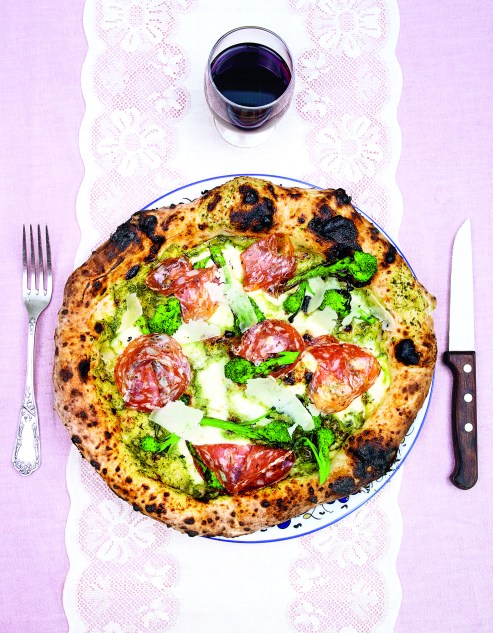
Green Pizz’ from Big Momma Cucina Popolare

121 Green Pizz.jpg

Rapini (broccoli rabe) cream, finocchiona, mozzarella and pecorino pizza

Per 1 pizza

Preparation time: 20 minutes
Resting time: 10 minutes
Cooking time: 30 minutes

Ingredienti

2 bunches rapini (broccoli rabe) or Tenderstem broccoli (broccolini)
2 tablespoons olive oil
2 anchovy fillets in oil, drained
1/2 quantity (250 g/9 oz) Pizza Dough (see below)
5 thin slices of finocchiona or salami
90 g/3 and ¼ oz fior di latte (or mozzarella di bufala), roughly cut
70 g/2 and ½ oz (3/4 cup) grated pecorino, plus a few shavings to garnish
Salt

Come fare

Chop half the rapini (broccoli rabe) stalks (stems) and remove the leaves. Cook the rapini for 2 minutes in a large pan of salted boiling water. Drain, then immerse them in a large container of ice water to stop further cooking. Leave to cool for 10 minutes.

Make the rapini cream. In a large pan, heat 1 tablespoon of the olive oil over a high heat. Chop the remaining rapini stalks and fry with the anchovies for 15 minutes over a medium heat. Process everything in a food processor until you have a smooth cream.

Preheat the oven to 250°C/480°F/Gas Mark 9. Cover a baking sheet with baking (parchment) paper. On a floured work surface, roll out the pizza dough into a circle about 30 cm/12 inches in diameter and about 2 cm/ 3/4 inch thick.

Place the pizza base (crust) on the baking paper. Cover it with the rapini cream and drizzle over the remaining 1 tablespoon of olive oil. Bake for 5 minutes.

Remove from the oven and add the chopped rapini, finocchiona slices and mozzarella. Bake for a further 5 minutes. Remove from the oven and sprinkle with the grated and shaved pecorino. Don’t wait, serve and enjoy immediately!

Cool to know
Finocchiona is a type of traditional Italian salami from Tuscany. Its name comes from ‘finocchio’ – meaning ‘fennel’ in Italian – which, along with pepper, gives this salami its distinctive flavour.

Neapolitan Pizza Dough
A tip from Giuseppe Cutraro

Per 2 pizze

Preparation time: 25 minutes
Rising time: 8 hours

5 g/1/8 oz (13/4 teaspoons) fresh yeast or 1 teaspoon fast-action dried (active dry) yeast
300 g/11 oz (2½ cups) soft (pastry) flour, such as Italian type ’00’
1 generous tablespoon olive oil
2 teaspoons fine salt

Come fare

Dissolve the yeast in 200 ml/7 fl oz (scant 1 cup) of lukewarm water. Sift the flour and add half to the water. Work by hand for 10 minutes, without leaving any lumps, gently mixing the liquid with the flour and kneading the resulting dough well. Incorporate the remaining flour,olive oil and salt.

Continue to knead by hand for 15 minutes until the dough is very smooth and comes off the work surface very easily.

Put into a bowl, cover with a wet cloth and leave to rise for 2 hours in a warm room (about 24°C/75°F).

Dust a rimmed baking sheet. Divide the dough into two and put the dough balls onto the baking sheet. Cover with a cloth or lid without touching the dough and leave to rise in a warm room for 6 hours. The pizza dough can be stored in the refrigerator for 3–4 days.

How to stretch pizza dough

Neapolitan pizza-making is an art form (now recognized as intangible cultural heritage by UNESCO). Giuseppe Cutraro, our chief pizzaiolo, ‘made in Napoli’, explains how to stretch the dough. Professional tips below…

You begin by dusting your work surface (preferably marble to keep the temperature at about 20°C/70°F) with flour.

Put the dough on the work surface and start by stretching it with your hands to form a circle about 30 cm/12 inches in diameter. And here’s where things get a little tough: twirling the pizza with your hands. Unlike what you might think, you don’t toss the dough high into the air, even though it looks like a really cool thing to do. This can even be done on the work surface: make the dough into a circle by rotating it, or by repeatedly lifting it with the left hand while holding it with the right. These actions allow the dough to be stretched uniformly.

Then lay the dough on the work surface and start pushing it from the centre towards the edges with your finger, which pushes the air to the edges and creates a raised lip that is light and puffed when cooked. We pizzaioli call it a cornicione (‘cornice’). It’s the hallmark of genuine Neapolitan pizza – generous edges, about 2 cm/¾ inch, which puff up at 430°C/800°F in the wood-fired pizza oven.

Giuseppe started learning the trade at the age of 15, at the historic Starita a Materdei pizzeria in Naples. We will probably never equal his pizza-making skills, but we can at least pretend.

Cook more from this book 
La Gran Carbonara
The Incredible Lemon Pie

Read the review 

Buy this book
Big Mamma Cucina Popolare: Contemporary Italian Recipes
Phaidon, £27.95

La Gran Carbonara from Big Momma Cucina Popolare

191 La Gran Carbonara.jpg

Spaghetti carbonara

Per 4 amici

Preparation time: 20 minutes
Cooking time: 15 minutes
30 minutes or less, 5 ingredients or less

Ingredienti

3 whole eggs and 6 egg yolks
90 g/3 oz (1 cup) grated pecorino cheese
90 g/3 oz (1 cup) grated Parmesan cheese
1 teaspoon pepper
400 g/14 oz spaghetti
8 slices of guanciale (cured pork cheek/jowl), finely sliced

Come fare

In a bowl, mix the whole eggs and egg yolks with the pecorino, Parmesan and pepper. Set aside.

Bring a large pan of salted water to the boil and cook the spaghetti according to the package directions, then drain, reserving the cooking water.

In the meantime, add the guanciale slices to a dry frying pan (skillet) over a medium heat and sear for 5 minutes, or until crispy. Add 1 tablespoon of the pasta cooking water, followed by the spaghetti.

Remove the pan from the heat. Add the egg mixture and mix briskly. The eggs should not cook too much and the consistency of the sauce should be creamy.

Transfer to a large serving dish and serve immediately.

Cool to know
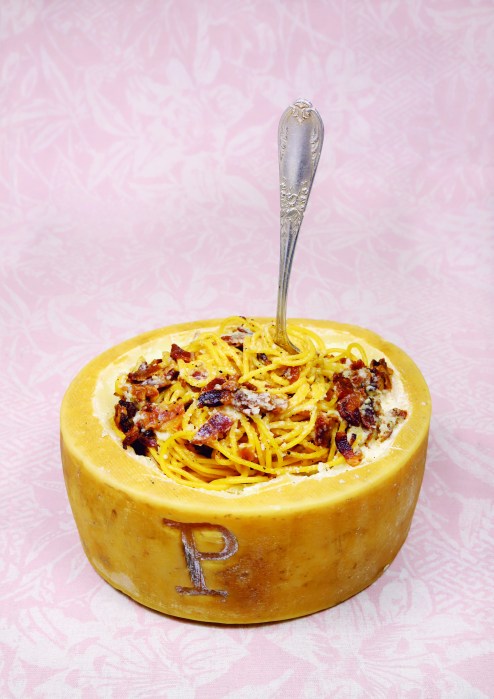
You heard right: real Italian carbonara sauce is made without cream. Our chef Filippo La Gattuta makes a spectacle of serving it straight out of a big pecorino wheel at our London trattoria Gloria.

Cook more from this book
Green Pizz’
The Incredible Lemon Pie

Read the review 

Buy this book 
Big Mamma Cucina Popolare: Contemporary Italian Recipes
Phaidon, £27.95
Vietnamese Scrambled Eggs with Sesame Bread by Lee Tiernan

069 Vietnamese eggs

This is a dish we used to serve as staff meal at St. JOHN Bread and Wine from time to time. I’m not sure why we called it Vietnamese Scrambled Eggs, but it’s basically scrambled eggs with Asian flavours, and it’s fucking tasty. If you can’t be bothered to make the Sesame Bread by all means use whatever bread you have at home, but preferably something with a bit of texture, like sourdough. Sweet coffee goes well with this. Or even a White Russian.

ESSENTIAL EQUIPMENT non-stick frying pan (skillet) rubber spatula

SERVES 4

3–4 cloves garlic, thinly sliced
2 thumb-sized pieces of ginger, peeled and finely chopped
sunflower or vegetable oil, for frying
2 red chillies, finely chopped
3 spring onions (scallions), whites thinly sliced, greens reserved
1 bunch coriander (cilantro), stems sliced, leaves left whole and reserved
25 g (1 oz/2 tablespoons) butter
8 eggs, beaten
fish sauce, to taste
salt

FOR THE SALAD
400 g/14 oz bean sprouts
reserved greens of the spring onions (see above), finely sliced
2 tablespoons Pickled Red Chillies (page 201)
2 tablespoons Pickled Red Onions (page 200)
1 tablespoon olive oil
juice of 1⁄2-1 lime
reserved coriander leaves (see above)

TO SERVE
4 BAM Flatbreads (pages 56–63), topped with sesame seeds and a dash of sesame oil after cooking
8 rashers BAM Bacon, or shop bought, grilled (page 50; optional)
dried baby shrimp (optional)
2 tablespoons shop-bought crispy fried onions

In a non-stick frying pan (skillet) over a low heat, soften the garlic and ginger in a little oil for 2 minutes. Add the chillies with a pinch of salt and cook for a further minute. Add the whites of the spring onions (scallions) and the coriander (cilantro) stalks and cook for 1–2 minutes more. Don’t cook the latter for too long as they will lose their vibrant green colour. Remove from the heat and set aside.

Next, toss all the salad ingredients in a mixing bowl until well combined, and set aside.

Wipe the non-stick frying pan clean, and then get the pan hot over a high heat. Melt the butter in the pan and add the garlic, ginger and chilli mix. When it starts to sizzle, add the eggs and stir with a rubber spatula. Turn the heat down to low. Keep stirring and turning the eggs, then add a good splash of fish sauce, bearing in mind that this is all the seasoning the eggs are going to get. I like to go pretty heavy with it – at least 1⁄2 tablespoon – but really it depends how salty and funky you want it. I’d recommend tasting a little of the egg once it’s mixed in to check. Continue to cook the eggs for around 2 minutes – you want them just cooked and super silky, as opposed to dried out and rubbery.

Place the breads on plates. Distribute the scrambled eggs onto each bread and top with the salad. Add the bacon and dried baby shrimp (if using) and the crispy fried onions. Serve with steak knives for ease of eating

PICKLED RED CHILLIES

These pickled chillies cut through fatty meat and add the welcome hit of spice I’m always craving. We use them a lot at BAM. Reserve the vinegar to use in a salad dressing after you’ve used all the actual chilli.

MAKES ABOUT 800 G/13⁄4 LB

250 g/9 oz red chillies
350 ml (12 fl oz/11⁄2 cups) red wine vinegar 175 g (6 oz/3⁄4 cup) caster (superfine) sugar

In a small bowl, whisk the sugar into the vinegar until it has dissolved.

Blister the chillies under a hot grill, over the coals of a barbecue or with a blow torch, then cut into 5 mm (1⁄4 inch) chunks. Combine the chillies and vinegar in an airtight container and store in the refrigerator.

PICKLED RED ONIONS

MAKES 800 G (13⁄4 LB/3 CUPS)

1 tablespoon salt
4–6 red onions, thinly sliced
125 g (41⁄4 oz/1⁄2 cup) caster (superfine) sugar
250 ml (8 fl oz/1 cup) red wine vinegar

In a colander or sieve set over a sink, dis- tribute the salt over the sliced onions and let sit for 10 minutes.

While the onions are salting, dissolve the sugar into the vinegar in a saucepan over a low heat. When the liquid has cooled, add the onions. Tip into an air- tight container.

These can be used after a few hours, but will be better after a few days in the refrigerator.

Cook more from this book
Pressed Octopus And Szechuan Vinaigrette
Crispy Fuckin’ Rabbit

Buy this book
Black Axe Mangal
Phaidon, £24.95

Read the review