The Female Chef by Clare Finney and Liz Seabrook

The Female Chef

What’s the USP? Interviews with and recipes from 31 leading British chefs/cooks (despite the book’s title, there is much debate in the introduction and the interviews about which is the correct/preferred title) including Angela Hartnett, Thomasina Miers, Andi Oliver, Gizzi Erskine, Ravinder Bhogal, Olia Hercules and er, Elizabeth Haig (click here to catch up on the controversy that has recently sprung up around Haig).

Who wrote it? Food writer Clare Finney won Food Writer of the Year in Fortnum and Mason’s Food and Drink Awards in 2019. She contributes to a wide variety of national publications. This is her first book. Liz Seabrook is a portrait and lifestyle photographer.

Is it good bedtime reading? Finney ponders the question Cooks or Chefs? in her  introductory essay, a question more fraught than you might imagine. Finney says that the words ‘cook’ and ‘chef’ are ‘inherently gendered’ and that ‘several women in this book have chosen to reject the label ‘chef”. However, she also explains that ‘the question ‘Do you consider yourself a chef or a cook?’ continued to prompt an extraordinary array of discussions’. I don’t have room to detail the various viewpoints here but the 30 short interviews (Sam Evans and Shauna Guinn of the now closed Hang Fire Southern Kitchen in Barry are interviewed together) are well worth reading to discover them for yourself.

How annoyingly vague are the recipes? The first recipe in the book is Anna Jones’ Dhal with Crispy Sweet Potato and Quick Coconut Chutney.  Ingredients include ‘2 sweet potatoes’ no size or weight indicated, ‘olive oil for drizzling’,  ‘vegetable or coconut oil for frying’ a ‘thumb-sized piece of ginger’ (my wife’s thumb is roughly half the size of mine) ‘bunch of fresh coriander’ (according to my local Asda, a bunch is either a 30g bag or a ‘growers selection’ which is about three times the size and would be enough coriander for a week’s worth of recipes). There are plenty of other recipes in the book with similarly vague ingredients lists, although with 30 different contributors (Ravinder Bhogal of Jikoni restaurant in London has failed to cough up a recipe for some reason) the accuracy waxes and wanes as you might expect as the recipe writing style varies.

You may say at this point, well, can’t you just use your common sense you annoying (male) pedant. To which I would respond, have a look at these recipes for Pasta Salad by professional chef, baker and YouTuber Brian Lagerstorm which include gram weights for every ingredient including the water and salt to boil the pasta in and all the vegetables (he does specify ‘a splash of olive oil’ to dress the cooked pasta with directly after cooking but I’m going to let him off that one minor detail as it is an instinctive part of the process).  They are just very well developed and written recipes that anyone could follow. Cookery books are manuals and should have the appropriate level of detail. If you bought a woodwork book and it said ‘drill a hole in some bits of wood and screw them together’ you’d quite rightly be pissed off that it didn’t specify the type of wood, size of the hole and the type of screw (that’s a very male example isn’t it. Or is it?).  Recipes are really not that different. Although if you’re cooking up screws and bits of wood I  don’t want to eat at your house.

Will I have difficulty finding the ingredients? With dozens of contributors, all with their own unique styles, the book covers a lot of culinary ground, so it’s not surprising that one or two more difficult to track down ingredients appear in the recipes. Erchen Chang of BAO restaurant in London uses doubangjiang (fermented broad bean paste) for her Braised Pork Gua Bao that’s available in Chinese supermarkets or online at Sous Chef, and Pamela Brunton of Inver in West Scotland pairs Gigha Halibut (which, unless you have a top class fishmonger nearby, you can order from the Fish Society) with coastal greens such as sea blite and sand wort (again, the Fish Society has something similar). Good luck finding tasso ham for Sam Evans and Shauna Guinn’s Shrimp and Tasso File Gumbo though, you might have to make your own.

How often will I cook from the book? There are some recipes, like Angela Hartnett’s Anolini that requires chuck beef, veal rump, Italian sausage, beef brisket, smoked bacon, Toulouse sausage, a free range chicken and much else besides that might be once a year or even once in a lifetime cooks. However, there are plenty of everyday dishes like Skye Gyngell’s Leek, Potato and Parsley Soup and Lisa Goodwin-Allen’s Sundried Tomato and Goat’s Cheese Quiche that make this a genuinely useful book to have on your shelf.

Killer recipes: Wadadli spiced roast chicken and coconut gravy; beef kofta; apricot tarte tatin; braised squid, parsley and potatoes; Thai noodle soup; Tahini and preserved lemon cookies; fish curry and pumpkin maize meal.

Should I buy it? Eight of the 29 recipes (as mentioned above, Ravinder Bhogal hasn’t contributed a recipe and Sam Evans and Shauna Guinn contribute one between them) have already been published elsewhere so if you already have a large cookbook collection it might be worth checking how many of the recipes you already own if that is your main reason for buying the book.

Finney’s prose can at times tend towards the overheated (for example, of Thomasina Meirs’ Wahaca Mexican restaurant group, she claims that ‘it’s impossible to overstate the impact the chain has had on our culinary landscape’. Um, OK) but she has succeeded in identifying a group of genuinely interesting talents, some of which may be new names to readers or at least under-reported, which makes this a worthwhile purchase for anyone interested in the modern British restaurant scene.

Cuisine: Global
Suitable for: Confident home cooks
Cookbook Review Rating: Three stars

Buy this book
The Female Chef: 30 women redefining the British food scene
£28, Hoxton Mini Press

Gelupo Gelato by Jacob Kenedy

Gelupo Gelato Jacob Kenedy

What’s the USP? This little square book offers up a wide selection of recipes for various ice creams and associated forms – ‘a frosty masterclass in the simple art of gelato’, or so the publishers claim.

Who wrote it? Jacob Kenedy, who is perhaps best known for his restaurant Bocca di Lupo, a favourite of London food critics since 2008. He has since opened the neighbouring Gelupo, a gelateria of similar renown. Here, then, is the recipe book for the latter venture – a small but dense volume that runs the gamut from classic favourites (fior de latte, pistachio, hazelnut) to less expected flavours (rice, for instance, or the elderflower, cucumber and gin granita).

Is it good bedtime reading? There’s no denying that Kenedy squeezes plenty of extra reading into the book, starting with an extended introduction to gelato. That said, the information in this section can be a little confusing; Kenedy claims that gelato is simply the Italian word for ice cream and that there is no difference between the two – only to admit in the very next sentence that ‘there is something a bit special about Italian gelati’. This isn’t all that useful if you’re trying to get your head around the differences – which most writers do not struggle to identify (fat content is a major factor).

Elsewhere the book offers more useful insights, though – the importance of scraping the bowl in a game where ingredient ratios can make such a big difference, the best way to store gelato (pre-freezing your containers to aid that transition to the freezer). Each recipe has an introduction too – many draw on the cultural significance of the flavours, whilst others simply espouse the virtues of a particular combo.

Will I have trouble finding the ingredients? Yes. Many of the recipes rely on the use of stabilisers like locust bean gum powder and glucose syrup. Thankfully, Kenedy is happy to offer more supermarket-ready alternatives, like arrowroot and light runny honey. That said, his willingness to compromise for home cooks is not limited – both the hazelnut and pistachio recipes specifically require pastes that need to be sourced online. This is a shame when these two flavours are so iconic in the gelato world – perhaps Kenedy is keen to maintain authenticity here, but I’m much keener on the idea of actually being able to make the damn ice cream.

What’s the faff factor? Ice cream is never a simple task, regardless of what cookbooks try to tell you. Even the smoothest of processes for a churned ice cream will involve creating a custard base, giving it time to cure in the fridge, and then wrestling with your maker of choice. Kenedy spells out each step fairly clearly here, but he can be a little vague in his instructions – perhaps the result of not knowing precisely which equipment the reader is using.

How often will I cook from the book? How often does anyone actually use their ice cream maker? I bought one earlier this summer and quickly went on something of an ice cream making bender – I still have the remnants of malted milk, strawberry, peach and cherry and chocolate ventures in my freezer right now. But once that initial burst fades – maybe once a month? At a push? If you live with someone who you’re trying to justify the purchase to?

What will I love? Hands down the stand out feature of the book is its absolutely gorgeous contents page. No dull list here: instead, each flavour in the book is represented by a minimalistic coloured circle laid out in an 8×10 grid. It’s an impactful start to the book that would look just as good framed on the living room wall of some beautiful couple who are absolutely not the type to consume ice cream ever.

What won’t I love? For all the variety and exciting flavours, there are a few more familiar options that have been left out. Strawberry ice cream is off the table – instead you’ll have to opt for a strawberry granita, wild strawberry sherbet, or strawberry & pink peppercorn. All told, though, the book’s problem isn’t the lack of choice (Kenedy has filled it with a ridiculous selection to suit every taste), but the lack of precision and attention to detail.

Killer recipes: Lemon & Rosemary, Whisky & Vanilla, Pear & Blackberry Crumble, Roast Plum Sorbet

Should I buy it? If the flavours tempt you, and you already have a very solid grasp of the art of ice cream making, then Gelupo Gelato has some great ideas. For most people, though, this title shouldn’t be the top of the list when learning to create ice cream at home – there are more useful books like Dana Cree’s Hello, My Name is Ice Cream that are better suited for that.

Cuisine: Italian
Suitable for: Confident home cooks/Professional chefs
Cookbook Review Rating: Three stars

Buy this book
Gelupo Gelato: A delectable palette of ice cream recipes
£14.99, Bloomsbury Publishing

Review written by Stephen Rötzsch Thomas a Nottingham-based writer. Follow him on Twitter and Instagram at @srotzschthomas

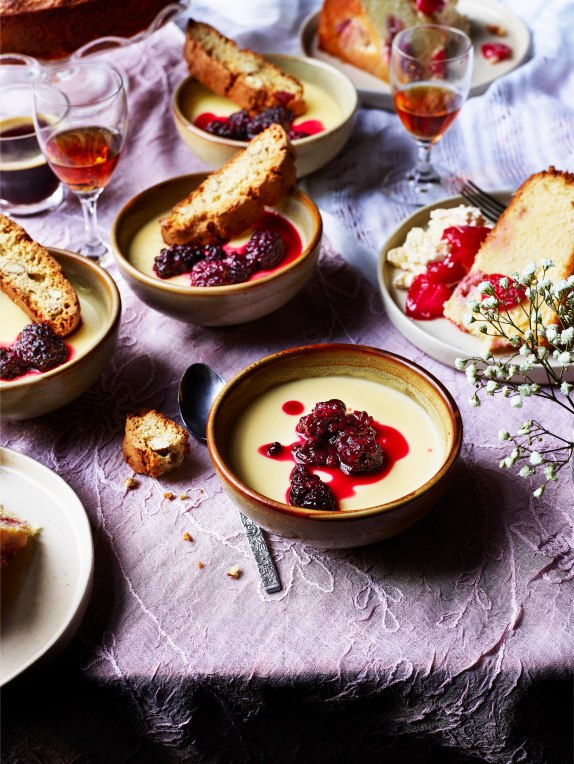
Sicilian Lemon Cream by Ben Tish

1419_AbsolutePress_Ben_Tish_Sicilia_2020-09-14_Peter_Moffat
Unlike similar puddings that use flours for thickening, this very simple posset-style pudding really showcases the zingy, fragrant flavour of the lemons. The mix of cream and mascarpone is not only rich and indulgent, but fresh too. Unwaxed lemons will give the best flavour. I like to make this in the early winter months when Sicilian and Amalfi lemons are bursting into season.

Mulberries aren’t as common in the UK as they are in Europe but if you can find them, perhaps in a Middle Eastern supermarket or a specialist fruiterer, they are utterly delicious. They resemble an elongated blackberry with denser flesh and a singular sweet-sour aromatic flavour. Blackberries will make a very good alternative.

Serves 4

For the lemon cream
2 large unwaxed lemons with unsprayed leaves
150g caster sugar
150ml double cream
300g mascarpone

For the berries
250g mulberries or blackberries
150ml good red wine
60g golden caster sugar
1 tablespoon honey

Zest the lemons and squeeze the juice; you need 80ml juice. Put the lemon zest and 80ml juice in a saucepan with the sugar. Heat over a medium-low heat, stirring until the sugar has dissolved completely. Remove from the heat and keep warm.

In a separate pan, heat the cream and mascarpone over a medium-low heat, bringing just to a simmer – do not let it boil (otherwise it may separate). Remove from the heat, add the lemon mixture and whisk. Cool slightly, then strain through a fine sieve into bowls. Cool completely, then leave in the fridge for at least 8 hours or until firm and chilled.

While the lemon cream is chilling, prepare the stewed berries. Place the fruit in a saucepan, just cover with water and add the wine, sugar and honey. Bring to the boil, then simmer for 10 minutes or until the fruits are very tender but still holding their shape. Use a slotted spoon to remove the fruits from the liquid to cool. Boil the remaining liquid until syrupy. Let this cool, then pour over the berries. Chill.

To serve, spoon some of the berries on to each cream. Delicious with biscotti.

Cook more from this book
Pasta alla Norma by Ben Tish
Aeolian-style Summer Salad by Ben Tish

Read the review
Coming soon

Buy the book
Sicilia: A love letter to the food of Sicily
£26, Bloomsbury Absolute

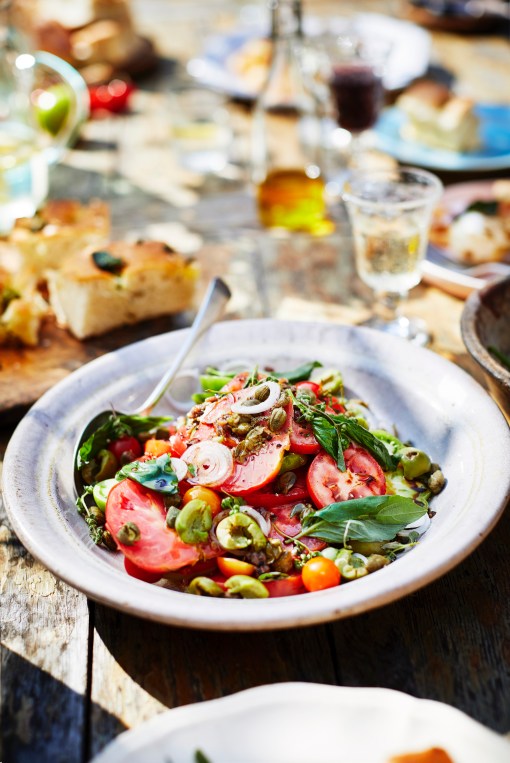
Aeolian-style Summer Salad by Ben Tish

4_Aeolianstyle_Summer_Salad
This dish is all about the tomatoes. It’s hard to perfectly replicate a delicious, fresh salad from Sicily’s Aeolian islands when in the UK, yet we produce many delicious varieties of tomatoes that will stand up well in comparison. I’d use a plum vine or a Bull’s Heart tomato – ensure they are ripe, but not over ripe.  I like to use a sweet-sour grape must (saba) for the dressing, which is smoother and fruitier than a vinegar, but an aged balsamic will also do nicely.

Serves 4

10 medium-sized, medium-ripe, sweet red tomatoes (vine-ripened are best), sliced into rounds
2 tablespoons plump capers
2 handfuls of pitted green olives
2 tropea onions or small red onions, finely sliced
6 anchovies in oil, chopped
1 tablespoon oregano leaves
10 basil leaves, torn

For the vinaigrette
2 tablespoons saba (grape must) or balsamic vinegar
4 tablespoons extra virgin olive oil
sea salt and freshly ground black pepper

Whisk together the grape must and extra virgin olive oil. Season to taste.

To assemble the salad, carefully arrange the tomato slices on a serving plate and sprinkle over the capers, olives, onions, anchovies and herbs. Season well, then drizzle over the vinaigrette.

Leave the salad for 5 minutes, so all the flavours come together, before serving.

Cook more from this book
Pasta alla Norma by Ben Tish
Sicilian Lemon Cream by Ben Tish

Read the review
Coming soon

Buy the book
Sicilia: A love letter to the food of Sicily
£26, Bloomsbury Absolute

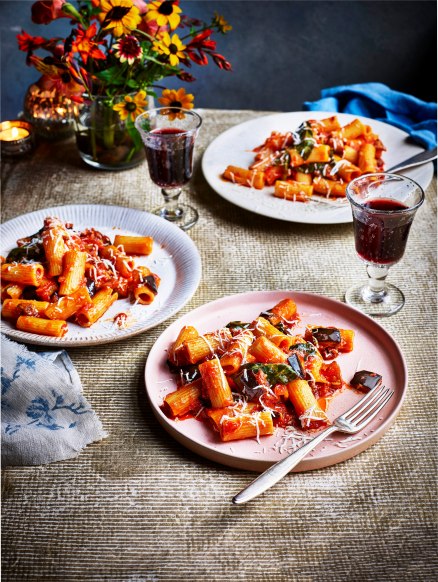
Pasta alla Norma by Ben Tish

1419_AbsolutePress_Ben_Tish_Sicilia_2020-09-14_Peter_Moffat
Pasta alla Norma has become the unofficial signature dish of Sicily. Originally created in the city of Catania around the same time as Vincenzo Bellini’s romantic opera ‘Norma’, it is said that the pasta was created as a homage to the composer and to the opera. Another story tells of a talented home cook who served her creation to a group of gourmands and was duly christened at the table via the classic Sicilian compliment of Chista e na vera Norma (‘this is a real Norma’). Whatever the truth, the dish became an instant classic and its fame spread around the world.

Serves 4

2 firm aubergines, trimmed and cut into 2cm dice
150ml extra virgin olive oil
½ onion, finely chopped
2 garlic cloves, finely chopped
a good handful of basil leaves
800g quality canned chopped tomatoes or passata
400g dried rigatoni
200g ricotta salata cheese, grated
sea salt

Put the diced aubergines in a colander in the sink and sprinkle with salt. Leave to drain for 30 minutes.

Preheat the oven to its highest temperature, around 250°C/230°C fan/Gas Mark 10.

Rinse the aubergine in cold water and pat dry with a kitchen towel, then toss in a bowl with half the oil. Spread out on a baking tray, place in the oven and cook for 15–20 minutes or until caramelised, turning occasionally to make sure the pieces don’t dry out.

Meanwhile, heat the remaining oil in a medium saucepan over a medium heat and add the onion and garlic. Sauté for a couple of minutes, then add half the basil and the tomatoes. Bring to a simmer. Turn down the heat and cook gently for 23–30 minutes or until thickened (the exact time will depend on your canned tomato brand).

When the sauce is almost ready, cook the pasta in plenty of boiling salted water according to the packet instructions to al dente. Add the aubergine to the sauce. Drain the pasta (reserving a little of the cooking water) and toss in the sauce. If the sauce seems too thick, add some cooking water to loosen.

Divide among the plates and sprinkle with the ricotta and remaining basil leaves, roughly torn over the top. It’s best to allow this to cool slightly before eating.

Cook more from this book
Aeolian-style Summer Salad by Ben Tish
Sicilian Lemon Cream by Ben Tish

Read the review
Coming soon

Buy the book
Sicilia: A love letter to the food of Sicily
£26, Bloomsbury Absolute

monk by Yoshihiro Imai

monk Light and Shadow on the Philosopher's Path by Yoshihiro Imai

What’s the USP? Recipes and stories from monk in Kyoto, a 14 seat restaurant located on the philosophers path on the outskirts of the city where locally sourced ingredients are cooked with fire and the signature dish is, surprisingly, pizza.

Who wrote it? Yoshihiro Imai is the chef and owner of monk. Born in the small village of Mito-city, 60 miles northeast of Tokyo, Imai studied sociology at university, but an interest in baking bread and a stint working in a mountain resort hotel in Karuizawa lead Imai to take a job as a chef at enboca, a nearby pizza restaurant. Imai opened a sister restaurant to enboca in Kyoto in 2010. Inspired by a short internship at Noma, Imai opened monk in 2015.

Is it good bedtime reading? Food writing often falls flat when it aspires to any sort of  literary merit, lapsing into adjective-heavy, pseudo-poetic cliché that manages to express little more than the author’s desire to be taken seriously at all costs, including the text’s clarity and use to the reader. But, in a series of beautifully written essays about his life, career and culinary philosophy that includes subjects such as Oharah village market; Yoshida Farm cheese from the mountains of Okayama, and Yu Sasaki, ‘the mushroom whisperer’ of Iwate prefecture in Honshu, Imai communicates what is obviously a very deeply felt and considered passion for ingredients, the process of cooking and the nature and art of hospitality with a welcome directness and simplicity. For example (just one of many):

‘For us at monk, lighting the oven each day has become part of our daily lives, and we spend the entire day living with fire. The guests who join us at the counter end up gazing at the flames in silence during gaps in their conversation. Fire must have some kind of power to bring us back to our roots, to something ancient within us, and inspire philosophical thoughts. By cooking almost everything entirely by the heat of the fire at monk, I hope our guests can connect with this part of them through the food we share with them.’

What does it look like? There is an elemental simplicity and beauty to Imai’s food. Even a bowl of turnip soup looks like a work of art – swirled with purees of turnip greens and carrots and served in an elegant grey and blue-flecked artisan ceramic ‘vessel’ (of a large dark blue dish made by Taniai-based ceramicist Teppei Ono, Imai says, ‘Looking at it, I get the sensation that this is not a plate, but a hole in space through which one can peer into a deep ocean.’) The signature pizzas – made perhaps with fresh nori or fiddlehead ferns and koshiabura (the sprouts of a wild tree) – are extraordinary. Kyoto itself, depicted through the seasons (the book is divided into spring, summer, autumn and winter) looks like heaven on earth, with lush greenery, vibrant blossoms, crystal waters and open blue skies in the spring and summer; rich red and orange foliage in the autumn and a land of moss and frosts in the winter. At the risk of repeating myself on this blog, the publisher Phaidon are past masters at creating visually pleasing cookbooks, but monk is simply ravishing.

Will I have trouble finding ingredients? If you want to follow the recipes to the letter and you don’t live in Japan, you are going to run into problems. Try tracking down Shogoin turnip, shirako bamboo shoots (‘the fresh heads of the shoots before they appear above ground’, explains Imai), seri (Japanese parsley), yomogi (Japanese mugwort), or nanohana blossoms in Middlesbrough(or London, probably).

What’s the faff factor? If you have a wood fired oven and you can navigate your way through the ingredients lists, finding reasonable substitutes for items that Imai sources locally in Kyoto, then often the recipes are fairly straightforward to execute. Some dishes, including slow-roasted napa cabbage; tomato soup, and the pizza dough recipe could even be adapted for a domestic oven, with a bit of tweaking. The reality for many home cooks however will be that this is a book to read, enjoy, marvel at and dream of visiting monk one day to experience it all for yourself, rather than try and replicate at home. Professional chefs are more likely to have the skills resources and suppliers to make more practical use of the book, especially those based in Japan.

What will I love? monk captures Imai’s distinctive, individual and inspiringly soulful culinary expression.  It’s a complete pleasure to read and to gaze at Yuka Yanazume’s gorgeous images.

What won’t I love? This is probably not a book that you will be cooking from on a regular basis.

Killer recipes: pea soup; suyaki pizza crust; romaine lettuce, egg and yomogi; cherry leaf roast beef; octopus, red shisho and red onion; assorted roasted vegetables, summer; plum lemon verbena and green tea oil.

Should I buy it? If you are passionate about modern gastronomy and love to travel to eat, this book is for you.

Cuisine: Japanese
Suitable for: Confident home cooks/Professional chefs
Cookbook Review Rating: Four stars

Buy the book 
monk: Light and Shadow on the Philosopher’s Path
£29.95, Phaidon

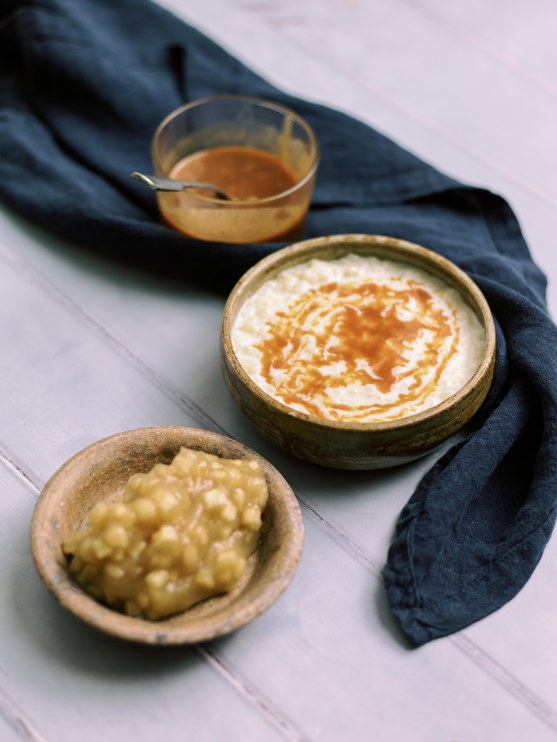
Rice pudding with apple compote and milk jam by Rob Howell

Rice pudding - 227

Muller Rice was a regular treat growing up and I love them to this day – ‘madeleine’ memory flavours are always the best. This is Root’s take on Muller Rice which we serve cold on top of an apple compote. The puddings can be made in advance and will keep very well in the fridge for a good few days along with the milk jam.

SERVES 4

FOR THE APPLE COMPOTE
20g caster sugar
3 large cooking apples, peeled, cored and thinly sliced
2 Granny Smith apples, peeled, cored and cut into 3mm dice

FOR THE MILK JAM
65g caster sugar
280ml whole milk
½ teaspoon bicarbonate of soda

FOR THE RICE PUDDING
100g pudding rice
650ml whole milk
50ml double cream
65g caster sugar
1 teaspoon vanilla seeds (scraped from ½ vanilla pod)
1 bay leaf
1 star anise
zest of 1 unwaxed lemon

First, make the apple compote. Tip the sugar into a medium saucepan and add the sliced cooking apples. Place the pan over a medium heat and allow the apples to break down for about 5 minutes, until soft. Transfer the apple mixture to a food processor and blitz until smooth. Return the purée to the pan and add the diced Granny Smiths. Place the pan over a low heat and cook the sauce for about 2–3 minutes, until the apples have softened. Remove from the heat and set aside.

Make the milk jam. Place all the ingredients into a small saucepan over a medium heat. Bring to the boil, then turn down the heat to a low simmer. Cook, whisking occasionally, for approximately 15–20 minutes until you have a dark brown caramel. Leave to cool. (Any leftovers will store in the fridge for up to 5 days.)

Rinse the pudding rice in a bowl and repeat until the water runs clear. Tip the rice into a large saucepan and add the remaining pudding ingredients. Place over a low heat and cook, stirring well, for 15 minutes, or until the rice is softened but still has a little bite.

Spoon the apple compote equally into the bottom of each bowl. Top with equal amounts of the rice pudding and spoonfuls of milk jam, adding as much as you wish. Serve warm or cold.

Cook more from this book
Buttermilk-fried celeriac with Korean-style sauce by Rob Howell
Roasted carrots with spiced pumpkin seeds, peaches and crème fraîche by Rob Howell

Read the review

Buy this book
Root: Small vegetable plates, a little meat on the side
£26, Bloomsbury Absolute

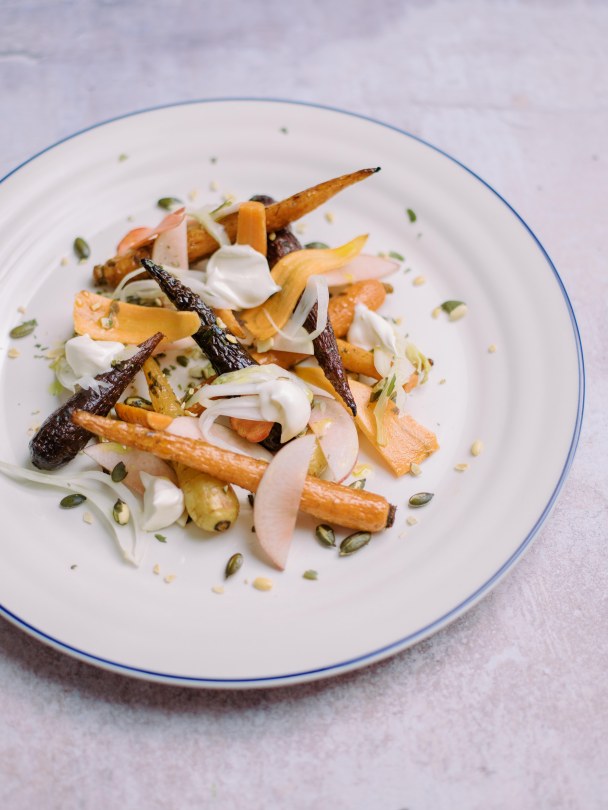
Roasted carrots with spiced pumpkin seeds, peaches and crème fraîche by Rob Howell

Roasted carrots - 133
Carrots simply roasted with honey or agave syrup and some herbs is pretty much carrot heaven. The peaches are a lovely addition, but you could also use apricots, pears or, if you wanted something a little more exotic, kimchi.

SERVES 4

FOR THE SPICED PUMPKIN SEEDS
100g pumpkin seeds
1 pinch of paprika
1 pinch of allspice
1 pinch of ground coriander

FOR THE PICKLED CARROT
1 carrot, peeled and sliced thinly with a mandolin
pickle liquid (see below)

FOR THE ROASTED CARROTS
2 bunches of carrots (about 16 carrots), green tops discarded
6 thyme sprigs
6 rosemary sprigs
2 bay leaves
3 garlic cloves, crushed
3 tablespoons runny honey or agave syrup
3 tablespoons rapeseed oil
juice of 1 orange
2 peaches, destoned and sliced, to serve
100g crème fraîche, to serve
fennel fronds, torn, to garnish
salt and freshly ground black pepper

Make the pumpkin seeds. Preheat the oven to 180°C/160°C fan/Gas Mark 4. Scatter the pumpkin seeds over a baking tray and scatter over the spices. Give it all a shake to combine. Place the tray in the oven and roast the seeds for 10–15 minutes, until they are lightly coloured and nicely toasted. Leave to cool, then transfer to a food processor and blitz to a crumb. Set aside.

Make the pickled carrot. Place the thinly sliced carrot in a bowl and pour over pickle liquid to cover. Set aside.

Increase the oven to 200°C/180°C fan/Gas Mark 6.

Make the roasted carrots. We don’t peel our carrots, as we feel the softer skin of the variety we use adds to the texture of the dish, but you can peel yours if you prefer. Place the carrots in a baking tray and scatter over the herbs and garlic, and drizzle over the honey or agave and the rapeseed oil. Season well and toss everything together in the tray. Place the tray in the oven and roast the carrots for 15–20 minutes, then add the orange juice to the tray and roast for a further 2 minutes, or until the carrots are tender but retain a good bite (the exact cooking time will depend on the size of your carrots).

Chop the roasted carrots into random sizes and divide them equally among 4 plates. Scatter over the pumpkin-seed crumb, then drizzle over any roasting juices. Add the peach slices and the pickled carrot. Finish with a nice spoonful of crème fraîche and garnish with the fennel fronds.

PICKLE LIQUID
Just like vegetable stock, we keep pickle liquid in the restaurant kitchen at all times ready to go. This is our base pickle recipe. You can tailor the pickle as you wish, adding extra flavourings such as citrus peels, spices or aromatics. Make a large amount to keep in the fridge for use as the occasion demands.

MAKES ABOUT 1 LITRE
600ml white wine vinegar
400ml caster sugar
300ml white wine

Place the ingredients in a saucepan with 300ml of water. Whisk them together and place them over a medium heat. Bring to the boil, then immediately remove from the heat. Leave the liquid to cool, transfer it to an airtight container and keep refrigerated until you’re ready to use.

Cook more from this book
Buttermilk-fried celeriac with Korean-style sauce by Rob Howell
Rice pudding with apple compote and milk jam by Rob Howell

Read the review

Buy this book
Root: Small vegetable plates, a little meat on the side
£26, Bloomsbury Absolute

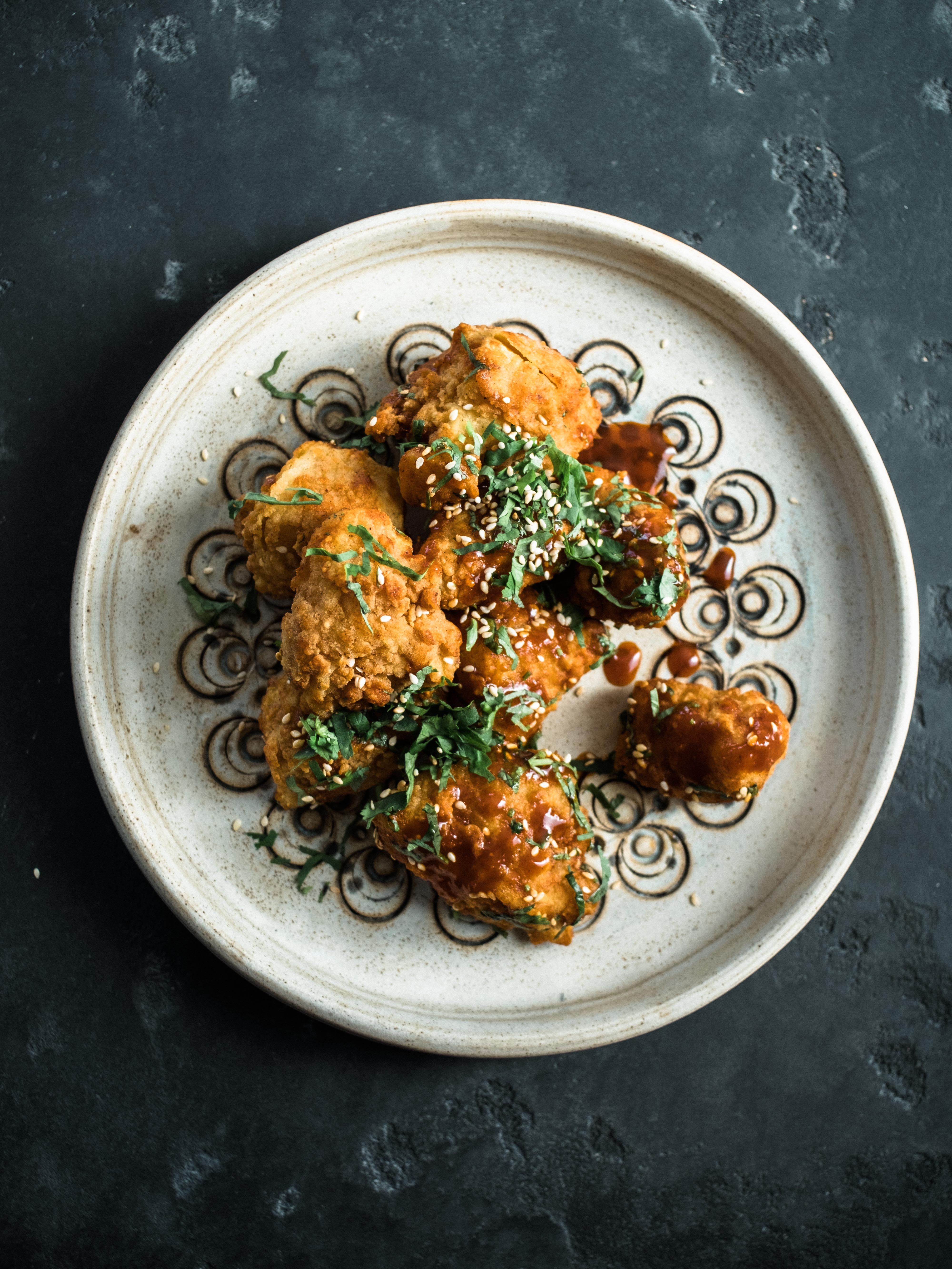
Buttermilk-fried celeriac with Korean-style sauce by Rob Howell

Buttermilk fried celeraic - 27

SERVES 5

Forget fried chicken, this celeriac is all you will need to satisfy your KFC cravings. The sauce is easy to make and demands just a few specialist ingredients, though nothing you can’t find in a large supermarket, and will help transform all sorts of dishes. It also keeps very well.

FOR THE SAUCE
150g gochujang paste
100ml dark soy sauce
50g light brown soft sugar
25ml mirin
75ml rice wine vinegar
2 garlic cloves
50ml sesame oil
50g stem ginger and
1 tablespoon syrup

FOR THE FRIED CELERIAC
1 celeriac
1 litre cooking oil, for frying, plus 1 teaspoon for rubbing the celeriac
200g buttermilk (or oat milk for a vegan version)
dredge (see below)
2 teaspoons chopped coriander
2 tablespoons sesame seeds, toasted
sea salt

For the sauce simply place all the ingredients into a food processor and blend until smooth. Add a little water if needed to reach a nice, saucy consistency. Keep in the fridge in a sealed container until needed.

Heat the oven to 200°C/180°C fan/Gas Mark 6.

Rub the celeriac with the teaspoon of oil and then rub over a good amount of sea salt and wrap the celeriac tightly in foil. Cover with a further 4 layers of foil – this helps the celeriac almost steam itself and leaves it with an amazing texture. Bake for about 1½ hours (the exact time will depend on the size of your celeriac), until tender when pierced with a sharp knife. Then, remove it from the oven and leave it to cool in the foil for 2 hours or so.

Remove the foil and then, using a knife, remove the celeriac skin, taking as little flesh away as possible. Using your hands, tear the celeriac flesh into small chunks – different sizes is best, so you end up with some nice, small crispy bits alongside some lovely large pieces.

Pour the cooking oil into a deep pan until two-thirds full and heat the oil to 180°C on a cooking thermometer or until a cube of day-old bread turns golden in 60 seconds (or preheat a deep-fat fryer to 180°C).

Get 2 mixing bowls: put the buttermilk (or oat milk) in one of them and the dredge in the other. Using your hands, place the celeriac pieces into the buttermilk or oat milk first, then into the dredge. Make sure the celeriac pieces have a good coating on them. Fry the pieces in batches, for about 3 minutes per batch, until golden and crisp. Set aside each batch to drain on kitchen paper, while you fry the next. Once all the pieces are fried and drained, place them in a clean mixing bowl, season them slightly with salt and coat them in the sauce. Finish with a sprinkling of chopped coriander and toasted sesame seeds.

DREDGE

Our chef Josh Gibbons brought this fantastic recipe with him when he joined us and it’s been used with most things imaginable ever since. In the book I’ve used it with the celeriac dish on page 26 and the chicken recipe on page 210, but don’t stop there and be free to use it as you wish.

400g strong white bread flour or gluten-free flour
40g corn flour
2g baking powder
6g garlic powder
8g onion powder
10g white pepper
6g smoked paprika
5g cayenne pepper
3g ground turmeric

Combine the ingredients in a large bowl, then transfer to an airtight container and store in a dry place. The dredge will keep for 6 months or more.

Cook more from this book
Roasted carrots with spiced pumpkin seeds, peaches and crème fraîche by Rob Howell
Rice pudding with apple compote and milk jam by Rob Howell

Read the review

Buy this book
Root: Small vegetable plates, a little meat on the side
£26, Bloomsbury Absolute

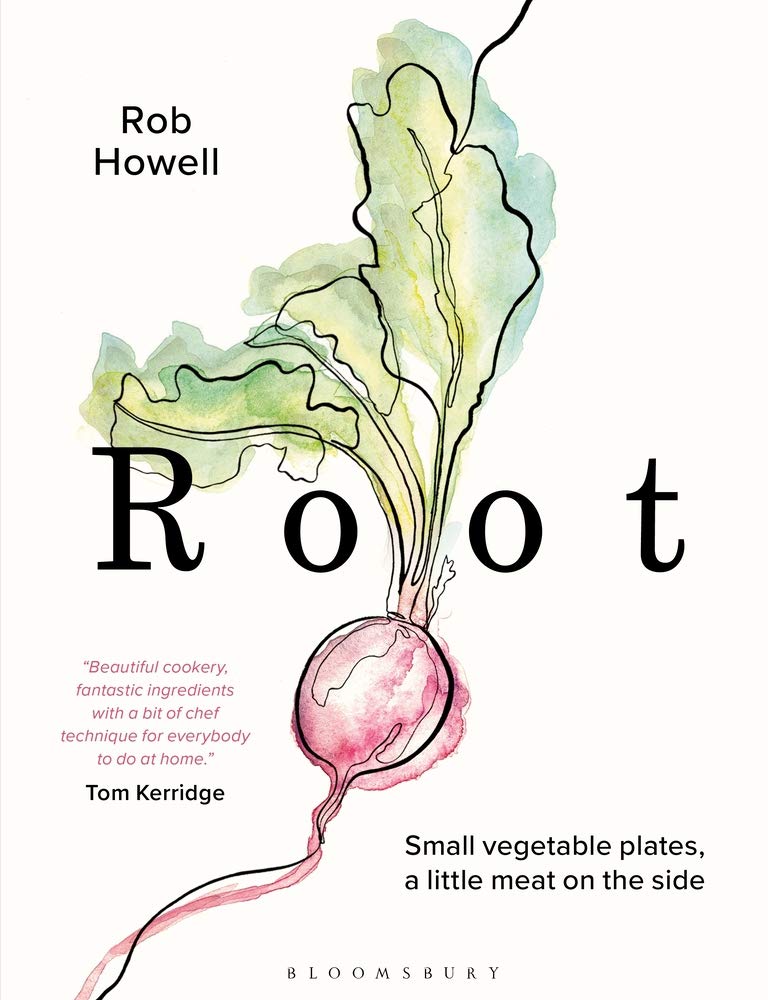
Root by Rob Howell

Roots by Rob Howell

What’s the USP? A collection of modern, inventive vegetable-forward, often vegan recipes that also includes seafood and meat dishes. 

Who’s the author? Rob Howell is the head chef of Root, the Bristol restaurant that’s set in a converted shipping container on the city’s Wapping Wharf.  

Is it good bedtime reading? Aside from a brief introductory section that includes a forward from Root’s co-founder Josh Eggleton, an introducton from Howell himself and notes on  seasonality, produce and seasoning, the bulk of the reading material lies in the short but informative recipe introductions. So one more for the kitchen than the nightstand.  

Will I have trouble finding ingredients? Salsify is still one vegetable that’s still a little tricky to get hold of, at least in the UK, so crispy frying it and serving it with roasted garlic mayo might take a little bit of effort, similarly kolrhabi for a slaw to accompany grilled flatbreads with babganoush. You’ll need a good cheesemonger for ewe’s curd to add to turnip and apple-filled chicory leaves and a decent deli for smoked rapeseed oil to add to yoghurt to serve with salt-baked beetroot.  You’ll hopefully have a good butcher who will get you ox heart to grill and serve with pickled red cabbage and sweetbreads to glaze with Marmite and maple syrup (God, that sounds good), plus a reliable fishmonger for pretty much everything in the fish chapter. That aside, the recipes include many accessible ingredients.  

What’s the faff factor? This is a book by a chef based on recipes from a small plates restaurant so you won’t be surprised that many dishes require several elements to be prepared and then brought together; easier to do in a professional kitchen compared to a domestic one. Often, you’ll need to put quite a bit of effort into something that will only be big enough to form one course of a meal. Therefore recipes such as oysters two ways (fresh with chilli ginger and gherkin and crispy with tartare sauce) or grilled red mullet with a sauce made from the bones will remain dinner party fodder. However, there are plenty of dishes like chilli and ginger Sharpham Park spelt with chestnut mushrooms or courgette ragu baked in a marrow that are  straightforward and satisfying enough to make a delicious mid-week meal.  

How often will I cook from the book? Although the book probably sits in the hobby/weekend-cooking category, there are dozens of delicious sauces, dressings, dips, relishes, pickles and savoury jams that you’ll want to add to your regular repertoire, as well as simple salads and vegetable courses that could be adapted as side dishes, making it a book that you’ll want to refer to often.    

Killer recipes? Roasted squash with kale pesto, squash barigoule prune puree and Old Winchester;  buttermilk-fried celeriac with Korean-style sauce; crispy potato and cheese terrine; hassleback parsnips with honey-mustard mayonnaise; heritage tomatoes with grilled focaccia, aubergine puree and tomato jam; baked seaweed hake with tikka masala-style sauce and bok choi; chicken schnitzel with garlic, parmesan and fresh anchovies; carrot jam-filled doughnuts with mascarpone vanilla cream. 

What will I love? The ‘larder’ chapter will help modernise your cooking with recipes for trendy items like seaweed vinegar, burnt onion puree, kale pesto and pickled wild garlic capers.  

Should I buy it? Root is bursting with exciting and inspirational ideas that any keen cook will delight in. The accent on vegetables is bang on trend and will help those of us in search of help in cutting down our meat intake.  One of 2021’s essential purchases. 

Cuisine: International
Suitable for: confident home cooks/professional chefs
Cookbook Review Rating: Five stars 

Buy this book
Root: Small vegetable plates, a little meat on the side
£26, Bloomsbury Absolute