Slow cooked duck by Tom Kerridge

duck6033

We already had a great little business, but Great British Menu became one of the most pivotal moments in the pub’s history. The programme is very special: it shines the spotlight on quality British produce and showcases food and restaurants around the UK, which is brilliant because that underlines that our world isn’t just about London and the Southeast.

To get to the final, you compete in ‘heats’, and in 2010, my cook-off location was Waddesdon Manor, which is near Aylesbury. So, to me, the obvious thing to cook was something with Aylesbury duck. These ducks taste amazing and they’re from a small-scale producer – everything Great British Menu is about. Since an important part of our Hand & Flowers menu includes chips on the side (we’re a pub, after all), I decided to make the ultimate chips, cooked in duck fat.

I needed peas, too. So, I went down the route of petits pois à la française, except, instead of using bacon, which you’d normally do, I used crisp-fried duck leg confit. And then I finished the dish with a gravy that uses honey from the Waddesdon estate.

It all added up to a winner. I remember one Saturday night after the banquet was televised, we did 84 covers and served 78 portions of duck in one sitting. The success of this dish has been extraordinary.

serves 4

To prepare the duck
2 large Aylesbury ducks, about 2kg each
3 tsp ground mace

Remove the legs and wings from the ducks and take out the wishbone (reserve for the faggots, gravy etc., see right and overleaf). Remove the excess fat and skin, placing it all in a frying pan. Now carefully cut away the backbone; you should be left with the crown.

Place the pan of fat and skin over a low heat to render the fat out. Set aside for later use. Score the skin on the duck crowns and rub in the mace. Heat a heavy-based frying pan over a medium high heat. Add the duck crowns and sear on all sides for 5–10 minutes to render the fat and give the skin a good golden colour. Remove the
duck crowns from the pan and allow to cool.

Put each duck crown into a large vacuum-pack bag and vacuum-seal on full pressure. Immerse in a water-bath at 62°C and cook for 1½ hours. Lift out the vacuum-pack bags and remove the ducks. Carefully cut the breasts from the crowns. Cover and refrigerate until ready to cook.

Duck gravy
500g duck bones and wings, chopped
A little vegetable oil for cooking
4 carrots, peeled and chopped into 3cm pieces
4 celery sticks, cut into 3cm pieces
1 onion, peeled and diced into 3cm pieces
1 garlic bulb, cut across in half, through the equator
150g runny honey
4 cloves
2 litres chicken stock (see page 400)
50ml soy sauce
About 500g unsalted butter
Lemon juice, to taste (optional)
Sea salt and freshly ground pepper

Preheat the oven to 205°C/Fan185°C/Gas 6–7. Put the chopped duck bones and wings into a roasting tray and roast in the oven for about 25–30 minutes until golden brown and caramelised.

Heat a little oil in a large heavy-based saucepan over a medium-high heat. Add the chopped carrots and colour until darkly caramelised. Add the celery, onion and garlic and similarly colour until well browned.

Remove the duck bones and wings from the roasting tray and add them to the saucepan. Drain off the excess fat from the roasting tray, then add the honey and cloves to the tray. Place over a medium heat and take the honey to a dark golden caramel. Add a splash of the chicken stock and the soy sauce to deglaze the tray, stirring to scrape up the sediment.

Add the liquor to the duck bones and vegetables. Pour in the rest of the chicken stock and reduce down by half, to 1 litre. Pass the liquor through a muslin lined sieve into a clean pan and skim off any excess fat from the surface. Add 250g butter to every 500ml duck liquor and reduce down until it has emulsified into the sauce. Season with salt and pepper and add a little lemon juice if required. Set aside for serving.

Duck faggots
250g minced duck leg (skin on)
50g minced chicken liver
50g breadcrumbs
1 medium free-range egg
5g salt
2g cracked black pepper
100g caul fat, soaked in cold water for 30 minutes

Put all the faggot ingredients into a bowl and mix well until evenly combined. Divide and shape the mixture into 50g balls. Wrap each one in caul fat to enclose. Steam the duck faggots at 100°C for 20 minutes. Remove from the steamer and allow to cool, then chill until needed. When ready to serve, preheat the oven to 205°C/Fan 185°C/Gas 6–7.  Place the faggots on a baking tray and bake for 8 minutes. Hold the faggots in the duck gravy until ready to plate up.

Duck legs & peas
2 duck legs
1 star anise
½ cinnamon stick
10 black peppercorns
1 tsp coriander seeds
1 tsp fennel seeds
1 tbsp rock salt
2 bay leaves
About 300ml duck fat
500g freshly podded peas
4 tbsp runny honey
A little vegetable oil for cooking
2 large banana shallots, peeled and finely diced
100ml chicken stock
2 Gem lettuces, finely sliced
20 small mint leaves

Preheat the oven to 150°C/Fan 130°C/ Gas 2. Put the duck legs into a large ovenproof pan or flameproof casserole. Tie the spices together in a muslin bag and add them to the pan with the rock salt and bay leaves. Pour on enough duck fat to cover and bring to the boil over a medium heat. Transfer the pan to the oven and cook for 3½ hours or until the duck legs are soft. Leave them to cool in the duck fat. Once cooled, remove from the fat and place in the fridge. Meanwhile, add the peas to a pan of boiling salted water, bring back to the boil and blanch for no longer than 1 minute. Immediately drain and refresh in iced water. Drain and set aside.

Preheat the oven to 205°C/Fan 185°C/Gas 6–7. Place an ovenproof heavy-based frying pan over a medium-high heat. Add the duck legs, skin side down, and place in the oven for 10–12 minutes to crisp up. Remove the duck legs to a plate and add the honey to the pan. Allow to caramelise, then pour over the duck legs and allow to cool. When ready to serve, heat a little oil in a saucepan over a medium heat. Add the shallots and sweat for 10–15 minutes until softened. Add the peas and stock and bring to a simmer. Meanwhile, flake the duck leg. Stir the duck meat into the peas with the lettuce and mint. Divide between 4 small serving pots.

Duck fat chips
15 large potatoes for chipping
2.5 litres duck fat for deep-frying

Cut a slice from the top and bottom of each potato, then press an apple corer through from top to bottom to make round cylinder chips. Put the cut chips into a colander under cold running water to wash off some of the starches. Now add the chips to a pan of boiling salted water, bring back to a simmer and poach for about 10 minutes until just soft, but still holding their shape. Drain on a perforated tray and leave
to cool.

Heat the duck fat in a deep-fryer to 140°C. Lower the chips into the hot fat in a wire basket and deep-fry for 8–10 minutes until the oil stops bubbling. Remove the chips from the fryer, drain and leave to cool. Set aside until needed. When ready to serve, heat the duck fat to 180°C and deep-fry the chips for about 6–7 minutes until golden
and crispy. Remove, drain on kitchen paper and season with salt.

To serve
2 tbsp runny honey
50g unsalted butter
Pea shoots, to garnish

Just before serving, preheat the oven to 200°C/Fan 180°C/Gas 6. Heat a little oil in a heavy-based ovenproof frying pan over a medium-high heat. Add the duck breasts, skin side down, and fry for 3–4 minutes to crisp up the skin, then place in the oven for 4–5 minutes to heat through. Pour off any excess fat from the pan, then add the honey and butter and turn the duck around in the pan to coat in the honey glaze.
Remove the duck breasts to a warmed plate and rest in a warm place. Increase the heat under the pan to caramelise the honey glaze then pour it over the duck breasts.
Serve the duck breasts with the duck legs and peas, duck faggots, gravy and chips. Finish with a garnish of pea shoots.

Cook more from this book
Smoked haddock omelette
Vanilla crème brûlée

Buy this book
The Hand & Flowers Cookbook
£40, Bloomsbury Absolute

Read the review
Coming soon

Smoked haddock omelette by Tom Kerridge

Smoked-haddock_621

A delicate, beautiful omelette is one of those pure dishes that makes you realise great food does not have to be about hundreds of ingredients on a plate. It’s about allowing a simple product to sing. I learnt that lesson back in the day when I worked for Gary Rhodes and we used to do a lobster omelette which showcased the chef ’s technique rather than putting a load of fancy things on the plate.

This smoked haddock omelette, which has been on The Hand & Flowers menu pretty much since we opened, started off as a lobster one. But I took a sharp, commercial learning curve early on. Starting out, of course, we had no accolades and were relatively unknown, so there was no reason for customers to spend what, at the time, was the equivalent of £30 or £35 on an omelette, even if it had lobster in it!

I still loved the idea of an omelette, so we tried an omelette Arnold Bennett (a fluffy open omelette created at The Savoy in the 1920s for the novelist, playwright and critic). Most people didn’t know who Arnold Bennett was, so we just called it ‘smoked haddock omelette with Parmesan’ and after a first couple of bumpy weeks it became one of our most popular dishes.

There is no reason why this dish should ever change. I can’t improve it. The flavour profile of the humble omelette is heightened with gently poached smoked haddock, a brilliant glaze made from hollandaise sauce and a béchamel sauce flavoured with the fish poaching liquor. So, even the glaze has got that lovely smoked taste, which really drives the flavour.

Actually, this omelette is probably my favourite dish on the menu. I am very pleased to say the lobster version has reappeared at Kerridge’s Bar & Grill in London some 14 or 15 years down the line, and has gone on to become one of our most Instagrammed dishes. Thank you Gary Rhodes…

serves 4

Poached smoked haddock
1 side of smoked haddock, 600g,
skin and pin bones removed
600ml whole milk

Check the smoked haddock for any tiny pin bones. Bring the milk to the boil in a wide-based saucepan. Carefully lay the smoked haddock in the pan, ensuring it is covered by the milk. Place a lid on the pan, turn off the heat and leave the fish to poach in the residual heat for about 10 minutes. Once the haddock is cooked, remove it from the milk and gently flake the fish into a tray lined with greaseproof paper. Cover the tray with cling film and place in the fridge until ready to serve.
Pass the milk through a fine chinois into a clean saucepan and keep to one side.

Smoked fish béchamel
250ml smoked haddock poaching
liquor (see left)
15g unsalted butter
15g plain flour
Sea salt and freshly ground pepper

Bring the smoked haddock poaching liquor to a gentle simmer. In a separate pan over a medium-low heat, melt the butter. Stir in the flour to make a roux and cook, stirring, for 2 minutes. Gradually ladle in the warm poaching liquor, stirring as you do so to keep the sauce smooth. Cook gently over a very low heat for 20 minutes. Pass the sauce through a fine chinois and cover the surface with a piece of baking parchment or cling film to prevent a skin forming. Set aside until needed. (You won’t need all of the fish béchamel but you can freeze the rest.)

Omelette glaze
4 tbsp warm smoked haddock
béchamel (see left)
4 tbsp hollandaise sauce
(see page 403)
4 medium free-range egg yolks
Sea salt and freshly ground pepper

Gently warm the béchamel in a saucepan then pour into a bowl and whisk in the hollandaise and egg yolks. Season with salt and pepper to taste and pass through a chinois into a warm jug or bowl. Keep warm to stop the glaze from splitting.

To assemble & cook the omelette
12 medium free-range eggs
4 tbsp unsalted butter
100g aged Parmesan, finely grated
Sea salt and freshly ground pepper

Crack the eggs into a jug blender and blend briefly to combine. Pass through a chinois into a measuring jug. Place 4 individual omelette pans (we use Staub) over a low heat. Take the smoked haddock from the fridge, remove the cling film and lay on a grill tray. Warm under the salamander or grill. To each omelette pan, add 1 tbsp butter and heat until melted and foaming. Pour the blended egg into the pans, dividing it equally. Using a spatula, gently move the egg around in the pans until they start to firm up. Remove from the heat; you want the eggs to be slightly loose, as they will continue to cook off the heat.

Season the omelettes with salt and pepper and sprinkle the grated Parmesan over their surfaces. Divide the flaked smoked haddock between the omelettes, then spoon on the glaze to cover the fish and extend to the edge of the pans. If the glaze spills over the side of the pan, wipe it away, as this will burn on the side when  blowtorching. To finish, wave a cook’s blowtorch over the surface of the omelettes to caramelise the glaze. Allow the glaze to become quite dark, as the bitterness will balance out the richness of all the other ingredients.

Cook more from this book
Slow cooked duck
Vanilla crème brûlée

Buy this book
The Hand & Flowers Cookbook
£40, Bloomsbury Absolute

Read the review
Coming soon

Stark by Ben and Sophie Crittenden

Stark by Ben and Sophie Crittenden
Stark is no ordinary Michelin-starred restaurant. In December 2016, chef proprietor Ben Crittenden, formerly of the West House in Biddenden, converted a sandwich shop in Broadstairs and, working alone in a tiny kitchen, served creative tasting menus to a dozen customers a night. A rave review on the Guardian in 2017 was followed by a Michelin star in 2019. This year, Stark moved to larger premises in the same road and there are plans to turn the original restaurant into a tapas bar.

It’s fitting then that Stark is also no ordinary cookbook. In addition to the recipes, 42 of them such as Hake, mushroom, dashi, and Poussin, korma, grape (there are also a dozen tapas dishes including a wagyu slider), the extraordinary story of the restaurant is told with breath-taking honesty from both sides of the pass, Ben in the kitchen and Sophie, whose contributions appear in bold text in the book, front of house.

In his introduction, Ben Crittenden says ‘there’s no sugar coating or PR spin’ and he is true to his word. At one point in his career, the pressure of work coupled with a draining extended daily commute see Crittenden contemplating steering his car into the central reservation rather than face another day in the kitchen. On a business trip to San Sebastian, he recalls standing on the ledge of a hotel balcony, ready to jump.

But it’s Sophie Crittenden’s voice that really sets this book apart. Being able to understand the devasting impact of a severe lack of work-life balance on the couple’s relationship and family life (the Crittendens have three children) is sobering. Their personal life is laid out so barely that at times it feels like eavesdropping on a private conversation. But that searing honestly is what makes Stark such a compulsive read and so valuable to anyone considering following in the Crittenden’s footsteps and opening their own restaurant.

This review was first published in The Caterer magazine.

Cuisine: Progressive British
Suitable for: Professional chefs
Cookbook Review Rating: Four stars

Buy the book
Stark by Ben and Sophie Crittenden
£30, A Way With Media
Also available at Amazon Stark

Cook from this book
Duck liver parfait
Poussin, korma, grape
Pecan pie, banana, chocolate

Poussin, korma, grape by Ben Crittenden

B27A9579
BRINE
2 litres water
120g seasalt
40g sugar
1 bulb garlic
1/2 bunch thyme
1 tsp black peppercorns
10 poussin crowns

Bring the water to the boil with everything except the poussin and simmer until the salt has dissolved. Chill in the fridge and then submerge the poussin for 24 hours. Drain and discard the brine. Pat dry the crowns.

POUSSIN MARINADE
40g mild cheddar
100g single cream
100g natural yogurt
1/2 bunch mint leaves
1/2 bunch coriander leaves
1/2 lemon juice
1 green chilli
2-inch knob ginger, peeled and grated
4 garlic cloves
2 tbs sunflower oil
2 tbs gram flour
1/2 tsp turmeric

Mix the gram flour and oil with the turmeric in a pan. Cook out gently for 5 minutes or until the flour turns slightly golden. Blitz in a blender with all the other ingredients. Smother the poussin in the marinade. Cook in BBQ at 220c for 10-12 minutes. Remove and rest under heat lamps for 10-15 minutes. Remove the breasts and serve 1 per portion.

KORMA SAUCE
2 tbs sunflower oil
1 large onion, thinly sliced
10 cardamon pods
2 blades of mace
½ tsp garam masala
1-inch knob ginger, peeled and grated
4 garlic cloves, grated
100g cashew paste
100g single cream
100g natural yogurt
200g cashew milk
Pinch salt
Lightly toast the cardamom pods, mace and garam masala for a minute. Add the onions, garlic and ginger and cook lightly for 5 minutes. Add the remaining ingredients and cook in Thermomix at 90c, speed 5, for 40 minutes. Then blitz on full and pass through a fine sieve.

ONIONS
2 red onions
50ml white wine vinegar
25g sugar
10 mint leaves
Pinch salt
Thinly slice the onions on a mandoline. Salt lightly and leave for 1 hour. Wash off the salt and dry off a little on a J cloth. Whisk the sugar and vinegar together until dissolved. Chop the mint and mix everything together and vacuum seal on full pressure.

TOASTED CASHEWS
100g blanched peeled cashew nuts
500g sunflower oil
1/2tsp mild chilli powder
Pinch salt

Heat the oil to 160c. Add the nuts and stir constantly until golden brown. Drain from oil onto a J cloth and dust in chilli powder and season with salt.

CORIANDER OIL
300ml sunflower oil
2 bunches coriander
Pinch salt

Heat the oil and salt in a Thermomix for 5 mins at 80c. Add the coriander and cook at 80c for 4 minutes on speed 8 then blitz on full for 1 minute. Pass through muslin and chill immediately.

TO SERVE
Red grapes, thinly sliced
Coriander cress
Coriander oil

Cook more from this book
Duck liver parfait
Pecan pie, banana, chocolate

Buy the book
Stark by Ben and Sophie Crittenden
£30, A Way With Media
Also available at Amazon Stark

Read the review

Pecan pie by Ben Crittenden

B27A8496

SWEET PASTRY
450g plain flour
150g icing sugar
Pinch salt
225g butter
1 egg
50g cream

Add everything except the egg and cream to a food processor and pulse to bring the ingredients together, Then add the egg and cream and pulse to create a stiff paste, being careful not to over work. Chill in the fridge for at least 1 hour then roll out to about 3mm thick and line 2.5” tart cases. Trim excess and line the inside of the cases with cling film. Fill with rice or baking beans and place in freezer for an hour. Set oven to 190c and bake the cases for 8 minutes. Turn the oven down to 160c and bake until the pastry is cooked through. Remove the baking beans and make sure the bottoms are cooked, which should take about 20 minutes in total.

PECAN PIE
250g golden syrup
50g treacle
85g fresh bread crumbs
80g ground pecans
1 egg
150g cream
1 lemon zest
100g toasted pecans

In a blender, blitz everything except the toasted pecans until smooth. Decant into a container and refrigerate overnight. Crumble the toasted pecans into the base of the cooked tart cases. Set oven to 170c. Give the batter mix a good stir and then spoon into the cases on top of the crumbled pecans. Bake for 10 minutes at 170c then turn the oven down and bake for a further 10 minutes at 150c. Remove from the oven and allow to cool for 5 minutes before serving.

BANANA SORBET
5 ripe bananas
50g glucose
1/2 lemon juice
Blitz everything together and freeze in Pacojet canisters. You don’t need to heat anything just blitz and freeze.

CHOCOLATE PURÉE
150g 70% Valrhona chocolate
50g cocoa powder
150g sugar
400g water
Ultratex to thicken

Bring the sugar and water to a simmer and pour over the chocolate and cocoa powder. Mix well and chill in the fridge overnight. Beat with a whisk to loosen and then add Ultratex a teaspoon at time. Mix well and leave 10 minutes between adding to allow time to absorb the moisture. When thickened pass through a fine sieve and decant into bottles.

CANDIED PECANS
100g pecans
225g sugar
125g water
Pinch salt
Bring 125g sugar, water, nuts and salt to simmer and cook for 5 minutes. Add the remaining 100g of sugar and simmer for a further 5 minutes. Drain off the syrup and bake the nuts on parchment paper for 10 minutes in an oven preheated to 150c.

TO SERVE
Lemon balm

Cook more from this book
Duck liver parfait
Poussin, korma, grape

Buy the book
Stark by Ben and Sophie Crittenden
£30, A Way With Media
Also available at Amazon Stark

Read the review

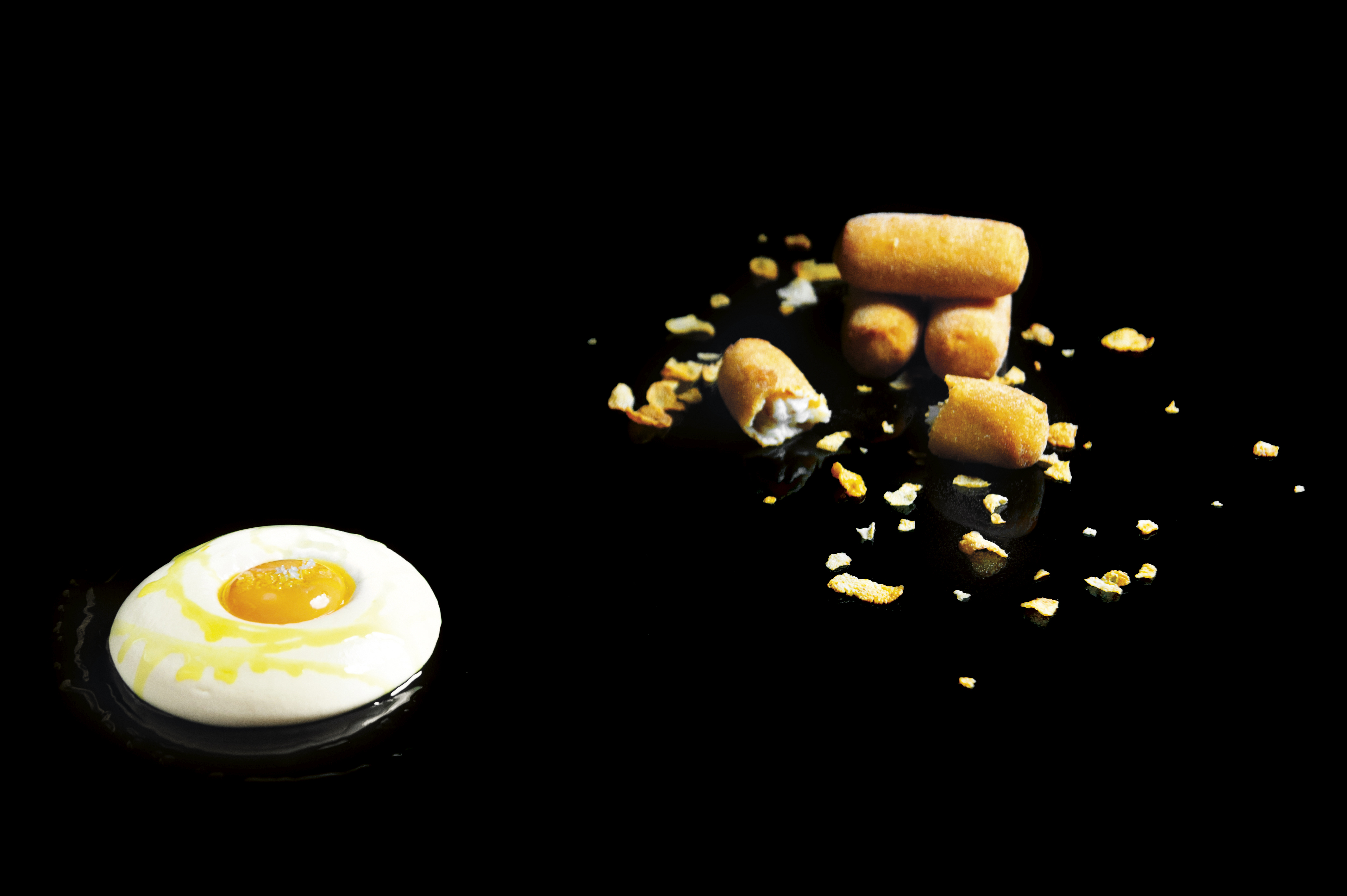
Haddock and Eggs – Cornflakes – curry oil by Glynn Purnell

haddockegg-1
For the Haddock Milk Foam
4 litres whole milk
2 fillets yellow dyed haddock
2 fillets Arbroath smokies
Trim from 6 fillets naturally smoked haddock including skin etc
(this is the trim from the home-cured smoked haddock and in the brandade mix)
54g Agar
6g Xantham Gum

1. In a large saucepan, heat all fish in the milk and slowly bring to a boil while stirring occasionally.
2. Once boiled, remove from heat and transfer to a large container and cool at room
temperature. Cover and leave to infuse in the fridge for 24 hours.
3. Pass into a clean container. Remove 3 litres of the infused milk and reserve the rest in the fridge until needed.
4. Bring 3 litres of the haddock infused milk to the boil with the Agar, whisking occasionally. Once boiling, whisk continuously for two minutes.
5. Remove from heat and pass into a clean container. Leave to set in the fridge for a minimum of 12 hours, or until fully set.
6. Once set, blend back with 900ml of the reserved haddock milk and Xantham gum.
7. Split into 450g portions and seal in vac pac bags. Reserve in the fridge until needed.
Always weigh the haddock milk to check the ratios are correct. If you have less then 3900ml, use these ratios to adjust the mix as necessary:
18g Agar Agar per litre
1.75g Xantham Gum per litre
Blend back with 300ml of haddock milk per litre

For the Smoked Eel Brandade
140g smoked eel, diced
70g cod
70g smoked haddock
120g salted butter, softened
120g warm dry mash potato
1 lemon
Milk, to cover

1. Place the smoked eel and fish into a saucepan.
2. Cover the fish in milk, bring to a simmer and cook gently.
3. Once the fish is cooked, pass off the mixture, reserving the milk and keeping it warm.
4. Mix the cooked fish mixture with the warm mash potato.
5. Put the fish and potato mixture into an electric mixer with a paddle attachment fitted. Beat in the softened butter for 30 seconds.
6. Add 20ml of the reserved milk and beat until fully incorporated. Add more if the mix is too dry.
7. Season with the zest and juice of the lemon.
8. Pipe into even ballotines on top of cling film. The ballotines should be approx. 1.5 inches in diameter and 20 inches in length. Roll the ballotine in the cling film to form a tube and twist the ends of the cling film over and over until they can’t twist any more. This should form an airtight tube and the ends of the ballotine should be sealed up due to the pressure. Tie these ends to seal and freeze the brandade mixture.
9. Set up a pane station with flour, beaten egg and a 50:50 mixture of breadcrumbs and cornflake crumbs.
10. Carefully remove all the clingfilm from the brandade ballotines and portion into 3-inch cylinders.
11. Pane the cylinders in the flour, egg and breadcrumb and cornflake mix. Reserve on a tray in the fridge until needed.

For the Curry Oil
1 litre sunflower oil
2 tablespoons mild curry powder

1. Place the oil and curry powder into a large vac pac bag and seal to remove all air.
2. Place into a water bath at 65˚c for four hours. Remove and leave in the fridge for 12 hours.
3. Hang the mixture through a muslin cloth set over a bowl but do not push through. Vac pac the passed oil into medium bags and reserve in the fridge until needed.
4. Decant the oil into squeezy bottles once it is at room temperature.

For the smoked haddock
6 haddock fillets
Coarse rock salt
Sunflower oil

1. Skin the haddock fillets.
2. Submerge in the salt for 4 minutes.
3. Removed the haddock from the salt. Thoroughly wash off the salt and dry.
4. Rub the haddock fillets in sunflower oil.
5. Set up a hot smoker with oak chips. When the smoker is ready, place the fillets on to the wire rack and smoke for 10 minutes.
6. Remove the haddock fillets from the smoker and leave to cool completely. Seal in a vac pac bag and keep in the fridge until needed.

For the Baked Cornflakes
250g Cornflakes
250g salted butter, melted
10tbsp milk powder
2tbsp caster sugar
1tsp table salt

1. Preheat oven to 140˚c.
2. Mix all the ingredients together. Spread out evenly onto a tray lined with a silpat mat. Bake in the oven for 10 minutes.
3. Remove from the oven. Once cooled, place in a blender and pulse blend until a crumb-like consistency is achieved. Reserve in an airtight container until needed.
To serve one portion
1. Deep fry the brandade croquettes at 170˚c for 2-3 minutes until golden and crispy. Remove and drain.
2. Heat 40g of the smoked haddock in the oven until warm.
3. Separate an egg yolk, removing all the white, and carefully drop the yolk into a pan of water at 50-55˚c. Poach gently for no longer than two minutes. The yolk should be just sealed on the outside.
4. Place the haddock into the bottom of the serving bowl. Sprinkle with a pinch of chopped chives, a splash of curry oil and add a teaspoon of the baked cornflakes.
5. Get the ISI gun containing the haddock foam. Give it a good shake and squeeze gently to form a dome of haddock foam which should just cover the haddock in the bottom of the bowl.
6. Carefully remove the poached egg yolk from the water and place into the centre of the haddock foam. Season with sea salt and drizzle the top with curry oil. Serve with a brandade croquette on the side.

Cook more from this book
Monkfish masala with red lentils
Lemon meringue pie

Buy this book
A Purnell’s Journey
£85, A Way With Media
Also available at Amazon: There And Back Again: A Purnell’s Journey

Read the review

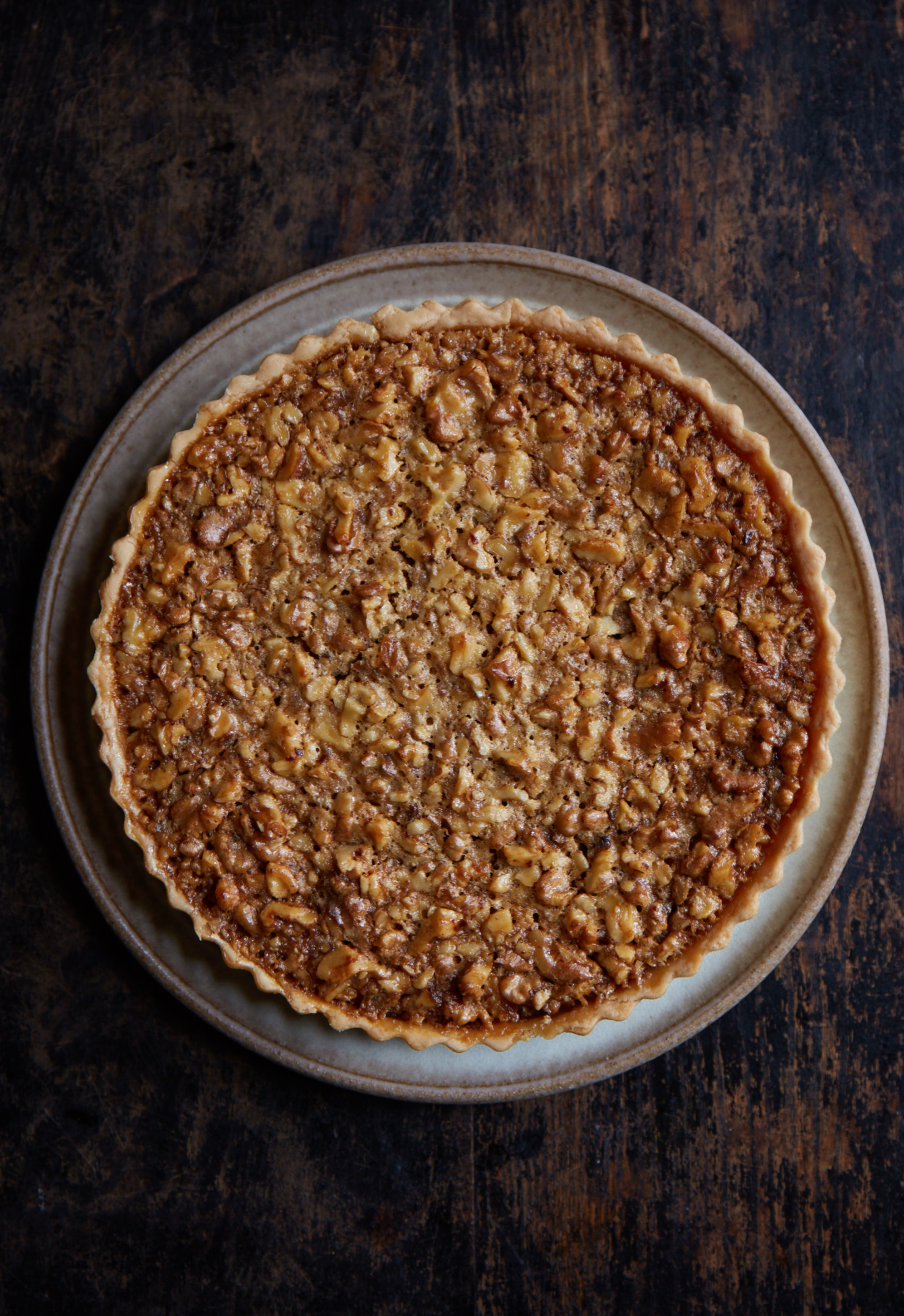
Rum & Walnut Tart with Rum Butterscotch Sauce by Maura O’Connell Foley

Maura_ Walnut_Rum_Tart_027
Ingredients
Serves 8

Pâté Sucrée:
• 125g plain white flour
• 55g butter, softened
• 55g icing sugar
• Pinch of sea salt
• 1 egg

Rum Butterscotch Sauce:
• 30g butter
• 70g light brown sugar
• 70g golden syrup
• 90ml cream
• 45ml dark Jamaican rum

Walnut Filling:
• 300g walnuts, roughly chopped
• 150g caster sugar
• 120g butter, melted
• 150g honey
• 5 egg yolks
• 100ml cream
• 50ml dark Jamaican rum

Equipment:
23cm / 9in flan tin

Method
For the pâté sucrée, add the flour, butter, sugar and salt to a food processor and blend to a fine crumb. Use a fork to lightly beat the egg and then add to the food processor and pulse to bring the pastry together. Wrap in clingfilm and chill for 1 hour in the fridge.

To  make the butterscotch sauce, place the butter, sugar and golden syrup in a saucepan over a medium heat, stirring to dissolve the sugar. Continue to cook to a smooth and shiny syrup. Carefully add the cream (as it will splutter) and stir to combine. Bring to a gentle bubble then simmer for 3 minutes. Add the rum and remove from the heat.

Preheat the oven to fan 160°C / fan 325°F / gas mark 4.

Roll out the pastry to 2-3mm / 0.1in thick and use to line a 23cm / 9in flan tin. Chill for at least 30 minutes in the fridge.

To make the walnut filling, gently mix together the walnuts, sugar, butter, honey, egg yolks, cream and rum in a large bowl. Pour the mixture into the prepared pastry and bake in oven for 50-60 minutes or until golden brown and set with a slight wobble.

Allow to set for at least 1 hour before serving with the butterscotch sauce and if desired some vanilla ice-cream.

Cook more from this book
Twice baked cheese souffles
Smoked cod cakes

Buy this book
€35 Order from mywildatlantickitchen.com 

(The book is also available from Amazon
My Wild Atlantic Kitchen: Recipes and Recollections
£35, Maura O’Connell Foley)

Read the review
Coming soon

Ekstedt by Niklas Ekstedt

Ekstedt by Niklas Ekstedt
What’s the USP? The subtitle for Ekstedt is ‘The Nordic art of analogue cooking’, which makes the book sound like one of those lifestyle books that seek to teach us all the true meaning of a nation’s idealised characteristic by expanding on a single word with complex meaning, be that ‘hygge’, ‘ikigai’ or ‘nunchi’.

‘Ekstedt’ is not a Swedish word for analogue cooking, but rather the surname of the Michelin-starred chef who has become almost synonymous with the practice. This massive coffee-table cookbook seeks to reconcile home chefs with the revived Nordic traditions of cooking over an open flame. That’s what ‘analogue cooking’ means – cooking without the use of gas or fire. So don’t expect any dishes that can be reheated in the microwave later.

Who wrote it? Niklas Ekstedt is something of an icon in the Nordic food world. Over the last twenty years or so, Ekstedt has run four fine-dining restaurants across Sweden, and has grown increasingly interested in traditional Nordic cooking techniques. His latest eponymous restaurant cooks entirely over open flames – and it’s this approach to food that he espouses in his second book. Actually, it’s also the same approach he took to his first book. But this one’s out now, ready for Christmas, looking all monolithic and filled with worthy prose and grounded, earthy photographs of fishermen and very beautiful (but very small) dishes.

Is it good bedtime reading? There’s certainly reading, though how good it is will depend on how much you like fantasy writing. That is, the fantasy that you’ll ever actually cook anything from this book.

There’s an introduction in which Ekstedt speaks of the self-evaluation he had to do when his third fine-dining restaurant didn’t do quite as well as his first two. There’s a chapter on the techniques you’ll use throughout the book, from using your wood oven (you have a wood oven, right?) to cooking over embers, or ‘hay-flaming’ a dish. That’s where you get your hay (you have hay, right?), bosh it into a pan, set it on fire, and chuck some scallops or something on top. Actually, that’s not fair. It’s more complicated than that. Which is exactly what you were hoping for, isn’t it? Oh, and don’t forget flambadou, where you baste a dish with burning fat that you’ve melted in your red-hot cast-iron cone on a stick (you have a red-hot cast-iron cone on a stick, right?)

Elsewhere, there’s well-meaning Radio 4 documentaries essays on reindeer herding with the Sami and fishing off of Lofoten, Instagram’s favourite Norwegian archipelago. Ekstedt also offers short introductions to each of his recipes – though these frequently amount to little more than a sentence.

Will I have trouble finding the ingredients? HA! Hahahahahahahahahahaha. Ahahahaha. Haha. Ha.

No.

No, I’m sure you’ll be fine. Why would you even ask that? It’s not like the first recipe in the book is for smoked moose heart. Oh, can’t get your hands on a moose heart? Ekstedt doesn’t actually offer any advice for substituting it for another ingredient, but later on does offer a completely different heart recipe: this time it needs a reindeer’s.

Other fun ingredients to ask the guy restocking the shelves in Sainsbury’s about: ättika vinegar, cloudberries, meadowsweet, birch wood, reindeer blood, chickweed, nasturtium leaves, redfish collars, ‘a branch of juniper, fresh and green’, dried reindeer, vendace roe, and bladderwrack seaweed.

I guess you could try B&Q for the birch wood, and maybe you can juice that reindeer heart from earlier to get the 250ml of blood you’ll need. When you see the words ‘veal sweetbreads’ and consider them one of the more accessible ingredients you’ve seen recently, you know you’re in trouble.

My favourite, for what it’s worth, is the casual request for 400ml of fresh bovine colostrum, which the glossary at the back of the book helpfully defines as ‘the milk a cow produces during the first days after calving’. Expect a rush on your local dairy farm come spring, then.

What’s the faff factor? Do you even need to ask? Look, one of the joys I have when I sit down with a new cookbook is this: I take some little multi-coloured index stickers and mark out all of the recipes I’m keen to try. On most cookbooks, I manage to find at least eight to ten really tempting dishes that I can’t wait to get to work on. In a really great cookbook, like Claire Thomson’s recent Home Cookery Year, I find myself marking off every other page. In reading through Ekstedt, I didn’t reach for my bookmarks even once.

This isn’t to say that the book isn’t filled with things I’d love to eat. In fact, I’d be more than happy to stick a fork into almost every recipe in here. Maybe not the butternut squash, fermented salsify and vegetable foam – but even then that’s only because I’m not sure what the best utensil is when reckoning with foam. It’s got to be a spoon, right?

The problem is just that everything in here is so damned impractical. If – and it really is a huge, wobbly ‘if’ – you manage to source all the ingredients for a given dish, you’ve still got to cook the bastard. And that’s not easy in a book that champions ‘analogue cooking’. Ekstedt has made no noticeable concessions for the home chef, except that he lets you flambadou your beef fat in a pan. A typical recipe might ask you to ‘hot smoke the parsley root for 10 hours every day for 1-2 weeks until it is dried out’. Who does he think I am? I think Niklas Ekstedt has mistaken me for his sous chef.

As a final kicker, the end result of all your hard work will be an authentic Michelin-star level dish. Which sounds fantastic, until you remember how big a dish is in a Michelin-starred restaurant. The semi-raw hay-flamed sea bass, sorrel & Swedish ponzu takes longer to announce than it does to eat. Three slices of the sea bass per person, with three (three!) sorrel leaves as accompaniment. Ekstedt says his recipe serves 4 as a middle course, but he doesn’t tell us how many middle courses he’s expecting us to have in what is now apparently a tasting menu that we’re expected to put together from this self-indulgent collection of impossible wonders.

How often will I cook from the book? Never. You will never cook from this book. It will sit on your shelves, untouched and forgotten except for the occasions when you reach for something adjacent to it – something useful, with primary ingredients like chicken, or pork – and pick it out for a moment, open it to a random page – let’s say ‘Langoustine, charcoal cream and cold-smoked parsnip’, allow yourself a few good minutes to stop laughing at the idea you would ever find it within your energy limits to ‘place the langoustines on an untreated wood plank and sear each tail for 8-10 seconds with burning beef fat from the flambadou’, and then place it straight back onto the shelf until the next time you need decent laugh.

Should I buy it? Only if Niklas Ekstedt is coming round your house for tea, and you want to make him like you by shelling out forty(!) pounds(!) on pretty pictures of things you will never eat.

Cuisine: Nordic
Suitable for: Professional chefs with access to Scandinavian deer hearts
Cookbook Review Rating: One star

Buy this book
Ekstedt: The Nordic Art of Analogue Cooking

Review written by Stephen Rötzsch Thomas a Brighton-based writer. Follow him on Twitter and Instagram at @srotzschthomas.

A Purnell’s Journey: There and Back Again by Glynn Purnell

Weighing in at 6.5kg and standing over a foot tall, Glynn Purnell’s third book dwarfs his previous two volumes. Printed on high quality matt paper and presented in a clamshell box lined with the same pattern as the wallpaper in Purnell’s eponymous Michelin-starred restaurant, it’s a lavish production. But what do you expect from a chef with ego enough to anoint himself ‘The Prince of Birmingham’? 

Purnell tells his story in a series of chapters titled with postcodes that relate to where he has lived or cooked. It begins in B37, his childhood home in the Chelmsley Wood council estate in Solihull where the closest the young chef came to foraging was helping his father carry home boxes of meat purchased in pub car park deals. The book then follows Purnell’s route to Michelin success in the heart of Birmingham’s city centre via stints at the Birmingham Metropole, Simpson’s in Kenilworth and Hibiscus in Ludlow, with detours for stages at Gordon Ramsay’s Aubergine and Le Manoir aux Quat’Saisons. 

Although Purnell relates how he came to national attention and won his first Michelin star at Jessica’s in Edgebaston in 2005, the recipe for the restaurant’s signature dish of veal with caramelised squid is sadly not included. Instead, there are a selection of Purnell’s restaurant’s ‘greatest hits’ including monkfish masala with red lentils, pickled carrots and coconut garnish that ably demonstrate the chef’s knack for creating memorable dishes that stand the test of time.

Purnell is undoubtedly a macho chef and the book charts his passions for boxing, shooting, fishing and football. But there’s more than just testosterone on display here. His detailed description of the evolution of his signature haddock and eggs, cornflakes and curry oil dish proves Purnell to be a creative, thoughtful and reflective cook. 

With just 33 recipes, you may feel the need to buy Purnell’s other books to understand the full extent of his culinary talents, but There and Back Again serves up a generous enough helping of amusing anecdotes and stunning visuals to justify its hefty price tag.   

This review was originally published in The Caterer magazine.

Cuisine: Progressive British
Suitable for: Professional chefs
Cookbook Review Rating: Four stars

Buy this book
A Purnell’s Journey
£85, A Way With Media
Also available at Amazon: There And Back Again: A Purnell’s Journey

Cook from this book
Haddock and Eggs – Cornflakes – curry oil
Monkfish masala with red lentils
Lemon meringue pie

Classic puff pastry by Calum Franklin

The Pie Room Book dishes

Classic Puff Pastry

I always assumed puff pastry was invented in France. It is so dominant throughout French food culture, evident in the windows of every pâtisserie, that this is an easy assumption to make. However, Spanish recipes for puff pastry precede the French with the first documented appearance right at the beginning of the seventeenth century, while the first French recipe appears mid-century.

A classic butter puff pastry is a laminated dough that rises due to the power of steam. When making the dough, many thin, alternating layers of fat and dough are created so that, when cooked at a high enough heat, the fat melts to leave a pocket of air in the dough. The moisture in the dough and fat then boils to create steam, which causes these pockets to expand. Before you cook puff pastry, it is important to make sure the oven is at the correct temperature so that this transformative process occurs quickly, allowing the structure to form and be locked in.

This recipe creates a puff pastry that rises evenly and is neater than rough puff, so it is better suited to dishes like vol au vents where a little refinement is needed. Honestly, it is a myth that puff pastry is difficult to make. All that is required for success is planning, patience, and following the instructions closely. This recipe creates a large batch of dough – if you’re going to spend an afternoon making puff pastry, you may as well make plenty – so divide it into smaller amounts based on the recipes you plan to make before wrapping and freezing for later use.

MAKES 1.5KG

For the dough
350g strong flour
200g plain flour
15g table salt
115g butter, softened and diced
250ml ice-cold water

For the lock-in butter
500g chilled butter, diced
50g strong flour

First prepare the dough. If making the pastry by hand, sift the flour into a large bowl and add the salt, butter and water. Using your fingers, gently mix to an even dough. Transfer the dough to a lightly floured surface and knead it for 5 minutes or until smooth.

If making the pastry using a mixer, sift the flour into the mixer bowl and add the salt, butter and water. Using a dough hook, work at a medium speed for a few minutes to incorporate the butter into the flour until it forms a smooth dough.

Flatten the dough into a neat rectangle, wrap it tightly in clingfilm and rest in the refrigerator for 45 minutes.

Meanwhile, prepare the lock-in butter. Thoroughly clean and dry the bowl and line a baking tray with parchment paper. Place the butter and flour in the bowl and either work the flour into the butter using a wooden spoon for 5–10 minutes, or use the mixer working at a low speed for 2 minutes or until everything is well incorporated. Scrape the butter mixture onto the lined tray and, using floured hands, shape it into a square about 1cm thick. Place the butter mixture in the refrigerator until just chilled but not completely hard. (It is important that the chilled dough and lock-in butter are similarly firm, otherwise they will not roll together evenly and this may cause rips and holes in the dough.)

On a lightly floured surface, roll out the dough into a large square that is twice the size of the lock-in butter. Place the butter in the centre of the dough but at an angle so that the corners point towards the edges of the dough. Making sure you do not trap any air, fold the corners of the dough over the butter, bringing them into the middle like an envelope. Lightly pinch together all the joins to seal and completely encase the butter.

Roll out the dough and butter into a rectangle roughly three times as long as it is wide, using the sides of your hands to make sure the edges are neat and square. Dust any excess flour from the surface of the dough. With the shortest side closest to you, visually divide the dough horizontally into thirds and very lightly dampen the centre third with a little water, then fold the bottom one third of the dough over the centre third. Repeat by folding the remaining top third over the double layer of dough, then tightly wrap the dough in clingfilm. Lightly press your finger into the bottom right-hand corner of the dough to make an indentation which signifies the first turn and how the dough was positioned on the board before you put it into the refrigerator.

Chill the dough in the refrigerator for 30 minutes. (Chilling the pastry between each roll out and fold allow the butter to harden so that clean, even layers of dough and butter are built up.)

Unwrap the dough and place it on a lightly floured surface with the indent in the same position as before at the bottom right-hand corner. Next, turn the dough 90 degrees clockwise. Roll out the dough into an 18cm by 25cm rectangle and repeat the folding process. Make sure all corners and sides are straight. Wrap the dough in clingfilm again and this time make two indents on the dough in the bottom right corner. Chill in the refrigerator for a further 30 minutes.

Repeat the turning and folding processes two more times, each time chilling the dough for 30 minutes and marking with indents in the bottom right-hand corner to make sure the dough is turned in the correct direction. After the final turn, chill the dough in the refrigerator for 45 minutes and then it is ready to use.

This classic puff pastry dough can be kept for up to three days in the refrigerator or one month in the freezer. If freezing, weigh out the dough into the quantities needed for individual recipes – it will take less time to thaw and you won’t be potentially wasting any dough. To use the dough from the freezer, allow it to come back to refrigerator temperature overnight.

Cook more from this book
The ultimate sausage roll
Hot pork pie 
Glazed apple tart  

Read the review

Buy the book
The Pie Room: 80 achievable and show-stopping pies and sides for pie lovers everywhere
£26, Bloomsbury Absolute