Souffled Crepes by Michel Roux Jr

9781399610650_interior applicationmichel roux at home text finalsouffled_crepes_7506
Crêpes soufflées à l’orange et Grand Marnier

Serves four
4 oranges
250g crème pâtissière
(see p.238)
6 free-range egg whites
Pinch of sugar
50ml Grand Marnier
20g icing sugar,
for dusting

Pancakes
1 free-range egg
75g plain flour
1 tbsp caster sugar
Pinch of salt
210ml milk
1 tbsp clarified butter
This show-stopping dessert was one of my Uncle Michel’s favourites.

First make the pancake batter. Beat the egg in a bowl, then whisk in the flour a little at a time. Add the sugar and salt and mix well with a whisk. Stir in the milk to make a smooth batter, then leave it to rest in a cool place for at least an hour. To cook, brush a frying pan or crêpe pan with a little of the clarified butter and heat. Ladle in less than a quarter of the batter and cook the pancake for 1 or 2 minutes on each side, turning it with a palette knife. You should get 4 or 5 pancakes.

Segment 2 of the oranges (see page 86) and squeeze all the membranes into a pan to extract any juice. Add the juice of the other 2 oranges to the pan. Place over a low heat and reduce by half, then strain into a bowl and set aside at room temperature.

Put the crème pâtissière in a bowl, place it over a pan of simmering water and heat gently. Meanwhile, beat the egg whites with a pinch of sugar until they form soft peaks. Take the crème pâtissière off the heat, whisk in the Grand Marnier and beat briefly, then add one-third of the egg whites. Mix well,
then carefully fold in the rest of the egg whites with a spatula.

Preheat the oven to 240°C/Fan 220°C/Gas 9. Lay a pancake on a board and spoon a quarter of the crème pâtissière mix over one half. Add a few orange segments, then fold the pancake over and press down gently to seal the edges. Repeat with the remaining pancakes, crème pâtissière mix and orange segments. Put the filled pancakes on a lightly greased baking tray and bake in the preheated oven for 2–5 minutes. Remove and dust them generously with icing sugar, then place under a hot grill for 4–5 minutes, so that the sugar melts and becomes partly caramelised. To serve, slide each pancake on to a plate. Pour some of the reduced orange juice around each one and add a few orange segments. Serve at once.

Cook more from this book
Prawn French toast with walnut & coriander pesto by Michel Roux Jr
Root Vegetable Tart Tatin by Michel Roux Jr

Read the review
Coming Soon

Buy this book: Michel Roux at Home 
£26, Seven Dials

Restaurant Gordon Ramsay: A Story of Excellence by Gordon Ramsay

Restaurant Gordon Ramsay

What’s the USP? A follow up of sorts to Ramsay’s 2007 book Three Star Chef  that focuses on the food and story of his three Michelin starred flagship restaurant Restaurant Gordon Ramsay in Chelsea, London. Recipes are organised by seasons, each with an introduction to the key ingredients available at the time of year. Interspersed is Ramsay’s anecdotal history of the restaurant. As such, the book is aimed at professional chefs and those who want a memento of what might possibly be a meal of a lifetime and be of less interest to the audience for Ramsay’s usual quick and easy-style cookbooks such as Ramsay in 10: Delicious Recipes Made in a Flash.

Who is the author? That bad tempered shouty bloke from off the telly, that’s who. Born in Scotland and brought up in Stratford-upon-Avon, he is a former aspiring professional footballer turned most-famous-chef-currently-on-the-planet. Trained by some of the leading chefs of the time including Albert Roux, Marco Pierre White, Guy Savoy and Joël Robuchon, Ramsay opened his first restaurant Aubergine in Fulham in 1993 where he won two Michelin stars. The third came when he opened Restaurant Gordon Ramsay in 1998. His restaurant empire currently spans the UK, France, the US, Dubai and Singapore and encompasses everything from the two Michelin starred Le Pressoir d’Argent in Bordeaux to a string of Street Pizza and Street Burger restaurants. Ramsay is a familiar figure on TV both sides of the Atlantic with shows including Hell’s Kitchen, Masterchef, Masterchef Jr., 24 Hours To Hell & Back, Gordon Ramsay: Uncharted and Gordon, Gino And Fred.

The book’s co author is Restaurant Gordon Ramsay Chef Patron Matt Abé who has worked for Ramsay for 16 years. Born in Australia, he worked at Aria Restaurant in Sydney and Vue du Monde in Melbourne before moving to the UK at the age of 21 to work as chef de partie at Claridge’s. He then moved to Restaurant Gordon Ramsay, working his way up from chef de partie to his current position overseeing the whole restaurant.

Are the recipes easy to follow? Well, sort of. Let’s take ‘Veal Sweetbread, Toasted Grains, Ajo Blanco, Malt’ as an example. First you’ll need to make your veal stock and chicken stock (separate recipes for both are included in the ‘basics’ section). You’ll need 4kg of veal bones and 3kg of chicken wings and necks and 24 hours during which you’ll be regularly skimming the stocks. The recipe fails to explain how you’ll get any sleep during this process so you’ll have to figure that one for yourselves.

Anyway, once you’ve had a nap, it’s time to get the malt jus on. You’ll just need a kilo of veal trimmings for this and fair amount of time for browning and reducing and passing. Once you’ve got your beautiful and extremely expensive sauce, it’s time to deep fry some wild rice and amaranth grains to puff them up for garnish. The cost of living crisis means this alone is an horrendously expensive process, but it’ll be worth it.

Once you’ve got those boxed up, all you need to do is trim 2kg of veal heart sweetbreads (they were all out at Asda but I’m sure you can track them down at your local butcher. Do you have one of those? Lucky you) removing the membrane with your razor sharp Japanese-style chef’s knife. Then just fry them up and top with some honey glaze (there’s a separate recipe for that), your puffed grains plus some sobacha and malted oats you just happen to have in the cupboard, along with all those allium buds and flowers you were looking for something to do with. Then you pour over your ajo blanco (sorry, didn’t I mention it that before? Yes, that’s another thing you need to make) and your malt jus and job’s a good’un.

It’s at this point you begin to realise why dinner at Restaurant Gordon Ramsay costs £180 a head just for the food. So to answer the question, the recipes are pretty straightforward, if you take each individual component by itself. But it’s the amount of components, the number of ingredient, the time involved and the skill and equipment required (you’ll need a Vitamix if you are going to follow the recipe to the letter and achieve the sort of velvety texture Abé does in the restaurant for example) that’s the issue.

Will I have trouble finding the ingredients? There are a number of dishes such as canapes and amuse-bouche where you will find it impossible as there are no recipes, just images and a description. This sadly includes the restaurant’s fantastic Parker House rolls. If anything would have been worth the £60 cost of the book it would be a recipe for that bread, one of the highlights of a recent meal I was lucky enough to enjoy at RGR.

While many of the ingredients for most of the dishes in the book are readily available in some form or another, there are quite a few instances of micro herbs/foraged flowers, herbs and leaves and the sort of powders associated with molecular gastronomy (although the food in the book is very far removed from that) being required. So you’ll need for example to track down mustard frills, chickweed leaves and three cornered garlic flowers for a asparagus and morel starter, and some Ultratex (and a Pacojet) to make a herb puree for a cod and Jersey Royal dish. However, it would only take a little thought and ingenuity for an experienced cook (and certainly a professional chef) to work around these requirements without straying too far from the original intention of the dish.

How often will I cook from this book? While this is at heart a coffee table book, it could also have a useful life in your kitchen. If you are a home cook, most of the complete dishes in the book will be quite a serious undertaking. However, many of the individual components are fairly straightforward, so you might make the saffron emulsion (mayo) that accompanies a crab and melon mousse and that’s flavoured with paprika and Espelette chilli powder and serve it with some simply grilled fish.

Does it make for a good bedtime read? This is the story of the restaurant as well as a recipe book so there’s a good amount to read. This is very much Ramsay’s version of events however and key players like Marcus Wareing, Angela Hartnett, Mark Sargeant, Jason Atherton and Mark Askew  (none of whom still work for Ramsay) get only a passing mention. There are a few juicy nuggets like the fact Ramsay was paid £200k for the Boiling Point documentary series and that he applies ‘ruthless margins on wine’ (now you know the other reason why your dinner is so expensive). If you’ve read Playing With Fire or Humble Pie, Ramsay ‘s two autobiographies you won’t learn much new here but it’s an enjoyable read nevertheless. There are also some interesting observations on seasonal ingredients including the fact that lobsters are never cooked whole at the restaurant because each part cooks at a different rate.

Should I buy the book? The book looks a million dollars, especially the fantastic food shots by John Carey, is a decent read and has some great, if daunting recipes. Ramsay fans, professional chefs and ambitious home cooks will find much to enjoy and inspire here. What it’s definitely not is a practical everyday cookbook, but there are plenty of those already. Perhaps a book you would gift rather than buy for yourself.

Cuisine: Modern British
Suitable for: For professional chefs
Cookbook Review Rating: Four stars

Buy this book: Restaurant Gordon Ramsay: A Story of Excellence by Gordon Ramsay

Simply Scandinavian by Trine Hahnemann

Simply Scandinavian
In 2004, chefs from the Scandinavian countries of Norway, Sweden and Denmark assembled alongside other Nordic chefs from Finland, Iceland, the Faroe Islands, Greenland, and Åland. After days gathered around what surely must have been an immaculately crafted solid oak table, bathed in natural light pouring in from floor to ceiling windows and set in the middle of a minimalist, yet tasteful, room of bare concrete walls, they emerged with The New Nordic Food Manifesto. The manifesto outlines ten aims of what food from the Nordic regions should be. One states that food should be reflective of the seasons, made with ingredients that are able to be sourced locally while another seeks to provide basic standards for animal welfare and responsible fishing. Noma’s live prawns topped with black ants, could be seen as an extreme example of an aim for purity, freshness and simplicity.

Gravlax, smørrebrød and IKEA meatballs aside, it’s likely that when we think of Scandinavian food, it looks something like the manifesto envisioned: conscious and graceful food, using few ingredients and cooked well. As a young budget traveller many moons ago, my idea of Scandinavian dishes used to be cheap newsagents hotdogs, the ones that pirouette in their own swill for hours before being decanted into a sweet, bleached bun and lathered with sauce from a hand pump.

Simply Scandinavian is thankfully lacking in hotdog recipes and instead, presents the fresh, seasonal and straightforward food Scandinavian cookery is synonymous with. It’s the latest in a line of Scandinavian cookbooks from chef and food writer Trine Hahnemann, with others focusing on comfort food, baking and entirely vegetable-based recipes.

It’s an easy book to drop into, not requiring any special ingredients than what you might already have lurking in the fridge. They’re predominantly vegetable-based and with chapters arranged by a “what do you fancy?” approach like Daily Comfort Food, Feeling Green or Light Dinners it makes selecting what to cook even more accessible.

Most recipes require little investment of time or energy. A meal of Chilled Pea Soup, a creamy Curry with Grapes accompanied by a Black and White Salad of lentils and rice came together within the hour. Most take less than thirty minutes, like a Roast Tomato Soup, featuring a tickle of coriander seeds or the Hot Smoked Salmon, Spinach and Fennel Salad.

There are some that require more involvement, the Roast Pork Loin or most dishes in the slightly misleading ‘Baking on a Whim’ chapter which to me suggests cinnamon rolls in a jiffy but tends to entail a fair amount of effort. Some are definitely whimmy, a Creamy Filo Vegetable Pie can be made in under an hour as can the Beautiful Cauliflower Trees on Filo, whereas the Buttery Leek Tart takes a little over. Rhubarb Sticky Buns are a morning’s work though happen to be entirely worth the effort and everything you’d want from a title like that.

Simple food is hard to get right both for cooks and, I imagine, cookbook authors. In a dish with few parts, so much will rely on the quality of those ingredients and the skill to prepare them well, especially with a cuisine like this, which doesn’t rely heavily on strong flavoured ingredients or spices. And while I don’t judge a book by its cover, I do judge it on how straightforward it claims to be on that cover. Can I make multiple dishes from it simultaneously? Does it inspire me to cook well when time is short? Is it easy to adapt to ingredients I have available?

Resoundingly, yes. The writing is clear, concise and easy to follow and dietary adaptations are made with simple instructions though for my tastes, some dishes would be better with a little more complication. I’d sacrifice the ease of some recipes if it meant not having to eat raw asparagus or cauliflower again.

Simply Scandinavian is ultimately a collection of intentionally unshowy recipes featuring fresh food that’s occasionally hearty, often delicate and almost always as easy as a cycle around Copenhagen.

Cuisine: Scandinavian
Suitable For: Beginners/Confident home cooks
Cookbook Review Rating: four stars
Buy this book: Simply Scandinavian
£27, Quadrille Publishing Ltd

Review written by Nick Dodd a Leeds-based pianist, teacher and writer. Contact him at www.yorkshirepiano.co.uk

Breadsong by Kitty and Al Tait

Breadsong by Kitty and Ali Tait

From the publishers: Breadsong tells the story of Kitty Tait who was a chatty, bouncy and full-of-life 14 year old until she was overwhelmed by an ever-thickening cloud of depression and anxiety and she withdrew from the world. Her desperate family tried everything to help her but she slipped further away from them.

One day her dad Alex, a teacher, baked a loaf of bread with her and that small moment changed everything. One loaf quickly escalated into an obsession and Kitty started to find her way out of the terrible place she was in. Baking bread was the one thing that made any sense to her and before long she was making loaves for half her village. After a few whirlwind months, she and her dad opened the Orange Bakery, where queues now regularly snake down the street.

Breadsong is also a cookbook full of Kitty’s favourite recipes, including:

– the Comfort loaf made with Marmite, and with a crust that tastes like Twiglets
– bitesize queue nibbles, doughnuts with an ever-changing filling to keep the bakery queue happy
– sticky fika buns with mix-and-match fillings such as cardamom and orange
– Happy Bread covered with salted caramel
– cheese straws made with easy homemade ruff puff pastry
– the ultimatebrown butter and choc chip cookies with the perfect combination of gooey centre and crispy edges.

About the Author

Kitty Tait and her Dad Al live in Watlington, Oxfordshire and between them run the Orange Bakery. From the most original flavoured sourdough (miso and sesame, fig and walnut) to huge piles of cinnamon buns and Marmite and cheese swirls, the shop sells out every day and the queues stretch down the street. In 2018, Kitty was at school and Al worked at Oxford University, but when Kitty became so ill she couldn’t leave the house, the two discovered baking and, in particular, sourdough. Chronicled in Kitty’s Instagram @kittytaitbaker they went from a small subscription service to pop ups to a shop – all in two years. Along the way Kitty got better, a Corgi got involved and Al realised that he was now a baker not a teacher.

Our review coming soon

Cuisine: Baking
Suitable for: Beginner and confident home cooks
Cookbook Review Rating: Three stars

Buy the book: Breadsong by Kitty and Al Tait
£20, Bloomsbury Publishing

Breadsong has been shortlisted for the Andre Simon Food and Drink Book Awards 2022

andre simon logo

The Wilderness Cure by Mo Wilde

The Wilderness Cure by Mo WildeThe Wilderness Cure begins and ends on Black Friday. In what Mo Wilde saw as a symbol of destructive consumer behaviour towards the planet, she made a pledge: to live off entirely free and foraged food for an entire year. As a foraging specialist, ethnobotanist and research herbalist, Mo was more than equipped to meet the demands of her wild experiment.

The book diaries her year, journaling the seasons and weaving in historical accounts and studies to present a compelling argument for more mindful eating habits. She details the highs and lows of the journey from the scarce winter months, her relationship with eating meat, to how her body changes and reacts to a diet of foraged food. And while food may be wild, the meals she makes are as elegant as the writing describing it. Nothing goes to waste, nuts are made into flours, berries into ferments and ingredients dehydrated to last for longer. They are turned into meals that sound as if they’d be at home on the menu of any fine dining restaurant.

It’s written with such charm and an open reverence for the natural world, it’s impossible not to want to join her in examining our relationship with food. For instance, she forages an astonishing amount of different plant species and in doing so, shines a light on the relatively small amount that most of us eat as supermarket consumers. In a time of soaring living costs, the knowledge of how to find nutritious and free food on our doorstep would be valuable to have.

The Wilderness Cure makes a thought-provoking case for us to examine what, how and when we eat certain foods and our relationship with the environment that produces them. It is essential reading, not just for those interested in foraging and food but for all of us as consumers.

Review Rating: Five stars
Buy this book: The Wilderness Cure by Mo Wilde
£16.99, Simon & Schuster UK

Review written by Nick Dodd a Leeds-based pianist, teacher and writer. Contact him at www.yorkshirepiano.co.uk

The Wilderness Cure has been shortlisted for the Andre Simon Food and Drink Book Awards 2022

andre simon logo

Interview with Jeremy Lee by Andy Lynes

Jeremy Lee

Jeremy Lee is one of the shortlisted authors in the food category of this year’s Andre Simon Awards for his marvellous debut Cooking. Dundee born Jeremy Lee one of London’s most celebrated chef and heads up the kitchens at Quo Vadis restaurant and club in London’s bustling Soho. He was previously the head chef of Sir Terence Conran’s Blueprint Cafe in Shad Thames and at Euphorium in Islington where he first came to national attention (Independent news paper critic Emily Bell said that Lee ‘delivers flavour like Oliver Stone serves up violence’, a very 1995 sort of thing to say). Working backwards in time, Lee also cooked at Alistair Little at 49 Frith Street (now home to Hoppers Sri Lankan restaurant and just a ladle’s throw from Quo Vadis in Dean Street) and at Bibendum in South Kensington for Simon Hopkinson.

Cooking has quite rightly been described by ESQUIRE magazine as ‘cookbook of the year’ and also ‘long awaited’ which is equally true. What took you so long! 

Ah, you are too kind. This was a greatly appreciated gong. Oh golly, so many factors contributed to the time taken, not least building the confidence to realise that not all had been written about food as food evolves constantly as does cooking, ingredients and seasons. It took so long finding the path that would include, Mum and Dad, childhood, home, becoming a chef and the extraordinary learning curve required to acquire the knowledge to run a kitchen, write menus and find the produce with which to furnish the kitchen to produce the dishes. The book was not so different. It was also hugely impactful learning that writing a book and running a kitchen were not the easiest of bedfellows, played a considerable role in a lengthy delay.

The book is very distinctive, in terms of writing style, content and design. Was it a conscious decision to try and do something different or just the way the book turned out?

Illustrations

Ah, thank you. In truth, the arbitrary approach seemed to fall quite naturally on the pages. There was always just the great hope the book would be good but there was never really a structured plan, more an instinctive and intuitive feeling that grew exponentially as the book progressed. I have written much for newspapers and journals but had never written on this scale. The most fascinating thing was the realisation that the book had to feel quite natural and pleasing.

I’ve had the good fortune to see chef’s kitchen ‘recipes’ in situ which are often no more than a list of ingredients and weights if they are even written down. The recipes in Cooking are brilliantly written for the home cook and work perfectly in the domestic kitchen. Did that take some mental re-wiring on your part to see things from the home cook’s perspective? 

Ah, years of writing columns for the Guardian, other broadsheets and a fair few journals had taught me much. The most important quality was a genuine and honest approach avoiding myriad pitfalls. Most importantly, taking nothing for granted and ensuring a place in the finished manuscript. There were too a wealth of memories from years watching my Granny and my Mum in the kitchen cooking for her family which were easily tapped being buried deep in our, my siblings and my subconscious.

I’m guessing that you had a lot of recipes to draw on for the book, how did you go about narrowing down the selection?

jeremy_lee_

Oh that was fun, I would say, mostly trial and the occasional error. Writing a menu, you only ever choose dishes you want to cook and eat yourself. It was the same with the book. Some old, some new, some constant, some occasionally. It seemed natural to pay homage to the great writers, cooks, chefs, restaurants, suppliers and producers enjoyed over the years with a growing awareness of being in the now and dishes that would continue to please. Louise Haines who had commissioned and was to publish the book and Carolyn who edited the book were brilliant at steering with the most subtle of quiet comments ensured nothing went in that had not been fully considered and put down on paper fully. Many chapters grew wildly such as fish, a chapter that could have been twice the size until Louise calmly explained about the flow and balance of the chapters.

What are your three favourite recipes in the book or recipes that best represent your style of cooking for readers who might be new to your food? 

Oh no, terrible ask. I love them all. It’s like someone in the dining room asking what they should order. Were I to choose, eek, then, roast leg of pork with bitter leaves, onions and sage might be one, another might be steamed kid pudding and probably that good friend, a smoked eel sandwich. But oh, there are so many more.

You’ve done some TV (Great British Menu obviously but I also remember a magazine programme on Channel 4 I think to which you contributed recipe demonstrations including what I recall as an historic version of mushrooms on toast – hope I haven’t misremembered that!) but isn’t it high time you had your own series? Could Cooking be the perfect springboard for that?

Oh Telly…well thank you, you certainly know how to make a cook blush. I love telly and think often of Michael Smith, Claudia Roden and Madhur Jaffrey who presented cooking with such ease, charm and style. Should the stars align, perhaps something charming in the loveliest kitchen with the glorious family we made when turning a manuscript into a book?

What does being shortlisted for the Andre Simon award mean to you? 

Oh my goodness, such a nomination means the world. I have judged books several times and it is a task not taken lightly. I know well from my time as adjudicator that each book had to be scrutinised and each decision made, justified to a scrupulous committee. When the judgement of the judge is under scrutiny , oh lordy, one must be so sure and say so. So this is truly a very great honour and I could not bow lower.

What is your desert island cookbook? 

Oh my, there are so many. Yet there is always a pile of constant favourites and I think, the one forever on the or near the top is French Provincial Cooking, beside Italian  Food by Elizabeth David. Peerless.

Cooking has been a big success, are you planning a follow up? 

Thank you. Tis such a great honour. And, well, as it happens, there is to be another ,4th Estate having just commissioned a second book. We barely touched on puddings,  and I can say no more as the scraps of paper covered in thoughts once again litter desk and floor at home.

Jeremy-Lee

Read the review

Buy the book: Cooking by Jeremy Lee
£30, Fourth Estate

Read more about the Andre Simon Award 2022

andre simon logo

Prawn Pad Thai by Norman Musa

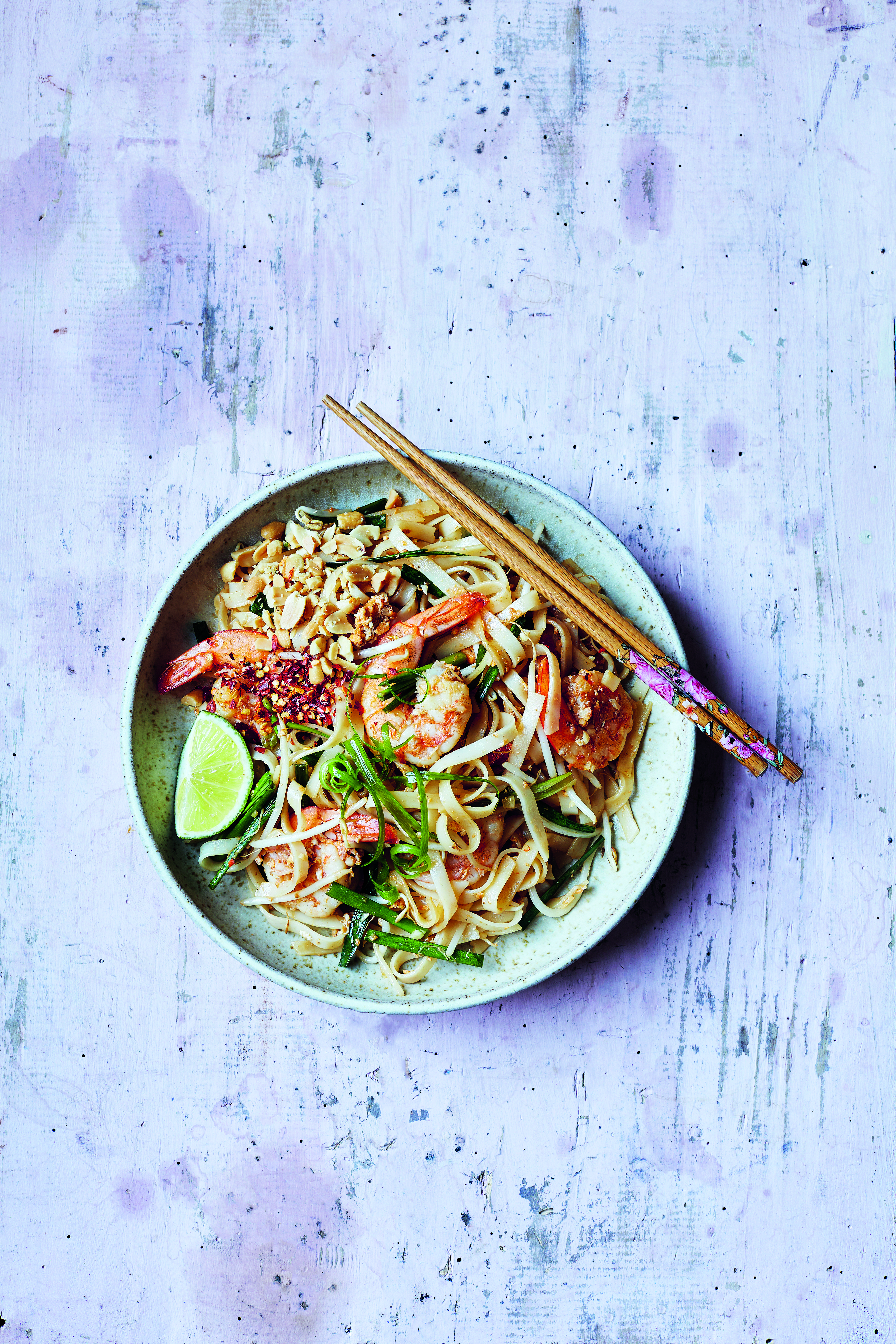
Prawn Pad Thai - BOWLFUL. IMAGE CREDIT Luke J Albert

When anyone asks about the best Thai dishes that have been exported around the world, Pad Thai is certainly among the most sought after. My visit to the country’s capital in search of the best Pad Thai in Bangkok revealed how easy it actually is to cook this dish. It has a wonderful combination of sweet, sour and salty flavours with a good crunch of peanuts. Forget about ready-made sauce in a jar, you can make your own by combining tamarind, palm sugar, fish sauce and soy sauce – it’s as simple as that.

SERVES 2

200g/7oz flat rice noodles
½ tbsp vegetable oil, plus extra for the egg
3 garlic cloves, finely chopped
10 raw king prawns, shelled and deveined, but tails left on
1 egg
125g/4½oz bean sprouts
50g/1¾oz garlic chives (kow choi)

FOR THE SEASONING

1½ tbsp tamarind paste
1 tbsp palm sugar
1 tbsp fish sauce
2 tbsp light soy sauce

FOR THE GARNISH

1 spring onion, cut into thin strips and soaked in cold water until curled, then drained
10 sprigs of fresh coriander, leaves picked
2 tsp dried chilli flakes
½ lime, cut into 2 wedges
2 tbsp salted peanuts, lightly crushed

Prepare the noodles according to the packet instructions; drain and set aside. In a small bowl, mix the seasoning ingredients with 2 tablespoons of water and stir well.

Heat the oil in a wok or large frying pan over a high heat. Fry the garlic for 30 seconds, then add the prawns and cook for 1 minute. Push the prawns to one side of the wok or frying pan and drizzle in a little more oil. Crack in the egg, scramble it, cook until dry and then add the noodles and seasoning mixture. Cook for 2 minutes, then stir in the bean sprouts and chives, continue to cook for 1 more minute and then turn off the heat.

Transfer to two serving bowls and garnish with the spring onion, coriander, chilli flakes, lime wedges and peanuts. Serve at once. 

Image: Luke J Albert

Cook more from this book: 
Vegetarian Biryani with Chickpeas by Norman Musa

Read our review 
Coning soon

Buy this book: Bowlful: Fresh and vibrant dishes from Southeast Asia by Norman Musa (Pavilion Books).

Pistachio madeleines by Sam and Sam Clark

277_Pistachio_Madeleines
Madeleines are always best served straight out of the oven. Make the batter, then bake the madeleines 10–15 minutes before you want to serve them. They are an excellent accompaniment to the ice creams.

Makes 24

100g butter (room temperature) + extra for greasing
100g caster sugar
2 free-range or organic eggs, lightly beaten
finely grated zest 1 lemon + extra for serving
70g very finely ground pistachios + extra for serving
50g self-raising flour, sieved + extra for dusting

Beat the butter and sugar until very pale and light, approximately 10 minutes. Stir in the eggs one by one, ensuring the first is fully incorporated before adding the second, followed by the lemon zest and pistachios. Once combined, gently fold in the flour. Leave the batter to rest in the fridge overnight.

Preheat the oven to 190°C/375°F/gas 5.

Generously grease two madeleine or cupcake trays with butter and lightly dust with flour, tapping off any excess.

Spoon a dessertspoon of the mixture into each mould, being careful not to overfill them – this quantity should make 24 madeleines. Bake for 10–12 minutes, until golden.

Serve with the extra pistachios and lemon zest sprinkled over.

Cook more from this book
Roast shoulder of pork marinated with orange and cumin by Sam and Sam Clark
Roast squash, sweet vinegar, garlic and rosemary by Sam and Sam Clark

Buy this book: Moro Easy by Sam and Sam Clark

Read the review

Roast squash, sweet vinegar, garlic and rosemary by Sam and Sam Clark

119_Roast_Squash_Sweet_Vinegar

The sweetness of the squash contrasts beautifully with the vinegar. Delicious with labneh, fish, chicken or lamb, like the Maghrebi slow-roast shoulder of lamb or tomato bulgur with lamb and cinnamon yoghurt.

Serves 4
1 large butternut squash or sweet potatoes, approx. 800g, peeled, deseeded and cut into 3cm chunks
5 tablespoons olive oil
1 teaspoon ground cinnamon
2 garlic cloves, thinly sliced
3 tablespoons finely chopped rosemary
3 tablespoons aged, good-quality red wine vinegar like cabernet sauvignon, or sherry vinegar (page 303) + pinch sugar if not sweet
1–2 teaspoons finely chopped red chilli (to taste)

Preheat the oven to 200°C/400°F/gas 6.

Toss the squash with 2 tablespoons olive oil, the cinnamon, salt and pepper. Lay on a large roasting tray and roast in the oven for 20 minutes, until soft and caramelised. Check for seasoning.

Meanwhile, heat the remaining olive oil over a low to medium heat. Add the garlic and rosemary and fry gently for 2–3 minutes until the garlic is golden, then add the vinegar, taking care it doesn’t spit too much, and simmer for 30 seconds. Spoon the vinegar mixture over the squash and serve with the chilli on top.

Cook more from this book
Roast shoulder of pork marinated with orange and cumin by Sam and Sam Clark 
Pistachio madeleines by Sam and Sam Clark

Buy this book: Moro Easy by Sam and Sam Clark

Read the review  

Roast shoulder of pork marinated with orange and cumin by Sam and Sam Clark

239_Roast_Shoulder_Pork

This really is a delicious way to cook pork shoulder. It is slow-roasted until the meat is soft and tender and the marinade has turned into a gravy delicately flavoured with orange and cumin. We recommend spinach, pine nuts and sultanas (page 133) and some fried potatoes to go with it.

Serves 4

1 boneless pork shoulder, 1.2–3kg

Marinade
100ml orange juice
zest 1 orange, finely grated
2 rounded teaspoons roughly ground cumin seeds
1 tablespoon white wine vinegar
¼ teaspoon smoked sweet paprika
¼ teaspoon hot paprika
pinch saffron
1 small onion or banana shallot

Blitz all the marinade ingredients together in a food processor or with a hand blender and season with salt. Smear the marinade all over the meat and leave for a minimum of 30 minutes or overnight.

Preheat the oven to 190°C/375°F/gas 5.

When you are ready to roast the meat, wrap it tightly in tin foil and place it on a roasting tray. Slow-roast for 3 hours, then remove from the oven and let it rest for 20 minutes.

When you take off the foil, take care to keep all the juices from the marinade. Slice the meat and spoon over the juices.

Cook more from this book
Roast squash, sweet vinegar, garlic and rosemary by Sam and Sam Clark
Pistachio madeleines by Sam and Sam Clark

Buy this book: Moro Easy by Sam and Sam Clark

Read the review