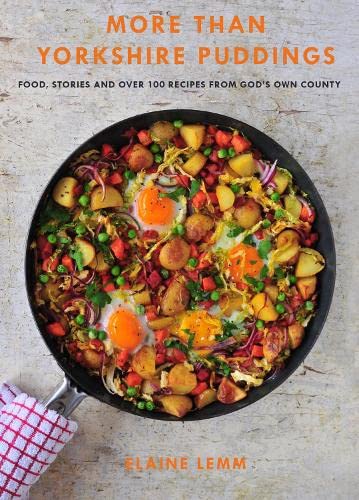
More than Yorkshire Puddings by Elaine Lemm

More than Yorkshire puddings

What’s the USP? It all depends on who you’re asking. According to the front cover, More Than Yorkshire Puddings features ‘food, stories and over 100 recipes from God’s Own County’. This isn’t exactly the truth, though. The back cover does a much better job, promising ‘both much-loved Yorkshire favourites and a wealth of multicultural recipes’. 

Who wrote it? Yorkshire-born food writer Elaine Lemm, who seems equally confused about the purpose of her book. In her preface, she starts by explaining the long route taken to get to this point. She originally pitched her idea to publishers Great Northern several years ago: a cookbook championing the culinary wealth of Yorkshire. There is more to Yorkshire than Yorkshire puddings, and she planned to celebrate all of it. In a move that is far funnier than it really should be, Great Northern promptly turned her down, waited six months, and then commissioned her to write a book solely about Yorkshire puddings. It did very well, by her own account.

A few years on and, as Lemm is keen to point out, after a change of management at Great Northern, she finally gets to offer us the book she envisioned all along. And the end result is… well, still very different from what was originally pitched.

Different how? More Than Yorkshire Puddings takes its title and ignores the final word. It offers us some classic Yorkshire dishes, sure. But the overwhelming majority of the book has nothing to do with Yorkshire at all. The back cover blurb does allude to this, suggesting that we’ll be offered a look at Lemm’s culinary journey. But what journey is really on show here? There’s no real throughline that connects the recipes. Some are inspired by her time training in Tuscany. Others are presented without any apparent reason or context at all.

There’s plenty of room on my bookshelves for cookbooks that capture the culinary id of the author. Titles filled with relatively disparate dishes connected by stories, or personality. But Lemm’s book frequently falls back on others for inspiration. A recipe named ‘The Ultimate Chilli’ comes with the disclaimer ‘at least according to my husband… given it is not my thing!’ Elsewhere, a recipe for BBQ Rib Eye Steak, Grilled Asparagus and Teriyaki Sauce, though tempting, appears to be provided unedited, photo and all, ‘courtesy of British Asparagus’. It makes for a cookbook that under-delivers on every promise it makes. 

So does Yorkshire feature at all? Yes! Enough to confuse readers further, but not so much to offer any real value. Though the front cover promises ‘over 100 recipes from God’s Own County’ there are only 88 recipes in the book itself, and barely 30 of them are even tangentially connected to Yorkshire. 

It’s a real shame, because being England’s largest county, Yorkshire has a wide and fascinating culinary culture to draw on. It is, indeed, more than Yorkshire puddings. There are varied traditional foods, including parkin, pikelets and curd tarts – only two of which are covered (briefly) here. It is home to the world famous Rhubarb Triangle, represented by just two recipes and a single mention. Hell, it’s the county that’s given us Jelly Babies, Kit-Kats, and Terry’s Chocolate Oranges. They aren’t high cuisine, but they’re all iconic parts of the British culinary landscape. But Lemm doesn’t seem that committed to the concept that she’s apparently been fighting for years to deliver. A brief introductory chapter knocks through the classics (yorkshire puds, game pies and treacle tarts), before the book gives way to a hodge-podge of unrelated dishes, from Cantonese Ginger Fish to dhal, stromboli, and chicken marbella. There’s a two page spread dedicated to the filipino noodle dish pancit, and the book rounds off with a recipe for risalamande, a sort of Danish Christmas pudding. 

What will I love? Look, the dishes themselves often look very tasty. It’s just that they usually have nothing to do with Yorkshire. You’ll love the rich, bright Torta di Pomodoro, the Burrata and Grilled Peaches, and the Coconut Shrimp – but is that what you bought a book about Yorkshire food for?

What won’t I love? Apart from the confused premise and pick and mix approach to recipes? More Than Yorkshire Puddings also boasts one of the worst indexes I’ve ever seen in a cookbook. There’s no individual listings for ingredients, types of dish, or even Yorkshire places referenced – it lists only the 88 recipes of the book and does so using the exact name used on the page. Which means that readers looking for the classic gingerbread cake parkin will need to know not to look under ‘P’, but rather ‘T’ for ‘Traditional Yorkshire Parkin’. Looking to make a Yorkshire Curd Tart? You’ll want to remember that Lemm’s recipe is for individual ones, and so they’re listed under the letter ‘I’. 

Should I buy it? Probably not. There’s a wealth of interesting cookbooks drawing on traditional British foods at the moment, including recent additions from Ben Mervis and Carol Wilson. Though both of those cover much bigger regions, they’re frankly still likely to feature slightly more dishes that authentically represent Yorkshire cuisine than this book.

Cuisine: British/International
Suitable for: Beginner and confident home cook
Cookbook Review Rating: Two stars

Buy this book: More than Yorkshire Puddings by Elaine Lemm
£19.99, Great Northern Books Ltd

Review written by Stephen Rötzsch Thomas a Nottingham-based writer. Follow him on Twitter and Instagram at @srotzschthomas
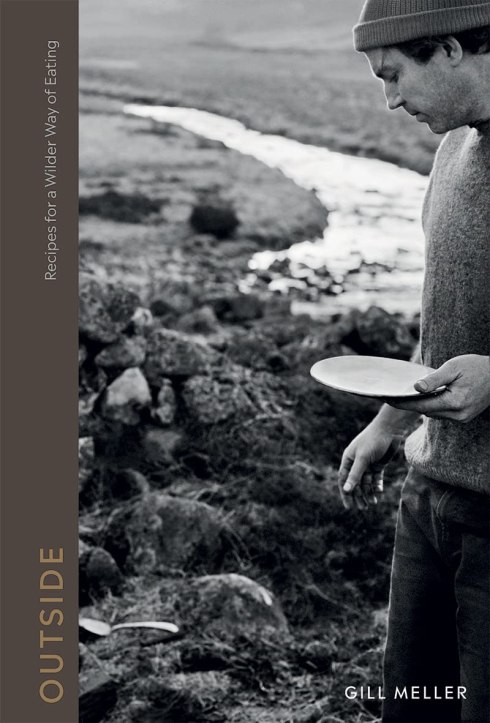
Outside by Gill Meller

Outside by Gill Meller

What’s up?  You haven’t had a look on your face like that since your tortoise died. 

I’m not sure I can go through this again 

Through what?

It’s another one. By him. 

Have you had a stroke? What are you talking about?

Gill Meller, he’s got a new book out.

Who?

Don’t tell me you don’t remember. The last one was during lockdown. I’m still not really over it.

Oh, you mean Gill Meller, alumni of Hugh Fearnley Whittingstall’s River Cottage organization and chef, food writer and teacher. His first book Gather won the Fortnum and Mason award for Best Debut Food Book in 2017 and his other books include root, steam, leaf, flower and Time, both of which you’ve reviewed.

Why are you talking like that? You sound like a newspaper article or something.

I’m not talking like anything. Anyway, I don’t know why you’ve got such a problem with him, I think he’s great. The books always look fantastic, and his recipes are ace. Let me see. Oh, it’s Andrew Montgomery doing the pics. I like him. That one of Meller in the woods, that’s stunning.

Hmm, what do you know? I’m the cookbook blogger. Give it here. Actually, before you do, check something for me.

What? That Gill Meller is still better looking and more successful than you, you bitter old…

Poetry. Is there any poetry in the book? 

Oh, good point. That’s what tipped you over the edge last time wasn’t it? Let me have a look. Nope, nothing, unless you count the recipe for ‘The Bacon Sandwich’ which is better than an Amanda Gorman stanza.

It’s called ‘the’ bacon sandwich? 

Yeah. Why? What’s the problem with that?

Nothing. Not really, it’s just, you know…

Oh God, I remember, you’ve got a problem with his recipe titles, haven’t you? ‘Unnecessarily overwritten, arch and twee constructions like ‘A tart for May’ and ‘Aubergines and roast tomatoes for everything’ are like fingernails down a blackboard to me’ is what you said. What is wrong with you?

Tell me some other titles, go on. Do your worst, let’s get it over with. 

Well, sorry to disappoint you, but they’re all just sort of normal.

What?! Let me see. 

Alright, don’t snatch! Learn some manners.

This is weird, ‘Salted cabbage salad with chestnut mushrooms and flaked seaweed’, ‘Wild garlic polenta with barbecued asparagus and crispy stinging nettles’. They are just sort of normal. No poetry, no offensive recipe titles. It’s almost like he’s read my review. 

Oh, do not flatter yourself! You sound ridiculous.

I’ll have you know I’m an internationally renowned food writer.

*yawns*

What is Outside actually about? Let me have a look at the back cover. ‘We shouldn’t be shutting doors anymore – we should be opening them’. That’s terrible advice. One, obvious security issue, who leaves their front door open? Two, you’re going to let all the heat out and no one can afford to do that, hasn’t he heard about the cost-of-living crisis? And three, you’re not really using the full functionality of a door if you’re just opening it are you? Doors by their very nature open and close. You might as well just have a hole in the wall if you’re never going to shut it. Stands to reason. 

Very funny, have you considered a career in stand up? Russell Howard must be shitting himself.    

Anyway, it doesn’t make any sense, I’m going to have to read the introduction, aren’t I?

I see you’ve deliberately ignored the bit on the back cover where it also says ‘Gill Meller’s new book Outside is a thoughtful celebration of the joys of cooking and eating outdoors’, but you know, comic effect is more important than accuracy. And it is your bloody job to read the introduction. 

Suppose.

*sighs*

Read out the best bits otherwise there’s just going to be a blank space.

You mean a silence? 

Erm, yeah, whatever. 

I’m through the first paragraph, no problem. I think everything’s going to be OK…

Well done you. Keep going. You’re a hero. 

Oh shit…spoke too soon. 

What is it now? Jesus. 

Writing. Creative writing. So much. Can’t breathe. Heart is racing. Must stay calm. 

Read it out, you’ll feel better. We’ll all feel better. 

What do you mean ‘we’ll all feel better’? Who is ‘we’?

Just read it, there’s a dear. 

So, he’s writing about moving to the countryside from the town when he was a kid and getting into bird watching as way of adapting to the change. Which is all fine, and then he says, ‘the rooks would fall on to the wing and dance up over the pine, tumbling, shrieking, wheeling to the weather. They cut a shifty, marauding form, but squabbled with eloquence as they turned and raked together, a black ballet in the afternoon.’ 

Gosh. That’s…a lot. It’s very descriptive though, isn’t it? I mean, who wouldn’t enjoy a black ballet in the afternoon. Don’t get distracted, what’s the book actually about?

OK, now were getting to it. He’s having a Proust’s madeleine moment except it involves a flask of soup and some bread. The general idea seems to be that by cooking and eating outside we can reconnect with a kinder gentler time when we were closer to nature and not so tied to technology. 

What, by having a picnic? 

Actually, yes. 

Well, you can’t beat Ginster’s and a packet of Frazzles in the park can you? 

Don’t forget your four pack of Special Brew, will you? That doesn’t sound very ‘elemental’ does it, you’re not going to discover ‘another aspect of our primal hardwiring’ with that heart attack on a paper plate are you? No, Gill has something a little more sophisticated in mind for you, like wild mushroom and thyme sausage rolls or a ham hock, potato and parsley terrine.  

Ooh, fancy. Actually, I do fancy that. Go on, what else is in the book?

Why don’t you have a look yourself? 

Because you’ve got to tell me. Otherwise, this doesn’t work.

What won’t work? Honestly, you are in a strange mood today. Well, there’s a chapter on cooking over fire, one on eating out (don’t even think about making a joke, it’s beneath even you) that’s based around raw preparations, a chapter on camping out (I’ll just pause for a moment here. Are you done? Good) which is really just more cooking over fire, a section on wild things (foraging) and an early autumn feast that’s based around setting a sheep on fire by the looks of things. 

That doesn’t sound very PC. 

Hold that call to PETA. It says, ‘A Sheep on Fire’ but what it actually means is ‘A Sheep on a Fire’ which is an entirely different thing. It’s already dead and has had a pole stuck up its…

That’s quite enough detail thanks. So, what are you cooking for us tonight then, oh former Masterchef semi-finalist. 

Can you be a ‘former Masterchef semi-finalist’? You either are or you aren’t. It’s a bit like being a president. 

What, do you tart about insisting people call you by your title? When they ask you for your name at Starbucks do say ‘Masterchef semi-finalist Lynes’.

No, of course not. At least not since the, er, incident. I’m not cooking anything if you’re just going to take the piss.  

Just pick a recipe.

Alright, I’m thinking. I’m not setting fire to a sheep, that’s for sure. I could make the hispi cabbage with miso, honey, tamari and sesame. Sounds nice. Oh, hold on, I’ll need ‘a bed of hot chunky embers’ and some clay to wrap the cabbage in. Maybe not. Smokey anchovies with baked wet garlic? But where am I going to get fresh anchovy fillet and wet garlic from? Venison cured with blackberries, elderberries, juniper and bay…no good, got to marinate the meat for 24 hours. 

You’re just looking for problems, aren’t you? Give me the book. Look, what’s wrong with lentils cooked with garlic, chilli and rosemary with baked eggs and kale. Or spatchcock chicken, aioli and toast. Or a lovely vegetarian ‘Campervan’ stew?

*shrugs*

Sorry, I didn’t hear you. 

I said ‘nothing’. 

Right then. Supermarket it is. Well, shall we go?

Yes, let’s go. 

They do not move.

Cuisine: British
Suitable for: For confident home cooks/professional chefs
Cookbook Review Rating: Three stars

Buy this book: Outside by Gill Meller
£30, Hardie Grant


Interview: Cindy-Marie Harvey, author of Watercress, Willow and Wine

What inspired you to come up with the idea for the book?
Like many people, there has been a potential book meandering around the edges of my mind for quite a while, and it was always going to be about food & wine pairing. But in lockdown, as all of the tours that I organise to vineyards around the world were not happening, I started doing online Zoom tastings for clients. I would choose between 6 – 10 wines and I would send recipes to match for clients to cook at home and share on screen during the tasting. I would also send suggestions of cheeses or charcuterie as easy pairings, and discovered a wealth of lesser known artisan cheeses and cured meats made in Britain. So after one particular English Wine tasting, with a glass of Pinot Blanc in hand, the germ of Watercress, Willow & Wine was created.

Why is it the right time for a book about English wine now?
English Wine is experiencing a really exciting time, as wine lovers both at home and abroad are starting to discover its quality and diversity. No longer a “patriotic one off” purchase, English wine is establishing a very loyal following – from sparkling wines that have repeatedly beaten top Champagne producers in blind tastings at international awards, through to crisp whites that delight the palate, fruit filled Rosés perfect for a picnic, even the fickle grape variety of Pinot Noir has found a happy new home in the South of England.

How did you develop the recipes for the book – were they directly inspired by your visits to the vineyards and tastings of the wine?
Some of the recipes draw inspiration from the produce of the county where the wine is produced, such as watercress in Hampshire. Some of them are inspired by my meanderings around the vineyards of the world, so might have an Italian influence but using clams from Cornwall or apples from Kent. Some of them indeed direct from the vineyards themselves. But the starting place was always the featured wine from each producer in the book. So it was a case of pouring a glass of the chosen wine, sitting quietly with a notebook and giving my creative food-brain free range to see what flavours the wine could inspire. It was such a tough job!

There’s a wide range of cuisines in the book, were you surprised at how adaptable the wines were in terms of dishes they would pair with?
Not really, as that was one of the reasons that I wrote the book – to share this incredible versatility with people. At the moment, quite a few wine lovers still think that we only make sparkling wines in this country – so spreading the word about what great food friendly still English wines there are being produced – and that will pair happily with a myriad of food styles. I hope the book encourages people to try new pairings – I’d love to see more people drinking white wine with cheese (rather than red) and also more people understanding that Sparkling wines are not just as an aperitif – but are fabulous with a meal as well.

It’s a beautiful book and I love the illustrations. Why did you decide on the drawings rather than photographs?
Much as I love great food photography, for this book I wanted a very quintessentially English feel – and was lucky enough to discover the brilliant illustrator, Chloe Robertson who lives just down the road from myself in the South Downs. As I envisioned the book as taking readers on a voyage of discovery of English wine, I wanted to make it as accessible as possible . I feel that illustrations are a lot more forgiving to the home cook – I’m sure that I’m not alone in having cooked a recipe for the first time and looked at the spectacular accompanying photo and been slightly disheartened at the comparison! Chloe’s beautiful illustrations give the cook an idea to aim for whilst still allowing for home creativity.

It’s arguable that, although English sparkling wines have been embraced by the public, the still wines are perhaps less well understood. Is there one wine and recipe pairing in the book that you would point to that would open people’s eyes to English still wines.
I absolutely agree, our still wines are getting better known but still don’t have the wider spread fame of our sparkling wines (yet!). A hard call to mention just one, but perhaps the Pinot Gris from Stopham in West Sussex paired with Chameleon Curry. The off dry style of the Pinot Gris is fabulous with a host of spicy foods but also so much more.

Readers will probably be familiar with the big named vineyards in the book like Nyetimber and Chapel Down. Where would you recommend people to start if they wanted to explore some of the lesser-known vineyards?
If they are lucky enough to live close to a vineyard, then start by booking a tasting visit on their own doorstep as it were! There are so many smaller, family run wine estates that welcome visitors by appointment, where a warm welcome awaits from the people who actually grow the grapes themselves! Do visit winegb.co.uk as they have over 200 wine estates listed – You can search by location, those that offer lunches, those with accommodation and everything you need to know for a visit! From the private English Wine tours that we have organised, I can definitely say that a day out visiting a couple of English wine estates, is a great way to celebrate a birthday or just getting together with friends.

How do you think English wine tourism compares to other wine regions around the world?
In its infancy for sure, but growing rapidly and generally in the right direction. It’s great to see winery restaurants opening up such as the new one at Wiston (West Sussex), at Sandridge Barton (Devon) and at Hambledon (Hampshire). But also smaller estates that offer platters of local cheeses, or as at Nutbourne (West Sussex), a glorious picnic full of home baked goodies and heritage tomatoes from a few fields away! Looking ahead, I think it’s important that wine estates remember that all visitors are different, and not to follow the “one size fits all” approach of some of the New World Cellar Door operations, where the personal touch has been lost.

Did you come to any conclusions about English wine as a region in terms of style compared to other regions around the world?
Not in terms of style, as there is so much diversity – from Bacchus grapes fermented in terracotta amphorae to late harvested Ortega grapes resulting in delicious dessert wine. But one thing that did emerge, was that being a relatively young wine region, that our winemakers are unfettered by tradition, which gives them a huge scope for experimentation – which is great news for us, the curious wine drinkers.

What will be your next project?
Well once I’ve been to Sicily, Alto Adige, Piemonte and Chile on tour this Autumn, I’ll start focusing on my next book – but a few more glasses of wine are still needed yet, for creative purposes of course, before I decide which region to focus on!

Cindy-Marie Harvey’s book Watercress, Willow and Wine is published 15 September 2022 by whitefox. Visit Cindy-Marie’s website, Love Wine Food, to find out more: lovewinefood.com

Buy this book: Watercress Willow and Wine by Cindy-Marie Harvey
£25, Love Wine Food Books 

Read the review 

Cook from this book
Roasted Monkfish Tail with ’Nduja, White Beans and Samphire by Cindy -Marie Harvey
Twice-Baked Goat’s Cheese and Wasabi Leaves Soufflé by Cindy-Marie Harvey
Hazelnut Roulade with Rosewater and Raspberries by Cindy-Marie Harvey

The Year of Miracles by Ella Risbridger

The Year of Miracles Ella Risbridger

The best food writing is never really about the food. There is almost always something else that sits at the heart of the food writing that most appeals to us; the essays, memoirs or cookbooks that we read cover to cover as though they were a novel. Food, when written well, is a character that interacts with the world around it. In the same way that The Great Gatsby isn’t really about Gatsby, or Nick, the very best food writing uses food to tell us more about ourselves, and who we are as individuals. 

Nigel Slater remains one of the finest food writers around – whether he’s using food nostalgia as a means to explore family is his memoir Toast, or simply to meditate on the value of the seasons in books like his two Greenfeast volumes. Even Julia Child seems to have a sort of philosophy on her mind when she writes about food. In My Life in France she writes that ‘No one is born a great cook, one learns by doing’, and comes across as a sort of gourmand Yoda. 

The Year of Miracles is the second cookbook by Ella Risbridger and, like its predecessor Midnight Chicken (& Other Recipes Worth Living For), is about so much more than the recipes within. As debut cookbooks by non-household names go, Midnight Chicken was a phenomenal success, becoming a bestseller both in classic hardback and the less traditional novel-sized paperback formats, and winning Cookbook of the Year at the Guild of Food Writers Awards in 2020. 

And, excellent a collection of recipes as it was, this success is every bit as much down to the real subject matter of the book. It was a book not about food, but finding peace for oneself through food. About coming to terms with what life has given you, and learning how to build something you want around that. Much of the book speaks lovingly of ‘The Tall Man’ – Risbridger’s partner with whom she shared a home. Their relationship is portrayed evocatively as one that, though not without its clashes, was built on mutual respect and a deep, empathetic love. Which made the revelation that was tucked away amidst the acknowledgements a tremendous gut punch for those readers who were not already aware of Risbridger’s story. Much of the book was written whilst her partner was receiving treatment in hospital. Around the time she handed in her final draft, The Tall Man passed away. Though this part of Risbridger’s life doesn’t directly feature in the book itself, it impacts it at every turn, with the author’s view the world inevitably tied to what that world is presenting to her. 

Now, three years on from the publication of Midnight Chicken, we are gifted The Year of Miracles. It doesn’t feel entirely right to call the new title a sequel – we should reserve those for superhero films and YA adaptations on Netflix. This is simply: a life, continued. We return to Risbridger at the beginning of 2020, as she leaves the tiny flat she had shared with The Tall Man (here named Jim, though this is a pseudonym, as are all the other friend’s names throughout the book). Some months have passed since Jim’s death, and though she continues to grieve, the action of moving into a new home with a close friend feels like the opportunity for a fresh start. Of course, fresh starts were few and far between at the beginning of 2020, and so a food diary about change and new beginnings turns into something that is about grief, and solitude, and friends, and the family we build for ourselves as the world falls apart around us. 

Fans of Midnight Chicken will find nothing to disappoint them here. Everything that made Risbridger’s first book so lovable returns for this, her fourth (she’s tucked a children’s novel and a poetry anthology in between). Elisa Cunningham’s bright illustrations return, offering imperfect visions of dishes that are sort of meant to be imperfect. Risbridger does not fuss with stiff, precise recipes. Her dishes are flexible, so that they can fit around whatever life is throwing at you. Her ingredients lists are gloriously candid, filled with little asides offering ideas for substitutes, or simply reassuring you. She calls for vanilla extract a number of times – the first comes with a plea ‘(not essence! never essence!)’, the second with practical advice: ‘(don’t worry about using very expensive stuff; they’ve run tests and you can’t tell in baked goods)’.

The recipes themselves are similarly unpretentious, with instructions that kindly explain why you do the things you do or, just as frequently, politely request that you ‘just trust me’ on the matter. As in Midnight Chicken, the dishes are a mix between big meals you might serve to friends (Bourride! Pho! Fish Pie!) and small moments of sustenance that will keep you going when you need them most. These dishes are often the most fun in the book – a celebration of the unlikely combinations we discover in our early adulthood, and can be raised infinitely with a smart food-centric mind like Risbridger’s. Here we have a Salt & Vinegar Crisp Omelette, Jacket Potato Garlic Soup, or Marmite Crumpet Cauliflower Cheese. 

These recipes might not speak to everyone, but they will resonate with many. Risbridger approaches food as a restorative action. For the soul, for the heart, and for just about anything else that might need it. Every element of The Year of Miracles offers an element of comfort. Even as we touch on grief, guilt and the frustrations of living through a pandemic, Risbridger’s prose is written with such a contemplative warmth that it is impossible not to feel comforted – if only in knowing that we are not suffering alone. 

As the miraculous year ticks along, and the seasons change, and lockdowns are lifted, we are exposed more and more to the friendships that fuel both Risbridger and the book itself. The best food writing is never really about food. Here, it is a way of connecting with friends, with those we love, those we have lost, and those we are only just getting to know. The food has as much to say as anyone in this story, and it serves as a means to bring people together – for a conversation in the park, a cry in the kitchen, or a singalong in the back garden. We don’t need food for any of these things, but it is there nonetheless, and it is something that can be shared between whoever might be nearby. Something to bring us all together. 

It seems very likely that we can expect a third cookbook from Ella Risbridger at some point. After these first two, it would be a huge shame if there were not. What’s harder to guess is whether that third book will be all that similar to the two that came before it. The Year of Miracles itself was never intended to look like this, with the author initially pitching a ‘cheerful dinner-party’ cookbook. Perhaps that’s what we’ll get next. In a way, you sort of hope for it. For Risbridger to have an opportunity to explore something new. And down the line, maybe, there’ll be time again for another book like this. Not a sequel, simply: a life, continued.

Cuisine: International 
Suitable for: Beginner, confident home cooks 
Cookbook Review Rating: Five stars

Buy this book:
The Year of Miracles by Ella Risbridger
£22, Bloomsbury Publishing

Review written by Stephen Rötzsch Thomas a Nottingham-based writer. Follow him on Twitter and Instagram at @srotzschthomas


Aloo ko tarkari – Potato curry by Santosh Shah

Aloo ko tarkari Potato curry

SERVES 4

Aloo Ko Tarkari (potato curry) is so often eaten with puri, that I have combined the two recipes for you here. Puri are also served alongside other dishes, such as Chana Ko Dal (Spicy Chickpeas, see page 93 of the book). The puri here are vegan, but see page 177 of the book for an alternative recipe, with the option of ghee (clarified butter), and if you want to make them without the potato curry.

For the puri (makes 20)
500g (3¾ cups) plain (all-purpose) flour or roti (chapati) flour, or an equal mixture of both
2 teaspoons salt
1 tablespoon vegetable oil, for working into the dough
1 litre (4 cups) vegetable oil, for deep-frying
2 tablespoons vegetable oil, for rolling

For the potato curry
2½ tablespoons vegetable oil
1 teaspoon fenugreek seeds
½ teaspoon cumin seeds
½ teaspoon nigella seeds
½ teaspoon garlic paste
½ teaspoon ginger paste
500g (18oz) red-skinned waxy potatoes, unpeeled and diced
½ teaspoon salt, or to taste
2 dried hot red chillies, crushed
¼ teaspoon Kashmiri chilli powder, or medium hot chilli powder
½ teaspoon Sakahar Barha Masala (Vegetable Garam Masala, see page 194 of the book)
½ teaspoon ground turmeric
500ml (2 cups) vegetable stock, or water

A kitchen thermometer

Method

First, make the puri dough. Combine the flour and salt into a bowl. Add the 1 tablespoon of oil and, using your fingers, work the oil into the flour until well incorporated. Make a well in the flour and measure out 250ml (1 cup) of water. Add some of the water into the well and start mixing the dough, gradually adding the remaining water, a little at a time, until a firm dough forms. Knead the dough well with your hands for about 10 minutes until soft and elastic. Cover with a clean damp cloth and set aside for 15 minutes. Divide the dough into 20 pieces and keep them covered.

Make the potato curry. Heat the oil in a medium non-stick frying pan. Add the fenugreek seeds and let them crackle until they turn dark brown.  Add the cumin and nigella seeds. Cook them for a few seconds just until they crackle. Add the garlic and ginger pastes, potato cubes, salt, crushed red chillies and all the ground spices. Sauté for a couple of minutes, until the potatoes are well coated with oil and spices. Add the vegetable stock or water, bring the mixture to the boil, and then turn down the heat to low.

Simmer on low heat for about 30 minutes until most of the liquid has been absorbed and the potatoes are soft. When the potatoes are soft enough, start stirring them while lightly crushing them with a spatula. You want the potatoes to absorb all the liquid and to have some chunkiness and texture. When they are thick and glossy from the juices, they are ready.

While the potatoes are cooking, fry the puri. Heat the oil in a deep sauté pan until it reaches 190°C (375°F). Roll one of the dough pieces in your hand to make a smooth ball. Apply a little oil on the dough ball and roll it out on an oiled surface with a rolling pin to obtain a 10-cm (4-in) disc. Repeat with the other dough balls. Keep the discs covered with a wet cloth. Place a puri in the hot oil. When it rises to the surface, press it down very gently into the oil with a skimmer. The puri will start puffing up. Flip it over and cook for a few seconds. When the puri are crisp and golden brown – this should take a couple of minutes on each side – remove from the oil and place on kitchen paper (paper towels) to drain.

Serve the potato curry hot with the crisp puri on the side.

Cook more from this book
Steamed chicken momos with ginger and chilli with a tomato sesame chutney (Kukhura ko momo) by Santosh Shah
Crispy chilli chicken (Swadilo piro tareko valeko masu) by Santosh Shah
Coriander and peanut chutney (Badam ko chutney) by Santosh Shah

Read the Review
Coming soon

Buy this book
Ayla: A Feast of Nepali Dishes from Terai, Hills and the Himalayas by Santosh Shah.
£20, DK

Photographer: Matt Russell


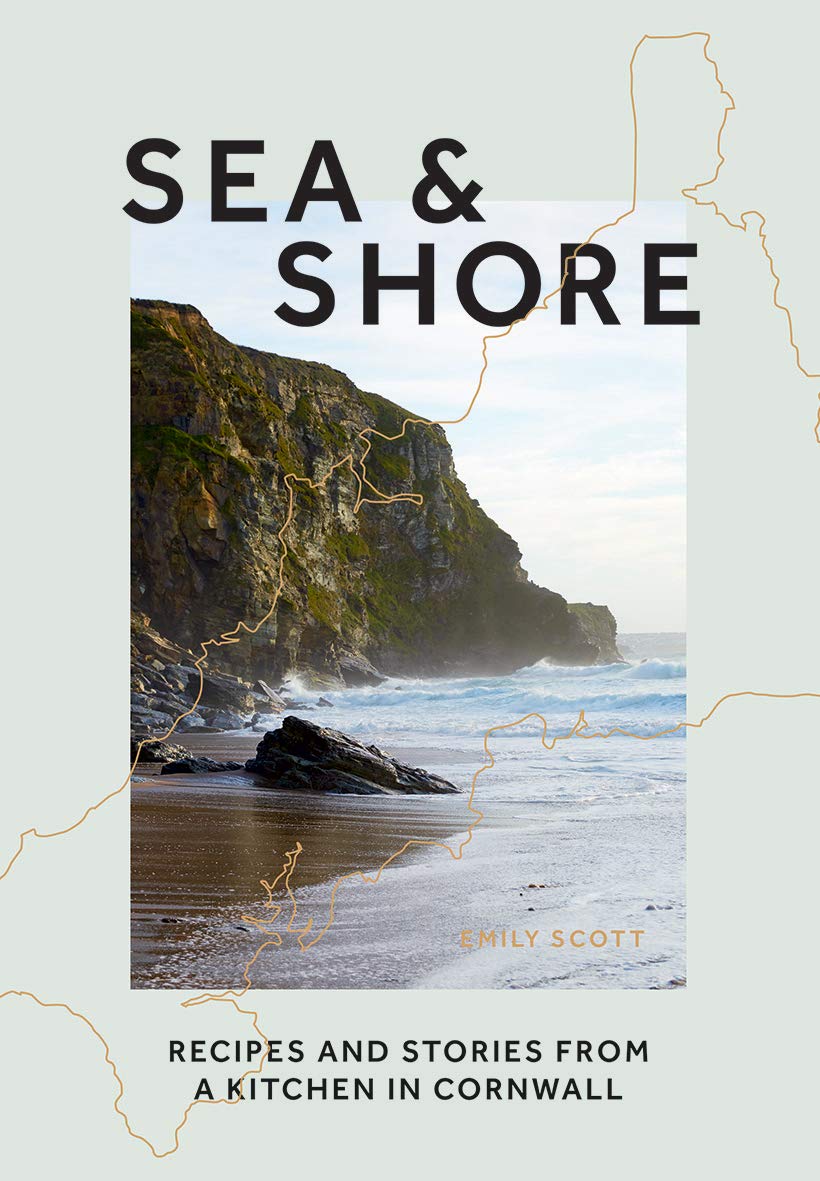
Sea and Shore by Emily Scott

Emily Scott Sea and Shore

Sea and Shore is a collection of recipes by a chef inspired by living and working in Cornwall. As there isn’t really such a thing as ‘Cornish cuisine’, it’s probably best to think of it as one cook’s personal culinary response to the produce and surroundings of the county.

The author is Emily Scott, chef of Emily Scott Food in Watergate Bay in north Cornwall and the former owner and chef of St Tudy Inn near Bodmin. She recently hit the headlines as one of the team who catered the G7 conference at Carbis Bay in Cornwall in 2021. Scott also appeared on the BBCs Great British Menu series in 2019.

You should buy Sea and Shore because you’ll want to make Cornish crab linguine with chilli, lemon and parsley; slow roasted lamb shoulder with smoked paprika, garlic and thyme; little gem tart with Keen’s Cheddar, spring onions and flat leaf parsley; meringue roulade with clementine curd, cream and passionfruit and Cornish faring biscuits made with coconut, ginger and golden syrup, plus many of the other 80 simple recipes, making it an ideal book for novice cooks. The food looks colourful and appetising while the Cornish landscape photography will inspire your next English summer holiday.

Cuisine: British
Suitable for: For beginners/confident home cooks
Cookbook Review Rating: Four stars

Buy this book
Sea and Shore by Emily Scott 
£26, Hardie Grant

Kamo Negi – Duck With Grilled Leeks by Brendan Liew

TUL_Izakaya_Kamonegi

Like bacon and eggs, kamo (duck) and negi (leek) can be listed as just two ingredients on a menu, but the combination is so well known in Japan that people can envisage the dish based only on those two words alone. Kamo negi is usually seared, thinly sliced duck breast accompanied by the whites of leeks that have been slowly pan-fried or roasted to have nicely brown grill marks. It could be served plated
as an okazu (side dish) as part of a larger feast, or made into a delightful noodle soup. I’ve included both versions of the dish here, as you can double the amount of duck breast and turn it into two completely different meals. It is best to start this recipe the day before, to allow the duck breast to cure with the salt and sansho overnight. This draws out water from the meat while seasoning the duck at the same time, resulting in crispier duck skin and more flavoursome meat.

2 duck breasts
2 teaspoons salt
1 teaspoon ground sansho pepper
1 thin leek, cleaned, whites cut into 4 pieces, greens discarded or used for stock
30 ml (1 fl oz) soy sauce
30 ml (1 fl oz) sake
15 g (1/2 oz) zarame or sugar

PLATED VERSION
1 bunch of spring onions
(scallions)

SOUP VERSION
500 ml (2 cups) dashi (see page 32 of book for recipe)
250 g (9 oz) ramen noodles, home-made (see page 130 of book for recipe) or store bought
1 bunch of green vegetables, washed and cut into bite-sized pieces
shichimi togarashi, to serve

SERVES 2
Using a sharp knife, remove any silver skin from the underside of the duck breasts. Rub 1 teaspoon salt over the skin and meat of each breast, then rub the sansho pepper over only the flesh. (We season only the meat side with the sansho, because the sansho will burn on the skin side, which is pan-fried for a longer time than the meat side.) Place the duck breasts, skin side up, on a rack with a tray underneath. Leave uncovered in the refrigerator for up to 24 hours, but at least 2 hours.

When ready to cook, use a sharp knife to cut lines down the duck skin, along the length of the breast, about 2 mm (1/8 inch) deep and 1 cm (1/2 inch) apart. This creates channels for the duck fat to render out, resulting in a crispier skin.

Place the duck, skin side down, in a cold frying pan and turn the heat to medium–low. When the duck starts sizzling and a thin layer of rendered duck fat coats the bottom of the pan, add the leek to the pan.

Cook for 15 minutes over medium–low heat, skin side down the whole time; there should be a light frying noise. Every 5 minutes, drain the fat from the pan, reserving it for roasted potatoes or stir-fries. Turn the leek over after 7 minutes.

Meanwhile, in a small saucepan, heat the soy sauce, sake and zarame just enough to dissolve the zarame.  At this point, you can take the recipe in two different directions.

FOR THE PLATED VERSION:
Wash the spring onions, then divide into the green and white parts. Shred the green bits and very thinly julienne the whites, keeping them separate.

After the duck has finished cooking on the skin side for 15 minutes, turn it over onto the flesh side and sear all the parts that appear uncooked. After you’ve seared each side, leave the duck on the meat side for a further minute (it should be 2 minutes in total), then transfer the duck and leek from the pan to a plate and allow to rest for 5 minutes. Take the pan off the heat, but do not wash.

After 5 minutes, place the pan back on the heat and turn the heat up to high. Add the spring onion greens and stir-fry until wilted. Add the soy sauce mixture and any accumulated juices under the duck. Allow to bubble until slightly thickened, then remove from the heat. Slice the duck, then place on your serving dish with the leek. Pour the sauce over, garnish with the spring onion whites and serve.

FOR THE SOUP VERSION:
While the duck is cooking, bring the dashi to a simmer and prepare a pot of boiling water for cooking the noodles.

After the duck has finished cooking on the skin side for 15 minutes, very quickly sear the flesh side of the duck just to colour it, then remove from the pan with the leek. Don’t worry if you think it’s still raw; it will cook further in the soup.

Quickly blanch your vegetables in the boiling water; remove with tongs and place in a colander to drain. Boil the noodles in the same water, then pour into the colander to drain, shaking the colander to remove as much excess water as possible.

Divide the noodles and vegetables among bowls. Add 3 tablespoons of the soy sauce mixture to the simmering dashi. Taste and add more of the dashi mixture, or salt, until you are happy with the flavour. Pour it over the noodles and top with the greens. Slice the duck breast and fan it out over the noodles with the leek. Serve with shichimi togarashi for sprinkling over.

Cook more from this book
Salmon Ochazuke by Brendan Liew
Mizu Shingen Mochi – Raindrop Cakes by Brendan Liew

Buy this book
Tokyo Up Late by Brendan Liew
£26,  Smith Street Books

Read the review
Coming soon

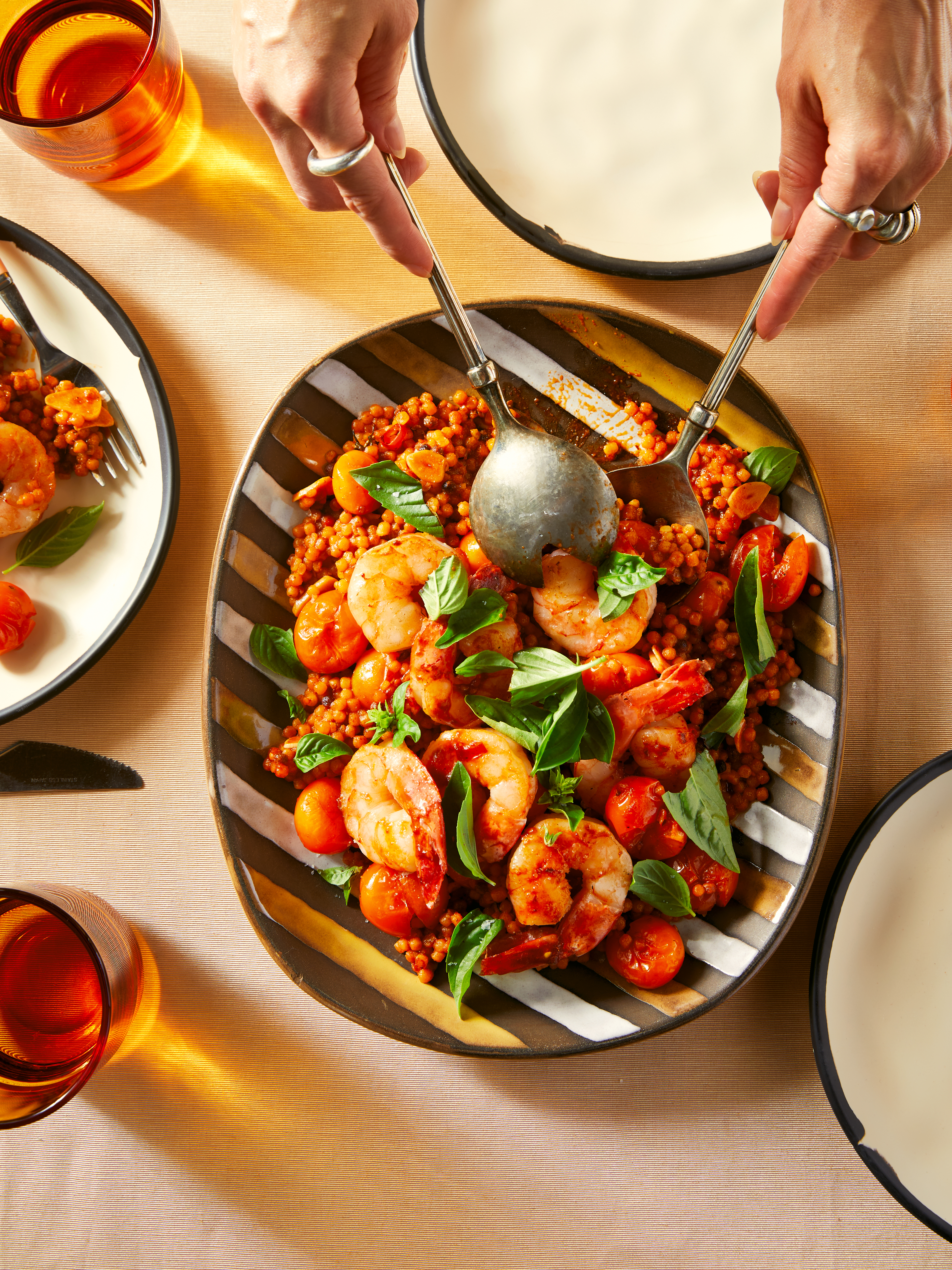
Smoky and Spicy Shrimp with Anchovy Butter and Fregola by Colu Henry

SmokyAndSpicyShrimp_p111a_ColuCooks_p111a

It’s all right there for you in the title. Sweet shrimp is sautéed until just cooked through, and fregola (a tiny toasted pasta from Sardinia) is added to the pot to toast in the melted anchovy butter and spices with some cherry tomatoes. I love Calabrian chiles packed in oil and use them here for some punchy heat, but if red pepper flakes are within closer reach feel free to use them instead. Once the fregola finishes cooking, return the shrimp to the pot to warm them through and serve straight from the pan. Serve with many bottles of chilled red wine.

Serves: 4
Time: 30 minutes

INGREDIENTS
1 pound (455 g) extra-large or jumbo shrimp, peeled and deveined
Kosher salt and freshly ground black pepper
¼ cup (½ stick/55 g) unsalted butter
4 cloves garlic, thinly sliced
4 oil-packed anchovies
3 Calabrian chiles, roughly chopped, or 1 teaspoon red pepper flakes
½ teaspoon smoked paprika
2 tablespoons tomato paste
1 pint (290 g) cherry or Sungold tomatoes
1½ cups (270 g) fregola
3 cups (700 ml) chicken stock
½ cup (20 g) loosely packed basil leaves, torn if large, or roughly chopped parsley or mint, or a combination of all three

METHOD
Season the shrimp well with salt and black pepper. In a 12-inch (30.5 cm) skillet, melt the butter over medium heat. Add the shrimp and cook until pink, 1 to 2 minutes per side. Remove and set aside on a plate.

Add the garlic, anchovies, Calabrian chiles, and smoked paprika to the skillet and stir until the garlic is fragrant and the anchovies have dissolved, about 2 minutes. Add the tomato paste and toast for a minute or so. Add the cherry tomatoes and stir to coat. Cook until the tomatoes begin to burst, pressing down on them gently to help release their liquid, 3 to 4 minutes.

Add the fregola to the pan and stir until the pasta is well coated in the spiced butter. Pour in the stock and bring to a boil. Reduce the heat to low, cover, and simmer until the fregola is al dente, 10 to 12 minutes.

Add the shrimp back to the pan with any juices that have accumulated on the plate and stir until they are just warmed through. Scatter with herbs and serve.

Cook more from this book
Swordfish with Burst Tomatoes, Peppers, and Za’atar and Preserved Lemon by Colu Henry
Spring lamb ragu with anchovies and pea shoots by Colu Henry


Buy this book
Colu Cooks by Colu Henry
£25, Abrams Books

Read the review
Coming soon

Baking with Fortitude by Dee Rettali

Baking with fortitude
What’s the USP? Just because we’re not in lockdown any more doesn’t mean we’ve abandoned our national sourdough habit, does it? Either way, here’s a collection of sourdough cakes and bakes (and non-fermented recipes too) from cult London bakery Fortitude to keep your (sourdough) mother happy.  The book is the winner of  the Andre Simon Food Book Award 2021.

Who wrote it? Irish-born baker Dee Rettali was something of an organic food pioneer, opening Patisserie Organic in London in 1988. She is the former head chef of the London-based cafe chain Fernandez and Wells and opened Fortitude bakery in Bloomsbury in 2018.  This is her first book.

Is it good bedtime reading? There’s a six page introduction plus one or two page introductions to each of the seven chapters but that’s your lot.

Will I have trouble finding ingredients? You’ll need an online specialist supplier for dried meadowsweet to make the first recipe in the book, a butter loaf cake flavoured with honey and meadowsweet (one of eight butter loaf cakes recipes – the book is organised around base recipes and their variations).

Go anywhere but your local supermarket for the ‘fresh ripe’ fruit Rettali specifies for things like Lavender and Pear Butter Loaf Cake because, well,  when was the last time you bought fruit from Asda et al that was fresh and ripe? If you need overpriced stuff that is rock hard, tasteless and goes bad before it approaches ripeness then you’d be laughing.

You’ll need to buy organic flour of course, including buckwheat flour to make orange, yoghurt and polenta cake, but you should have few issues obtaining the vast majority of ingredients specified in the book.

What’s the faff factor? Although the book is billed as a collection of sourdough bakes which might sound complicated, in fact most of the recipes don’t use a starter but can be fermented if you wish to deepen the resultant flavour which Rettali claims is an innovation in cake baking.  This process takes no additional effort, you just need to plan ahead.  The base recipes, that include the aforementioned butter loaf cake as well as olive oil cake, yoghurt cake and sour milk soda bread are often just a matter of combining the ingredients in a bowl although the brioche and sourdough butter cake mixes are a little more complex.

The complete recipes range from the simple and straightforward Blueberry and Lime Little Buns to the slightly more involved Sticky Cinnamon Buns with Molasses Sugar, but there is nothing off-puttingly complex or too fiddly here. This is good old fashioned baking rather than fancy detailed patisserie work.

What will I love? Rettali has a very clear culinary vision and distinct style so that the recipes never feel over-familiar. There are some classics like Eccles cakes and  hot cross buns (albeit a sourdough-based version mad with candied orange) but also creations you may not have come across before like  turmeric custard and roast pear brioche buns or chocolate and chilli sugar olive oil loaf cake.

What won’t I like so much? Using the base-recipe-and-variations format means there is cross over and similarity among the groups of recipes (there are an awful lot of loaf cakes for example) in what, at 192 pages, is a relatively short book. You will need a food mixer for some of the recipes as alternative methods are not provided. 

How often will I cook from the book? If you are a keen baker, there is enough variety, from tahini, za’tar and sesame seed biscuits to tomato, garlic and oregano soda bread to keep you busy for many weeks.

Should I buy it? If you are an experienced baker looking to create something that little but different, this is definitely the book for you. Newbies will also appreciate Rettali’s encouraging attitude, ‘By sharing my recipes and approach to baking, I want to take away the fear. Use your hands, get your fingers right into the bottom of the bowl and feel the dough.’ 

Cuisine: British baking
Suitable for: Confident home cooks/beginners/professional chefs
Cookbook Review Rating: Four stars

Buy this book
Baking with Fortitude by Dee Rettali
£22, Bloomsbury

Cook from this book
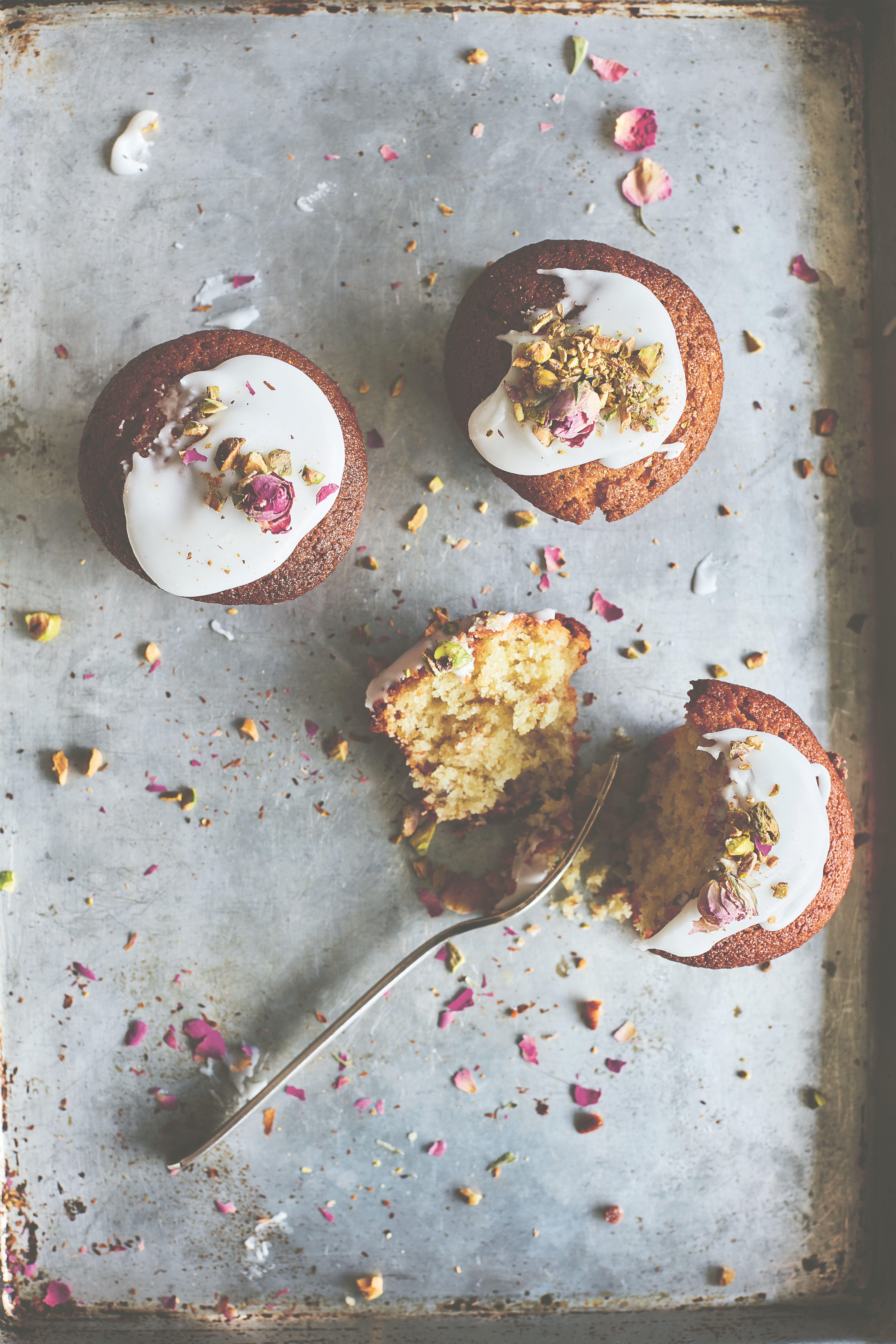
Rose and Pistachio Little Buns by Dee Rettali

Winner of the Andre Simon Food Book Award 2021. Click the image below to find out more.

Food Longlist (3)

Rose and Pistachio Little Buns by Dee Rettali

Rose and Pistachio (1)

At Fortitude, I top these rosewater-flavoured buns with organic dried rose buds from the Merzouga valley in Morocco. I have visited this region on many occasions, where you are always greeted by the heady floral smell of organic roses.

Makes 12 little buns

12-hole muffin tin or easy-release silicone mould, greased well with oil
170ml pomace oil (or light virgin olive oil)
200g unrefined golden caster sugar
4 eggs
125g fine semolina
50g pistachios, finely ground into a flour
200g ground almonds
1. teaspoons baking powder
25ml rosewater

To decorate
250g icing sugar
25g finely chopped pistachios
12 dried rose buds (optional)

In a large bowl, beat together the pomace oil and caster sugar with an electric whisk until light and fluffy.

Add the eggs one at a time and continue to mix until combined, but do not overmix.

In a separate bowl, combine the semolina, ground pistachios, ground almonds and baking powder.

Fold the semolina mixture into the whipped olive oil mix using a metal spoon. When it is almost combined, add the rosewater and gently fold through. Leave overnight in the fridge.

Preheat the oven to 200°C/Fan 180°C/Gas 6.

Fold any oil that is sitting on the surface back into the mixture to combine again. Making sure that the muffin tin or mould is greased well with oil, divide the mixture equally between the holes of the tin or mould, then place it on a baking tray. Bake in the centre of the hot oven for 22 minutes or until the buns feel set to the touch.

Transfer the buns from the tin or mould to a wire cooling rack and leave to cool completely.

To make the icing, mix the icing sugar with just enough warm water to make a thick paste. Spread the top of each bun with the icing using the back of a spoon and sprinkle over the pistachios. If preferred, place a dried rose bud in the middle of each bun.

When stored in an airtight container in the fridge,
these little buns will keep for 7 days.

To ferment

Once mixed, store the cake batter in an airtight container in the fridge for up to 3 days to allow it to ferment. Fold any oil sitting on the surface back into the mixture before baking.

Read the review 
Coming soon

Buy this book