Ramen: 80 Easy Noodle Bowls and Broths by Makiko Sano

 Ramen by Makiko SanoDear reader of cookbookreview.blog, I have a confession. I’m not that into ramen. I know this isn’t a universally shared opinion but I’ve never had a bowl of ramen that has inspired the awe it’s meant to. The kind that true devotees hunch over steaming bowls of broth like medieval alchemists and whisper in hushed reverence about the exact marination time for soy eggs. 

Not that Ramen: 80 Easy Noodle Bowls and Broths was designed to convince this particular chump of the virtues of a globally loved dish but Makiko Sano does present a compelling argument in a punchy, colourful and enlightening book. Although between her other cookbooks, a Japanese restaurant, sushi school and catering company I don’t think she was expecting to add “unwitting couples counsellor” between ramen and I to her overflowing CV.

The book opens with an unexpectedly fascinating history of ramen, one of innovation through necessity, clandestine noodle traders and a burst in popularity in the years after World War II. To co-opt a saying: when life gives you an abundance of wheat flour in postwar aid shipments and the worst rice harvest in decades, make ramen. Due to its inherent versatility and Momofuku Ando’s instant ramen noodles, we now have infinite versions of the noodley, soupy thing we’re all familiar with across the globe. 

As Sano details, traditional ramen follows four building blocks: a highly seasoned sauce, the tare, which forms a base layer upon which the second element, the broth, is poured over. The noodles follow and finally a variety of toppings layered on top. I am always appreciative of a cookbook that teaches not only what to cook but how to cook and in theory, you could go no further than here. Make the classic tares, broths and tinker with the recommended toppings list forevermore.

However life is for living and after these more traditional dishes follow a number of varied, sometimes weird, sometimes wonderful but always easy ramen recipes. It’s a fun book to flick through. Bright, well organised and recipes that are incredibly concise with a succinct historical context or introduction. Many of the basic Japanese ingredients won’t be hard to come by but a trip will be needed to an international supermarket or online stockist for ingredients like bonito flakes, nori and saké.

Despite being variations on the same theme, there’s admirable scope. The chapters are arranged by protein, vegetables and a final “Instant Ramen Plus” chapter, an anything goes section that feels like the last day of school, sticking twos up at the Head of Geography, breaking into food tech and concocting a ramen of tinned hotdogs and cheese.

While that last dish wasn’t for me, there are plenty that were. The Vegetable Garden Ramen, various vegetables floating atop a white broth made with soy milk and the Mushroom Miso Ramen were two of my favourites, both eaten when feeling a little under the weather and warming me from the ground up. Another highlight was the Chilli Miso Ramen and delicious as it was, it helps to have a pack of tissues nearby if you inadvertently double the amount of gochujang paste. The Tahini Ramen (made better with its Japanese cousin neri goma if you can get it) was rich and nutty and only slightly less morish than the Coconut Curry Ramen. 

Much of the complexity of flavour in ramen and the time taken making it comes from the broth. However much of the ease in this book relies on using a broth made from stock granules. The book does help you to make your own and I would encourage you to do so. It’s an easy kitchen task: plonk meat or vegetable gubbins in a pot of boiling water, leave for a bit, strain then freeze in smaller portions. Failing that, buy the best stock you can afford in gelatinous pots or pre-made pouches. Without it, the simpler recipes become more reminiscent of drinking Oxo with a few ingredients chucked in.

The scope of the book means it’s easy to find something to appreciate. Ramen newbies will have the most joy as Sano removes much of the complexity of the dish in an endearing and uncomplicated way. I’m yet to be converted to a ramen fanatic but I appreciate the endeavour. Perhaps by the time I’ve cooked all eighty, I’ll see the light.

Cuisine: Japanese
Suitable for: Beginners
Cookbook Review Rating: Four stars

Buy This Book: Ramen by Makiko Sano
£18.99, OH! Life

Review written by Nick Dodd, a Leeds-based pianist and writer.
Chicken Ramen

Chicken-Ramen

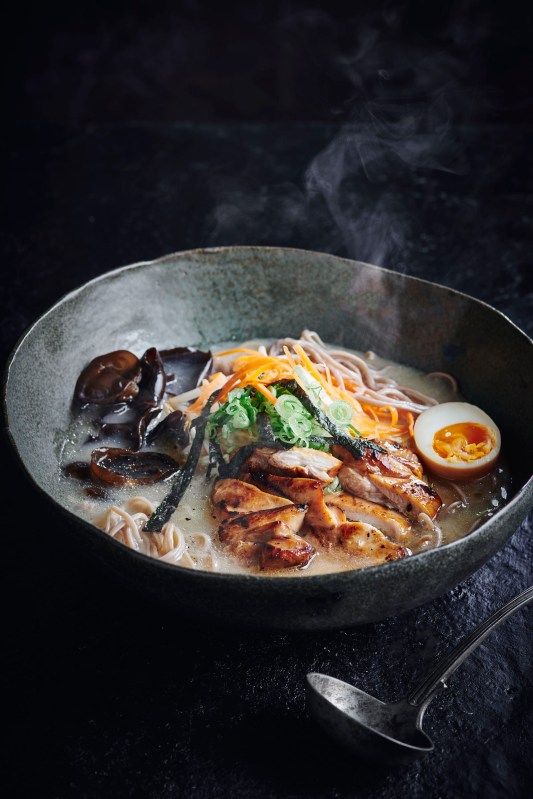
The base of this ramen comes from making a simple chicken stock – just simmer the bones of the chicken and some vegetables in water to garner the goodness. You can make the chicken stock up to four days ahead if you need to and keep it stored in the fridge. It freezes well, too, for up to three months.

Serves 4

FOR THE RAMEN
1 x quantity Chicken Chashu (recipe included in book), chilled
2 medium eggs
10g (¼oz) dried black fungus mushrooms
200g (7oz) dried buckwheat noodles (or see tip in book for soba noodles)
1–2 tbsp Mayu garlic oil, or to taste (or see tip in book)
200g (7oz/4 cups) beansprouts
125g (4½oz/1²/³ cups) iceberg
lettuce, shredded
1 carrot, shredded or coarsely grated

FOR THE CHICKEN STOCK
2 chicken carcasses
6 black peppercorns
1 medium carrot
1 garlic clove, smashed
½ leek
1 small onion, halved

Start by making the chicken stock. Put the chicken carcasses into a large pan. Add the peppercorns, carrot, garlic, leek and onion. Pour over 2 litres (3½ pints) cold water, then cover the pan with a lid. Bring to the boil and, as soon as the liquid is boiling, reduce the heat to the lowest setting and cook on a very low simmer for 1 hour. Strain into a clean pan – there should be around 1.4 litres (2½ pints) stock. Add a splash more water if it needs topping up.

When you’re ready to make the ramen, take the chicken chashu out of the fridge to come up to room temperature.

Next, cook the eggs. Carefully lower the eggs into a saucepan of boiling water, reduce the heat a little and simmer for 7 minutes. Lift into a bowl of iced water and leave for 4–5 minutes. Remove and peel off the shells. Set aside.

While the eggs are boiling, put the dried black fungus mushrooms in a bowl of hot water and set aside to rehydrate.

Cook the noodles in a pan of boiling water, according to the instructions on the pack. Drain in a colander and cool under cold running water.

Put the chicken on a board, discarding the string, and slice into finger-width strips.

Pour the stock into a large pan and stir in the garlic oil. Add the noodles and the beansprouts, reserving a handful to garnish.

Divide this evenly among four large soup bowls. Divide up the chicken, black mushrooms, reserved beansprouts, lettuce and carrot equally and put on top of each bowl. Finally, slice the eggs in half and put a half on each bowl, then serve.

Cook more from this book
Chicken Katsu Noodles
Veggie Crunch Rolls

Buy the book
Japanese Cooking for the Soul: Healthy. Mindful. Delicious.
£14.99, Ebury Press

Read the review 
Coming soon

japanese cooking for the soul_fc_100%

French Onion Ramen by Tim Anderson

05.13.19_VeganJapaneasy_D4_FrenchRamen_022 3

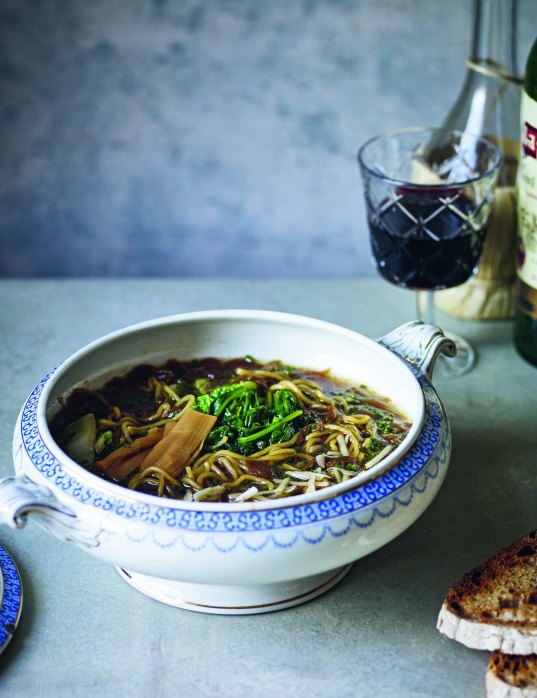
FRENCH ONION RAMEN
SERVES 4

I can never figure out why French onion soup ever went out of style. It’s just so good. I had some that my great aunt Jean made a few years back at a family get-together in Wisconsin and it made me think, ‘I should eat French onion soup every day!’
Suddenly fixated on French onion soup, my thoughts quickly turned to ramen. The molten onions mingle beautifully with the noodles so you get a lovely sweetness and silky texture in every bite, all bathed in a rich, beefy broth that just happens to contain no beef. The onions do take a while to caramelise properly, but for comfort food I think it’s worth the wait.

4 tablespoons olive oil
2 red onions, halved and thinly sliced
2 brown onions, halved and thinly sliced
pinch of salt, or more, to taste
1 teaspoon caster (superfine) or granulated (raw) sugar
2 garlic cloves, crushed and thinly sliced
4 tablespoons sake
2 tablespoons ruby port or red wine
1.2 litres (40 fl oz/4¾ cups) Mushroom or Triple Seaweed Dashi
2 bay leaves
4 sprigs of fresh thyme (optional)
a few grinds of black pepper, or more, to taste
4 tablespoons soy sauce, or more, to taste
1 tablespoon balsamic vinegar
1 tablespoon mirin, or more, to taste
1 tablespoon Marmite (yeast extract)
1½ teaspoons cornflour (cornstarch)
200 g (7 oz) fresh spinach, washed
¼ Savoy cabbage, cut into thin strips
4 portions of uncooked ramen noodles
4 spring onions (scallions), thinly sliced
80 g (3 oz) bamboo shoots (if you can, use Japanese menma – pickled bamboo shoots)
a few drops of sesame oil and/or truffle oil
60–80 g (2–3 oz) vegan cheese (‘Cheddar’ or ‘Italian-style’), grated (shredded)
4 slices of good-quality bread, toasted

Heat the oil in a deep saucepan or casserole (Dutch oven) and add the onions and the salt. Cook over a medium-high heat for 10 minutes or so, stirring frequently, until they soften, then reduce the heat to medium-low and cook for another 45–50 minutes, stirring every 10 minutes. After about 15 minutes, the onions will start to caramelise, so make sure you scrape the bottom of the pan when you stir to prevent them from catching and burning prematurely. When the onions are just starting to brown, stir in the sugar and add the garlic. During the last 10 minutes of cooking, you will have to stir and scrape often to ensure the onions don’t burn. (If it’s proving difficult to scrape up the stuck bits, add a splash of water, which should help them release nicely.)

Add the sake and the port or wine. Add the dashi, bay leaves, thyme and black pepper and bring to a simmer. Simmer for 30 minutes, then stir in the soy sauce, balsamic vinegar, mirin and Marmite. Taste and adjust the seasoning as you like it – it should be fairly salty and slightly sweet. Remove the bay leaves and thyme stems and discard. Spoon about 3 tablespoons of the broth into a small dish and leave to cool. Stir the cornflour into the cooled broth to make a thin slurry, then stir it back into the soup and bring to the boil to thicken the broth slightly.

Bring a large saucepan full of water to the boil and blanch the spinach for 15 seconds. Remove with a slotted spoon and rinse under cold water. Drain well, pressing out any excess water. In the same pan, boil the cabbage for 3–4 minutes until just tender, then remove with a slotted spoon and set aside. Let the water return to a rolling boil, then cook the ramen until al dente, according to the packet instructions. Drain well.

Divide the ramen among 4 deep bowls and ladle over the soup. Gently stir the noodles through the soup to ensure they aren’t sticking together. Top each ramen with the spinach, cabbage, spring onions, bamboo shoots, sesame or truffle oil and vegan cheese. Serve with the toast on the side to soak up the broth once the noodles have all been slurped away.

Buy this book
Vegan JapanEasy: Classic & modern vegan Japanese recipes to cook at home

Cook from this book
Japanese Mushroom Parcels with Garlic and Soy Sauce
Sweetcorn Curry Croquettes