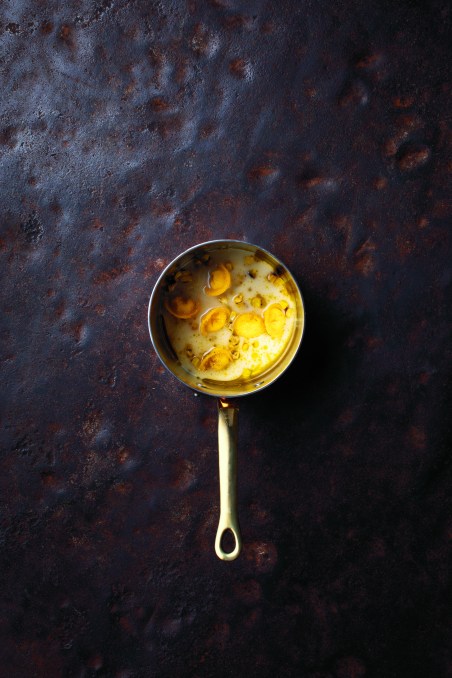
Goat cottage cheese ravioli by Ana Roš

053 ravioli

Ah, ravioli. Every time I want to get rid of them, people get upset. Diners seem to be addicted to my pasta. So, who cares about the trends!

Serves 6

For the dough

500 g semola rimacinata di grano duro
360 g egg yolks
1 egg
30 ml olive oil

For the filling

500 g goat cottage cheese
500 ml cream

For the garnish

nasturtium flowers nasturtium leaves

For the hazelnut and prosciutto broth

1 carrot
1 roasted onion
1 stick celery
350 g prosciutto
500 ml hazelnut oil
100 g brown butter

For the corn

300 g corn

For the fried polenta

100 g polenta

For the praline

200 g 50 ml 15g peeled hazelnuts
hazelnut oil
salt

Work the dough ingredients together with your hands until the dough is slightly hot. Cover it with clingfilm (plastic wrap) and let it sit in the refrigerator for 1 hour.

Place the filling ingredients in a Thermomix and blend into an emulsion, heating up to 70oC (160oF). Cool it down and let it sit in the refrigerator before making the ravioli.

For the broth, cook the vegetables, prosciutto and 2.5 l water in a pressure cooker for 2 hours. Strain. Emulsify with hazelnut oil and brown butter.

Boil the corn for 30 minutes. Drain and roast it in a cast iron pan until golden and smoky. Allow to cool.

Roast the polenta flour in a dry iron pan until brown. Let cool on baking paper.

Roast the hazelnuts in the oven at 175oC (345oF) for 10 minutes without adding any fat, just shaking the tray from time to time. Blend with hazelnut oil and salt until smooth.

When you are ready to serve, first cook the ravioli. Pan fry them with hazelnut praline, some cooking water and prosciutto broth. Add the corn. Top with roasted polenta flour. Serve over the prosciutto hazelnut broth.

Cook more from this book
Summer Pear
Bread

Read the review

Buy this book
Ana Ros: Sun and Rain (Food Cook)
£39.95, Phaidon

Turkey Meatballs in Tomato Sauce by Jessie and Lennie Ware

045_Turkey_Meatballs

These are light as a feather and seem to invite a confession, like when my dear friend the singer/songwriter Sam Smith explained they thought Mexico was in Spain while we fed these beauties to them.

50g fresh white breadcrumbs
75ml whole milk
500g minced turkey thighs
2 garlic cloves, crushed or finely grated
finely grated zest of 1 lemon
1 egg, beaten
40g pecorino or Parmesan cheese, finely grated, plus extra to serve
2 tsp finely chopped fresh oregano, or 1 tsp dried oregano
about ¼ nutmeg, freshly grated
1 tsp fine salt
freshly ground black pepper

TOMATO SAUCE
2 tbsp olive oil
1 small onion, finely diced
2 garlic cloves, crushed
1 heaped tbsp tomato purée
1 tsp paprika (mild or hot)
2 × 400g tins chopped tomatoes
1 large handful of basil leaves
½–1 tsp caster sugar (optional)
salt and pepper

Serves 4–6

First, make the tomato sauce. Heat the oil in a large sauté pan or shallow casserole over a medium heat. Add the onion and a good pinch of salt and gently fry for 5–10 minutes until softened. Add the garlic and fry for 2 minutes, then stir in the tomato purée and paprika and cook for another 2 minutes.

Tip in the tomatoes and chopped basil, then gently simmer for 20 minutes. Taste to check the seasoning, adding salt, pepper and a little sugar to balance the acidity of the tomatoes if needed.

Meanwhile, make the meatballs. Place the breadcrumbs in a large mixing bowl and pour over the milk. Add the turkey, garlic, lemon zest, egg, cheese, oregano, nutmeg, salt and a good grinding of black pepper. Using your hands, gently combine, taking care not to overmix. With wet hands, gently shape the mixture into about 20 small–medium meatballs (about the size of golf balls – roughly 40g each and 5cm in diameter).

Gently drop the meatballs into the simmering sauce, cover with a lid and simmer for 20 minutes, turning them after about 10 minutes and giving the pan a shake from time to time.

Remove the lid and simmer for another 5 minutes. Serve the meatballs with the basil leaves and a grating of pecorino or Parmesan.

Cook more from this book
‘Triple Threat’ Chocolate Brownies
Chicken soup

Read the Review

Buy this book
Table Manners: The Cookbook
£22, Ebury Press

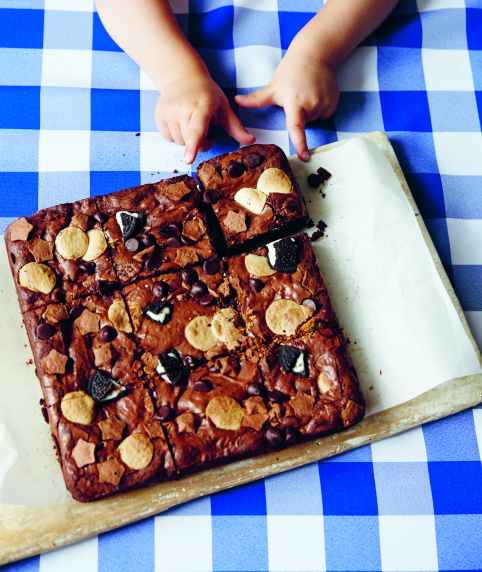
‘Triple Threat’ Chocolate Brownies by Jessie and Lennie Ware

271_Brownie_1 cropped

People have requested this recipe the most after hearing about it in the Ed Sheeran episode. A triple shot of chocolatey goodness, my doctor brother Alex says that it’s more like a ‘triple threat’ to your cholesterol levels, but don’t let that stop you from making them.

Get creative! Add whatever you like to your brownie batter. Generous chunks of white, milk or dark chocolate will all work well, as will roughly broken-up Oreos or any other chocolate confectionery. I generally add three things to mine, hence the triple threat. Experiment. Ultimately, whatever you choose will be delicious. 7

These brownies are best if slightly undercooked, so they still retain their gooeyness. What you want is a brownie that gets stuck to your teeth when eating it.

Makes 9–18 (depending on levels of greediness)

200g unsalted butter, cubed
200g dark chocolate, chopped
3 large eggs
275g caster sugar
90g plain flour
50g cocoa powder
250–300g ingredients of your choice to add to the mix (white, dark or milk chocolate, chocolate biscuits, your favourite chocolate bar), chopped

Preheat the oven to 190°C/170°C fan/gas 5. Line a 23cm square baking tin with baking parchment. Put the butter and chocolate into a heatproof bowl over a pan of barely simmering water and leave until they start to melt. Stir regularly, taking care not to burn the chocolate. Once completely melted, remove from the heat and leave to cool a little.

In a large bowl, using an electric whisk on high power, beat the eggs and sugar together until pale and almost doubled in volume. Add the cooled chocolate and butter mix and gently combine, using a figure-of-eight motion to fold the 2 mixtures into one another.

Sift the flour and cocoa powder together and then fold into the chocolate and egg mixture. Again, fold gently using a figure-of-eight motion until all is combined. It will appear dusty at first, but be patient and it will come together. Take care not to overdo the mixing: as soon as you cannot see any dusty flour mix, you are there.

Now add your extra ingredients and gently fold in, reserving a few to scatter over the top if you like. Transfer the mixture to the lined baking tin, levelling it out and pressing any reserved ingredients into the top of the mixture. Bake for around 35 minutes. The top should be just firm, but the middle should be slightly undercooked and gooey: it will continue to cook in the tin once removed from the oven. Leave the tin on a wire rack to cool before cutting into squares.

Cook more from this book
Chicken Soup
Turkey Meatballs in Tomato Sauce

Read the Review

Buy this book
Table Manners: The Cookbook
£22, Ebury Press

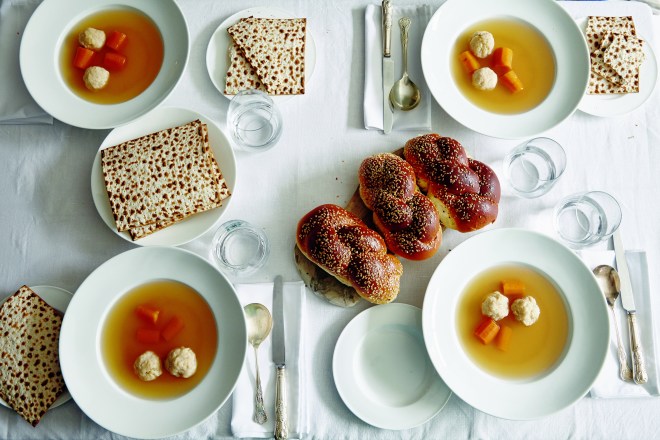
Chicken Soup by Jessie and Lennie Ware

135_Chicken_Soup_Matzo_Balls

Every Jewish family thinks their mother’s chicken soup is the best. In emergencies, I have been known to send my soup across London in a taxi, because this ‘Jewish penicillin’ most definitely has healing qualities. Reminiscent of Friday nights spent with family when I was a girl, the fragrance of the simmering soup is delicious. Chicken soup is synonymous with every Jewish household, and is one of the things that makes me most proud to be Jewish.

Serve with matzo crackers and challah bread.

Serves 6 (makes about 2 litres)

2kg chicken thighs and legs
5 large onions, skins left on, halved, cutting off the rooty bit
8 carrots, sliced about 2–3cm thick
4 celery sticks, with leaves, halved
1 leek, halved
½ swede
2 tbsp Telma Chicken Soup Mix (available from a kosher shop or online), or 2 good quality chicken stock cubes
1 tsp whole black peppercorns
1 tsp salt
Matzo Balls (see below), to serve

Put the chicken and all the vegetables in a stockpot or very large pan (about 4 litres capacity) with enough cold water to cover everything by about 5cm (about 3 litres) and bring to the boil. When boiling, skim off all the frothy scum until there is none left. Add the soup mix or stock cubes, the peppercorns and salt, bring back to the boil and then reduce the heat and gently simmer for 2–3 hours. Season the soup to taste, then leave to cool.

Pour the soup through a colander into a large bowl. Carefully retrieve the carrots from the colander and add back to the soup. Give everything else a good squeeze to release the juices. Some people put a little of the chicken into the soup, but I’m not sure it has much taste after being boiled for so long – and you will make your cat/dog very happy if you give them the bone-free chicken meat.

Put the clear soup and carrots into the fridge for at least 2 hours or overnight. When it’s well chilled the fat will rise to the top and you can easily skim it off. To serve, bring the soup to the boil over a medium heat and add your cooked matzo balls just before serving.

Tip The soup may not be completely clear (and it doesn’t really matter), but if you want to make it as clear as a consommé then you can either put it all through a tea strainer (as I did when Jay Rayner was our guest) or you can use one or two egg shells from the matzo balls and put them in the soup as you bring it back to the boil – fish out the egg shells before you put the matzo balls in.

Matzo Balls

In the words of Marilyn Monroe: ‘Isn’t there any other part of the matzo you can eat?’ It has taken me ages to achieve light fluffy matzo balls, but I think after 40-odd years of making them I have finally managed it. Of course, you can cheat and use the ready-made packets, which are sometimes sold under the name ‘kneidl’. Matzo balls are very divisive: some prefer them fluffy like clouds, some prefer them dense like bullets. Some have them in the soup, others save them till after. But if you start by saying ‘I’ll only have one’ you will always submit to the second. Delicious and crucial to Chicken Soup.

Makes about 15 balls

100g medium matzo meal
1 tsp baking powder
pinch of salt
pinch of white pepper
3 large eggs, beaten
1 tbsp rapeseed oil
4 tbsp hot Chicken Soup or boiling water

Put all the dry ingredients in a bowl, gradually stir in the eggs and oil and then gradually add the chicken soup, mixing until smooth. Cover the bowl and chill for 30 minutes – it will firm up slightly.

Line a tray with baking parchment. Bring a large pan of salted water to the boil.

Wet your fingers and take small pieces of the mixture to make soft balls, about 2cm in diameter, placing them on the lined tray until you have used up all the mixture.

Drop the balls into the boiling water, turn down the heat and gently simmer for about 20–25 minutes until they are soft. They should swell up slightly, rise to the surface and look like little clouds. Lift out using a slotted spoon and serve them in chicken soup.

Cook more from this book
Turkey meatballs in Tomato Sauce
‘Triple threat’ chocolate brownies

Read the Review

Buy this book
Table Manners: The Cookbook
£22, Ebury Press

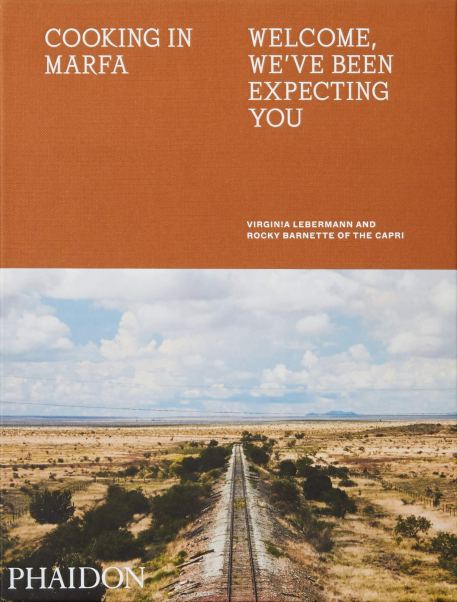
Cooking in Marfa by Virginia Lebermann and Rocky Barnette

Cooking in Marfa

Set in the Chihuahuan Desert, the Texan town of Marfa boasts a population of two thousand and occupies just over one and half square miles. Despite being 200 miles from the nearest commercial airport, its premier restaurant, the Capri has been featured in Vogue, the New York Times and Conde Nast Traveller magazine, which included the converted army airfield hangar in a list of the 34 most beautiful restaurants in the world.

Marfa was first put on the map by its thriving arts scene and Capri co-owner Virginia Lebermann initially intended it to be a cultural arts project, launching in 2007 with a gig by Sonic Youth. However, the arrival in Marfa of Inn at Little Washington-trained chef Rocky Barnette in 2008 led to the Capri’s rebirth as a restaurant focusing on the region’s distinctive natural larder.

Barnette’s cooking is the ultimate expression of contemporary Tex-Mex (a style that Lebermann says was created in Marfa in 1887 when Tula Borunda Gutierrez opened a restaurant using Mexican ingredients and ‘added to them to suit the taste of ranchers’) incorporating ingredients grown or cultivated in the local region including cacti, mesquite beans and dessert flowers as well as Mexican produce such as dried grasshoppers (chapulines) from Oaxaca and huitlacoche, a black fungus that grows on corn.

Although many of the 80 recipes in the book reflect the site-specific nature of the Capri’s menu, it doesn’t mean they are unachievable for UK-based cooks. You may have trouble finding fresh yucca blossoms to tempura, but online resources such as coolchile.co.uk means you should find nearly everything you need for dishes such as masa pasta ravioli with cured egg yolks and bottarga or tostados al carbon, made with activated charcoal and served with razor clams and chorizo.

The story of the Capri and the people behind it (who are as extraordinary as the restaurant itself) makes for fascinating and inspiring reading. In his introduction, three Michelin starred chef Daniel Humm of New York’s Eleven Madison Park calls the book, ‘a window into [Rocky and Virginia’s] creativity and passion’; it’s one that every curious cook will want to look through.

This review first appeared in The Caterer magazine

Cuisine: Mexican
Suitable for: Confident home cooks/Professional chefs
Cookbook Review Rating: Four Stars

Buy the book
Cooking in Marfa: Welcome, We’ve Been Expecting You (FOOD COOK)
Phaidon, £35

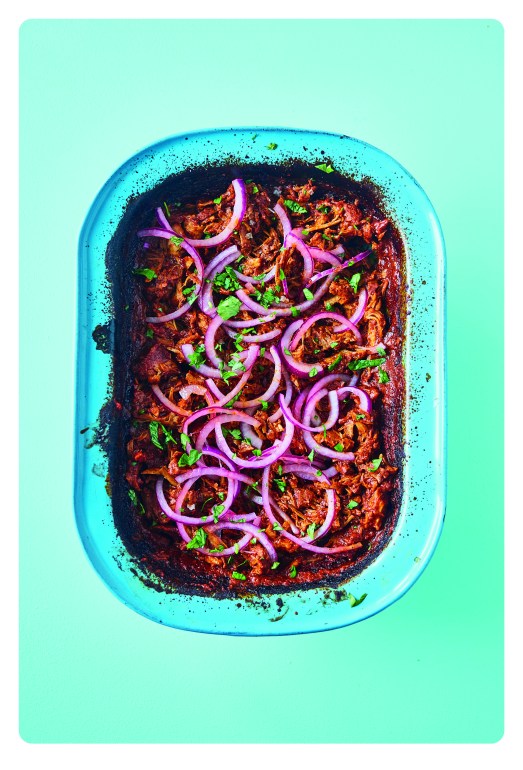
Slow-cooked pork pibil with pink pickled onions by Rukmini Iyer

Pork Pibil

SLOW-COOKED PORK PIBIL WITH PINK PICKLED ONIONS

You may have had pork pibil at your favourite Mexican restaurant: it’s a classic Yucatán dish of pork, slow-cooked in achiote, a paste made from annatto seeds, from which the dish gets its lovely colour. Achiote paste is easily available online, and once you have it, this dish will be a staple in your repertoire – it’s so easy to put together.

Serves: 4
Prep: 10 minutes
Cook: 3 hours

1 onion, roughly chopped
6 cloves of garlic, roughly chopped
1 teaspoon ground cumin
1 tablespoon dried oregano (Mexican if you have it)
8 cloves
250ml orange juice (ideally freshly squeezed)
2 limes, juice only
50g achiote paste
2 teaspoons sea salt
800g free-range pork shoulder, diced

PICKLED ONIONS
1⁄2 red onion, very thinly sliced
1 lime, juice only

TO SERVE
Chopped fresh coriander
Tortillas and sour cream

Preheat the oven to 140°C fan/160°C/gas 2.
Tip the onion, garlic, cumin, oregano, cloves, citrus juice, achiote paste and salt into a blender or food processor and blitz until smooth.
In a small deep roasting tin or lidded casserole dish, mix the pork shoulder with the spice paste. Cover tightly with foil or the lid, then transfer to the oven and cook for 3 hours.
Meanwhile, mix the very thinly sliced red onion with the lime juice and set aside for 3 hours, stirring occasionally. (The acid in the lime juice will turn the onions a beautiful bright pink by the time the pork is ready.)
Once cooked, remove the foil or lid and shred the pork while hot. Serve with the pink pickled onions, chopped coriander, warm tortillas and sour cream.
Note: This dish isn’t at all spicy, so it’s a good one for kids, and can be easily made ahead, frozen and defrosted in portions.

Extracted from: The Roasting Tin Around the World Global One Dish Dinners by Rukmini Iyer (Square Peg) 14th May, £16.99 HBK Photography by David Loftus. Follow Rukmini on instagram @missminifer

Cook more from this book
Peach & Dulce De Leche Cake With Meringues and Cream
Slow Roasted Peppers With Chilli, Lemon and Garlic Beans

Read the review

Buy this book
The Roasting Tin Around the World: Global One Dish Dinners
£16.99, Square Peg

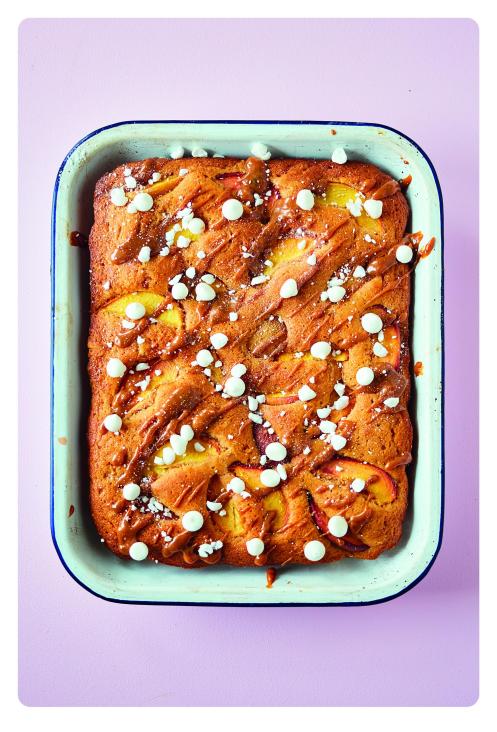
Peach and Dulce De Leche Cake with Meringues & Cream by Rukmini Iyer

Dulche-de-Leche-Cake

In Uruguay, the original version of this cake is known as chajá – layers of light, fluffy sponge soaked in peach syrup, whipped cream, dulce de leche, peach slices and crumbled meringue. My version incorporates the dulce de leche and fresh peaches into an olive oil cake – serve it warm out of the oven, with crème fraiche or lightly whipped cream alongside.

Serves: 8
Prep: 15 minutes
Cook: 25 minutes

225g olive oil
225g dulce de leche (you can use tinned Nestlé caramel, sold next to the condensed milk)
50g caster sugar
4 free-range eggs
225g self-raising flour
1 teaspoon baking powder
3 under- to just-ripe peaches, thinly sliced
TO SERVE
175g dulce de leche (this is the remaining caramel in the tin)
A handful of crushed shop-bought meringues
Crème fraîche or lightly whipped cream

Preheat the oven to 160°C fan/180°C/gas 4.
In a food processor or by hand, mix the olive oil and dulce de leche together with the sugar until well combined, then beat in the eggs, one at a time. Fold in the flour and baking powder, then pour into a 26cm by 20cm roasting tin or cake dish.
Arrange the sliced peaches over the batter, then transfer to the oven and bake for 25 minutes, until golden brown and a skewer inserted into the middle comes out clean.
Let the cake cool in the tin for 10 minutes.
Melt the remaining dulce de leche in a pan until smooth and pourable, then drizzle this over the warm cake. Scatter with a handful of crushed meringues, then serve with crème fraîche or lightly whipped cream alongside.
Notes: As this cake contains fresh fruit, if you are not eating it on the day you make it, store it in the fridge. I like to warm it up slice by slice in the microwave – 30 seconds on high.

Extracted from: The Roasting Tin Around the World Global One Dish Dinners by Rukmini Iyer (Square Peg) 14th May, £16.99 HBK Photography by David Loftus. Follow Rukmini on instagram @missminifer

Cook more from this book
Slow-Cooked Pork Pibil with Pink Pickled Onions
Slow Roasted Peppers With Chilli, Lemon and Garlic Beans

Read the review

Buy this book
The Roasting Tin Around the World: Global One Dish Dinners
£16.99, Square Peg

The Roasting Tin Around The World by Rukmini Iyer

Roasting Tin

What’s the USP? Globally-inspired dishes that can be put together within the happy confines of a roasting pan – ideal for the sort of person who would rather spend their Sunday afternoon planning their next holiday (whenever that might turn out to be) than up to their elbows in dirty dishes.

There have been a lot of these roasting tin books recently, haven’t there? Absolutely – and most of them have been by Rukmini Iyer. This is the fourth in her Roasting Tin series, which has had annual installments since debuting in 2017, selling over half a million copies in the process.

As well as Iyer’s books, the lure of the one-pan dinner has inspired several other cookbooks over the past few years, from Sue Quinn’s excellent Roasting Tray Magic to a forthcoming National Trust title. Even the Hairy Bikers have been drawn in, with last year’s One Pot Wonders.

So what makes this one stand out from the pack? Roasting Tin Around the World is a decidedly international take on the genre – though it’s fair to say the dishes are generally inspired by specific cuisines, rather than an authentic attempt to recreate the local dishes. Brazil, for instance, is represented by black beans and rice (spot on) with added avocado and radish, neither of which are common plate-fellows in the country. Not to start a riot, but the baked paella recipe absolutely features chorizo.

Iyer is pretty open about the dishes being her take on what is often little more than a loose idea of each nation’s favourite dishes. Like a supermarket ready meal, or Heinz’s frequent attempts to cash in on Britain’s burgeoning taste for international flavours, dishes are listed as ‘Cuban-style’ rather than ‘Cuban’. These dishes have been designed for accessibility, and Iyer seems to have that in mind on every page.

Will I have trouble finding the ingredients? Not at all – the major benefit of the book’s loose approach to each cuisine. The international flavours of each dish are generally summoned by the vegetables and protein rather than niche local ingredients. In fact, across the entire book there are, by my count, only half a dozen ingredients that you’d struggle to find in a big Asda. Given the range of nations and flavours on offer here, that’s something of an achievement.

What’s the faff factor? Unsurprisingly, it’s all tremendously easy. Iyer’s writing is unpretentious (ingredients lists might call for ‘pointy peppers’), and the joy of a roasting tin dish is, of course, the sheer ease of chucking everything in one place and watching it come together.

Will it make good bedtime reading? This is the one big failing of the book – besides a relatively unexciting introduction, there’s not much to sit down and read here. Recipe intros are short and practical – though bonus points for the repeated championing of Niki Segnit’s incredible Flavour Thesaurus.

Should I buy it? This all depends on what you’re looking for from your cookbooks. This is a fantastically practical entry point to international cooking – if you’re looking to expand your cooking repertoire on a weekday night, and have potentially fussy family members to worry about, this is the book for you.

If, however, you’ve already got a few international cookbooks on the shelf, some of these recipes might feel like a step backwards. Though the roasting tin angle does afford some functionality to the recipes, the truth is a basic understanding of cooking combined with any of the specialised ingredients you’ve picked up for other cookbooks, and you’ll like be able to knock up something equally delicious and potentially a little more authentic.

Cuisine: International
Suitable for: Beginners
Cookbook Review Rating: Three stars

Buy this book
The Roasting Tin Around the World: Global One Dish Dinners
£16.99, Square Peg

Review written by Stephen Rötzsch Thomas a Brighton-based writer. Follow him on Twitter and Instagram at @srotzschthomas.

Cook from this book

Slow Roasted Peppers With Chilli, Lemon and Garlic Beans by Rukmini Iyer
Slow-cooked pork pibil with pink pickled onions by Rukmini Iyer
Peach and Dulce De Leche Cake with Meringues & Cream by Rukmini Iyer

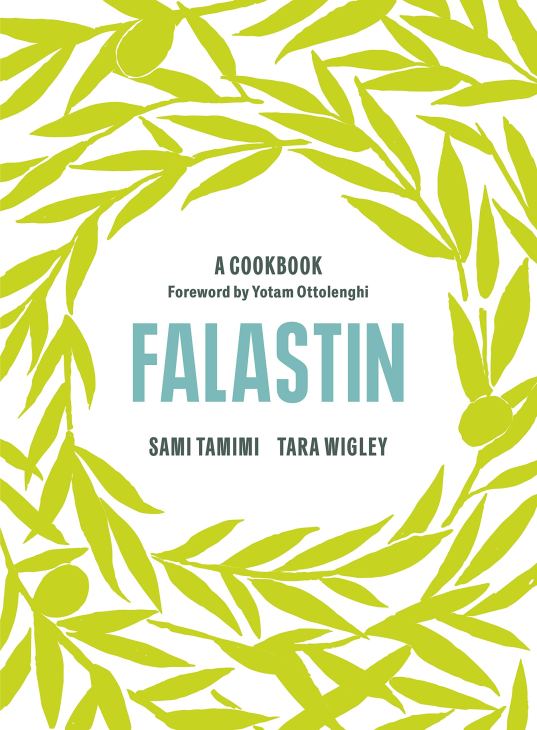
Falastin by Sami Tamimi and Tara Wigley

Falastin

What’s the USP? I can’t do better than quote the introduction: ‘This is a book about Palestine – its food, its produce, its history, its future, its people and their voices’. There are also recipes, more than 100 of them.

Who are the authors? You’ll know Sami Tamimi and Tara Wigley from such books as Jerusalem and Ottolenghi: the Cookbook. Tamimi co-founded the Ottolenghi restaurant empire. Wigely worked in publishing before joining the Ottenleghi test kitchen a decade ago.

Is it good bedtime reading? In addition to the short foreword by Ottolenghi and seven-page introduction, there are page-long introductions to each of the nine chapters that cover everything from breakfast to sweets as well as articles covering subjects including ‘The yoghurt making ladies of Bethlehem’, ‘Vivien Sansour and the Palestinian Seed Library’ and ‘The Walled Off Hotel, the seperation wall, and the Balfour balls up’.   

Will I have trouble finding the ingredients? As has been noted before on this site, thanks in part to Ottolenghi, ingredients such as za’atar, Aleppo pepper, date syrup, rose harissa, sumac and labneh now seem quite commonplace, at least to the enthusiastic home cook. If you do have trouble tracking them down in your local shop, you can source them online from ottolenghi.co.uk.

What’s the faff factor? This is not restaurant cooking but on the other hand, these are not quick’n’easy one pot wonders either. You’ll be chopping, finely slicing, picking leaves, chargrilling, roasting, whipping, braising, frying, baking, blitzing, caramelising and making dumplings, dressings, and dips; soups, salsas, and sauces. Nothing however is excessively complex or beyond the abilities of your average keen cook.

Must cook recipes: spiced chicken arayes (pan fried pitta bread sandwiches); chilled cucumber and tahini soup with spicy pumpkin seeds; spiced salmon skewers with parsley oil; upside-down spiced rice with lamb and broad beans; sumac onion and herb oil buns; knafeh nabulseyeh (a sweet mozzarella, ricotta and feta kataifi pastry dessert drenched in orange blossom water syrup.

What will I love? Tamimi and Wigley have already proved beyond doubt that they are a class act and Falastin does nothing to alter that. The recipes are uniformly enticing and well written, the articles are informative and fascinating, the book is beautifully designed and the location and food photography by Jenny Zarins is gorgeous. As is usual with the Ottolenghi family of books, there’s a code to access a fully illustrated and searchable database of all the recipes online (you can even print off a shopping list for each recipe) which is a very useful and fun bonus.

What won’t I love? I can’t believe you’re even asking this question, go to the back of the class.

Should I buy it? If you’re already a fan of Tamimi and Wigley (and Ottolenghi of course) there is just no way you won’t want to add this terrific book to your collection. If you are just getting into Middle Eastern cooking then is a great place to start.

Cuisine: Palestinian/Middle Eastern
Suitable for: Confident home cooks
Cookbook Review Rating: Five Stars

Buy the book
Falastin: A Cookbook
Ebury Press, £27

Cook from this book
Sweet tahini rolls (Kubez el tahineh)
Chicken musakhan
Labneh cheesecake with roasted apricots, honey and cardamom

Giffords Circus Cookbook by by Nell Gifford and Ols Halas

Giffords Circus

What’s the USP? Some people go to the circus for the clowns, some for the acrobats and their feats of derring-do. But if you’re headed to the traditional touring circus of Giffords, which performs across the Cotswolds and the South West of England each year, then you might well be going for the food.

For the last 17 years, Giffords has also been host to the UK’s only travelling restaurant. After each show, 60 audience members gather for a 3-course banquet that seems to carry all the wonder of the circus over into each dish. Here, then, is the Giffords cookbook; now you can create your own whimsical feast without having to worry about your children’s coulrophobia (that’s a fear of clowns, as if you couldn’t guess).

Sounds magical! Who’s the author? The circus’ founding matriarch, Nell Gifford has teamed up with the restaurant’s head chef, Ols Halas. Both get ample time to share their stories at the beginning of the book and, as you might expect, they’re pretty fun (it’s not often a chef’s background involves literally running way to join the circus).

Is it good bedtime reading? The reading is probably where Giffords Circus Cookbook is at its best. There’s an absolute tentful of writing here, from Marco Pierre White’s fawning foreword to the chapter introductions that offer insight both into the challenges of cooking in a travelling restaurant and of the inner-workings and community of a modern circus.

Will I have trouble finding the ingredients? Nothing here is particularly unusual, though the recipes do tend to fall on the more luxurious end of the scale. You’ll want a good butcher at hand, and some of the ingredients (romanesco broccoli, activated charcoal and fresh truffles) are a little more Waitrose than Asda. It would be nice to see a cookbook knock up this sort of wonder and magic in their dishes using more down-to-earth ingredients, but I suppose that’s not the point, is it?

What’s the faff factor? Look, Willy Wonka didn’t build his chocolate factory in a day. It took bloody ages and required the slave labour of Loompaland’s indiginous people. So consider yourself lucky when your own slice of whimsy only needs a two-day brine beforehand, or perhaps necessitates the creation of a meringue (there’s a lot of meringue in here – apparently this is a staple of the circus diet).

What will I love? There’s an irrepressible joyfulness that runs throughout the entirety of the Giffords Circus Cookbook. Everything is bright, and everyone always seems to be having so much fun. It’s an infectious sort of a feeling, and reading the book makes you feel every bit a part of the mish-mash vaguely-Moominesque family of oddballs and misfits.

What won’t I love? The recipes aren’t organised in any sense that could be considered even remotely helpful. Instead, the eight chapters loosely tell the story of a season with the circus and might feature anywhere between one and nineteen recipes. Desserts are mixed in, and as such the panna cotta might be found next to the monkfish tails, the black forest trifle opposite roast guinea fowl. If you know what you’re looking for, you can dive right into the index – but for inspiration, it’s not particularly practical. But then, what part of ‘60-seat restaurant serving the clientele of a travelling circus’ suggested practicality to you?

Should I buy it? If you entertain regularly and want to inject a little bit of magic into your dinner parties, this cookbook is not to be missed. There isn’t much here for the casual, everyday cook – except escapism. And that’s always worth a look.

Review written by Stephen Rötzsch Thomas a Brighton-based writer. Follow him on Twitter and Instagram at @srotzschthomas.

Cuisine: British
Suitable for: Confident home cooks
Cookbook Review Rating: Three stars

Buy this book
Giffords Circus Cookbook: Recipes and stories from a magical circus restaurant
£27, Quadrille