Roasted New Potato and Green Bean Salad with Mint recipe by Ceri Jones

No summer BBQ is complete without a potato salad, and this is my go-to. I know, I know, waxy new potatoes are meant to be served boiled, but I don’t love the papery skins so prefer to roast until the skins are crispy yet the insides remain soft. I sometimes use thinly sliced shallots instead of spring onions, swap the mint for watercress or the green beans for asparagus.

SERVES 2 AS A SIDE | TIME TO PREPARE – 40 MINUTES

400g/14oz baby or new potatoes, scrubbed clean and left whole if small enough or chopped into bite-sized pieces
1 tbsp olive oil
150g/5½oz green beans, end trimmed and cut in half or into 3 x 2.5cm/1 inch pieces
2 spring onions, very thinly sliced on an angle
zest of 1 lemon
large handful of mint leaves (approx. 5g/1/8oz )
salt and pepper

FOR THE DRESSING
½ tsp wholegrain mustard
½ tsp honey
juice of half a lemon (approx. 1 tbsp)
3 tbsp olive oil

Preheat the oven to 200°C fan/220°C/450°F/gas mark 7. On a baking tray, toss the potatoes with 1 tablespoon of olive oil and season with salt. Roast for 20 minutes. Reduce to 180°C fan/200°C/400°F/gas mark 6 and cook for another 15 minutes, until crispy on the outside and cooked through on the inside. Remove from the oven and cool off for a short time, around 5 minutes. Meanwhile, make the dressing. In a small bowl stir together the mustard, honey, and lemon juice until combined. Whisk in the oil until emulsified.

Season with salt and pepper to taste. Set aside for the flavours to mingle.

Bring a small saucepan of salted water to the boil, then blanch the beans for 2–3 minutes, until just al dente. Drain and rinse immediately under cold water until cold to the touch. Shake off any excess water then leave to dry on kitchen paper. To put the salad together, toss the cooked potatoes in a medium-sized bowl with the beans, chopped spring onions, and enough dressing to just coat. Season with lemon zest, then tear your mint leaves and add to the bowl (they will go black more quickly if sliced). Transfer to a serving platter or bowl to serve.

Buy this book: It Starts with Veg: 100 Seasonal Suppers and Sides
£20.00, Pavilion Books

Read the review

It Starts with Veg by Ceri Jones – Cookbook Review

Who is Ceri Jones?
Ceri Jones trained as a Natural Chef in Berkeley, California before embarking on a career cooking food for yoga and well-being retreats around the world. She currently works part-time as a Food Educator at the Garden Museum in London, where she pioneered one of the first museum food learning programmes in the country. She is also a freelance writer and content creator and regularly shares seasonal recipes and cooking tips with her followers on social media. It Starts with Veg is her first cookbook.

What is It Starts with Veg’s USP?
Looking for ways to include more vegetables in your diet? It Starts with Veg promises 100 easy and delicious seasonal recipes for every occasion. Focusing on 40 vegetables, from potato to celeriac, Jones takes us through the best ways to prepare them and the tastiest flavour pairings. Vegetables are the stars of the show, but recipes also include seasonal fruits, herbs, whole grains, beans and pulses, as well as a little meat, dairy, fish and seafood, all designed to help you enjoy eating more veg.

What will I love?
If you want to include more veg in your diet, this is a good place to start, with chapters based around vegetable families including brassicas, fungi, pods and leaves. There’s plenty of advice on substituting vegetables which means you can be flexible with what you have already to hand and you won’t necessarily need to buy more ingredients or adjust recipes to suit your tastes, ideal if there are certain veg you really cannot stand.

It’s refreshing to see a flexitarian book that celebrates seasonality and plant-based produce, while including meat and fish. As Jones explains in her introduction, she views them as the ‘seasoning’ to add flavour although vegetarian alternatives are given, where possible. It feels more approachable, in contrast to some fully vegetarian and vegan books that can come across as a bit ‘preachy’.

Most of the recipes are for two people, which is perfect for couples or those living on their own who don’t want to be left with lots of leftovers. However, they are all easy to scale up if cooking for family and friends. The UK-US conversion chart and UK-US culinary terms list are both very useful, as is the ‘further reading’ list of resources. It feels like a great deal of thought and care has gone into making  It Starts with Veg as inspiring and comprehensive as possible. It is more of a ‘vegetable bible’ than a cookbook. 

Is it good bedtime reading?
This is a book to be read as much as it is to be cooked from. Jones is generous with her wisdom and the book is brimming with highly readable advice on how to cook more sustainably; from seasonal eating and minimising food waste to how to reduce food costs. Each chapter and recipe has an introduction and there is also a list of ‘cooking terms’ which is helpful for less confident cooks.

Will I have trouble finding the ingredients?
You shouldn’t do if you are cooking in season, although there is plenty of advice on how to substitute if you struggle to source a particular veg. Jones includes ingredients like ‘Nduja and pul biber to pack in plenty of flavour, but these are widely available nowadays.

How easy are the recipes to follow?
Very. Each recipe includes the number of servings and the time it should take (and yes, the latter is accurate for a fairly competent home cook as opposed to a Michelin-starred chef with everything good-to-go), followed by a clearly set out list of ingredients and well-explained recipe. 

Stand-out recipes?
The ‘Leftover Roasties, Herb and Gruyère Frittata’ will become a Monday staple for those of you who enjoy a Sunday roast, while the ‘Leek, Roasted Pepper and Cheese Toasties’ are delicious for a quick lunch. The ‘Purple Sprouting Broccoli Puff Pastry Tarts with Ricotta and Olive Tapenade’ is a great base recipe to adjust throughout the seasons with different veg, while the ‘Griddled Leeks and Spring Onions with ‘Nduja Butter Sauce’ simply must be served with cous cous or warm bread to mop up every last morsel of the flavour-packed sauce.

How often will I cook from this book?
There is every chance that this book could be cooked from regularly. The recipes are affordable, and accessible and include a wide variety of flavours to suit all tastes. There are options for a myriad of occasions, from simple summer lunches (‘Roasted Radishes with Whipped Feta on Toast’) to comforting winter warmers (‘Cavolo Nero, ‘Nduja and Butter Bean Stew’), not to mention a host of starters and sides which can be easily be transformed into mains.

Any negatives?
There aren’t any photos which may disappoint those who like to see what a dish will look like before deciding whether to make it. However, some lovely illustrations complement the tone of the book.

Should I buy the book?
If you are a fan of vegetables or looking to include more plant foods in your diet, yes. This book will revolutionise your approach to veg and leave you feeling excited and inspired.

Cuisine: Flexitarian 
Suitable for: Cooks of all abilities who want to broaden their veg-centred recipe repertoire. 
Great for fans of: Joe Woodhouse and Anna Jones
Cookbook review rating: 4 stars
Buy this book: It Starts with Veg: 100 Seasonal Suppers and Sides
£20.00, Pavilion Books

Cook the Book
Roasted New Potato and Green Bean Salad

This review was written by Freelance Food Writer and Recipe Developer Sophie Knox Richmond. Follow her on Instagram on @sophie_kr_food

Root Vegetable Tart Tatin by Michel Roux Jr

9781399610650_interior applicationmichel roux at home text finalTart_Tatin_9298

Tarte tatin de legumes
Here we have a great French classic made into a vegetarian treat. I’ve suggested a selection of vegetables, but you can vary them according to the season and spice them up with more chilli if you like a bit of heat. Delicious as a main meal or as an accompaniment, this can be made in individual portions as well as a large tart. It’s fine to use shop-bought puff pastry – I do!

Serves four

3 small heads of red chicory
3 small heads of yellow chicory
200g slender carrots,
halved lengthways
300g kohlrabi, cut into batons
100g cauliflower florets or
sprouting broccoli, halved
1 large onion, cut into wedges
2 tbsp olive oil
2 tbsp butter
2 tbsp caster sugar
1 red chilli, deseeded
and sliced
leaves from 1 thyme sprig
350g puff pastry
Flour, for dusting
Salt and black pepper

Preheat the oven to 220°C/Fan 200°C/Gas 7. Cut the heads of chicory in half (or if they are large, into quarters) and put them in a bowl with the other vegetables. Add the oil and toss,
then season with salt and black pepper. Spread the vegetables over a baking tray and roast them in the oven for 8–10 minutes. The vegetables should be partly cooked and have a little colour.

Melt the butter in a large (28cm) ovenproof frying pan, then sprinkle over the sugar. Place the cooked vegetables, sliced chilli and thyme on top, making sure to pack the vegetables tightly.

Roll out the pastry on a floured work surface to 3mm thick. Place the pastry over the vegetables, tucking it in around the edges. Make a few holes in the pastry with the point of a knife, then bake for 20 minutes. Leave to cool a little, then place a plate over the pan and carefully turn the pan over to invert the tart on to the plate. Serve warm.

Cook more from this book
Prawn French toast with walnut & coriander pesto by Michel Roux Jr
Souffled Crepes by Michel Roux Jr

Read the review
Coming Soon

Buy this book: Michel Roux at Home 
£26, Seven Dials

Vegetarian round up: The Part-Time Vegetarian’s Year and Italy: The World Vegetarian

What’s the USP? Two USPs, actually! Having explored meat-free options from India and Japan with their initial installments earlier this year, Bloomsbury’s ‘World Vegetarian’ series takes its first step into Europe with Christine Smallwood’s volume on the food of Italy. Meanwhile, Nicola Graimes follows up 2015’s The Part-Time Vegetarian with a seasonal take on her flexitarian cooking. Are they good bedtime reading? Once the recipes are out of the way, there’s not a lot of extra-curricular writing in Smallwood’s book on Italy. Like many cookbooks that form part of a larger series, this is a fairly utilitarian affair. This isn’t a book for reading over cosy winter evenings, but rather a practical volume you can take down from the shelf when you need dinner on the table in forty minutes. The Part-Time Vegetarian’s Year has a lot more to offer on this front – the division of a cookbook by seasonal availability has been something of a trend in the last couple of years, and lends itself brilliantly to vegetarian cooking (as Nigel Slater demonstrated with his brilliant Greenfeast books). So here we have practical advice about how best to utilise your freezer, how to minimise your food waste and, of course, handy lists of which vegetables are in season when. Will I have trouble finding the ingredients? One of the most underrated elements of vegetarian cooking, I think, is that recipes are usually incredibly easy to source. Dishes rely on the flavours of the vegetables and the method of cooking to extract as much flavour as possible out, and as such rarely call upon more hard-to-source ingredients. Smallwood’s book, drawing as it does from a cuisine that has been so warmly taken in and appropriated by Britons, features nothing but instantly recognisable ingredients that can be found most anywhere you care to shop. Graimes might send you out into the world for hoisin sauce or silken tofu, but you’re not going to consider that much of a challenge, are you? How often will I cook from the books? Both titles are filled with interesting and vibrant dishes – though Italy: The World Vegetarian probably has the upper hand on this front. Smallwood’s dishes are ready made for weeknight cooking, and you could easily find yourself picking out a simple but effective recipe from this book once or twice a week. Graimes’ Part-Time Vegetarian’s Year asks a little more from the reader – both in terms of culinary skills and commitment of time to the dishes. The results are equally as tempting, though, so will likely find their way onto your dinner table a couple of times a month without any trouble. What will I love and what won’t I love? For all of The World Vegetarian’s positives, the book is just a bit, well, drab. It’s hard to really put your personality into a pre-existing format – and in terms of Smallwood’s involvement this is much more ‘Gary Barlow takes over X-Factor’ than ‘Taika Waititi shakes up the Marvel Cinematic Universe’. We’re spoiled for vegetarian cookbooks at the moment, and sheer practicality isn’t necessarily enough of a selling point to really make a mark. This is something The Part-Time Vegetarian’s Year understands – it’s significantly more vibrant, and the reader gets a much stronger sense of Nicola Graimes’ voice and personality. It’s also, dare I say it, more fun. The flexitarian options allow for the entire thing to feel more interactive, more of a loose guide than the overt instruction manual vibes of Smallwood’s book. Killer recipes: Italy: The World Vegetarian’s highlights include Sciatt with Cicoria, Spicy Farro Soup and Assassin’s Spaghetti. The Part-Time Vegetarian’s Year travels a little further afield to offer Sesame Empanada Pie, Mushroom Noodle Larb and Spiced Leek Flatbreads with Mint Aioli. Should I buy it? Both will find a place on any vegetarian’s shelf. Smallwood’s entry to the World Vegetarian series is perhaps better suited for cooks seeking to expand on their own repertoire of dishes – though it’s probably the more useful of the two offerings, it lacks the pizazz we tend to seek in the books we give to others. The Part-Time Vegetarian’s Year, however, has exactly that. It’s accessible and fun – and the flexitarian element means it will be equally loved by both vegetarians and those looking to cut their meat-consumption down in the future. Cuisine: Italian/Global Suitable for: Beginners/Beginners and confident home cooks Cookbook Review Rating: Three stars/Three stars Review written by Stephen Rötzsch Thomas a Brighton-based writer. Follow him on Twitter and Instagram at @srotzschthomas. Buy the books The Part-Time Vegetarian’s Year: Four Seasons of Flexitarian Recipes £25, Nourish Books  Italy: The World Vegetarian £20, Bloomsbury Absolute

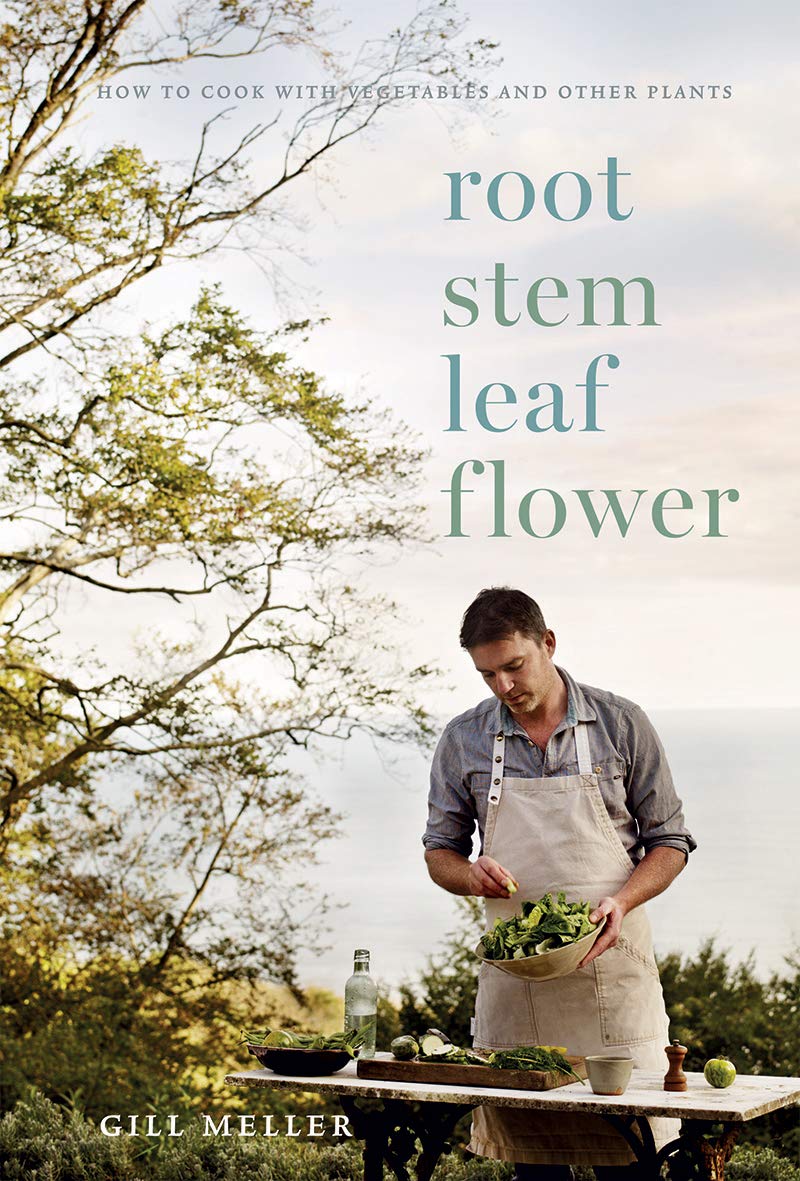
root, stem, leaf, flower by Gill Meller

root stem leaf flower

What’s the USP? Go wild (go wild!) go wild in the country, where nettles in a bush are absolutely free. It’s time to eschew meat and fish for all that lovely fruit and veg that you know will do you good. And here’s Gill Mellor with dirt on his hands and love in his heart to show you ‘how to cook with vegetables and other plants’.

Who is the author? You’ll know Gill Mellor from such books as Outdoor Cooking: River Cottage Handbook No.17 and Time by Gill Meller previously reviewed on this site and awarded a whopping 4 stars (I must have been feeling generous that day. I’m kidding. Or am I?). As I mentioned in that review, Meller is an alumni of Hugh Fearnley Whittingstall’s River Cottage organization and is a chef, food writer and teacher. His first book Gather won the Fortnum and Mason award for Best Debut Food Book in 2017.

Is it good bedtime reading? There’s a fairly chunky introduction to the book and the recipe introductions are interesting and informative, but this is a cookbook for the kitchen rather than one for the bedside table. If you actually enjoy what there is to read will depend on your tolerance for Food Writing with a captial F and capital W; the stuff that usually results from an English degree and a lifetime reading Elizabeth David, Richard Olney and Nigel Slater. It’s the sort of adjective-heavy prose where radishes have a ‘tussle of coarse green leaves on top’ and you find ‘lucent green’ gooseberries among a ‘burr and wrangle of thorns’.

It will also depend on your tolerance for being told how to shop and cook. There is nothing particularly radical in Meller’s suggestion to eat organic, local and seasonal, or in his assertion that ‘we need to be eating less meat and fish’ and that what we do eat should come from ‘ethical and sustainable sources’ and from ‘animals that have led natural, happy lives’. But it’s easy for him as a professional food writer to say that and less easy for those working full time with a family to feed and limited time and financial resources to live up to those lofty ideals. Meller places all the onus on the individual to do the right thing and makes no suggestion that changes should be made at the food supply chain level in order to make produce that meets his stringent criteria easily available and affordable to all. Instead, there is the implication that you are falling short as a human being if you don’t buy organic, sustainable, ethically produced goods. And frankly, fuck that.

Will I have trouble finding the ingredients? If you are going to adhere to the Meller mantra of organic, sustainable, ethically produced stuff, then you will be narrowing the field substantially. However, most of the actual ingredients are not that obscure and you should be able to track them down without too much effort, especially if you are willing to eat ordinary people’s food. You’ll die sooner and be killing the planet with every single bite, but at least you’re not a serial killer with someone chained up in your cellar. Are you? I mean, if you are, I don’t approve obviously, but it’s interesting, isn’t it? I know lots of people are bored with serial killers but I think there’s an enduring fascination. Drop me a line, there’s a contact widget somewhere on this site, tell me about your sickness.

What’s the faff factor? Have we stopped talking about serial killers already? Oh well. WHAT’S THE FAFF FACTOR? IS THAT WHAT YOU WANT TO KNOW? IS THAT REALLY WHAT’S BOTHERING YOU RIGHT AT THIS PRESENT MOMENT IN TIME? Sorry, I don’t know why I’m shouting. I haven’t had my meds today and lockdown is really starting to get to me. Faff factor, yes, good point. You should know about that before you buy a book. You work hard for your money, you don’t want to waste it on something you’re never going to use. It’s a reasonable question. I don’t know why I’m making such a big deal about it. I mean, I write the bloody questions myself, it’s not as though someone is dictating to me what I need to tell you. So, faff factor. Faaaaaaaaf faaaaaactor. Try saying that out loud. It’s funny. Like the Shadrack scene in Billy Liar.You know the bit. Actually, you’re probably too young. Or from a country where they never showed the film on the telly. You should stream it. Anyway, where were we? Oh yes, faffing about. No, the recipes are fine really, they’re mostly short and straightforward. You can judge for yourself; I’ve posted a couple of recipes for you to try (the publisher only allowed two instead of the usual three for some reason. Gill’s special. So special.) The links are at the bottom of the page because this is such a well-designed site.

How annoyingly vague are the recipes? You will find the odd ‘small pinch of sea salt’ which is fine, and a ‘small handful’ of this and that which is OK if you’ve got small hands or know someone who has that could come to your house and grab a handful of herbs for you, although exactly how small their hands need to be isn’t really clear. Just be sensible about it. Perhaps ask a child. No, don’t do that. Unless you’re related to them, then it’s OK.

More annoying is ‘the juice of half a lemon’. Why do recipes rarely give ml measures for lemon juice? I mean, it’s a liquid just like any other isn’t it? And the amount you put in a recipe will affect the final result. I don’t know if you’ve bought a lemon recently, but the amount of juice that you get out of them varies massively from a meager teaspoon to a flood. They are as unpredictable as, erm, something that it’s politically correct to describe as unpredictable. I’m not sure what that might be. Me. I’m unpredictable. The amount of juice you get out of a lemon is as unpredictable as the mood I’ll be in when I wake up on any given day. And that’s pretty unpredictable. Imagine the mood I’m in now, writing this. You don’t want to know.

How often will I cook from the book? How often do you imagine you might fancy ‘tomatoes in the hole’ instead of toad? That’s the question you need to ask yourself. Ultimately, the amount you use this book will depend on precisely how middle class you are. That’s just the truth. Take this stupid quiz and find out. When you discover that the stupid quiz appeared in the Mirror and you decide you don’t want to take it because you don’t want anything to do with that disgusting rag, congratulations, you are middle class and you will cook from this book a lot. If you do decide to take the quiz, it doesn’t matter what your score is, you have read something in the Mirror and are by default not middle class and the book will collect dust languorously on your shelf. Power to the people.

Killer recipes: Do we have to do this? OK (sighs) they include: sweetcorn, rosemary and smoked cheddar soufflé; squash, lentil, tomato and rosemary pie; salted chocolate pumpkin tart; asparagus and quinoa salad with peas and broad beans.

What will I love? The photography by Andrew Montgomery is up to his usual very high standards and there’s a good amount of variety in the recipes, given the relatively narrow subject matter. That was sensible wasn’t it?

What won’t I like so much? Meller’s editors have failed to dissuade him from writing poems. I love poetry. I read lots of it, from Renaissance to 21st Century (give Reckless Paper Birds by John McCullough a go) and I even write some myself. I’m just not convinced a cookbook is the right platform for it. Or maybe I just don’t like Meller’s poems. Sorry Gill.

Should I buy it? This book isn’t really for me, but that doesn’t mean it’s not for you. There’s nothing really wrong with it, so if you need some inspiration in the fruit and veg department and you feel the stylistic issues I’ve outlined above won’t be problematic for you, then go ahead. Oh, I forgot to mention the recipe titles. Unnecessarily overwritten, arch and twee constructions like ‘A tart for May’ and ‘Aubergines and roast tomatoes for everything’ are like fingernails down a blackboard to me (the same goes for the book’s title and the lack of capitals). But most of them aren’t like that, they’re just normal so it’s not the end of the world. Don’t let it put you off. I know it probably wouldn’t but I’m just saying. It’s honestly more about my odd sensitivities to certain tropes of Food Writing, which I think far too much about, than anything else. I shouldn’t have said anything. It’s fine, really.

(Have you had enough of this yet? I could go on all day like this. Once I get on a roll it’s difficult to stop me. What shall we talk about next? No, maybe you’re right, let’s leave it there. Till next time then.)

Cuisine: English
Suitable for: Confident home cooks
Cookbook Review Rating: Three stars

Buy this book
Root, Stem, Leaf, Flower: How to Cook with Vegetables and Other Plants
£27, Quadrille Publishing Ltd.

Cook from this book
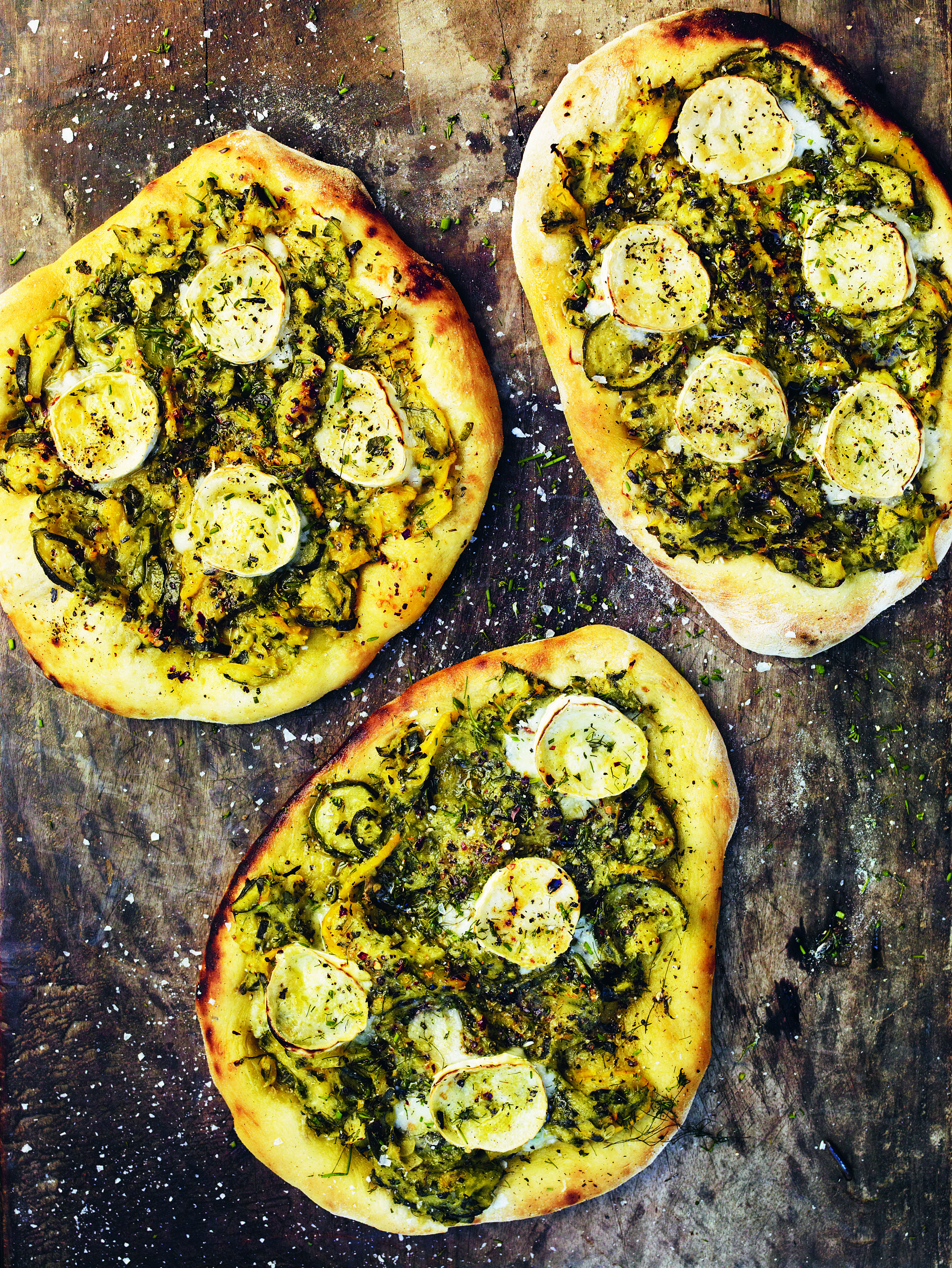
Courgette flatbreads with lots of herbs and goat’s cheese
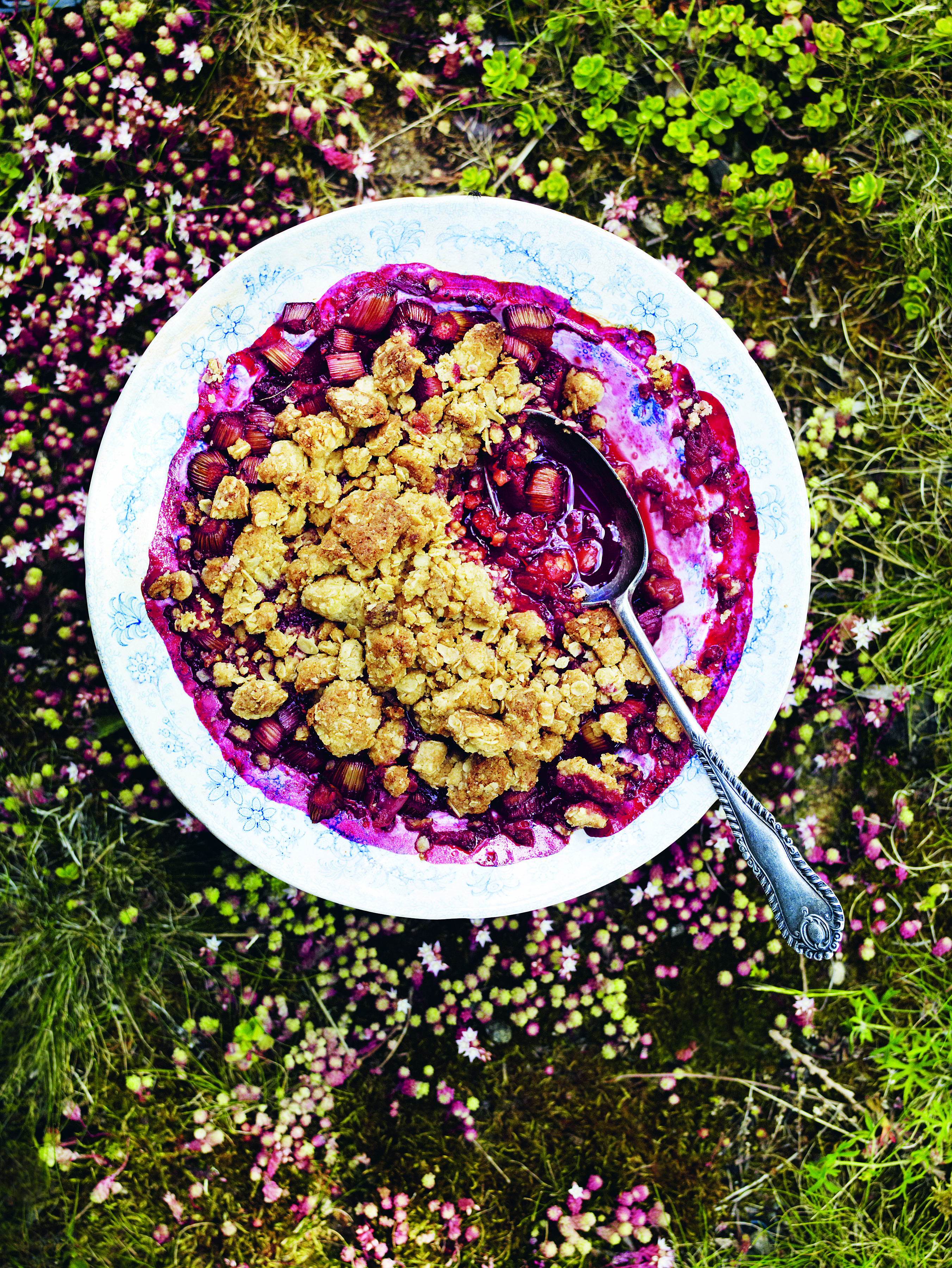
Raspberry and rhubarb crumble

Courgette flatbreads with lots of herbs and goat’s cheese by Gill Meller

Courgette flatbreads Gill Meller

Cooking courgettes slowly with garlic and olive oil has to be one of my favourite ways to deal with this summer vegetable. Fistfuls of herbs go in at the end, then you could simply pile the courgettes on to warm bruschetta, but these flatbreads are infinitely better.

MAKES 3

FOR THE FLATBREADS
500G (1LB 2OZ) STRONG WHITE BREAD FLOUR,PLUS EXTRA FOR DUSTING
1 TSP FINE SEA SALT
1 TSP FAST-ACTION DRIED YEAST
2 TSP CRUSHED FENNEL SEEDS
FINELY GRATED ZEST OF 1 LEMON
2 TBSP EXTRA-VIRGIN OLIVE OIL, PLUS EXTRA FOR GREASING
4 TBSP NATURAL YOGHURT

FOR THE TOPPING
4 TBSP EXTRA-VIRGIN OLIVE OIL
2 GARLIC CLOVES, THINLY SLICED
1.2KG (2LB 10OZ)COURGETTES, SLICED INTO 5MM (¼IN) ROUNDS
1 SMALL HANDFUL OF DILL, CHOPPED
1 SMALL HANDFUL OF MINT,LEAVES PICKED AND THINLY RIBBONED
1 SMALL HANDFUL OF BASIL, CHOPPED
1 SMALL HANDFUL OF CHIVES, CHOPPED
150G (5½OZ) SOFT GOAT’S CHEESE
PINCH OF CHILLI FLAKES (OPTIONAL)
SEA SALT AND FRESHLY GROUND BLACK PEPPER

Make the flatbreads. Place the flour, salt, yeast, fennel seeds and lemon est in a large bowl. Add the oil, yoghurt and 275ml (9½fl oz) of water and mix everything thoroughly until it forms a dough. Turn out onto a lightly floured surface and knead for about 10 minutes, until soft and smooth. (You can use a stand mixer with a dough hook for this part.) Shape the dough into a rough round and place in a lightly oiled bowl; cover with a clean cloth and leave to rise in a warm place for up to 24 hours.

When you’re ready to make the flatbreads, start the topping. Place a large, heavy-based pan over a medium heat. Add half the olive oil and when it’s hot add the garlic and sizzle for a few seconds, then add the courgettes. Season with salt and pepper. Cook the courgettes slowly over a gentle heat,stirring regularly, for about 25 minutes or so, until they break down but still retain a little of their shape. They should be soft without colouring too much and almost spoonable in texture.

Take the pan off the heat, stir all but a handful of the herbs into the courgettes, then season again to taste with plenty of salt and pepper. Place 3 baking sheets in the oven (alternatively, bake one at a time if you have limited oven space) and heat the oven to 240°C/220°C fan/475°F/ gas mark 8.

Turn out the dough onto a lightly floured surface, then cut it into 3 equal pieces. Form each piece into a nice neat round and leave to rest for 20 minutes or so. When you’re ready to bake the flatbreads, roll out the pieces of dough. They want to be quite thin, but don’t worry if they’re not especially round, that doesn’t matter.

Take the hot baking sheets out of the oven and place a rolled-out dough on each. Spread the courgette mixture evenly over the top of each. Dot the goat’s cheese over the top of the courgette mixture and trickle all over with some of the remaining olive oil. Add the chilli flakes, if using, and a sprinkling of salt and pepper, too.

Place the trays in the oven for 12–14 minutes, or until the dough is puffed up and golden around the edges. Remove from the oven and slide onto a board. Sprinkle with a few reserved herbs and serve.

Cook more from this book
Raspberry and rhubarb crumble by Gill Meller

Buy this book
Root, Stem, Leaf, Flower: How to Cook with Vegetables and Other Plants
£27, Quadrille Publishing Ltd.

Read the review

Raspberry and rhubarb crumble by Gill Meller

Raspberry and rhubarb crumble Gill Meller

When you sit down to a bowl of warm raspberry and rhubarb crumble, it’s easy to forget that the apple ever existed at all. In fact, you forget anything that begins with A, or anything green. For in that moment, your world literally crumbles away, leaving you with reds and gentle, sugary pinks and the magic that happens when these two ingredients are cooked together. I like to pack my crumble topping full of oats and bake it separately from the fruit, at least for a while. It becomes remarkably crunchy this way.

SERVES 4

FOR THE OAT CRUMBLE
100G (3½OZ) PLAIN FLOUR
PINCH OF FINE SEA SALT
100G (3½OZ) UNSALTED BUTTER, CUBED AND CHILLED
75G (2½OZ) UNREFINED CASTER SUGAR
75G (2½OZ) JUMBO OATS

FOR THE FILLING
ABOUT 400G (14OZ)RHUBARB STALKS, TRIMMED AND CUT INTO 2–3CM (¾–1¼IN) PIECES
ABOUT 200G (7OZ)RASPBERRIES
100G (3½OZ) UNREFINED CASTER SUGAR
1 TSP VANILLA EXTRACT

First, make the oat crumble. Heat the oven to 175°C/155°C fan/335°F/gas mark 3–4. Combine all the ingredients in a large bowl and rub them thoroughly together until you have formed clumps and lumps. Line a large baking tray with a piece of baking parchment. Tip out the mixture onto the tray and distribute evenly. Set aside.

Make the filling. Place the rhubarb in a 25cm (10in) baking dish. Add the raspberries, sugar and vanilla along with a couple of tablespoons of water and tumble everything together. Place the dish of fruit in the oven as well as the tray of crumble and bake for 20 minutes, turning the crumble mixture over three or four times during baking, until clumped together, biscuity and golden. Spoon the crumble mixture onto the fruit and continue to cook for a further 10 minutes, or until the rhubarb and raspberries are soft, the juices are bubbling away and the crumble is
golden brown.

Cook more from this book

Buy this book
Root, Stem, Leaf, Flower: How to Cook with Vegetables and Other Plants
£27, Quadrille Publishing Ltd.

Read the review

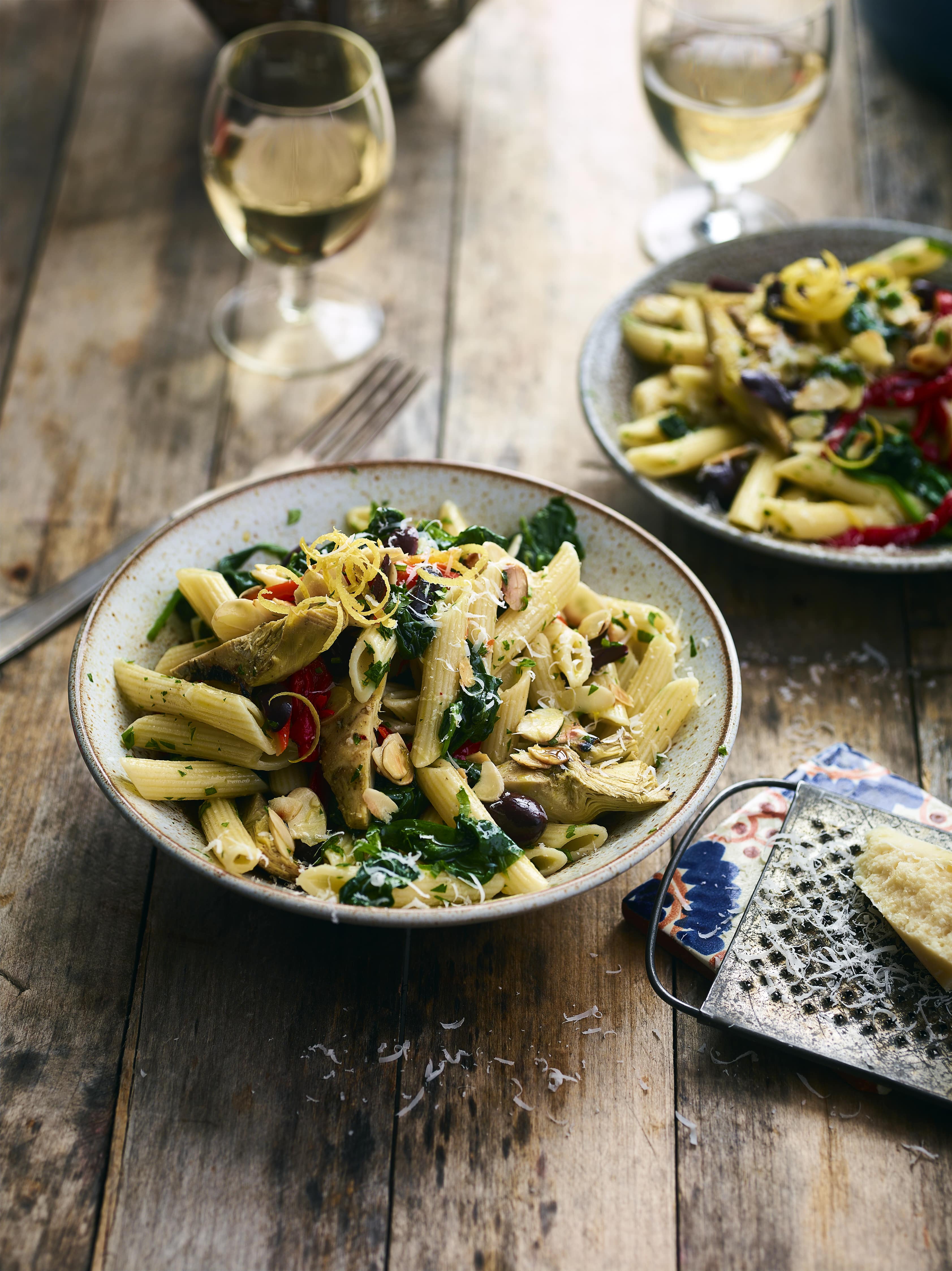
Penne with artichokes, peppers, spinach and almonds by Ainsley Harriot

088_ainsley_Artichoke_pasta

This pasta dish has a Spanish twist with chargrilled artichokes and roasted red peppers combined with toasted almonds. It’s a delightfully simple and tasty recipe using storecupboard ingredients and great for a mid-week supper. Use the best quality jarred artichokes you can find – the chargrilled ones in oil really do add extra flavour to the dish. If you aren’t following a vegan diet, top with some grated vegetarian hard cheese.

SERVES 4
400g dried penne pasta or other short pasta of choice
1 x 175g jar chargrilled artichoke hearts in olive oil
2 garlic cloves, finely chopped
1 medium–hot red chilli, finely chopped
3 roasted red peppers from a jar, sliced
50g Spanish or Kalamata olives, pitted and halved
35g chopped almonds, lightly toasted
extra-virgin olive oil, for drizzling
100g baby spinach leaves
2 tbsp chopped fresh flat-leaf parsley, plus extra to garnish
zest from 1 lemon
sea salt and freshly ground black pepper
a handful of flaked almonds, lightly toasted, to garnish (optional)

Bring a large saucepan of salted water to a rolling boil, add the penne, stir once, then cook until al dente, according to the packet instructions.

Meanwhile, strain the olive oil from the jar of artichokes into a large frying pan, then cut the artichoke hearts into quarters and set aside. Set the frying pan over a medium heat. When the oil is hot, add the garlic and chilli and cook for 30 seconds until fragrant. Add the artichoke hearts to the pan along with the red pepper strips and olives, season with salt and pepper and stir to combine. Cook for 2–3 minutes to warm through, then stir through the almonds and a good drizzle of extra-virgin olive oil. Cook for 1 minute, then add the spinach to the pan, a handful at a time, and allow to just wilt down.

Drain the pasta, reserving a little of the cooking water. Add the pasta to the vegetables along with 2 tablespoons of the reserved cooking water, stirring to combine. Add the parsley and lemon zest and check for seasoning.

To serve, share the pasta among warmed pasta bowls, drizzle with a little extra olive oil, if needed, and scatter with the parsley and toasted flaked almonds, if using.

Cook more from this book
Lentil and haloumi bake
Mediterranean sea bass with potato bake

Buy the book
Ainsley’s Mediterranean Cookbook
£20, Ebury Press

Read the review

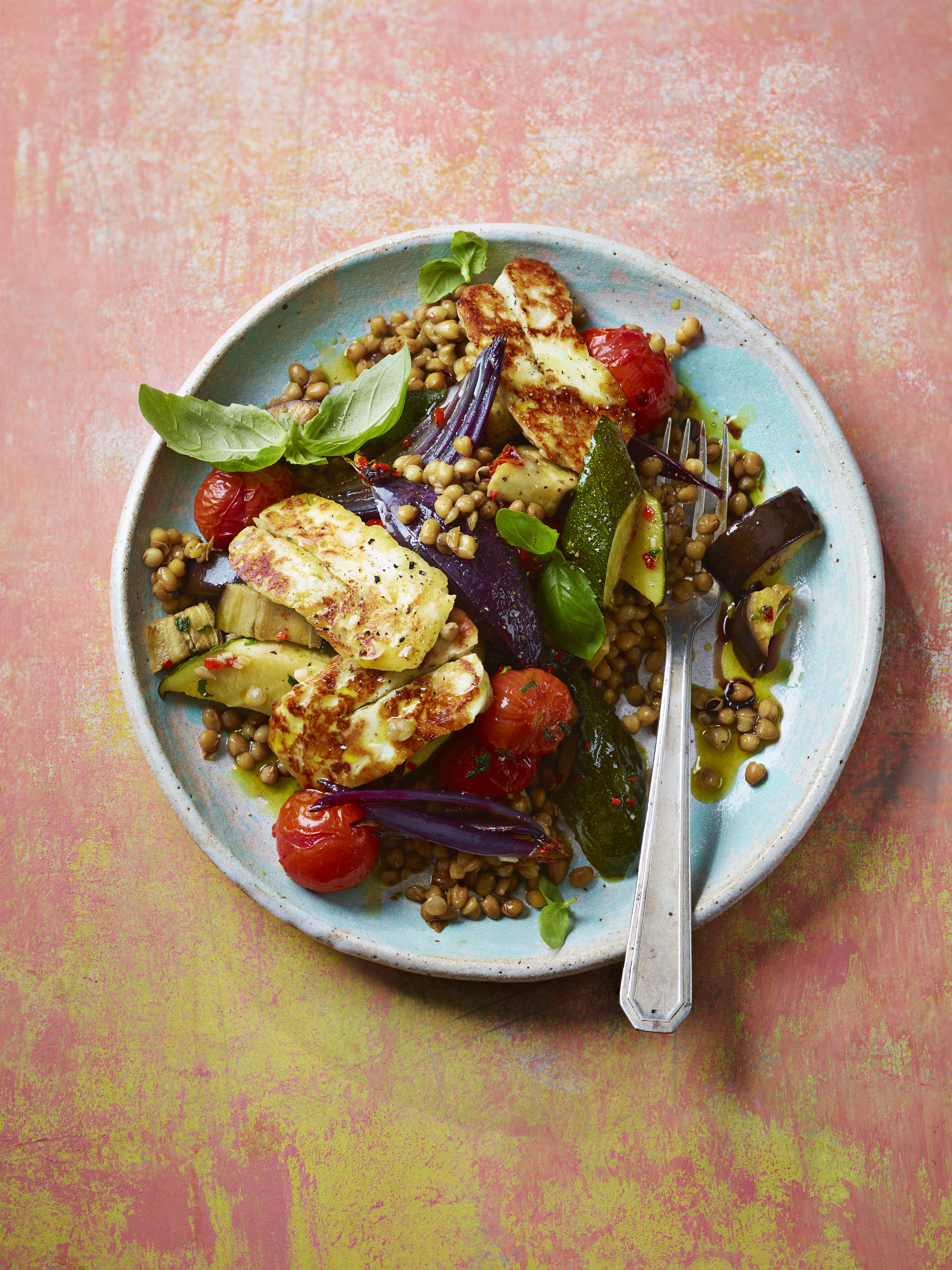
Lentil and haloumi bake by Ainsely Harriot

067_ainsley_Lentil_Halloumi_Bake

While I was in Corsica, I tried many delicious vegetarian dishes that were simply prepared yet full of flavour from fresh herbs and garlic. Marjoram is a versatile and aromatic herb that works beautifully with vegetables; it’s similar in taste to oregano but with a milder sweeter flavour. This dish is easy to prepare for a mid-week dinner – just toss it all together in the one dish! For a creamy topping, serve with a little Greek yoghurt or hummus. This is great on its own or with my Quick Flatbreads.

SERVES 4

2 courgettes, cut into 2-cm slices
1 red onion, cut into 8 thin wedges
1 medium aubergine, cut into small cubes
2 red peppers, de-seeded and cut into chunks
1 red chilli, de-seeded and finely chopped
2 large garlic cloves, chopped
2 tbsp extra-virgin olive oil, plus extra for drizzling
2 tsp fresh marjoram leaves (or 1 tsp dried oregano)
1 x 400g tin lentils, drained and rinsed
1 tbsp balsamic vinegar
250g cherry tomatoes
1 x 250g block halloumi, thickly sliced
zest and juice of ½ lemon
8–10 basil leaves, shredded with a few reserved whole for garnish
sea salt and freshly ground black pepper

Preheat the oven to 200°C/180°C fan/gas 6.

Put the courgettes, onion, aubergine, red pepper, chilli and garlic into a large, shallow baking dish, drizzle with 1 tablespoon of the olive oil, season well, then scatter over half of the marjoram and toss together. Roast for 16–18 minutes.

Remove from the oven and toss through the lentils and balsamic vinegar, then stir in the cherry tomatoes and sit the halloumi slices on top. Drizzle with another 1 tablespoon of olive oil and sprinkle over the lemon zest and remaining marjoram.

Roast for a further 16–18 minutes until the tomatoes start to blister and release their juices and the halloumi is golden around the edges. If you like, you can brown the halloumi a little more under a hot grill for 1–2 minutes after baking.

To serve, drizzle with a little oil, squeeze over the lemon juice and scatter with the fresh basil.

Cook more from this book
Mediterranean sea bass with potato bake
Penne with artichokes, peppers, spinach and almonds

Buy the book
Ainsley’s Mediterranean Cookbook
£20, Ebury Press

Read the review

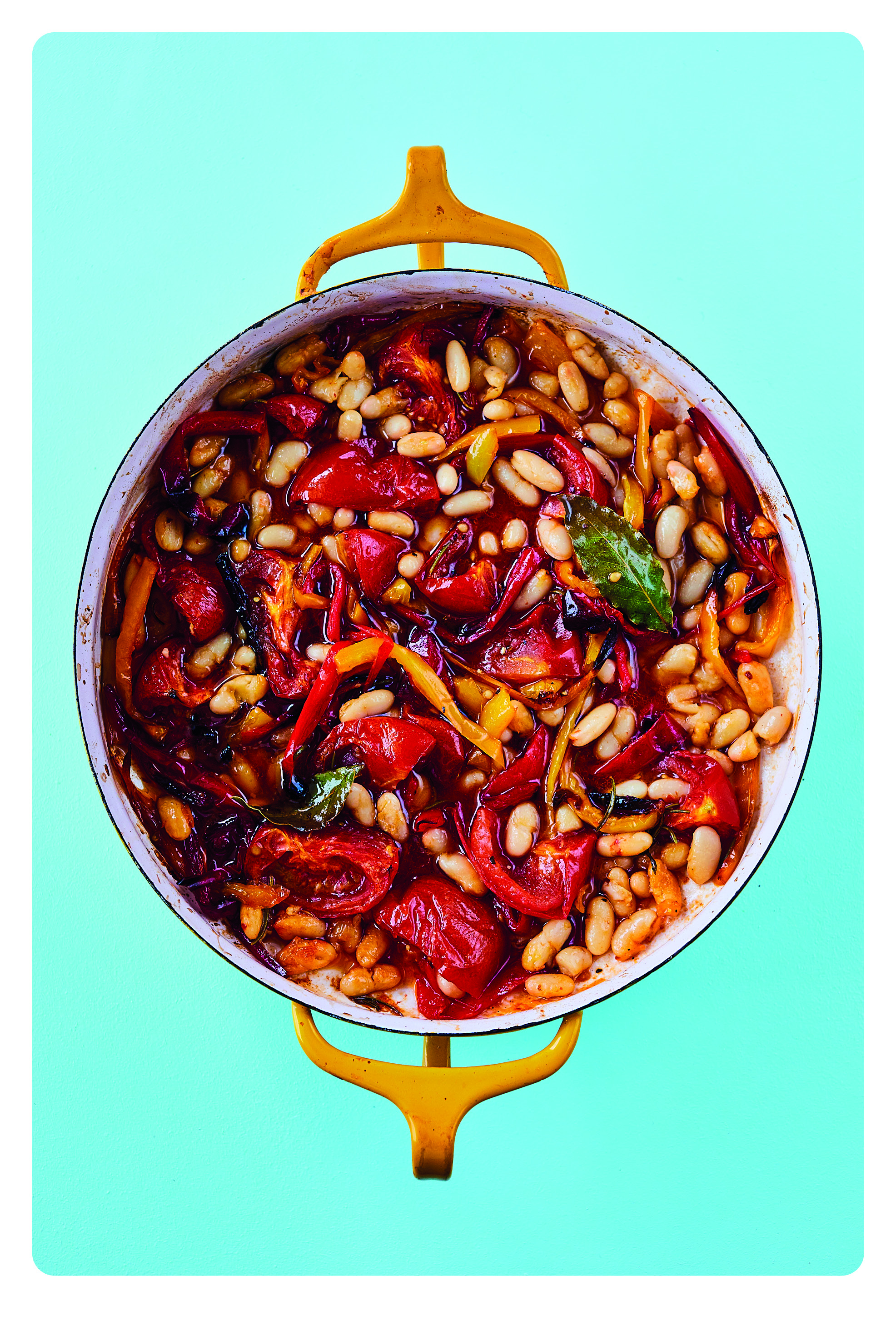
Slow Roasted Peppers With Chilli, Lemon and Garlic Beans by Rukmini Iyer

Slow roasted peppers with chilli, lemon & garlic beans

My favourite dish when working in a restaurant kitchen was peperonata – red and yellow peppers softened down slowly in a frying pan along with oil, garlic and onions until they almost melted. It was, as many good things are, time-consuming to make, so I wondered if one might achieve a similar result with oven cooking – and the answer is yes. With garlicky beans, this dish is perfect piled on to rounds of thickly sliced toasted bread.

Serves: 4
Prep: 15 minutes
Cook: 1 hour

5 vine tomatoes, quartered
1 red pepper, thinly sliced
1 yellow pepper, thinly sliced
1 orange pepper, thinly sliced
2 tablespoons olive oil
2 bay leaves
1 large sprig of fresh rosemary
1⁄2 – 1 teaspoon sea salt flakes
Plenty of freshly ground black pepper

BEANS

2 tablespoons extra virgin olive oil
1⁄2 clove of garlic, finely grated
1⁄2 teaspoon chilli flakes
1⁄2 – 1 teaspoon sea salt flakes
1 x 400g tin of cannellini beans, drained and rinsed
1⁄2 lemon, zest only

TO SERVE

Rounds of thickly sliced,toasted bread

Preheat the oven to 180°C fan/200°C/gas 6.

Tip the tomatoes, peppers, oil, herbs, salt and pepper into a roasting tin large enough to hold everything in one layer, mix well, then transfer to the oven and roast for 50 minutes. If after half an hour it looks as though the peppers are catching a bit too quickly, turn the heat down a fraction. Meanwhile, stir the extra virgin olive oil, garlic, chilli flakes, salt, cannellini beans and lemon zest together in a bowl and set aside.

Once the peppers have had 50 minutes, stir through the beans, then turn the oven down to 160°C fan/180°C/gas 4 and cook for a further 10 minutes. Taste and adjust the salt and pepper as needed, adding a little more olive oil if you wish, then remove the bay leaves and rosemary sprigs and serve piled on to toasted bread. This tastes even better the next day, so it’s well worth making in advance and reheating.

Extracted from: The Roasting Tin Around the World Global One Dish Dinners by Rukmini Iyer (Square Peg) 14th May, £16.99 HBK Photography by David Loftus. Follow Rukmini on instagram @missminifer

Cook more from this book
Peach and Dulce De Leche Cake With Meringues and Cream
Slow-Cooked Pork Pibil With Pink Pickled Onions

Read the review

Buy this book
The Roasting Tin Around the World: Global One Dish Dinners
£16.99, Square Peg