Chocolate Tart with Marsala Sabayon and Toasted Hazelnuts recipe by Sarah Johnson

Marsala is a fortified wine from Sicily that was once popular among chefs and wine enthusiasts alike. However, excessive production cheapened its quality over time, leading to a decline in its reputation. Fortunately, a select few winemakers continue to produce marsala in its authentic form, capturing its deep and mellow character with notes of muscovado and sun-dried fruit. If you haven’t any already, now may be the time to add a bottle to your pantry. In this recipe, sweet marsala is used in a sabayon (or zabaglione in Italian). Both creamy and light, this boozy custard is traditionally served with summer fruits. But I have opted to serve it with a chocolate tart and toasted hazelnuts.

SERVES 10–12

Ingredients:
For the chocolate tart shell:
150g (5½oz) unsalted butter, softened, plus extra for greasing
90g (3¼oz) icing sugar, sifted
1 egg
½ teaspoon salt
200g (7oz) plain flour
50g (1¾oz) cocoa powder

For the chocolate filling:
530g (1lb 3oz) good-quality chocolate (70% cocoa solids), broken into pieces
3 egg yolks
200ml (7fl oz) double cream
270ml (9½fl oz) whole milk
1 teaspoon salt

For the marsala sabayon:
190ml (6½fl oz) double cream
7 egg yolks
80g (2¾oz) sugar
150ml (5oz) sweet marsala
150g (5½oz) hazelnuts, lightly toasted and coarsely chopped, to serve

For the chocolate dough, butter the bottom and sides of a 25cm (10in) fluted tart tin, and line the base with baking parchment. Place the butter and icing sugar into a mixing bowl and beat until smooth. Add the egg and salt and continue beating until the egg is absorbed.

Sift in the flour and cocoa powder and mix until everything comes together. The dough may feel dry at this stage, but the crust will have a nicer texture when the dough is cooked.

Using your hands, press the dough as evenly as possible into the prepared tart tin. Place a piece of baking parchment over the dough and use the back of a measuring cup (a small glass will also do) to gently press the dough into a smooth even layer. Press the dough up the sides of the tart tin, then trim the excess dough, reserving it for patching up any cracks that may form during baking. Place in the refrigerator until firm.

Preheat the oven to 160°C/325°F/gas mark 3.

Prick the bottom of the tart using a fork, then place it into the oven. After 7 minutes, you may notice the sides of the tart shell beginning to slouch. Gently press a flatbottomed measuring cup around the edges where the dough has shrunk and encourage it back up the side of the tart tin. Continue to bake for about 20 minutes until the tart shell is cooked all the way through. Remove from the oven and cool on a wire rack.

For the chocolate filling, prepare two large heatproof bowls – add the chocolate to one and the egg yolks to the other. Fill a saucepan with water and bring it to the boil. Remove it from the heat and place the bowl of chocolate on top, ensuring it doesn’t come into contact with the water. Allow the chocolate to melt gradually. Meanwhile, in a separate heavy-based saucepan, combine the double cream, milk and salt. Place it over medium heat. Put your bowl of egg yolks nearby, with a towel underneath to secure it.

When the milk mixture begins to simmer, take it off the heat and slowly ladle it into the yolks, stirring constantly with a whisk. Once you have incorporated all the milk into the yolks, return the mixture to the saucepan and place it over a low heat. Stir constantly until the custard thickens slightly and coats the back of a spoon.

Strain through a fine-mesh sieve into the chocolate and let it sit over the hot water for 1 minute. Remove from heat and wipe the water from underneath the bowl. Place a clean, dry spatula into the centre of the chocolate and, using small circular motions, begin to emulsify the chocolate. Once the mixture begins to look glossy, continue to bring in more chocolate and custard, all the while using small circular motions to emulsify the chocolate. Gentle stirring will prevent unwanted air bubbles. If the mixture begins to split, your chocolate may be too hot. However, a small splash of cold milk stirred into the chocolate should bring it back to its glossy texture. Scrape the sides and base of the bowl with spatula every so often. Once the chocolate is properly emulsified, pour into the prepared tart shell and shimmy the tart back and forth to evenly spread the filling. Place in a cool part of the kitchen for 2–3 hours until the filling is set.

For the marsala sabayon, take a small mixing bowl and whip the double cream until the whisk leaves tracks in the cream, stopping before soft peaks form. Chill the whipped cream in the refrigerator until needed. Prepare a large bowl with ice-cold water, filling it about one-third of the way up then set aside. Bring a pan of water to the boil and place the egg yolks into another large heatproof bowl. Sit this on top of the pan of boiling water. Whisk the yolks until they are warm to the touch, then add the sugar and whisk vigorously until the yolks turn pale and thick. Add the marsala and continue whisking until the custard is doubled in size. Notice how the sabayon changes; the bubbles will become smaller and the whisk will leave trails as the mixture thickens and becomes glossy. Remove from the heat and place over the bowl of ice-cold water. Continue whisking until completely chilled. Remove the cream from the refrigerator and whisk to soft peaks. Fold one-third of the sabayon into the cream, then fold in the rest. Store in the refrigerator for up to 4 hours until you are ready to use.

Serve slices of the tart with generous spoonfuls of chilled sabayon and a scattering of toasted hazelnuts.

Book credit: Fruitful by Sarah Johnson. Published by Kyle Books. Photography: Patricia Niven.

Cook more from this book
Lemon Drizzle Cake
North African Lamb with Plums

Read the review: click here
Buy this book:
Fruitful by Sarah Johnson
£30, Kyle Books
Lemon Drizzle Cake recipe by Sarah Johnson

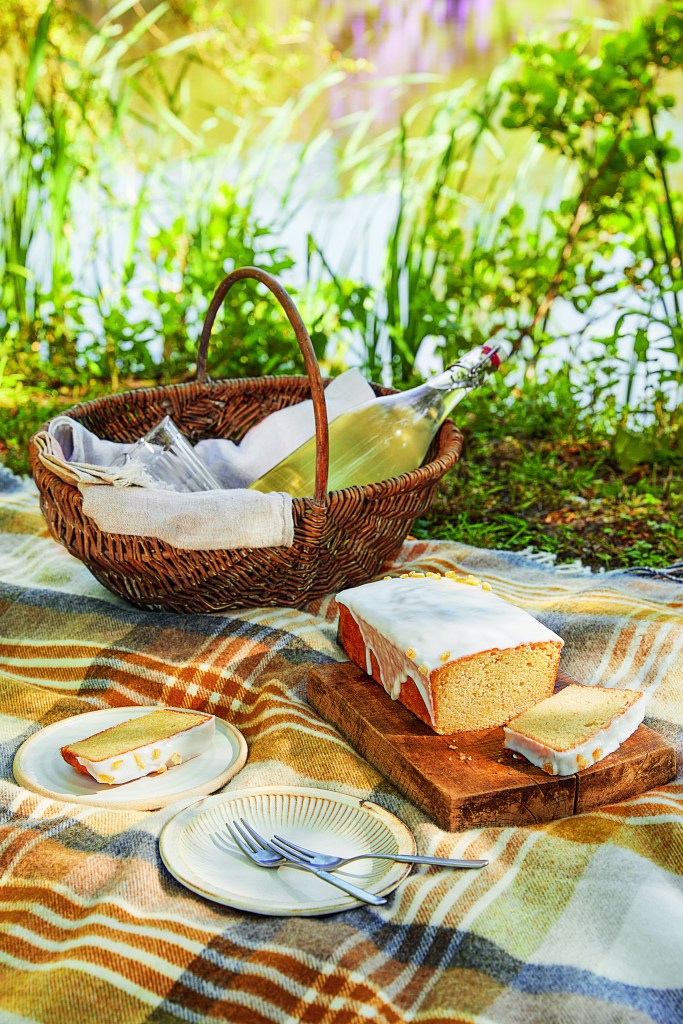
It’s worth having a recipe for a classic lemon drizzle in your baking repertoire. I adore this particular version because it’s reliable, full of lemon flavour, and the addition of buttermilk provides a tender crumb.

SERVES 8–10

Ingredients:
For the cake:
200g (7oz) flour
1¼ teaspoons baking powder
¼ teaspoon bicarbonate of soda
zest of 1 lemon
225g (8oz) caster sugar
135g (4¾oz) butter, room temperature
140g (5oz) eggs (2–3 eggs)
¼ teaspoon salt
175ml (6oz) buttermilk

For the lemon soak:
2 tablespoons lemon juice, strained
1 tablespoon caster sugar

For the lemon icing:
150g (5½oz) icing sugar, sifted
1–1½ tablespoons lemon juice, strained

Position a rack in the middle of the oven and preheat it to 160°C/325°F/gas mark 3. Grease a loaf tin with butter and lightly dust it with flour. Tap out any excess flour and line the bottom with baking parchment. Sift the flour, baking powder and bicarbonate of soda into a bowl. Set aside. Zest the lemon directly over the measured sugar then rub it together using the tips of your fingers.

In a separate mixing bowl, beat the butter until smooth and satiny. Add the lemony sugar and continue to cream until the mixture becomes light in colour and fluffy in appearance.

Beat the eggs together and add to the butter and sugar, a third at a time, mixing until fully incorporated before adding the next third. Continue to cream the mixture, scraping the sides of the bowl once or twice. Once all the eggs have been added, the texture will be fluffy, light and increased in volume (it should resemble whipped cream cheese and the graininess should disappear). If you are using a stand mixture, remove the bowl now and proceed to mix by hand.

Gently fold in one-third of the dry ingredients, followed by half of the buttermilk. Repeat this process, alternating between the dry and wet ingredients. After each addition, scrape the sides of the bowl and continue mixing until the batter is smooth.

Pour the batter into the prepared loaf tin, smoothing out the top, and bake for 25–30 minutes. Rotate the cake and bake for another 15–20 minutes until a skewer inserted into the middle of the cake comes out clean.

While the cake is baking, make the lemon soak by combining the lemon juice and sugar together until the sugar dissolves. When the cake is done, transfer it to a wire rack (still in the tin) and use a skewer or toothpick to poke holes in the surface. Spoon the lemon soak over the top and allow it to cool in the tin.

When you’re ready to ice the cake, remove it from the tin by running a palette knife or butter knife along the edges. Turn out the cake and remove the parchment from the bottom. Place it back onto the rack while you prepare the icing. Put the sifted icing sugar into a bowl and add the smaller amount of lemon juice. Mix with a small spoon or spatula until all the icing sugar is dissolved. If the icing seems thick, you can thin it out with a bit more juice. Spoon the icing over the cake, covering the top completely and allowing any excess icing to drizzle down the sides. Leave the icing to set before serving.

Book credit: Fruitful by Sarah Johnson. Published by Kyle Books. Photography: Patricia Niven.

Cook more from this book
Chocolate Tart with Marsala Sabayon and Toasted Hazelnuts
North African Lamb with Plums

Read the review:click here
Buy this book:
Fruitful by Sarah Johnson
£30, Kyle Books
North African Lamb with Plums recipe by Sarah Johnson

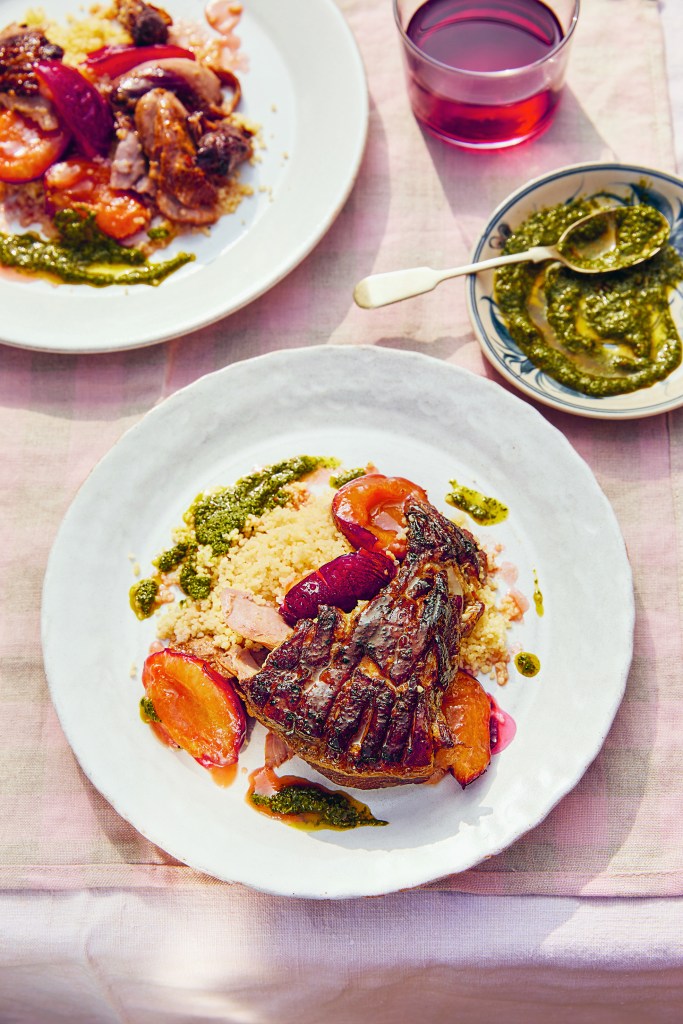
Plums add brightness and a touch of sweetness to this sticky, spice-scented lamb. Serve with steamed couscous or rice and something green like slow-cooked chard.

SERVES 6–8

Ingredients:
1.2–1.5kg (2lb 10oz–3lb 5oz) lamb shoulder, on the bone, excess fat trimmed
2 teaspoons cumin seeds 2 teaspoons coriander seeds
2 garlic cloves
1 fresh red chilli, deseeded and finely chopped
3cm (1¼in) piece of ginger, finely chopped
olive oil
2 medium onions, sliced
10 medium plums
1 cinnamon stick salt and pepper

For the chermoula:
1cm (½in) piece of ginger, peeled and diced
1 fresh red chilli, deseeded and finely chopped
1 garlic clove
½ teaspoon toasted cumin seeds
2 slices Lemon Confit in Oil (see page 41) finely chopped, or the zest of 1 lemon
juice of ½ lemon
25g (1oz) flat-leaf parsley
50g (1¾oz) fresh coriander

Lightly score the top of the lamb shoulder, then season with salt and pepper. Toast the cumin and coriander seeds until fragrant, then place them in a mortar with the garlic and pound into a paste. Add the red chilli, ginger and a tablespoon or two of olive oil and mix together. Rub the marinade over the lamb shoulder, then cover and refrigerate overnight. Remove from the refrigerator 2 hours before cooking and allow it to come to room temperature.

Preheat the oven to 160°C/325°F/gas mark 3.

Scatter the onions over the base of a roasting tray. Slice four of the plums, removing the stones, then add them to the tray with the cinnamon. Place the lamb on top, skin side up, and add 400ml (14fl oz) of water. Cover loosely with a piece of foil and roast for 2 hours. Flip the lamb and cook, covered for another 2 hours. Remove the foil and turn the lamb once more, so the skin side is facing up. Add a splash of more water if the tray looks dry, then place it back into the oven, uncovered, and increase the temperature to 180°C/350°F/gas mark 4. Continue to cook for 1–1½ hours, basting every 30 minutes or so, until the skin is crisp and the meat is falling from the bone. Remove from the oven, transfer the lamb to a board and allow it to rest in a warm place, loosely covered, for at least 30 minutes.

Increase the temperature to 220°C/425°F/gas mark 7 and halve and stone the remaining six plums. Place them into a ceramic casserole. Strain the juices from the roasting tray, then pour enough juice over the plums to come up one-third of the way. Reserve the leftover juices. Roast in the oven for 10–15 minutes until plums are soft and slightly caramelized around the edges.

For the chermoula, place the ginger, red chilli, garlic, cumin and a pinch of salt in a mortar and pound into a paste. Transfer to a bowl and add the confit lemon and lemon juice. Finely chop the parsley and coriander, then fold into the other ingredients and add the oil. Taste and adjust the seasoning if necessary. To serve, carve the lamb into portions and arrange on a platter. Top with roasted plums, drizzle over any remaining juices, and accompany with a bowl of chermoula.

Book credit: Fruitful by Sarah Johnson. Published by Kyle Books. Photography: Patricia Niven.

Cook more from this book
Chocolate Tart with Marsala Sabayon and Toasted Hazelnuts
Lemon Drizzle Cake

Read the review: click here
Buy this book:
Fruitful by Sarah Johnson
£30, Kyle Books

Roasted New Potato and Green Bean Salad with Mint recipe by Ceri Jones

No summer BBQ is complete without a potato salad, and this is my go-to. I know, I know, waxy new potatoes are meant to be served boiled, but I don’t love the papery skins so prefer to roast until the skins are crispy yet the insides remain soft. I sometimes use thinly sliced shallots instead of spring onions, swap the mint for watercress or the green beans for asparagus.

SERVES 2 AS A SIDE | TIME TO PREPARE – 40 MINUTES

400g/14oz baby or new potatoes, scrubbed clean and left whole if small enough or chopped into bite-sized pieces
1 tbsp olive oil
150g/5½oz green beans, end trimmed and cut in half or into 3 x 2.5cm/1 inch pieces
2 spring onions, very thinly sliced on an angle
zest of 1 lemon
large handful of mint leaves (approx. 5g/1/8oz )
salt and pepper

FOR THE DRESSING
½ tsp wholegrain mustard
½ tsp honey
juice of half a lemon (approx. 1 tbsp)
3 tbsp olive oil

Preheat the oven to 200°C fan/220°C/450°F/gas mark 7. On a baking tray, toss the potatoes with 1 tablespoon of olive oil and season with salt. Roast for 20 minutes. Reduce to 180°C fan/200°C/400°F/gas mark 6 and cook for another 15 minutes, until crispy on the outside and cooked through on the inside. Remove from the oven and cool off for a short time, around 5 minutes. Meanwhile, make the dressing. In a small bowl stir together the mustard, honey, and lemon juice until combined. Whisk in the oil until emulsified.

Season with salt and pepper to taste. Set aside for the flavours to mingle.

Bring a small saucepan of salted water to the boil, then blanch the beans for 2–3 minutes, until just al dente. Drain and rinse immediately under cold water until cold to the touch. Shake off any excess water then leave to dry on kitchen paper. To put the salad together, toss the cooked potatoes in a medium-sized bowl with the beans, chopped spring onions, and enough dressing to just coat. Season with lemon zest, then tear your mint leaves and add to the bowl (they will go black more quickly if sliced). Transfer to a serving platter or bowl to serve.

Buy this book: It Starts with Veg: 100 Seasonal Suppers and Sides
£20.00, Pavilion Books

Read the review

Fruit scones recipe by Ranveet Gill

FRUIT SCONES

One of my earliest pastry jobs involved making hundreds of scones each morning for afternoon tea service. The key was never to overmix the dough and to get your hands involved to bring it together, then to rest it before cutting. A scone is best served on the day it is baked with copious amounts of clotted cream and jam on the side.

MAKES 6 SCONES

Equipment
flat baking tray
15g/1 tbsp raisins
just-boiled water, to cover
250g plain flour, plus extra for dusting
12g/21/2 tsp baking powder
1/4 tsp fine salt
30g caster sugar
75g cold unsalted butter, cubed
25g (prepped weight) eating apple
(approx. 1/4 small apple), cored and grated
125ml full-fat milk
1 egg, beaten, for the egg wash

Put the raisins in a small, heatproof bowl, cover with just-boiled water and leave to soak for 20 minutes, then drain.

In a large bowl, stir together the flour, baking powder, salt and sugar. Add the butter and use your fingertips to breadcrumb it together. Mix through the apple and strained raisins.

Keeping one hand out of the bowl, make a well in the centre and add the milk. Use your hand (that’s in the bowl) to bring it together initially to a loose dough, but do not overwork it. Tip this onto your workbench and then use both hands to gently bring it together to form a dough. Gently shape into a disc, then wrap tightly in baking paper or clingfilm and refrigerate for 30 minutes.

Preheat the oven to 180°C fan/200°C/gas mark 6. Line the baking tray with baking paper.

Lightly dust your workbench and a 6.5cm (23/4in) round biscuit cutter with flour. Unwrap the chilled dough and gently roll it into a round, about 3cm (11/4in) thick. Position the cutter, then press down in one straight motion (don’t twist the cutter) with your hand to cut out each scone, then gather the trimmings and cut out another scone.

Place the rounds on the lined baking tray, then brush the top of each one with egg wash.

Bake for 18–20 minutes or until risen and lightly golden.

Remove from the oven, transfer the scones to a wire rack and allow to cool fully before serving. Serve split and spread with butter and jam, or clotted cream and jam, or all three!

These scones are best eaten fresh on the day they are made.

Cook more from this book
Fig rolls

Read the review

Buy the book: Baking for pleasure by Ranveet Gill
£26, Pavillion Books

One-pot meatballs with tomato sauce and orzo by Rick Stein

103_simplesuppers_OnePotMeatballs

I tried making these meatballs with minced pork but they were too dry, so I think they are much better made with good-quality sausage meat, by which I mean at least 90 per cent pork. A lot of the brands of tomato passata with flavourings are not to my taste, but the Napolina soffritto is just tomato, garlic, onion and celery.

SERVES 4
400g premium pork sausages, skins removed and discarded
¾ tsp fennel seeds, coarsely ground
¼ tsp chilli flakes
4 tbsp olive oil
250g orzo
3 garlic cloves, chopped
60ml white wine
400ml soffritto passata (I like Napolina)
1 rosemary sprig
Salt and black pepper

To serve
Parmesan, grated
Basil leaves, torn

Mix the sausage meat, fennel seeds and chilli flakes in a bowl and shape into balls about the size of cherry tomatoes.

Heat 2 tablespoons of the oil in a shallow casserole dish or a large pan with a lid and fry the meatballs until lightly browned all over. Transfer them to a plate and set aside.

Add the remaining oil to the pan, add the orzo and fry for a couple of minutes. Add the garlic and fry for a minute, then pour in the wine and bring to the boil. Add the passata and 650ml of water, season and bring to the boil again. Turn the heat down to a simmer and cook for 2–3 minutes.

Add the meatballs and rosemary, season with salt and pepper, then cover the pan with a lid and leave to simmer for about 10 minutes. Remove the lid and cook for a final couple of minutes until the pasta is done and the sauce is thickened.

Serve with plenty of freshly grated Parmesan cheese and torn basil leaves.

Rick Stein's Simple Suppers
Extracted from Rick Stein’s Simple Suppers (BBC Books, £28). Photography by James Murphy
Cook more from this book 

Read the review
Coming soon

Buy this book
Rick Steins Simple Suppers

Prawn French toast with walnut & coriander pesto by Michel Roux Jr

9781399610650_interior applicationmichel roux at home text finalPrawn_Toast_Back_5551

Croque aux crevettes

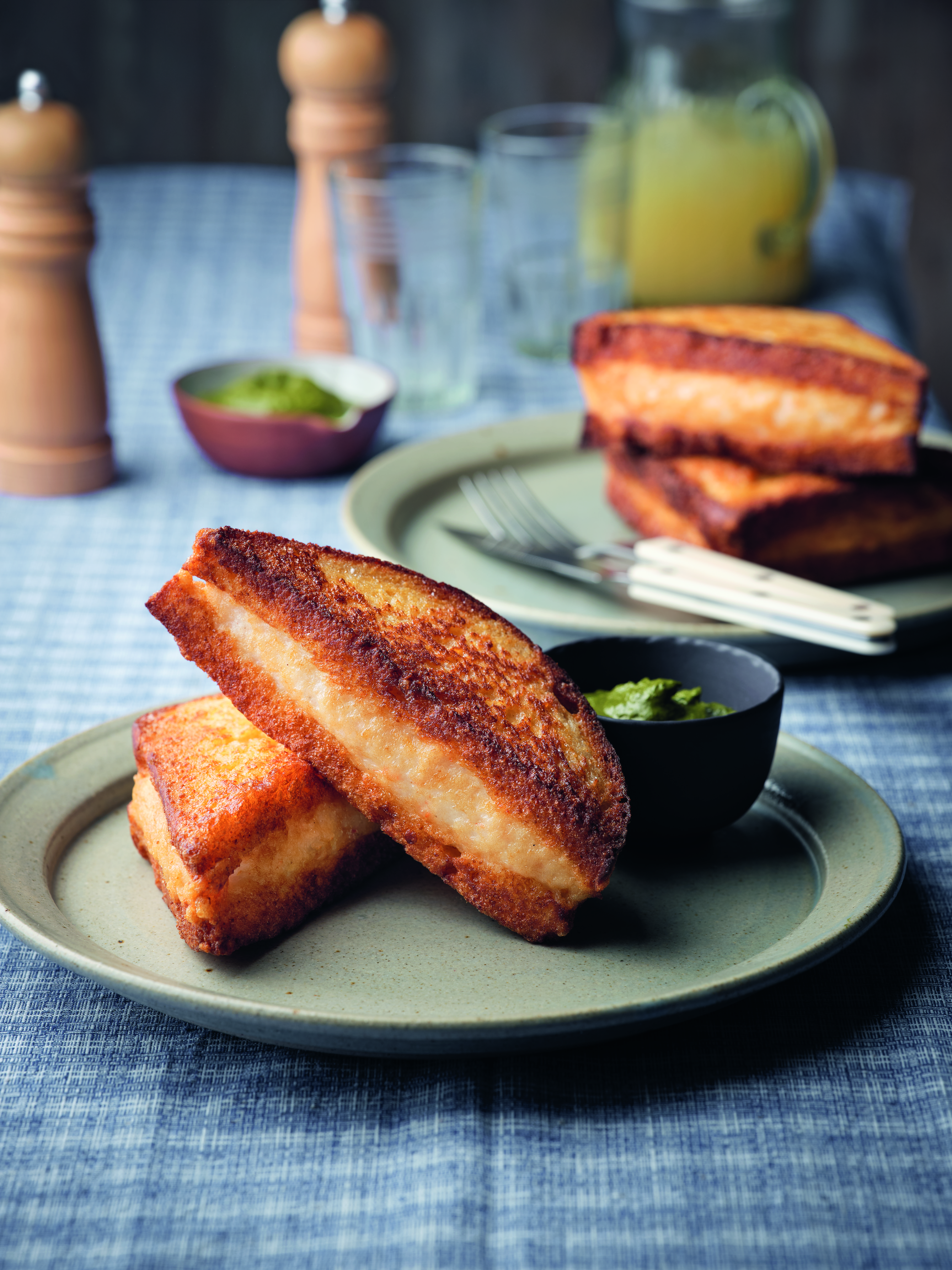
A really special brunch dish, this is my French take on Chinese prawn toast. These are hearty sandwiches, so if you’re serving them as part of a brunch buffet, just a half will be enough – unless you’re not planning to eat again until the evening! The walnut and coriander pesto makes a nice change from the usual basil version. The recipe makes more than you need for the sandwiches, but the pesto keeps well in the fridge for a week and is delicious with pasta.

Makes four sandwiches

450g peeled raw prawns
3 tbsp vegetable oil
3 free-range egg whites
3 free-range eggs
3 tbsp whole milk
Grating of nutmeg
8 slices of sourdough bread
Vegetable oil, for frying
1 tsp red chilli flakes,
to serve (optional)
Salt and black pepper

Walnut & coriander pesto
60g walnuts
Big bunch of coriander
(about 120g),
roughly chopped
1 garlic clove,
roughly chopped
1 tbsp grated Parmesan
1 green chilli roughly
chopped, seeds removed
6 tbsp olive oil
Salt

First, make the pesto. Put the walnuts, chopped coriander, garlic, Parmesan, chilli and olive oil into a blender and blitz to make a smooth mixture. Season with salt.

Put the prawns in a food processor with the oil and egg whites and season with salt and pepper. Blitz until smooth.

Beat the whole eggs with the milk in a bowl and season with salt, pepper and a grating of nutmeg, then set aside.

Divide the prawn mixture between 4 of the slices of bread, spreading it evenly, then top with the remaining slices. Cut the sandwiches in half, then dip each half into the egg mixture.

Pour some oil into a frying pan to a depth of about 1cm and heat. Shallow-fry the sandwiches, a few halves at a time, turning them until golden on all sides – this will take about 4 minutes in total. Drain the sandwiches on kitchen paper, then keep them warm in a low oven while you cook the rest.

Cut the sandwiches in half or into bite-sized pieces. Serve warm with the pesto and sprinkle a few chilli flakes on top if you want your sandwich to have a bit of a kick.

Cook more from this book
Root Vegetable Tart Tatin by Michel Roux Jr
Souffled Crepes by Michel Roux Jr

Read the review
Coming Soon

Buy this book: Michel Roux at Home 
£26, Seven Dials

Souffled Crepes by Michel Roux Jr

9781399610650_interior applicationmichel roux at home text finalsouffled_crepes_7506
Crêpes soufflées à l’orange et Grand Marnier

Serves four
4 oranges
250g crème pâtissière
(see p.238)
6 free-range egg whites
Pinch of sugar
50ml Grand Marnier
20g icing sugar,
for dusting

Pancakes
1 free-range egg
75g plain flour
1 tbsp caster sugar
Pinch of salt
210ml milk
1 tbsp clarified butter
This show-stopping dessert was one of my Uncle Michel’s favourites.

First make the pancake batter. Beat the egg in a bowl, then whisk in the flour a little at a time. Add the sugar and salt and mix well with a whisk. Stir in the milk to make a smooth batter, then leave it to rest in a cool place for at least an hour. To cook, brush a frying pan or crêpe pan with a little of the clarified butter and heat. Ladle in less than a quarter of the batter and cook the pancake for 1 or 2 minutes on each side, turning it with a palette knife. You should get 4 or 5 pancakes.

Segment 2 of the oranges (see page 86) and squeeze all the membranes into a pan to extract any juice. Add the juice of the other 2 oranges to the pan. Place over a low heat and reduce by half, then strain into a bowl and set aside at room temperature.

Put the crème pâtissière in a bowl, place it over a pan of simmering water and heat gently. Meanwhile, beat the egg whites with a pinch of sugar until they form soft peaks. Take the crème pâtissière off the heat, whisk in the Grand Marnier and beat briefly, then add one-third of the egg whites. Mix well,
then carefully fold in the rest of the egg whites with a spatula.

Preheat the oven to 240°C/Fan 220°C/Gas 9. Lay a pancake on a board and spoon a quarter of the crème pâtissière mix over one half. Add a few orange segments, then fold the pancake over and press down gently to seal the edges. Repeat with the remaining pancakes, crème pâtissière mix and orange segments. Put the filled pancakes on a lightly greased baking tray and bake in the preheated oven for 2–5 minutes. Remove and dust them generously with icing sugar, then place under a hot grill for 4–5 minutes, so that the sugar melts and becomes partly caramelised. To serve, slide each pancake on to a plate. Pour some of the reduced orange juice around each one and add a few orange segments. Serve at once.

Cook more from this book
Prawn French toast with walnut & coriander pesto by Michel Roux Jr
Root Vegetable Tart Tatin by Michel Roux Jr

Read the review
Coming Soon

Buy this book: Michel Roux at Home 
£26, Seven Dials

SORREL HOISIN FRIED ‘CHICKEN’ BURGER by Denai Moore

ChickenSando_066
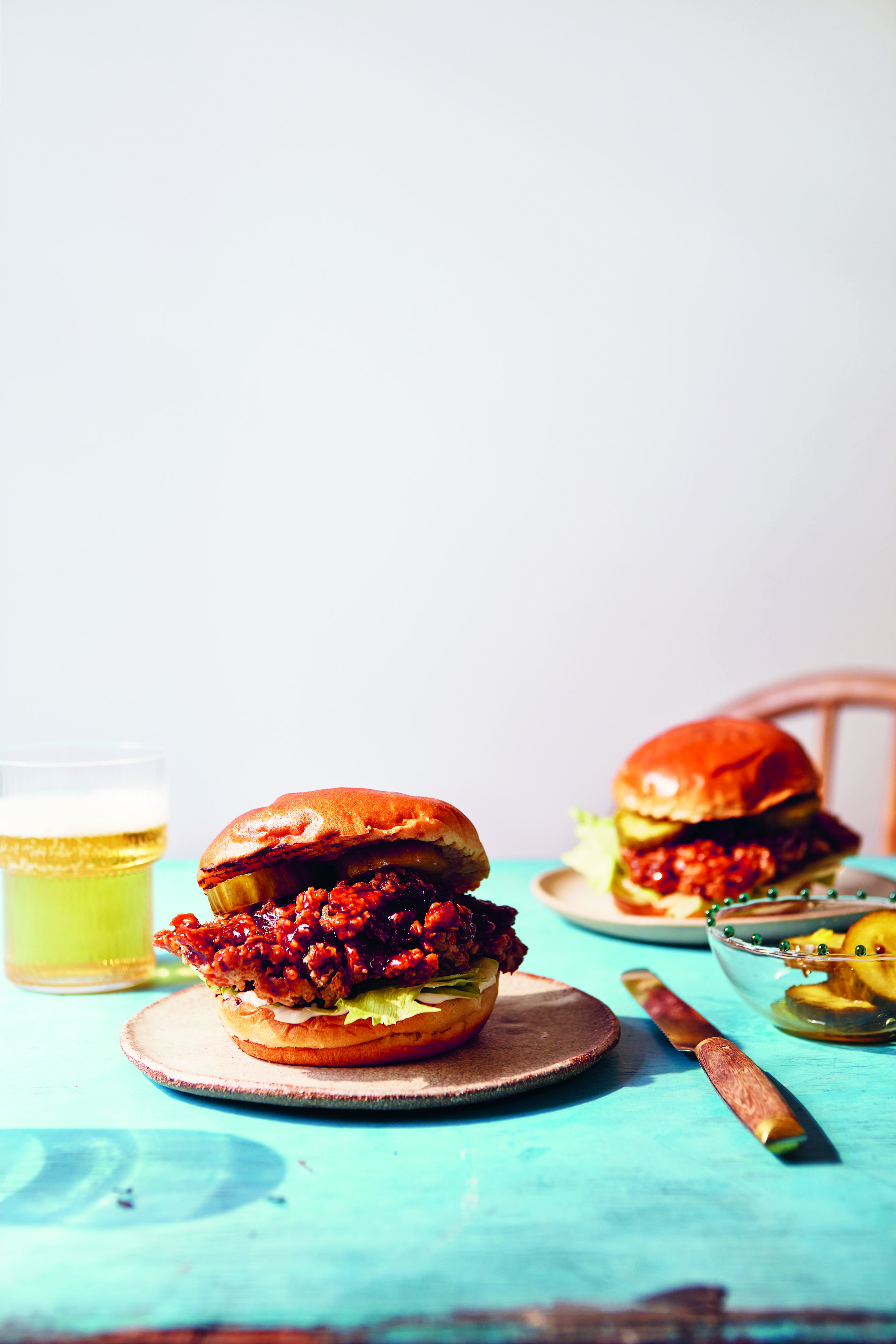
Every now and then you need a good burger in your life, and this one satisfies that craving. This is the kind of dish I make for my non-vegan friends. The sorrel hoisin glaze is quietly delicious and adds a fruity twist. Lettuce and pickles are non-negotiable here. There’s just something about the hot, crispy, sticky glazed oyster mushrooms and the ice-cold lettuce.

SERVES 6
PREP TIME 20 MINUTES, PLUS 20 MINUTES MARINATING TIME
COOK TIME 30 MINUTES

250 g (9 oz) oyster mushrooms
2 tablespoons Green Seasoning (see below)
1 tablespoon soy sauce
1 tablespoon ground allspice
vegetable oil, for deep-frying
1 x quantity Sorrel Hoisin Glaze (see below)
salt and freshly ground black pepper

FOR THE WET DREDGE
400 ml (13 fl oz/generous 1½ cups) soya milk
1 tablespoon lemon juice
2 tablespoons hot sauce of your choice

FOR THE CRISPY COATING
200 g (7 oz/1⅔ cups) plain (all-purpose) flour
50 g (2 oz/scant ½ cup) cornflour (cornstarch)
1 tablespoon all-purpose seasoning
1 teaspoon dried sage
1 teaspoon ground allspice
1½ teaspoons onion powder
1½ teaspoons garlic granules

TO SERVE
6 vegan-friendly brioche burger buns
knob of vegan block butter
vegan mayonnaise
½ iceberg lettuce
gherkins (pickles)

In a bowl, toss the mushrooms with the green seasoning, soy sauce, allspice and some salt and pepper. Set aside to marinate for 20 minutes. Combine the wet dredge ingredients in one bowl and the crispy coating ingredients in another, seasoning the coating mix with plenty of salt and pepper.

Add a little of the wet dredge to the dry coating and mix in – this will create small lumps, which will become crispy pockets. Dip the mushrooms in the wet dredge, then into the coating mix and then repeat for a double coating. Tap off any excess coating mix and set aside on a baking sheet, ready to fry.

Pour enough vegetable oil into a high-sided heavy-bottomed frying pan (skillet) or saucepan to fill to halfway and gently bring to heat. Test the temperature by using a wooden spoon – if lots of bubbles appear around it immediately, it’s ready to go.

Add 4–5 mushrooms to the pan, taking care not to overcrowd. Fry for 5–6 minutes until crisp and golden. Drain off any excess oil on a wire rack. Repeat until all the mushrooms are cooked. Brush the sorrel hoisin glaze on the mushrooms and set aside.

Toast the brioche buns with a touch of vegan butter. On the base of each bun spread a tablespoon of vegan mayonnaise and add a couple of lettuce leaves. Now add the glazed mushrooms and pickles. And another dollop of vegan mayo on the top bun. Serve and enjoy!

GREEN SEASONING
SERVES 10–12
PREP TIME 3 MINUTES

This flavour bomb is great to add to stews, soups and marinades.

bunch of coriander (cilantro)
bunch of flat-leaf parsley
10 springs of thyme, leaves picked
5 spring onions (scallions), roughly chopped
2 celery stalks, roughly chopped
1 bulb of garlic, cloves peeled
1 onion, roughly chopped
1 green (bell) pepper, roughly chopped
1 Scotch bonnet
sea salt and freshly ground black pepper

Put all the ingredients in a food processor and blend for 2–3 minutes to your desired consistency. I like mine quite fine, but you might like yours more coarse. Store in a clean jar and refrigerate for up to 2 weeks.

SORREL HOISIN GLAZE
SERVES 3–4 PREP TIME 5 MINUTES
COOK TIME 10 MINUTES

Sorrel is a hibiscus drink. The floral notes really work with the sweetness of the hoisin sauce. This would work well in various dishes, especially anything crispy and fried.

400 ml (13 fl oz/generous 1½ cups) sorrel soft drink
1 Scotch bonnet
4 allspice berries
100 ml (3/2 fl oz/scant ½ cup) hoisin sauce

Combine the sorrel, whole Scotch bonnet and allspice in a saucepan, bring to the boil, then reduce by half – it should hold on the back of a spoon and be sticky. Add the hoisin sauce, then transfer to a clean jar and store for up to 2 weeks in the refrigerator.

Cook more from this book

Buy this book: Plentiful by Denai Moore

Read the review   

Introducing: Ideas for legs by Stephen Rötzsch Thomas 

Profile Picture

Here’s how I eat: first with my mind, and then with my body.

I’m the sort of person who is thinking about what’s for dinner while they’re still munching on their breakfast. A planner who plots a big shop at the beginning of the week, and an improviser, who then adapts those plans as the days unfurl around him.

I am also – whisper this – not exactly rolling in cash. I don’t know if anyone’s told you, but shit is expensive right now. And so a lot of my cooking is based around the food that will offer me the most value. Affordable ingredients are a key part of my eating at the moment, and this is what led me to launch a new recipe newsletter called Ideas with Legs.

Chicken legs are easily the best bit of the bird. Full of flavour, the perfect size for an individual portion and, above all else, really affordable. Even Waitrose and Ocado will sell you a pair of the bad boys for less than £1.50. 

Annoyingly, though, the leg doesn’t get a whole lot of attention in cookbooks. Plenty of room for skinned, boned thighs, yes. Not so much for the simple, cost-effective full leg. 

Ideas with Legs has been born out of my ongoing quest to find fun, varied recipes that make the most of this underappreciated ingredient. As I toy around with different dishes from all around the world, I’ll be sharing what I find and, hopefully, offering up some new ideas that will help you to enjoy affordable, flavour-filled dinners.

Each month, subscribers will receive a new recipe centred on chicken legs. Last month I opened the Ideas with Legs account by sharing a recipe for a Filipino chicken adobo. Later this week, I’ll spin the globe and explore a Brazilian rice dish called galinhada that I’m enjoying so much I keep forgetting I’m supposed to be working on other recipes too. 

If you want to delve into food a little deeper with me, I’m also offering a cheeky subscription version of Ideas with Legs. You’ll get extra recipes that go beyond the leg: I’ll share Offally Good Ideas that make the most of some of the most overlooked cuts of meat. Occasionally I might offer up Ideas with Veg(etables) too. Oh, and everything I share will be gluten free. Mainly because I don’t get a choice in the matter.

I don’t expect to make much money from the paid part of Ideas with Legs, and I’m not really doing it for that reason anyway, so subscriber fees have been set at the minimum Substack will let me get away with. I know this because I tried to make it cheaper and they told me off. 

Having spent three years reviewing cookbooks here, it’s probably about time I put my best (chicken) leg forward and offer something up myself. Hopefully some of you will join me. I’ve plenty of delicious ideas in the works, and have even managed to get some gorgeous artwork for the newsletter by the Observer newspaper’s political cartoonist and former Children’s laureate Chris Riddell. Now, I suppose, I just need to get cooking. 

You can sign up to receive Ideas with Legs here.