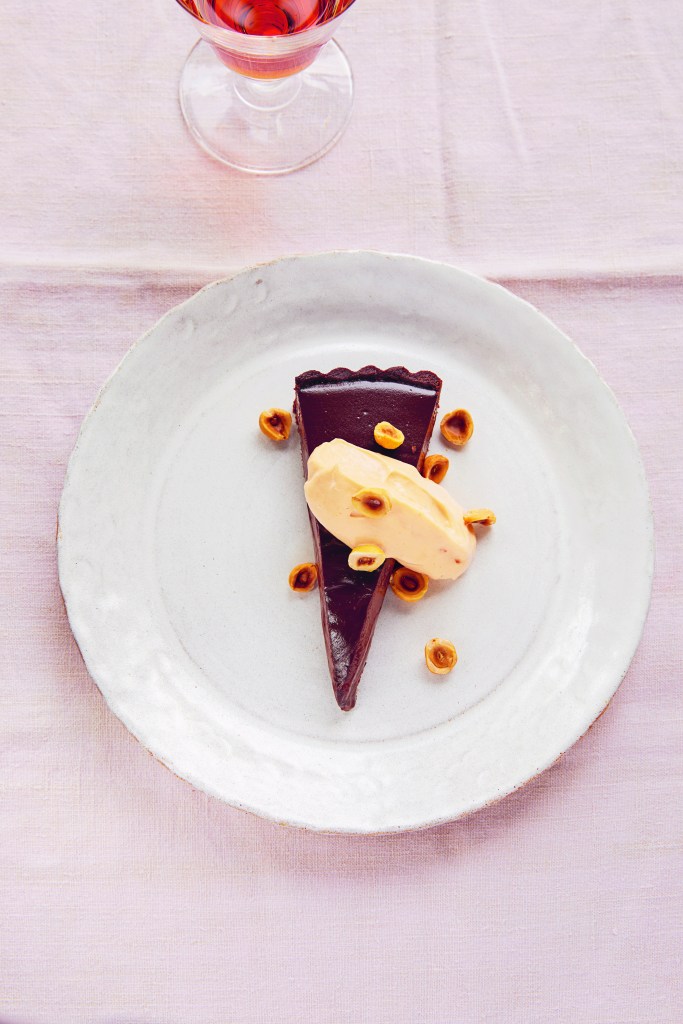
Chocolate Tart with Marsala Sabayon and Toasted Hazelnuts recipe by Sarah Johnson

Marsala is a fortified wine from Sicily that was once popular among chefs and wine enthusiasts alike. However, excessive production cheapened its quality over time, leading to a decline in its reputation. Fortunately, a select few winemakers continue to produce marsala in its authentic form, capturing its deep and mellow character with notes of muscovado and sun-dried fruit. If you haven’t any already, now may be the time to add a bottle to your pantry. In this recipe, sweet marsala is used in a sabayon (or zabaglione in Italian). Both creamy and light, this boozy custard is traditionally served with summer fruits. But I have opted to serve it with a chocolate tart and toasted hazelnuts.

SERVES 10–12

Ingredients:
For the chocolate tart shell:
150g (5½oz) unsalted butter, softened, plus extra for greasing
90g (3¼oz) icing sugar, sifted
1 egg
½ teaspoon salt
200g (7oz) plain flour
50g (1¾oz) cocoa powder

For the chocolate filling:
530g (1lb 3oz) good-quality chocolate (70% cocoa solids), broken into pieces
3 egg yolks
200ml (7fl oz) double cream
270ml (9½fl oz) whole milk
1 teaspoon salt

For the marsala sabayon:
190ml (6½fl oz) double cream
7 egg yolks
80g (2¾oz) sugar
150ml (5oz) sweet marsala
150g (5½oz) hazelnuts, lightly toasted and coarsely chopped, to serve

For the chocolate dough, butter the bottom and sides of a 25cm (10in) fluted tart tin, and line the base with baking parchment. Place the butter and icing sugar into a mixing bowl and beat until smooth. Add the egg and salt and continue beating until the egg is absorbed.

Sift in the flour and cocoa powder and mix until everything comes together. The dough may feel dry at this stage, but the crust will have a nicer texture when the dough is cooked.

Using your hands, press the dough as evenly as possible into the prepared tart tin. Place a piece of baking parchment over the dough and use the back of a measuring cup (a small glass will also do) to gently press the dough into a smooth even layer. Press the dough up the sides of the tart tin, then trim the excess dough, reserving it for patching up any cracks that may form during baking. Place in the refrigerator until firm.

Preheat the oven to 160°C/325°F/gas mark 3.

Prick the bottom of the tart using a fork, then place it into the oven. After 7 minutes, you may notice the sides of the tart shell beginning to slouch. Gently press a flatbottomed measuring cup around the edges where the dough has shrunk and encourage it back up the side of the tart tin. Continue to bake for about 20 minutes until the tart shell is cooked all the way through. Remove from the oven and cool on a wire rack.

For the chocolate filling, prepare two large heatproof bowls – add the chocolate to one and the egg yolks to the other. Fill a saucepan with water and bring it to the boil. Remove it from the heat and place the bowl of chocolate on top, ensuring it doesn’t come into contact with the water. Allow the chocolate to melt gradually. Meanwhile, in a separate heavy-based saucepan, combine the double cream, milk and salt. Place it over medium heat. Put your bowl of egg yolks nearby, with a towel underneath to secure it.

When the milk mixture begins to simmer, take it off the heat and slowly ladle it into the yolks, stirring constantly with a whisk. Once you have incorporated all the milk into the yolks, return the mixture to the saucepan and place it over a low heat. Stir constantly until the custard thickens slightly and coats the back of a spoon.

Strain through a fine-mesh sieve into the chocolate and let it sit over the hot water for 1 minute. Remove from heat and wipe the water from underneath the bowl. Place a clean, dry spatula into the centre of the chocolate and, using small circular motions, begin to emulsify the chocolate. Once the mixture begins to look glossy, continue to bring in more chocolate and custard, all the while using small circular motions to emulsify the chocolate. Gentle stirring will prevent unwanted air bubbles. If the mixture begins to split, your chocolate may be too hot. However, a small splash of cold milk stirred into the chocolate should bring it back to its glossy texture. Scrape the sides and base of the bowl with spatula every so often. Once the chocolate is properly emulsified, pour into the prepared tart shell and shimmy the tart back and forth to evenly spread the filling. Place in a cool part of the kitchen for 2–3 hours until the filling is set.

For the marsala sabayon, take a small mixing bowl and whip the double cream until the whisk leaves tracks in the cream, stopping before soft peaks form. Chill the whipped cream in the refrigerator until needed. Prepare a large bowl with ice-cold water, filling it about one-third of the way up then set aside. Bring a pan of water to the boil and place the egg yolks into another large heatproof bowl. Sit this on top of the pan of boiling water. Whisk the yolks until they are warm to the touch, then add the sugar and whisk vigorously until the yolks turn pale and thick. Add the marsala and continue whisking until the custard is doubled in size. Notice how the sabayon changes; the bubbles will become smaller and the whisk will leave trails as the mixture thickens and becomes glossy. Remove from the heat and place over the bowl of ice-cold water. Continue whisking until completely chilled. Remove the cream from the refrigerator and whisk to soft peaks. Fold one-third of the sabayon into the cream, then fold in the rest. Store in the refrigerator for up to 4 hours until you are ready to use.

Serve slices of the tart with generous spoonfuls of chilled sabayon and a scattering of toasted hazelnuts.

Book credit: Fruitful by Sarah Johnson. Published by Kyle Books. Photography: Patricia Niven.

Cook more from this book
Lemon Drizzle Cake
North African Lamb with Plums

Read the review: click here
Buy this book:
Fruitful by Sarah Johnson
£30, Kyle Books
Lemon Drizzle Cake recipe by Sarah Johnson

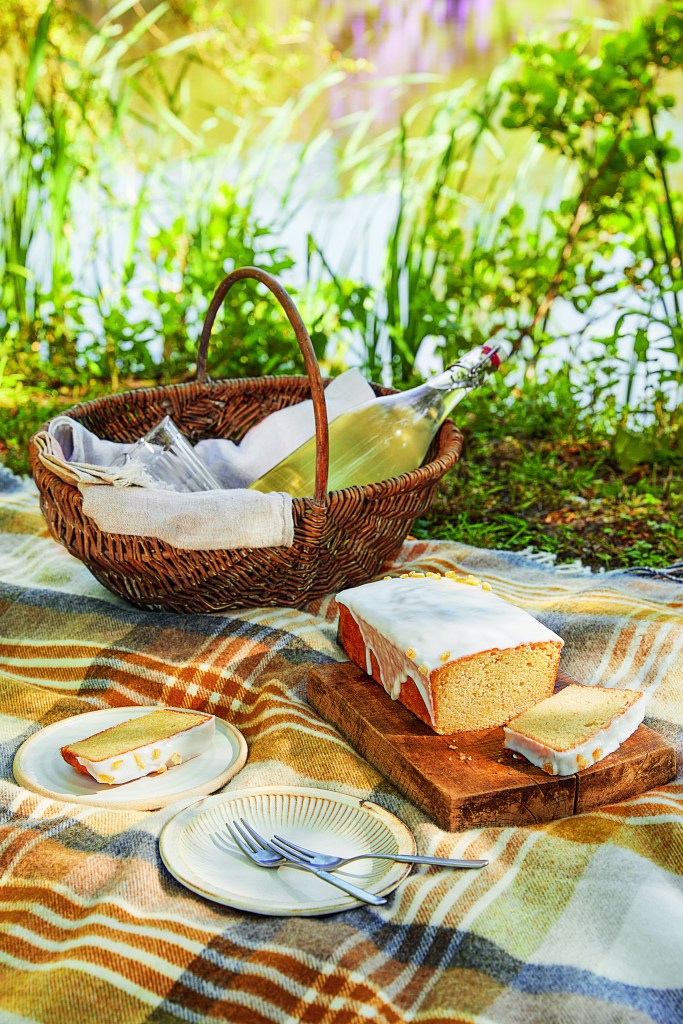
It’s worth having a recipe for a classic lemon drizzle in your baking repertoire. I adore this particular version because it’s reliable, full of lemon flavour, and the addition of buttermilk provides a tender crumb.

SERVES 8–10

Ingredients:
For the cake:
200g (7oz) flour
1¼ teaspoons baking powder
¼ teaspoon bicarbonate of soda
zest of 1 lemon
225g (8oz) caster sugar
135g (4¾oz) butter, room temperature
140g (5oz) eggs (2–3 eggs)
¼ teaspoon salt
175ml (6oz) buttermilk

For the lemon soak:
2 tablespoons lemon juice, strained
1 tablespoon caster sugar

For the lemon icing:
150g (5½oz) icing sugar, sifted
1–1½ tablespoons lemon juice, strained

Position a rack in the middle of the oven and preheat it to 160°C/325°F/gas mark 3. Grease a loaf tin with butter and lightly dust it with flour. Tap out any excess flour and line the bottom with baking parchment. Sift the flour, baking powder and bicarbonate of soda into a bowl. Set aside. Zest the lemon directly over the measured sugar then rub it together using the tips of your fingers.

In a separate mixing bowl, beat the butter until smooth and satiny. Add the lemony sugar and continue to cream until the mixture becomes light in colour and fluffy in appearance.

Beat the eggs together and add to the butter and sugar, a third at a time, mixing until fully incorporated before adding the next third. Continue to cream the mixture, scraping the sides of the bowl once or twice. Once all the eggs have been added, the texture will be fluffy, light and increased in volume (it should resemble whipped cream cheese and the graininess should disappear). If you are using a stand mixture, remove the bowl now and proceed to mix by hand.

Gently fold in one-third of the dry ingredients, followed by half of the buttermilk. Repeat this process, alternating between the dry and wet ingredients. After each addition, scrape the sides of the bowl and continue mixing until the batter is smooth.

Pour the batter into the prepared loaf tin, smoothing out the top, and bake for 25–30 minutes. Rotate the cake and bake for another 15–20 minutes until a skewer inserted into the middle of the cake comes out clean.

While the cake is baking, make the lemon soak by combining the lemon juice and sugar together until the sugar dissolves. When the cake is done, transfer it to a wire rack (still in the tin) and use a skewer or toothpick to poke holes in the surface. Spoon the lemon soak over the top and allow it to cool in the tin.

When you’re ready to ice the cake, remove it from the tin by running a palette knife or butter knife along the edges. Turn out the cake and remove the parchment from the bottom. Place it back onto the rack while you prepare the icing. Put the sifted icing sugar into a bowl and add the smaller amount of lemon juice. Mix with a small spoon or spatula until all the icing sugar is dissolved. If the icing seems thick, you can thin it out with a bit more juice. Spoon the icing over the cake, covering the top completely and allowing any excess icing to drizzle down the sides. Leave the icing to set before serving.

Book credit: Fruitful by Sarah Johnson. Published by Kyle Books. Photography: Patricia Niven.

Cook more from this book
Chocolate Tart with Marsala Sabayon and Toasted Hazelnuts
North African Lamb with Plums

Read the review:click here
Buy this book:
Fruitful by Sarah Johnson
£30, Kyle Books

Torta pastiera by Theo Randall

torta pastiera

This recipe is inspired by my friend Maria Hedley, who originates from Sorrento and has made torta pastiera for me on many occasions. Last Easter (the traditional time for eating it), at her place in Dorset, we had had a magnificent Neapolitan lunch of cannelloni and needed a long walk to burn off the carbs. We walked for miles and miles along the stunning coastline, and throughout the walk we had the happy thought that we still had the torta pastiera to return to. Long strides of anticipation carried us back to Maria’s, where she made a pot of hot coffee, gave us each a small glass of cold, homemade orange liqueur (much like limoncello but with orange) and a slice of her torta… Heaven. As a tip: the great thing about this cake is that it tastes even better after a couple of days. 

Serves 8  

For the pastry
250g (9oz) tipo OO flour
100g (3½oz) unsalted butter
75g (2½oz) icing (confectioner’s) sugar, plus extra for dusting
pinch of sea salt
1 egg, beaten
2 tablespoons whole milk
1 tablespoon runny honey
zest of 1 lemon
zest of 1 orange

For the filling
150g (5½oz) grano cotto (or, pre-boil some risotto rice in water for 15 minutes until al dente; drain and cool)
350ml (12fl oz) whole milk
zest of 1 lemon
2 whole eggs
2 egg yolks
250g (9oz) caster (superfine) sugar
400g (14oz) sheep’s ricotta
75g (2½oz) candied orange and lemon peel, chopped
seeds from 1 vanilla pod
2 tablespoons orange blossom water (optional)

First make the pastry. Sift the flour into a large bowl, and add the butter, icing (confectioner’s) sugar and salt. Run your hands under the cold tap for a minute to make sure they are really cold, then dry them and, using your fingertips, work everything together until the mixture is almost like breadcrumbs. Add the beaten egg, along with the milk, honey and lemon and orange zests. Mix well to combine, bringing the dough together into a smooth ball. Flatten the ball into a disc about 2cm (¾in) thick with the palm of your hand. Wrap the disc in cling film (plastic wrap) and leave it in the fridge to rest for 15 minutes.

Preheat the oven to 170°C/150°C fan/325°F/Gas 3.

Meanwhile, make the filling. Place the rice in a large saucepan with the milk and lemon zest. Place the pan over a medium heat and bring the mixture to a simmer. Simmer for 15 minutes, then pour the mixture out over a large, clean baking tray to cool down.

In a large bowl, ideally with an electric hand whisk, whisk the whole eggs and egg yolks with the caster (superfine) sugar until pale in colour. In another bowl, again using the electric hand whisk if you have one, whisk the ricotta for about 4 minutes so it is light and fluffy. Fold the ricotta into the beaten eggs. Add the cold cooked rice mixture, candied orange and lemon peel, vanilla seeds and orange blossom water (if using). Gently fold everything together so all the ingredients are well combined. Leave to one side.

Dust your work surface with icing (confectioner’s) sugar and remove the pastry from the fridge. Roll out the pastry to a disc about 5mm (¼in) thick, then transfer the disc to a loose-bottomed cake tin and press the pastry into the tin, leaving an overhang. Using a sharp knife, cut off the excess pastry and shape these trimmings into a ball. Roll out the ball of trimmings to a rectangle about 5mm (¼in) thick and, using a pasta ravioli cutter, cut strips from the rectangle of dough. Leave to one side.

Pour the filling mixture into the raw pastry case, then cover it with the strips of pastry and trim any overhang (see photograph). Bake the torta for 80 minutes, until a skewer inserted into the centre comes out clean. Transfer the torta in the tin to a wire rack and leave it to cool completely. You can eat it on the day you bake it, but Italians tend to eat it at least one day after baking, as the flavour just gets better. Dust with icing (confectioner’s) sugar before serving.

Cook more from this book
Paccheri with leeks, parmesan and prosciutto di Parma by Theo Randall
Aubergine and Courgette lasagne by Theo Randall

Read the review
The Italian Pantry by Theo Randall

Buy this book 
The Italian Pantry by Theo Randall
£26, Hardie Grant

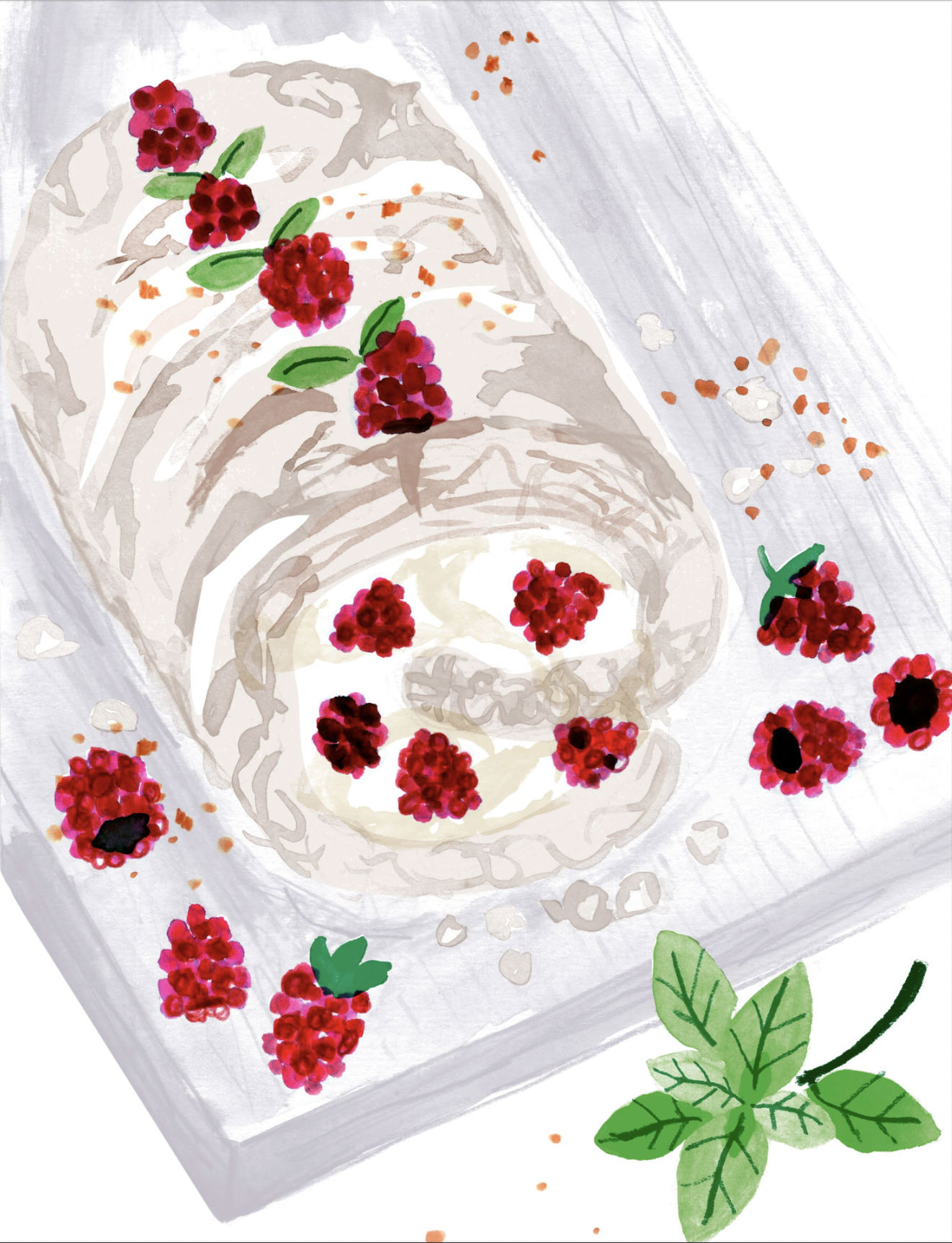
Hazelnut Roulade with Rosewater and Raspberries by Cindy-Marie Harvey

Hazelnut Roulade with rosewater & raspberries

Paired Wine: Sparkling Rosé NV from Wiston Estate 

If you are reading this recipe on a dark, grizzly November day, I urge you to make this roulade and open a bottle of Wiston Sparkling Rosé. You will instantly be transported to a long, lazy, summer Sunday lunch in a sunny English garden. Roulades are a bit of a go-to in my kitchen if I need something that looks very impressive but is a doddle to make, be it sweet or savoury. Although I have suggested raspberries here, you could use redcurrants, rhubarb or strawberries, all of which match the red-fruit aromas in this delectable sparkling wine. As an aside, this rosé is also the ideal wine to serve with sweet-cured bacon and ricotta pancakes for brunch!

SERVES SIX TO EIGHT

4 egg whites
225g caster sugar
50g roasted hazelnuts, finely chopped, plus extra to serve
300ml double cream
Rosewater, to taste
200g raspberries, plus extra to serve Neutral vegetable oil, to grease 

Preheat the oven to 180°C fan/200°C/gas mark 6. Grease a Swiss roll tin (23 × 33cm) with neutral vegetable oil and line with baking parchment.

Put the egg whites into the scrupulously clean bowl of a stand mixer. Whisk until stiff points form.

Still whisking, gradually add the sugar, about a heaped teaspoon at a time, and whisk well. By the time all the sugar is added the meringue should be glossy with very stiff peaks. Spread into the prepared tin, sprinkle with the nuts and bake for 8 minutes – it should be lightly coloured.

Reduce the temperature to 140°C fan/160°C/gas mark 3 and bake for another 20 minutes. Meanwhile, lay a large sheet of baking paper on a flat surface.

Remove the meringue from the oven and turn it over onto the sheet of baking paper (the nutty side will be underneath). Carefully peel off the lining paper from the meringue. Allow to cool for about 10–15 minutes.

Meanwhile, whip the cream until soft peaks form. Add the rosewater according to taste. It is quite enthusiastic in flavour, so start with 1⁄2 teaspoon and taste to see if you need more.

Spread the whipped cream over the cold meringue and scatter with the raspberries.

Now form it into a Swiss roll shape. Using the base sheet of paper as an aid, roll the meringue firmly from one long side. Wrap in a fresh sheet of baking paper and chill in the fridge for an hour before serving.

Serve the roulade in thick slices, perhaps with more fresh raspberries on the side and a few chopped hazelnuts.

Cook more from this book
Roasted Monkfish Tail with ’Nduja, White Beans and Samphire by Cindy -Marie Harvey
Twice-Baked Goat’s Cheese and Wasabi Leaves Soufflé by Cindy-Marie Harvey

Buy the book: Watercress, Willow and Wine

Read the review

Read an interview with Cindy-Marie Harvey

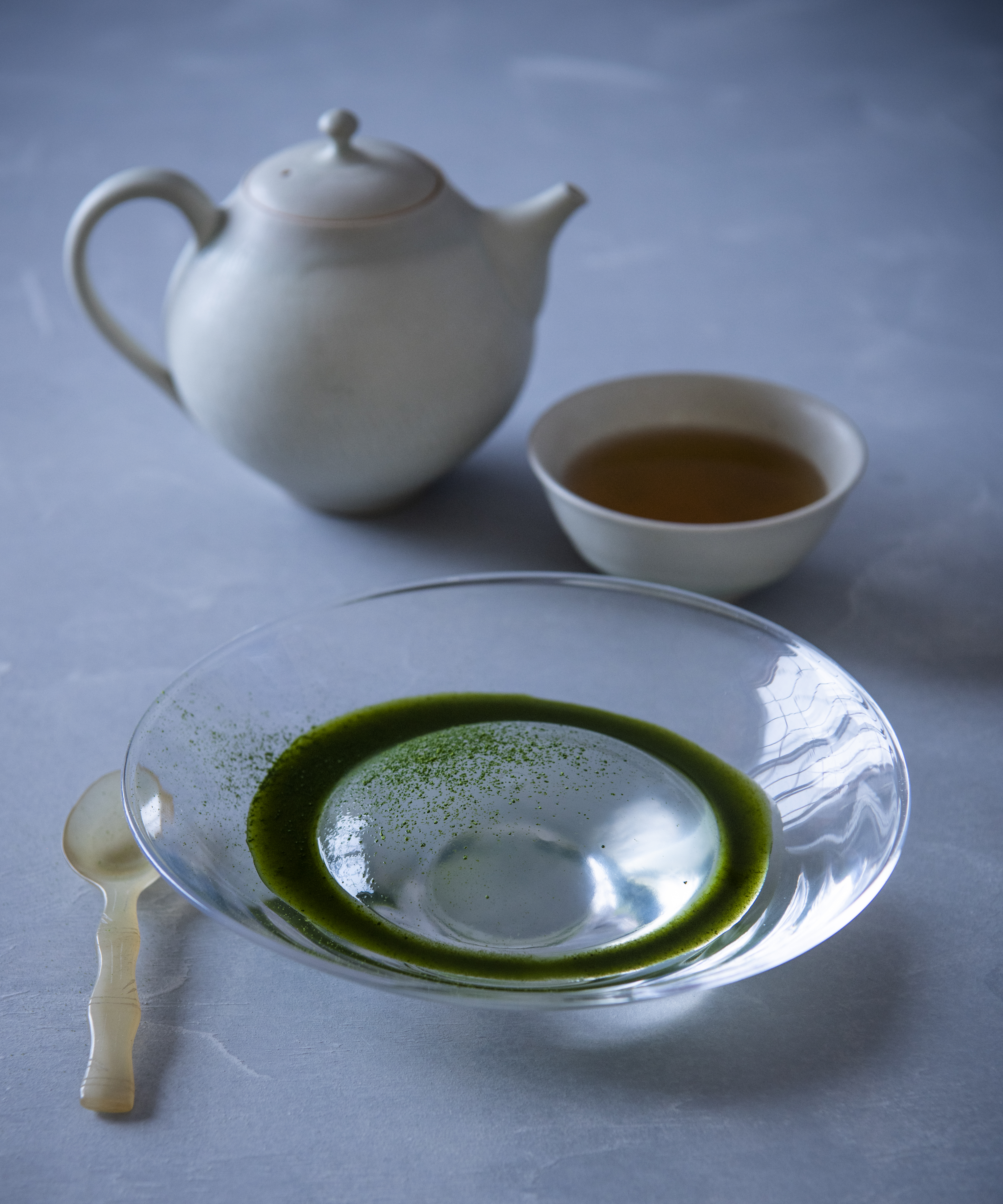
Mizu Shingen Mochi – Raindrop Cakes by Brendan Liew

TUL_Izakaya_Mizu Shingenmochi
This may be called a ‘cake’ in English, but it is really a jelly. A jelly that is very lightly set using agar, and resembles a crystal-clear raindrop, accompanied by a flavoured syrup. I’ve gone with a matcha syrup for this recipe, but traditionally it is served with the black sugar syrup (see page 188 of the book) and sprinkled with kinako (roasted soy bean flour). A raindrop cake looks spectacular, and with the right moulds (spherical ice moulds or semicircular moulds) is very easy to prepare. This makes it a great, easy dessert for busy izakayas, and a refreshing end to a meal.

1 g (1/28 oz) kanten agar
400 ml (14 fl oz) water
80 g (23/4 oz) sugar
2 teaspoons matcha powder, plus extra for sprinkling

SERVES 4
Set out four small bowls or circular moulds, about 6 cm (21/4 inches) in diameter. In a small saucepan, combine the agar, water and 20 g (3/4 oz) of the sugar. Bring to a simmer, stirring constantly to dissolve the sugar and agar. Working quickly, so the liquid doesn’t start solidifying in the pan, pour the mixture into the bowls, then refrigerate for at least 2 hours to set.

Make a matcha syrup by whisking together the matcha powder and remaining (60 g) sugar in a small bowl. Heat 30 ml (1 fl oz) water in a small saucepan until simmering, then slowly stream it into the matcha powder and sugar, whisking well.

Pour the mixture back into the saucepan and cook over low heat, just until the sugar has dissolved. Pour the syrup into a container and refrigerate.

When the cakes have set, unmould each one onto a serving plate. Spoon the matcha syrup around them, sprinkle a little matcha powder over and serve.

Cook more from this book
Salmon Ochazuke by Brendan Liew
Kamo Negi – Duck With Grilled Leeks by Brendan Liew

Buy this book
Tokyo Up Late by Brendan Liew
£26,  Smith Street Books

Read the review
Coming soon

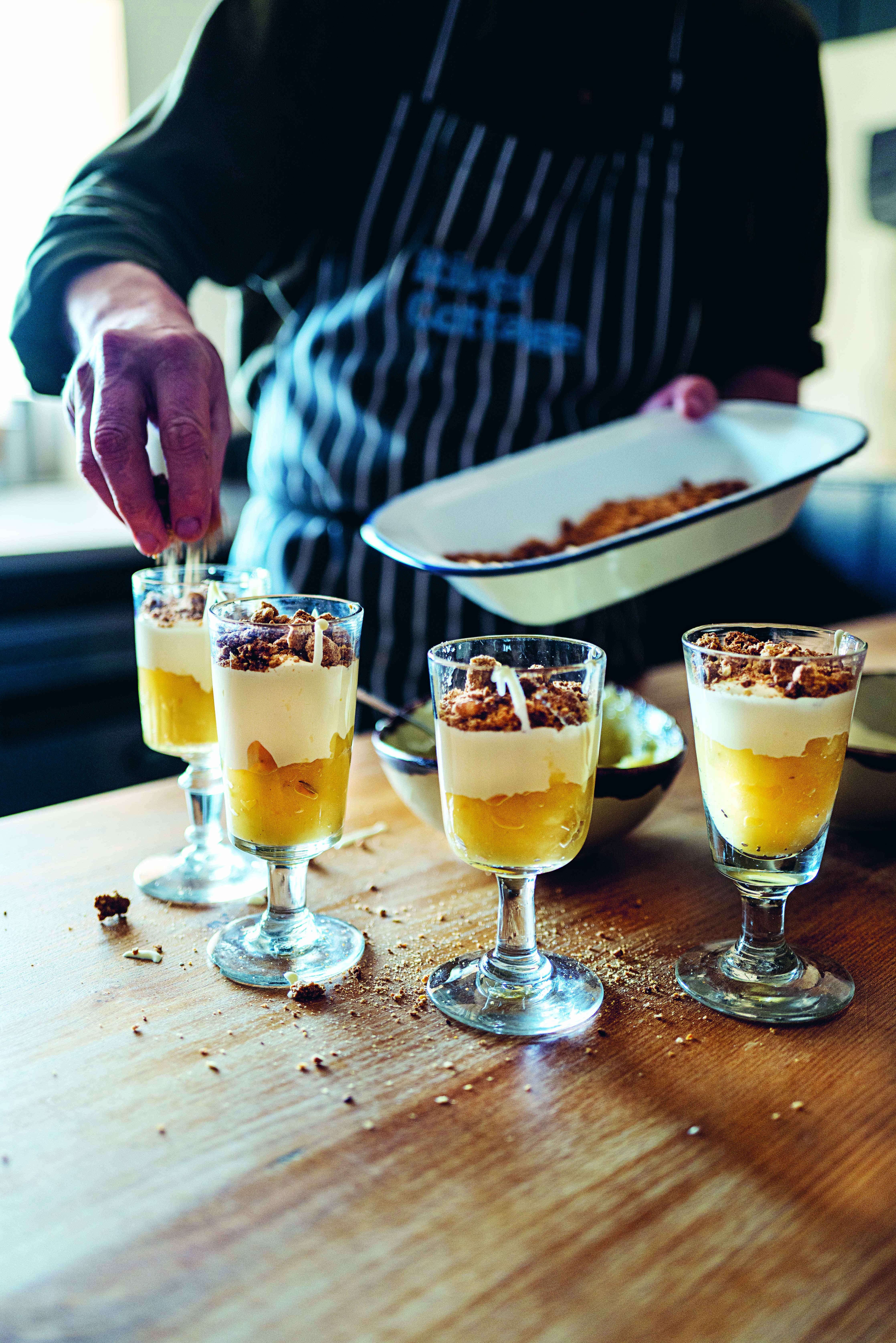
A Festive Fumble by Hugh Fearnley-Whittingstall

L1450308

6 servings

For the ‘independent’ crumble:
50g butter, diced (or use 50ml vegetable oil, for a vegan crumble)
75g light wholemeal cake flour or wholegrain spelt flour
50g porridge oats or fine oatmeal 50g ground almonds or hazelnuts 100g almonds, hazelnuts or walnuts, roughly bashed or chopped, or 100g cooked chestnuts, crumbled
30g sugar (soft brown, golden granulated or demerara)
A pinch of salt

For the Bramley and verbena compote:
Juice of 1 lemon
1kg Bramley or other cooking apples
12 dried lemon verbena leaves (see book)
50–100g caster sugar

To serve:
Plain yoghurt, lightly whipped cream (or a mixture of both)

For the crumble, preheat the oven to 190°C/Fan 170°C/Gas 5 and have ready a large baking tray. Either rub the butter into the flour in a large bowl to get a coarse breadcrumb texture then stir in the other ingredients, or soften the butter first and mix everything together in one go with your hands (which is the best approach if you’ve used oil).

Either way, break the mix into chunky clumps and spread out in the baking tray. Bake for 15–20 minutes, stirring the mix at least once, until golden brown. Leave to cool completely. If you are not using it straight away, store the crumble in a jar, or sealed tin or plastic container for up to a week.

To make the compote, put the lemon juice into a large pan. Peel, core and slice the apples into the pan, tossing them with the juice as you go so they don’t brown. Add the dried lemon verbena leaves, sugar and 2 tbsp water.

Bring to a simmer, stirring often, and cook gently, stirring occasionally to help the apples break down, for about 20 minutes until you have a slightly chunky purée. Taste and add more sugar if you like – but keep the compote nicely tart because it will be paired with the sweet crumble. You can either serve your compote straight away or let it cool then chill it.

To assemble your festive fumble, divide the apple compote between serving glasses or bowls. Add a generous dollop of yoghurt, whipped cream or a combination of the two. Top with a layer of crumble mix, and tuck in – swirling your fumble as you eat.

Variation
Citrusy Bramley compote
Instead of lemon verbena, use the finely grated zest and juice of 1 orange; also include the grated zest of the lemon used in the recipe. Add to the lemon juice in the pan as you start the apple compote and proceed as above, but don’t add the 2 tbsp water.

Cook more from this book
Chestnut and Chocolate Cake by Hugh Fearnley-Whittingstall
My Favourite Stuffing by Hugh Fearnley-Whittingstall

Read the review
Coming soon

Buy this book
Christmas at River Cottage
£22, Bloomsbury Publishing

Extract taken from Christmas at River Cottage by Lucy Brazier, with seasonal notes and recipes from Hugh Fearnley-Whittingstall (Bloomsbury, £22)
Photography © Charlotte Bland

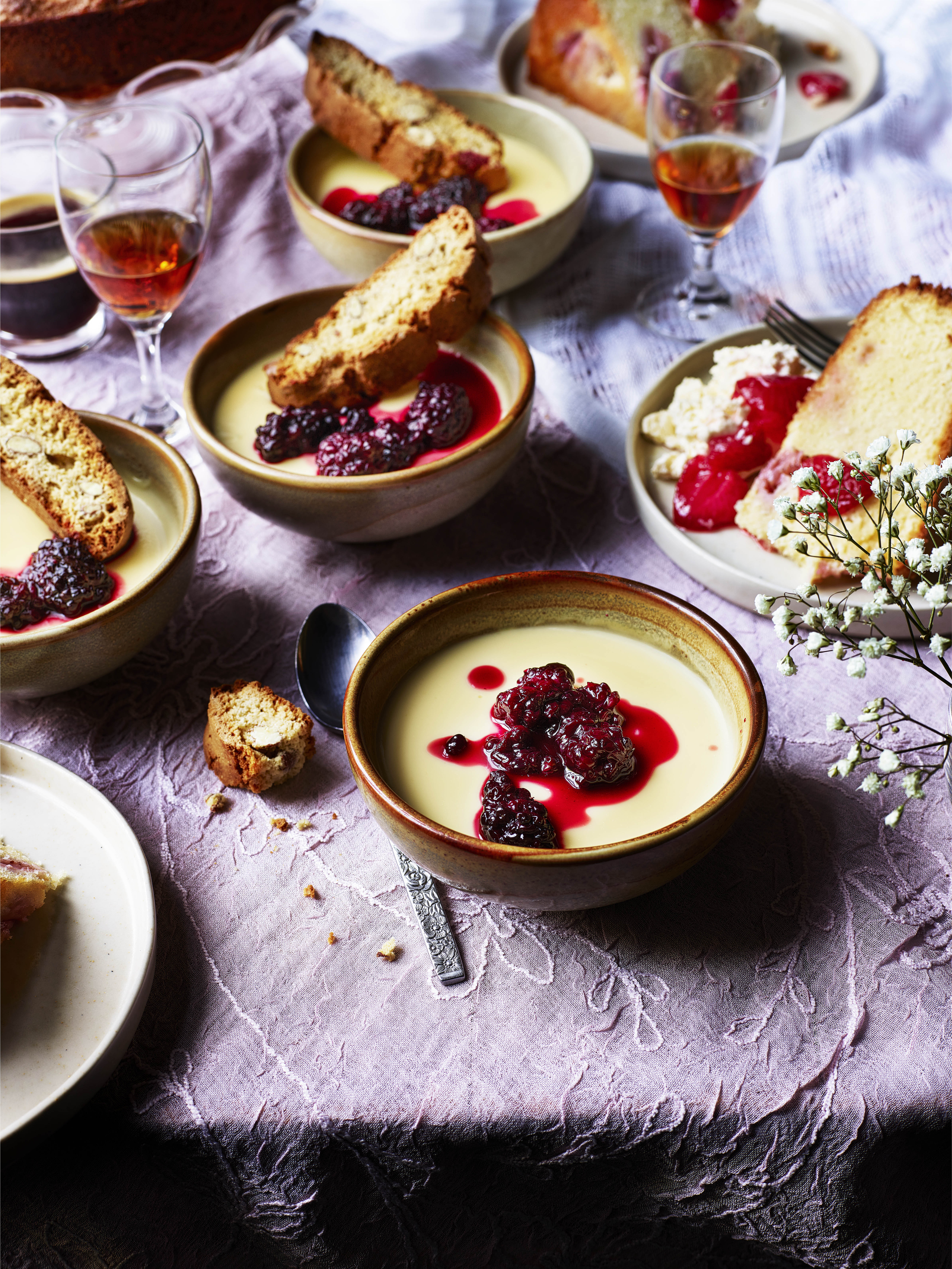
Sicilian Lemon Cream by Ben Tish

1419_AbsolutePress_Ben_Tish_Sicilia_2020-09-14_Peter_Moffat
Unlike similar puddings that use flours for thickening, this very simple posset-style pudding really showcases the zingy, fragrant flavour of the lemons. The mix of cream and mascarpone is not only rich and indulgent, but fresh too. Unwaxed lemons will give the best flavour. I like to make this in the early winter months when Sicilian and Amalfi lemons are bursting into season.

Mulberries aren’t as common in the UK as they are in Europe but if you can find them, perhaps in a Middle Eastern supermarket or a specialist fruiterer, they are utterly delicious. They resemble an elongated blackberry with denser flesh and a singular sweet-sour aromatic flavour. Blackberries will make a very good alternative.

Serves 4

For the lemon cream
2 large unwaxed lemons with unsprayed leaves
150g caster sugar
150ml double cream
300g mascarpone

For the berries
250g mulberries or blackberries
150ml good red wine
60g golden caster sugar
1 tablespoon honey

Zest the lemons and squeeze the juice; you need 80ml juice. Put the lemon zest and 80ml juice in a saucepan with the sugar. Heat over a medium-low heat, stirring until the sugar has dissolved completely. Remove from the heat and keep warm.

In a separate pan, heat the cream and mascarpone over a medium-low heat, bringing just to a simmer – do not let it boil (otherwise it may separate). Remove from the heat, add the lemon mixture and whisk. Cool slightly, then strain through a fine sieve into bowls. Cool completely, then leave in the fridge for at least 8 hours or until firm and chilled.

While the lemon cream is chilling, prepare the stewed berries. Place the fruit in a saucepan, just cover with water and add the wine, sugar and honey. Bring to the boil, then simmer for 10 minutes or until the fruits are very tender but still holding their shape. Use a slotted spoon to remove the fruits from the liquid to cool. Boil the remaining liquid until syrupy. Let this cool, then pour over the berries. Chill.

To serve, spoon some of the berries on to each cream. Delicious with biscotti.

Cook more from this book
Pasta alla Norma by Ben Tish
Aeolian-style Summer Salad by Ben Tish

Read the review
Coming soon

Buy the book
Sicilia: A love letter to the food of Sicily
£26, Bloomsbury Absolute

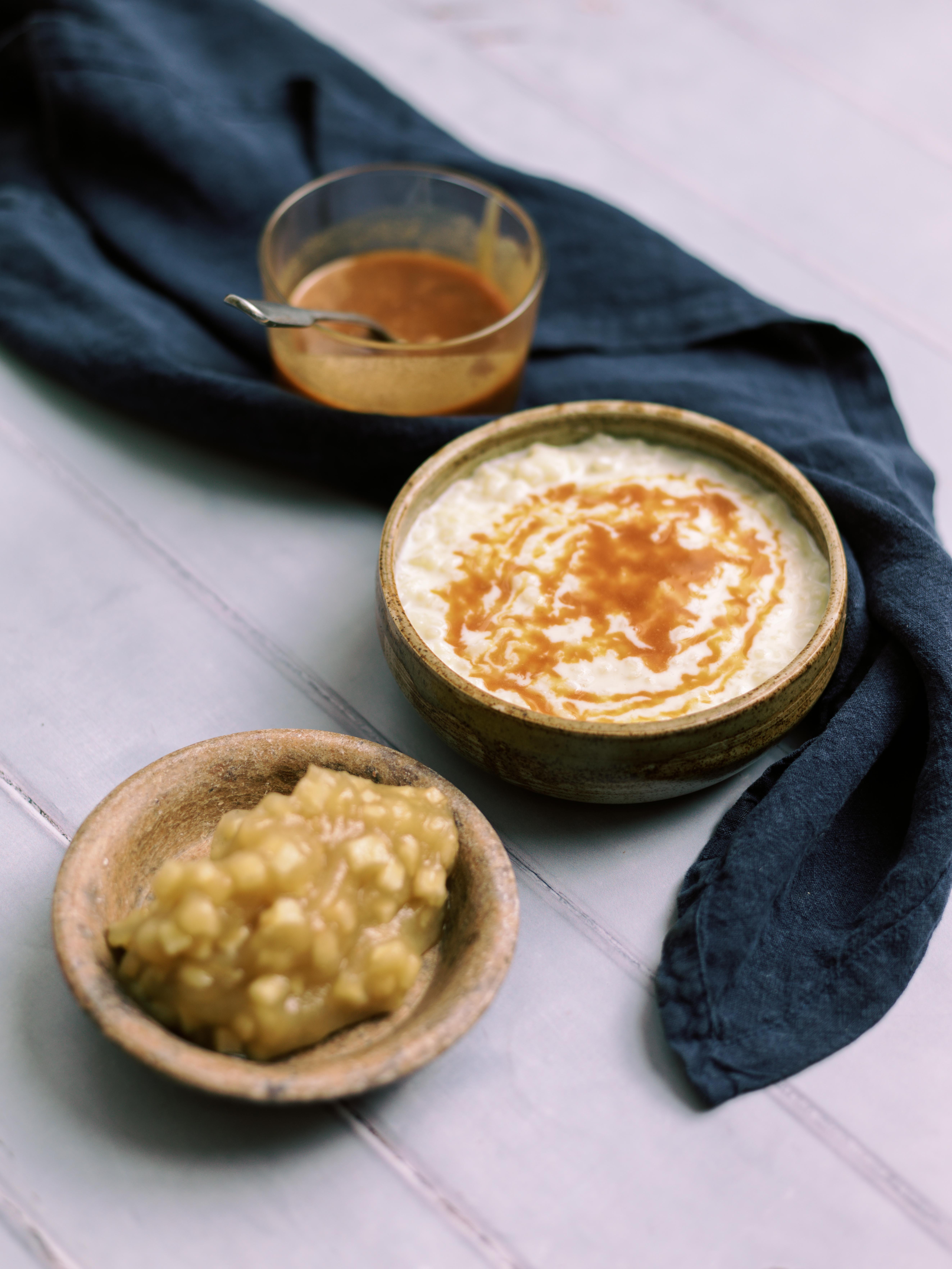
Rice pudding with apple compote and milk jam by Rob Howell

Rice pudding - 227

Muller Rice was a regular treat growing up and I love them to this day – ‘madeleine’ memory flavours are always the best. This is Root’s take on Muller Rice which we serve cold on top of an apple compote. The puddings can be made in advance and will keep very well in the fridge for a good few days along with the milk jam.

SERVES 4

FOR THE APPLE COMPOTE
20g caster sugar
3 large cooking apples, peeled, cored and thinly sliced
2 Granny Smith apples, peeled, cored and cut into 3mm dice

FOR THE MILK JAM
65g caster sugar
280ml whole milk
½ teaspoon bicarbonate of soda

FOR THE RICE PUDDING
100g pudding rice
650ml whole milk
50ml double cream
65g caster sugar
1 teaspoon vanilla seeds (scraped from ½ vanilla pod)
1 bay leaf
1 star anise
zest of 1 unwaxed lemon

First, make the apple compote. Tip the sugar into a medium saucepan and add the sliced cooking apples. Place the pan over a medium heat and allow the apples to break down for about 5 minutes, until soft. Transfer the apple mixture to a food processor and blitz until smooth. Return the purée to the pan and add the diced Granny Smiths. Place the pan over a low heat and cook the sauce for about 2–3 minutes, until the apples have softened. Remove from the heat and set aside.

Make the milk jam. Place all the ingredients into a small saucepan over a medium heat. Bring to the boil, then turn down the heat to a low simmer. Cook, whisking occasionally, for approximately 15–20 minutes until you have a dark brown caramel. Leave to cool. (Any leftovers will store in the fridge for up to 5 days.)

Rinse the pudding rice in a bowl and repeat until the water runs clear. Tip the rice into a large saucepan and add the remaining pudding ingredients. Place over a low heat and cook, stirring well, for 15 minutes, or until the rice is softened but still has a little bite.

Spoon the apple compote equally into the bottom of each bowl. Top with equal amounts of the rice pudding and spoonfuls of milk jam, adding as much as you wish. Serve warm or cold.

Cook more from this book
Buttermilk-fried celeriac with Korean-style sauce by Rob Howell
Roasted carrots with spiced pumpkin seeds, peaches and crème fraîche by Rob Howell

Read the review

Buy this book
Root: Small vegetable plates, a little meat on the side
£26, Bloomsbury Absolute

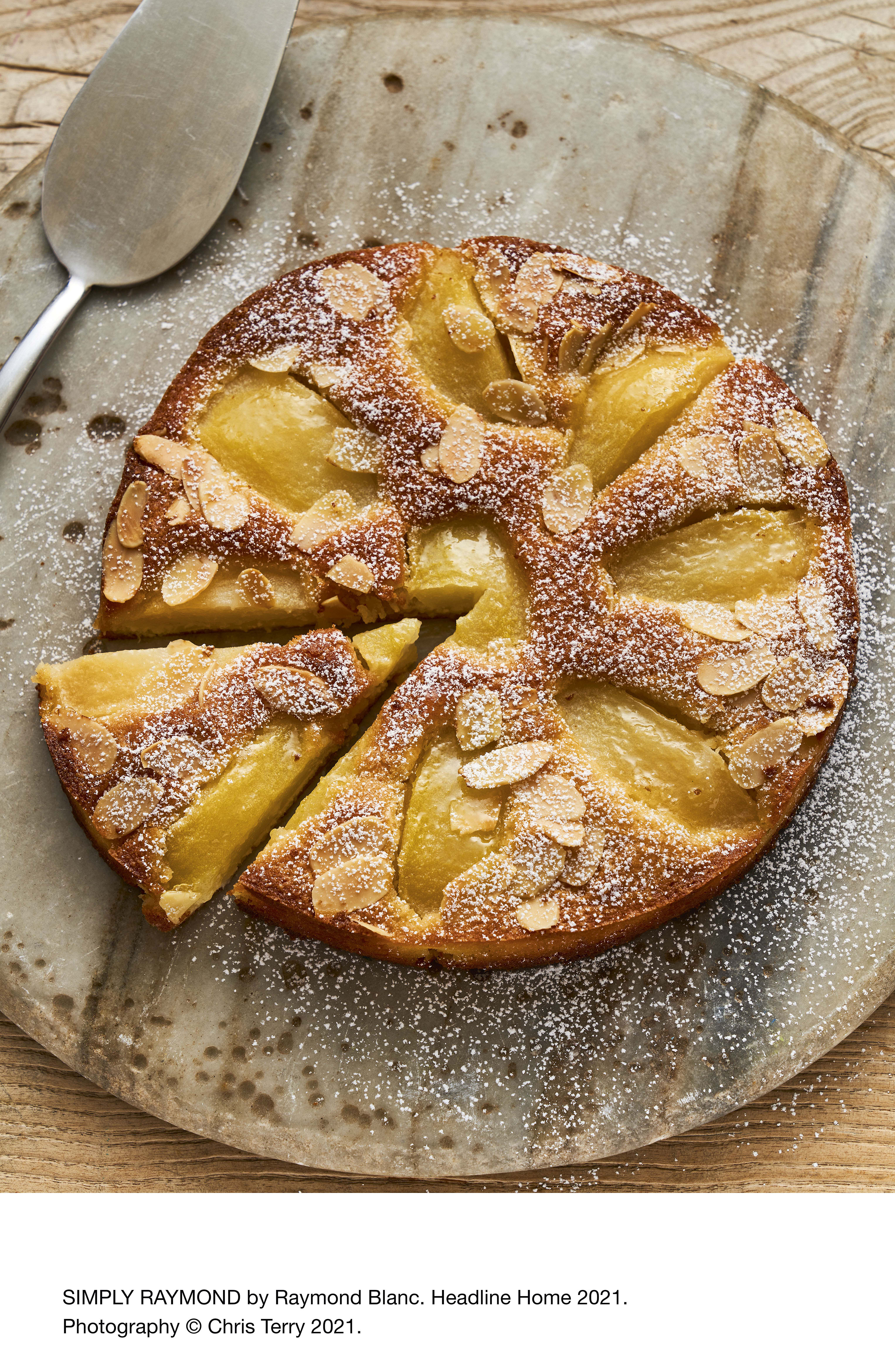
Pear almondine by Raymond Blanc

SIMPLY RAYMOND by Raymond Blanc. Headline Home 2021

It’s rare to find a dessert that is both simple and extraordinarily delicious. Pear Almondine is one of my favourites. You can find some excellent preserved Williams pears in jars or tins, ideal for this recipe. This dessert is a template to accommodate many other fruits and flavours. For baking like this, I like to use a baking stone. However, if you don’t have this, it will still be a winner.

SERVES 6
6 pear halves, tinned or jarred
100g unsalted butter, at room temperature, plus extra for brushing the tin
100g caster sugar
100g ground almonds
1 teaspoon cornflour
1 teaspoon vanilla extract
1 medium egg (preferably organic or free-range)

To serve
a handful of flaked
almonds (for extra flavour, first toast them in a dry pan)
icing sugar, for dusting

Preheat the oven to 200°C/180°C fan/gas 6. Butter (or oil) a tart ring, about 18cm x 2cm. Cut a long strip of greaseproof paper to stick to the inside. Place the lined tart ring on a lined baking tray or baking stone. Drain the pears and slice them in half again if they are large. In a large bowl, mix the softened butter and sugar. Then add ground almonds, cornflour, vanilla and egg, and mix well. Spoon the mixture into the cake tin, spreading it evenly.

Arrange the pear halves evenly around the outside of the tart, resting them on top of the almond sponge mixture, and with the tip of each half meeting in the middle. According to size of the pears, you may require the base of half a pear to fill a space in the centre. Scatter with almonds. Bake the tart on the middle shelf of the oven, on the preheated baking stone or baking tray, for 20–25 minutes, or until golden. Leave the cake to cool for a few minutes before removing it from the ring. Before serving, dust with icing sugar.

VARIATION
In a saucepan, reduce the syrup from the jar, let it cool and add a dash of Poire William, the pear liqueur. After baking, puncture the pears with a fork and pour over the syrup. It adds colour and flavour.

Cook more from this book
Mussel and saffron risotto by Raymond Blanc
Slow-roasted shoulder of lamb, harissa by Raymond Blanc

Read the review

Buy this book
Simply Raymond: Recipes from Home – The Sunday Times Bestseller, includes recipes from the ITV series
£25 Headline Home

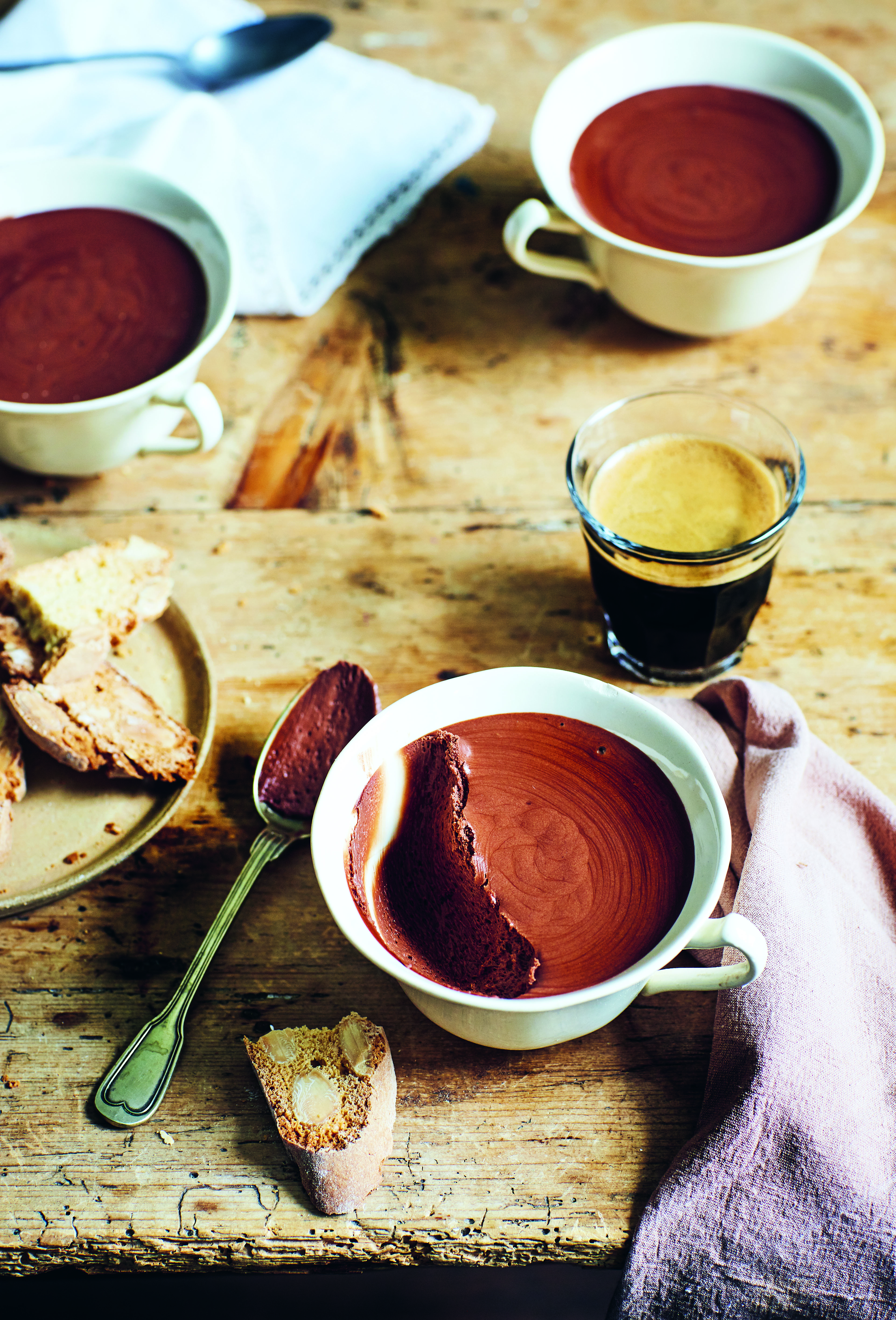
Chocolate, espresso and vin santo pots with cantuccini biscuits by Theo Randall

2020602_TheoW2_ChocolatePots_075

I first tasted vin santo many years ago at Paolo di Marchi’s estate Isole e Olena, in Chianti, Tuscany. After the vineyard tour, we came to a brick outhouse that had no windows, and was breezy but dry. There were bamboo mats full of the most beautifully coloured grapes that were starting to shrivel up like raisins, soon to be pressed for their juice to make vin santo. That evening, after a huge meal and lots of Paolo’s other wines, we had a glass of vin santo and a plate of homemade cantuccini biscuits. I use vin santo in lots of sweet dishes, especially ice cream, but I love chocolate, too, so I came up with this recipe. What could be better?

Serves 6

For the cantuccini

2 organic eggs
2 tbsp honey (chestnut honey is best, if possible)
1 tbsp Amaretto or brandy
zest of 1 unwaxed orange
250g (9oz) plain (all-purpose) flour
150g (5½oz) caster (superfine) sugar
1 tsp baking powder
150g (5½oz) whole almonds50g (1¾oz) shelled pistachios

For the chocolate pots
100ml (3½fl oz) whole milk
25ml (1fl oz) vin santo
300ml (10½fl oz) double (heavy) cream
200g (7oz) 80% dark (bittersweet) chocolate (use 70% if you can’t find 80%), chopped
50g (1¾oz) caster (superfine) sugar
4 organic egg yolks

First, make the cantuccini biscuits. In a large bowl whisk together the eggs, honey, Amaretto or brandy, and orange zest. Add the flour, sugar and baking powder. Using your hands, mix everything together to a dough, then add the almonds and pistachios. Mix well to distribute the nuts evenly through the dough.  Divide the dough into two equal pieces. Wet your hands and then roll out each piece of dough into a log about 3cm (1¼in) wide and 20cm (8in) long. Place the logs on a baking sheet, cover with a sheet of baking parchment and refrigerate for 30 minutes.

Preheat the oven to 180°C/160°C fan/350°F/Gas Mark 4.

Bake the chilled cantuccini logs for 30 minutes, or until they are a golden brown. Remove from the oven (but leave the oven on) and transfer (off the baking sheet) to a wire rack to cool. When they are cool, using a bread knife, cut the cantuccini at a 45 degree angle into pieces 1 cm (1/2 inch) thick.

Place the cantuccini, spaced well apart, on a baking sheet lined with baking parchment. Return tot he oven for 10 minutes until crisp and golden brown.  Remove from the oven and transfer (off the baking sheet)  to a wire rack to cool completely. Once cool, place in a sealed container or serve straight away with the chocolate pots. (If you’re storing the biscuits, it’s very important that the cantuccini are fully cooked before you place them in the sealed container, otherwise the residual heat will make them go soggy.) 

To make the chocolate pots, pour the milk, vin santo and cream into saucepan and place on a medium heat. Bring to the simmer, then turn off the heart and add the chocolate. Leave for 1-2 minutes for the chocolate to soften. Using a spoon or a whisk, stir until the chocolate has melted and the mixture is smooth. 

Whisk the sugar and egg yolks in the bowl of a stand mixer on medium speed for about 3 minutes, until the mixture is pale and creamy. (Alternatively whisk by hand in a bowl for about 5 minutes.)

If using a machine, reduce the speed to its lowest setting. Slowly pour in the melted chocolate mixture and mix until an even colour. (Or do this in a bowl by hand.)

Pour the mixture into individual serving dishes (ramekings, glasses or cups will work). Refrigerate for at least 2 hours, then serve with cantuccini biscuits and really good, hot espresso. 

Cook more from this book
Roasted Italian sausages with borlotti beans and ’nduja sauce by Theo Randall
Twice-baked squash and fontina soufflé by Theo Randall

Buy this book
The Italian Deli Cookbook: 100 Glorious Recipes Celebrating the Best of Italian Ingredients
£26, Quadrille Publishing

Read the review