The ultimate sausage roll by Calum Franklin

The Pie Room Book dishes
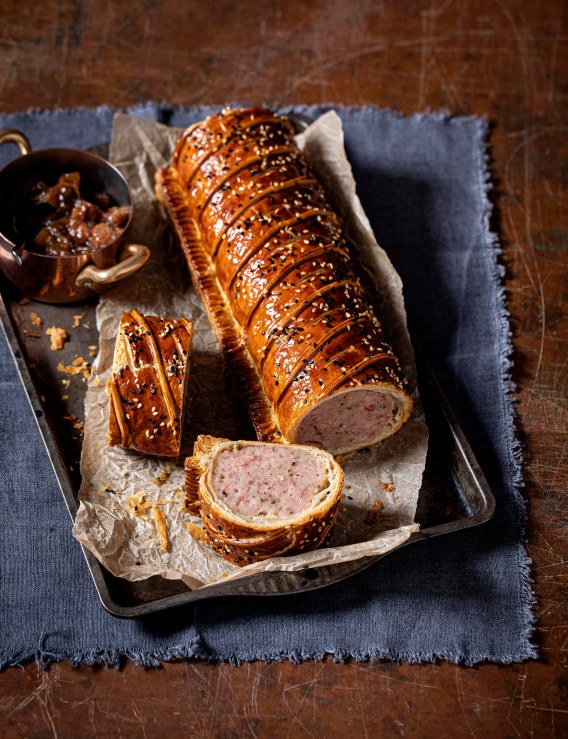
In an attempt to find the perfect example, we have tested different flavours and textures for the filling of our sausage rolls at The Pie Room. It always comes back to one thing: simplicity. The filling should be tasty but not overcrowded with too many flavours and textures. The addition of a little chopped bacon and a few thyme leaves
to Cumberland sausagemeat are the only changes we make, but the devil is in the detail. For me, the key to the Ultimate Sausage Roll actually lies in the ratio of meat to pastry. When the meat takes longer to cook, the crisper the pastry will be.

Serves 4

400g rough puff pastry (see book for recipe or use classic puff pastry or shop-bought puff pastry)
2 egg yolks beaten with 2 teaspoons water, for brushing
pinch of black sesame seeds
pinch of white sesame seeds
Plum and Star Anise Chutney, to serve (see page 248)

For the filling
700g Cumberland sausages, skins removed
150g streaky bacon, finely chopped
25g thyme, leaves picked
⅓ teaspoon table salt
large pinch of freshly ground black pepper

Equipment
large plastic piping bag
(optional)

Line a large baking tray with parchment paper. On a lightly floured surface, roll the pastry out to 5mm thick in a 40cm x 25cm rectangle. Slide the rolled-out pastry onto the lined tray and chill in the refrigerator for 30 minutes.

Meanwhile, put the sausagemeat, bacon, thyme, salt and pepper into a bowl and mix well with your hands. Fill a large plastic piping bag with the sausagemeat filling. If you don’t have a piping bag, shape the filling into a 6cm wide sausage and wrap tightly in clingfilm, firmly twisting the ends. Chill the filling in the refrigerator for 20 minutes.

Remove the rolled-out pastry from the refrigerator and dust off any excess flour from the surface. Leave the pastry on the parchment paper.  Using kitchen scissors, snip the tip of the piping bag to make a 5cm wide opening. Working from one end of the pastry rectangle, slowly pipe the sausagemeat filling down the length of the pastry 6cm inside one edge.

Alternatively, remove the clingfilm from the sausagemeat, unwrapping it over
the pastry rectangle, and place the filling 6cm inside one edge of the pastry. Lightly brush the larger exposed area of pastry all over with egg wash, leaving the narrow 6cm border clear. Fold the egg-washed pastry over the filling to meet the narrow border, align the pastry edges and press firmly together. Lightly dust the tines of a fork with flour and tap off any excess. Working down the length of the seam, firmly press the ends of the fork into the pastry to leave an impression of the tines. Whenever necessary, dust the fork with more flour to stop it sticking to the pastry.

Lightly brush the sausage roll all over with egg wash and return to the refrigerator for 10 minutes to allow the egg wash to dry. Brush a second layer of egg wash over the sausage roll and then, using a sharp knife, lightly score the top of the pastry with diagonal lines all the way down its length. (This gives the pastry a little stretching room and stops it from tearing open at the seam.) Return the sausage roll to the refrigerator to chill for a further 10 minutes.

Preheat the oven to 190°C fan/210°C/gas mark 6½.

Trim a little off the fluted seam of the pastry to neaten it into a straight edge, then brush a final layer of egg wash all over the sausage roll. Sprinkle the black and white sesame seeds along the top of the roll. Pop the tray into the preheated oven and bake the sausage roll for 25 minutes. Check the internal temperature of the filling with a digital probe thermometer – you are looking for 75°C or above. If necessary, return the sausage roll to the oven and check the temperature again every 5 minutes until it reaches 75°C. Alternatively, insert a metal skewer into the centre of the sausage roll and then press it against your hand – it should be very hot to the touch.

Remove the tray from the oven and transfer the sausage roll to a wire cooling
rack. Leave to cool for 10 minutes before cutting the sausage roll with a serrated
knife into eight equal slices. Serve warm with spoonfuls of chutney

Cook more from this book
Hot pork pie 
Glazed Apple Tart
Classic puff pastry

Read the review

Buy the book
The Pie Room: 80 achievable and show-stopping pies and sides for pie lovers everywhere
£26, Bloomsbury Absolute
Hot pork pie by Calum Franklin

The Pie Room Book dishes

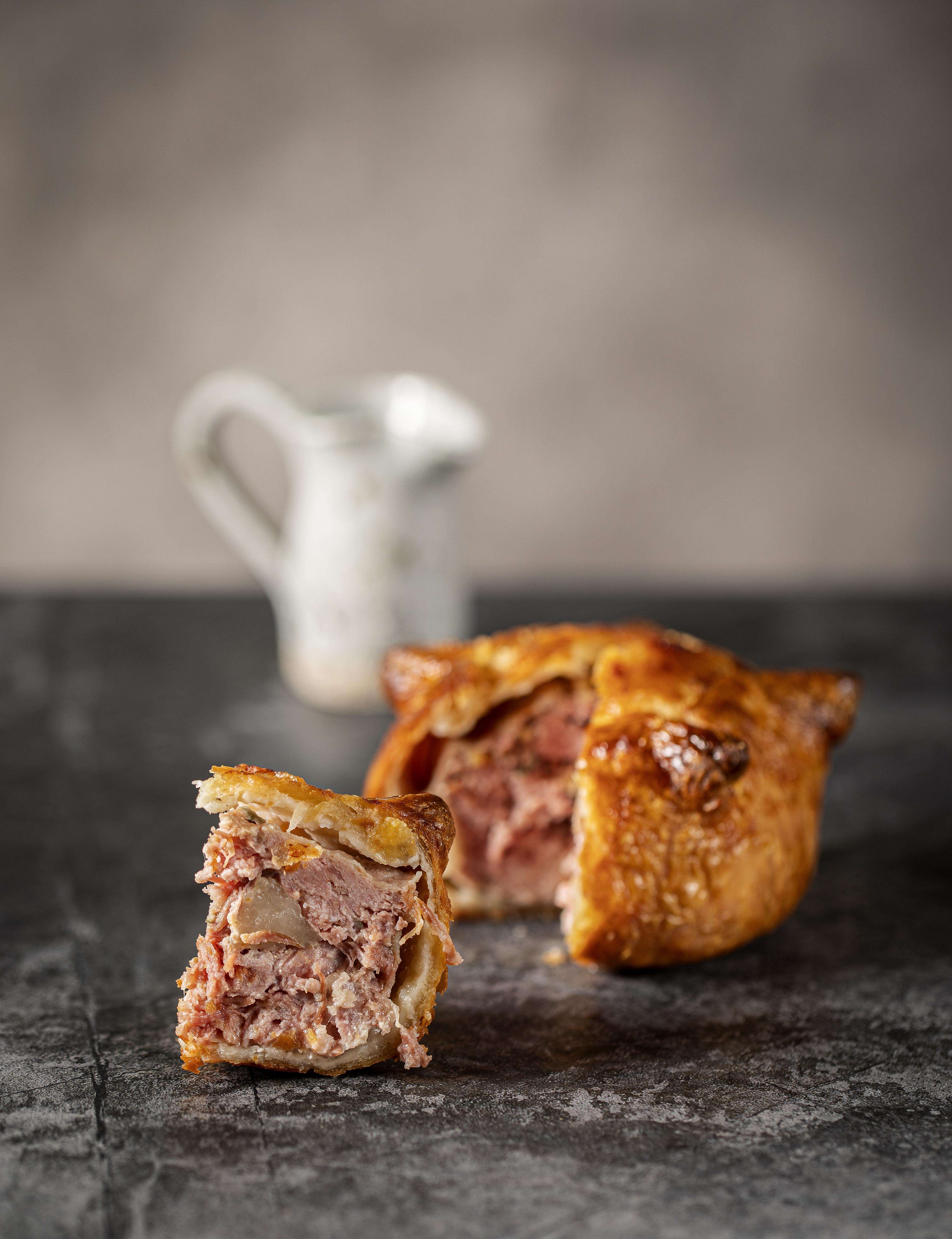
Hot Pork Pie

 For centuries, pork pies have firmly held a place in British food culture as a way to use up cuts of pork less desirable than, say, fillet or loin, but truly delicious when handled with care. The most common style of pork pie found in the UK is the cold, jellied picnic pie, however my preferred way to serve a pork pie is piping hot, just out of the oven. The pastry is crispier, the fats are still unctuous, juicy and melting, and the herbs are fragrant.

The first time I ate a hot pork pie was at a pub in the West Country: I remember so clearly wondering why we had never served a hot version in the Holborn Dining Room. As soon as I went back to work, I immediately set about rectifying that. In this recipe, a traditional pork pie dolly (a smooth wooden tool) is used to shape the dough. You can find a dolly easily online, but you could also use a jam jar or a well-buttered metal ring of the same diameter. Roll the pastry into a circle, use it to line the ring, fill and press on a lid, then carefully remove the pie from the ring. Try using a dolly though – you will feel like a character from a Dickens novel (dressing up as one is not necessary, though fully applauded).

SERVES 4

800g hot water crust pastry
plain flour, for dusting
2 egg yolks beaten with 1 teaspoon water, for brushing

For the filling

500g pork shoulder, half minced and half roughly chopped
120g smoked streaky bacon, roughly chopped
100g lardo, cut into 1cm dice
1 teaspoon fennel seeds
1 teaspoon yellow mustard seeds
1½ teaspoons fine table salt
30g sage, leaves picked and finely chopped
a few good twists of freshly ground black pepper

To serve

mashed potato
Onion, Stout and Thyme Gravy (see below)

Equipment

7.5cm diameter pie dolly and digital probe thermometer
Line a baking tray with parchment paper.

Weigh out the pastry dough into four balls weighing 150g and four smaller balls weighing 40g. On a lightly floured surface, flatten the 40g dough balls and roll out to 5mm thick circles. Lay the pastry circles on the lined baking tray and chill in the refrigerator until needed.

Combine all the ingredients for the filling in a mixing bowl. Using your hands, work everything well for a few minutes until the mixture holds together. Split the mixture evenly into four balls and set aside.

Take one of the 150g dough balls and gently flatten it out into a circle until it is slightly wider than the pie dolly. Dust the pie dolly well with flour, centre it on top of the dough circle and then firmly press it down into the dough. The dough will rise up the sides of the dolly and puff out like an inflatable swimming ring. Lift the dolly out of the dough and dust it with more flour. Return the dolly to the centre of the dough and, cupping the edges of the dough in your hands, squeeze it up the dolly while at the same time turning and also pushing down on the dolly. Imagine a pottery wheel as you turn and squeeze, keeping the pastry as tight to the dolly as possible.

Periodically, pause to lift out the dolly and dust with more flour to prevent the pastry from sticking to it. Keep working the pastry dough in this way until the wall of the pastry case is about 7–8cm in height and the base is 5mm thick. Carefully remove the dolly from the pastry case and pack it with one of the balls of pork meat filling.

Repeat with the remaining 150g balls of dough until you have four pie cases filled with the pork meat filling. There should be a slight excess of pastry at the top of each case, so gently curl that outwards to form a collar.

Preheat the oven to 190°C fan/210°C/gas mark 6½.

Take the pastry lids out of the refrigerator. Wet the pie collars with a little water and lay the lids on top. To join, firmly press the collars and lids together. Crimp the edges into the middle and then transfer the pies back onto the lined baking tray.

Using a skewer or the tip of a knife, make a small hole in the top of each pie to allow the steam to escape. Avoiding the base, brush the wall and lid of each pie with the egg wash and return the pies to the lined baking tray.

Place the tray in the preheated oven and bake the pies for 35 minutes or until the core temperature reads 70°C on a digital probe thermometer. If you don’t have a probe thermometer, insert a metal skewer into the centre of a pie and leave it there for 10 seconds – when it comes out, the skewer should be piping hot. Remove the pies from the oven and leave to rest for 10 minutes before serving with mash and gravy.

Onion, Thyme & Stout Gravy

Serves 8

1 litre beef stock
440ml stout
40g butter
2 teaspoons vegetable oil
4 Spanish onions, peeled and sliced
½ teaspoon table salt
15g plain flour
4 thyme sprigs, leaves picked

Place a pan over a high heat, pour in the beef stock and stout and leave to reduce by two-thirds. Meanwhile, melt the butter and oil in another pan and add the onions and salt. Gently cook the onions for 15 minutes, stirring frequently, until they start to brown. Do not rush cooking the onions; any water in the onions needs to evaporate fully in order for the natural sugars to caramelise. Add the flour and thyme to the pan with the onions and, stirring continuously, cook for a further 2 minutes.

Once reduced, gradually add half the stock to the pan with the onions. Stirring continuously, bring the stock with the onions back up to heat and allow it to thicken. Add the remaining stock to the pan and cook further until the gravy is thick enough to coat the back of a spoon. If the gravy is too thick, add a splash of water. If the gravy is too thin, continue to reduce it for a little longer.

Hot Water Crust Pastry

Traditionally used to encase cold pork pies, hot water crust pastry is one of the oldest British pie dough recipes. With early origins showing ingredients as just flour and hot water, it was likely in the Medieval times that it developed into what we now more closely know: flour, hot water and lard. It would have been used to make huge pies for banquets, encasing goose, venison and whole swans. Over time this pastry technique has changed little; it is still worked with while hot as it firms up as it cools. In The Pie Room, however, we have worked hard at adapting the traditional recipe to form a slightly lighter, crispier crust, that is fresh with the flavour of herbs and that can be worked with at a cooler room temperature and even used again after refrigeration.

Makes 1kg

200ml water
160g lard
2 rosemary sprigs
10g salt
500g plain flour
2 eggs, beaten

Combine the water, lard, rosemary and salt in a medium saucepan. Bring to the boil, then reduce to a simmer and wait for the lard to melt fully, then turn off the heat and allow to infuse.

Sift the flour into a bowl. Using either a round-bladed knife or the paddle attachment of a mixer, start to work on a medium speed. Add the egg and mix until thoroughly dispersed through the flour – this will take 2–3 minutes.

Remove the rosemary from the pan with a fork and then bring the water and fat mix to a boil. Slowly pour onto the flour and egg mix, scraping the bowl and paddle halfway through to prevent any lumps from forming. Mix for 2–3 minutes until well combined.

Allow the dough to cool on a tray between parchment paper until the heat has dissipated and then chill for 10 minutes in the refrigerator before using.
This hot water crust pastry dough can be kept for up to three days in the refrigerator or one month in the freezer. If freezing, weigh out the dough into the quantities needed for individual recipes – it will take less time to thaw and you won’t be potentially wasting any dough. To use the dough from the freezer, allow it to come back to refrigerator temperature overnight.

Cook more from this book
The ultimate sausage roll
Glazed Apple Tart
Classic puff pastry 

Read the review

Buy the book
The Pie Room: 80 achievable and show-stopping pies and sides for pie lovers everywhere
£26, Bloomsbury Absolute

Glazed apple tart by Calum Franklin

The Pie Room Book dishes

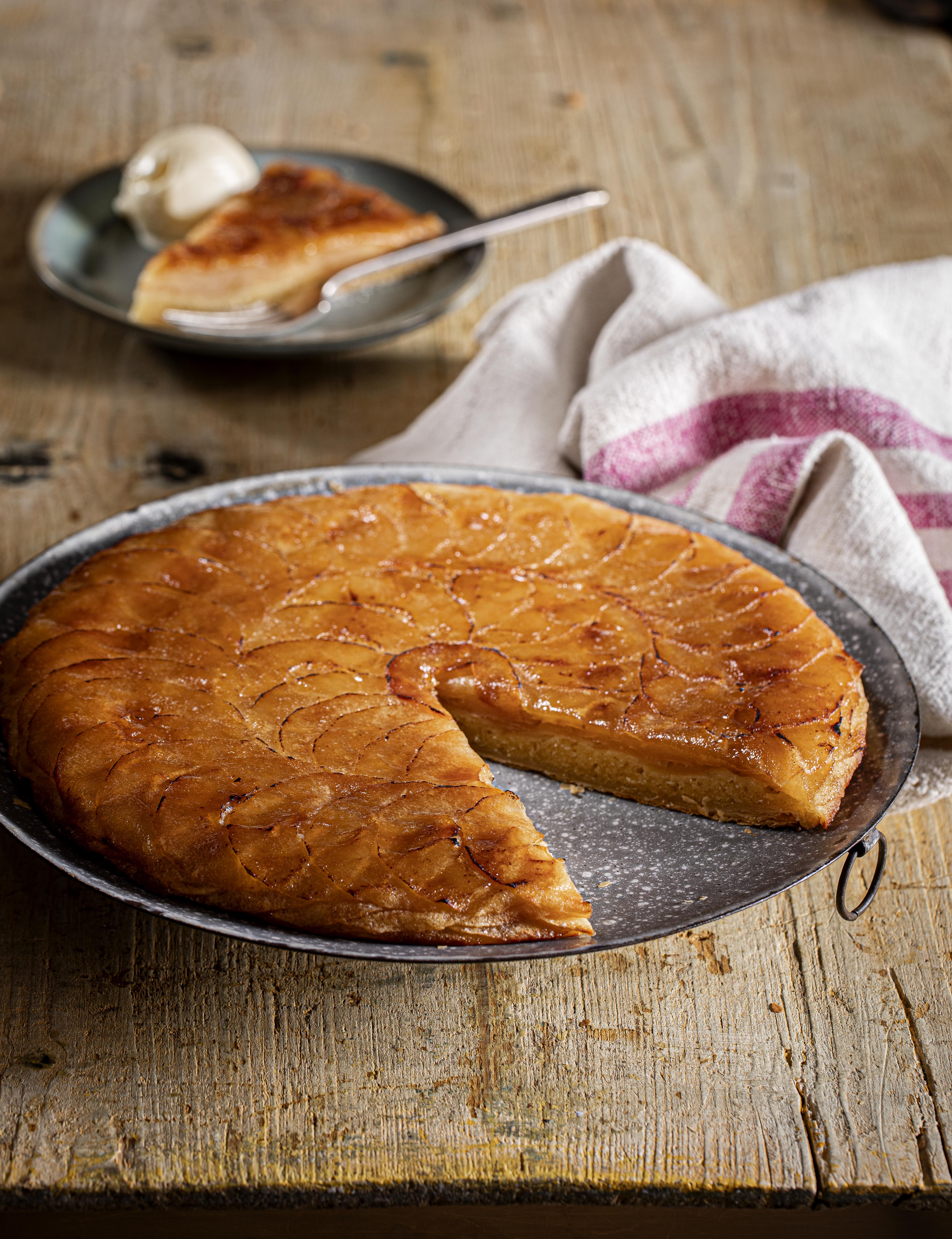
The slightly more elegant sibling of the classic apple pie, this tart is a stunning dessert. It has similar flavours to a tarte tatin as the sugar caramelises as it cooks. You could serve this tart with clotted cream to balance the sweetness of the apples.

Serves 6

300g classic puff pastry (or shop-bought)
200g frangipane (see below)
80g caster sugar
80g unsalted butter, softened
6–8 Pink Lady or Granny Smith apples
20g icing sugar
clotted cream, to serve

Line a baking tray with parchment paper. On a lightly floured surface, roll out the pastry into a large circle about 5mm thick. Slide the rolled-out pastry onto the lined baking tray and rest in the refrigerator for 15 minutes or in the freezer for 10 minutes. Remove the tray from the refrigerator or freezer. Trim the edges of the pastry into a neat circle that measures 24cm in diameter and return to the refrigerator or freezer.

Once chilled, remove the pastry from the refrigerator or freezer, and preheat the oven to 185°C fan/200°C/gas mark 6. With the pastry still on the lined baking tray, and leaving a border of 2cm around the edge, spread around 200g of the frangipane evenly across the pastry.

Using a pastry brush, mix the caster sugar and softened butter together to make a paste.

Peel and core the apples. Using a mandoline, slice the apples to 2mm thick. Take just over one-quarter of the slices and fan them out in a circle around the outer edge, keeping in line with the edge of the frangipane. Roughly brush the apples with some of the butter mixture.

Repeat with the remaining apple slices and butter mixture to create concentric circles until the pastry is covered. Make sure the top layer of apple slices is evenly coated with the butter mixture.

Place the tray in the preheated oven and bake the tart for 30 minutes or until the apples are starting to caramelise and the pastry is beginning to crisp up.

Remove the tray from the oven. Using a sieve, dust the tart with the icing sugar and then lay another sheet of parchment paper over the top of the apples. Take a second baking tray and lay it on top of that parchment paper. Using a dish towel or oven gloves to protect your hands, quickly flip the tart over so the apples are now facing downwards on the new tray. Lightly press down the top tray and then remove it and the original parchment paper. Return the tart to the oven for a further 20 minutes.

Remove the tart from the oven. This time place a serving plate or platter on top of the pastry, and then flip the tart again. Check the apples are evenly glazed and caramelised. If it needs a little longer, flip the tart back again and return it to the oven for a further 10 minutes. Serve warm with spoonfuls of clotted cream.

Frangipane

225g butter, softened
225g caster sugar
1 vanilla pod, deseeded, seeds retained
5 medium-sized eggs
225g ground almonds

Beat the butter, sugar and vanilla seeds together until the butter has turned pale and creamy. Add one egg at a time, whisking until each is fully incorporated before adding another.  Once all the eggs are incorporated, use a large metal spoon to fold in the almonds until well mixed.

Cook more from this book
The ultimate sausage roll
Hot pork pie
Classic puff pastry

Read the review

Buy the book
The Pie Room: 80 achievable and show-stopping pies and sides for pie lovers everywhere
£26, Bloomsbury Absolute

The Pie Room by Calum Franklin

The Pie Room by Calum Franklin

What’s the USP? ‘The book for pie lovers the world over’, The Pie Room is intended to be your first port of call for pie (and pie-adjacent) recipes.

Who wrote it? Calum Franklin, the executive head chef of Holborn Dining Room – a sort of eat-in altar to pies tucked in the Rosewood London Hotel. Since opening in 2014, Franklin’s pies have been winning plaudits from all corners, from food critics to Instagram, where over 100,000 users watch in awe as he shares his intricate, luxurious creations.

It’s through Instagram, in fact, that I first became aware of Franklin’s cooking. Though I am not a particularly big fan of the pie myself, there’s something irresistible about his posts. These are pies as sustenance, as delicacy, and as art – all at once.

Sorry. We skipped over something important there. Sorry?

You don’t like pies? Ah.

What’s wrong with you? Look, look, I get it. Pies are one of the few quintessentially British food traditions that remain a part of our day to day lives, sold over the deli counter at Morrisons, or awash with gravy at the football. They’re also, frequently, not particularly interesting. We rest on our pie laurels, as a nation. Where elsewhere we innovate and reinvent our food to move with the times, pies often remain more or less the same as they always have – heavy on the stodge, uninventive in their flavours and…

They called you ‘Pie Muncher’ at school, didn’t they? Well, yes, that might come into it a little too. But here’s the thing – who better, then, to take this book on and see how functional it is as a manual to all things pie? After all, Franklin’s book takes in all sorts of pie forms, includes extensive information on pastry-making, and aims to show off the dish at its very best.

So how does the book fare when preaching to the unconverted? Pretty damn well. Franklin knows his audience, so has plenty of time to spare for all the big names in pastry. If you’re looking for a recipe for a massive bloody sausage roll, a suet pudding, or a classic gala pie, you won’t be disappointed. But Franklin also makes room for more unusual ideas – a Keema-Spice Cottage Pie with a cumulonimbus potato topping, or a Moroccan Chickpea & Feta Pie, hidden beneath filo pastry that has been scrunched up like torn wrapping paper on Christmas morning.

What’s the faff factor? Not nearly as bad as it could be. Franklin acknowledges the effort involved in making your own pastry from scratch, and is happy to accept that his dishes will work just as well with a shop-bought pastry. In fact, he doesn’t even give a recipe for filo pastry, claiming that ‘I don’t see a big enough difference in handmade and shop-bought filo that justifies the time needed to make it’.

I’ve taken on a couple of the recipes from the book so far – ‘Nduja Stuffed Brioche, and the Hot and Sour Curried Cod Pie. The former definitely took some time – I was making a brioche dough from scratch, and leaving it overnight to prove. The process itself was simple enough, though, and yielded beautiful results (as well as enough leftover dough for a brioche loaf the following morning).

The Hot & Sour Curried Cod Pie was a much quicker process. If, like me, you opt to use ready made puff pastry, it could just about work as a midweek dinner. Again, the end result was a delight – the tamarind, tomatoes and chillies all playing off one another perfectly. It’s likely to find its way back into my kitchen a few times this winter.

How often will I cook from the book? The nature of pie-making (and the potential mess you’ll need to clear up) might be enough to keep this book on the shelf much of the time. But for weekend treats and impressive dinner party dishes, this will be worth at least a few visits a year.

Killer recipes: Both the dishes I tried out proved to be worth more than the price of admission, to be honest – but there’s also the Red Onion, Carrot & Hazelnut Tatin, a ridiculously over-indulgent Mac ‘n’ Cheese Pie, a Honey & Five-Spiced Glazed Ham that looks set to liven up any Christmas lunch, and a Panettone & Gianduja Pudding that I suppose I could leave a little room for after, too. And, of course, the Beef Wellington recipe you’d expect.

Should I buy it? This isn’t going to be a cookbook everyone is going to find useful – but it’s a lot more accessible than I expected it to be, and has definitely converted this pie-skeptic. For those among us who really do aspire to eat all the pies, this is essential. For everyone else, it’s still a pretty excellent book.

Cuisine: British
Suitable for: Confident home cooks/Professional chefs
Cookbook Review Rating: Four stars

Buy the book
The Pie Room: 80 achievable and show-stopping pies and sides for pie lovers everywhere
£26, Bloomsbury Absolute

Cook from this book
Hot Pork Pie
The Ultimate Sausage Roll
Glazed Apple Tart
Classic Puff Pastry

Review written by Stephen Rötzsch Thomas a Brighton-based writer. Follow him on Twitter and Instagram at @srotzschthomas.

Jikoni by Ravinder Bhogal

What’s the USP? A ‘proudly inauthentic’ cookbook, that mashes together flavours from across the globe – with particularly heavy influences from South Asian and African cuisines and a whole lot of love for tamarind.

Who wrote it? Jikoni is the passion project of Ravinder Bhogal, the chef and restaurateur behind the Marylebone joint of the same name. Born in Kenya to Indian parents, Bhogal grew up in Britain, and has clearly learnt a joyful irreverence towards the strict cultural boundaries we impose upon food. This, as someone who regularly makes katsu curry schnitzel with spätzle, is an idea worth getting behind. You get the sense that Bhogal would have no qualms adding chorizo to a paella, if she thought the dish called for it.

Is it good bedtime reading? There’s plenty to be getting on with here, with short essays to open each chapter, occasional treatises on ingredients or dishes, and vivid descriptions to introduce each recipe. Bhogal’s writing is locked into the language of the contemporary cookbook, which is to say that the heady nostalgia and wide-eyed admiration of the food she grew up with doesn’t necessarily feel new or exciting to read, but will have you salivating over the very concept of a samosa nonetheless.

Will I have trouble finding the ingredients? The short answer is yes, probably. Whilst the majority of ingredients are easy enough to find, many recipes have at least one addition that will stump your local supermarket. Often these are optional, though, allowing you to choose an inauthentic recreation of Bhogal’s inauthentic dishes.

As an added bonus, most elements of the dishes are created from scratch, meaning the number of ingredients frequently tumbles deep into double figures. The Duck and Pistachio Pierogi with Hot Yoghurt Sauce and Pul Biber Butter requires around 30 individual ingredients, including multiple varieties of some: dried and fresh mint, ground allspice, and allspice berries. Stocking up for even two or three of these dishes will be enough to topple most spice racks.

What’s the faff factor? Max faff. All the faff. Here’s the thing: everything in Jikoni looks, and no doubt tastes, absolutely delicious. But my god, is it a lot of effort. Take the Prawn Toast Scotch Eggs with Banana Ketchup. That is, without a doubt, one of the top five most appetising recipe names I’ve ever seen in a cookbook. Prawn toast scotch eggs. Jesus Christ. Even at a conservative estimate, I reckon I could devour six of those right now – and that’s before we even consider that the recipe calls for quail eggs. Did I say six? Let’s double that, easily.

But now take a moment to ruminate on that title. Scotch eggs are a faff at the best of times. But we’re replacing the sausagemeat with raw tiger prawns that need peeling, deveining and processing into a suitable substitute? And then we’re making our banana ketchup from scratch? Don’t get me wrong – it’s all very do-able. But this is not a weeknight dinner cookbook. This isn’t even a weekend treat cookbook, for the most part. This is a dinner party host seeking redemption for all their past sins cookbook.

Killer recipes: Bhogal’s recipes are frequently a little overwhelming at first glance, but when they tempt you, boy do they tempt you. The inspired Duck Rendang looks as tasty as anything I’ve seen this year, and I’m sure I’d have made it multiple times already if I only had an easy source of fresh turmeric and galangal (and dried bird’s eye chillies, and shrimp paste). In fact, the curries are frequently attention grabbing, from Goose Leg Qorma to the Massaman Pork and Peanut Curry with Pineapple Relish. The Oyster Pani Puris, too, look incredible – but also seems like the most complex and stressful dish in the whole book, despite a very reasonable seven ingredients.

Review written by Stephen Rötzsch Thomas a Brighton-based writer. Follow him on Twitter and Instagram at @srotzschthomas.

Cuisine: Global
Suitable for: Confident home cooks
Cookbook Review Rating: Three stars

Buy this book
Jikoni: Proudly Inauthentic Recipes from an Immigrant Kitchen
£26, Bloomsbury Publishing

Cook from this book
Lamb and Aubergine Fatteh
Lemongrass Poussin with Green Mango and Peanut Salad
Banana Cake with Miso Butterscotch and Ovaltine Kulfi

Lamb and Aubergine Fatteh by Ravinder Bhogal

190628_LambFatteh_009

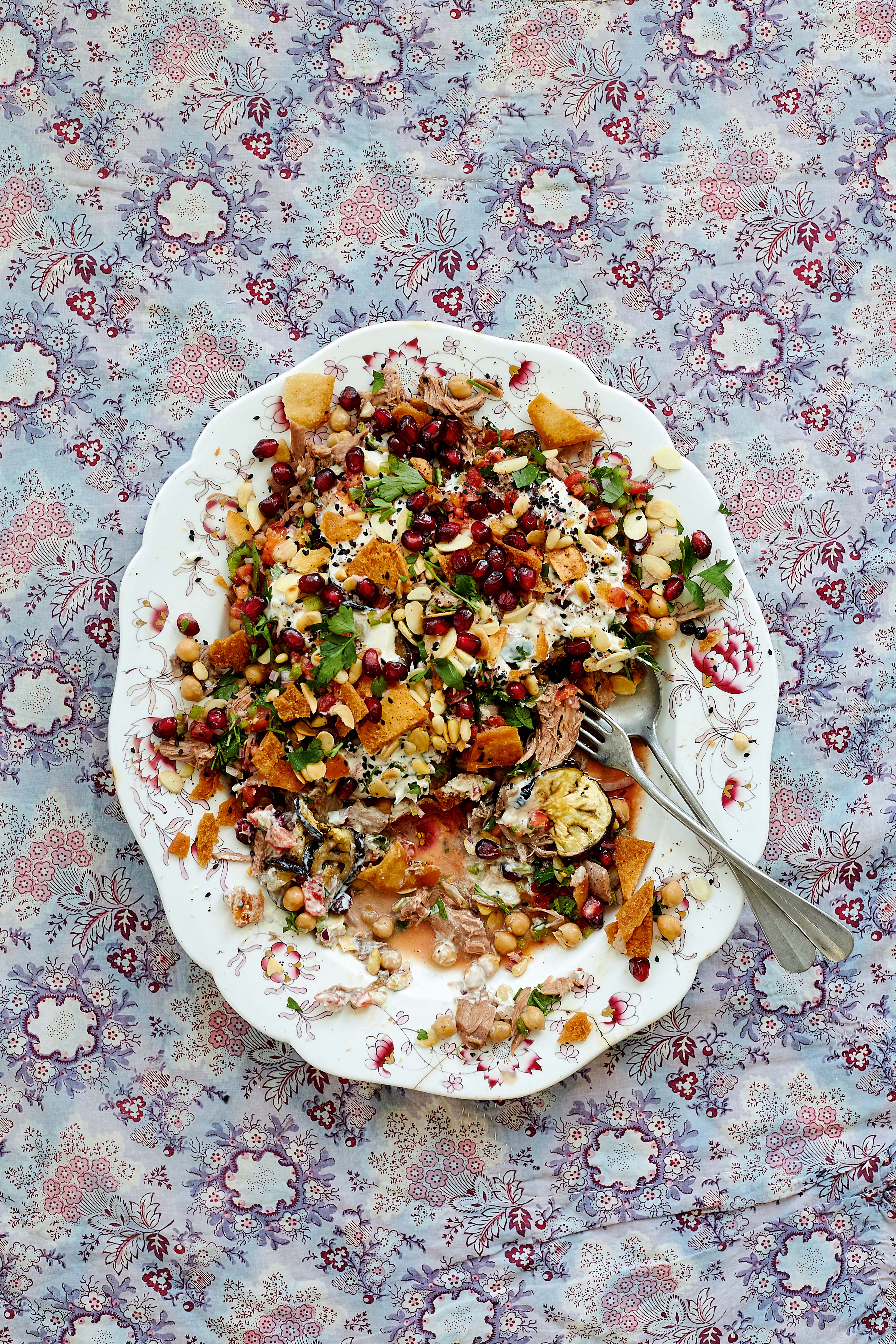
Fatteh is a layered feasting dish. This one features lamb, aubergine and pulses, ladlefuls of garlic-spiked tahini yoghurt sauce and spicy tomato salsa, all topped off with fried shards of flatbread, pine nuts and almonds – and that most iconic Middle Eastern ingredient, pomegranate. This is a great recipe for a crowd. With every bite, your guests will luxuriate in different flavours.

SERVES 6

4 tbsp olive oil
4 lamb shanks
1 cinnamon stick, broken up
2 tsp allspice berries
2 tsp coriander seeds
6 green cardamom pods, bruised 1 tsp black peppercorns
2 red onions, unpeeled, cut into quarters
1 whole garlic bulb, halved crossways
2 aubergines, thinly sliced into rounds
1 × 400g tin chickpeas, drained 2 Lebanese flatbreads

Groundnut oil, for deep-frying 1 tbsp ghee
2 tbsp flaked almonds
2 tbsp pine nuts
Seeds from 1⁄2 large pomegranate 1 tbsp black sesame seeds
1 tsp sumac
Handful of parsley leaves
Sea salt and black pepper

For the sauce
250g yoghurt
1 tbsp tahini
Juice of 1 lemon
1 garlic clove, crushed

For the salsa
1 heaped tsp Turkish pepper paste (biber salcasi) or good-quality harissa
2 tbsp olive oil
Juice of 1 lemon
4 tomatoes, peeled and finely chopped
1 red onion, finely chopped
1 green pepper, finely chopped Large handful of finely chopped parsley
1 tsp sumac
1 tsp Turkish pepper flakes (pul biber) 1⁄2 tsp dried mint

Preheat the oven to 180°C/160°C Fan/Gas Mark 4. Pour 2 tablespoons of the oil into a large flameproof casserole over high heat and sear the lamb shanks all over. Add the cinnamon, allspice, coriander seeds, cardamom pods, peppercorns, onions and garlic and fry for 1 minute. Pour in 1.5 litres of water, then cover and cook in the oven for 2 hours.
In the meantime, place the sliced aubergine on a lined baking sheet, drizzle over the remaining 2 tablespoons of oil and season with salt and pepper. Roast in the oven for 45 minutes or until soft, then set aside.

Make the sauce by simply mixing all the ingredients together.
For the salsa, put the paste, oil and lemon juice into a bowl, season with salt and pepper and stir until well combined, then add the tomatoes,red onion, green pepper, parsley, sumac, Turkish pepper flakes and dried mint.
Take the lamb out of the oven and add the chickpeas, then cover again and return to the oven for a further 30 minutes.

Using scissors, cut the Lebanese bread into bite-sized shards. Fill a large, heavy-based saucepan a third full with the deep-frying oil. Heat the oil
to 180°C – if you don’t have a thermometer, you will know the oil is ready when a cube of bread turns golden brown in 20 seconds. Fry the flatbread for 1 minute, or until golden and crisp, then drain on kitchen paper.

Heat the ghee in a frying pan over medium heat and fry the almonds and pine nuts until golden and toasty, keeping a close eye on them as they can quickly burn. Drain on kitchen paper.

To serve, lift the lamb shanks out of the casserole and onto a chopping board. Shred the meat with two forks, then lay over a serving dish. Fish out the chickpeas with a slotted spoon and tumble over the lamb, along with a few ladlefuls of the stock to moisten the lamb. (Keep the rest of the stock to make soup another time.) Cover the lamb and chickpeas with
the aubergines, arranging them in a single layer, followed by the tomato salsa and dollops of the yoghurt sauce. Finish with the fried flatbread, almonds, pine nuts, pomegranate seeds, sesame seeds, sumac and parsley.

Cook more from this book
Lemongrass Poussin with Green Mango and Peanut Salad
Banana Cake with Miso Butterscotch and Ovaltine Kulfi

Read the review

Buy this book
Jikoni: Proudly Inauthentic Recipes from an Immigrant Kitchen
£26, Bloomsbury Publishing

Lemongrass Poussin with Green Mango and Peanut Salad by Ravinder Bhogal

SpatchcockLemongrassPoussin_206

This wildly flavourful roast poussin is inspired by the fragrant and punchy flavours of Thailand. If the weather permits, throw it on the barbecue and cook it in the seductive plumes of its smoke. Serve with steamed jasmine rice.

SERVES 6

6 poussins, spatchcocked 3 tbsp rapeseed oil

For the marinade
Large thumb of ginger, grated
5 garlic cloves
2 lemongrass stalks, sliced
Large handful of roughly chopped coriander, leaves and stalks
50g light brown sugar or palm sugar
250ml light soy sauce

For the dressing
1⁄2 red chilli, finely chopped
1 garlic clove, grated
Small thumb of ginger, finely grated
1 tbsp clear honey
2 tbsp fish sauce
2 tbsp light soy sauce
2 tbsp groundnut or rapeseed oil
A few drops of sesame oil
Juice of 1 lime
1 tbsp rice vinegar
1 small shallot or 1⁄2 red onion, finely chopped

For the salad
2 red bird’s eye chillies, finely chopped
1 garlic clove
2 tbsp soft brown sugar
2 tbsp fish sauce
2 tbsp rice vinegar
2 tbsp lime juice
3 green (unripe) mangoes, peeled and cut into matchsticks
100g mixed cherry tomatoes
1 small red onion, very thinly sliced
Handful of Thai basil leaves
Handful of coriander leaves
Handful of mint leaves, torn
75g peanuts, roughly crushed

To make the marinade, put the ginger, garlic, lemongrass, coriander and sugar in a food processor and blitz to a paste. Transfer to a large bowl and stir in the soy sauce. Add the poussins and massage well, using your fingers to gently loosen the skin so you can get some of the marinade underneath it. Cover and leave in the fridge for 2 hours or overnight.

Take the poussins out of the marinade and set aside. Strain the marinade into a saucepan and bring it to the boil, then let it bubble and reduce for about 10 minutes until you have a lovely glaze.

Preheat the oven to 200°C/Fan 180°C/Gas Mark 6.
Pour the oil into a large ovenproof frying pan over medium–high heat, add the poussins and fry, skin side down, until crisp and well browned. Brush over the glaze, then transfer to the oven and roast for 30–45 minutes, glazing again halfway through the cooking time.

Meanwhile, make the dressing by shaking together all the ingredients
in a screwtop jar. For the salad, use a mortar and pestle to pound the chillies, garlic and sugar to a smooth paste. Stir in the fish sauce, vinegar, lime juice and 2 tablespoons of warm water. Taste and adjust the flavours as necessary with more sugar, fish sauce, vinegar or lime juice until you have that classic Thai balance of hot, sweet, salty and sour, then transfer to a large bowl. Lightly pound the mango with the pestle and mortar to tenderise, then add to the bowl and pour in the dressing. Crush the tomatoes with the mortar and pestle, then add to the bowl, along with the red onion. Just before serving, add the herbs, toss to combine and scatter with the peanuts. Serve the poussins with the salad on the side.

Cook more from this book
Banana Cake with Miso Butterscotch and Ovaltine Kulfi
Lamb and Aubergine Fatteh

Read the review

Buy this book
Jikoni: Proudly Inauthentic Recipes from an Immigrant Kitchen
£26, Bloomsbury Publishing

Banana Cake with Miso Butterscotch and Ovaltine Kulfi by Ravinder Bhogal

191023_BananaCake_013

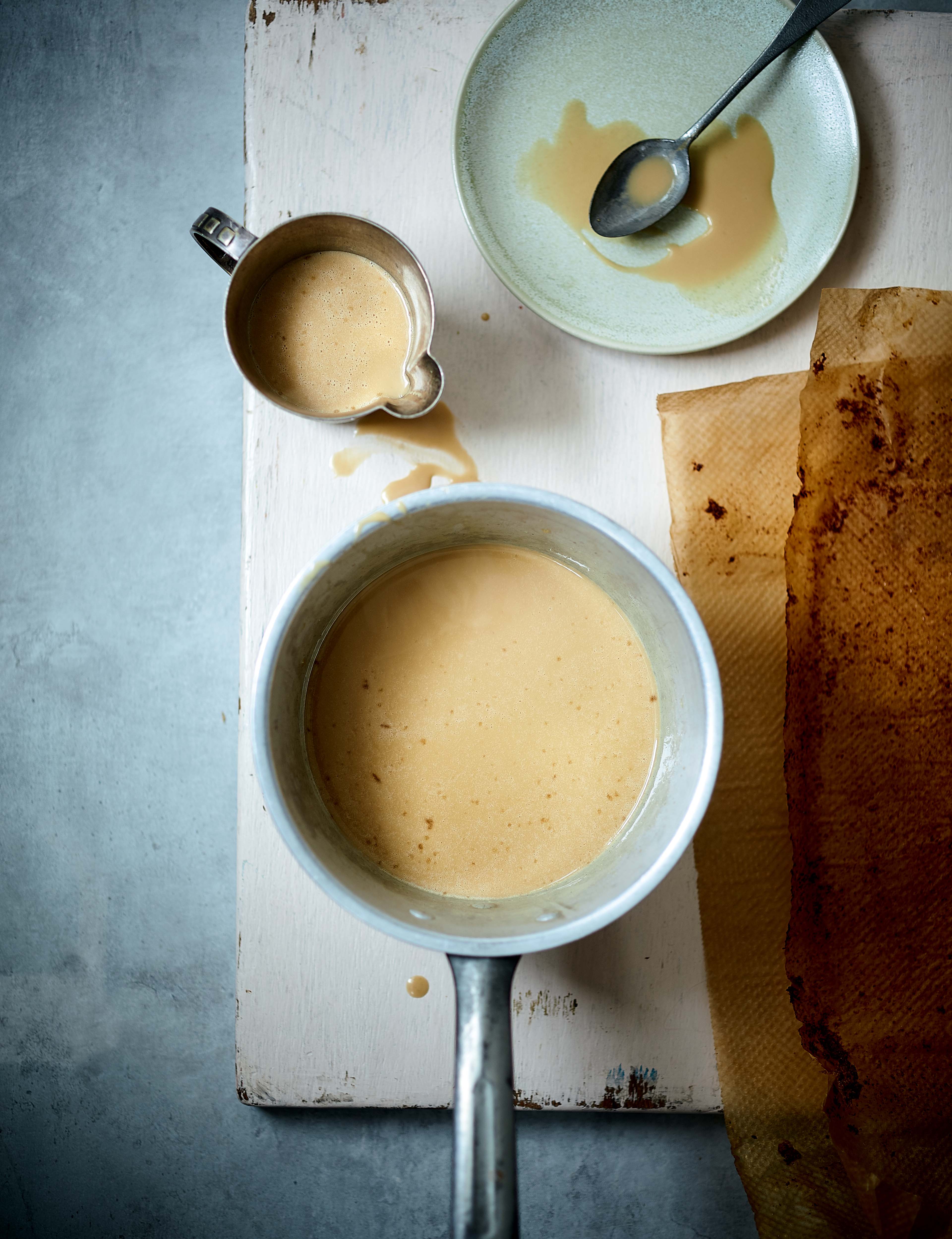
To confine your use of miso to just soup would be to miss out on a multitude of exciting gastronomic opportunities – one of the best of which would have to be the miso butterscotch that goes with Jikoni’s famous banana cake. This dessert has such a cult following that certain die-harders will call ahead to make sure we have a portion saved for them.

The banana cake is based on the idea of a sticky toffee pudding, although it
is much less dense. Then there’s that dizzyingly luxurious miso butterscotch with its compelling mix of sweet and salty flavours. To top it all off, we have the ‘nostalgia in a bowl’ of Ovaltine kulfi, a condensed-milk ice cream that has an almost chewy texture. And if that wasn’t enough to make you fall in love with this dessert, making it is a piece of cake!

SERVES 12

1 tbsp black tea leaves
200ml boiling water
200g pitted dates
110g unsalted butter
350g dark muscovado sugar
1 tbsp treacle
1 tbsp date syrup
400g self-raising flour
4 eggs
1 tsp vanilla extract
1 tbsp bicarbonate of soda 200g peeled bananas

For the kulfi
50g Ovaltine
450g condensed milk
300ml double cream

For the butterscotch
500ml double cream
175g demerara sugar
175g unsalted butter
1 tbsp golden syrup
60g white miso

The kulfi will take at least 6 hours to set, so make it ahead of time. In a large bowl, mix the Ovaltine into the condensed milk until there are no lumps. In a separate bowl, whip the cream to soft peaks, then fold it into the condensed milk mixture. Pour the kulfi into a tub and freeze until set. It really is as simple as that!

Preheat the oven to 190°C/Fan 170°C/Gas Mark 5. Line a 24cm square cake tin with baking parchment.

Put the tea leaves in a heatproof jug or bowl, pour over the boiling water and allow to infuse for a minute. Strain the tea, discarding the tea leaves, then soak the dates in the hot tea for 10 minutes.

In a large bowl, beat together the butter and sugar until smooth. Stir in the treacle and date syrup, followed by the flour, and mix well. Mix the eggs in one at a time.

Tip the soaked dates and tea into a blender or food processor, along with the vanilla extract, and blitz to a puree. Add the bicarbonate of soda and pulse briefly, then add to the bowl and mix thoroughly.

Wipe out the blender, add the bananas and blend until smooth, then add to the cake batter and stir in well. Pour into the tin and bake for 1 hour or until a skewer inserted in the centre of the cake comes out clean.

Meanwhile, to make the butterscotch, put the cream in a saucepan over low heat. Add the sugar, butter and golden syrup and whisk until the sugar has dissolved and the butter has melted. Finally whisk in the miso, then remove from the heat.

Turn the cake out on to a wire rack and leave to cool a little.

To serve, cut into 12 portions, then serve warm with the hot miso butterscotch and the Ovaltine kulfi.

Cook more from this book
Lemongrass Poussin with Green Mango and Peanut Salad
Lamb and Aubergine Fatteh

Read the review

Buy this book
Jikoni: Proudly Inauthentic Recipes from an Immigrant Kitchen
£26, Bloomsbury Publishing

Sun and Rain by Ana Roš

9780714879307

Self-taught Slovenian chef Ana Roš highly unusual path to the professional kitchen is set out in the biographical section of this fascinating and visually stunning book. She trained as a professional dancer and was a member of the Yugoslav national ski team before going on to study international science and diplomacy. Her plans for a career in international diplomacy changed when she met her future husband and natural wine expert Valter Kramar. The couple decided to work in Kramar’s family countryside restaurant Hiša Franko in the remote Soča Valley where Roš eventually took over the running of the kitchen. International acclaim followed with Roš taking part in culinary events like Cook IT Raw and being featured on Netflix’s Chef’s Table documentary series.

Roš‘s lack of any formal culinary training has led to a highly individual style based on the abundant natural larder of the extreme north-west of Slovenia. A community of local foragers, shepherds, cheese makers, hunters and fishermen (some of which are profiled in the book) supply Roš with trout, deer, goats, dairy produce and fruits which she transforms into eye-catchingly plated dishes such as marble trout roe with rosa di Gorizia chicory and yeast; veal consommé, celeriac and young linden leaves, and beeswax peaches and elderflower.

The majestic natural glory of the Soča Valley is well represented in the photography of Suzan Gabrijan who has also captured the rugged elegance of Roš’s food. Even by publisher Phaidon’s consistently high standards, this is an exceptionally beautiful book. Disappointingly, however, apart from two photographs taken in the kitchen, there are no shots of the restaurant interior or exterior which is a puzzling and frustrating omission.  The recipes are hived off into a separate chapter at the end of the book so that it’s necessary to flick back and forth to the images of the finished dishes if you want to understand exactly what you are looking at.  These minor niggles criticisms aside, Sun and Rain is a comprehensive look at the life, culinary philosophy, and cooking of a remarkable figure in the modern culinary scene that will inspire any progressive thinking chef or very keen home cook.

Cuisine: Slovenian/Progressive
Suitable for: Professional chefs
Cookbook Review Rating: Five stars

This review was first published in The Caterer

Buy the book
Ana Ros: Sun and Rain (Food Cook)
£39.95, Phaidon

Cook from this book
Summer Pear by Ana Roš
Bread by Ana Roš
Goat cottage cheese ravioli by Ana Roš

What is Cooking by Ferran Adrià and elBullifoundation

What is Cooking Ferran Adria

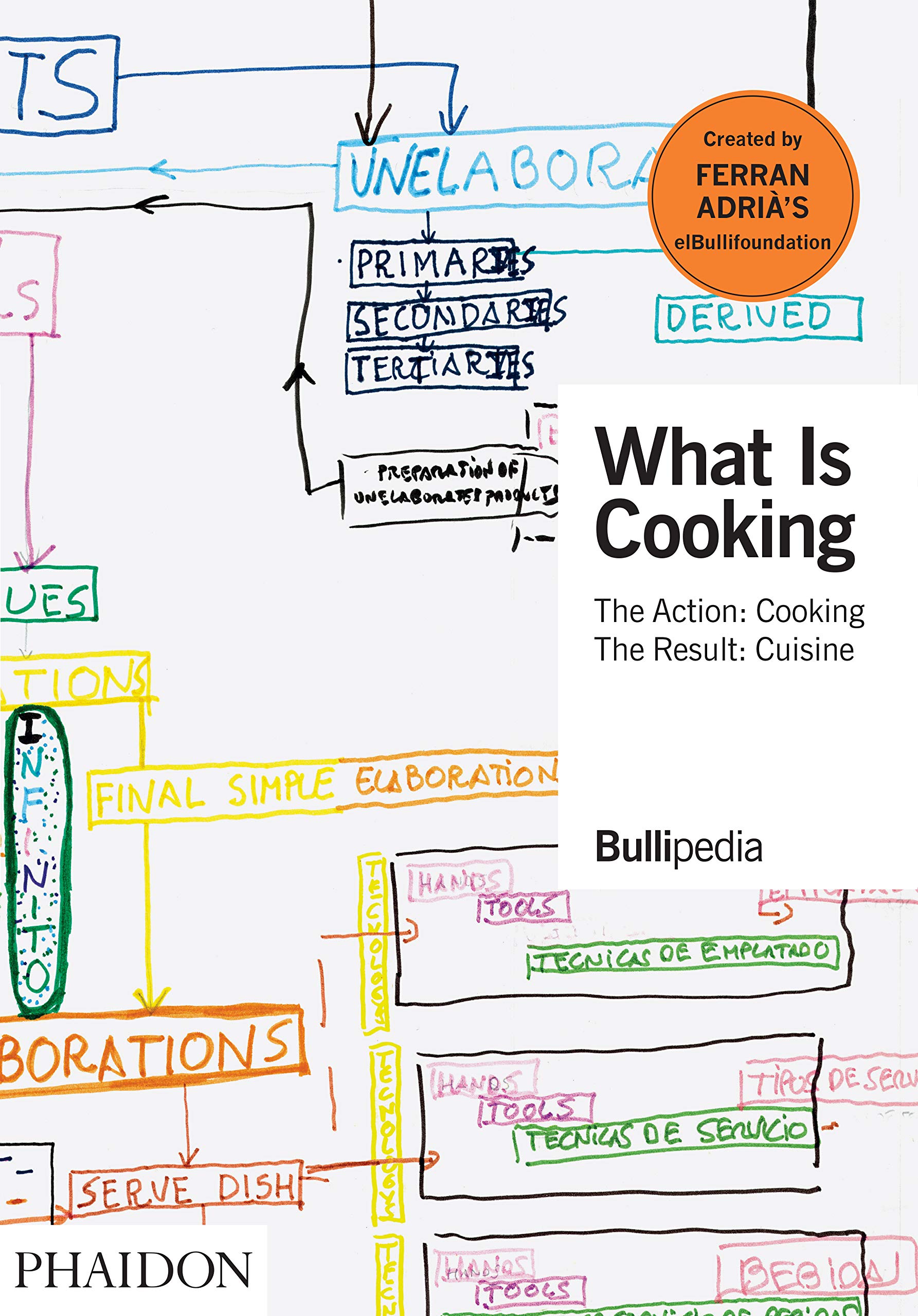
What’s the USP? This is not a cookbook and there are no recipes. According to the authors, it’s ‘a compilation of the connected knowledge needed in order to answer the question: ‘What is cooking?’. According to me, it’s nothing less than an intellectual land grab by one of the world’s most famous chefs in an attempt to place himself at the forefront of the study of cuisine and gastronomy as a formal academic subject.

Who is the author? Ferran Adrià is one of the world’s most famous chefs. Along with his brother Albert, he is the architect of what is commonly known as ‘molecular gastronomy’ but which Adrià refers to as ‘techno-emotional’ cuisine.

He closed the doors of his restaurant el Bulli back in 2011 and has since dedicated his time to the elBullifoundation, which, the website says is ‘a private, family-run foundation, promoted by Ferran Adrià and Juli Soler. Established on 7 February 2013, it came out of the need to transform elBullirestaurant, with a vision based on the desire to continue promoting innovation and creativity through the language of cooking and to preserve the legacy and spirit of elBulli for society’.

In practice that means publishing books, mounting exhibitions, the production of a documentary series about el Bulli restaurant, consulting services and whole raft of other projects including the development of educational courses. The one project that Adrià has been talking about almost since the day elBulli closed is the launch of elBulli1846, the re-purposing of el Bulli restaurant as ‘an exhibition lab’ for ‘studies, investigation and experimentation to generate knowledge around the theme of efficiency in innovation’. Although the website explicitly says that elBulli1846 is not a restaurant, that has been talk in the past of some food being prepared and served there, but no one seems to know if and when that will actually happen and if it does, who gets to eat it.

Is it good bedtime reading? Put it this way, there is a lot to read but it might keep you awake all night puzzling out just what it’s all meant to be for. To take an example, in the 48 page introductory section (broken down into a pre-foreword statement, a foreword by Adrià himself, a one page summary, a ten-page descriptive index and a 25 page introduction) you will find a flow chart that explains that, if you want to run a business that generates a gastronomic offering you will need a team of professionals from the sector that have a business culture and that they will need resources for different systems including storage tools and plating tools. In other words, if you want to run a restaurant, you need trained chefs who want to earn money and they will need things like fridges, tongs and spoons. The book continues in this vain, finding complex, opaque ways of expressing very simple and common ideas, for much of its 400-odd pages.

For example, in Chapter One: Let’s Start by Understanding Lexical-Symantic Aspects, you’ll ‘discover’ that ‘not all liquid is a beverage’ and that sometimes it’s food in a liquid state. Congratulations, you now know what soup is. You’ll also find out that 19th century food writer Brillat-Savarin ‘devoted his life to the tasting and enjoyment of food in different settings, which suggests a concept of alimentation that was not limited to survival, but that encompassed hedonism and recognized quality’. I hope you were sitting down for the earth-shattering revelation that people sometimes eat for pleasure.

In the same chapter, you’ll also find the definition of a word used no less than 913 times in the book- ‘elaboration’. Adrià would like you to use the word in place of cooking because ‘helps to give a more specific understanding of a stage within the culinary process’, which is a bit like trying to force your friends to call you by a nickname you’ve coined for yourself. However, Adrià is such a respected figure in modern gastronomic circles that he might just pull it off. Start practicing now if you want to be in with the cool kids, ‘I’m just going to elaborate this Aldi frozen minced beef pie in the heat supplying apparatus that is located within the area dedicated to the preparation of elaborations’. See, it’s fun!

Let’s for a moment imagine that it’s acceptable to take up 85 pages of a 464-page book introducing your subject and defining your terms. It might be then not unreasonable to expect that by chapter three you would be getting to the meat of the subject, that the author would be communicating some information, some facts from their research or at least some opinions or philosophy. And yet on page 97 we are confronted with this piece of spectacularly circular nonsense, ‘We can speak of interpretative creativity when the creation corresponds to the skilful interpretation of other, already existing creations. Whether or not this can be regarded as a level of creative outcome is a matter for debate, as it is a very subjective question.’

But there must be some concrete answers somewhere in the book, surely? How about in the section titled ‘We suggest several main criteria to discover the types of cooking a cook or a restaurant does’. Let’s take Adrià’s own dish, Pea Spheres. Here’s some of the things I ‘learned’ from reading about how it’s classified under 17 different criteria: it’s hedonistic food designed to produce pleasure; it’s an elaboration with food use; it’s an elaboration for the savoury world; it’s served in a fine dining restaurant and designed for customers of middle to high class social profiles, the working classes need not apply; it is an elaboration from a professional kitchen but amateurs with a spherification kit could reproduce it; it’s of the highest level of quality, sophistication and refinement, it is no less than creative culinary art. So, what do I do with that information? How do I apply that to the real world? If I use those same 17 criteria to analyse and categorise the fish and chips I’m having for my tea tonight, how will that change anything. I already know its savoury, it’s working class, it’s not particularly sophisticated and I could make it at home, but I can’t really be arsed. The process seems to be pointless.

But surely, Ferran Adrià and his multi-disciplinary team haven’t spent the last decade producing something of absolutely no value, have they? One last chance. Let’s read ‘As an action that is repeated over time, cooking generates consequences’, a chapter that views cooking from an historical perspective. The first line is ‘History is the time frame in which ‘everything’ happens.’ It’s not looking good is it? Anyway, let’s persevere. What does the book have to say about the Neolithic period? ‘With the Neolithic period came permanent settlements, and this sedentariness brought about sedentary cooking. Gradually, as a result, specialization emerged, with different elaborations giving rise to specialized cooking.’ That’s pretty much it. No specific examples of what the different elaborations or specialized cooking might actually be. It’s time for me to stop this. I’ve gazed long enough into the Adrià abyss. I can feel the Adrià abyss gazing back into me.

What will I love? I particularly enjoyed the infographic titled ‘The chef model: cooks, periods, styles and movements in contemporary fine-dining cuisine in western society’ which lists some of the biggest names in western gastronomy since the turn of the 20th century including Escoffier, Fernand Point and Alain Ducasse but reserves the largest font size on the page for the names Ferran and Albert Adria. History is always written by the victors.

That aside, the book looks great, and, er, that’s about it.

What won’t I like so much? In the introduction, the claim is made that ‘In spite of the large number of publications dealing with cooking or cuisine, we were unable to find any that offered a direct response to our seemingly simple question.’ One has to assume that eBullifoundation is including in that rather sweeping statement authoritative works such as the 1350 page Larousse Gastronomique (which in fact does have a page-long entry on the term ‘cooking’), the 900 page The Oxford Companion to Food (it too has entries on the terms ‘cook’ and ‘cooking), Grand Livre de Cuisine d’Alain Ducasse and Le Repertoire to mention just a few. Set alongside those august tomes, the book singularly fails to justify its own existence.

I admit I may have missed the point, that I may not be sufficiently intelligent to understand how the Sapiens methodology works. Other readers, who may well be more sophisticated and erudite may possibly get a great deal from it. At the time of writing, there has been no other meaningful published review of What is Cooking (i.e. where the reviewer has actually read some or all of the book) and I don’t know anyone who has bought a copy and publicly expressed their views. I can’t imagine anything but praise from Adrià’s peers so the critical jury is currently out. You’ll just have to take my word for it at the moment.

Should I buy it? It’s £100. If you’ve got that to spare, if you wouldn’t miss it at all and if you are the world’s biggest Ferran Adria fan, then go ahead. Otherwise think very carefully before you are parted from your money. If you work in the fine dining sector, it’s worth considering whether you will actually learn anything of value by wading through 464 pages of powder dry theory. Will it help you do your job better? Will your understanding of the craft of cooking and cuisine have increased in a way that you can apply in a practical way to your business? Because there is very little pleasure to be derived from What is Cooking. In truth, this review has been an unpleasant ordeal, a tiresome bore and I wouldn’t wish the experience on my worst enemy, of which there are many and to which I’ve probably just added one more.

Cuisine: International
Suitable for: Professional chefs
Cookbook Review rating: 1 star (for the design)

Buy this book
What is Cooking: The Action: Cooking, The Result: Cuisine (FOOD COOK)
£100, Phaidon