Simple by Yotam Ottolenghi

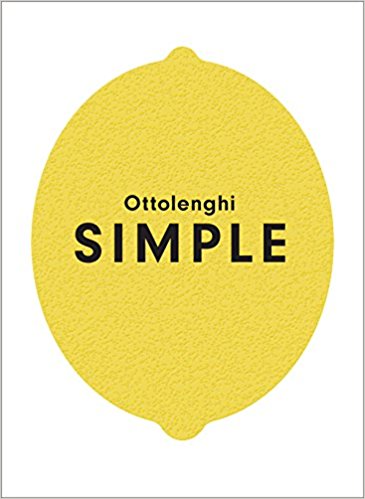
Simple Ottolenghi

What’s the USP? The publishing phenomenon that is Yotam Ottolenghi returns with a seventh volume of his signature Middle Eastern-inflected food but this time, with colour-coded, simplified recipes for cooks who are short on time or just plain lazy.

Who’s the author? Ottolenghi is a world-famous cookery writer and restaurateur who has almost single-handedly brought Middle Eastern cuisine into the mainstream (although he would no doubt acknowledge the importance of ground-breaking writers such as Claudia Roden who wrote the definitive Book of Middle Eastern Food back in 1972). He runs NOPI and ROVI restaurants in London, alongside a group of four Ottolenghi deli’s dotted around the capital. He has filmed two series of Mediterranean Feasts for Channel 4 and Jerusalem on a Plate for the BBC.

What does it look like? Colourful. From the big lemon on the cover to the bright chapter headers (aubergine purple for Cooked Veg, marine blue for Fish, each accompanied by a charming graphic) and of course the always vibrant, multi-hued food, the book will bring a little ray of sunshine into your kitchen whatever the weather outside. And then there’s the six-step ‘traffic light’ recipe colour-coding using the acronym SIMPLE – an orange ‘S’ for ‘short on time’, a yellow ‘I’ for ‘ingredients: 10 or less’, a green M for ‘make ahead’, a blue P for ‘pantry’, a light green L for ‘lazy’ and a red ‘E’ for ‘easier than you think’.

Is it good bedtime reading? This is a straight up recipe book with an introduction that explains how the colour coding works and short recipe introductions that are often breezy, chatty and mostly about serving suggestions or alternative ingredients. A book for when you are looking for inspiration to cook rather than recreational reading.

How annoyingly vague are the recipes? Ottolenghi has been good enough to credit his two co-authors, food writer Tara Wigley and chef and recipe tester Esme Howarth and, between the three of them, they have produced a book of carefully written recipes that even give weights for herbs instead of ‘bunches’ or ‘handfuls’ and unusually, specify many ingredients by both number and weight, so you know for example that 2 small onions should equal about 250g. It’s a very useful and practical feature and one that should make the book particularly appealing to less confident cooks.

Will I have trouble finding ingredients? You shouldn’t have any problems tracking down everything you need, but if you do get stuck, good old Ottolenghi has his own web store, stocked with everything from black glutinous rice to dried sour cherries that will get you out of any purchasing hole. Handy eh?

What’s the faff factor? For a book titled Simple, there are a fair-few long ingredient lists and complicated methods.

How often will I cook from the book? Simple is one of those rare cookbooks where you’ll want to try every recipe so there’s no danger that it will sit sad and unused on your shelf.

Killer recipes? Standouts include gem lettuce with herby avocado and tahini ‘fridge-raid’ dressing that is bound to become part of your standard repertoire, and a wicked hazelnut, peach and raspberry cake that’s a cinch to make but tastes like your pastry chef sweated hours over it.

What will I love? The useful directory of  ‘Ottolenghi’ ingredients like sumac, za’atar and urfa chilli flakes that help define his cooking; the meal and feast suggestions that will help you plan your cooking, and the book’s upbeat, approachable style. A unique code is printed at the back of the book which gives access to a fully searchable online version of Simple which means you can cook from the book via your phone or tablet (or laptop) when you are away from home (or even if you are at home but don’t want to get pomegranate molasses stains on the pages of your beautiful new cookbook).

What won’t I like? Although the SIMPLE colour coding is a nice conceit, I’m not convinced of its practical use. A more straightforward indication of time to prepare and cook the dishes would be more useful in deciding which recipe to cook on any given day. And not all the recipes are even that simple; slow cooked chicken with a crisp corn crust for example has 16 ingredients and requires you to separate eggs, whisk up the whites and fold back into a corn batter to make the crust, in addition to a two-stage cooking process that will take well over an hour and half to complete (that said, the dish does look well worth the effort).

Should I buy it? If you are new to Ottolenghi, this is an excellent place to start and if you are a converted fan then you will want to add this to your collection.

Cuisine: Middle Eastern
Suitable for: Confident home cooks
Cookbook Review Rating: 4 Stars

Buy this book
Ottolenghi SIMPLE

Cook from this book
Braised eggs
Iranian herb fritters
Slow cooked chicken with a crisp corn crust

Quince tart with gingerbread ice cream by Simon Rogan

Quince Tart

MAKES 8

Gingerbread
80g unsalted butter
50g molasses
400g plain flour
250g caster sugar
1 tsp baking powder
a pinch of salt
zest of 1 lemon
50ml whole milk
80g preserved stem ginger (from a jar)
½ tsp ground cinnamon
1 tsp ground ginger
50g fresh ginger
2 eggs

Gingerbread ice cream
500ml whole milk
2 egg yolks
25g caster sugar
½ tsp salt
125g gingerbread, from recipe above, roughly broken into chunks
Pastry
270g plain flour, plus extra for dusting
150g unsalted butter, softened
75g soft light brown sugar
1 tsp salt
1 egg

Poached quince
1 quince
350ml red wine
250g caster sugar
50g unsalted butter

Preheat the oven to 195°C/175°C Fan/Gas Mark 5, grease a 900g (2lb) loaf tin and line it with baking parchment.

To make the gingerbread, melt the butter and the molasses in a heavy-based saucepan over a medium heat. Once melted, remove from the heat and leave to one side. Mix the flour, caster sugar, baking powder, salt and lemon zest together in a large bowl. Blitz the milk, stem ginger, cinnamon, ground ginger and fresh ginger in a small food processor until smooth, then pass through a fine sieve. Beat the eggs in a bowl and mix with the ginger milk, then add the molasses mix. Whisk the wet ingredients into the dry ingredients little by little, until fully incorporated.

Transfer the mixture to the prepared tin and bake for 50 minutes. Once cooked (a skewer inserted into the middle of the cake should come out clean), remove from the oven and leave to cool. Remove from the tin and cut into suitable size 125g pieces, wrap each piece in cling film and freeze.

To make the ice cream, bring the milk to the boil in a heavy-based saucepan over a medium heat. Combine the egg yolks, sugar and salt in a heatproof bowl. Gradually pour the hot milk into the yolk and sugar mixture, whisking constantly to prevent the eggs from scrambling. Return to the pan and cook over a low heat until the temperature of the mixture reaches 80°C (check with a thermometer), stirring constantly. Remove from the heat and add the fresh or defrosted from frozen gingerbread, then allow to cool. Blitz in a blender until smooth then churn in an ice-cream maker until frozen. Transfer the ice cream to a piping bag fitted with a star nozzle and keep in the freezer.

While the ice cream is churning, make the tart bases. Mix the flour and the butter together by hand in a bowl until the mixture resembles breadcrumbs, then add the sugar, salt and egg and keep mixing until you have a smooth dough. Wrap the dough in cling film and put it in the fridge to rest for 1 hour. Once rested, dust a work surface with flour, unwrap the dough and roll it out to a thickness of 3mm.

Cut to size with a cutter or upside-down small bowl to fit eight 4cm small tart tins. Line the tins with the pastry, pushing the pastry all the way down the sides, lightly prick the base of the tartlets and line them with greaseproof paper and a few baking beans. Bake blind for 8 minutes. Remove from the oven and allow to cool in the tins, then transfer to a wire rack to cool completely. Store in an airtight container.

Peel and cut the core away from the quince. In a small, heavy-based saucepan bring the wine and 200g of the sugar to the boil. Reduce the heat to low, add the quince and simmer for 18–20 minutes, or until the quince are just tender but still have a little bite. Remove from the heat and leave the quince to cool in the wine.

Cut the cooled quince into 5mm dice. Make a caramel with the remaining sugar: heat the sugar in a heavy-based pan over a medium heat, without stirring, until it begins to melt, then start to stir and keep stirring until all the sugar crystals have dissolved. Cook for about 10 minutes until the sugar is a dark honey colour.

Remove from the heat and add the butter, whisking constantly. Add the diced quince to the pan and cook for a further 30 seconds. Remove the caramelised quince from the pan and allow to cool.

Place a small amount of the quince in each tart case then pipe a rosette of ice cream on top to cover and serve immediately.

Cook more from this book
Radish stew
Smoked lamb shoulder

Read the review

Buy this book 
Rogan

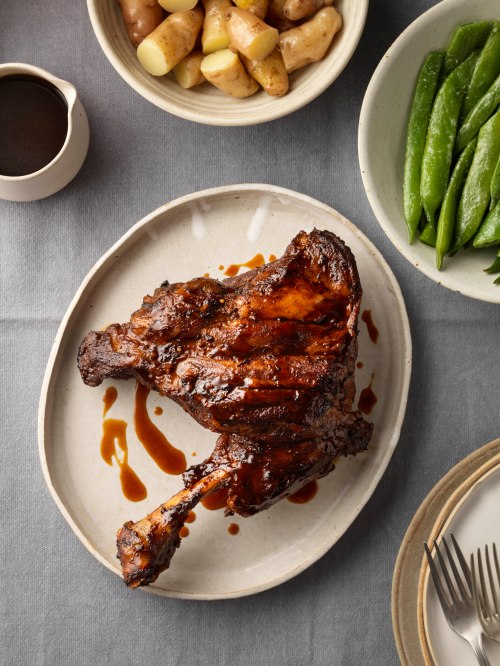
Smoked lamb shoulder by Simon Rogan

Smoked Lamb Shoulder

SERVES 6–8

Lamb shoulder
400g coarse sea salt
1 lamb shoulder (about 2.8–3kg)
100g soft light brown sugar
200g granulated sugar
20g garlic powder
50g smoked paprika
50g sweet paprika
6 star anise
1 tbsp yellow mustard seeds
1 tbsp juniper berries
1 tbsp cayenne pepper
1 tbsp ground cumin
1 tbsp ground black pepper
1 tbsp coriander seeds

Runner beans
500g young, tender runner beans, such as Tenderstar
40g unsalted butter
salt, for seasoning

enough wood smoking chips to create an even layer in the baking tray
Lamb Jus (SEE RECIPE AT END OF MAIN RECIPE), to serve

Dissolve 300g of the salt in 1.5 litres of water in a large bowl. Submerge the lamb shoulder in the brine and put it in the fridge for 24 hours. The next day, rinse the shoulder under cold running water and pat it dry with kitchen paper. Mix the remaining ingredients together in a bowl, including the 100g salt, and rub into the shoulder.

Put the smoking chips in a nice even layer in a large roasting tin lined with foil. Sit a wire rack on top, one that is a similar size to the roasting tin, making sure the wire isn’t touching the chips. Put the shoulder on the rack and cover the entire rack and tin with a tent of foil, so no smoke escapes. Sit the tin on the hob over a low–medium heat for 10 minutes. Remove the covered tin from the heat and allow the shoulder to smoke in the foil tent for 30 minutes.

Preheat the oven to 150°C/130°C Fan/Gas Mark 2. Transfer the smoked lamb shoulder to a clean baking tray, place in the oven and cook for 4 hours until tender.

Top and tail the runner beans and remove the stringy sides. Bring a large saucepan of salted water to the boil, add the butter and cook the beans for 3 minutes. Drain.

Serve the lamb in the middle of the table with a jug of sauce for guests to help themselves and with the runner beans and confit potatoes in a large bowl alongside.

LAMB JUS

2 tbsp sunflower oil
2 carrots, roughly chopped
2 onions, roughly chopped
2 celery sticks, roughly chopped
1 leek, roughly chopped
2 garlic cloves
1kg lamb bones
3 litres White Chicken Stock (RECIPE BELOW)

WHITE CHICKEN STOCK
3kg chicken wings

Roughly chop the chicken wings and put them in a large,heavy-based saucepan with 5 litres of water. Bring to the boil over a medium heat, then reduce the heat and simmer for 2–3 hours, skimming occasionally. Remove from the heat and leave to cool, the strain through a muslin-lined sieve. Keep the stock covered in the fridge and use within 3–4 days, or freeze and use within 3 months.

To make the lamb jus, warm the oil in a large, heavy-based saucepan over a low heat, add the vegetables and cook for 2–3 hours, stirring regularly, until completely soft and no moisture is left in the pan.

Preheat the oven to 220°C/200°C Fan/Gas Mark 7. Put the lamb bones in a roasting tin and roast for 40 minutes, or until deeply golden. Add the bones to the pan with the vegetables, reserving the fat for the potatoes. Deglaze the roasting tin with 200ml water and add it to the pan. Cover with the chicken stock and bring to the boil over a high heat. Reduce the heat and simmer for 2 hours over a low heat, skimming it regularly. Strain through a fine sieve into another heavy-based saucepan then reduce the stock over a medium heat to a sauce consistency.

Cook more from this book
Radish stew
Quince tart

Read the review

Buy this book 
Rogan

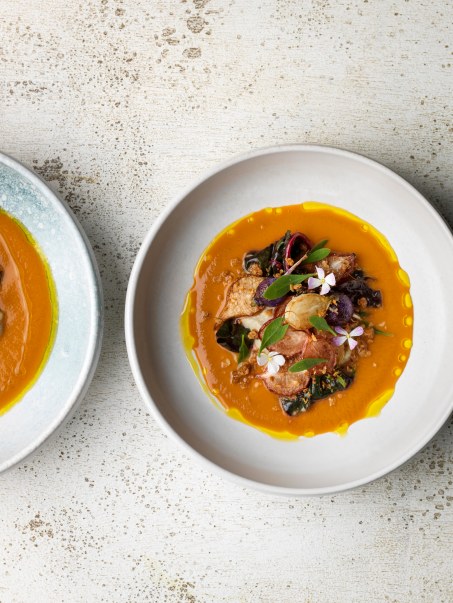
Radish stew by Simon Rogan

Radish Stew

SERVES 4, AS A STARTER

Aubergine purée
1 large aubergine (about 450g)
½ tbsp tahini paste
1 tbsp natural yoghurt
½ tsp roasted chopped garlic

Radish sauce
1 tbsp sunflower oil
1 shallot, sliced
40g button mushrooms, sliced
1½ tsp tomato purée
250g red radishes, thinly sliced
500ml Vegetable Stock (see recipe at end of main recipe)
sherry vinegar, for seasoning
5g unsalted butter

Truffle granola
135g honey
35g black truffle oil
35g chilli oil
150g porridge oats

Radishes
12 mixed radishes, such as Cherry Belle,
Albena and Viola
2 tbsp rapeseed oil
8 stalks of rhubarb chard (or Swiss chard),
stalks removed and cut in half

salt, for seasoning
rapeseed oil, for drizzling
assorted radish flowers and sea purslane, to serve

Preheat the oven to 200°C/180°C Fan/Gas Mark 6.

First, make the aubergine purée. Wrap the aubergine in foil and bake it in the oven for 35–40 minutes until completely soft, then halve it lengthways and scoop out the flesh. Put the flesh in a blender with the tahini, yoghurt and garlic and blitz until smooth. Pass through a fine sieve and season with a pinch of salt.

While the aubergine is cooking, make the radish sauce. Warm the oil in a medium, heavy-based saucepan over a medium heat, add the shallot and sweat for 5–6 minutes, or until translucent, stirring regularly. Add the mushrooms and sweat for a further 3 minutes, or until soft and tender. Stir in the tomato purée and cook for 3–4 minutes. Add the radishes and vegetable stock and bring to the boil. Reduce the heat and simmer for 8 minutes. Remove from the heat and blitz with a hand-held blender until smooth, then strain through a fine sieve. Finish the sauce by seasoning with sherry vinegar and salt and whisking in the butter.

Reduce the oven temperature to 160°C/140°C Fan/Gas Mark 2.

To make the granola, warm the honey, oils and 1 teaspoon of salt in a small saucepan over a low heat until the honey has melted and the salt dissolved. Mix in the oats.  Transfer to a baking tray, spread it out in an even layer and bake for 15 minutes, or until golden. Remove from the oven and leave to cool, then break into small pieces. Leave the oven at the same temperature.

Put the radishes on a baking tray, chopping any larger ones in half, season with a pinch of salt, drizzle over half the oil and roast for 10–12 minutes.

Heat the remaining oil in a medium, non-stick saucepan and add the rhubarb chard leaves along with a splash of water. Cook gently until the leaves have wilted and season with a little salt.

Warm the radish sauce. Put a spoon of the purée in the centre of four plates and place the roasted radishes on top. Add the chard, purslane leaves and flowers. Spoon the sauce around the outside and sprinkle with truffle granola. Drizzle with rapeseed oil.

VEGETABLE STOCK

3 onions, finely chopped
2 celery sticks, finely chopped
2 carrots, finely chopped
1 fennel bulb, finely chopped
1 leek, finely chopped
1 head of garlic, halved
15g chervil
15g tarragon
15g flat-leaf parsley

Put all the vegetables and the garlic halves in a large, heavy-based saucepan with 4 litres of water. Bring to the boil over a medium heat, then reduce the heat and simmer for 30 minutes. Take off the heat, add the herbs and leave to cool, then chill and infuse in the fridge overnight. The following day, strain it through a muslin-lined sieve. Keep the stock covered in the fridge and use within 3–4 days, or freeze and use within 3 months.

Cook more from this book
Smoked lamb shoulder
Quince tart

Read the review

Buy this book 
Rogan

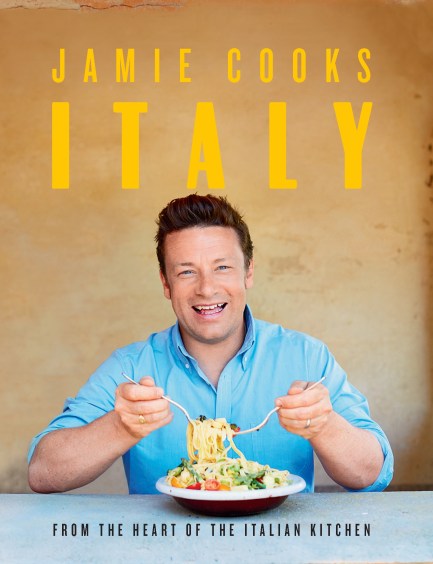
Jamie Cooks Italy by Jamie Oliver

Jamie Cooks Italy jacket (1)

What’s the USP? According to the author’s introduction, it’s ‘your go-to Italian book, a manual of deliciousness’. According to recent reports in the press, it’s part of a carefully planned strategy to help shore up the ailing Jamie’s Italian restaurant chain. Jon Knight, chief executive of the Jamie Oliver Restaurant Group was quoted as saying that, “We lost touch with Jamie, there was a growing disconnect between what Jamie was doing on TV and in his books – people weren’t experiencing that in the restaurants”. So, what better way to realign Jamie’s Italian the restaurant with Jamie the chef than a TV series and cookbook tie-in all about Italy?

Who’s the author? You might have heard of Jamie Oliver. He’s the chef that was recently accused of cultural appropriation for selling ‘Punchy Jerk Rice’ in supermarkets (even though there’s no such thing as jerk rice) and caused outrage with his attempts to curb junk food advertising and extend the sugar tax with accusations of taking food out of poor people’s mouths and hypocrisy, given that his Jamie’s Diner restaurant in Gatwick Airport serves burgers and shakes. He’s also one of the most famous chefs in the world who helped revolutionise food on TV with his debut series The Naked Chef in the 90’s and has a long track record of philanthropy. So, take your pick.

What does it look like? Bold, bright and colourful, there’s nothing subtle about this book. Long-time collaborator David Loftus’s photos seem supersaturated with Sicilian (and many other Italian regions) sun and even the recipe titles are printed in a vibrant sunshine yellow.

Is it great bedtime reading? Not really. A brief introduction and the pen pictures of the various Nonna’s that Oliver has tapped up for recipes on his travels around Italy are brief, superficial and not particularly well written.

Will I have trouble finding ingredients?
As ever, a Jamie Oliver recipe is all about accessibility so you’ll have no problem finding pretty much everything you need, bar the odd grouper or rabbit with its offal intact, at the supermarket

What’s the faff factor?
The preparation times given for the wide range of recipes in the book start at 15 minutes to knock up golden breaded tuna with Aeolian spaghetti with lemon, capers, pecorino, chilli and herbs to five hours plus marinating overnight for ‘wildest boar ragu’ so the ‘faff factor’ really depends on whether you feel life’s too short to stuff your own agnolotti.

How annoyingly vague are the recipes?
If you’re expecting Jamie to be all gor-blimey-guv’ner-bish-bosh-bash-glug-of-oil-matey you’ll be disappointed; even half a bunch of flat leaf parsley is given an indicative weight (15g if you’re interested).

How often will I cook from the book?
This is a something-for-every-occasion sort of book which you may easily find yourself reaching for mid-week for a simple supper or for a weekend of pasta making and baking.

Killer recipes? Semolina teardrop dumplings from the Aosta Valley in Northwest Italy (a sort of spätzle, traditional to the Walsers community in Italy that has Swiss and German roots); baked risotto pie with sweet spicy squash and oozy cheeses; panissa rice with smoked pancetta, cured meats, borlotti beans, tomatoes and red wine, and many others

What will I love? There is no question that Italy is Oliver’s greatest inspiration (watch the Jamie’s Italy or Jamie Cooks Italy TV series and you can see pure joy in his face) and thanks to that TV budget, he and his team have been able to research the recipes first hand, so this is no hastily thrown-together cash in.

What won’t I like? Oliver has a very distinctive food writing voice, one that bursts with enthusiasm and which never leaves a hyperbolic statement unturned; you’ll either love it or it will grate. If you don’t appreciate the flavour of rosemary being described as ‘genius deep savouriness’ then you might want to turn to more level-headed writers like Anna Del Conte or Elizabeth David for your Italian fix.

Should I buy it? Does the world need another Jamie Oliver cookbook, especially another Jamie Oliver cookbook on Italian food, especially given that he published the excellent Jamie’s Italy back in 2005? In fact, there is very little, if any crossover between the two books, quite a feat given that together they run to more than 700 pages. Oliver divides opinion, but if you are a fan, and I am, then this is a welcome 21st addition to the chef’s ever-growing canon.

Cuisine: Italian
Suitable for: Confident home cooks
Cookbook Review Rating: 4 Stars

Buy this book
Jamie Cooks Italy
£26, Michael Joseph

Octopus, Mixed Bean and Black Olive Salad by Tom Kitchin

Octopus salad528

Over the past few years octopus is more popular on menus around Britain, but it’s always been a part of Mediterranean cuisine. As with many great products, the octopus is really versatile, whether it’s braised, barbecued, pickled or, as in this recipe, served in a salad. When you come across octopus in the UK it will most likely have been frozen, but that’s actually a good thing as the freezing process helps to tenderise the meat. When you’re cooking octopus, make sure the water is just simmering when you add it, or the beautiful colour will be lost.

Serves 3–4

500g raw octopus, cleaned with head and eyes removed, but the tentacles left attached (ask your fishmonger to do this for you, or if you buy it frozen, allow to thaw in the fridge)
1 lemon, cut in half
1 tablespoon black peppercorns, lightly crushed
1kg live mussels, cleaned (page 25) and soaked in cold water to cover for 20 minutes
olive oil
2 shallots, finely chopped
125 ml dry white wine
60g podded broad beans
2 garlic cloves, crushed
800g cooked cannellini beans, drained and rinsed if tinned
100g cherry tomatoes, quartered
60g stoned black olives, sliced
sherry vinegar
a handful of basil leaves, torn
sea salt and freshly cracked black pepper

To cook the octopus, first bring a large saucepan of salted water to the boil with the lemon and peppercorns. As soon as it boils, turn the heat down so the water is just simmering. Add the octopus to the water and pop a plate on top to keep it submerged, then simmer for 90 minutes, or until it’s tender. It’s really important that the octopus does not boil, as this will ruin the lovely skin. Once cooked, leave the octopus to cool, uncovered, in the stock.

Meanwhile, cook the mussels and blanch the broad beans. Drain the mussels and discard any that do not snap shut when tapped. Heat a large heavy-based saucepan with a tight-fitting lid over a medium-high heat, then add a splash of oil. When it is hot, add half the shallots and sauté for about 1 minute. Add the mussels and wine and give them a good stir. Cover the pan and boil for 3 minutes, or until all the mussels open. Drain the mussels, then discard any that are not open. Set the remainder aside.

To blanch the broad beans, bring a large saucepan of salted water to the boil and place a bowl of iced water in the sink. Add the beans to the boiling water and blanch for 3 minutes, then drain well. Immediately tip them into the iced water to stop the cooking and set the colour. When they are cool, drain them again, shake off any excess water and set aside.

When the octopus is cool enough to handle, use a slotted spoon to transfer it to a chopping board and dice the body, but leave the tentacles whole. Place it in a bowl, add the garlic cloves, season with salt and pepper and pour over enough olive oil to cover.

In a separate bowl, mix together the remaining shallots, cannellini beans, tomatoes, olives, and the blanched broad beans. Now add the octopus mixture and a couple of tablespoons of sherry vinegar, to taste, and adjust the seasoning with salt and pepper. Scatter with the basil leaves. The salad is best eaten fresh, but you can cover and chill for up to 4 hours, just remember to remove it from the fridge 15 minutes before serving.

Cook more from this book
Crispy Fish Goujons and Pickled Red Cabbage Tacos
Salmon Wellington

Read the review
Coming soon

Buy this book
Tom Kitchin’s Fish and Shellfish

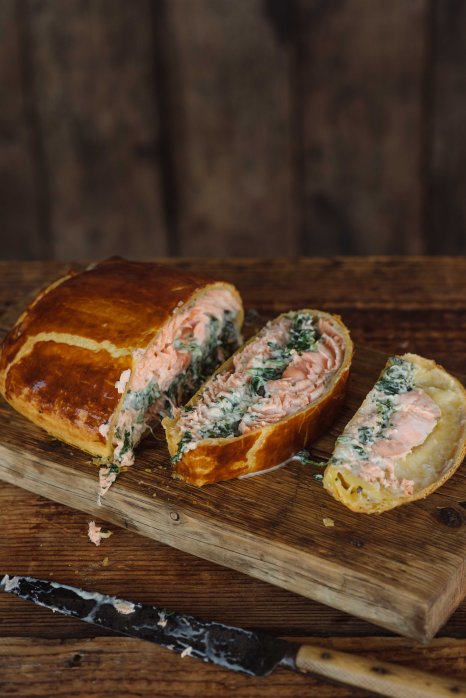
Salmon Wellington by Tom Kitchin

by www.schnappsphotography.com

People are always looking for dinner party and special-occasion ideas, and this recipe ticks all the boxes. You can get the dish prepared in advance, allowing you to relax and enjoy the evening as much as your guests, as all you have to do is bake and then carve the salmon. Just be careful to really squeeze all the excess water out of the spinach after cooking. Also, when you’re carving use a really sharp knife or serrated knife. I’m sure if you try this it will become a favourite in your family, too.

Serves 4

100g spinach, thick central stalks removed
100g watercress sprigs
1 garlic clove, peeled but left whole
olive oil
1 shallot, finely chopped
30g cream cheese
2 teaspoons chopped dill
1½ tablespoons creamed horseradish
300g puff pastry, thawed if frozen
plain white flour for dusting
2 salmon fillets, about 250g each, skinned and pin bones removed (page 27)
1 free-range medium egg, beaten
sea salt and freshly cracked black pepper

First prepare the spinach and watercress for the filling. Rinse the spinach and watercress well and shake dry. Spear the garlic clove with a fork. Heat a well-seasoned sauté or frying pan over a medium-high heat, then add a splash of oil. When it is hot, add the spinach and watercress with just the water clinging to the leaves, season with salt and toss with the garlic fork until the spinach is just wilted. Tip into a sieve and squeeze out the excess water, then transfer to a bowl and set aside.

Wipe out the pan and reheat over a medium-high heat, then add another splash of oil. Add the shallot with a pinch of salt and sauté for 1 minute before adding the spinach and watercress and mixing together. Remove the pan from the heat, transfer the spinach mixture to a bowl and leave cool completely.

When the spinach is cool, stir in the cream cheese, dill and horseradish, and adjust the seasoning, if necessary. Line a baking sheet with greaseproof paper and set aside. Make room in your fridge for the baking sheet.

Roll out the puff pastry on a very lightly floured surface with a lightly floured rolling pin into a 30cm square, about the thickness of a £1 coin. Pat the salmon fillets dry and season them with salt and pepper, then place one fillet in the centre of the pastry. Spread the salmon and watercress mixture over, then top with the remaining salmon fillet.

You now want to completely enclose the fillets in pastry. Use both hands to carefully lift the pastry and fold inwards to meet at the top, so both ends just overlap. Trim off any excess pastry to avoid a layer of unbaked pastry. Brush the edges and press together firmly to seal. Brush the pastry on both short ends with beaten egg and press together, again cutting off the excess pastry. You want about a 0.5cm gap between the edge of the salmon parcel and the pastry seals.

Carefully transfer the salmon parcel to the prepared baking sheet, seam side down. Brush the pastry all over with the beaten egg and chill for at least 20 minutes. When you are ready to bake, preheat the oven to 200˚C Fan/220˚C /Gas Mark 7. Place the baking sheet in the oven and bake the salmon Wellington for 35 minutes, or until golden brown. Leave to rest for 5 minutes before slicing.

Cook more from this book
Crispy Fish Goujons and Pickled Red Cabbage Tacos
Octopus, Mixed Bean and Black Olive Salad

Read the review
Coming soon

Buy this book
Tom Kitchin’s Fish and Shellfish

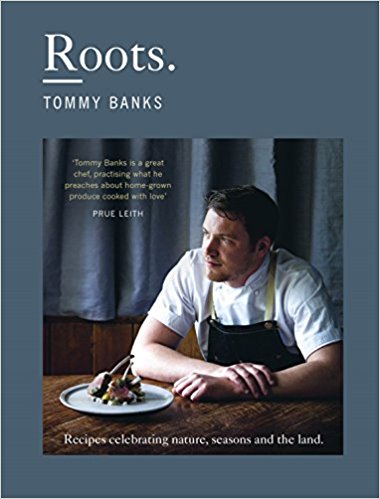
Roots by Tommy Banks

roots tommy banks

What’s the USP?  Fans of Kunta Kinte will be disappointed to learn that this is not another  update of Alex Haley’s famous slave saga. The title actually refers to the ‘root ingredients’ used fresh or preserved by acclaimed young chef Tommy Banks, who divides the year into three rather four seasons which he calls The Hunger Gap (January to May); Time of Abundance (June to September) and the Preserving Season (October to December) which reflects the way he cooks at his North Yorkshire restaurant The Black Swan at Oldstead.

Who’s the author? Tommy Banks has had something of a meteoric rise since taking over the kitchens of the family restaurant in 2013, aged just 24. He’s one of the youngest ever Michelin starred chefs in the UK and has become something of a TV personality, appearing on the Great British Menu where he cooked turbot with strawberries and cream (recipe included in the book) at the grand banquet at Wimbledon and was a featured chef on Masterchef the Professionals where he demonstrated his signature dishes including crapudine beetroot cooked slowly in beef fat with smoked cod’s roe and linseeds, also included in this, his debut book.

What does it look like? Bucolic. The North Yorkshire landscape looks stunning and there are plenty of shots of Banks posing in fields and on the family farm gathering his beloved ingredients. The food is colourful and attractive without being too tortured on the plate.

Is it good bedtime reading? The short autobiographical introduction is bolstered by chapter introductions and essays on favoured ingredients such as elderflower, summer berries and ‘hedgerow harvests’ making Roots more than simply a collection of recipes.

Will I have trouble finding ingredients? If you’re not a keen gardener then you might find it tricky to lay your hands on things like crapudine beetroot and courgette stalks, and you’ll need to follow Banks’s recipes for fermenting vegetables to make a number of dishes, plus you’ll need a good fishmonger if you’re planning on serving raw red mullet, and a decent butcher who can sell you sweetbreads and mince pork back fat for you, and you’ll need to get out picking elderflowers in June if you want to make elderflower drizzle cake, and…

What’s the faff factor? This is fundamentally a collection of restaurant dishes so expect to put in a fair amount of effort for your dinner.

How often will I cook from the book? This is more weekend project than mid-week supper cooking.

Killer recipes? See above, but also crab, elderflower and potato salad; scallops cured in rhubarb juice with Jerusalem artichoke, and potato skin and brassica broth with cheddar dumplings.

What will I love? All the recipes are rated either 1,2 or 3 for complexity which makes choosing what you want to cook from the book, depending on the time you have to hand easy. But this is more than just a collection of delicious sounding, interesting and characterful recipes, a real effort has been made to give a sense of Banks’s cooking ethos and life at The Black Swan.

What won’t I like? Some readers may feel they’ve been-there-and-done-that with the pickling, fermenting and foraging aspect of the book.

Should I buy it? Roots is a substantial debut effort from one of the UK’s highest profile young chefs with his own take on field to fork cookery which makes it well worth investigating.

Cuisine: Modern British
Suitable for: Professional chefs/Confident home cooks
Cookbook Review Rating: 4 stars

Buy this book
Roots
£25, Orion Books

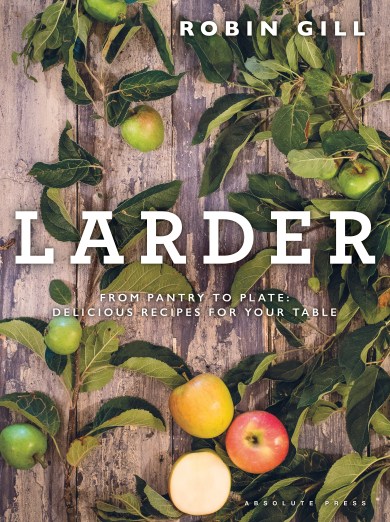
Larder by Robin Gill

9781472948540 (4)

What’s the USP? An urban update on traditional larder-driven cooking based around fermentation, curing, pickling, flavoured butters and oils, stocks, sauces and seasonings.

Who’s the author? Irish-born, London-based chef Robin Gill has revitalized the capital’s dining scene with his distinctive take on top drawer cooking set in casual surroundings at The Diary, Counter Culture and Sorella, all in Clapham.

What does it look like? There’s a distinctly rustic feel to the whole thing with matt finish pages, pictures of Gill on the farm, by the shore or posing with a brace of rabbits and food plated on vintage or earthenware crockery. I wouldn’t want to utter that overused and lazy term ‘hipster’, but you get the idea.

Is it good bedtime reading? Although first and foremost a recipe book, there is plenty of food writing to enjoy in the form of substantial recipe introductions, producer profiles and general musings on cooking techniques and ingredients. The autobiographical introduction provides a fascinating, and at times troubling, look behind the scenes of the restaurant industry.

Will I have trouble finding ingredients?  Cod collars, pig’s head, buffalo milk, Baron Bigod cheese, chardonnay vinegar, espelette pepper and dried wakame mean that you’ll have to look further than your local Tesco for many of the recipes.

What’s the faff factor? Don’t be fooled by the rustic vibe; Gill has worked in some very serious kitchens and although the food is presented in a naturalist way, there’s often lots of work gone into making it all look laid back and simple.

How often will I cook from the book? Because many of the dishes rely on larder recipes (the hint’s in the title) some of which take days, weeks, months or even a year before they are ready, this is more a culinary philosophy that you need to buy into than recipe a book that you can easily dip in and out of.

Killer recipes?  Galician octopus with summer vegetables and nduja brioche; belted Galloway onglet, piatone beans, young garlic and hay; game faggots, celeriac, toasted hazelnuts; white peach with almond skin ice cream, elderflower jelly.

What will I love? The extended larder section provides a real insight into Gill’s style of cooking so you get a real sense of what makes his restaurants so different and special. There is also an excellent selection of inventive cocktails including Panic! At The Pisco made with pisco, white vermouth and rhubarb puree and even a recipe for homemade pumpkin beer.

What won’t I like? The lack of quick and easy dishes. But there’s more than enough of those sort of books knocking about already if that’s more your thing.

Should I buy it? If you want to learn the techniques behind contemporary British restaurant cooking and employ them in your own home (or your own gaff if you’re a chef) this is an essential purchase.

Cuisine: Modern British
Suitable for: Professional chefs and confident home cooks
Cookbook Review Rating: 4 stars

Buy this book 
Larder: From pantry to plate – delicious recipes for your table
£26, Absolute Press

Cook from this book
Loch Duart Salmon Oyster Emulsion, Fennel, Fried Wakame by Robin Gill
Smoked beetroot tartare Cacklebean egg yolk, hazelnut by Robin Gill
Salted Caramel Cacao, Malt Ice Cream by Robin Gill

Out of My Tree by Daniel Clifford

Out of my tree cover idea Daniels Head.indd

What’s the USP? Two decades worth of recipes and stories that chart the evolution of the iconic two Michelin-starred Cambridge restaurant Midsummer House and its chef/patron Daniel Clifford.

Who’s the author? Daniel Clifford is one of the most revered, respected and, at times, controversial chefs working in the UK today. In addition to those Michelin gongs, he also holds five AA rosettes, the title of AA Chefs’ Chef of the Year 2015 and 8 out of 10 in the Good Food Guide. In short, he’s premier league.

What does it look like? A million dollars. Clifford’s food is very photogenic and has been allowed to speak for itself. Many of the dishes appear to be ‘plated’ directly onto the white of the page, a la Michel Bras’s 2002 book Essential Cuisine, which gives the intricate presentations room to breathe. The exemplary food photography is supplement by ‘family album’ snapshots in the autobiographical sections, bringing personality to the book and breaking up all the glossy perfection with a dose of behind the scenes realism.

Is it good bedtime reading? Clifford is brutally honest in the fascinating autobiographical passages that begin each chapter, both about the industry and his personal life, making Out of My Tree as much of a page-turning blockbuster as it is a document of modern British haute cuisine. Expect to be up to the early hours finishing it.

Will I have trouble finding ingredients? There’s a fair few specialist items such as gelepressa (a thickening agent) that you’d need to hunt down online, and if you want to emulate Clifford’s food you’ll need to source the highest quality raw ingredients you can lay your hands on, so forget the supermarket for the most part and think top notch butchers, fishmongers and your best local independent market for fruit and veg.

What’s the faff factor? This is unashamedly Michelin food, so the recipes are often long with numerous elements and many ingredients and replicating them will be demanding, requiring intricate and precise cooking.

How often will I cook from the book? On very special occasions or simply when the urge to spend a whole weekend (and a whole weeks wages on ingredients) hits you. For the home cook, it’s probably best to see this book as a source of inspiration from which you can cherry pick a sauce here and a vegetable preperation there rather than tackling entire dishes.

Killer recipes? We could be here all day. One of the many wonderful things about Out of My Tree is the warts and all approach. Of course there are the many triumphs; the insanely complicated Chicken, Sweetcorn, Truffle and Peas that won Clifford four perfect 10s on the Great British Menu and includes ballotine of chicken lined with spinach, stuffed with steamed truffled egg white and sweetcorn jelly (to resemble an egg), wrapped in potato string and deep fried. But there are also some embarrassing also rans such as parfait of banana, chocolate and a palm tree-shaped coconut tuile from 1998 (all the recipes are dated) that looks like it might have come straight from a TGI Fridays menu. Clifford has also included recipes for his mums egg sandwiches (served for staff lunch every Friday at the restaurant) and his nan’s cheese scones which he put on the menu when she came to eat at Midsummer House. Cute.

What will I love? Clifford and his publisher deserve a standing ovation for the obvious effort put into this book. A reported three years have gone into its production and it shows from the perfect food (as someone who has been involved in the making of a cookbook, trust me that getting 140 dishes of this degree of complexity to look immaculate on the page takes some doing) to the extensive biography and numerous extras like interviews with past employees and the string of forewords by Sat Bains, Tom Kerridge, Claude Bosi and others. Little details like illustrating the stock recipes with photos of how the finished product should look like elevate the book above the norm.

What won’t I like? This is unashamedly Michelin-starred, fine-dining, testosterone fueled stuff which may not appeal to every reader.

Should I buy it? Out of My Tree is the new White Heat, a once in a generation book. Clifford has put his heart and soul onto every page, making it the culinary equivalent of Dylan’s Blood on the Tracks. Any chef that aspires to Michelin glory and wants to know what that really takes will want it on their shelf and every chef that has achieved that status it will want to share in Clifford’s journey.  Enthusiastic diners will find the book truly eye opening. If you’re a chef, don’t just buy it, send Clifford an email to thank him for writing it; there is much hard-won wisdom generously shared in these 400-odd pages that, read carefully, might just save you years of grief.

Cuisine: Progressive British
Suitable for: Professional chefs
Cookbook Review Rating: 5 stars

Buy this book 
Out of my tree (Midsummer House)
£45 Meze