Michel Roux at Home by Michel Roux Jr

Michel Roux at Home
What’s the USP? A Michelin-starred chef eschews the involved methods and techniques of the professional kitchen and shares his favourite (but not always) simple recipes from home that he cooks for family and friends.

Who’s the author? Michel Roux Jr is restaurant royalty, son of the legendary Albert Roux, father of Emily (who runs the acclaimed London restaurant Caractère). At the time of writing, he is chef/patron of legendary two Michelin-starred Mayfair restaurant Le Gavroche which is due to close in January 2024. He remains head of food and beverage at The Langham hotel in London. He is a regular on TV shows like Saturday Kitchen and has written eight previous cookbooks including The French Revolution.

Is it good bedtime reading? A five page intro and succinct recipe introductions and that’s your lot. Best keep the latest Richard Osman handy.

How much difficulty will I have getting hold of ingredients? You will need a decent butcher to mince some pork fat for you if you’re going to make the delicious sounding venison turnovers (and you could buy the venison leg or shoulder you’ll need while you are there, although you can get it from some supermarkets too), lamb merguez sausages to serve with red rice and herb pesto, pigs trotters and ears to serve with boned and rolled pork shoulder, and the various meaty elements of a game pate or a terrine made with rabbit and green ham hock.

A good cheesemonger or online supplier will probably be required for the Fleur de Maquis or Berkswell cheese for an omelette with mushrooms, parsley and sheep cheese or the Mimolette required for a chicory tart recipe. Your local greengrocer might have dandelion leaves for a salad made with potatoes, bacon and quince vinegar (good luck finding that, although you can substitute the good old cider variety) but you will have to get your wellies on and go foraging for the nettles for a chilled soup with radish tops. If you are in the UK, you can get cod cheeks from The Fish Society to roast and serve with a watercress salad, a whole sea bass to roast with vegetables or a whole sea bream to bake in a salt crust. What they won’t sell you is the smoked eel required for a canape with beetroot and horseradish cream as it’s now considered a critically endangered species.

Although that might seem like a long list, the book is mainly full of recipes with easily accessible ingredients, as demonstrated by the following list of killer recipes.

Killer recipes? Cauliflower and broccoli gratin with Comte cheese; courgette gratin; sausage, pea and potato casserole; barbecued chicken with summer salad; potato and sweetcorn waffles with bacon crumb; prawn French toast with walnut and coriander pesto; linguine with olives, artichokes, sundried tomatoes and herbs; blackberry and apple mille-feuiiles.

How annoyingly vague are the recipes? For the most part, the recipes are specific when you want them to be. For example, the lovely cauliflower and broccoli gratin recipe gives weight indications for both the main ingredients which is extremely helpful given that cauliflowers range from golf ball to beach ball in size (I’m exaggerating for effect, but not much). Elsewhere, however, things are more hazy, with a ‘bunch of asparagus and a ‘bunch’ of spring onions for a barbecued lamb steak recipe. Both of course as sold in bunches, but the number (and weight) of asparagus spears and spring onions in any given bunch can vary wildly. This is a minor niggle, as cooking from the book has been a pleasure, with clear, easy to follow methods and delicious results.

What will I love? With chapters including Breakfast and brunch, quick lunches, simple suppers for two, meals for family and friends, sweet finish, family celebrations at home and kitchen basics, it’s quick and easy to choose a recipe appropriate to your needs on any given occasion. There’s a huge variety of dishes, from simple sweetcorn soup to the more challenging game pate as well as dishes such as pork steaks with summer vegetables that would make a great mid-week meal.

Should I buy it? There’s still a fair amount of Michel Roux the two-star chef in the book with some fairly time consuming preparations and ingredients that are everyday to the French but more challenging for us Brits to get our hands on. That said, there is much to inspire keen home cooks into the kitchen and dishes that you won’t find in your average TV chef’s cookbook, so it’s a hearty ‘Oui chef’ from us.

Cuisine: French
Suitable for: confident home cooks
Cookbook Review Rating: Four stars

Buy this book
Michel Roux at Home by Michel Roux Jr
£26, Seven Dials

Cook from this book
Prawn French toast with walnut & coriander pesto by Michel Roux Jr
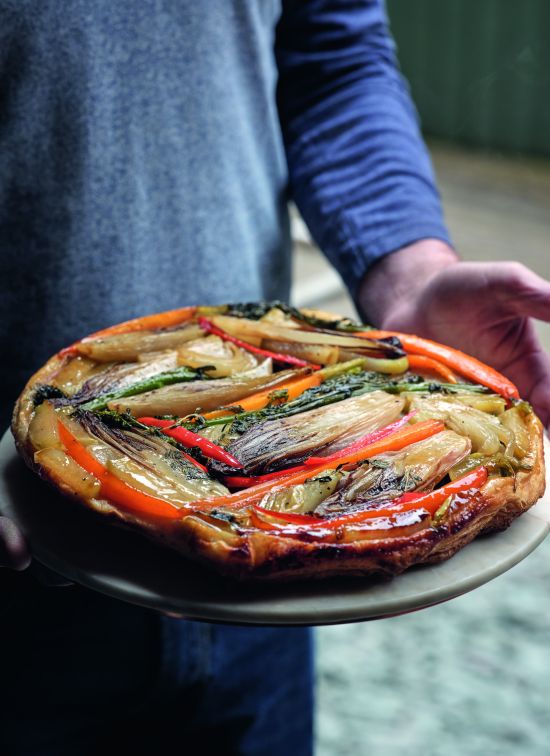
Root Vegetable Tart Tatin by Michel Roux Jr
Souffled Crepes by Michel Roux Jr

Prawn French toast with walnut & coriander pesto by Michel Roux Jr

9781399610650_interior applicationmichel roux at home text finalPrawn_Toast_Back_5551

Croque aux crevettes

A really special brunch dish, this is my French take on Chinese prawn toast. These are hearty sandwiches, so if you’re serving them as part of a brunch buffet, just a half will be enough – unless you’re not planning to eat again until the evening! The walnut and coriander pesto makes a nice change from the usual basil version. The recipe makes more than you need for the sandwiches, but the pesto keeps well in the fridge for a week and is delicious with pasta.

Makes four sandwiches

450g peeled raw prawns
3 tbsp vegetable oil
3 free-range egg whites
3 free-range eggs
3 tbsp whole milk
Grating of nutmeg
8 slices of sourdough bread
Vegetable oil, for frying
1 tsp red chilli flakes,
to serve (optional)
Salt and black pepper

Walnut & coriander pesto
60g walnuts
Big bunch of coriander
(about 120g),
roughly chopped
1 garlic clove,
roughly chopped
1 tbsp grated Parmesan
1 green chilli roughly
chopped, seeds removed
6 tbsp olive oil
Salt

First, make the pesto. Put the walnuts, chopped coriander, garlic, Parmesan, chilli and olive oil into a blender and blitz to make a smooth mixture. Season with salt.

Put the prawns in a food processor with the oil and egg whites and season with salt and pepper. Blitz until smooth.

Beat the whole eggs with the milk in a bowl and season with salt, pepper and a grating of nutmeg, then set aside.

Divide the prawn mixture between 4 of the slices of bread, spreading it evenly, then top with the remaining slices. Cut the sandwiches in half, then dip each half into the egg mixture.

Pour some oil into a frying pan to a depth of about 1cm and heat. Shallow-fry the sandwiches, a few halves at a time, turning them until golden on all sides – this will take about 4 minutes in total. Drain the sandwiches on kitchen paper, then keep them warm in a low oven while you cook the rest.

Cut the sandwiches in half or into bite-sized pieces. Serve warm with the pesto and sprinkle a few chilli flakes on top if you want your sandwich to have a bit of a kick.

Cook more from this book
Root Vegetable Tart Tatin by Michel Roux Jr
Souffled Crepes by Michel Roux Jr

Read the review
Coming Soon

Buy this book: Michel Roux at Home 
£26, Seven Dials

Root Vegetable Tart Tatin by Michel Roux Jr

9781399610650_interior applicationmichel roux at home text finalTart_Tatin_9298

Tarte tatin de legumes
Here we have a great French classic made into a vegetarian treat. I’ve suggested a selection of vegetables, but you can vary them according to the season and spice them up with more chilli if you like a bit of heat. Delicious as a main meal or as an accompaniment, this can be made in individual portions as well as a large tart. It’s fine to use shop-bought puff pastry – I do!

Serves four

3 small heads of red chicory
3 small heads of yellow chicory
200g slender carrots,
halved lengthways
300g kohlrabi, cut into batons
100g cauliflower florets or
sprouting broccoli, halved
1 large onion, cut into wedges
2 tbsp olive oil
2 tbsp butter
2 tbsp caster sugar
1 red chilli, deseeded
and sliced
leaves from 1 thyme sprig
350g puff pastry
Flour, for dusting
Salt and black pepper

Preheat the oven to 220°C/Fan 200°C/Gas 7. Cut the heads of chicory in half (or if they are large, into quarters) and put them in a bowl with the other vegetables. Add the oil and toss,
then season with salt and black pepper. Spread the vegetables over a baking tray and roast them in the oven for 8–10 minutes. The vegetables should be partly cooked and have a little colour.

Melt the butter in a large (28cm) ovenproof frying pan, then sprinkle over the sugar. Place the cooked vegetables, sliced chilli and thyme on top, making sure to pack the vegetables tightly.

Roll out the pastry on a floured work surface to 3mm thick. Place the pastry over the vegetables, tucking it in around the edges. Make a few holes in the pastry with the point of a knife, then bake for 20 minutes. Leave to cool a little, then place a plate over the pan and carefully turn the pan over to invert the tart on to the plate. Serve warm.

Cook more from this book
Prawn French toast with walnut & coriander pesto by Michel Roux Jr
Souffled Crepes by Michel Roux Jr

Read the review
Coming Soon

Buy this book: Michel Roux at Home 
£26, Seven Dials

Souffled Crepes by Michel Roux Jr

9781399610650_interior applicationmichel roux at home text finalsouffled_crepes_7506
Crêpes soufflées à l’orange et Grand Marnier

Serves four
4 oranges
250g crème pâtissière
(see p.238)
6 free-range egg whites
Pinch of sugar
50ml Grand Marnier
20g icing sugar,
for dusting

Pancakes
1 free-range egg
75g plain flour
1 tbsp caster sugar
Pinch of salt
210ml milk
1 tbsp clarified butter
This show-stopping dessert was one of my Uncle Michel’s favourites.

First make the pancake batter. Beat the egg in a bowl, then whisk in the flour a little at a time. Add the sugar and salt and mix well with a whisk. Stir in the milk to make a smooth batter, then leave it to rest in a cool place for at least an hour. To cook, brush a frying pan or crêpe pan with a little of the clarified butter and heat. Ladle in less than a quarter of the batter and cook the pancake for 1 or 2 minutes on each side, turning it with a palette knife. You should get 4 or 5 pancakes.

Segment 2 of the oranges (see page 86) and squeeze all the membranes into a pan to extract any juice. Add the juice of the other 2 oranges to the pan. Place over a low heat and reduce by half, then strain into a bowl and set aside at room temperature.

Put the crème pâtissière in a bowl, place it over a pan of simmering water and heat gently. Meanwhile, beat the egg whites with a pinch of sugar until they form soft peaks. Take the crème pâtissière off the heat, whisk in the Grand Marnier and beat briefly, then add one-third of the egg whites. Mix well,
then carefully fold in the rest of the egg whites with a spatula.

Preheat the oven to 240°C/Fan 220°C/Gas 9. Lay a pancake on a board and spoon a quarter of the crème pâtissière mix over one half. Add a few orange segments, then fold the pancake over and press down gently to seal the edges. Repeat with the remaining pancakes, crème pâtissière mix and orange segments. Put the filled pancakes on a lightly greased baking tray and bake in the preheated oven for 2–5 minutes. Remove and dust them generously with icing sugar, then place under a hot grill for 4–5 minutes, so that the sugar melts and becomes partly caramelised. To serve, slide each pancake on to a plate. Pour some of the reduced orange juice around each one and add a few orange segments. Serve at once.

Cook more from this book
Prawn French toast with walnut & coriander pesto by Michel Roux Jr
Root Vegetable Tart Tatin by Michel Roux Jr

Read the review
Coming Soon

Buy this book: Michel Roux at Home 
£26, Seven Dials

Giggling Squid Cookbook

Giggling Squid cookbook

Cephalopods are amazing. Octopi have been shown to use tools, cuttlefish can camouflage in an instant and squid giggle if you give them ten-tickles (I’m very, very sorry). Giggling Squid really is a fantastic name for a restaurant. It was originally a nickname for the son of co-founders Andy and Pranee and subsequently the name of their first restaurant in Brighton. One place has turned into many and it’s now a chain of Thai restaurants across the UK and their debut cookbook is an attempt to make their menu accessible to home cooks.

On that menu is everything that makes Thai cuisine so brilliant: curries of all colours, noodles that are sweet, spicy, salty and sour in equal measure and vibrant stir-fries and salads. It also has “Thai Tapas”, marketing speak for small dishes like spring rolls, corn cakes and satay.

Cookbooks that come from chains can be a mixed bag. At best it can be a peek behind the curtain, a thrilling glimpse into the kitchen sorcery that goes into your favourite dishes. Dishoom’s debut cookbook is a great example, a comprehensive exploration of their menu and the extensive work behind seemingly simple dishes. It can equally be a disappointment. A cash-in turning high street prevalence into a stocking filler for your sister because she really likes the dough balls at Pizza Express.

Giggling Squid feels like neither. There’s enough good stuff to feel like there’s thought behind it and the wide variety of food that makes Thai cuisine so popular is well represented. A cashew nut stir-fry and coconut rice that’s all the best sweet and spicy bits of Thai cuisine (but I believe owes a debt to The Wok for my improved stir-frying); Lamb Shank Massaman are three words that just can’t fail; and their more unique dishes like Chubby Pork Cheek Stew or butternut squash hollowed out and stuffed with vegetable curry are all decent fodder. It’s straightforward enough and as Thai ingredients are now very easy to source in the big supermarkets you should have no difficulties in finding them unless it’s the more bespoke ingredients like galangal or Thai Basil.

If you’re a Giggling Squid ultra or this is your first introduction to Thai cooking, you’ll probably get a lot from this. There’s the menu’s big hitters and the recipes are accessible and easy enough to make. If you happen to have almost any other Thai cookbook, there’s little to be found that’s new.

Cuisine: Thai
Suitable for: Beginners
Cookbook Review Rating: Three stars

Buy this book: Giggling Squid
£25, Ebury Press

Review written by Nick Dodd, a Leeds-based pianist and writer.

Mo Wilde Author of The Wilderness Cure Interview

Mo-Wilde-social-21

Mo Wilde is a forager, research herbalist and ethnobotanist. She lives in West Lothian in a self-built wooden house on four organic acres where she encourages medicinal and foraging species to make their home, creating a wild, teaching garden. She lived for a year on a wild food diet, started on Black Friday, 27 Nov 2020. She has a Masters degree in Herbal Medicine, is a Fellow of the Linnean Society, a Member of the British Mycological Society and a Member of the International Lyme and Associated Diseases Society (ILADS). She also teaches foraging and herbal medicine courses, with the aim of “Restoring Vital Connection” – the mantra of the Association of Foragers. She is the author of The Wilderness Cure which was shortlisted in the Andre Simon awards in 2022. Nick Dodd spoke to her for cookbookreview,org.

The Wilderness Cure is such an interesting and thought-provoking read. It’s a pleasure to have spent a year in your company and go on this adventure with you. How do you reflect on that time now, a couple of years later?
My wild food year really feels as though it was just yesterday. I think this is because as soon as I’d finished the year, I was writing my book about it. So I was reliving the year until June 2022 when it was published. Then, after realising that my gut results were fascinating but needed to be approached scientifically, I started working on The Wildbiome Project – 26 people eating wild as a ‘citizen science’ research study – which has just started. This has created a continuum which means my wild year has never finished!

Most of the issues that propelled me into the wild food year are still there, just under different news headings. So the political act of a ‘supermarket hunger strike’ is still relevant. The food shortages of ‘Beast from the East’ and COVID-19 are replaced by salad shortages as climate-induced drought reduces supply of Spanish imports and the cost-of-living crisis has reduced UK poly farmers’ supply. And we need, more than ever, to think about how we provide people with nutrient-rich food while living sustainably on this planet.

There is an incredible array of plant species you eat throughout the year that many readers, including myself, will have never heard of. You reference that in general, we eat an alarmingly low amount of species from the hundreds that are available all around us. How did you find writing about the tastes of these plants assuming the reader wouldn’t have the same reference points?
I ate over 300 species of plants, 87 species of fungi and 20 seaweeds – as well as fish, shellfish and culled game like venison. That’s a lot when you consider that half of the world’s daily calorie intake is from just 3 starchy species – wheat, corn and rice. However, it is a fraction of what is available. It is difficult explaining what things taste like sometimes. That’s why foraging books often say asparagus-like or celery-like. For instance, young Rosebay Willowherb shoots do taste a little like a cross between asparagus and okra; Ground Elder a cross between celery and parsley; wild Fuchsia berries a cross between a fig and a grape. But, young Common Hogweed shoot tempura… it’s undescribable. Either you know what fried Common Hogweed tastes like, or you don’t!

You invest a huge amount of time in the sourcing and preparation of your food, often using ingredients that have taken months or years to cultivate. How did the book begin to take shape alongside this?
Ironically, if you even the time out across the week, I averaged 1 1/2 hours per day in the pursuit, preparation and cooking of wild food. I don’t think that is long but it does take being very organised and thinking ahead. For example, I am not near the coast. But two days a year of dedicated harvesting is all the seaweed I need for a year. It’s a tiny fraction of what is available and I always harvest sustainably so there is little impact on the colonies I pick from. I guess the use of time boils down to what our priorities are. I would rather be outside than at the gym, watching TV, playing video games or losing my time to social media. It’s better for my physical and mental health.

A theme throughout the book was one of reclamation, whether through tools or techniques of our ancestors or eating according to the seasons. You also refer to your “Wild Self’ being reclaimed from your ‘Digital Self’ and I wonder how you’ve ensured they can live together in harmony. Where did you find technology to be of the most help or hindrance throughout your year of wild eating? For instance, you mention using Google Earth to scout out potential foraging spots.
When I’m teaching I’m sometimes asked to forage in a new place. Instead of wasting fuel on a recce trip I will use Google Earth to get a feel for the terrain. That is enough to tell me what I am likely to find there. The rest is up to the plants, fungi and seaweeds to observe the seasons, the weather and their normal patterns. They are usually pretty predictable! Certain technologies are vital as – even if we wanted to give it all up – the very nature of land ownership and exclusion precludes the necessarily nomadic life of an ancient hunter-gatherer. Modern foragers swop car or train trips for relocating with the seasons; a fridge-freezer for a souterrain; a dehydrator for a warm breezy day; an oven for a campfire! These are very different in nature though to the digital technologies that now consume us. Their constant demand for attention and reward-addiction triggers are creating a massive physical and mental health hazard. So many people never feel they are switched off. Without silence how can we hear other species, let alone the voice of our wild selves and souls? The extra blessing of foraging is that it roots you in the present moment, with the same freedom and focus of a child discovering nature. We badly need those moments in our busy lives.

Your year of wild food is one of enormous variety and as you note in the book, it’s all for free. With soaring living costs and climate change making some staples more difficult to produce, the ability to source nutritious and seasonal ingredients from your doorstep would be liberating. You’ve definitely convinced me to give it a go. What would your advice be for a beginner forager?
I’ve added some advice on ‘Getting Started’ at the back of my book. Start with one new species every week, giving it your focus, time and real-world attention. By the end of a year that’s over 50 new species. Books are great, field guides mandatory, but nothing beats going out with someone else who can show you the things the internet and print cannot: texture, smell, taste, context, scale, symbiotic partnerships. There’s a great organisation called the Association of Foragers where you can find a mindful foraging teacher near you. Visit their directory at foragers-association.org

Which other books on food or foraging would you recommend?
My bookshelves are groaning. As well as good field guides I recommend John Wright’s The Foragers’ Calender; Roger Philips’ Mushrooms; and other books by Association of Foragers’ members such as Robin Harford, Liz Knight, Miles Irving, Andy Hamilton, Emma Gunn, Adele Nozedar, Dave Hamilton, etc. This way you avoid the regurgitated errors that Google and Chat GPT make.

The meals you make from wild and foraged food all sound delicious. Could you be tempted to write a forager’s cookbook?!
I certainly could be tempted. I have a huge stash of recipes. There are lots of lovely books already out, Liz Knight’s ‘Forage’ for example, that combine farmed staples with wild ingredients. I am interested in that cookbook for ‘the end of time’ using only foraged ingredients – but also offering farmed substitutes as not everyone wants to go fully hard core!

What does being shortlisted for the Andre Simon award mean to you?
I am delighted, surprised and incredulous at getting on to the shortlist for the 2022 André Simon Food Book Award. I didn’t know Simon & Schuster had entered me so it came out of the blue. I’m still pinching myself to see if its real that I wrote a book, let alone getting such lovely reviews and recognition.

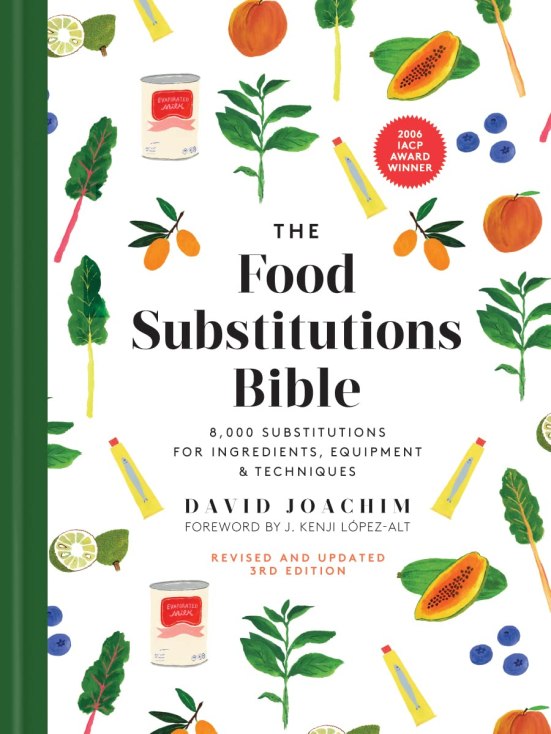
The Food Substitutions Bible by David Joachim

The Food Substitutions Bible
The Food Substitutions Bible is a hefty reference volume offering over 8000 ideas for smart replacements useful on those occasions when you’ve misjudged the contents of your cupboards. Need something to sit in for those fennel seeds you forgot to pick up in the weekend shop? Simply flick through to ‘F’ and discover that while anise seeds are your ideal swap, dill seeds will work in a pinch to offer a slightly milder flavour, or caraway seeds, if you’re happy to forgo some sweetness.

This is the third edition of David Joachim’s book, which first came out in 2005, before being revised in 2010. The way we eat has changed significantly in the past decade, and the new additions here reflect that. From freekeh to katsuobushi, Joachim acknowledges the ongoing global shift in the industry.

But the focus isn’t strictly on base-level ingredients – there are recommendations for tools that might stand in for a blowtorch, a steamer, or various specialist pots and pans. Folks with cookbooks that are more ambitious than their local supermarket shelves will find plenty of use in the suggestions of more readily accessible equivalents to elk, squirrel and crocodile.

There’s still room for improvements in future editions, though: having been diagnosed as coeliac last year, I’m still trying to get my head around substitutions for a long list of ingredients I have been surprised to have robbed from my kitchen (Marmite! Soy sauce! English mustard!) While each of these are addressed in some way in the book, none of them face the gluten question head on. This feels like a waste when the very concept of the book offers so much promise to those suffering from any number of dietary restrictions; those with nut allergies will be among those who might also feel a little underserved in some areas.

You should buy The Food Substitutions Bible for a handy point of reference while cooking. Yes, Google exists, but when you’re deep into a recipe and juggling several pans at once it can be a real faff to discern which citation-thirsty suggestion will actually work in practice. Even in the first week in my house, Joachim came to my rescue on two different occasions, suggesting simple replacements that saved dinner. For that alone, this is a purchase worth making.

Cuisine: Global
Suitable for: Beginner and confident home cooks as well as curious foodies and professional chefs
Cookbook Review Rating: Four stars

Buy this book: The Food Substitutions Bible

Review written by Stephen Rötzsch Thomas a Nottingham-based writer. Follow him on Twitter and Instagram at @srotzschthomas

Restaurant Gordon Ramsay: A Story of Excellence by Gordon Ramsay

Restaurant Gordon Ramsay

What’s the USP? A follow up of sorts to Ramsay’s 2007 book Three Star Chef  that focuses on the food and story of his three Michelin starred flagship restaurant Restaurant Gordon Ramsay in Chelsea, London. Recipes are organised by seasons, each with an introduction to the key ingredients available at the time of year. Interspersed is Ramsay’s anecdotal history of the restaurant. As such, the book is aimed at professional chefs and those who want a memento of what might possibly be a meal of a lifetime and be of less interest to the audience for Ramsay’s usual quick and easy-style cookbooks such as Ramsay in 10: Delicious Recipes Made in a Flash.

Who is the author? That bad tempered shouty bloke from off the telly, that’s who. Born in Scotland and brought up in Stratford-upon-Avon, he is a former aspiring professional footballer turned most-famous-chef-currently-on-the-planet. Trained by some of the leading chefs of the time including Albert Roux, Marco Pierre White, Guy Savoy and Joël Robuchon, Ramsay opened his first restaurant Aubergine in Fulham in 1993 where he won two Michelin stars. The third came when he opened Restaurant Gordon Ramsay in 1998. His restaurant empire currently spans the UK, France, the US, Dubai and Singapore and encompasses everything from the two Michelin starred Le Pressoir d’Argent in Bordeaux to a string of Street Pizza and Street Burger restaurants. Ramsay is a familiar figure on TV both sides of the Atlantic with shows including Hell’s Kitchen, Masterchef, Masterchef Jr., 24 Hours To Hell & Back, Gordon Ramsay: Uncharted and Gordon, Gino And Fred.

The book’s co author is Restaurant Gordon Ramsay Chef Patron Matt Abé who has worked for Ramsay for 16 years. Born in Australia, he worked at Aria Restaurant in Sydney and Vue du Monde in Melbourne before moving to the UK at the age of 21 to work as chef de partie at Claridge’s. He then moved to Restaurant Gordon Ramsay, working his way up from chef de partie to his current position overseeing the whole restaurant.

Are the recipes easy to follow? Well, sort of. Let’s take ‘Veal Sweetbread, Toasted Grains, Ajo Blanco, Malt’ as an example. First you’ll need to make your veal stock and chicken stock (separate recipes for both are included in the ‘basics’ section). You’ll need 4kg of veal bones and 3kg of chicken wings and necks and 24 hours during which you’ll be regularly skimming the stocks. The recipe fails to explain how you’ll get any sleep during this process so you’ll have to figure that one for yourselves.

Anyway, once you’ve had a nap, it’s time to get the malt jus on. You’ll just need a kilo of veal trimmings for this and fair amount of time for browning and reducing and passing. Once you’ve got your beautiful and extremely expensive sauce, it’s time to deep fry some wild rice and amaranth grains to puff them up for garnish. The cost of living crisis means this alone is an horrendously expensive process, but it’ll be worth it.

Once you’ve got those boxed up, all you need to do is trim 2kg of veal heart sweetbreads (they were all out at Asda but I’m sure you can track them down at your local butcher. Do you have one of those? Lucky you) removing the membrane with your razor sharp Japanese-style chef’s knife. Then just fry them up and top with some honey glaze (there’s a separate recipe for that), your puffed grains plus some sobacha and malted oats you just happen to have in the cupboard, along with all those allium buds and flowers you were looking for something to do with. Then you pour over your ajo blanco (sorry, didn’t I mention it that before? Yes, that’s another thing you need to make) and your malt jus and job’s a good’un.

It’s at this point you begin to realise why dinner at Restaurant Gordon Ramsay costs £180 a head just for the food. So to answer the question, the recipes are pretty straightforward, if you take each individual component by itself. But it’s the amount of components, the number of ingredient, the time involved and the skill and equipment required (you’ll need a Vitamix if you are going to follow the recipe to the letter and achieve the sort of velvety texture Abé does in the restaurant for example) that’s the issue.

Will I have trouble finding the ingredients? There are a number of dishes such as canapes and amuse-bouche where you will find it impossible as there are no recipes, just images and a description. This sadly includes the restaurant’s fantastic Parker House rolls. If anything would have been worth the £60 cost of the book it would be a recipe for that bread, one of the highlights of a recent meal I was lucky enough to enjoy at RGR.

While many of the ingredients for most of the dishes in the book are readily available in some form or another, there are quite a few instances of micro herbs/foraged flowers, herbs and leaves and the sort of powders associated with molecular gastronomy (although the food in the book is very far removed from that) being required. So you’ll need for example to track down mustard frills, chickweed leaves and three cornered garlic flowers for a asparagus and morel starter, and some Ultratex (and a Pacojet) to make a herb puree for a cod and Jersey Royal dish. However, it would only take a little thought and ingenuity for an experienced cook (and certainly a professional chef) to work around these requirements without straying too far from the original intention of the dish.

How often will I cook from this book? While this is at heart a coffee table book, it could also have a useful life in your kitchen. If you are a home cook, most of the complete dishes in the book will be quite a serious undertaking. However, many of the individual components are fairly straightforward, so you might make the saffron emulsion (mayo) that accompanies a crab and melon mousse and that’s flavoured with paprika and Espelette chilli powder and serve it with some simply grilled fish.

Does it make for a good bedtime read? This is the story of the restaurant as well as a recipe book so there’s a good amount to read. This is very much Ramsay’s version of events however and key players like Marcus Wareing, Angela Hartnett, Mark Sargeant, Jason Atherton and Mark Askew  (none of whom still work for Ramsay) get only a passing mention. There are a few juicy nuggets like the fact Ramsay was paid £200k for the Boiling Point documentary series and that he applies ‘ruthless margins on wine’ (now you know the other reason why your dinner is so expensive). If you’ve read Playing With Fire or Humble Pie, Ramsay ‘s two autobiographies you won’t learn much new here but it’s an enjoyable read nevertheless. There are also some interesting observations on seasonal ingredients including the fact that lobsters are never cooked whole at the restaurant because each part cooks at a different rate.

Should I buy the book? The book looks a million dollars, especially the fantastic food shots by John Carey, is a decent read and has some great, if daunting recipes. Ramsay fans, professional chefs and ambitious home cooks will find much to enjoy and inspire here. What it’s definitely not is a practical everyday cookbook, but there are plenty of those already. Perhaps a book you would gift rather than buy for yourself.

Cuisine: Modern British
Suitable for: For professional chefs
Cookbook Review Rating: Four stars

Buy this book: Restaurant Gordon Ramsay: A Story of Excellence by Gordon Ramsay

Simply Scandinavian by Trine Hahnemann

Simply Scandinavian
In 2004, chefs from the Scandinavian countries of Norway, Sweden and Denmark assembled alongside other Nordic chefs from Finland, Iceland, the Faroe Islands, Greenland, and Åland. After days gathered around what surely must have been an immaculately crafted solid oak table, bathed in natural light pouring in from floor to ceiling windows and set in the middle of a minimalist, yet tasteful, room of bare concrete walls, they emerged with The New Nordic Food Manifesto. The manifesto outlines ten aims of what food from the Nordic regions should be. One states that food should be reflective of the seasons, made with ingredients that are able to be sourced locally while another seeks to provide basic standards for animal welfare and responsible fishing. Noma’s live prawns topped with black ants, could be seen as an extreme example of an aim for purity, freshness and simplicity.

Gravlax, smørrebrød and IKEA meatballs aside, it’s likely that when we think of Scandinavian food, it looks something like the manifesto envisioned: conscious and graceful food, using few ingredients and cooked well. As a young budget traveller many moons ago, my idea of Scandinavian dishes used to be cheap newsagents hotdogs, the ones that pirouette in their own swill for hours before being decanted into a sweet, bleached bun and lathered with sauce from a hand pump.

Simply Scandinavian is thankfully lacking in hotdog recipes and instead, presents the fresh, seasonal and straightforward food Scandinavian cookery is synonymous with. It’s the latest in a line of Scandinavian cookbooks from chef and food writer Trine Hahnemann, with others focusing on comfort food, baking and entirely vegetable-based recipes.

It’s an easy book to drop into, not requiring any special ingredients than what you might already have lurking in the fridge. They’re predominantly vegetable-based and with chapters arranged by a “what do you fancy?” approach like Daily Comfort Food, Feeling Green or Light Dinners it makes selecting what to cook even more accessible.

Most recipes require little investment of time or energy. A meal of Chilled Pea Soup, a creamy Curry with Grapes accompanied by a Black and White Salad of lentils and rice came together within the hour. Most take less than thirty minutes, like a Roast Tomato Soup, featuring a tickle of coriander seeds or the Hot Smoked Salmon, Spinach and Fennel Salad.

There are some that require more involvement, the Roast Pork Loin or most dishes in the slightly misleading ‘Baking on a Whim’ chapter which to me suggests cinnamon rolls in a jiffy but tends to entail a fair amount of effort. Some are definitely whimmy, a Creamy Filo Vegetable Pie can be made in under an hour as can the Beautiful Cauliflower Trees on Filo, whereas the Buttery Leek Tart takes a little over. Rhubarb Sticky Buns are a morning’s work though happen to be entirely worth the effort and everything you’d want from a title like that.

Simple food is hard to get right both for cooks and, I imagine, cookbook authors. In a dish with few parts, so much will rely on the quality of those ingredients and the skill to prepare them well, especially with a cuisine like this, which doesn’t rely heavily on strong flavoured ingredients or spices. And while I don’t judge a book by its cover, I do judge it on how straightforward it claims to be on that cover. Can I make multiple dishes from it simultaneously? Does it inspire me to cook well when time is short? Is it easy to adapt to ingredients I have available?

Resoundingly, yes. The writing is clear, concise and easy to follow and dietary adaptations are made with simple instructions though for my tastes, some dishes would be better with a little more complication. I’d sacrifice the ease of some recipes if it meant not having to eat raw asparagus or cauliflower again.

Simply Scandinavian is ultimately a collection of intentionally unshowy recipes featuring fresh food that’s occasionally hearty, often delicate and almost always as easy as a cycle around Copenhagen.

Cuisine: Scandinavian
Suitable For: Beginners/Confident home cooks
Cookbook Review Rating: four stars
Buy this book: Simply Scandinavian
£27, Quadrille Publishing Ltd

Review written by Nick Dodd a Leeds-based pianist, teacher and writer. Contact him at www.yorkshirepiano.co.uk

SORREL HOISIN FRIED ‘CHICKEN’ BURGER by Denai Moore

ChickenSando_066
Every now and then you need a good burger in your life, and this one satisfies that craving. This is the kind of dish I make for my non-vegan friends. The sorrel hoisin glaze is quietly delicious and adds a fruity twist. Lettuce and pickles are non-negotiable here. There’s just something about the hot, crispy, sticky glazed oyster mushrooms and the ice-cold lettuce.

SERVES 6
PREP TIME 20 MINUTES, PLUS 20 MINUTES MARINATING TIME
COOK TIME 30 MINUTES

250 g (9 oz) oyster mushrooms
2 tablespoons Green Seasoning (see below)
1 tablespoon soy sauce
1 tablespoon ground allspice
vegetable oil, for deep-frying
1 x quantity Sorrel Hoisin Glaze (see below)
salt and freshly ground black pepper

FOR THE WET DREDGE
400 ml (13 fl oz/generous 1½ cups) soya milk
1 tablespoon lemon juice
2 tablespoons hot sauce of your choice

FOR THE CRISPY COATING
200 g (7 oz/1⅔ cups) plain (all-purpose) flour
50 g (2 oz/scant ½ cup) cornflour (cornstarch)
1 tablespoon all-purpose seasoning
1 teaspoon dried sage
1 teaspoon ground allspice
1½ teaspoons onion powder
1½ teaspoons garlic granules

TO SERVE
6 vegan-friendly brioche burger buns
knob of vegan block butter
vegan mayonnaise
½ iceberg lettuce
gherkins (pickles)

In a bowl, toss the mushrooms with the green seasoning, soy sauce, allspice and some salt and pepper. Set aside to marinate for 20 minutes. Combine the wet dredge ingredients in one bowl and the crispy coating ingredients in another, seasoning the coating mix with plenty of salt and pepper.

Add a little of the wet dredge to the dry coating and mix in – this will create small lumps, which will become crispy pockets. Dip the mushrooms in the wet dredge, then into the coating mix and then repeat for a double coating. Tap off any excess coating mix and set aside on a baking sheet, ready to fry.

Pour enough vegetable oil into a high-sided heavy-bottomed frying pan (skillet) or saucepan to fill to halfway and gently bring to heat. Test the temperature by using a wooden spoon – if lots of bubbles appear around it immediately, it’s ready to go.

Add 4–5 mushrooms to the pan, taking care not to overcrowd. Fry for 5–6 minutes until crisp and golden. Drain off any excess oil on a wire rack. Repeat until all the mushrooms are cooked. Brush the sorrel hoisin glaze on the mushrooms and set aside.

Toast the brioche buns with a touch of vegan butter. On the base of each bun spread a tablespoon of vegan mayonnaise and add a couple of lettuce leaves. Now add the glazed mushrooms and pickles. And another dollop of vegan mayo on the top bun. Serve and enjoy!

GREEN SEASONING
SERVES 10–12
PREP TIME 3 MINUTES

This flavour bomb is great to add to stews, soups and marinades.

bunch of coriander (cilantro)
bunch of flat-leaf parsley
10 springs of thyme, leaves picked
5 spring onions (scallions), roughly chopped
2 celery stalks, roughly chopped
1 bulb of garlic, cloves peeled
1 onion, roughly chopped
1 green (bell) pepper, roughly chopped
1 Scotch bonnet
sea salt and freshly ground black pepper

Put all the ingredients in a food processor and blend for 2–3 minutes to your desired consistency. I like mine quite fine, but you might like yours more coarse. Store in a clean jar and refrigerate for up to 2 weeks.

SORREL HOISIN GLAZE
SERVES 3–4 PREP TIME 5 MINUTES
COOK TIME 10 MINUTES

Sorrel is a hibiscus drink. The floral notes really work with the sweetness of the hoisin sauce. This would work well in various dishes, especially anything crispy and fried.

400 ml (13 fl oz/generous 1½ cups) sorrel soft drink
1 Scotch bonnet
4 allspice berries
100 ml (3/2 fl oz/scant ½ cup) hoisin sauce

Combine the sorrel, whole Scotch bonnet and allspice in a saucepan, bring to the boil, then reduce by half – it should hold on the back of a spoon and be sticky. Add the hoisin sauce, then transfer to a clean jar and store for up to 2 weeks in the refrigerator.

Cook more from this book

Buy this book: Plentiful by Denai Moore

Read the review