Spaghetti with creamy lemon sauce by Skye McAlpine

lemon spaghetti

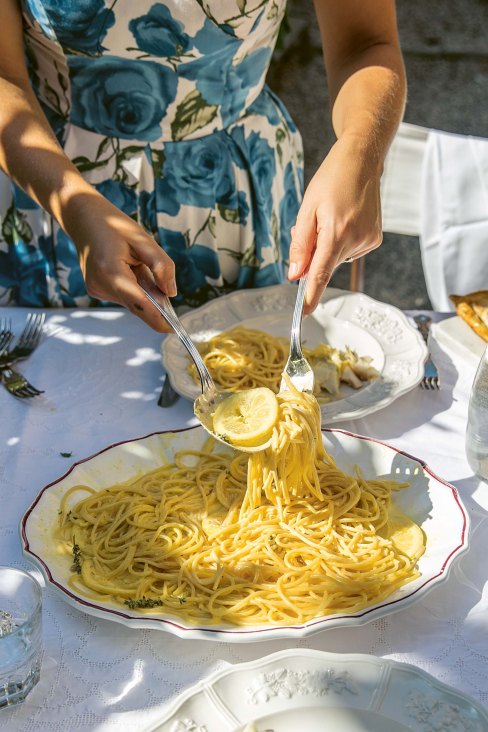
I don’t often trust myself to cook pasta for more than four people, because the timings are too delicate. As they say in Naples: ‘people wait for pasta, not the other way round.’ Overcooked pasta is a cook’s worst nightmare, while pasta eaten cold when it should be hot is not much better. But this recipe – like eating a bowl of sunshine – is so simple that even I can happily chat and bring it together at the same time. I prepare the sauce in advance and leave it covered on the hob, then, while the pasta is bubbling, slice the lemon, shuffle everyone to the table and assemble the dish once they are sitting down, so they eat it hot.

HANDS ON TIME

20–25 minutes

F O R 4

2 lemons
4 tbsp extra virgin olive oil
220ml single cream
1 egg yolk
350g spaghetti
A small bunch of thyme Fine sea salt
Freshly ground black pepper

Bring a large saucepan of water to the boil. Meanwhile, finely zest both the lemons and toss the zest into a deep frying pan, then add the olive oil and set it over a medium heat. Gently fry the zest for a few minutes until it begins to take on a deep, vibrant yellow colour.

Now pour in the cream and the egg yolk, mix well with a wooden spoon, then reduce the heat and leave to gently cook for 5–10 minutes, giving
it a stir every now and then.

Add a generous pinch of salt to the boiling water, and, when it begins
to gallop, add the spaghetti and cook until al dente according to the packet instructions. Finely slice one-third of a lemon.

When the pasta is cooked, drain in a colander, reserving a little of the cooking water (roughly 1⁄4 cup). Squeeze the juice of the remaining lemons into the sauce, add salt and pepper to taste, then toss the pasta into the frying pan. Add the reserved cooking water, throw in the lemon slices and toss everything together so the pasta is well covered with sauce.Tear up the thyme sprigs, sprinkle generously over and serve immediately.

SERVE WITH…

You need little more with this, as it’s pretty much a meal in itself. Perhaps a nice green salad with OLGA’S PEPPERY VINAIGRETTE (see book for recipe).

AND FOR PUDDING…
Something easy-going, such as a LAVENDER HONEY PANNACOTTA (see book for recipe), or STRAWBERRIES IN LEMONY SYRUP (see book for recipe).

Cook more from this book
Berry Cloud Cake
Sicilian couscous salad

Buy the book

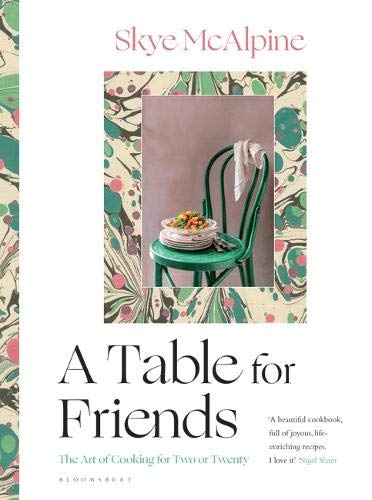
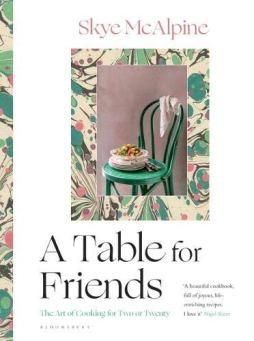
A Table for Friends by Skye McAlpine
A Table for Friends: The Art of Cooking for Two or Twenty
£26, Bloomsbury Publishing

Read the review
Coming soon

Berry Cloud Cake by Skye McAlpine

summer berry cloudcake-1403

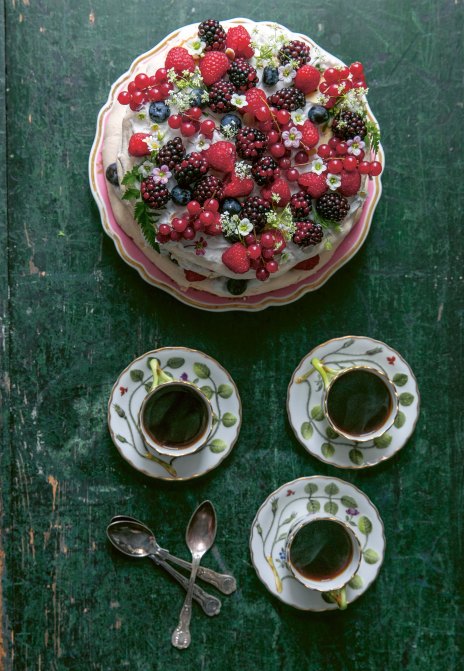
An ode to the fruits of British summer. If you are catering for friends with dairy intolerance, you can also make this with whipped chilled coconut cream, which is every bit as good.

HANDS ON TIME
25 minutes

HANDS OFF TIME
1 hour baking
1 hour cooling

FOR 8–10
Flavourless oil, for the trays
6 egg whites
300g caster sugar, plus 2 tbsp
2 tsp cornflour
1 tsp white wine vinegar
850ml double cream
150g blackberries
300g raspberries
300g blueberries
30g flaked almonds
Thyme sprigs, redcurrants and flowers, for decoration (optional)

Heat the oven to 150 ̊C/fan 130 ̊C/Gas 2. Oil 3 baking trays and line with baking parchment. Draw a circle on each roughly 23cm in diameter (I trace around a cake tin).

In a clean mixing bowl, whisk the egg whites until they begin to peak, then add the sugar a spoonful at a time, whisking all the while.When all the sugar has been added and the mixture is glossy, gently fold in the cornflour and the vinegar. Spoon the meringue on to the baking trays, spreading it out to make 3 discs. Bake for 1 hour, then switch the oven off and leave the meringues in there to harden for another hour.You want the meringue to be crisp so that it can support the weight of the cream. You can make the meringue up to 3 days in advance and store it in an airtight container.

To make the filling, whip the cream with an electric whisk until peaks form, but take care not to over-whip it, or it will lose that silky quality.

Take the first meringue disc and spoon roughly one-third of the cream on top, then sprinkle with one-third of the berries, half the flaked almonds and 1 tbsp caster sugar. Top with the second layer of meringue and repeat. Top with the third meringue, spoon on the last one-third of the cream and decorate with berries, thyme sprigs and flowers (just make sure they’re not noxious), if you like.

SERVE WITH…
Everyone loves BUTTERY LEMON ROAST CHICKEN (see book for recipe), cooked so the skin is golden and crisp and the meat succulent, almost sweet. To go with it, THE SIMPLEST ROAST POTATOES (see book for recipe), A REALLY GOOD GREEN SALAD (see book for recipe) and plenty of good bread (I love WALNUT SODA BREAD, see book for recipe, but good bread from the bakery will do just as well). You literally can’t go wrong. Follow with this dreamy, creamy concoction and strong espresso or mint tea (just mint leaves in a pot of boiling water). If you’re cooking for a crowd, this works every bit as well: just scale up to two (or three) birds and perhaps make a second cake.

Cook more from this book
Spaghetti with creamy lemon sauce
Sicilian couscous salad

Buy the book

A Table for Friends by Skye McAlpine

A Table for Friends: The Art of Cooking for Two or Twenty
£26, Bloomsbury Publishing

Read the review
Coming soon

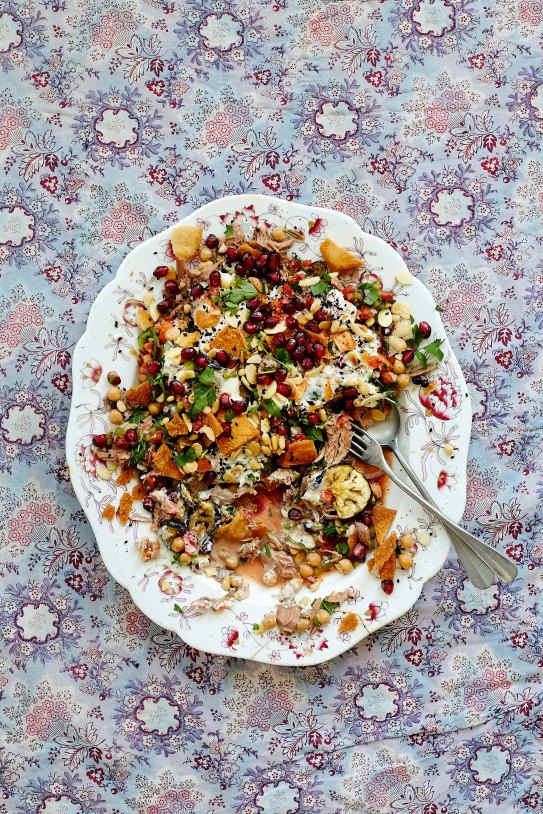
Lamb and Aubergine Fatteh by Ravinder Bhogal

190628_LambFatteh_009

Fatteh is a layered feasting dish. This one features lamb, aubergine and pulses, ladlefuls of garlic-spiked tahini yoghurt sauce and spicy tomato salsa, all topped off with fried shards of flatbread, pine nuts and almonds – and that most iconic Middle Eastern ingredient, pomegranate. This is a great recipe for a crowd. With every bite, your guests will luxuriate in different flavours.

SERVES 6

4 tbsp olive oil
4 lamb shanks
1 cinnamon stick, broken up
2 tsp allspice berries
2 tsp coriander seeds
6 green cardamom pods, bruised 1 tsp black peppercorns
2 red onions, unpeeled, cut into quarters
1 whole garlic bulb, halved crossways
2 aubergines, thinly sliced into rounds
1 × 400g tin chickpeas, drained 2 Lebanese flatbreads

Groundnut oil, for deep-frying 1 tbsp ghee
2 tbsp flaked almonds
2 tbsp pine nuts
Seeds from 1⁄2 large pomegranate 1 tbsp black sesame seeds
1 tsp sumac
Handful of parsley leaves
Sea salt and black pepper

For the sauce
250g yoghurt
1 tbsp tahini
Juice of 1 lemon
1 garlic clove, crushed

For the salsa
1 heaped tsp Turkish pepper paste (biber salcasi) or good-quality harissa
2 tbsp olive oil
Juice of 1 lemon
4 tomatoes, peeled and finely chopped
1 red onion, finely chopped
1 green pepper, finely chopped Large handful of finely chopped parsley
1 tsp sumac
1 tsp Turkish pepper flakes (pul biber) 1⁄2 tsp dried mint

Preheat the oven to 180°C/160°C Fan/Gas Mark 4. Pour 2 tablespoons of the oil into a large flameproof casserole over high heat and sear the lamb shanks all over. Add the cinnamon, allspice, coriander seeds, cardamom pods, peppercorns, onions and garlic and fry for 1 minute. Pour in 1.5 litres of water, then cover and cook in the oven for 2 hours.
In the meantime, place the sliced aubergine on a lined baking sheet, drizzle over the remaining 2 tablespoons of oil and season with salt and pepper. Roast in the oven for 45 minutes or until soft, then set aside.

Make the sauce by simply mixing all the ingredients together.
For the salsa, put the paste, oil and lemon juice into a bowl, season with salt and pepper and stir until well combined, then add the tomatoes,red onion, green pepper, parsley, sumac, Turkish pepper flakes and dried mint.
Take the lamb out of the oven and add the chickpeas, then cover again and return to the oven for a further 30 minutes.

Using scissors, cut the Lebanese bread into bite-sized shards. Fill a large, heavy-based saucepan a third full with the deep-frying oil. Heat the oil
to 180°C – if you don’t have a thermometer, you will know the oil is ready when a cube of bread turns golden brown in 20 seconds. Fry the flatbread for 1 minute, or until golden and crisp, then drain on kitchen paper.

Heat the ghee in a frying pan over medium heat and fry the almonds and pine nuts until golden and toasty, keeping a close eye on them as they can quickly burn. Drain on kitchen paper.

To serve, lift the lamb shanks out of the casserole and onto a chopping board. Shred the meat with two forks, then lay over a serving dish. Fish out the chickpeas with a slotted spoon and tumble over the lamb, along with a few ladlefuls of the stock to moisten the lamb. (Keep the rest of the stock to make soup another time.) Cover the lamb and chickpeas with
the aubergines, arranging them in a single layer, followed by the tomato salsa and dollops of the yoghurt sauce. Finish with the fried flatbread, almonds, pine nuts, pomegranate seeds, sesame seeds, sumac and parsley.

Cook more from this book
Lemongrass Poussin with Green Mango and Peanut Salad
Banana Cake with Miso Butterscotch and Ovaltine Kulfi

Read the review

Buy this book
Jikoni: Proudly Inauthentic Recipes from an Immigrant Kitchen
£26, Bloomsbury Publishing

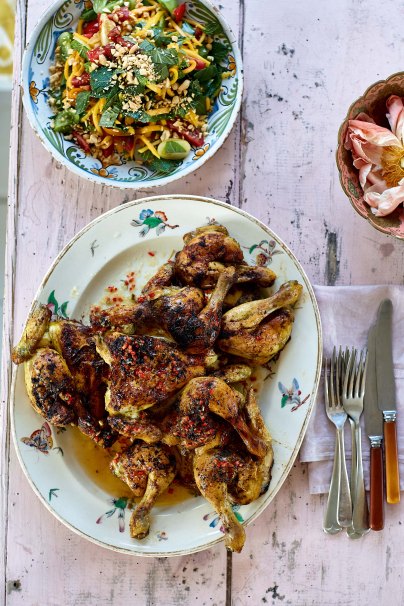
Lemongrass Poussin with Green Mango and Peanut Salad by Ravinder Bhogal

SpatchcockLemongrassPoussin_206

This wildly flavourful roast poussin is inspired by the fragrant and punchy flavours of Thailand. If the weather permits, throw it on the barbecue and cook it in the seductive plumes of its smoke. Serve with steamed jasmine rice.

SERVES 6

6 poussins, spatchcocked 3 tbsp rapeseed oil

For the marinade
Large thumb of ginger, grated
5 garlic cloves
2 lemongrass stalks, sliced
Large handful of roughly chopped coriander, leaves and stalks
50g light brown sugar or palm sugar
250ml light soy sauce

For the dressing
1⁄2 red chilli, finely chopped
1 garlic clove, grated
Small thumb of ginger, finely grated
1 tbsp clear honey
2 tbsp fish sauce
2 tbsp light soy sauce
2 tbsp groundnut or rapeseed oil
A few drops of sesame oil
Juice of 1 lime
1 tbsp rice vinegar
1 small shallot or 1⁄2 red onion, finely chopped

For the salad
2 red bird’s eye chillies, finely chopped
1 garlic clove
2 tbsp soft brown sugar
2 tbsp fish sauce
2 tbsp rice vinegar
2 tbsp lime juice
3 green (unripe) mangoes, peeled and cut into matchsticks
100g mixed cherry tomatoes
1 small red onion, very thinly sliced
Handful of Thai basil leaves
Handful of coriander leaves
Handful of mint leaves, torn
75g peanuts, roughly crushed

To make the marinade, put the ginger, garlic, lemongrass, coriander and sugar in a food processor and blitz to a paste. Transfer to a large bowl and stir in the soy sauce. Add the poussins and massage well, using your fingers to gently loosen the skin so you can get some of the marinade underneath it. Cover and leave in the fridge for 2 hours or overnight.

Take the poussins out of the marinade and set aside. Strain the marinade into a saucepan and bring it to the boil, then let it bubble and reduce for about 10 minutes until you have a lovely glaze.

Preheat the oven to 200°C/Fan 180°C/Gas Mark 6.
Pour the oil into a large ovenproof frying pan over medium–high heat, add the poussins and fry, skin side down, until crisp and well browned. Brush over the glaze, then transfer to the oven and roast for 30–45 minutes, glazing again halfway through the cooking time.

Meanwhile, make the dressing by shaking together all the ingredients
in a screwtop jar. For the salad, use a mortar and pestle to pound the chillies, garlic and sugar to a smooth paste. Stir in the fish sauce, vinegar, lime juice and 2 tablespoons of warm water. Taste and adjust the flavours as necessary with more sugar, fish sauce, vinegar or lime juice until you have that classic Thai balance of hot, sweet, salty and sour, then transfer to a large bowl. Lightly pound the mango with the pestle and mortar to tenderise, then add to the bowl and pour in the dressing. Crush the tomatoes with the mortar and pestle, then add to the bowl, along with the red onion. Just before serving, add the herbs, toss to combine and scatter with the peanuts. Serve the poussins with the salad on the side.

Cook more from this book
Banana Cake with Miso Butterscotch and Ovaltine Kulfi
Lamb and Aubergine Fatteh

Read the review

Buy this book
Jikoni: Proudly Inauthentic Recipes from an Immigrant Kitchen
£26, Bloomsbury Publishing

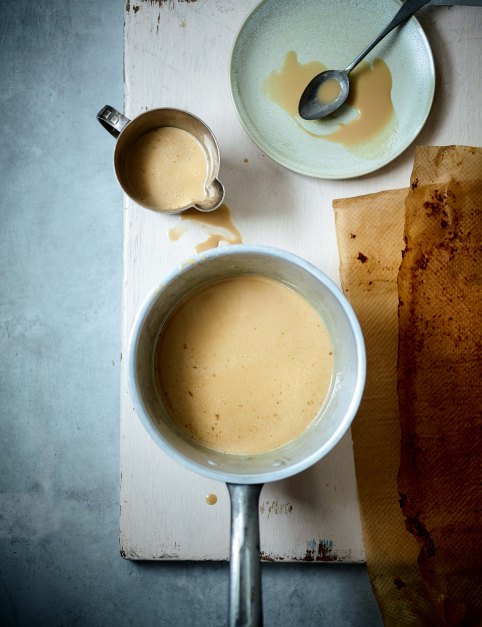
Banana Cake with Miso Butterscotch and Ovaltine Kulfi by Ravinder Bhogal

191023_BananaCake_013

To confine your use of miso to just soup would be to miss out on a multitude of exciting gastronomic opportunities – one of the best of which would have to be the miso butterscotch that goes with Jikoni’s famous banana cake. This dessert has such a cult following that certain die-harders will call ahead to make sure we have a portion saved for them.

The banana cake is based on the idea of a sticky toffee pudding, although it
is much less dense. Then there’s that dizzyingly luxurious miso butterscotch with its compelling mix of sweet and salty flavours. To top it all off, we have the ‘nostalgia in a bowl’ of Ovaltine kulfi, a condensed-milk ice cream that has an almost chewy texture. And if that wasn’t enough to make you fall in love with this dessert, making it is a piece of cake!

SERVES 12

1 tbsp black tea leaves
200ml boiling water
200g pitted dates
110g unsalted butter
350g dark muscovado sugar
1 tbsp treacle
1 tbsp date syrup
400g self-raising flour
4 eggs
1 tsp vanilla extract
1 tbsp bicarbonate of soda 200g peeled bananas

For the kulfi
50g Ovaltine
450g condensed milk
300ml double cream

For the butterscotch
500ml double cream
175g demerara sugar
175g unsalted butter
1 tbsp golden syrup
60g white miso

The kulfi will take at least 6 hours to set, so make it ahead of time. In a large bowl, mix the Ovaltine into the condensed milk until there are no lumps. In a separate bowl, whip the cream to soft peaks, then fold it into the condensed milk mixture. Pour the kulfi into a tub and freeze until set. It really is as simple as that!

Preheat the oven to 190°C/Fan 170°C/Gas Mark 5. Line a 24cm square cake tin with baking parchment.

Put the tea leaves in a heatproof jug or bowl, pour over the boiling water and allow to infuse for a minute. Strain the tea, discarding the tea leaves, then soak the dates in the hot tea for 10 minutes.

In a large bowl, beat together the butter and sugar until smooth. Stir in the treacle and date syrup, followed by the flour, and mix well. Mix the eggs in one at a time.

Tip the soaked dates and tea into a blender or food processor, along with the vanilla extract, and blitz to a puree. Add the bicarbonate of soda and pulse briefly, then add to the bowl and mix thoroughly.

Wipe out the blender, add the bananas and blend until smooth, then add to the cake batter and stir in well. Pour into the tin and bake for 1 hour or until a skewer inserted in the centre of the cake comes out clean.

Meanwhile, to make the butterscotch, put the cream in a saucepan over low heat. Add the sugar, butter and golden syrup and whisk until the sugar has dissolved and the butter has melted. Finally whisk in the miso, then remove from the heat.

Turn the cake out on to a wire rack and leave to cool a little.

To serve, cut into 12 portions, then serve warm with the hot miso butterscotch and the Ovaltine kulfi.

Cook more from this book
Lemongrass Poussin with Green Mango and Peanut Salad
Lamb and Aubergine Fatteh

Read the review

Buy this book
Jikoni: Proudly Inauthentic Recipes from an Immigrant Kitchen
£26, Bloomsbury Publishing

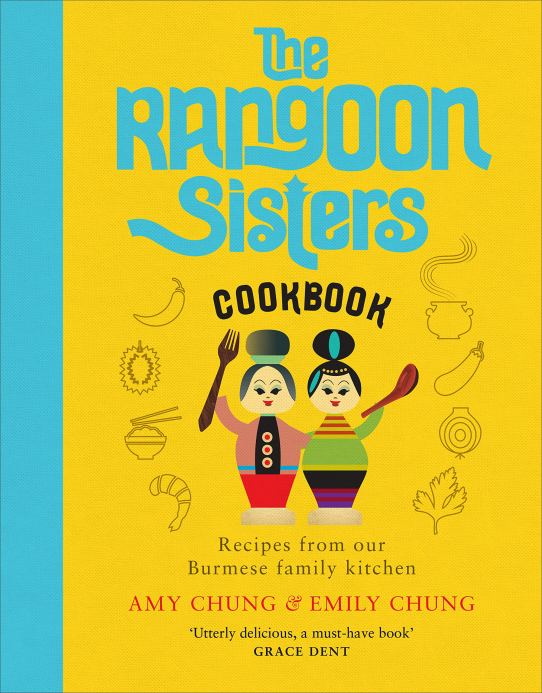
The Rangoon Sisters Cookbook by Amy Chung and Emily Chung

Rangoon Sisters

What’s the USP? An introduction to the flavours and dishes that are central to Burmese cooking. Bright, tempting recipes for salads, stews and assorted Burmese treats are balanced with an overview of the nation’s love for food.

Who wrote it? As the title suggests, the book was written by the Rangoon sisters. The siblings made their name running incredibly popular supper clubs for the past seven years (and raising over £10,000 for charity in the process). The book draws on the food they’ve created for these supper clubs over the years, as well as traditional Burmese dishes and the flavours they were raised with in their Anglo-Burmese childhood home in South London.

Is it good bedtime reading? The Rangoons fill their book with engaging and entertaining prose. Alongside personal and family histories, there’s plenty to read on Burmese cooking, the individual flavours and the history and influences behind individual dishes.

Given the in-depth approach that the book has to all the above, it is perhaps a little surprising that the book doesn’t touch upon any of the recent political issues that Myanmar has had. Many UK readers will only really be familiar with the nation through these ongoing events, and though it is wonderful to see and celebrate another side of the region, it is perhaps something of a missed opportunity for the Rangoon sisters not to address this at all.

Will I have trouble finding the ingredients? There are a few ingredients scattered across the recipes that will require access to an Asian supermarket, but for the most part the sisters do a fantastic job of recreating Burmese dishes with relatively easy to find ingredients. For those flavours that aren’t necessarily so familiar, there’s a brilliant (and extensive) rundown at the beginning of the book, with nearly ten pages of detail on different ingredients.

What’s the faff factor? Pretty low, all things considered. It’s easy to see why their supper clubs have gone so well – the recipes are all straight-forward and require no exceptional technical skills – but the results are never anything less than tantalising.

How often will I cook from the book? Though the recipes are all simple enough, most are fairly hands-on, and so this isn’t necessarily a school-night cookbook. Still, there’s plenty of variety in here, with more than enough to tempt you back on a regular basis.

Killer recipes: I’m a sucker for an interesting egg dish, and the kyet u hin curry is damn near irresistible. The sisters’ butter bean stew is guaranteed to make it onto the table as an easy-but-impressive side next time you have guests over, too. But the headliner of the Rangoon Sisters cookbook must be their famous mango and lime cheesecake – made with a ginger nut base, and kindly presented here with storage advice (a generous gesture given the likelihood of anything surviving the first call for ‘seconds, anyone?’).

Should I buy it? Absolutely. One of the better trends in cookbooks over the last few years has been the proliferation of titles focusing on cuisines hitherto ignored by the average British palate. When done well, these can be both a brilliant insight into eating habits around the world, and a much-needed injection of new flavours into our own diets.

The Rangoon Sisters is filled with lovingly crafted and surprisingly accessible recipes, and makes for pretty decent bedtime reading to boot. Credit is due also to food stylist Aya Nishimura, who has put together some of the most appetising looking dishes I’ve seen in print. If you’re looking to expand your taste horizons a little, this is an excellent place to start.

Review written by Stephen Rötzsch Thomas a Brighton-based writer. Follow him on Twitter and Instagram at @srotzschthomas.

Cuisine: Burmese
Suitable for: Beginners and confident home cooks
Cookbook Review Rating: Five stars

Buy this book
The Rangoon Sisters: Recipes from our Burmese family kitchen
£20, Ebury Press

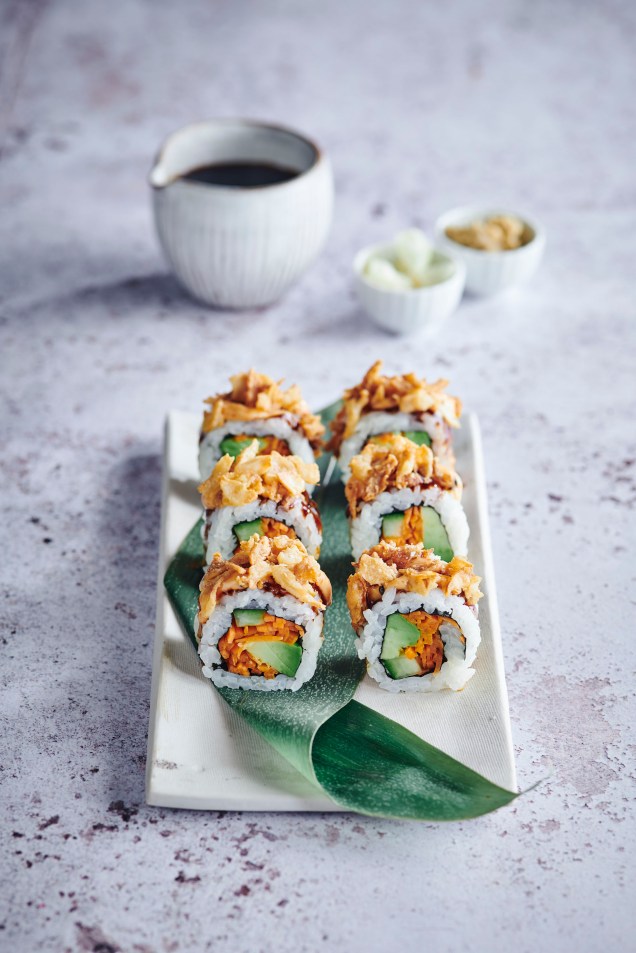
Veggie Crunch Rolls

Veggie_Crunch_Rolls

The combination of crisp vegetables, sweet teriyaki sauce, spicy mayo and crisp fried onions is sublime here.

Serves 4

180g (6oz/scant 1 cup) sushi rice
3 tbsp seasoned vinegar for sushi rice
4 nori half sheets
4 long slices of cucumber
1 small carrot, around 80g (3oz), cut into very fine matchsticks
8 slices avocado
teriyaki sauce, to drizzle
Spicy Mayo (included in the book ), to drizzle
ready-made fried onions, to sprinkle

TO SERVE
soy sauce, wasabi and sushi ginger

Make the rice according to the instructions on page 14, using 220ml (8fl oz/1 cup) water and the seasoned vinegar. Divide the rice roughly into four portions.

Put a sheet of nori on top of the sushi mat, shiny-side down and with the longest edge lying horizontally. Spread a portion of the rice to cover, then flip the nori over. Arrange a length of cucumber in the middle of the nori, followed by the carrot, spreading it out to the ends. Add a couple of slices of avocado and spread out again so it is even. Roll up to make an inside-out roll. Do the same again to make three more rolls.

Slice each into eight pieces, then drizzle with the teriyaki sauce, a little spicy mayo and top with the fried onions. Serve with soy sauce, wasabi and sushi ginger.

Cook more from this book
Chicken Ramen
Chicken Katsu Noodles

Buy the book
Japanese Cooking for the Soul: Healthy. Mindful. Delicious.
£14.99, Ebury Press

Read the review 
Coming soon

japanese cooking for the soul_fc_100%

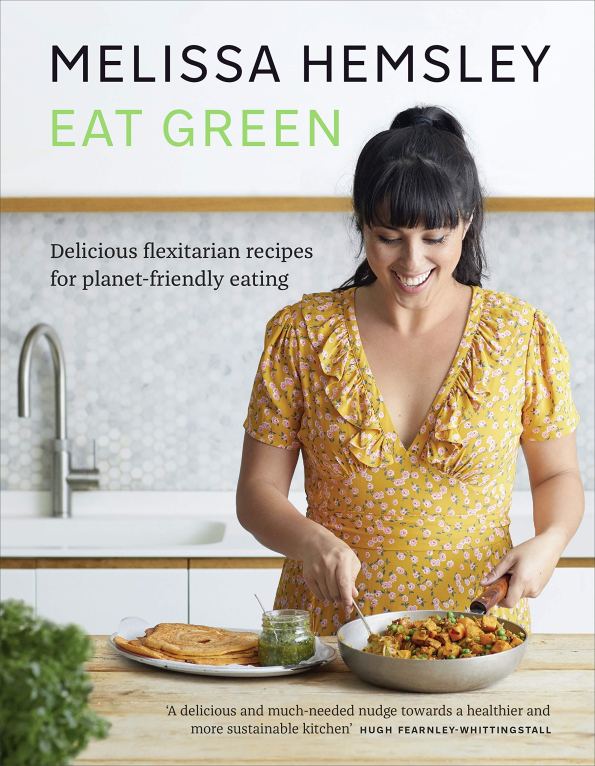
Eat Green by Melissa Hemsley

Eat Green by Melissa Hemsley

What’s the USP? Environmentally responsible cooking is ostensibly at the centre of Eat Green – a cookbook that looks to create dishes from sustainable, locally-sourced ingredients. The author, Melissa Hemsley, offers up plenty of recipes, all of which will look loosely familiar to fans of her previous cookbooks as one half of Hemsley + Hemsley.

Hemsley + Hemsley? Weren’t they involved in the whole ‘clean eating’ controversy a few years back? Oh no, the Hemsley sisters were very much not involved in the ‘clean eating’ fad. At least, not if you ask them. Back in 2017 the sisters distanced themselves from the movement, just days before being featured in a BBC Horizon documentary on its dangers. At the time, they argued that the term was poorly defined, and they’d never advocated it directly.

“We’re not interested in making anyone feel fearful of food, scared of food, confused about food. We’re the opposite. We never talk about weight, diets, calorie-counting,” Melissa told the press.

So they weren’t part of the fad? Well, not according to them – but the problem with ill-defined movements is that people don’t always agree on where the border falls. Certainly the Hemsley sisters’ books bore many similarities to other titles circling the movement. Their dishes eschewed gluten, grains and refined sugars. Whether mentioned weight and diets or not, there was always a very distinct sense of virtue to the lifestyle their books represented.

Eat Green doesn’t exactly seem free of preachy virtuosity, as titles go. No, and Melissa Hemsley definitely talks up the importance of sustainable eating. She doesn’t spend much time examining why it’s important – but then, that in itself is refreshing. We know the environment is spiralling out control, and Hemsley’s introduction treats our understanding as a given – as it should be.

The recipes themselves do their best to live up to the challenge the title sets. A chart at the beginning provides a helpful map of seasonal fruit and veg, and there are tips scattered throughout for avoiding waste – a really lovely idea that’s executed nicely. Hemsley also offers up suggestions for locally-sourced alternatives where possible. She ignores miso in favour of British-grown fava bean umami paste – which is a bit more of a mouthful than miso on a couple of fronts. 

So Melissa has moved on from clean eating in favour of something that’s more objectively a good idea? Well, yes and no. The central focus of the book is definitely sustainable, ‘green’ eating. But as far as the recipes go, nothing much has changed at all. Nothing here would have looked particularly out of place in either of the Hemsley + Hemsley books.  The whole collection clings closely to what you’d expect from ‘clean eating’ at every possible opportunity.

How do you mean? The ‘Celebrations’ section of the book features such extravagant dishes as chickpea caprese salad and ‘mushroom mince’ lettuce cups.

Ah, gotcha. In fact, there’s a remarkable lack of excitement and variety to the recipes on display. There are multiple pancake and galette recipes, and at least a dozen salads that look more or less the same in their photos – piles of loose leaves and chickpeas, etc, that you can tell will be fighting to roll off your cutlery every bit as hard as you are fighting to get them in your mouth.

It feels as if Hemsley was so eager to present green eating that she neglected to include any imagination. The goal, though worthy, should allow much more varied and interesting dishes than are on show here. As a guide, Tim Anderson’s Vegan JapanEasy, reviewed earlier this year, was overflowing with hugely exciting and endlessly appetising ideas – even though its remit was much tighter.

Alright, alright. Calm down, you’ll have a seizure. After this and that Gill Meller review last week, I’m getting the idea you might not have much room in your heart for the sustainable cooking movement. Oh, don’t get me wrong. It’s incredibly obvious that we all need to spend a lot more time thinking about our food habits and doing our best to limit their impact on the world we live in. It’s just…

Yes? Well, why is nobody fun writing a cookbook on sustainable cooking? Why is it always left to people who think a chai parsnip and carrot cake is the best dessert we can manage in our new, environmentally-conscious world?

Killer recipes? The Bubble and Squeak with a Japanese-Inspired Dipping Sauce is a stand-out anomaly, as is the Braised Chicken with Lettuce, Peas and Radish Greens and Mash in a Flash. The one bit of the book that is genuinely brilliant, though, isn’t even a recipe: just before the index Hemsley includes an ‘A-Z of Odds, Ends and Leftovers’ that offers plenty of excellent ideas on how to use those annoying bits and bobs that sit about in the fridge unloved – the tired old fennel, the spare carrot, and so on.

Should I buy it? Look, if you have the Hemsley + Hemsley books, or enjoy any of their contemporaries, you’ll likely get some use out of this too. But this isn’t anywhere close to what I’d call an insightful or particularly useful guide for the average home cook.

Review written by Stephen Rötzsch Thomas a Brighton-based writer. Follow him on Twitter and Instagram at @srotzschthomas.

Cuisine: English
Suitable for: Beginners and confident home cooks
Cookbook Review Rating: One star

Buy this book
Eat Green: Delicious flexitarian recipes for planet-friendly eating
£22, Ebury Press

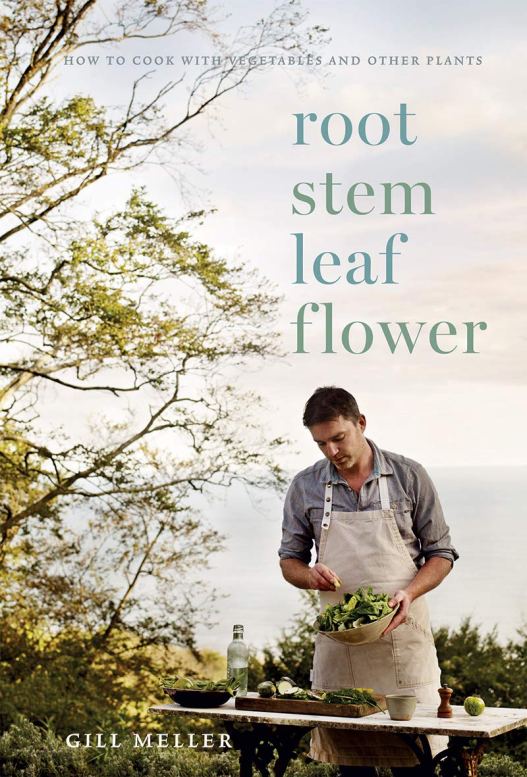
root, stem, leaf, flower by Gill Meller

root stem leaf flower

What’s the USP? Go wild (go wild!) go wild in the country, where nettles in a bush are absolutely free. It’s time to eschew meat and fish for all that lovely fruit and veg that you know will do you good. And here’s Gill Mellor with dirt on his hands and love in his heart to show you ‘how to cook with vegetables and other plants’.

Who is the author? You’ll know Gill Mellor from such books as Outdoor Cooking: River Cottage Handbook No.17 and Time by Gill Meller previously reviewed on this site and awarded a whopping 4 stars (I must have been feeling generous that day. I’m kidding. Or am I?). As I mentioned in that review, Meller is an alumni of Hugh Fearnley Whittingstall’s River Cottage organization and is a chef, food writer and teacher. His first book Gather won the Fortnum and Mason award for Best Debut Food Book in 2017.

Is it good bedtime reading? There’s a fairly chunky introduction to the book and the recipe introductions are interesting and informative, but this is a cookbook for the kitchen rather than one for the bedside table. If you actually enjoy what there is to read will depend on your tolerance for Food Writing with a captial F and capital W; the stuff that usually results from an English degree and a lifetime reading Elizabeth David, Richard Olney and Nigel Slater. It’s the sort of adjective-heavy prose where radishes have a ‘tussle of coarse green leaves on top’ and you find ‘lucent green’ gooseberries among a ‘burr and wrangle of thorns’.

It will also depend on your tolerance for being told how to shop and cook. There is nothing particularly radical in Meller’s suggestion to eat organic, local and seasonal, or in his assertion that ‘we need to be eating less meat and fish’ and that what we do eat should come from ‘ethical and sustainable sources’ and from ‘animals that have led natural, happy lives’. But it’s easy for him as a professional food writer to say that and less easy for those working full time with a family to feed and limited time and financial resources to live up to those lofty ideals. Meller places all the onus on the individual to do the right thing and makes no suggestion that changes should be made at the food supply chain level in order to make produce that meets his stringent criteria easily available and affordable to all. Instead, there is the implication that you are falling short as a human being if you don’t buy organic, sustainable, ethically produced goods. And frankly, fuck that.

Will I have trouble finding the ingredients? If you are going to adhere to the Meller mantra of organic, sustainable, ethically produced stuff, then you will be narrowing the field substantially. However, most of the actual ingredients are not that obscure and you should be able to track them down without too much effort, especially if you are willing to eat ordinary people’s food. You’ll die sooner and be killing the planet with every single bite, but at least you’re not a serial killer with someone chained up in your cellar. Are you? I mean, if you are, I don’t approve obviously, but it’s interesting, isn’t it? I know lots of people are bored with serial killers but I think there’s an enduring fascination. Drop me a line, there’s a contact widget somewhere on this site, tell me about your sickness.

What’s the faff factor? Have we stopped talking about serial killers already? Oh well. WHAT’S THE FAFF FACTOR? IS THAT WHAT YOU WANT TO KNOW? IS THAT REALLY WHAT’S BOTHERING YOU RIGHT AT THIS PRESENT MOMENT IN TIME? Sorry, I don’t know why I’m shouting. I haven’t had my meds today and lockdown is really starting to get to me. Faff factor, yes, good point. You should know about that before you buy a book. You work hard for your money, you don’t want to waste it on something you’re never going to use. It’s a reasonable question. I don’t know why I’m making such a big deal about it. I mean, I write the bloody questions myself, it’s not as though someone is dictating to me what I need to tell you. So, faff factor. Faaaaaaaaf faaaaaactor. Try saying that out loud. It’s funny. Like the Shadrack scene in Billy Liar.You know the bit. Actually, you’re probably too young. Or from a country where they never showed the film on the telly. You should stream it. Anyway, where were we? Oh yes, faffing about. No, the recipes are fine really, they’re mostly short and straightforward. You can judge for yourself; I’ve posted a couple of recipes for you to try (the publisher only allowed two instead of the usual three for some reason. Gill’s special. So special.) The links are at the bottom of the page because this is such a well-designed site.

How annoyingly vague are the recipes? You will find the odd ‘small pinch of sea salt’ which is fine, and a ‘small handful’ of this and that which is OK if you’ve got small hands or know someone who has that could come to your house and grab a handful of herbs for you, although exactly how small their hands need to be isn’t really clear. Just be sensible about it. Perhaps ask a child. No, don’t do that. Unless you’re related to them, then it’s OK.

More annoying is ‘the juice of half a lemon’. Why do recipes rarely give ml measures for lemon juice? I mean, it’s a liquid just like any other isn’t it? And the amount you put in a recipe will affect the final result. I don’t know if you’ve bought a lemon recently, but the amount of juice that you get out of them varies massively from a meager teaspoon to a flood. They are as unpredictable as, erm, something that it’s politically correct to describe as unpredictable. I’m not sure what that might be. Me. I’m unpredictable. The amount of juice you get out of a lemon is as unpredictable as the mood I’ll be in when I wake up on any given day. And that’s pretty unpredictable. Imagine the mood I’m in now, writing this. You don’t want to know.

How often will I cook from the book? How often do you imagine you might fancy ‘tomatoes in the hole’ instead of toad? That’s the question you need to ask yourself. Ultimately, the amount you use this book will depend on precisely how middle class you are. That’s just the truth. Take this stupid quiz and find out. When you discover that the stupid quiz appeared in the Mirror and you decide you don’t want to take it because you don’t want anything to do with that disgusting rag, congratulations, you are middle class and you will cook from this book a lot. If you do decide to take the quiz, it doesn’t matter what your score is, you have read something in the Mirror and are by default not middle class and the book will collect dust languorously on your shelf. Power to the people.

Killer recipes: Do we have to do this? OK (sighs) they include: sweetcorn, rosemary and smoked cheddar soufflé; squash, lentil, tomato and rosemary pie; salted chocolate pumpkin tart; asparagus and quinoa salad with peas and broad beans.

What will I love? The photography by Andrew Montgomery is up to his usual very high standards and there’s a good amount of variety in the recipes, given the relatively narrow subject matter. That was sensible wasn’t it?

What won’t I like so much? Meller’s editors have failed to dissuade him from writing poems. I love poetry. I read lots of it, from Renaissance to 21st Century (give Reckless Paper Birds by John McCullough a go) and I even write some myself. I’m just not convinced a cookbook is the right platform for it. Or maybe I just don’t like Meller’s poems. Sorry Gill.

Should I buy it? This book isn’t really for me, but that doesn’t mean it’s not for you. There’s nothing really wrong with it, so if you need some inspiration in the fruit and veg department and you feel the stylistic issues I’ve outlined above won’t be problematic for you, then go ahead. Oh, I forgot to mention the recipe titles. Unnecessarily overwritten, arch and twee constructions like ‘A tart for May’ and ‘Aubergines and roast tomatoes for everything’ are like fingernails down a blackboard to me (the same goes for the book’s title and the lack of capitals). But most of them aren’t like that, they’re just normal so it’s not the end of the world. Don’t let it put you off. I know it probably wouldn’t but I’m just saying. It’s honestly more about my odd sensitivities to certain tropes of Food Writing, which I think far too much about, than anything else. I shouldn’t have said anything. It’s fine, really.

(Have you had enough of this yet? I could go on all day like this. Once I get on a roll it’s difficult to stop me. What shall we talk about next? No, maybe you’re right, let’s leave it there. Till next time then.)

Cuisine: English
Suitable for: Confident home cooks
Cookbook Review Rating: Three stars

Buy this book
Root, Stem, Leaf, Flower: How to Cook with Vegetables and Other Plants
£27, Quadrille Publishing Ltd.

Cook from this book
Courgette flatbreads with lots of herbs and goat’s cheese
Raspberry and rhubarb crumble

Sun and Rain by Ana Roš

9780714879307

Self-taught Slovenian chef Ana Roš highly unusual path to the professional kitchen is set out in the biographical section of this fascinating and visually stunning book. She trained as a professional dancer and was a member of the Yugoslav national ski team before going on to study international science and diplomacy. Her plans for a career in international diplomacy changed when she met her future husband and natural wine expert Valter Kramar. The couple decided to work in Kramar’s family countryside restaurant Hiša Franko in the remote Soča Valley where Roš eventually took over the running of the kitchen. International acclaim followed with Roš taking part in culinary events like Cook IT Raw and being featured on Netflix’s Chef’s Table documentary series.

Roš‘s lack of any formal culinary training has led to a highly individual style based on the abundant natural larder of the extreme north-west of Slovenia. A community of local foragers, shepherds, cheese makers, hunters and fishermen (some of which are profiled in the book) supply Roš with trout, deer, goats, dairy produce and fruits which she transforms into eye-catchingly plated dishes such as marble trout roe with rosa di Gorizia chicory and yeast; veal consommé, celeriac and young linden leaves, and beeswax peaches and elderflower.

The majestic natural glory of the Soča Valley is well represented in the photography of Suzan Gabrijan who has also captured the rugged elegance of Roš’s food. Even by publisher Phaidon’s consistently high standards, this is an exceptionally beautiful book. Disappointingly, however, apart from two photographs taken in the kitchen, there are no shots of the restaurant interior or exterior which is a puzzling and frustrating omission.  The recipes are hived off into a separate chapter at the end of the book so that it’s necessary to flick back and forth to the images of the finished dishes if you want to understand exactly what you are looking at.  These minor niggles criticisms aside, Sun and Rain is a comprehensive look at the life, culinary philosophy, and cooking of a remarkable figure in the modern culinary scene that will inspire any progressive thinking chef or very keen home cook.

Cuisine: Slovenian/Progressive
Suitable for: Professional chefs
Cookbook Review Rating: Five stars

This review was first published in The Caterer

Buy the book
Ana Ros: Sun and Rain (Food Cook)
£39.95, Phaidon

Cook from this book
Summer Pear by Ana Roš
Bread by Ana Roš
Goat cottage cheese ravioli by Ana Roš