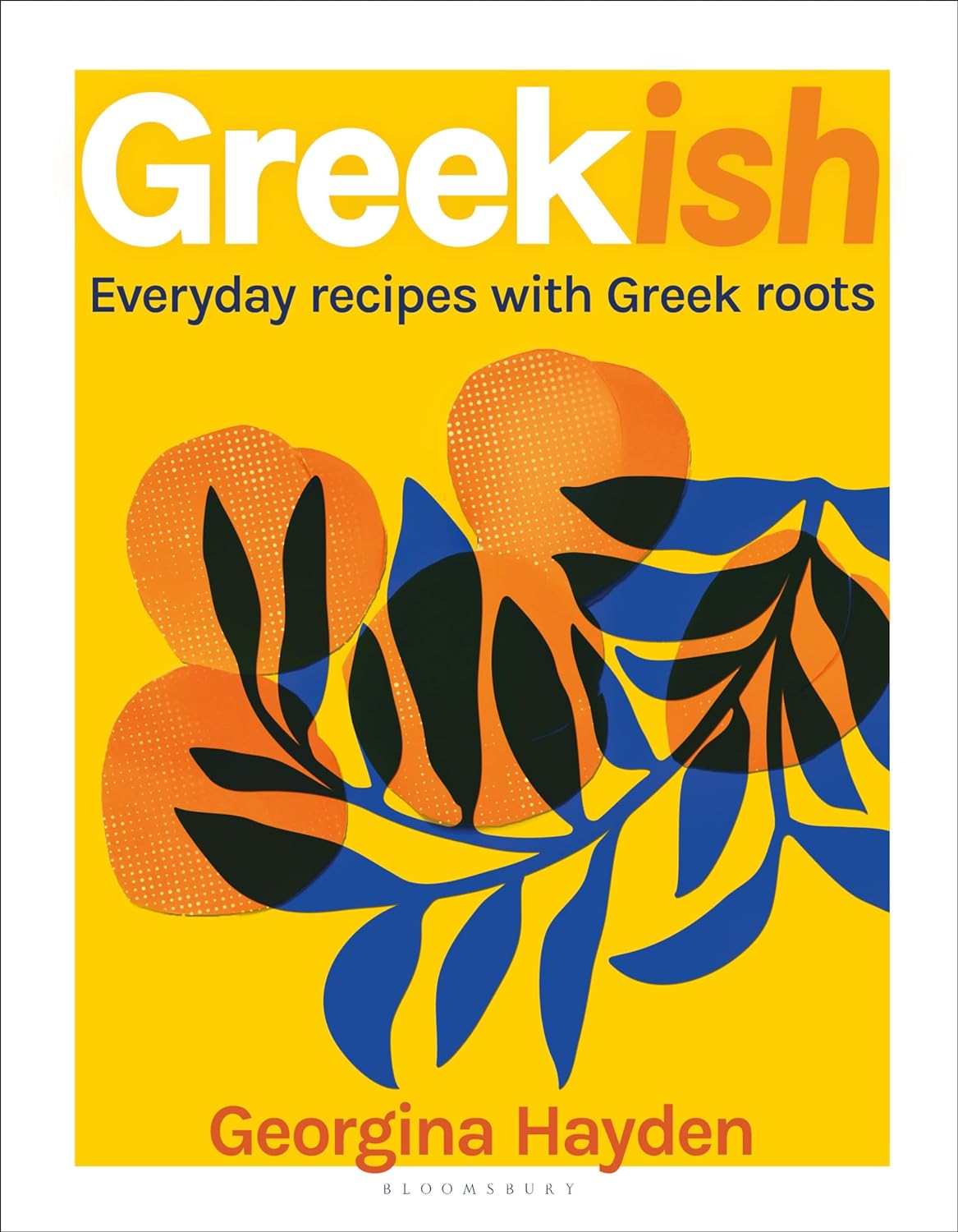
Greekish: Everyday Recipes with Greek Roots by Georgina Hayden – Cookbook Review

Greekish by Georgina Hyden

reviewed by Sophie Knox Richmond

Who is Georgina Hayden?
Georgina Hayden is a food writer and stylist from North London who regularly writes for publications such as The Telegraph, delicious. magazine and Observer Food Monthly. She is also a regular on Channel 4’s Sunday Brunch and BBC1’s Saturday Kitchen. 

Hayden developed a love of food, cooking and storytelling through recipes whilst growing up above her grandparents’ Greek Cypriot taverna. She began her career as a food assistant, working at various food magazines, before joining Jamie Oliver’s food team where she worked for 12 years styling and developing recipes for books, TV and magazines. She has since written 4 best-selling, award-winning, cookbooks captivating readers with a host of enticing Greek Cypriot-inspired recipes for every mood, diet and occasion. She recently launched her podcast ‘Family Feeds’ where she cooks a meal for guests in her home, in real-time, whilst chatting about what food means to them and their families.

What is Greekish’s USP?
Inspired by Hayden’s Greek Cypriot heritage and travels, Greekish promises ‘everyday recipes with Greek roots’. It is a collection of 120 simplified twists on her favourite Mediterranean dishes – all bursting with flavour, but made with fewer ingredients, less stress and designed to be easy enough to be cooked on repeat in busy households.

What will I love?
As Hayden says, this is very much her cookbook full of dishes she cooks in her own kitchen throughout the year. There is a distinctly personal feel to the writing and recipes, almost as if you are chatting with a friend about their favourite recipes. The delicious and inspiring recipes are accompanied by beautifully-shot images. Dietary preferences are catered for with notes on how to adapt recipes if they need to be gluten-free or vegan. Hayden has also included menu ideas for a host of occasions including Sunday lunch, mezedes (small plates), ‘easy but fancy’, plant-based feast, a romantic night in and a do-ahead dinner party. 

Is it good bedtime reading?
It isn’t a particularly ‘wordy’ book, but if you want to drift off dreaming of sunnier climes and delicious food, pop it on the bedside table. Hayden’s warmth and personality shines through in her 3-page introduction, whilst most recipes include a short-ish one of its own. There is also a section at the back with a glossary and advice on how to make the most of the book including tips on how to spatchock a chicken and choose halloumi as well as friendly reassurance that using a stock cube is absolutely fine for those who don’t have the time, or inclination, to make their own.

Will I have trouble finding the ingredients?
Not really. Greek cheeses like graviera and kefalotyri are mentioned, but alternatives such as pecorino are suggested. Once you have stocked your larder with staple Greek seasonings and dried goods (orzo pops up a fair bit), you should be well set to cook your way through the book. Almost all of the recipes can be made with ingredients from your local supermarket and the list of stockists at the back will help you track down anything else. 

How easy are the recipes to follow?
Very. Instructions are detailed without being waffly and ingredient lists are clear. The whole premise of the book is to make delicious, Greek-inspired food, achievable for busy people and Hayden well and truly nails the brief.

Stand-out recipes?
‘One-pot Chicken Thighs and Rice’ is a flavoursome fuss-free supper that has become a regular in our household. ‘HLT Kritharaki’ (a Greek sandwich-inspired tomato, orzo and halloumi dish) is also a firm favourite. ‘Roast Chicken with Tomatoey Bulgur Wheat’ is a great alternative to a traditional roast and ‘Youvetsi’ (meat and orzo stew) is perfect comfort food. ‘Roasted Lemon, Oregano and Feta Potatoes’ also deserves a special mention; prepare for it to become your new go-to potato dish. 

How often will I cook from this book?
There genuinely is something for every mood and occasion. Expect sweet and savoury breakfasts, small plates and snacks (don’t miss the ‘Fried Sesame Cheese Bites’), salads, mains and sweet treats. The unbelievably easy ‘Everyday Yoghurt Flatbreads’ (also adaptable for vegans) could be served throughout the day (some delicious topping ideas are included), whilst dishes like ‘One-pan Pastitsio’ are ideal for a simple supper. There are also plenty of recipes for entertaining, whether you are looking for a selection of dishes for a relaxed summer soiree, or a knock-out bake for an afternoon tea such as ‘Afternoon Chamomile and Honey Cake’.  

Any negatives?
I suppose if you are a staunch traditionalist, you might be horrified at the idea of a ‘Spanakopita Jacket Potato’, but after giving the recipe a go, you will soon change your mind. It would also be helpful to have the cooking time by the ingredients so you can easily see how long a recipe will take, rather than skimming the recipe and calculating it in your head. Apart from that, it is hard to find anything to complain about. 

Should I buy the book?
This is a joyful book brimming with delicious Mediterranean-inspired recipes. A must-have book for anyone who enjoys flavoursome, modern Greek food. It is one of those cookbooks that you will return to time and time again. 

Cookbook review rating: Five stars
Cuisine:
Modern Greek
Suitable for: Anyone who is a fan of Mediterranean food – less confident cooks will love Hayden’s simplified recipes and reassuring writing, whilst those with more experience will enjoy exploring vibrant new dishes.
Great for fans of: Irini Tzortzoglou and Meliz Berg

Buy this book: Greekish: Everyday recipes with Greek roots
£26, Bloomsbury Publishing

Cook from the this book
Coming soon

Easy Wins by Anna Jones

Easy Wins by Anna Jones

Who is Anna Jones?
Anna Jones is an award-winning cook, food writer and pioneer of modern plant based food. She  celebrates the joys of food – with vegetables firmly placed at the centre of the table. In recent years her books have taken a bolder stance on sustainability. In her fourth cookbook One: Pot, Pan, Planet (2021) she dedicated some chapters to educating readers on how to become more eco-friendly. Her recipes take simple, often side-lined, ingredients and transform them into innovative and exciting dishes inspired by cuisines from around the world. 

What is Easy Wins’ USP?
Based around 12 hero ingredients (lemons, olive oil, vinegar, mustard, tomatoes, capers, chilli, tahini, garlic, onions, miso and peanuts), Easy Wins promises 125 simple, seasonal, recipes to help you create delicious, veg-centred, dishes all year round.

As Jones explains in the introduction: ‘Simple ingredients, when shown a little bit of love and attention, come together to make more than the sum of their parts. This to me is an Easy Win. A little moment of kitchen alchemy that reassures me. Recipes that are reliable sources of joy in a world that is ever changing.’

What will I love?
A lot. This is a beautiful book full of stunning photography and enticing, ‘cookable’, recipes for every mood and occasion. Jones has made a concerted effort to utilise lesser-known ingredients in several recipes. Instead of asking the reader to buy a whole jar or pot of something only to leave it lingering in the cupboard after one outing, she gives multiple ideas for how to use it up.

Nearly every recipe is accompanied by a photograph which helps give a visual guide for those who like to see what the final dish looks like. Each beautifully shot images manages to be both striking and achievable at the same time. 

Flexibility is a running theme of the book; many of the recipes can be adapted for vegans and there are explanations on how to successfully swap ingredients, while still producing a delicious result. Jones includes invaluable advice on how to use flavour and texture to enhance any dish and take your cooking to the next level. 

Is it good bedtime reading?
If you are interested in seasonality, eating more sustainably, and learning more about how to make the most out of every meal, then hell yes. There is a personal, heartfelt introduction, followed by ‘Golden Rules for Easy Wins’ and informative guides to ‘Planet-friendly Cooking’ and ‘Salt and Seasoning’.  There’s also interesting and useful advice on ‘Vegetarian Flavour Swaps’, ‘How to Cook Flexibly’, ‘Layering Flavour’ and ‘Layering Texture’.  The ‘Vegetarian Flavour Swaps’ pages are particularly helpful for those looking to incorporate more meat-free dishes into their diet, with paragraph per recommendation to explain why it works, instead of merely offering a bullet-pointed list.

Each chapter begins with a mini-homage to its hero ingredient, followed by information on different types, complimentary flavours, storage tips and which varieties to buy; useful for experimenting with new recipes even beyond Jones’s book. Sections on ‘Herbs’ and ‘Spices’ provide handy information on flavour profiles, origins, flavour pairings, recommended uses and substitutions.  

Will I have trouble finding the ingredients?
Some ingredients, like Amalfi lemons, can be tricky (or expensive) to get hold of, but Jones has gone out of her way to offer advice on substitutions as much as possible. 

How easy are the recipes to follow?
Very. Ingredient quantities are listed in the recipe as well as in the ingredient list so you can keep track as you go along. Admittedly there is the usual ‘juice of a lemon’ instead of a specified quantity, but one of the aims of the book is to encourage you to become a more intuitive cook and taste as you go along. The introductions are also genuinely helpful and full of useful anecdotes about each recipe – as well as advice on how to adjust them with seasonal ingredients.  

Stand-out recipes?
Where to start? One Pot Pasta al Limone (an ingenious dish which relies on the starchy pasta cooking water to make a creamy, zesty pasta sauce), Double Lemon Pilaf with Buttery Almonds (a sublime combination of taste and texture – worth making for the buttery almonds alone), Double Lemon Cake with Streusel Topping (deliciously moist and refreshing – perfect for pudding or with coffee), Cheese and Pickle Roast Potatoes with Chilli-dressed Leaves (a must-try recipe for anyone who likes big flavours), Chipotle Aubergine Parmigiana (wonderfully smoky and cheesy – can also be made vegan-friendly), Confit Garlic Cauliflower Cheese (a decadent side dish for a special occasion), Lemongrass Dal with Garlic and Curry Leaves (subtly spiced, aromatic and soothing – comfort in a bowl), Miso Rarebit with Asian Herbs (an umami-packed twist on the classic – sure to become a firm favourite) and Peanut Butter Chocolate Chip Cookies (gooey, chocolatey and simply one of the best cookie recipes I have ever made). 

How often will I cook from this book?
Keen cooks will find themselves reaching for the book on a regular basis due to the variety of recipes suitable for every occasion. Think mezze sharing dishes like Smoky Aubergines with Tahini and Spiced Tomatoes, easy lunches like Sesame and Chilli Oil Noodles, flavour-packed sides including Corn on the Cob with Caper and Herb Crumbs, simple suppers like Traybake Lemon Dal with Pickled Green Chillies, quick desserts like Miso Banana Caramel Whip (ready in 15 minutes!), comforting cakes like the Double Ginger Cake with Lemon Crème Fraiche, and beautiful breads like Olia’s Pampushky (a garlic and parsley Ukrainian bread traditionally served with borscht). 

Any negatives?
This is a plant-based book so a passionate meat eater may feel it’s not for them. However, it’s a testament to Jones’ skill and creativity that none of the recipes feel incomplete due to the lack of meat. In fact, many work as side dishes that could be served alongside meat. 

Should I buy the book?
A resounding ‘yes’. Easy Wins is one of those cookbooks that you will find yourself returning to again and again – not just for the recipes, but for the culinary advice.  Jones writes with genuine passion and this book feels very personal. Her style is considered, almost conversational; encouraging, never dictatorial. Sustainability-focused cookbooks can be a bit too unattainable, but Easy Wins feels realistic and achievable. This is a guide to Jones’ approach to cooking and one that aims to provide you with the tools to build on the recipes, make them your own and become a more confident, sustainable, cook. 

Cuisine: Plant based
Suitable for: Confident cooks and those who enjoy exploring different tastes, textures and cuisines – and have an interest in broadening their plant based recipe repertoire 

Great for fans of: Claire Thomson (5 o’clock apron) and Meera Sodha
Cookbook review rating: Five stars
Buy this book: Easy Wins by Anna Jones
£28,  Fourth Estate 

This review was written by Freelance Food Writer and Recipe Developer Sophie Knox Richmond. Follow her on Instagram on @sophie_kr_food. 

Sohn-mat by Monica Lee and The Korean Cookbook by Junghyun Park and Jungyoon Choi

It doesn’t take a genius to work out that there is often a great void between the chef and the home cook. Though both are creating dishes for consumption, the context, methods, and sheer scale of their work differs tremendously. The same considerations should be made when a professional chef – particularly those operating in fine dining environments – write a cookbook.

It’s something I regrettably neglected to aptly reflect on when I reviewed Niklas Ekstedt’s ridiculously lavish entry into the canon a few years ago. How can I, a home cook in urban Britain, be expected to source reindeer hearts, I asked. I don’t even have an Ikea food hall near me.

But, of course, I wasn’t the intended audience. Ekstedt didn’t expect me, of all people, to knock up one of his many dishes that called for the cook to first gather their hay. Hell, he didn’t even expect most of the chefs who bought the book to build a fire from dried grass on his behalf. Most cookbooks by acclaimed chefs are about the theory of cooking as much as they are about the cooking itself. About sharing gastronomical philosophies, flavour combinations, and mutually revelling in what it means to get excited about presenting these bold, delicious ideas for others to taste.

Which is what makes two recent Korean cookbooks so interesting. Both Sohn-mat and The Korean Cookbook have been written by professional chefs with acclaimed restaurants to their name, and both books are aimed specifically at audiences looking to bring Korean flavours into their homes. The challenge here, then, is for the authors to translate their professional interest in cooking into a language that is relevant for domestic kitchens.

Monica Lee, the writer behind Sohn-mat, has a definite head start in this process. Lee was, before she opened her much-loved restaurant Beverly Soon Tofu in LA, a home cook with a small but very loyal fanbase of friends and family. Amongst the many Korean dishes she would recreate in her kitchen was the soon tofu chigae that she eventually became famous for.

Lee’s restaurant, opened in 1986, was entirely focused on this relatively low-key dish – a nutritious bowl normally associated with affordable diners in Korea. Beverly Soon Tofu closed in the midst of the pandemic, and Lee’s book is its legacy; her way of connecting with people one more time, and empowering them to create the food she served for over three decades.

In a move that feels spiritually aligned with the cookbooks of Michelin-starred chefs, most of the first eighty pages of Sohn-mat are dedicated wholly to recreating this dish. This means in-depth looks at the sourcing and handling of ttukbaegi – the clay pot Lee served her custardy tofu in. There are tips on ingredients and methodology, and no less than twenty-two recipes for components and variations so that the reader can recreate soon tofu chigae at home exactly the way they like it best.

Though Lee goes to lengths to make these recipes accessible, and considers almost every obstacle a home cook might come up against, the approach can feel a little overwhelming. To serve up a by-the-book version of the restaurant’s popular Combination Soon Tofu, home cooks will need to commit to making a beef broth from scratch, as well as preparing marinated short rib trimmings, and a seasoned red pepper paste that requires a day’s rest in the fridge before use. It’s not impossible by any means, but it does put the dish firmly into the ‘best saved for the weekend category’.

Beyond soon tofu chigae, Lee offers a wide ranging look at other Korean dishes. Starting with banchan – side dishes served alongside rice – we are presented with plenty of bright vegetable dishes and a select few for carnivores (who are given a much broader selection to choose from in a later section of sharing platters).

Lee’s recipes tend to be relatively wordy and this, combined with ingredients lists that feature those extra recipes to prepare in advance, can make the dishes look like a lot of work. And look, it’s a busy book – filled to the brim with tips and adjustments for different dietary needs – but the dishes are usually easier than they look. Those preparatory recipes only exist because Lee has offered DIY options for ingredients you can just buy off the shelf if you need. Save yourself the time and use standard soy sauce instead of Lee’s seasoned version, or any garlic you like, instead of her pre-blended take. If Sohn-mat has any real flaw, it is not that it is too difficult for home cooks – but rather that the writing and design makes everything look like a lot more effort than it really is.

Offering an even broader look at Korean cuisine is Phaidon’s The Korean Cookbook, written by Junghyun Park and Jungyoon Choi. Park is best known for Atomix, which was this year named the 8th best restaurant in the world by World’s 50 Best Restaurants. It’s one of four Korean-oriented restaurants he runs in New York, which puts him very much at the high-end of chefs-turned-writers. His co-author Choi is a research and development chef for Sempio Foods and – not that I’m claiming any foul play – Academy Vice Chair of Korea & China at World’s 50 Best Restaurants.

The Korean Cookbook is the latest entry in Phaidon’s ongoing mission to publish the definitive tome for any cuisine you care to imagine. The series always has its strengths and weaknesses, which we’ve covered over the years here. Historically, one of the series’ biggest issues has been a lack of context for the dishes presented. Here, thankfully, we see perhaps the most in-depth look at a cuisine that Phaidon have yet offered readers. Park and Choi offer an extensive forty-page introductory section exploring the concept of hansik, or Korean cuisine. There are also useful introduction to chapters on fermentation, and the different components that make up a meal in Korea. Perhaps most importantly – and frequently missing in older entries to the series, each recipe is given vital context.

The grand scope of the book means that there are over 350 recipes to choose from. Readers can be certain that any Korean dish they already know and want to recreate will be here – there are two options for the nation’s distinctive take on fried chicken, and three for bulgogi. But the joy is in discovering the unexpected, and there are plenty of exciting new ideas here for readers to explore, from Pan-Roasted Acorn Jelly to Ray with Bean Sprout Jjim and Yuja (Yuzu) Punch.

There are, as is often the case with Phaidon’s books, a large number of cases where audiences not actually based in Korea will struggle to source ingredients. Even the best stocked Asian supermarket is unlikely to provide stonecrop. Of course, this authenticity is what readers come to the series for. But sometimes it feels as though it goes too far – so much of this book is celebrating home cooking, but the authors make no effort to offer advice on substituting hard-to-find ingredients.

This is a particular shame for those looking to recreate those iconic dishes – both The Korean Cookbook and Sohn-Mat are all too keen to include pre-mixed cooking powders in their recipes. Park and Choi use a store-bought seasoned flour mix for both fried chicken recipes, but offer no DIY substitute. The jeon (pancake) recipes across the books almost all call for ‘Korean pancake mix’ but, again, offer no substitute. In offering an authentic view of Korean home cooking, The Korean Cookbook is a success. In making the dishes universally accessible, less so.

But then, do people come to cookbooks that explore other cuisines expecting the author to present every dish as a simple half-hour recipe? It takes millennia to form the way a nation eats – The Korean Cookbook offers a potted history that starts in the neolithic period. It shouldn’t be a matter of rocking up at the tail end of this evolution and demanding simple translations. And, frankly, if that is what you’re looking for, we’re probably only six months out from a six-part BBC2 series and accompanying book: Rick Stein’s Korea.

For now we should relish that we are being offered so many nuanced, informative takes on one of the most unique and flavour-filled cuisines in the world. Time to move beyond bulgogi, and get into the real heart of Korean cooking.

Cuisine: Korean
Suitable for: Confident home cooks
Cookbook Review Rating: Four stars/Four stars

Buy these books:
Sohn-mat by Monica Lee, £25, Hardie Grant US
The Korean Cookbook by Junghyun Park and Jungyoon Choi , £39.95, Phaidon Press

Cook from The Korean Cookbook

Slow-roasted shoulder of lamb, harissa by Raymond Blanc

SIMPLY RAYMOND by Raymond Blanc. Headline Home 2021
PREP 10 MINS / COOK ABOUT 4½ HOURS / MARINATE 1 HOUR (BUT NOT ESSENTIAL)

When I was about 12 years old, I was introduced to the food of Algeria, and by strange means. This was during the Algerian War, and in France there were camps for Algerian refugees. One such camp was close to my village and, with my friend René, I would go and visit these intriguing, kind and friendly people. They fed us well. I remember seeing whole lambs roasted on the spit and, as the meat was turned, it was also painted with the spicy juices. For my young palate, it was perhaps a bit too spicy. I was the stranger who was drawn in, and have never forgotten their kindness. This dish does not require a whole lamb. When it comes to slow cooking lamb, the shoulder is the best cut, meltingly tender and incredibly tasty. When harissa is added, this is a wonderful dish, and the chickpeas will only complement it. A shoulder of lamb varies in weight, becoming heavier as the year progresses. A 2.5kg shoulder, like the one in this recipe, will take about 4½ hours; one weighing 3kg will need 5½ hours. Aim to remove it from the fridge 4–5 hours before cooking to come to room temperature.

1 tablespoon sea salt
1 tablespoon ground cumin
100g rose harissa
100ml extra-virgin olive oil
2.5kg new season’s
shoulder of lamb
300ml water

For the chickpea salad
1 jar (230g) piquillo peppers
2 preserved beldi lemons
a large handful of curly or flat-leaf parsley
2 tins (400g) chickpeas
sea salt and black pepper

TO PREPARE Mix together the salt, cumin and harissa, and then add the extra-virgin olive oil. Place the lamb in a roasting tin. Lightly score the skin of the lamb and rub it all over with the salty harissa mixture. At this point, you can leave the lamb for an hour, allowing the harissa flavours to infuse, but this is not essential.

Preheat the oven to 180°C/160°C fan/gas 4. Roast the lamb for 20 minutes, and then reduce the temperature to 150°C/130°C fan/gas 2. Cover the lamb shoulder loosely with foil, and return it to the oven to roast for a further 2 hours. Now baste the lamb, add the water and return it to the oven for 2 hours, again loosely covered with foil.
While the lamb is roasting, chop the piquillo peppers, finely chop the preserved lemons (skin and pulp) and coarsely chop the parsley. Put them to one side; you will need them to finish the dish.

Remove the lamb from the oven. Spoon out most of the fat from the tin, leaving the roasting juices. To the warm roasting juices, add the chickpeas, peppers and lemon. Add the parsley too and season with the salt and pepper. Toss together and bring to the boil on the hob. Place the lamb shoulder on a platter with the chickpea salad. Bring the lamb to the table and invite your guests to help themselves. The lamb will be tender enough to fall from the bone with a spoon, though it can be carved if you prefer.

Cook from this book 
Mussel and saffron risotto by Raymond Blanc
Pear almondine by Raymond Blanc

Read the review

Buy this book
Simply Raymond: Recipes from Home – The Sunday Times Bestseller, includes recipes from the ITV series
£25 Headline Home

Mussel and saffron risotto by Raymond Blanc

SIMPLY RAYMOND by Raymond Blanc. Headline Home 2021
PREP 20 MINS / COOK 40 MINS

Mussels and saffron are united harmoniously in this classic risotto. There’s no need for that constant stirring. Instead, the rice is stirred towards the end of the cooking time to activate the starches, a trick you can use with any risotto you make.

SERVES 4

For the mussels
1kg fresh mussels
1 onion
2 bay leaves
2 thyme sprigs
1 tablespoon unsalted butter
100ml dry white wine

For the risotto
1 garlic clove
1 tablespoon unsalted butter
200g carnaroli rice (or arborio)
2 bay leaves
a couple of pinches of saffron powder or strands
pinch of cayenne pepper
2 pinches of sea salt flakes
100ml dry white wine
300ml water (or fish stock)

To finish
50g Parmigiano Reggiano cheese
2 teaspoons unsalted butter, at room temperature
a handful of coarsely chopped flat-leaf parsley
100g cooked peas (optional)
a handful of baby-leaf spinach (optional)
½ lemon, for squeezing

TO PREPARE First, the mussels. Ensure that all the mussels are tightly closed and not damaged before you begin to cook; any mussels that are damaged or open should be discarded. The preparation can be done in advance. Wash the mussels in a large bowl and under cold running water. Mussels that float at this stage are not very fresh, so discard them. Remove any barnacles and beards, but don’t scrub the shells as this can end up colouring the cooking juices. Drain.

Finely chop the onion and peeled garlic and grate the cheese. In a large saucepan over a medium heat, sweat half the onion, the bay leaves and thyme in the butter for 1 minute. Increase the heat to high, add the mussels, pour in the wine, cover with a lid and cook for 3 minutes. Drain in a sieve over a large bowl and discard any mussels that have not opened. Reserve the cooking juices, you will need about 200ml to make the risotto. Once the mussels have cooled, pick the mussels from their shells, leaving a few in their shells for decoration, and put them all aside.

Now, to the risotto … Melt the butter in a large saucepan on a medium heat. Add the remaining onion, cover with a lid and cook for 2–3 minutes, until the onion is translucent. Add the garlic and stir in the rice. Add the bay leaves, saffron and cayenne pepper and lightly season with salt. Stir and continue to cook on a medium heat for 2 minutes, until the grains of rice are shiny. Pour in the wine and let it boil for 30 seconds – bubble, bubble – and stir. Pour in the mussel cooking liquor and the water or fish stock and stir again. Now cook on the gentlest simmer, with just a single bubble breaking the surface. Cover with a lid and leave for 20 minutes, but it mustn’t boil. 4

Now it’s time for 5 minutes of some serious and fast stirring. At full speed, stir the risotto. The grains rub against each other, extracting the starch, and this gives the rice its creaminess. Yet every grain remains whole, unbroken. Taste – the rice should have a slight bite. Add the cheese, butter and parsley to the risotto, along with the cooked peas and spinach, if using, all the cooked mussels and a strong squeeze of lemon. Stir, taste and correct the seasoning just before serving. 

Cook more from this book
Slow-roasted shoulder of lamb, harissa by Raymond Blanc
Pear almondine by Raymond Blanc

Read the review

Buy this book
Simply Raymond: Recipes from Home – The Sunday Times Bestseller, includes recipes from the ITV series
£25 Headline Home

Book extract: A Vegetarian Monster: Revenge, Betrayal & Berries in Mary Shelley’s Frankenstein from A Gothic Cookbook by Ella Buchan and Alessandra Pino

Frankenstein main image
Food humanises Dr Frankenstein’s cobbled-together creation and raises the question: who is the real monster here?

An existential crisis doesn’t sound all that appetising. Nor does a jumble of long-expired body parts, cobbled together to create something resembling a human. And nor do gaping, stomach-churning chasms of icy loneliness. Yet this enduringly classic tale of the created and the creator, nature and nurture, and the pursuer and the pursued is an endless source of discussion worthy of the most salubrious of dinner parties.

The kind that Mary Shelley might have hosted or attended with her husband, Percy Bysshe Shelley, holding court over a table groaning with glazed meats and platters laden with jewel-hued fruits. (Though Shelley may have abstained from the meat; the poet spent long periods as a vegetarian.) Guests glugging ruby wine and contributing bon mots might have included Lord Byron, who was present when the seeds of Frankenstein were sown.

In fact, one of the world’s most famous Gothic novels might not exist at all if it weren’t for Byron. Mary Wollstonecraft Godwin (she was yet to marry), Shelley, and his fellow Romantic poet Bryon were among the luminaries holidaying in Lake Geneva in 1816, which “proved a wet, ungenial summer”, according to Mary’s introduction to the 1831 edition of Frankenstein. Conversation ducked and scurried down dark, Gothic avenues and, after long discussions dissecting ghost stories and musing on the horror genre, Byron had a proposal: they each pen their own terrifying tale.

After days struggling against writer’s block, Mary – then aged just 18 – created her monster after a particularly terrifying) “waking dream”. It wasn’t (and isn’t) a ghost story in any traditional sense, but it seems safe to say that her story cast a creepy shadow over the others. The novel was published in 1818 and has since been published in more than 300 editions and turned into several movies (perhaps most famously James Whale’s 1931 version, starring Boris Karloff as the droopy-lidded, bolt-necked monster).

Its themes of exile, misery, loneliness and guilt elevate it above a simple horror story and place it firmly in the complex Gothic genre, with a sprinkling of pioneering science fiction. Much discussed, too, are the novel’s parallels with the creation story and the Fall of Man, spelled out when Victor Frankenstein’s creation quotes Satan in John Milton’s epic biblical poem Paradise Lost:

‘all Good to me is lost;
Evil be thou my Good.’

The creature didn’t ask to be created; abandoned, rejected and betrayed by Victor, he morphs into the dangerous monster others already believe him to be. But is he really a monster? Or is Victor the monster for playing God in the most godless of ways: digging up bodies and using science to bring forth life? Their relationship is at the heart of the novel’s moral muddiness (a point on which it was criticised when it was released – The Quarterly Review described its “unmeaning hollowness”).

Common confusion over the eponymous character – with the creature often misidentified as Frankenstein – reflects this ambiguity. Literary critics have pointed out the sympathetic nature, eloquence and even innocence of the so-called monster. There’s a thin, blurred and sometimes invisible line between perpetrator and victim.

Yet there is one aspect in which this line is drawn quite clearly, if you grab a knife and fork and really dig in – and that’s food.

If there’s any uncertainty and moral fogginess when it comes to the creature’s innocence – and perhaps whether he should be considered “human” – then his diet should quash those doubts. He eats, for a start – and familiar foods, at that. He’s a sentient, living, breathing being, and that poses serious questions as to the ethics of Victor’s experiment. He brought the creature into a world that would inevitably reject him.

Mary Shelley doesn’t underplay her character’s vegetarianism; it isn’t incidental to the story’s central themes. On the contrary, she makes much of his choice to eschew the flesh-eating habits of humans. It becomes a device to emphasise his empathy and how connected he is to nature, perhaps more so than his fellow man. She throws in a conundrum for readers to wrestle with: how do you categorise a vegetarian monster?

The creature’s diet becomes even more significant in light of Percy Shelley’s vegetarianism, and indeed that of his friend Lord Byron. In the 1860 edition of his Life, Letters, and Journals of Lord Byron, Thomas Moore recalls the poet asking him, over dinner: ‘Moore, don’t you find eating beef-steak makes you ferocious?’ While Shelley’s 1813 poem, Queen Mab, he blames humans devouring the “mangled flesh” of lambs for “nature’s broken law”.

In Frankenstein, vegetarianism simultaneously highlights the creature’s separation from human society (unlike them, he doesn’t “glut” his appetite with meat) and becomes a symbol of his inherent goodness. Of course, goodness is corruptible.

Banished to the wilderness by Victor, who’s horrified by his own experiment, the creature observes a family living in a cabin in the woods. He gently observes their rituals, mainly revolving around food: preparing breakfast, gathering around the table, building and lighting fires for cooking, foraging for roots and plants. Their diet, he notices, is “coarse but wholesome”. It’s simple; uncomplicated by modern society and technology. Pre-Fall, if you like. The creature mimics their routine and attunes to the changing weather and seasons.

Moved by observing their interactions and sensitive to their poverty, he makes a conscious decision to only eat fruit and nuts. He will not steal from them, he vows to himself, because that would leave them hungry. The softness he shows in these moments endears us to him. And it makes his murderous rampage later in the novel – driven by repeated rejections and injustices – all the more shocking. He metamorphosises from a philosophical, gentle grazer, hungry for friendship, to a furious being consumed by fury and bent on revenge.

His reaction is both human and monstrous. The first kill he makes for food is an act to taunt Victor, gifting him with a dead hare as he leads him to “the everlasting ices of the north”.

In a desperate, final attempt to be accepted and forgiven, the creature uses his diet as a bargaining tool with his creator. If Victor would only “build” him a female companion, and allow him to be free, he could be happy subsisting on foraged acorns and berries. He describes a kind of utopian ideal that once again evokes Eden and the Fall of Man:

‘If you consent, neither you nor any other human being shall ever see us again; I will go to the vast wilds of South America. My food is not that of man; I do not destroy the lamb and the kid to glut my appetite; acorns and berries afford me sufficient nourishment. My companion will be of the same nature as myself and will be content with the same fare. We shall make our bed of dried leaves; the sun will shine on us as on man and will ripen our food. The picture I present to you is peaceful and human, and you must feel that you could deny it only in the wantonness of power and cruelty.’

Sadly, there isn’t such a happy ending for the creature (nor for Victor, nor for anyone for that matter). The creature becomes the monster after all – one who murders from a very human impulse for revenge, out of anger that he has been judged and rejected by a world he skipped into, innocently and happily as a child, or perhaps a lamb.

The creature entered his dysfunctional life drawn to the earth, feeling a deep connection to the soil, flowers and nature. His final, heart-wrenching monologue describes the “cheering warmth of summer” and his wonder at the “warbling birds”. He tells how he was “nourished with high thoughts of honour and devotion”. He longed for companionship, for “love and fellowship”. Spurned, he retaliated against a world that had turned its back on him. There is again a reference to Paradise Lost: “The fallen angel becomes a malignant devil.”

Frankenstein’s creature, hollowed out by hunger and his unsated appetite for human kindness, is utterly, hellishly alone.

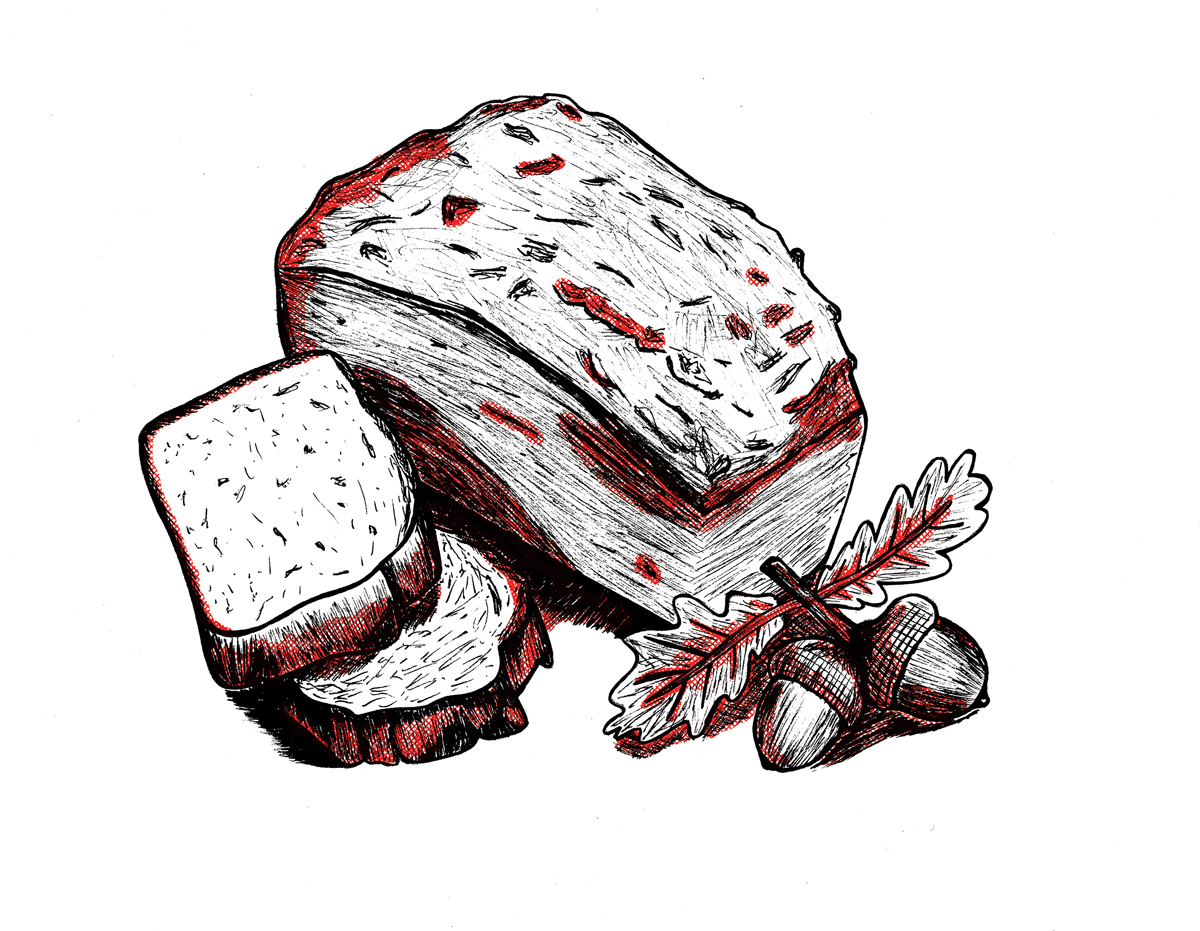
Acorn Bread
Frankenstein acorn bread image

Frankenstein’s creature ate them raw, freshly plucked from the oak tree (or foraged from the woodland floor). It seems his stomach was a little stronger than ours, as unprocessed and uncooked acorns contain tannins that can be toxic to humans. They also have a rather unpleasant, bitter taste, so you probably wouldn’t want to nibble on them, anyway. Leave them on the tree for the squirrels (and any wandering, cobbled-together creatures) and instead get hold of some acorn flour to make this dense, crumbly, delicately sweetened bread. It has a similar texture to cornbread, and is perfect for sharing. Omit the spices if you prefer something more savoury – a pinch of chilli flakes will give it a kick, and pair wonderfully with a hunk of cheese.

Makes 1 medium loaf
Ingredients
250g acorn flour
100g caster sugar
2 tsp baking powder
Pinch of salt
1 tsp ground cinnamon
A little freshly grated nutmeg (optional)
25g unsalted butter, melted
1 medium egg, beaten
250ml milk

Method
1. Preheat oven to 180°C (350°F/gas mark 6) and grease a medium (2 lb/900g capacity) loaf tin.
2. Combine all the dry ingredients, including the cinnamon and nutmeg (if using), in a large mixing bowl and make a well in the centre.
3. Whisk together the milk, egg and melted butter and pour into the well, mixing gradually with a wooden spoon until well combined.
4. Bake for around 20 minutes, until a skewer or sharp knife inserted into the middle comes away clean.
5. Remove from the oven and leave for around 10 minutes in the tin, then tip on to a wire rack to cool. (You might want to tear some off and slather it with butter before it loses all its oven-warm loveliness, though.)

Shepherd’s Breakfast

Shepherd's Breakfast from Frankenstein

While crunching on acorns and foraging berries and roots might not be hugely appealing, the “shepherd’s breakfast” – which the creature “greedily” devours, having unwittingly frightened away its preparer – sounds pretty delicious. It’s a simple platter of bread, cheese, milk and wine. This dish takes those humble plate-fellows and turns them into a warm, oozily baked savoury bread pudding. A warning, though: it can serve six people as a side but, should you be tempted to dig in a spoon just to try a little, don’t be surprised if you get carried away and end up with an empty dish, a full belly and hungry guests.

Serves 6

Ingredients
1 medium loaf of day-old or slightly stale bread, sliced
50g unsalted butter, softened
1 clove garlic, finely chopped
Handful of fresh herbs (parsley, oregano, tarragon, rosemary etc), chopped
100g hard cheese (you can use cheddar or a mix), grated
200ml whole milk
2 eggs
200ml double cream
1tsp English or Dijon mustard
Salt and pepper

For the caramelised onions:
2 red onions, finely sliced
1tbsp olive oil
50ml or balsamic vinegar
2 tbsp granulated sugar
Glug of red wine
Salt and pepper

Method
1. For the onions, heat the olive oil over a medium heat, add onions and and sauté for a few minutes or until soft. Add vinegar, sugar and wine, increase heat and cook until the liquid has evaporated and the onions are sticky. Season with salt and pepper.
2. Beat together the softened butter and garlic, stir in herbs and add a pinch of salt. Spread this mix over each slice of bread, then quarter each one into triangles.
3. Preheat oven to 180°C/gas mark 4 and grease a large baking dish. Arrange a layer of bread on the bottom, top with a layer of onions and sprinkle with cheese. Repeat the layers until the ingredients are used up, ending with cheese.
4. Whisk together the milk, eggs, cream, mustard and a little salt and pepper. Pour over the bread, pushing down so it soaks up the liquid.
5. Rest for 5 minutes then bake for 25-30 minutes, until puffy and lightly golden.

Berry Bite Squares

Berry bites

Our creature spends his first few days of existence subsisting on berries and the occasional acorn. He was happy (or, at least, willing) to do so, but we wonder if he would have enjoyed these crumbly, moreish fruit crumble squares a little better? Most probably. You can make these with pretty much any in-season fruit, from apples to rhubarbs. Eat for breakfast, afternoon tea, a snack, on a picnic…

Makes around 12 squares

Ingredients

For the crumble:
175g unsalted butter, melted
180g plain flour
125g soft brown sugar
150g rolled oats
1 tsp ground cinnamon
pinch salt

For the filling:
1 large egg at room temp
150g caster sugar
30g plain flour
pinch of salt
1 tsp vanilla extract
zest of 1 orange
400g berries (blackberries, raspberries, blackcurrants etc)

Method
1. Preheat oven to 180°C (350°F/gas mark 6). Grease and line a 20cm (8in) square tin (or similar).
2. Combine the dry ingredients for the crumble in a bowl, pour in the butter and mix.
3. Tip around two-thirds of it into the tin and press down firmly to make a base.
4. For the filling, whisk together the egg and sugar, then slowly add the flour, lemon zest and vanilla. Stir in the berries so each is coated.
5. Pour this over the base, then loosely sprinkle over the remaining crumble mix.
6. Bake for around 40-45 minutes until golden. Allow to cool completely in the tin before cutting into squares.
working cover

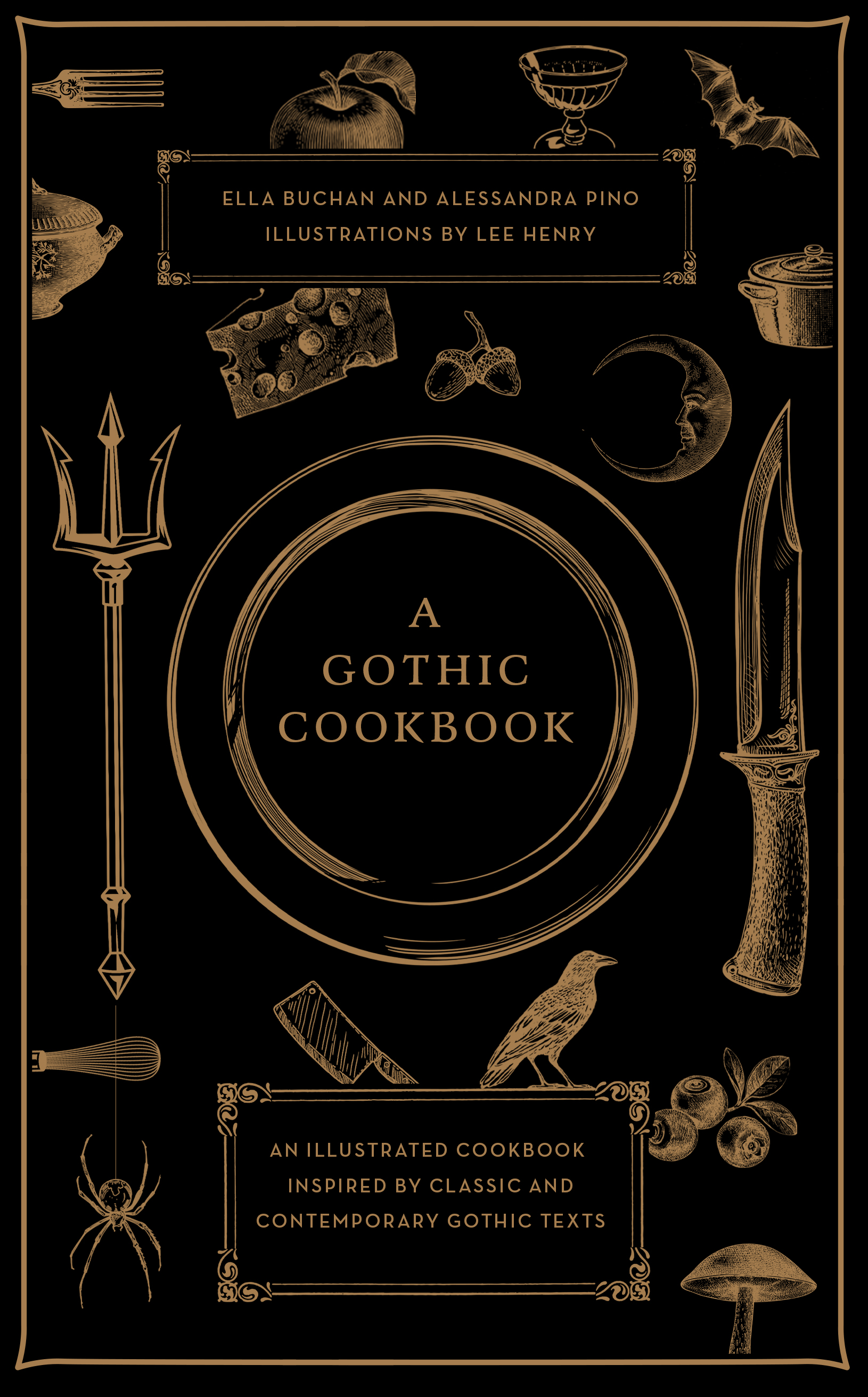
Extracted from A Gothic Cookbook by Ella Buchan and Alessandra Pino, with illustrations by Lee Henry. Find out more here.

The Whole Chicken by Carl Clarke

The Whole Chicken Carl Clarke

What’s the USP? It’s nose-to-tail cooking, but for chickens! So beak-to-tail-feather, then. The Whole Chicken breaks down the bird both literally and metaphorically, with chapters dedicated to all our favourite cuts, as well as mince, offal, bones, skin and, in a move that technically fits the bill but feels a little too eager to get the chicken on the table, eggs.

Who wrote it? Author Carl Clarke has definite chicken-cred. I mean, I imagine his credibility is at rock bottom with actual chickens – he keeps eating them. But through Chick ‘n’ Sours and spin-off Chick’n he has two of the coolest bird-and-apostrophe-centric restaurants in London to his name.

Is it good bedtime reading? Though Clarke skips out on chapter introductions (who needs to be told that thighs are the best bit of the chicken for the umpteenth time?), he quickly makes up for it with passionate and practical introductions to each recipe. Forget about the bedtime reading though, it’s the kitchen dance-offs that you’ll be focused on: the book offers five brilliantly curated playlists to keep you entertained whilst you prepare, cook and eat the whole of your chicken.

How annoyingly vague are the recipes? Not even a little bit. Clarke goes into a decent amount of detail throughout. There’s a refreshing commitment to clarity, in fact. The book lists both metric and imperial measurements at every opportunity, and even features both British and American terms where necessary (cling film/plastic wrap, etc).

What’s the faff factor? Clearly marked at the side of the page. A small scale next to each recipe ranks the dish as either ‘easy peasy’, ‘almost breezy’, or ‘worth the effort’. That said, quite a lot of the dishes fall into that latter category. The scale isn’t particularly consistent either. The Next Level Breville grilled sandwich is listed as ‘worth the effort’, and whilst it’s certainly a lot more of a commitment than your usual toastie, it pales by comparison to the Chicken Nuggets with Kimchi Bacon Ranch Dip and Spicy Shake.

What will I love? The sheer range of dishes on offer here. Clarke draws on a number of different cuisines, though East Asia and the United States are perhaps the most obvious influences. Everything here looks absolutely delicious, and the design of the book itself only emphasises this. The Whole Chicken is intensely cool, and you’ll be a little surprised to find that it’s willing to hang out with you and your other cookbooks.

What won’t I love? There’s a disappointing amount of recipes representing the less commonly used pieces of the chicken. Given the title of the book is ‘The Whole Chicken’, you’d perhaps expect a little more attention to be paid to these areas. Instead, the overwhelming majority of the book is dedicated to those traditional cuts. The entire offal section comprises of just five recipes, meaning that those looking for inspired uses for chicken heart (a delicacy in several countries) will find just one stand-alone recipe. The same goes, inexplicably, for the liver, gizzards and feet – despite each of these having myriad uses in various global cuisines.

Killer recipes: My Friend Romy’s Butter Chicken Recipe, Doritos-Coated Schnitzel with Fried Eggs and Anchovies, Gunpowder Wings, Xian-Spiced Chicken Scratchings and Cherry Cola Chicken Legs.

Should I buy it? Despite not fully realising the promise of its title, The Whole Chicken does offer up an irresistible wealth of dishes drawn from genuinely global influences. It isn’t the first book to do a deep dive on the chicken, but it feels very much of its own space. I have Diana Henry’s lovely A Bird in the Hand on my shelves too, but comparing the two here feels a little like throwing Delia Smith in the ring with David Chang.

Cuisine: Global
Suitable for: Beginner to confident home cooks
Cookbook Review Rating: Four stars

Review written by Stephen Rötzsch Thomas a Brighton-based writer. Follow him on Twitter and Instagram at @srotzschthomas

Buy this book
The Whole Chicken: 100 easy but innovative ways to cook from beak to tail
£22, Hardie Grant

Australian Food by Bill Granger

Australian Food by Bill Granger

Bill Granger could not have picked a better time to publish his first book in six years. With its bright, orange, red and yellow cover and vibrant, globally inspired recipes, Australian Food brings some very welcome sunshine from down under into these gloomy lockdown autumn days. Granger first came to international attention in 2002 when the New York Times dubbed him ‘The Egg Master of Sydney’ and described the scrambled eggs at bills restaurant ‘as light as the breath of an angel’.

The recipe (the secret of which appears to be quite a lot of whipping cream and some careful cooking) is included in a chapter of ‘classics’ that features other signatures such as chocolate banana bread, and ricotta hotcakes with honeycomb butter and banana, a dish much-copied by the likes of Nigella and Ottolenghi. These breakfast specialities might be the foundations of a restaurant empire that now includes London, Honolulu, Seoul and Japan, but Australian Food confirms there’s much to the self-taught chef’s repertoire.

Australian chefs have long been renowned for incorporating Southeast Asian flavours into their food (Neil Perry of Rockpool Dining Group is just one high profile example) and Granger does it better than most. Deftly sidestepping issues of authenticity and appropriation, dishes such as turmeric-spiced chicken in lettuce parcels with green chilli dipping sauce, or grilled pork chops with cashew satay with pineapple and cucumber relish employ ingredients with gleeful abandon to create something delicious and decidedly Australian.

Italy also looms large in Granger’s gastronomic imagination so there’s also recipes for braised lamb ragu with tagliatelle and pecorino and green herb risotto with raw summer salad.  But he doesn’t stop there. With chapters on barbecue, bowl food, small plates and bakery (Granger is an excellent baker as his miso caramel brownies prove), the book leaves no culinary stone unturned.  The sheer variety on offer makes Australian Food a pandemic kitchen panacea but Granger’s skill as a creative chef and recipe writer, honed over more than a quarter of a century, ensures it will have enduring appeal.  

Cuisine: Australian/International 
Suitable for: Beginners/Confident home cooks
Cookbook Review Rating: Five stars

Buy this book
Australian Food
£20, Murdoch Books


Pizza: A book by Pizza Pilgrims by James and Thom Elliot

Pizza by Pizza Pilgrims

What’s the USP? The ultimate book about pizza! As well as recipes, Pizza offers up interviews with figures central to the pizza-eating world, pop cultural insights, and lessons in etymology and maths.

Who wrote it? Brothers James and Thom Elliot, who are best known as the founders of Pizza Pilgrims – a small chain of restaurants that evolved out of a single street food stand in London. Named after a toe-to-top journey through Italy that the brothers undertook in 2011 as an attempt to discover the secrets of great pizza, the brand has since become one of the most celebrated names to hoist a margherita upon the British people.

Is it good bedtime reading? Look, this is nothing if not filled with bedtime reading. In fact, it’s probably better not to think of Pizza as a cookbook, but rather food writing with added recipes. The book comes in just shy of 270 pages, and yet features only 26 pizza recipes, plus some pizza-adjacent ideas that bring the total recipe count to 30.

It’s hard to know exactly how to feel about this number. Pizzas are relatively intuitive things once the dough is made, and the overwhelming majority of the recipes that make the cut are both innovative and enticing. There are only so many pizzas one needs to be told how to make, after all. I’m not convinced there is much need to spell out how to put together a Hawaiian, for example, so it’s hard to fault the brothers for excluding it.

The rest of the content falls broadly into one of three categories. Firstly, there’s the genuinely interesting stuff, like a deep dive on the perfect pizza dough, and the city guides that champion the best pizzerias in Naples, Rome, and a smattering of other cities across the world.

Secondly, there’s the missed opportunities. Chief amongst these is the four-page section that looks at collaborative pizzas the Pilgrims have created with other restaurants over the years. Given the relative lack of actual pizza recipes in the book, it seems a tremendous waste to list twelve delicious sounding hybrids like the Dishoom-inspired Bacon & Egg Naan Pizza and not provide the means to create them at home.

Finally, there’s the filler – and, frustratingly, much of the book falls under this category. In an attempt to create a definitive text on pizza, the Elliots have included some genuinely useless sections. A two-page spread entitled ‘Pizza-Loving Celebrities’ lists thirteen famous people who have publicly professed to liking one of the most popular foods on the planet. There are four pages on the best fictional pizzerias and, later on, a further four pages on pop culture moments for the dish. Both of these amount to little more than a slightly wordy Buzzfeed list. Home Alone gets significant coverage in each.

Occasionally, the book gets really desperate – a gallery of pizza box designs customers have drawn up over the years, an advert for their ‘pizza in the post’ DIY delivery service and, most bafflingly, one-dimensional interviews with corporate figures from Domino’s, Pizza Hut and Papa John’s. There might be some interesting insights to be found in the development kitchens of these brands, but half a page with the UK operations director of Domino’s ultimately amounts to nothing but empty calories.

Oof. So you’re not a fan, then? Well, see this is the problem. Perhaps eighty percent of this book is useless to a serious home chef – but the twenty percent that remains is brilliant. The recipes frequently show the value of the brothers’ initial pilgrimage through Italy, demonstrating a depth of knowledge and understanding that results in genuine learning opportunities.

My favourite choice at my local takeaway is a light ham and sweetcorn affair that is revealed here to be a version of the Mimosa pizza. I had no idea that it was something of a nostalgic favourite in Naples, where children think of it in much the same way that Brits might think of fish fingers and chips.

The Elliots also champion the frying pan as their preferred method for cooking pizzas at home – an idea I might have been unconvinced by before, but will likely be my standard going forward. These sorts of revelations are worth the price of admission by themselves.

I’m not going to deny, either, that there will be audiences who lap this up. The style of the book reminds me of cash-in influencer titles at times, and for better or worse, it will appeal to plenty of people as a result. It might also offer an excellent entry point for pizza lovers who perhaps haven’t previously considered making their own at home. 

What will I love? The recipes are faultless, even if there aren’t all that many of them. Alongside those inexplicable big brand takeaway interviews, there’s also a lovely conversation with Antimo Caputo, who makes flour that enjoys a cult status in pizza circles. It’s worth taking a moment, too, to celebrate the inspired cover design, which mocks up a takeaway pizza box with joyful, tactile precision.

What won’t I love? The recurring feeling that the publishers are trying to make the book thick enough to charge twenty quid for. The frustration that instead of achieving this by including more recipes, they threw in filler pages with titles like ‘Pizza Facts’. The sheer incredulity you feel when the first fact on the ‘Pizza Facts’ page – that the pepperoni pizza emoji is the most used emoji in the US – is so obviously, quantifiably not true that it renders the entire page pointless. It’s the ‘face with tears of joy’ emoji, by the way, and you (or the publisher’s fact checkers) can confirm that with one four word Google search.

Killer recipes: There are no duds amongst the recipes, but the Mimosa, Datterini Filetti and Mortadella & Pistachio pizzas are particular highlights.

Should I buy it? This is definitely a browse-in-the-shop-first book. Anyone really passionate about homemade pizzas will benefit from the advice here, and I suspect this would be a great book for a young person who is getting increasingly ambitious in the kitchen. More confident cooks might want to consider if they can really afford to give up valuable space on their cookbook shelf to a title that barely fits the description of ‘cookbook’ in the first place, though.

Cuisine: Italian
Suitable for: Beginner home cooks
Cookbook Review Rating: Three stars

Review written by Stephen Rötzsch Thomas a Brighton-based writer. Follow him on Twitter and Instagram at @srotzschthomas.

Buy this book
Pizza: History, recipes, stories, people, places, love (A book by Pizza Pilgrims)
£20, Quadrille Publishing Ltd

The Whole Bird by Thomas Keller

The Whole Bird_Credit Deborah Jones
“The Whole Bird”
Poached Breast with Leg Rillettes, Crispy Skin, and Sauce Suprême

Makes 4 servings

Poularde
1 (3½-­ to 4-­pound/1,500-­ to 1,800-­gram) poularde

Poularde Leg Confit
150 grams kosher salt
45 grams sugar
1.5 grams thyme leaves
1.5 grams lemon zest (grated on a rasp grater)
1 gram freshly ground black pepper
2 garlic cloves
5 grams thyme sprigs
2 bay leaves
Duck fat (optional)

Poularde Stock
1,200 grams chicken stock (page 285)
leg Rillettes
100 grams mousse base (recipe follows), made with 200 grams reserved poularde leg meat
5 grams Burgundy mustard
2.5 grams roasted garlic puree (page 133)
1.5 grams kosher salt
1 gram minced shallot
Two grinds black pepper

Sauce Suprême
200 grams heavy cream
100 grams whole butter, cut into cubes and chilled
Lemon juice
Kosher salt
Armagnac

To Complete
Activa GS (transglutaminase), for dusting
Burgundy mustard

Special Equipment
Meat grinder with a medium die, chilled in the refrigerator
Chamber vacuum sealer (optional)
Immersion circulator (optional)

Poularde—a chicken slaughtered before reaching sexual maturity at around three months—from Four Story Hill Farm is exquisite, and Corey has developed an ingenious dish that puts the whole bird to work and a whole bird on the plate. Legs are both confited and used to make a mousse; the confit and mousse are then combined into a kind of rillette. These are spread on top of the breast, which is then poached gently. The skin is ground and rendered into cracklings, then used to coat the layer of rillettes. It’s both an ode to the poularde as well as a show of respect to Sylvia and Stephen Pryzant, who in raising this bird achieved a kind of benchmark for the breed. I couldn’t name a single chef in the country who had poularde on their menu before the Pryzants came along.

Of course, the beauty of this dish is that here two elements, the chicken and the sauce, are in fact extraordinary creations. The piece of chicken comprises every part of the chicken.

And the sauce. A sauce suprême, chicken stock thickened with a roux and finished with cream, is an elegant French sauce. Here Corey combines this classical idea with an Asian technique used for tonkatsu ramen broth. In classic French cuisine, stocks are simmered gently and skimmed continually to remove fat and impurities, while tonkatsu ramen broth is boiled heavily so the fat is emulsified into the broth. Corey takes that idea and applies it here, boiling his stock ramen-­style (see page 285), but then goes further: he blends more chicken fat into the stock with a hand blender as he’s chilling it. To finish the sauce, he combines this rich stock with reduced cream, mounts it with butter, and flavors it with lemon zest and Armagnac, creating this wonderfully rich and delicate version of sauce suprême.

I should note that Corey calls this “sauce suprême” knowing that it’s nothing like the classic—but for good reason. He once served it at a dinner attended by Daniel Boulud and Jean-­Georges Vongerichten, two of New York’s best French-­born chefs, and they kept delighting in the sauce and calling it an incredible sauce suprême. Corey tried to explain that they were mistaken, but they insisted it was the best sauce suprême. He was so honored, he continues to call it by this name.

For the Poularde
Cut the legs from the poularde. Remove and reserve the skin from the legs. One leg will be used for the confit and the other to make the mousse base. Remove and reserve the skin from the rest of the poularde. Cut off each side of the breast, keeping the small tender attached to each breast.

Remove the bones from one leg and weigh the meat. You will need 200 grams to make the mousse base; if you do not have 200 grams, trim off some of the meat that remains on the carcass. Rinse the bones and feet (if they were on your poularde) under cold running water to remove all visible blood. Remove and discard any organs still attached to the bones. Cut the bones into 1-­inch (2.5-­centimeter) pieces and reserve them for the poularde stock.

Keep all parts of the poularde refrigerated in an airtight container until you are ready to use them, up to 2 days.

Grind the skin through the chilled medium die of a meat grinder and place it in a 2-­quart (2-­liter) saucepot. Cook over low heat for about 30 minutes to render. The fat will separate and the skin will become crisp and golden brown. Strain the fat through a chinois or fine-­mesh strainer into a bowl and let cool to room temperature; reserve the fat for the stock. Drain the fried skin on paper towels and let cool until crisp, then chop it very finely and reserve it for finishing the dish.

For the Poularde Leg Confit
Mix the salt, sugar, thyme, lemon zest, and pepper in a bowl. On a piece of plastic wrap, make a bed of just less than half of this cure. Lay the bone-­in poularde leg on the bed of cure and pat the remaining cure over and around the sides of the leg. Cover with the plastic wrap and refrigerate for about 2½ hours.  Rinse and dry the cured poularde leg.

If you have a chamber vacuum sealer, set an immersion circulator in a water bath and heat the water to 80°C (176°F). Place the cured poularde leg, garlic, thyme, and bay leaves in a sous vide bag. Place the bag in the sealer chamber and vacuum seal. Cook in the water bath for 5 hours.

If you do not have a chamber vacuum sealer, preheat the oven to 200°F (93°C). Place the cured poularde leg, garlic cloves, thyme sprigs, and bay leaves in a small heavy-­bottomed pan and add duck fat to cover. Cover with a cartouche and cook in the oven for about 2 hours, until completely tender.

Remove the bag from the water bath or the pan from the oven and let the leg cool in the fat. Remove the leg from the fat and dry it on a clean kitchen towel. Carefully pick the meat from the bones, removing any veins. Shred the meat as finely as possible and chop. Reserve the meat for the rillettes.

For the Poularde Stock
Combine the reserved poularde bones and feet (if using) and the chicken stock in a 2-­quart (2-­liter) saucepot and bring to a rapid boil over high heat. Boil for about 30 minutes, until the stock has reduced by half. Do not skim or reduce the heat at any point.

Strain the stock through a chinois or fine-­mesh strainer into a clean pot, bring to a boil, and reduce the stock by about two-­thirds to about 200 grams. Strain the reduced stock into a narrow vessel and nestle the container in an ice-­water bath to cool.

When the stock has cooled, using a hand blender, blend in 55 grams of the reserved rendered poularde fat on high speed.

Refrigerate the stock in an airtight container until ready to use, up to 3 days. Once the emulsion is set, it can be reheated or cooled without any risk of breaking.

For the leg Rillettes
Combine 75 to 100 grams of the chopped poularde leg confit with the mousse base, mustard, roasted garlic puree, salt, shallot, and pepper and mix until completely homogenous. Transfer to a disposable piping bag and refrigerate until ready to use, up to 1 day.

For the Sauce Suprême
Bring the cream to a gentle boil in a 2-­quart (2-­liter) saucepot over medium-­high heat, adjusting the heat as necessary, and reduce the cream by a little more than half to about 75 grams. Add 200 grams of the poularde stock to the pan and reduce the sauce by half. Rapidly stir the butter into the sauce (this will improve the richness, body, and shine of the sauce).  Season with lemon juice, salt, and Armagnac to taste. Keep in a warm spot until serving.

To Complete
Lay the two poularde breasts on the work surface with the tenders facing up. Using a paring knife, very carefully remove the white tendon on each tender. Peel the tenders back but leave them attached to the breasts. Lightly spray the exposed side of the breasts with water and sprinkle the surface lightly with Activa (shake it through a small fine-­mesh strainer or from a shaker). Fold the tenders back into place. Turn the breasts over.

Wipe the work surface with a slightly dampened kitchen towel. Lay out two pieces of plastic wrap, each about 9 inches (23 centimeters) long. Smooth the plastic so that there are no creases. Spray the plastic lightly with nonstick spray. Lay a breast on each piece of plastic, about one-­third of the way up from the bottom edge. The length of the breast should run the direction of the length of the plastic. Pipe a line of the rillettes down the center of each breast.

Use a small offset spatula to spread the rillettes evenly into a ¼-­inch (6-­millimeter) layer across each breast, spreading it to the edges of the breasts. Fold the top of the plastic up and over each breast to meet the other side.

Continue to “flip” the breasts in the plastic, keeping the bottom of the breast flat and the rillettes in a natural dome. Keep the plastic wrap tight. Pull the ends of the plastic tightly, then trim them and tuck under the breast to hold its shape.

If you have a chamber vacuum sealer, set an immersion circulator in a water bath and heat the water to 60°C (140°F). Place the breasts in a sous vide bag. Place the bag in the sealer chamber and vacuum seal. Cook in the water bath for 45 minutes. Remove the bag and let rest until cool enough to handle. Remove the breasts from the bag and remove the plastic wrap.

If you do not have a chamber vacuum sealer, preheat the oven to 180°F (80°C). Put the poularde in a wide 2-­quart (2-­liter) saucepot (just large enough to hold the pieces of poularde without their touching each other) and add enough water to cover by 1 inch (2.5 ­centimeters). Remove the poularde and set aside in a bowl. Bring the stock to 180°F (80°C). Return the poularde to the pot, cover with a lid, and place in the oven. Poach for 30 to 40 minutes, until an instant-­read thermometer inserted into a breast reads 160°F (71°C). Remove the poularde breast from the stock and let rest until cool enough to handle. Remove the breasts from the plastic wrap.

Slice each breast in half on a slight bias. Using a small pastry brush, lightly brush the top of the breast with mustard. Carefully cover the top of the breast with the reserved crispy skin. Spoon the sauce suprême on each serving plate and place a piece of the poularde alongside.

Mousse Base
Makes 370 grams

200 grams lean protein
30 grams egg whites
5 grams potato starch
4 grams kosher salt
90 grams heavy cream
40 grams crème fraîche, preferably Kendall Farms

Special Equipment
Meat grinder with a medium die

This recipe works well with all types of lean protein, including chicken, pike, scallops, raw lobster, beef, or veal.

Refrigerate a medium die for a meat grinder, food processor bowl, and food processor blade until cold. Cut the protein into ½-­inch (1.25-­centimeter) dice. Grind the protein twice through the chilled medium die into a bowl.

Transfer the protein to the chilled food processor bowl and process until smooth. Add the egg whites and process briefly to emulsify. Using a silicone spatula, scrape the bowl and the lid of the food processor. Add the potato starch and salt and process briefly to combine. It is important not to overwork the mousse, as the friction of the blade will overheat the mousse and cause it to break.

With the machine running, slowly add the cream to maintain the emulsification. Scrape the sides and the lid of the food processor again. Add the crème fraîche and process until the mousse becomes smooth and develops a nice shine.

Transfer the mousse to a bowl and nestle the bowl in an ice-­water bath to chill. Press a piece of plastic wrap directly against the surface of the mousse, smoothing out any air bubbles, and refrigerate until cold. For longer storage, transfer the mousse to an airtight container, press a piece of plastic wrap directly against the surface, cover, and refrigerate for up to 3 days.

Golden Chicken Stock
Makes about 5,500 grams (5½ quarts/5.5 liters)

2,500 grams chicken wings
450 grams chicken feet
3,750 grams (3¾ quarts/3.75 liters) cold water
2,000 grams ice cubes
225 grams carrots, cut into 1-inch (2.5-centimeter) dice
225 grams leeks (white and light green portions only), cut into 1-inch (2.5-centimeter) dice and rinsed to remove any dirt
225 grams onions, cut into 1-inch (2.5-centimeter) dice
20 grams garlic cloves, roots removed, crushed
20 grams fresh thyme
20 black peppercorns
1 bay leaf

We call this golden because of the color that the abundant carrots give to the stock (as always, we add the vegetables at the end). It’s also very concentrated (we often water it down if its flavor could become too pronounced if used in, say, making risotto) and, from the additional chicken feet, very gelatinous. For chefs at The French Laundry (per se also has a fortified chicken stock—see Ramen-Style Stock—that is based on the golden chicken stock), it’s an all-purpose tool each night on the line, used for braising and glazing and finishing. Because it’s so rich and flavorful, we can use more stock and less butter to obtain a beautiful glaze, and a very nutritious one that the vegetables can absorb.

Rinse the chicken wings and feet thoroughly under hot running water to remove visible blood and place in a 15-quart (15-liter) stockpot. Cover with the cold water. Set the stockpot slightly off center over the burner. (This will cause any impurities that rise to gather at one side of the pot, making them easier to skim off.) Bring slowly to a simmer, skimming continually. Once the liquid is at a simmer, add the ice; this will cause the fat to congeal. Remove the fat and skim off as much of the impurities from the surface as possible. Bring the stock back to a simmer and cook gently for 90 minutes. Remove any excess fat as necessary.

Add the carrots, leeks, onions, garlic, thyme, and bay leaf and slowly bring the liquid back to a simmer, skimming frequently. Simmer for 35 to 45 minutes, skimming often. Turn off the heat and let the stock rest for about 20 minutes; this allows any particles left in the stock to settle at the bottom of the pot.

Set a chinois over a large container. Carefully ladle the stock off the top, disturbing the bones as little as possible so that the impurities that have settled to the bottom are not mixed into the stock. Once you reach the bones, tilt the pot to reach the stock; once again, be extremely careful not to move the bones. Do not press on the solids in the strainer or force through any liquid that does not pass through on its own. Discard any stock at the bottom of the pot that is cloudy with impurities. Nestle the container in an ice-water bath to chill.

Cover the container with a lid and store the stock in the refrigerator for up to 3 days or freeze for longer storage.

Roasted Garlic Puree
Makes 250 grams

10 large heads garlic
Kosher salt
15 grams extra-­virgin olive oil

While this may seem like a lot of puree, it has many uses. It can be used to make roasted garlic bread (added to the dough itself), roasted garlic aïoli, garlic hummus, and garlic butter. It imparts a garlic flavor to items such as pasta sauce without adding the strong, pungent flavor of raw garlic.

Preheat the oven to 325°F (163°C). Place a baking rack over a sheet pan.Slice off just enough from the top of each head of garlic to expose the tops of the cloves. Place the heads of garlic in a medium saucepot and add water to cover. Bring the water to a boil over medium-­high heat. Turn off the heat and remove the garlic. Lightly season the garlic with salt.

Place the heads of garlic in the center of a 12-­inch (30-­centimeter) square of aluminum foil and fold up the sides to form a foil tray. Drizzle the olive oil over the garlic and cover with a second piece of foil, crimping the foil along the edges to seal the two pieces together. The sealed pouch will steam and roast the garlic at the same time.

Place the pouch on the baking rack and bake for 1 to 1½ hours, until the garlic is cooked through and light golden brown in color. Remove the garlic from the foil and let sit until cool enough to handle.

Place a fine-­mesh strainer or tamis over a bowl. While the garlic is still warm, push the whole heads of garlic, cut-­side down, against the strainer, pressing the garlic cloves through; discard the skins. Let the roasted garlic puree cool to room temperature. Refrigerate in an airtight container for up to 7 days.

Excerpted from The French Laundry, Per Se by Thomas Keller (Artisan Books). Copyright © 2020. Photography by Deborah Jones

Cook more from this book
Fish and Chips
Peaches ‘N’ Cream

Read the review
Coming soon

Buy this book
French Laundry, Per Se, The (Thomas Keller Library)
£60, Artisan