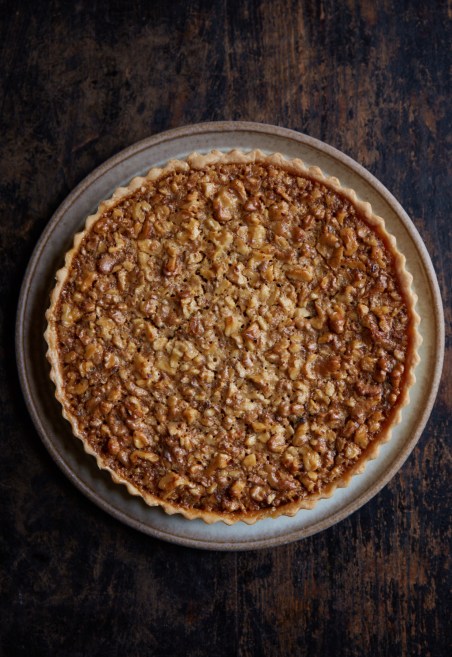
Rum & Walnut Tart with Rum Butterscotch Sauce by Maura O’Connell Foley

Maura_ Walnut_Rum_Tart_027
Ingredients
Serves 8

Pâté Sucrée:
• 125g plain white flour
• 55g butter, softened
• 55g icing sugar
• Pinch of sea salt
• 1 egg

Rum Butterscotch Sauce:
• 30g butter
• 70g light brown sugar
• 70g golden syrup
• 90ml cream
• 45ml dark Jamaican rum

Walnut Filling:
• 300g walnuts, roughly chopped
• 150g caster sugar
• 120g butter, melted
• 150g honey
• 5 egg yolks
• 100ml cream
• 50ml dark Jamaican rum

Equipment:
23cm / 9in flan tin

Method
For the pâté sucrée, add the flour, butter, sugar and salt to a food processor and blend to a fine crumb. Use a fork to lightly beat the egg and then add to the food processor and pulse to bring the pastry together. Wrap in clingfilm and chill for 1 hour in the fridge.

To  make the butterscotch sauce, place the butter, sugar and golden syrup in a saucepan over a medium heat, stirring to dissolve the sugar. Continue to cook to a smooth and shiny syrup. Carefully add the cream (as it will splutter) and stir to combine. Bring to a gentle bubble then simmer for 3 minutes. Add the rum and remove from the heat.

Preheat the oven to fan 160°C / fan 325°F / gas mark 4.

Roll out the pastry to 2-3mm / 0.1in thick and use to line a 23cm / 9in flan tin. Chill for at least 30 minutes in the fridge.

To make the walnut filling, gently mix together the walnuts, sugar, butter, honey, egg yolks, cream and rum in a large bowl. Pour the mixture into the prepared pastry and bake in oven for 50-60 minutes or until golden brown and set with a slight wobble.

Allow to set for at least 1 hour before serving with the butterscotch sauce and if desired some vanilla ice-cream.

Cook more from this book
Twice baked cheese souffles
Smoked cod cakes

Buy this book
€35 Order from mywildatlantickitchen.com 

(The book is also available from Amazon
My Wild Atlantic Kitchen: Recipes and Recollections
£35, Maura O’Connell Foley)

Read the review
Coming soon

Ekstedt by Niklas Ekstedt

Ekstedt by Niklas Ekstedt
What’s the USP? The subtitle for Ekstedt is ‘The Nordic art of analogue cooking’, which makes the book sound like one of those lifestyle books that seek to teach us all the true meaning of a nation’s idealised characteristic by expanding on a single word with complex meaning, be that ‘hygge’, ‘ikigai’ or ‘nunchi’.

‘Ekstedt’ is not a Swedish word for analogue cooking, but rather the surname of the Michelin-starred chef who has become almost synonymous with the practice. This massive coffee-table cookbook seeks to reconcile home chefs with the revived Nordic traditions of cooking over an open flame. That’s what ‘analogue cooking’ means – cooking without the use of gas or fire. So don’t expect any dishes that can be reheated in the microwave later.

Who wrote it? Niklas Ekstedt is something of an icon in the Nordic food world. Over the last twenty years or so, Ekstedt has run four fine-dining restaurants across Sweden, and has grown increasingly interested in traditional Nordic cooking techniques. His latest eponymous restaurant cooks entirely over open flames – and it’s this approach to food that he espouses in his second book. Actually, it’s also the same approach he took to his first book. But this one’s out now, ready for Christmas, looking all monolithic and filled with worthy prose and grounded, earthy photographs of fishermen and very beautiful (but very small) dishes.

Is it good bedtime reading? There’s certainly reading, though how good it is will depend on how much you like fantasy writing. That is, the fantasy that you’ll ever actually cook anything from this book.

There’s an introduction in which Ekstedt speaks of the self-evaluation he had to do when his third fine-dining restaurant didn’t do quite as well as his first two. There’s a chapter on the techniques you’ll use throughout the book, from using your wood oven (you have a wood oven, right?) to cooking over embers, or ‘hay-flaming’ a dish. That’s where you get your hay (you have hay, right?), bosh it into a pan, set it on fire, and chuck some scallops or something on top. Actually, that’s not fair. It’s more complicated than that. Which is exactly what you were hoping for, isn’t it? Oh, and don’t forget flambadou, where you baste a dish with burning fat that you’ve melted in your red-hot cast-iron cone on a stick (you have a red-hot cast-iron cone on a stick, right?)

Elsewhere, there’s well-meaning Radio 4 documentaries essays on reindeer herding with the Sami and fishing off of Lofoten, Instagram’s favourite Norwegian archipelago. Ekstedt also offers short introductions to each of his recipes – though these frequently amount to little more than a sentence.

Will I have trouble finding the ingredients? HA! Hahahahahahahahahahaha. Ahahahaha. Haha. Ha.

No.

No, I’m sure you’ll be fine. Why would you even ask that? It’s not like the first recipe in the book is for smoked moose heart. Oh, can’t get your hands on a moose heart? Ekstedt doesn’t actually offer any advice for substituting it for another ingredient, but later on does offer a completely different heart recipe: this time it needs a reindeer’s.

Other fun ingredients to ask the guy restocking the shelves in Sainsbury’s about: ättika vinegar, cloudberries, meadowsweet, birch wood, reindeer blood, chickweed, nasturtium leaves, redfish collars, ‘a branch of juniper, fresh and green’, dried reindeer, vendace roe, and bladderwrack seaweed.

I guess you could try B&Q for the birch wood, and maybe you can juice that reindeer heart from earlier to get the 250ml of blood you’ll need. When you see the words ‘veal sweetbreads’ and consider them one of the more accessible ingredients you’ve seen recently, you know you’re in trouble.

My favourite, for what it’s worth, is the casual request for 400ml of fresh bovine colostrum, which the glossary at the back of the book helpfully defines as ‘the milk a cow produces during the first days after calving’. Expect a rush on your local dairy farm come spring, then.

What’s the faff factor? Do you even need to ask? Look, one of the joys I have when I sit down with a new cookbook is this: I take some little multi-coloured index stickers and mark out all of the recipes I’m keen to try. On most cookbooks, I manage to find at least eight to ten really tempting dishes that I can’t wait to get to work on. In a really great cookbook, like Claire Thomson’s recent Home Cookery Year, I find myself marking off every other page. In reading through Ekstedt, I didn’t reach for my bookmarks even once.

This isn’t to say that the book isn’t filled with things I’d love to eat. In fact, I’d be more than happy to stick a fork into almost every recipe in here. Maybe not the butternut squash, fermented salsify and vegetable foam – but even then that’s only because I’m not sure what the best utensil is when reckoning with foam. It’s got to be a spoon, right?

The problem is just that everything in here is so damned impractical. If – and it really is a huge, wobbly ‘if’ – you manage to source all the ingredients for a given dish, you’ve still got to cook the bastard. And that’s not easy in a book that champions ‘analogue cooking’. Ekstedt has made no noticeable concessions for the home chef, except that he lets you flambadou your beef fat in a pan. A typical recipe might ask you to ‘hot smoke the parsley root for 10 hours every day for 1-2 weeks until it is dried out’. Who does he think I am? I think Niklas Ekstedt has mistaken me for his sous chef.

As a final kicker, the end result of all your hard work will be an authentic Michelin-star level dish. Which sounds fantastic, until you remember how big a dish is in a Michelin-starred restaurant. The semi-raw hay-flamed sea bass, sorrel & Swedish ponzu takes longer to announce than it does to eat. Three slices of the sea bass per person, with three (three!) sorrel leaves as accompaniment. Ekstedt says his recipe serves 4 as a middle course, but he doesn’t tell us how many middle courses he’s expecting us to have in what is now apparently a tasting menu that we’re expected to put together from this self-indulgent collection of impossible wonders.

How often will I cook from the book? Never. You will never cook from this book. It will sit on your shelves, untouched and forgotten except for the occasions when you reach for something adjacent to it – something useful, with primary ingredients like chicken, or pork – and pick it out for a moment, open it to a random page – let’s say ‘Langoustine, charcoal cream and cold-smoked parsnip’, allow yourself a few good minutes to stop laughing at the idea you would ever find it within your energy limits to ‘place the langoustines on an untreated wood plank and sear each tail for 8-10 seconds with burning beef fat from the flambadou’, and then place it straight back onto the shelf until the next time you need decent laugh.

Should I buy it? Only if Niklas Ekstedt is coming round your house for tea, and you want to make him like you by shelling out forty(!) pounds(!) on pretty pictures of things you will never eat.

Cuisine: Nordic
Suitable for: Professional chefs with access to Scandinavian deer hearts
Cookbook Review Rating: One star

Buy this book
Ekstedt: The Nordic Art of Analogue Cooking

Review written by Stephen Rötzsch Thomas a Brighton-based writer. Follow him on Twitter and Instagram at @srotzschthomas.

A Purnell’s Journey: There and Back Again by Glynn Purnell

Weighing in at 6.5kg and standing over a foot tall, Glynn Purnell’s third book dwarfs his previous two volumes. Printed on high quality matt paper and presented in a clamshell box lined with the same pattern as the wallpaper in Purnell’s eponymous Michelin-starred restaurant, it’s a lavish production. But what do you expect from a chef with ego enough to anoint himself ‘The Prince of Birmingham’? 

Purnell tells his story in a series of chapters titled with postcodes that relate to where he has lived or cooked. It begins in B37, his childhood home in the Chelmsley Wood council estate in Solihull where the closest the young chef came to foraging was helping his father carry home boxes of meat purchased in pub car park deals. The book then follows Purnell’s route to Michelin success in the heart of Birmingham’s city centre via stints at the Birmingham Metropole, Simpson’s in Kenilworth and Hibiscus in Ludlow, with detours for stages at Gordon Ramsay’s Aubergine and Le Manoir aux Quat’Saisons. 

Although Purnell relates how he came to national attention and won his first Michelin star at Jessica’s in Edgebaston in 2005, the recipe for the restaurant’s signature dish of veal with caramelised squid is sadly not included. Instead, there are a selection of Purnell’s restaurant’s ‘greatest hits’ including monkfish masala with red lentils, pickled carrots and coconut garnish that ably demonstrate the chef’s knack for creating memorable dishes that stand the test of time.

Purnell is undoubtedly a macho chef and the book charts his passions for boxing, shooting, fishing and football. But there’s more than just testosterone on display here. His detailed description of the evolution of his signature haddock and eggs, cornflakes and curry oil dish proves Purnell to be a creative, thoughtful and reflective cook. 

With just 33 recipes, you may feel the need to buy Purnell’s other books to understand the full extent of his culinary talents, but There and Back Again serves up a generous enough helping of amusing anecdotes and stunning visuals to justify its hefty price tag.   

This review was originally published in The Caterer magazine.

Cuisine: Progressive British
Suitable for: Professional chefs
Cookbook Review Rating: Four stars

Buy this book
A Purnell’s Journey
£85, A Way With Media
Also available at Amazon: There And Back Again: A Purnell’s Journey

Cook from this book
Haddock and Eggs – Cornflakes – curry oil
Monkfish masala with red lentils
Lemon meringue pie

Persian Lamb Neck Soup by Matty Matheson

Persian Lamb Neck SoupServes 6
PREP TIME: 4 HOURS, PLUS 2 HOURS INACTIVE TIME

I have only had this soup at a restaurant once in my life, and I loved it so much but have not gone back to where I had it because we had to sit on the floor pretty much, and if you know me, the big dog eating some interactive soup on the floor isn’t the greatest. So, make this in your home, and yes, it’s a lot of work, and some recipes are easy and some are hard, and now let’s get to work and build out a beautiful soup that’s gonna make your tongue explode in joy!

3 pounds (1.3 kg) lamb necks
1 tablespoon ground turmeric
1 teaspoon kosher salt, plus more as needed
1 teaspoon freshly cracked black pepper
300 g diced white onions
60 ml tomato paste
2 quarts (2 L) lamb stock, or water
4 Yukon Gold potatoes, peeled and quartered
150 g canned chickpeas, drained
150 g canned white beans, drained
60 ml lemon juice, plus more as needed
50 g garlic, thinly sliced
60 ml white vinegar
2 tablespoons sugar
6 flatbreads
180 ml plain Greek yogurt
40 g mint leaves
60 g tarragon leaves

Place the lamb necks in a shallow container and season with the turmeric, salt, and pepper. Keep in the refrigerator for 3 hours.

Preheat the oven to 200°C.

Place the lamb necks on a baking sheet fitted with a wire rack. Brown them in the oven for 30 minutes, then remove from the oven and transfer them to large Dutch oven, reserving the rendered lamb fat from the bottom of the baking sheet. Add the onions, tomato paste, and lamb stock. Bring to a boil over high heat, stirring to dissolve the tomato paste. Cover the pot, reduce heat to low, and simmer for 2 hours.

Add the potatoes, chickpeas, white beans, and lemon juice; simmer until the meat and potatoes are fork-tender, about 1 hour. Taste for seasoning; the broth should be tangy and bright. Remove from heat and let rest for 10 minutes.

Put the garlic in a small bowl. In a small saucepan, combine the vinegar, 60 ml water, and sugar and bring to a boil; pour over the garlic. Cool and reserve for the soup.

Use a slotted spoon to remove meat, beans, and potatoes from the broth and transfer them to a large bowl. Use a fork to pull the meat off the bones; discard the bones. With a potato masher, mash the meat, beans, and potatoes into a soft uniform paste. If it’s a little dry, add broth and continue mashing until fully broken down and emulsified.

Strain the stock through a fine chinois or strainer and heat it back up in the pan. Season with salt and lemon juice. This is a two-part meal: the broth and the meat paste. Serve the broth in soup bowls drizzled with rendered lamb fat and sprinkled with the pickled garlic. Put the meat paste in a serving bowl, spread it on the roti, dollop yogurt over it, and top with the herbs. Eat the little meat breads with your hands.

Cook more from this book
Green Curry Beef Ribs
Molasses Bread in an Apple Juice Can 

Read the review 

Buy this book
Matty Matheson: Home Style Cookery
£25, Abrams

Molasses Bread in an Apple Juice Can by Matty Matheson

SERVES: 8
PREP TIME: 1 HOUR, PLUS 1 HOUR INACTIVE TIME

Apple juice in cans are gonna fly off the shelves from this day on, I swear. Every family in the Maritimes has made a version of this recipe. Making cylinder-shape bread using a large apple juice can is scrappy and great for recycling. You get to drink shitty apple juice, which is great as well. Please make the eff ort to find these cans; it’ll make this process way funnier and an instant family tradition that your kids will love forever.

240 ml warm water (46 to 53°C)
1 teaspoon granulated sugar
1 tablespoon active dry yeast
160 ml molasses, such as Crosby’s Fancy, plus more for serving
90 g old-fashioned rolled oats
240 ml hot water
300 g whole-wheat flour
660 g all-purpose flour
2 teaspoons kosher salt
2 (1.05 L) cans Allen’s Apple Juice, or other similar-size cans
Unsalted butter
Sea salt (optional)

In a medium bowl, combine the warm water and sugar, then sprinkle the yeast over the top. Let sit for 8 to 10 minutes, or until the mixture becomes foamy and fragrant; this indicates the yeast is active and alive.

In another medium bowl, combine 160 ml of molasses and the oats; stir to incorporate. Pour the hot water into the molasses and oat mixture, stir with a whisk, then add the yeast mixture; whisk to fully incorporate. Transfer to the bowl of a stand mixer fitted with the dough hook attachment. With the mixer running, add the whole-wheat flour slowly (so you don’t get flour all over yourself). Then add the all-purpose flour and kosher salt and let it come together. Raise the speed to medium and knead the dough for 2 minutes, or until the dough just comes together. Turn the dough out onto a clean work surface and cut in half.

Grease the inside of the cans with butter. Transfer the dough halves into the cans. Drape a kitchen towel over them and place in a warm area for 1 hour, or until the dough is double in size.

While the dough is rising, preheat the oven to 175°C.

Place the cans on a baking sheet and bake for 45 minutes, or until the bread has a crispy shell and you can puncture the centre with a wooden skewer and it comes out clean.

Set the cans on a wire rack and let the bread cool for 30 minutes. Remove the bread from the cans and let cool further. Once you’re ready to dig in, slice a thumb-wide piece and smother with cold butter, molasses, and a pinch of sea salt, if you like, for a real treat. Wrap leftovers in plastic wrap and store in the fridge for up to a week. After a week, the bread can be turned into bread pudding (see my first cookbook for the recipe).

Cook more from this book
Green Curry Beef Ribs 
Persian Lamb Neck Soup

Read the review 

Buy this book
Matty Matheson: Home Style Cookery
£25, Abrams

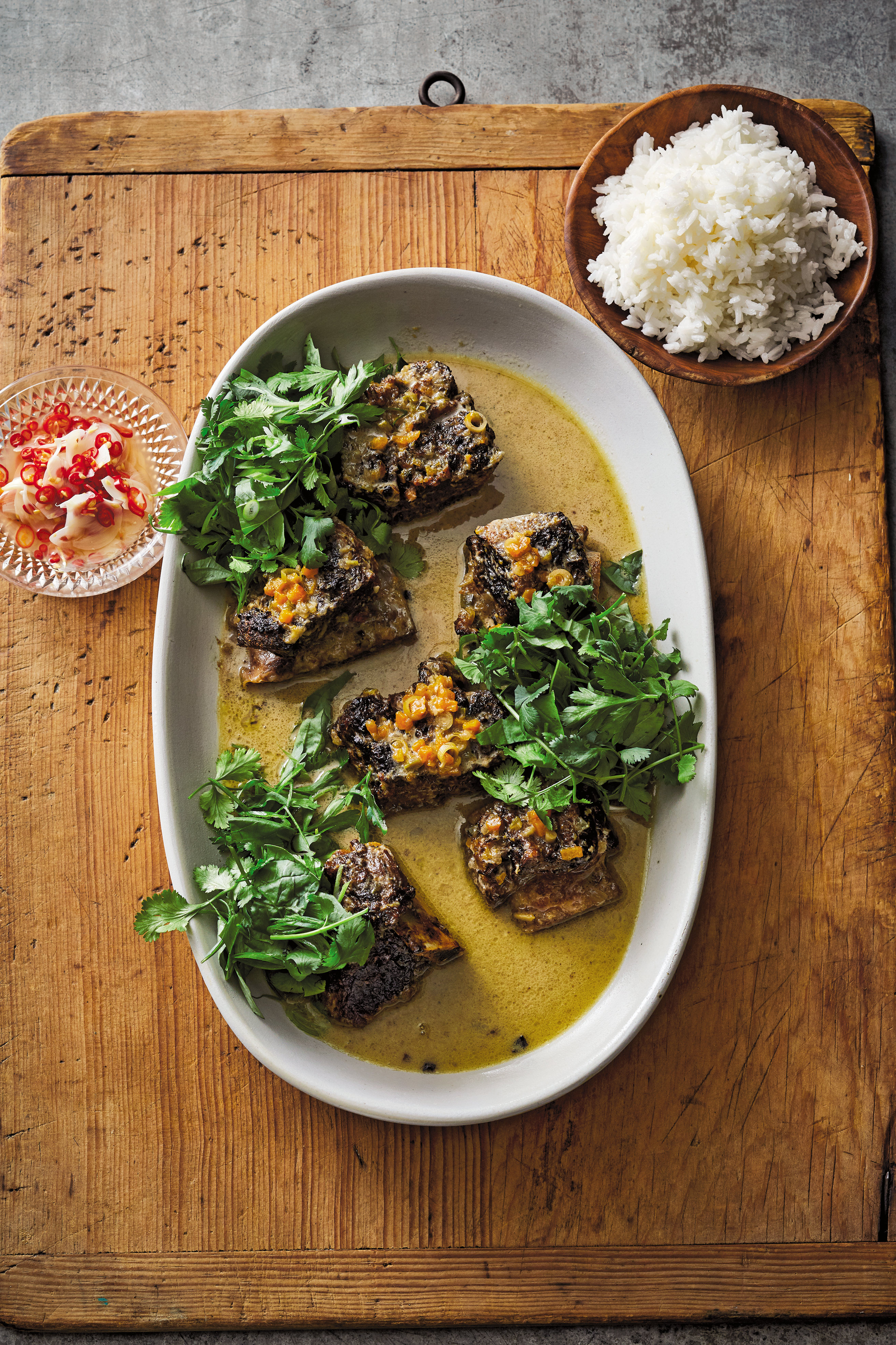
Green Curry Beef Ribs by Matty Matheson

Green Curry Beef Ribs_p180

Serves 4-6

PREP TIME: 3 HOURS

Meat and rice is the new meat and potatoes. And braised beef ribs in spicy green curry is great for any meal— breakfast, lunch, or dinner. Real flavor-building, real spice, real tasty meals for the whole family. Building your skills and your palates are very important to keep things exciting in your home life. And guess what, the day after, shred this beef and make little rotis; add some cheese, even. Fuck this shit up.

FOR THE BEEF SHORT RIBS:
4½ pounds (2 kg) beef short ribs, meat removed from the bone and cut into 1½-inch (4 cm) cubes
1 teaspoon kosher salt, plus more as needed
1 teaspoon freshly cracked black pepper
2 tablespoons vegetable oil
200 g diced onion
100 g diced celery
2 tablespoons sliced garlic
75 g seeded and diced jalapeño chile
100 g diced leek, white and green parts only
2 stalks lemongrass, cut in half and smashed with the side of a knife
1 tablespoon grated ginger
1 tablespoon green curry paste
1 tablespoon ground Thai spice (equal parts toasted ground cardamom and toasted ground cumin)
880 ml beef and bone marrow stock
240 ml canned unsweetened coconut milk
2 tablespoons lime juice

FOR THE PICKLED GARLIC:
4 garlic cloves, sliced paper-thin
2 bird’s eye chiles, sliced
2 tablespoons white vinegar

FOR SERVING:
30 g sliced scallions
60 g cilantro leaves, stems diced
steamed jasmine rice, or naan bread

Make the short beef ribs: Season the short ribs with the salt and pepper. Heat the vegetable oil in a medium Dutch oven over medium-high heat. Working in 2 batches, brown the short ribs on all sides, about 8 minutes per batch. Transfer the short ribs to a plate and pour out about 70 percent of the fat from the pot.

Add the onion, celery, garlic, jalapeño, leek, and lemongrass to the pot; cook, stirring occasionally, until the onion starts to brown, about 10 minutes. Add the ginger, curry paste, and toasted spice mix and stir to coat the vegetables. Add the short ribs and any juices from the resting plate. Add beef stock to barely cover the top of the short ribs. Bring to a boil, then turn down heat to low; simmer until the short ribs are tender, 2 to 2½ hours. Remove the lemongrass and whisk in the coconut milk. Taste the broth for seasoning. Add the lime juice and salt as needed.

While the beef is cooking, make the pickled garlic: In a small nonreactive bowl, combine the garlic and chiles. Heat the vinegar in a small skillet until bubbling. Pour the hot vinegar over the garlic and chiles and let sit for 1 hour.

To serve: Generously divide the curry into serving bowls. Garnish the bowls with little spoonfuls of pickled garlic and lots of chopped scallion and cilantro leaves. Enjoy with jasmine rice or a big piece of grilled naan.

Cook more from this book
Persian Lamb Neck Soup 
Molasses Bread in an Apple Juice Can

Read the review 

Buy this book
Matty Matheson: Home Style Cookery
£25, Abrams


Classic puff pastry by Calum Franklin

The Pie Room Book dishes

Classic Puff Pastry

I always assumed puff pastry was invented in France. It is so dominant throughout French food culture, evident in the windows of every pâtisserie, that this is an easy assumption to make. However, Spanish recipes for puff pastry precede the French with the first documented appearance right at the beginning of the seventeenth century, while the first French recipe appears mid-century.

A classic butter puff pastry is a laminated dough that rises due to the power of steam. When making the dough, many thin, alternating layers of fat and dough are created so that, when cooked at a high enough heat, the fat melts to leave a pocket of air in the dough. The moisture in the dough and fat then boils to create steam, which causes these pockets to expand. Before you cook puff pastry, it is important to make sure the oven is at the correct temperature so that this transformative process occurs quickly, allowing the structure to form and be locked in.

This recipe creates a puff pastry that rises evenly and is neater than rough puff, so it is better suited to dishes like vol au vents where a little refinement is needed. Honestly, it is a myth that puff pastry is difficult to make. All that is required for success is planning, patience, and following the instructions closely. This recipe creates a large batch of dough – if you’re going to spend an afternoon making puff pastry, you may as well make plenty – so divide it into smaller amounts based on the recipes you plan to make before wrapping and freezing for later use.

MAKES 1.5KG

For the dough
350g strong flour
200g plain flour
15g table salt
115g butter, softened and diced
250ml ice-cold water

For the lock-in butter
500g chilled butter, diced
50g strong flour

First prepare the dough. If making the pastry by hand, sift the flour into a large bowl and add the salt, butter and water. Using your fingers, gently mix to an even dough. Transfer the dough to a lightly floured surface and knead it for 5 minutes or until smooth.

If making the pastry using a mixer, sift the flour into the mixer bowl and add the salt, butter and water. Using a dough hook, work at a medium speed for a few minutes to incorporate the butter into the flour until it forms a smooth dough.

Flatten the dough into a neat rectangle, wrap it tightly in clingfilm and rest in the refrigerator for 45 minutes.

Meanwhile, prepare the lock-in butter. Thoroughly clean and dry the bowl and line a baking tray with parchment paper. Place the butter and flour in the bowl and either work the flour into the butter using a wooden spoon for 5–10 minutes, or use the mixer working at a low speed for 2 minutes or until everything is well incorporated. Scrape the butter mixture onto the lined tray and, using floured hands, shape it into a square about 1cm thick. Place the butter mixture in the refrigerator until just chilled but not completely hard. (It is important that the chilled dough and lock-in butter are similarly firm, otherwise they will not roll together evenly and this may cause rips and holes in the dough.)

On a lightly floured surface, roll out the dough into a large square that is twice the size of the lock-in butter. Place the butter in the centre of the dough but at an angle so that the corners point towards the edges of the dough. Making sure you do not trap any air, fold the corners of the dough over the butter, bringing them into the middle like an envelope. Lightly pinch together all the joins to seal and completely encase the butter.

Roll out the dough and butter into a rectangle roughly three times as long as it is wide, using the sides of your hands to make sure the edges are neat and square. Dust any excess flour from the surface of the dough. With the shortest side closest to you, visually divide the dough horizontally into thirds and very lightly dampen the centre third with a little water, then fold the bottom one third of the dough over the centre third. Repeat by folding the remaining top third over the double layer of dough, then tightly wrap the dough in clingfilm. Lightly press your finger into the bottom right-hand corner of the dough to make an indentation which signifies the first turn and how the dough was positioned on the board before you put it into the refrigerator.

Chill the dough in the refrigerator for 30 minutes. (Chilling the pastry between each roll out and fold allow the butter to harden so that clean, even layers of dough and butter are built up.)

Unwrap the dough and place it on a lightly floured surface with the indent in the same position as before at the bottom right-hand corner. Next, turn the dough 90 degrees clockwise. Roll out the dough into an 18cm by 25cm rectangle and repeat the folding process. Make sure all corners and sides are straight. Wrap the dough in clingfilm again and this time make two indents on the dough in the bottom right corner. Chill in the refrigerator for a further 30 minutes.

Repeat the turning and folding processes two more times, each time chilling the dough for 30 minutes and marking with indents in the bottom right-hand corner to make sure the dough is turned in the correct direction. After the final turn, chill the dough in the refrigerator for 45 minutes and then it is ready to use.

This classic puff pastry dough can be kept for up to three days in the refrigerator or one month in the freezer. If freezing, weigh out the dough into the quantities needed for individual recipes – it will take less time to thaw and you won’t be potentially wasting any dough. To use the dough from the freezer, allow it to come back to refrigerator temperature overnight.

Cook more from this book
The ultimate sausage roll
Hot pork pie 
Glazed apple tart  

Read the review

Buy the book
The Pie Room: 80 achievable and show-stopping pies and sides for pie lovers everywhere
£26, Bloomsbury Absolute

The ultimate sausage roll by Calum Franklin

The Pie Room Book dishes
In an attempt to find the perfect example, we have tested different flavours and textures for the filling of our sausage rolls at The Pie Room. It always comes back to one thing: simplicity. The filling should be tasty but not overcrowded with too many flavours and textures. The addition of a little chopped bacon and a few thyme leaves
to Cumberland sausagemeat are the only changes we make, but the devil is in the detail. For me, the key to the Ultimate Sausage Roll actually lies in the ratio of meat to pastry. When the meat takes longer to cook, the crisper the pastry will be.

Serves 4

400g rough puff pastry (see book for recipe or use classic puff pastry or shop-bought puff pastry)
2 egg yolks beaten with 2 teaspoons water, for brushing
pinch of black sesame seeds
pinch of white sesame seeds
Plum and Star Anise Chutney, to serve (see page 248)

For the filling
700g Cumberland sausages, skins removed
150g streaky bacon, finely chopped
25g thyme, leaves picked
⅓ teaspoon table salt
large pinch of freshly ground black pepper

Equipment
large plastic piping bag
(optional)

Line a large baking tray with parchment paper. On a lightly floured surface, roll the pastry out to 5mm thick in a 40cm x 25cm rectangle. Slide the rolled-out pastry onto the lined tray and chill in the refrigerator for 30 minutes.

Meanwhile, put the sausagemeat, bacon, thyme, salt and pepper into a bowl and mix well with your hands. Fill a large plastic piping bag with the sausagemeat filling. If you don’t have a piping bag, shape the filling into a 6cm wide sausage and wrap tightly in clingfilm, firmly twisting the ends. Chill the filling in the refrigerator for 20 minutes.

Remove the rolled-out pastry from the refrigerator and dust off any excess flour from the surface. Leave the pastry on the parchment paper.  Using kitchen scissors, snip the tip of the piping bag to make a 5cm wide opening. Working from one end of the pastry rectangle, slowly pipe the sausagemeat filling down the length of the pastry 6cm inside one edge.

Alternatively, remove the clingfilm from the sausagemeat, unwrapping it over
the pastry rectangle, and place the filling 6cm inside one edge of the pastry. Lightly brush the larger exposed area of pastry all over with egg wash, leaving the narrow 6cm border clear. Fold the egg-washed pastry over the filling to meet the narrow border, align the pastry edges and press firmly together. Lightly dust the tines of a fork with flour and tap off any excess. Working down the length of the seam, firmly press the ends of the fork into the pastry to leave an impression of the tines. Whenever necessary, dust the fork with more flour to stop it sticking to the pastry.

Lightly brush the sausage roll all over with egg wash and return to the refrigerator for 10 minutes to allow the egg wash to dry. Brush a second layer of egg wash over the sausage roll and then, using a sharp knife, lightly score the top of the pastry with diagonal lines all the way down its length. (This gives the pastry a little stretching room and stops it from tearing open at the seam.) Return the sausage roll to the refrigerator to chill for a further 10 minutes.

Preheat the oven to 190°C fan/210°C/gas mark 6½.

Trim a little off the fluted seam of the pastry to neaten it into a straight edge, then brush a final layer of egg wash all over the sausage roll. Sprinkle the black and white sesame seeds along the top of the roll. Pop the tray into the preheated oven and bake the sausage roll for 25 minutes. Check the internal temperature of the filling with a digital probe thermometer – you are looking for 75°C or above. If necessary, return the sausage roll to the oven and check the temperature again every 5 minutes until it reaches 75°C. Alternatively, insert a metal skewer into the centre of the sausage roll and then press it against your hand – it should be very hot to the touch.

Remove the tray from the oven and transfer the sausage roll to a wire cooling
rack. Leave to cool for 10 minutes before cutting the sausage roll with a serrated
knife into eight equal slices. Serve warm with spoonfuls of chutney

Cook more from this book
Hot pork pie 
Glazed Apple Tart
Classic puff pastry

Read the review

Buy the book
The Pie Room: 80 achievable and show-stopping pies and sides for pie lovers everywhere
£26, Bloomsbury Absolute

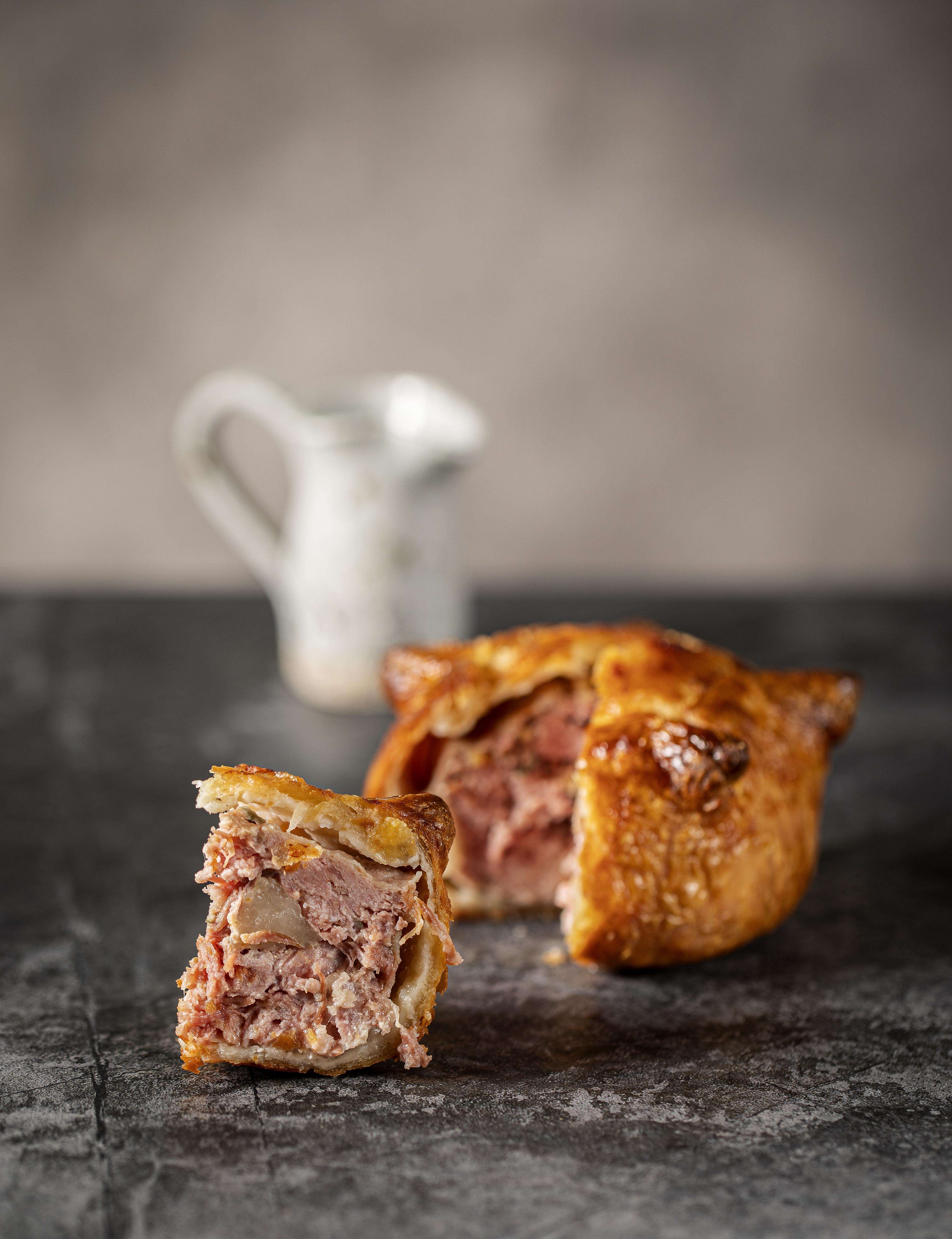
Hot pork pie by Calum Franklin

The Pie Room Book dishes

Hot Pork Pie

 For centuries, pork pies have firmly held a place in British food culture as a way to use up cuts of pork less desirable than, say, fillet or loin, but truly delicious when handled with care. The most common style of pork pie found in the UK is the cold, jellied picnic pie, however my preferred way to serve a pork pie is piping hot, just out of the oven. The pastry is crispier, the fats are still unctuous, juicy and melting, and the herbs are fragrant.

The first time I ate a hot pork pie was at a pub in the West Country: I remember so clearly wondering why we had never served a hot version in the Holborn Dining Room. As soon as I went back to work, I immediately set about rectifying that. In this recipe, a traditional pork pie dolly (a smooth wooden tool) is used to shape the dough. You can find a dolly easily online, but you could also use a jam jar or a well-buttered metal ring of the same diameter. Roll the pastry into a circle, use it to line the ring, fill and press on a lid, then carefully remove the pie from the ring. Try using a dolly though – you will feel like a character from a Dickens novel (dressing up as one is not necessary, though fully applauded).

SERVES 4

800g hot water crust pastry
plain flour, for dusting
2 egg yolks beaten with 1 teaspoon water, for brushing

For the filling

500g pork shoulder, half minced and half roughly chopped
120g smoked streaky bacon, roughly chopped
100g lardo, cut into 1cm dice
1 teaspoon fennel seeds
1 teaspoon yellow mustard seeds
1½ teaspoons fine table salt
30g sage, leaves picked and finely chopped
a few good twists of freshly ground black pepper

To serve

mashed potato
Onion, Stout and Thyme Gravy (see below)

Equipment

7.5cm diameter pie dolly and digital probe thermometer
Line a baking tray with parchment paper.

Weigh out the pastry dough into four balls weighing 150g and four smaller balls weighing 40g. On a lightly floured surface, flatten the 40g dough balls and roll out to 5mm thick circles. Lay the pastry circles on the lined baking tray and chill in the refrigerator until needed.

Combine all the ingredients for the filling in a mixing bowl. Using your hands, work everything well for a few minutes until the mixture holds together. Split the mixture evenly into four balls and set aside.

Take one of the 150g dough balls and gently flatten it out into a circle until it is slightly wider than the pie dolly. Dust the pie dolly well with flour, centre it on top of the dough circle and then firmly press it down into the dough. The dough will rise up the sides of the dolly and puff out like an inflatable swimming ring. Lift the dolly out of the dough and dust it with more flour. Return the dolly to the centre of the dough and, cupping the edges of the dough in your hands, squeeze it up the dolly while at the same time turning and also pushing down on the dolly. Imagine a pottery wheel as you turn and squeeze, keeping the pastry as tight to the dolly as possible.

Periodically, pause to lift out the dolly and dust with more flour to prevent the pastry from sticking to it. Keep working the pastry dough in this way until the wall of the pastry case is about 7–8cm in height and the base is 5mm thick. Carefully remove the dolly from the pastry case and pack it with one of the balls of pork meat filling.

Repeat with the remaining 150g balls of dough until you have four pie cases filled with the pork meat filling. There should be a slight excess of pastry at the top of each case, so gently curl that outwards to form a collar.

Preheat the oven to 190°C fan/210°C/gas mark 6½.

Take the pastry lids out of the refrigerator. Wet the pie collars with a little water and lay the lids on top. To join, firmly press the collars and lids together. Crimp the edges into the middle and then transfer the pies back onto the lined baking tray.

Using a skewer or the tip of a knife, make a small hole in the top of each pie to allow the steam to escape. Avoiding the base, brush the wall and lid of each pie with the egg wash and return the pies to the lined baking tray.

Place the tray in the preheated oven and bake the pies for 35 minutes or until the core temperature reads 70°C on a digital probe thermometer. If you don’t have a probe thermometer, insert a metal skewer into the centre of a pie and leave it there for 10 seconds – when it comes out, the skewer should be piping hot. Remove the pies from the oven and leave to rest for 10 minutes before serving with mash and gravy.

Onion, Thyme & Stout Gravy

Serves 8

1 litre beef stock
440ml stout
40g butter
2 teaspoons vegetable oil
4 Spanish onions, peeled and sliced
½ teaspoon table salt
15g plain flour
4 thyme sprigs, leaves picked

Place a pan over a high heat, pour in the beef stock and stout and leave to reduce by two-thirds. Meanwhile, melt the butter and oil in another pan and add the onions and salt. Gently cook the onions for 15 minutes, stirring frequently, until they start to brown. Do not rush cooking the onions; any water in the onions needs to evaporate fully in order for the natural sugars to caramelise. Add the flour and thyme to the pan with the onions and, stirring continuously, cook for a further 2 minutes.

Once reduced, gradually add half the stock to the pan with the onions. Stirring continuously, bring the stock with the onions back up to heat and allow it to thicken. Add the remaining stock to the pan and cook further until the gravy is thick enough to coat the back of a spoon. If the gravy is too thick, add a splash of water. If the gravy is too thin, continue to reduce it for a little longer.

Hot Water Crust Pastry

Traditionally used to encase cold pork pies, hot water crust pastry is one of the oldest British pie dough recipes. With early origins showing ingredients as just flour and hot water, it was likely in the Medieval times that it developed into what we now more closely know: flour, hot water and lard. It would have been used to make huge pies for banquets, encasing goose, venison and whole swans. Over time this pastry technique has changed little; it is still worked with while hot as it firms up as it cools. In The Pie Room, however, we have worked hard at adapting the traditional recipe to form a slightly lighter, crispier crust, that is fresh with the flavour of herbs and that can be worked with at a cooler room temperature and even used again after refrigeration.

Makes 1kg

200ml water
160g lard
2 rosemary sprigs
10g salt
500g plain flour
2 eggs, beaten

Combine the water, lard, rosemary and salt in a medium saucepan. Bring to the boil, then reduce to a simmer and wait for the lard to melt fully, then turn off the heat and allow to infuse.

Sift the flour into a bowl. Using either a round-bladed knife or the paddle attachment of a mixer, start to work on a medium speed. Add the egg and mix until thoroughly dispersed through the flour – this will take 2–3 minutes.

Remove the rosemary from the pan with a fork and then bring the water and fat mix to a boil. Slowly pour onto the flour and egg mix, scraping the bowl and paddle halfway through to prevent any lumps from forming. Mix for 2–3 minutes until well combined.

Allow the dough to cool on a tray between parchment paper until the heat has dissipated and then chill for 10 minutes in the refrigerator before using.
This hot water crust pastry dough can be kept for up to three days in the refrigerator or one month in the freezer. If freezing, weigh out the dough into the quantities needed for individual recipes – it will take less time to thaw and you won’t be potentially wasting any dough. To use the dough from the freezer, allow it to come back to refrigerator temperature overnight.

Cook more from this book
The ultimate sausage roll
Glazed Apple Tart
Classic puff pastry 

Read the review

Buy the book
The Pie Room: 80 achievable and show-stopping pies and sides for pie lovers everywhere
£26, Bloomsbury Absolute

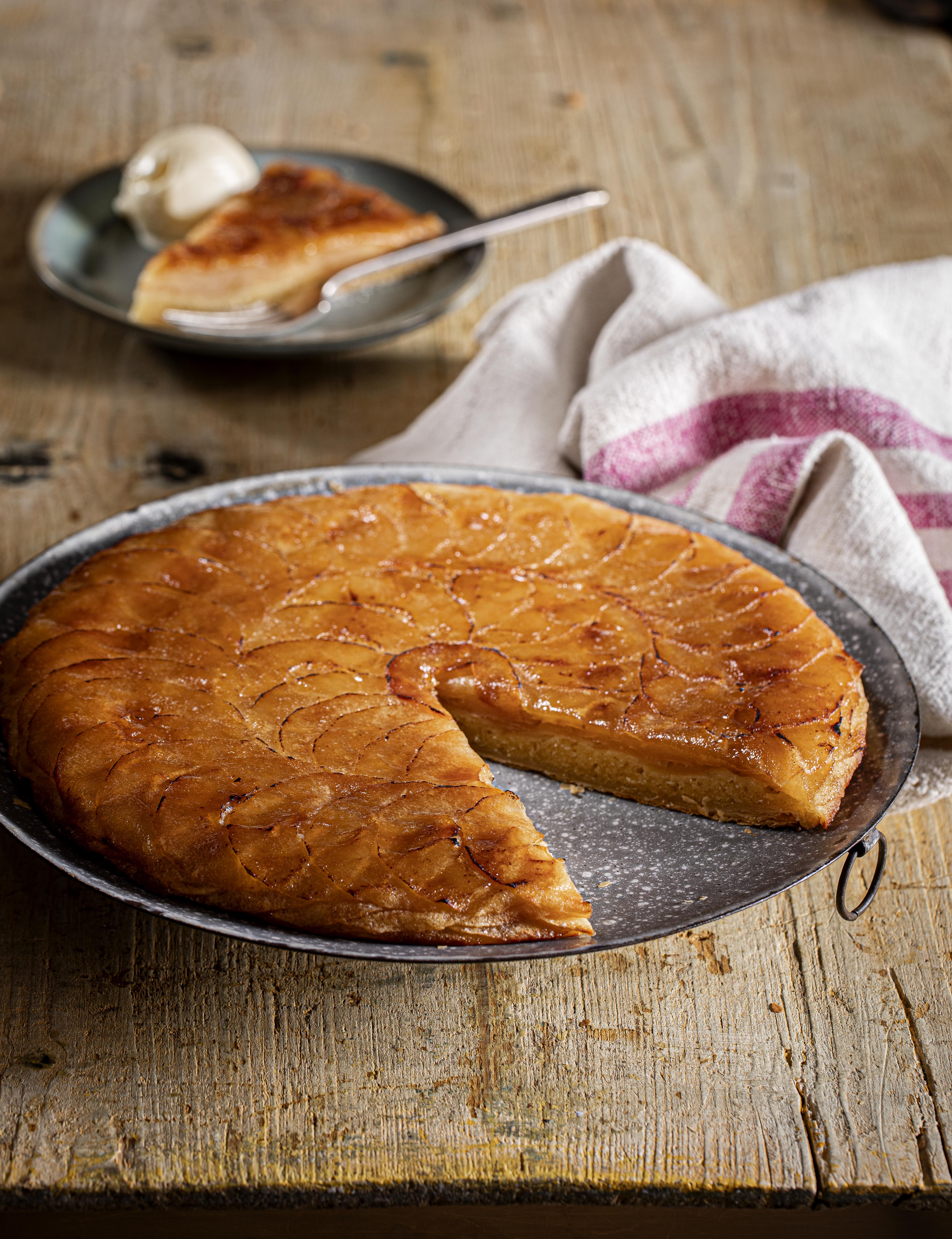
Glazed apple tart by Calum Franklin

The Pie Room Book dishes

The slightly more elegant sibling of the classic apple pie, this tart is a stunning dessert. It has similar flavours to a tarte tatin as the sugar caramelises as it cooks. You could serve this tart with clotted cream to balance the sweetness of the apples.

Serves 6

300g classic puff pastry (or shop-bought)
200g frangipane (see below)
80g caster sugar
80g unsalted butter, softened
6–8 Pink Lady or Granny Smith apples
20g icing sugar
clotted cream, to serve

Line a baking tray with parchment paper. On a lightly floured surface, roll out the pastry into a large circle about 5mm thick. Slide the rolled-out pastry onto the lined baking tray and rest in the refrigerator for 15 minutes or in the freezer for 10 minutes. Remove the tray from the refrigerator or freezer. Trim the edges of the pastry into a neat circle that measures 24cm in diameter and return to the refrigerator or freezer.

Once chilled, remove the pastry from the refrigerator or freezer, and preheat the oven to 185°C fan/200°C/gas mark 6. With the pastry still on the lined baking tray, and leaving a border of 2cm around the edge, spread around 200g of the frangipane evenly across the pastry.

Using a pastry brush, mix the caster sugar and softened butter together to make a paste.

Peel and core the apples. Using a mandoline, slice the apples to 2mm thick. Take just over one-quarter of the slices and fan them out in a circle around the outer edge, keeping in line with the edge of the frangipane. Roughly brush the apples with some of the butter mixture.

Repeat with the remaining apple slices and butter mixture to create concentric circles until the pastry is covered. Make sure the top layer of apple slices is evenly coated with the butter mixture.

Place the tray in the preheated oven and bake the tart for 30 minutes or until the apples are starting to caramelise and the pastry is beginning to crisp up.

Remove the tray from the oven. Using a sieve, dust the tart with the icing sugar and then lay another sheet of parchment paper over the top of the apples. Take a second baking tray and lay it on top of that parchment paper. Using a dish towel or oven gloves to protect your hands, quickly flip the tart over so the apples are now facing downwards on the new tray. Lightly press down the top tray and then remove it and the original parchment paper. Return the tart to the oven for a further 20 minutes.

Remove the tart from the oven. This time place a serving plate or platter on top of the pastry, and then flip the tart again. Check the apples are evenly glazed and caramelised. If it needs a little longer, flip the tart back again and return it to the oven for a further 10 minutes. Serve warm with spoonfuls of clotted cream.

Frangipane

225g butter, softened
225g caster sugar
1 vanilla pod, deseeded, seeds retained
5 medium-sized eggs
225g ground almonds

Beat the butter, sugar and vanilla seeds together until the butter has turned pale and creamy. Add one egg at a time, whisking until each is fully incorporated before adding another.  Once all the eggs are incorporated, use a large metal spoon to fold in the almonds until well mixed.

Cook more from this book
The ultimate sausage roll
Hot pork pie
Classic puff pastry

Read the review

Buy the book
The Pie Room: 80 achievable and show-stopping pies and sides for pie lovers everywhere
£26, Bloomsbury Absolute