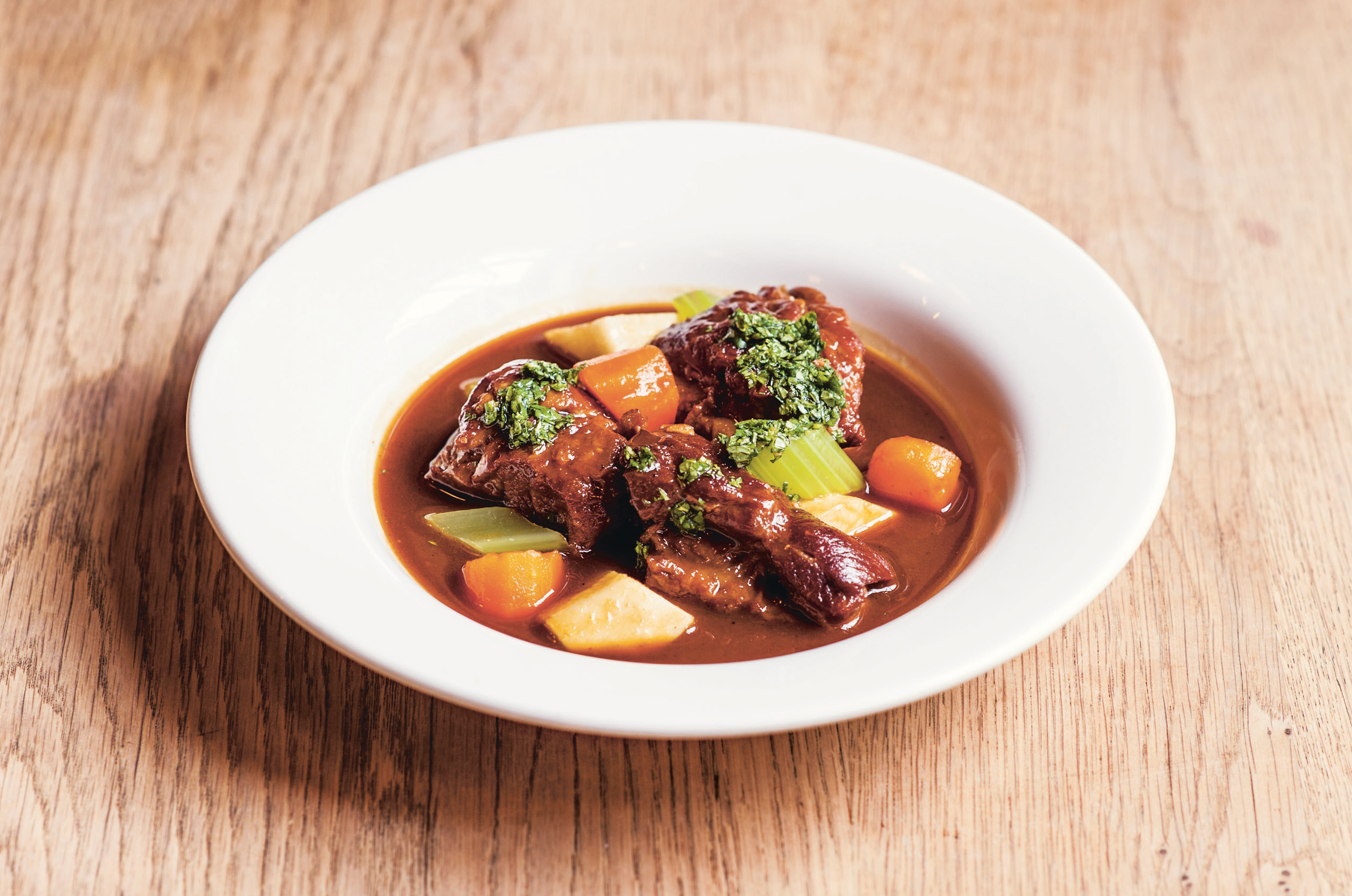
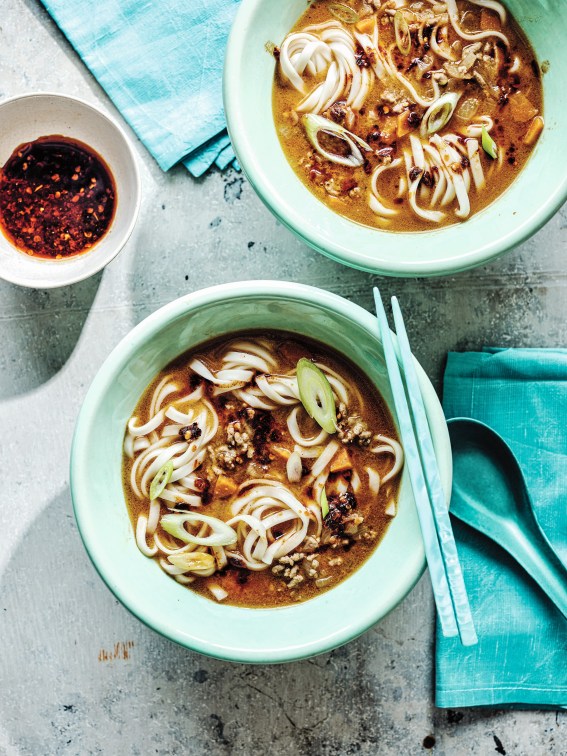
Lamb navarin by Neil Borthwick, The French House, London

027 Borthwick

Serves 4

4 lamb neck fillets, cut into 4 pieces
Salt
Mirepoix: 1 onion, 2 carrots • 1 garlic bulb, halved
3 tablespoons tomato paste (puree)
1 bouquet garni: thyme, bay leaf, rosemary
1 liter chicken stock
500 ml veal stock
6 organic carrots, peeled and cut into chunks
2 turnips, peeled and cut into chunks
2 stalks celery, cut into lozenges
Olive oil
Chopped fresh parsley
Fresh mint

Season the lamb well. In a sauté pan, sear the lamb until golden brown all over and set aside.  Add the mirepoix to the pan along with the garlic and cook until caramelized. Add the tomato paste (puree) and cook for 4–5 minutes. Return the lamb to the pan along with the bouquet garni and both the stocks. Bring to a gentle simmer, skim well, reduce the heat, and cook until the lamb is tender when pressed with a finger, 1–11⁄2 hours. Set aside and allow to cool for 1 hour. In a large pot of boiling salted water, cook the carrots, turnips, and celery until just tender. Shock in an ice bath. Drain and set aside.

Remove the lamb from the braise and pass the sauce through a sieve, pressing as much of the vegetables through as well, which will help to thicken the sauce and give you lots of flavour. 

Return the lamb, along with the cooked vegetables, to the sauce and finish with chopped parsley and a touch of mint. Serve with buttery mashed potato.

Dish photographed by Peter Clarke

Extracted from Today’s Special, 20 Leading Chefs Choose 100 Emerging Chefs, published by Phaidon

9781838661359-3d-1500

Cook more from this book
Concha by Elena Reygadas of Rosetta, Mexico City
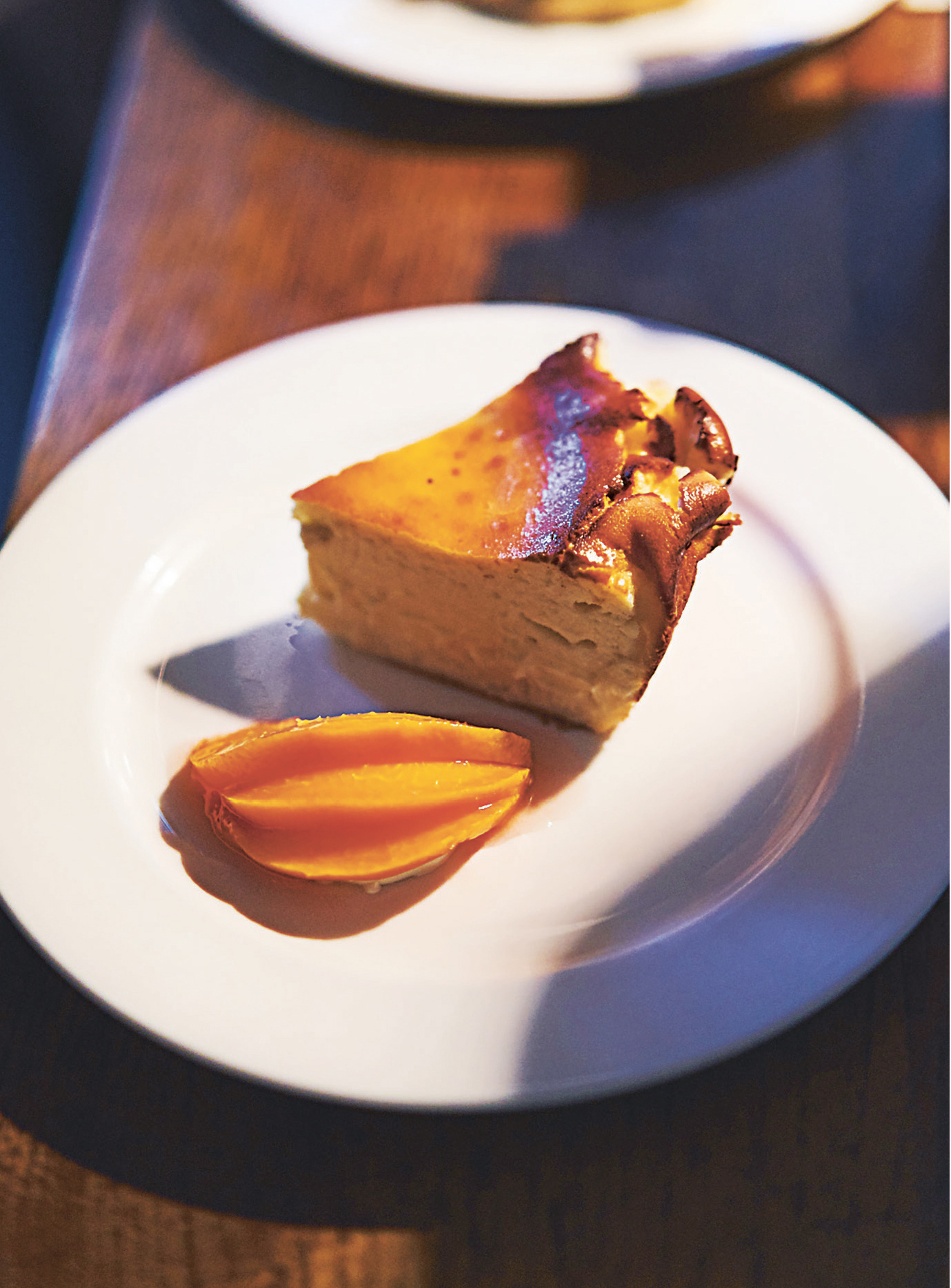
Cheesecake and wood roasted peaches by Tomos Parry of Brat, London

Buy this book
Today’s Special: 20 Leading Chefs Choose 100 Emerging Chefs
£39.95, Phaidon

Read the review
Today’s Special edited by Emily Takoudes

First Catch Your Gingerbread by Sam Bilton

First Catch Your Gingerbread

What’s the USP? Everything you always wanted to know about gingerbread, but were afraid to ask, including the history of gingerbread from ancient times to present day, plus gingerbread and ginger cake recipes. It is part of Prospect Books’ series ‘The English Kitchen’ that looks at dishes and their place in history and which has previously included books on quince, soup and trifle.

Who’s the author? Sam Bilton is a food historian and writer and is probably best known for her historically-themed supper club Repast. She’s also worked on projects with English Hertiage and the National Trust. This is her debut book.

Is it good bedtime reading? The first 80 pages are given over to the scholarly ‘The Story of Gingerbread’ that begins with its pre-history in the ‘reverence given by ancient civilisations to the medicinal properties of spices’ and continues with it’s medieval incarnation (including an appearance in The Canterbury Tales as ‘gyngebreed’) and includes the importance of treacle in the history of gingerbread, how the recipe migrated from England to America and the difference between the two varieties, historical gingerbread moulds and other related creations, and it’s more modern incarnations and enduring appeal.

Will I have trouble finding ingredients? You will find virtually everything you need in the supermarket. However, you will probably need an online supplier for grains of paradise (a West African spice that looks like black peppercorns but is in fact a member of the ginger family) if you want to make Små Pepparkakor, the ‘intensly crisp, aramatic small gingerbreads’ from Sweden, and for long pepper to make Dulcia Piperata (Roman Peppered Honey Cake). There are savoury recipes in the book too so you’ll want to visit your fishmonger for the langoustine and crayfish for an unusual stew that includes gingerbread crumbs.

What’s the faff factor? Some recipes will take a little bit of planning, for example a game terrine or chocolate stuffed lebkuchen (a spiced shocolate cake), both of which are two-day processes, although neither are particularly complicated. But generally speaking, the recipes are very approachable, especially for home bakers with some experience.

How often will I cook from the book? If you have a sweet tooth and are a keen baker, the book is a treasure trove of interesting, unusual and, most importantly, delicious recipes that you’ll want to work your way through. The inclusion of savoury recipes makes it useful for when you want something just a little bit different for a dinner party or even just a family meal.

Killer recipes? Ormskirk gingerbread; Elisenlebkuchen (chocolate-glazed spice and nut biscuits from Germany); Indian gingerbread; Ginger scotch rabbit; baked Camembert with gingerbread; carrot and ginger roulade with honeyed ricotta;

What will I love? This is quite obviously a labour of love. Bilton has unearthed a fascinating history behind an everyday cake shop favourite and curated a selection of appealing recipes that you’d struggle to find anywhere else.

Should I buy it? For keen bakers and lovers of food history, it’s a no-brainer.

Cuisine: International
Suitable for: Bakers/beginners/confident cooks
Cookbook Review Rating: Four stars

Buy this book
First Catch Your Gingerbread By Sam Bilton
£15, Prospect Books

Also available at Amazon
First Catch Your Gingerbread (English Kitchen)

Green Shakshuka by Gizzi Erskine

Green Shakshuka c. Issy Croker

I developed this recipe in the early days of Filth, with Rosemary Ferguson. Our mission was to get extra nutrition into everyday dishes. We wanted to make a healthy breakfast, both loved shakshuka and huevos rancheros, and thought we could somehow merge them. That week, I’d made a huge vat of Green Tomato Salsa that ended up being the base of this dish. We fried some cumin seeds in oil then added the salsa, before blending it with fresh spinach to an even more nutritious, virtually Hulk-green sauce, got some roasted green peppers into the dish and baked the eggs in this sauce instead of the usual red one. We finished it with a combo of Middle Eastern and Mexican toppings and served it with flatbreads or grilled Turkish breads with some good extra-virgin olive oil. It’s a superb healthy weekend brunch dish and pretty fancy-pants in the impressiveness stakes, too.

SERVES 2
Preparation time 10 minutes
Cooking time 10 minutes

3 tbsp olive oil
1 tsp cumin seeds
400g Green Tomato Salsa (page book for recipe)
1 tsp ground coriander
85g fresh spinach, washed, wilted in a pan for a minute and drained
80g green peppers, roasted (see book for Gizzie’s method) and sliced
4 free-range eggs
sea salt and freshly ground black pepper

TO SERVE
good handful of coriander leaves, chopped
a few dill fronds
a few mint leaves, shredded 2 tbsp sour cream
300g Qyeso Fresco (see book for further info) made to a firm and crumbly texture
3 tbsp toasted mixed seeds mixed with ½ tsp za’atar
freshly made Flatbreads (see book for Gizzi’s recipe) or grilled Turkish bread
extra-virgin olive oil, for drizzling

You will need 2 individual 22-25cm baking or gratin dishes.

Preheat the oven to 240°C/220°C fan/gas mark 9.

Heat the oil in a frying pan over a medium-high heat, add the cumin seeds and fry for a minute or two until toasted. Add the green tomato salsa, coriander and spinach and cook for a minute. Season with salt and pepper if necessary, then remove from the heat and blitz until smooth.

Divide the blitzed sauce between two individual (22-25cm) ovenproof baking or gratin dishes. Split the green peppers between the two dishes, then simply make two little holes in the top of the sauce in each dish and break an egg into each hole. Season each egg with salt and pepper and bake in the oven for about 8 minutes or until the egg whites are cooked through, but the eggs still have runny yolks.

Remove from the oven and top the two shakshukas with the chopped coriander, dill, mint, sour cream, queso fresco and seeds, and serve with toasted or warmed bread, drizzled with extra-virgin olive oil.

Recipe taken from Restore by Gizzi Erskine, available now (£25, HQ)’. Photography credit – c. Issy Croker

Restore

Cook more from this book
Bibimbap

Buy this book
Restore by Gizzi Erskine
£26, HQ

Read the review

Red Sands by Caroline Eden

Red Sands by Caroline Eden

What’s the USP? Ever wondered what the food, people and places of Kazakhstan, Kyrgyzstan, Tajikistan and Uzbekistan are really like? Then here’s your chance to find out.

Who is the author? Caroline Eden is a writer and journalist specialising in the former Soviet Union. Her first book Samarkand – recipes and stories from Central Asia and the Caucasus appeared in 2016 and was named Guardian book of the year and won Guild of Food Writers ‘Food and Travel’ award in 2017. He second book Black Sea was awarded the Art of Eating Prize, the John Avery Award at the Andre Simon Awards, Best Travel and Food Book of the Year at the Edward Stanford Travel Writing Awards and Best Food Book at the Guild of Food Writers Awards 2019.

Is it good bedtime reading? It’s probably best to think of Red Sands as a travelogue through Central Asia with recipes rather than a cookbook per se (on her website, Eden describes herself as ‘a writer about places’ rather than a food writer) so you will spend at least as much time with the book learning about Nur-Sultan, the ‘purse proud and machine made’ capital of Kazakhstan as you will cooking dishes like mushroom khinkali (dumplings), something Eden ate at Café Tselinnikov in the city.

Will I have trouble finding the ingredients? Although you may be new to Central Asian cuisine (I certainly was), the ingredients will be surprisingly familiar. Meatballs are flavoured with paprika and cumin in a soup from Karaganda made with lavash and chickpeas; Laghman, a noodle dish served throughout the region, features lamb, Chinese cabbage, peppers and cumin, and even canned peaches turn up in a sour cream cake from Northern Kazakhstan. You should even be able to find Tvorog, a soft curd cheese similar to quark in your local superstore (but if not head to a Polish shop if you have one nearby) which you’ll need to make a simple and light Zapekanka cake for breakfast.

What’s the faff factor? Basically non-existent. This is simple, homely food with mostly short ingredient lists and easy methods. There are a few dumpling recipes, including steamed pumpkin khunon, which by their nature are a little more complex as you’ll need to make both dough and filling and then shape and fill the dumplings  before cooking, but apart from that many of the recipes would be ideal for beginner cooks.

How annoyingly vague are the recipes? The ingredient list for non puju, (a sort of yeasted flat bread topped with beef stew flavoured with Chinese five spice, soy and chilli)  calls for 1/2 handful of coriander which is the epitome of vagueness, but the recipes are so straightforward that the odd handful (or half) is neither here nor there.

Killer recipes: Sultan kurgan tofu; autumnal soup with rice, barley and lamb; Kulich – Russian Easter bread; sweet bread and mung bean pilaf; blushing quince jam; Grand Asia Express samsa (chicken, potato and cumin puff pastry turnovers); pickled cauliflower.

How often will I cook from the book? With accessible and delicious recipes for soups, stews, breads, snacks, pickles, preserves, desserts and breakfasts, Red Sands should prove a useful resource that you’ll return to often.

What will I love? Eden has gone to the ends of the earth (well, sort of) to research the book and writes about her subject with great authority and style. The book is packed with telling details that enliven the prose and put the reader right in the action. For example, in a market in Tashkent, northeast Uzbekistan, Eden watches as ‘one sold out vendor packed his weighing scale back up and, reversing out of the block, licked the fingers of his right hand and counted the banknotes straight on to his ballooned belly.’ Also, what about that stunning cover?

Should I buy it?  Caroline Eden is an outstanding writer and if Red Sands doesn’t win as many if not more awards than Black Sea I’ll be amazed.  An essential purchase for anyone interested in world cuisine and travel. 

Cuisine: Central Asian
Suitable for: Beginners/Confident home cooks
Cookbook Review Rating: Five stars

Buy this book
Red Sands: Reportage and Recipes Through Central Asia, from Hinterland to Heartland
£26, Quadrille Publishing Ltd

The Whole Chicken by Carl Clarke

The Whole Chicken Carl Clarke

What’s the USP? It’s nose-to-tail cooking, but for chickens! So beak-to-tail-feather, then. The Whole Chicken breaks down the bird both literally and metaphorically, with chapters dedicated to all our favourite cuts, as well as mince, offal, bones, skin and, in a move that technically fits the bill but feels a little too eager to get the chicken on the table, eggs.

Who wrote it? Author Carl Clarke has definite chicken-cred. I mean, I imagine his credibility is at rock bottom with actual chickens – he keeps eating them. But through Chick ‘n’ Sours and spin-off Chick’n he has two of the coolest bird-and-apostrophe-centric restaurants in London to his name.

Is it good bedtime reading? Though Clarke skips out on chapter introductions (who needs to be told that thighs are the best bit of the chicken for the umpteenth time?), he quickly makes up for it with passionate and practical introductions to each recipe. Forget about the bedtime reading though, it’s the kitchen dance-offs that you’ll be focused on: the book offers five brilliantly curated playlists to keep you entertained whilst you prepare, cook and eat the whole of your chicken.

How annoyingly vague are the recipes? Not even a little bit. Clarke goes into a decent amount of detail throughout. There’s a refreshing commitment to clarity, in fact. The book lists both metric and imperial measurements at every opportunity, and even features both British and American terms where necessary (cling film/plastic wrap, etc).

What’s the faff factor? Clearly marked at the side of the page. A small scale next to each recipe ranks the dish as either ‘easy peasy’, ‘almost breezy’, or ‘worth the effort’. That said, quite a lot of the dishes fall into that latter category. The scale isn’t particularly consistent either. The Next Level Breville grilled sandwich is listed as ‘worth the effort’, and whilst it’s certainly a lot more of a commitment than your usual toastie, it pales by comparison to the Chicken Nuggets with Kimchi Bacon Ranch Dip and Spicy Shake.

What will I love? The sheer range of dishes on offer here. Clarke draws on a number of different cuisines, though East Asia and the United States are perhaps the most obvious influences. Everything here looks absolutely delicious, and the design of the book itself only emphasises this. The Whole Chicken is intensely cool, and you’ll be a little surprised to find that it’s willing to hang out with you and your other cookbooks.

What won’t I love? There’s a disappointing amount of recipes representing the less commonly used pieces of the chicken. Given the title of the book is ‘The Whole Chicken’, you’d perhaps expect a little more attention to be paid to these areas. Instead, the overwhelming majority of the book is dedicated to those traditional cuts. The entire offal section comprises of just five recipes, meaning that those looking for inspired uses for chicken heart (a delicacy in several countries) will find just one stand-alone recipe. The same goes, inexplicably, for the liver, gizzards and feet – despite each of these having myriad uses in various global cuisines.

Killer recipes: My Friend Romy’s Butter Chicken Recipe, Doritos-Coated Schnitzel with Fried Eggs and Anchovies, Gunpowder Wings, Xian-Spiced Chicken Scratchings and Cherry Cola Chicken Legs.

Should I buy it? Despite not fully realising the promise of its title, The Whole Chicken does offer up an irresistible wealth of dishes drawn from genuinely global influences. It isn’t the first book to do a deep dive on the chicken, but it feels very much of its own space. I have Diana Henry’s lovely A Bird in the Hand on my shelves too, but comparing the two here feels a little like throwing Delia Smith in the ring with David Chang.

Cuisine: Global
Suitable for: Beginner to confident home cooks
Cookbook Review Rating: Four stars

Review written by Stephen Rötzsch Thomas a Brighton-based writer. Follow him on Twitter and Instagram at @srotzschthomas

Buy this book
The Whole Chicken: 100 easy but innovative ways to cook from beak to tail
£22, Hardie Grant

Australian Food by Bill Granger

Australian Food by Bill Granger

Bill Granger could not have picked a better time to publish his first book in six years. With its bright, orange, red and yellow cover and vibrant, globally inspired recipes, Australian Food brings some very welcome sunshine from down under into these gloomy lockdown autumn days. Granger first came to international attention in 2002 when the New York Times dubbed him ‘The Egg Master of Sydney’ and described the scrambled eggs at bills restaurant ‘as light as the breath of an angel’.

The recipe (the secret of which appears to be quite a lot of whipping cream and some careful cooking) is included in a chapter of ‘classics’ that features other signatures such as chocolate banana bread, and ricotta hotcakes with honeycomb butter and banana, a dish much-copied by the likes of Nigella and Ottolenghi. These breakfast specialities might be the foundations of a restaurant empire that now includes London, Honolulu, Seoul and Japan, but Australian Food confirms there’s much to the self-taught chef’s repertoire.

Australian chefs have long been renowned for incorporating Southeast Asian flavours into their food (Neil Perry of Rockpool Dining Group is just one high profile example) and Granger does it better than most. Deftly sidestepping issues of authenticity and appropriation, dishes such as turmeric-spiced chicken in lettuce parcels with green chilli dipping sauce, or grilled pork chops with cashew satay with pineapple and cucumber relish employ ingredients with gleeful abandon to create something delicious and decidedly Australian.

Italy also looms large in Granger’s gastronomic imagination so there’s also recipes for braised lamb ragu with tagliatelle and pecorino and green herb risotto with raw summer salad.  But he doesn’t stop there. With chapters on barbecue, bowl food, small plates and bakery (Granger is an excellent baker as his miso caramel brownies prove), the book leaves no culinary stone unturned.  The sheer variety on offer makes Australian Food a pandemic kitchen panacea but Granger’s skill as a creative chef and recipe writer, honed over more than a quarter of a century, ensures it will have enduring appeal.  

Cuisine: Australian/International 
Suitable for: Beginners/Confident home cooks
Cookbook Review Rating: Five stars

Buy this book
Australian Food
£20, Murdoch Books


Pizza: A book by Pizza Pilgrims by James and Thom Elliot

Pizza by Pizza Pilgrims

What’s the USP? The ultimate book about pizza! As well as recipes, Pizza offers up interviews with figures central to the pizza-eating world, pop cultural insights, and lessons in etymology and maths.

Who wrote it? Brothers James and Thom Elliot, who are best known as the founders of Pizza Pilgrims – a small chain of restaurants that evolved out of a single street food stand in London. Named after a toe-to-top journey through Italy that the brothers undertook in 2011 as an attempt to discover the secrets of great pizza, the brand has since become one of the most celebrated names to hoist a margherita upon the British people.

Is it good bedtime reading? Look, this is nothing if not filled with bedtime reading. In fact, it’s probably better not to think of Pizza as a cookbook, but rather food writing with added recipes. The book comes in just shy of 270 pages, and yet features only 26 pizza recipes, plus some pizza-adjacent ideas that bring the total recipe count to 30.

It’s hard to know exactly how to feel about this number. Pizzas are relatively intuitive things once the dough is made, and the overwhelming majority of the recipes that make the cut are both innovative and enticing. There are only so many pizzas one needs to be told how to make, after all. I’m not convinced there is much need to spell out how to put together a Hawaiian, for example, so it’s hard to fault the brothers for excluding it.

The rest of the content falls broadly into one of three categories. Firstly, there’s the genuinely interesting stuff, like a deep dive on the perfect pizza dough, and the city guides that champion the best pizzerias in Naples, Rome, and a smattering of other cities across the world.

Secondly, there’s the missed opportunities. Chief amongst these is the four-page section that looks at collaborative pizzas the Pilgrims have created with other restaurants over the years. Given the relative lack of actual pizza recipes in the book, it seems a tremendous waste to list twelve delicious sounding hybrids like the Dishoom-inspired Bacon & Egg Naan Pizza and not provide the means to create them at home.

Finally, there’s the filler – and, frustratingly, much of the book falls under this category. In an attempt to create a definitive text on pizza, the Elliots have included some genuinely useless sections. A two-page spread entitled ‘Pizza-Loving Celebrities’ lists thirteen famous people who have publicly professed to liking one of the most popular foods on the planet. There are four pages on the best fictional pizzerias and, later on, a further four pages on pop culture moments for the dish. Both of these amount to little more than a slightly wordy Buzzfeed list. Home Alone gets significant coverage in each.

Occasionally, the book gets really desperate – a gallery of pizza box designs customers have drawn up over the years, an advert for their ‘pizza in the post’ DIY delivery service and, most bafflingly, one-dimensional interviews with corporate figures from Domino’s, Pizza Hut and Papa John’s. There might be some interesting insights to be found in the development kitchens of these brands, but half a page with the UK operations director of Domino’s ultimately amounts to nothing but empty calories.

Oof. So you’re not a fan, then? Well, see this is the problem. Perhaps eighty percent of this book is useless to a serious home chef – but the twenty percent that remains is brilliant. The recipes frequently show the value of the brothers’ initial pilgrimage through Italy, demonstrating a depth of knowledge and understanding that results in genuine learning opportunities.

My favourite choice at my local takeaway is a light ham and sweetcorn affair that is revealed here to be a version of the Mimosa pizza. I had no idea that it was something of a nostalgic favourite in Naples, where children think of it in much the same way that Brits might think of fish fingers and chips.

The Elliots also champion the frying pan as their preferred method for cooking pizzas at home – an idea I might have been unconvinced by before, but will likely be my standard going forward. These sorts of revelations are worth the price of admission by themselves.

I’m not going to deny, either, that there will be audiences who lap this up. The style of the book reminds me of cash-in influencer titles at times, and for better or worse, it will appeal to plenty of people as a result. It might also offer an excellent entry point for pizza lovers who perhaps haven’t previously considered making their own at home. 

What will I love? The recipes are faultless, even if there aren’t all that many of them. Alongside those inexplicable big brand takeaway interviews, there’s also a lovely conversation with Antimo Caputo, who makes flour that enjoys a cult status in pizza circles. It’s worth taking a moment, too, to celebrate the inspired cover design, which mocks up a takeaway pizza box with joyful, tactile precision.

What won’t I love? The recurring feeling that the publishers are trying to make the book thick enough to charge twenty quid for. The frustration that instead of achieving this by including more recipes, they threw in filler pages with titles like ‘Pizza Facts’. The sheer incredulity you feel when the first fact on the ‘Pizza Facts’ page – that the pepperoni pizza emoji is the most used emoji in the US – is so obviously, quantifiably not true that it renders the entire page pointless. It’s the ‘face with tears of joy’ emoji, by the way, and you (or the publisher’s fact checkers) can confirm that with one four word Google search.

Killer recipes: There are no duds amongst the recipes, but the Mimosa, Datterini Filetti and Mortadella & Pistachio pizzas are particular highlights.

Should I buy it? This is definitely a browse-in-the-shop-first book. Anyone really passionate about homemade pizzas will benefit from the advice here, and I suspect this would be a great book for a young person who is getting increasingly ambitious in the kitchen. More confident cooks might want to consider if they can really afford to give up valuable space on their cookbook shelf to a title that barely fits the description of ‘cookbook’ in the first place, though.

Cuisine: Italian
Suitable for: Beginner home cooks
Cookbook Review Rating: Three stars

Review written by Stephen Rötzsch Thomas a Brighton-based writer. Follow him on Twitter and Instagram at @srotzschthomas.

Buy this book
Pizza: History, recipes, stories, people, places, love (A book by Pizza Pilgrims)
£20, Quadrille Publishing Ltd

Vegetarian round up: The Part-Time Vegetarian’s Year and Italy: The World Vegetarian

What’s the USP? Two USPs, actually! Having explored meat-free options from India and Japan with their initial installments earlier this year, Bloomsbury’s ‘World Vegetarian’ series takes its first step into Europe with Christine Smallwood’s volume on the food of Italy. Meanwhile, Nicola Graimes follows up 2015’s The Part-Time Vegetarian with a seasonal take on her flexitarian cooking. Are they good bedtime reading? Once the recipes are out of the way, there’s not a lot of extra-curricular writing in Smallwood’s book on Italy. Like many cookbooks that form part of a larger series, this is a fairly utilitarian affair. This isn’t a book for reading over cosy winter evenings, but rather a practical volume you can take down from the shelf when you need dinner on the table in forty minutes. The Part-Time Vegetarian’s Year has a lot more to offer on this front – the division of a cookbook by seasonal availability has been something of a trend in the last couple of years, and lends itself brilliantly to vegetarian cooking (as Nigel Slater demonstrated with his brilliant Greenfeast books). So here we have practical advice about how best to utilise your freezer, how to minimise your food waste and, of course, handy lists of which vegetables are in season when. Will I have trouble finding the ingredients? One of the most underrated elements of vegetarian cooking, I think, is that recipes are usually incredibly easy to source. Dishes rely on the flavours of the vegetables and the method of cooking to extract as much flavour as possible out, and as such rarely call upon more hard-to-source ingredients. Smallwood’s book, drawing as it does from a cuisine that has been so warmly taken in and appropriated by Britons, features nothing but instantly recognisable ingredients that can be found most anywhere you care to shop. Graimes might send you out into the world for hoisin sauce or silken tofu, but you’re not going to consider that much of a challenge, are you? How often will I cook from the books? Both titles are filled with interesting and vibrant dishes – though Italy: The World Vegetarian probably has the upper hand on this front. Smallwood’s dishes are ready made for weeknight cooking, and you could easily find yourself picking out a simple but effective recipe from this book once or twice a week. Graimes’ Part-Time Vegetarian’s Year asks a little more from the reader – both in terms of culinary skills and commitment of time to the dishes. The results are equally as tempting, though, so will likely find their way onto your dinner table a couple of times a month without any trouble. What will I love and what won’t I love? For all of The World Vegetarian’s positives, the book is just a bit, well, drab. It’s hard to really put your personality into a pre-existing format – and in terms of Smallwood’s involvement this is much more ‘Gary Barlow takes over X-Factor’ than ‘Taika Waititi shakes up the Marvel Cinematic Universe’. We’re spoiled for vegetarian cookbooks at the moment, and sheer practicality isn’t necessarily enough of a selling point to really make a mark. This is something The Part-Time Vegetarian’s Year understands – it’s significantly more vibrant, and the reader gets a much stronger sense of Nicola Graimes’ voice and personality. It’s also, dare I say it, more fun. The flexitarian options allow for the entire thing to feel more interactive, more of a loose guide than the overt instruction manual vibes of Smallwood’s book. Killer recipes: Italy: The World Vegetarian’s highlights include Sciatt with Cicoria, Spicy Farro Soup and Assassin’s Spaghetti. The Part-Time Vegetarian’s Year travels a little further afield to offer Sesame Empanada Pie, Mushroom Noodle Larb and Spiced Leek Flatbreads with Mint Aioli. Should I buy it? Both will find a place on any vegetarian’s shelf. Smallwood’s entry to the World Vegetarian series is perhaps better suited for cooks seeking to expand on their own repertoire of dishes – though it’s probably the more useful of the two offerings, it lacks the pizazz we tend to seek in the books we give to others. The Part-Time Vegetarian’s Year, however, has exactly that. It’s accessible and fun – and the flexitarian element means it will be equally loved by both vegetarians and those looking to cut their meat-consumption down in the future. Cuisine: Italian/Global Suitable for: Beginners/Beginners and confident home cooks Cookbook Review Rating: Three stars/Three stars Review written by Stephen Rötzsch Thomas a Brighton-based writer. Follow him on Twitter and Instagram at @srotzschthomas. Buy the books The Part-Time Vegetarian’s Year: Four Seasons of Flexitarian Recipes £25, Nourish Books  Italy: The World Vegetarian £20, Bloomsbury Absolute

Home Cookery Year by Claire Thomson

Home Cookery Year by Claire Thomson

What’s the USP? Less of a unique selling point, and more of an all-encompassing approach to the cookbook, Home Cookery Year is a 400 page, 200+ recipe doorstop tat seeks to offer seasonal ideas for every possible situation, from midweek dinners to elaborate dinner party feasts.

Who wrote it? Claire Thomson, who has made something of a habit of releasing practical, down-to-earth cookbooks over the past five years. Her first title focused on cooking for families, and last year saw her release New Kitchen Basics, which offered a wide range of recipes based around ten classic ingredients.

If you’ve come across her this year, though, chances are it will have been during lockdown. Her 2017 title The Art of the Larder is one of the most informative titles on store-cupboard cooking available, and likely saw a healthy boost to sales around the tail end of March. It’s also the book that first introduced me to Thomson – albeit one that I didn’t enjoy as much as I’d expected to. Rather than re-invigorate the store-cupboard, it frequently reminded me of how drab tins and dried pulses can be. With that in mind, I find myself approaching this new book rather tentatively. Thomson has been inspired, she says, by the ‘evergreen’ cookbooks her mother had (‘and still has’) on her shelves. Paired with a title that Thomson herself admits is more honest than fashionable, I’m ready for a collection of practical, if dull, recipes.

This is heading for a delightful twist, isn’t it? Oh, you know me so well. The book’s an absolute bloody delight. Thomson’s straight-forward approach and practical application of her expertise means that from the outset, tHome Cookery Year is a joy to navigate. Though she has aspirations towards the simple, accessible and everyday cooking of all your mum’s favourite TV chefs of the 70s, her taste buds are firmly of the moment. This is an old-fashioned cookbook in spirit only.

Home Cookery Year is set out seasonally, with a chonker of a chapter for each season. These are split further, to allow the reader to find recipes that fit the bill whether they’re looking for a quick midweek supper, a budget meal from the larder, something a little more luxurious, and so on.

What’s the faff factor? Everything in the book is built towards accessibility. With a few (very rare) exceptions, you’ll be able to get all the ingredients from your local supermarket. Thomson’s recipes are straight-forward, even when they yield beautifully complex dishes and flavours. Even the recipes under the ‘leisurely weekend cooking’ headings are only listed as such because of the time they take, or the mess they’ll make.

How often will I cook from the book? Look, this is not something I get to say very often, but here goes: you could cook from this book every single day for a year and not get bored. The depth and variety within these pages is astonishing. Take Autumn, for example: the midweek offerings alone include comfort foods with a twist (Smoked Haddock with Curry Butter & Poached Egg), international staples (Goan Green Chicken, Nasi Goreng) and quick, simple recipes that are bound to impress anyone (Fig Leaf Pilaf with Aromatic Tomato Sauce & Toasted Almonds). The store cupboard dishes roam from an unctuous Cavolo Nero Polenta Soup to Sichuan classic Dan Dan Noodles.There are inspired takes on classic game recipes, simple yet irresistible desserts by the dozen and, most outrageously of all, a recipe for Duck and Damson Bao that is as good as anything I have in my healthy collection of far more specialised Chinese cookbooks. And that’s just Autumn.

Killer recipes: That Duck & Damson Bao, obviously. But also the Fried Potato Masala Toastie, or the Pasteis de Nata, which I am thrilled to finally have a decent recipe for. Or hey, how about the Crab Gnudi with Butter Baked Cherry Tomatoes & Tarragon. I put down the book and went to the other room to tell my wife about the Beer-brined BBQ Chicken with Mustard & Miso Mayonnaise Sauce. She was very understanding.

The desserts alone deserve a separate paragraph – the Cherry, Marshmallow & Dark Chocolate Chip Cobbler, the Peach & Dulce de Leche Cake, the Blackberry & Bay Brownies made with Rye. Look, there’s over 200 of these bad boys in here, and I honest-to-god reckon I’d eat every damn one of them.

Should I buy it? Oh god, like, twice over, at least. One for you, and one for anybody in your family who loves to cook. Because here’s the thing: with Christmas coming up faster than any of us are truly comfortable with, the bookshops are filled with brand new cookbooks vying for your attention. And this year, like every other, the big names like Nigella and Jamie are going to get the lion’s share of the sales.

Fun fact: I’ve worked in a bookshop at Christmas, and I’ve seen the absolute demolition of cookbook stock that happens on Christmas Eve. But the problem with gifting cookbooks is that you either have to go broad, which means celeb chefs, and the risk of giving your mum her third copy of the new Ottolenghi, or you need a deep insight into their personal tastes and their specific desire for a particular cuisine. This book lets you opt firmly for column A, whilst avoiding the obvious titles and throwing in some unexpected regional dishes to boot.

With Home Cookery Year, Claire Thomson has created exactly what she intended to: a five-star all-rounder that you will be using on a weekly basis for years to come. This is accessible, exciting cooking at its very finest, and though it’s up against bigger titles and starrier names, it might just be the best cookbook to give without discretion this Christmas.

Cuisine: International
Suitable for: Beginners and confident home cooks
Cookbook Review Rating: Five stars

Buy this book
Home Cookery Year: Four Seasons, Over 200 Recipes for All Possible Occasions
£30, Quadrille Publishing Ltd

Review written by Stephen Rötzsch Thomas a Brighton-based writer. Follow him on Twitter and Instagram at @srotzschthomas.

Japanese Cooking for the Soul

japanese cooking for the soul_fc_100%

What’s the USP? A collection of 70 Japanese dishes ‘inspired by’ chefs from the Hana Group (the name behind 14 Asian food concepts that’ll you’ll find in supermarkets and other retailers around the globe including Sushi Gourmet, Wok St and Poke-Lele) that celebrate the Itadakimasu ritual of gratitude and reflection.

So, spirituality meets global commerce? Sounds grim. Yeah, probably best to ignore the veneer of mindfulness that’s been applied to the faceless, corporate behemoth that’s behind Japanese Cooking for the Soul to try and make it look more human (spoiler altert: they failed) and stick to the meat of the book which is the rather good recipes.

They’re authentic then? I think we’ve all agreed authenticity is a problematic and nebulous concept when applied to food in the modern global age haven’t we? Or maybe we’re about to roll all of that back and enter a new age of puritanism. In any event, some may raise an eyebrow when they discover that the recipes have been written by former Good Housekeeping Cookery Editor Emma Marsden. If you insist on your Japanese recipes being written by a chef or food writer from Japan or of Japanese heritage, then this book is not for you. If however you’re in the market for an approachable selection of dishes that include sushi and maki; teppanyaki and noodles; poke and Japanese salads; gyoza and dim sum; robata, ramen and tempura, as well as some desserts, then you can’t go far wrong.

Will I have trouble finding the ingredients? You will need to find a fishmonger who deals in sushi-grade fish if you want to tackle salmon and tuna sushi or cristal salmon rolls, but you’ll find most, if not all of what you need at the supermarket. Online stores like Sous Chef will be able to fill in any gaps.

What’s the faff factor? By their very nature, things like sushi or shumai dumplings will take a bit of care and attention and the assembly of various elements, but there are plenty of straightforward dishes like grilled salmon in balsamic onion glaze and stir fried rice with chicken that you can knock up on a work night without too much sweat.

How often will I cook from the book? It’s easy to imagine the book becoming well thumbed and food splattered in no time at all. It’s full of delicious and achievable dishes suitable for quick mid-week diners, and for when you want to spend a bit of hobby-time (is that a thing? Lets assume it is) in the kitchen and prepare a feast.

Killer dishes: Pork and cabbage gyoza; yakitori chicken skewers; beef ramen; prawn tempura with spring onions; teppanyaki duck and many more.

Should I buy the book? If you don’t have any other Japanese cookbooks in your collection, this will serve as a fine introduction to the subject. If you want to delve much further into the cuisine, try Japan:The Cookbook. But at fifteen quid, or less if you click on the link below, this is something of a bargain and a purchase you won’t regret.

Cuisine: Japanese
Suitable for: Beginners and confident home cooks
Cookbook Review Rating: Three stars

Buy this book
Japanese Cooking for the Soul: Healthy. Mindful. Delicious.
£14.99, Ebury Press