The Food You Want to Eat by Thomas Straker – Cookbook Review

Who is Thomas Straker?
Thomas Straker is a chef and social media sensation from London, known for his viral “All Things Butter” series and his easy-going, ingredient-led cooking style. Formerly a private chef and alumni of some of London’s top restaurants, Straker blends fine dining flair with everyday accessibility. With over 3 million followers across platforms and a bustling restaurant in Notting Hill, Straker’s unpretentious, flavour-packed recipes are just as likely to appear in your feed as on your table. The Food You Want to Eat is his debut cookbook. Find him on instagram @thomas_straker

What is The Food You Want to Eat’s USP?
Straker promises “no-faff food that tastes banging.” This is not a book of chef-y techniques or food you’ll cook once and never revisit. Instead, it’s about dishes that are genuinely craveable, with big flavour pay-offs and short, confident ingredient lists. The book blends Italian, Middle Eastern, British and modern European influences, and above all, celebrates good food done simply.

What will I love?
If you have ever watched one of his interviews or listened to him on a podcast, you will see that Straker writes like he talks – direct, cheeky, and deeply enthusiastic about good, seasonal produce. The recipes feel like an extension of his online presence: unpretentious, visually beautiful, and centred around real-world cooking. He’s all about layering flavour, using butter generously, and showing you how to make food that “slaps”.

Expect dishes like ‘Paccheri with Wild Garlic Pesto’, ‘Chicken Caesar Salad’, and ‘Spiced Tomato Tagliolini’ that feel fresh but still achievable on a weeknight. The photography is particularly striking. The shots are moody, natural and appetising, showing real food that’s been cooked and eaten, not styled within an inch of its life.

Is it good bedtime reading?
Yes, if you like falling asleep to the thought of buttery sauces and garlicky roast potatoes. Straker’s voice carries through in short, punchy intros to each recipe, but the writing isn’t wordy; more friend-in-the-pub vibes than lyrical food memoir. Still, the passion is there, and you might find yourself bookmarking entire sections in your head before you drift off.

Will I have trouble finding the ingredients?
Not especially. Straker keeps things supermarket-friendly, and when he uses more niche ingredients (like ‘nduja or miso, although both are often easily available), they’re generally ones you will use again and again throughout the book. His cooking style thrives on a well-stocked larder of oils, vinegars, chilli pastes and, of course, butter (lots of butter). There’s also helpful guidance on swapping or omitting ingredients if needed.

How easy are the recipes to follow?
Very. This is cooking stripped of ego. Most dishes are done in a few simple steps, and Straker’s confidence as a cook comes through in how little hand-holding there is (in a good way). These are recipes written for home cooks who want to trust their instincts and don’t want to be micromanaged.

Stand-out recipes?
The ‘’Nduja and Mozzarella Flatbread’ is pure flavour with minimal effort, one of those recipes you make once and then crave weekly. There’s a touch of genius about the indulgent ‘Chilli Cheese Smash Burger’, while the ‘Chocolate Mousse’ might just ruin all other desserts for you. Don’t miss the ‘Roast Chicken, Butter Beans and Salsa Verde’ which will soon become a new staple (I recommend using Bold Beans butter beans).

How often will I cook from this book?
Frequently. The recipes are what they say on the tin; the food you actually want to eat. There’s no fluff, no filler. Expect easy weeknight pasta, juicy chicken traybakes, punchy salads, and crowd-pleasing sides. The food is adaptable, generous and built for sharing. It’s not one of those aspirational books you leave on a shelf. It’s one you’ll cook from midweek and again at the weekend, ideally with friends, wine, and a lot of napkins.

Any negatives?
If you are looking for particularly health-conscious or plant-based recipes, this probably won’t be for you. While there are veg-focused dishes, butter and meat do a lot of the heavy lifting. Also, if you like your cookbooks full of background essays, regional history or in-depth foodie musings, you will be disappointed. 

Should I buy the book?
Absolutely. If you follow Straker online, this book delivers exactly what you would hope for: big, bold, confident recipes that are genuinely doable and deeply delicious. It is for cooks who want fuss-free inspiration without compromising on flavour.

Cuisine: Seasonal British/Modern European home cooking
Suitable for: Anyone from confident beginners up
Great for fans of: Anna Jones, Jeremy Lee and Marcus Wareing
Cookbook review rating: 5 stars
Buy this book: Food You Want To Eat , £25.00, Bloomsbury.

This review was written by Freelance Food Writer and Recipe Developer Sophie Knox Richmond. Follow her on Instagram on @sophie_kr_food

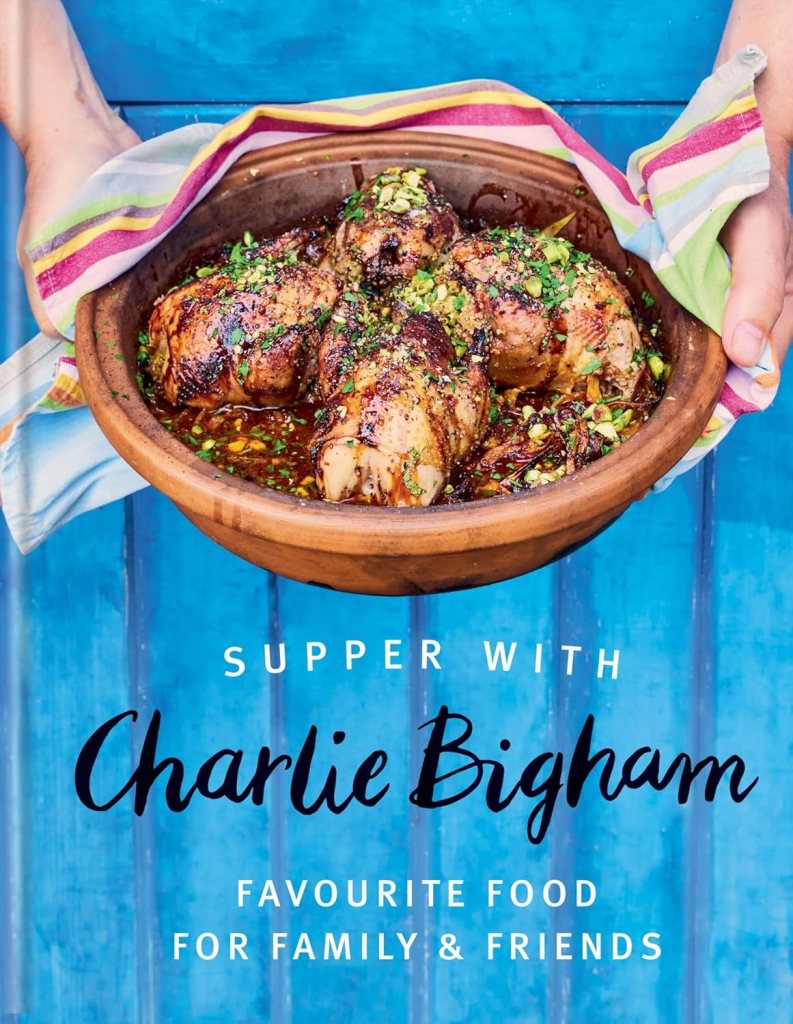
Supper with Charlie Bigham by Charlie Bigham – Cookbook Review

Charlie Bigham, the iconic premium food brand, has released its first cookbook Supper with Charlie Bigham. Written by Charlie Bigham himself (yes, there really is a Charlie Bigham, it isn’t a fictional character), the book promises over 100 relaxed fuss-free recipes to suit a host of supper occasions from fun family celebrations to easy midweek meals. 

What will I love?
The variety of dishes on offer for flexitarian family food and entertaining. Recipes include starters and canapés, mains for two, four, six or many (with advice on scaling up or down), vegetable sides for sharing and simple puddings (oh, and cocktails too!). Classic favourites like ‘Breton Chicken with Chive Mornay Sauce’, ‘The Ultimate Lasagne’ and ‘Beef Bourguignon’ are all there, but so are a host of more modern ideas such as ‘Slow-cooked Shoulder of Lamb with Marmite’ and ‘Penne with Parmesan, Spinach and Courgette’. 

Overall, the book feels very personal. The recipe intros all feel like you are sitting down chatting with Bingham himself as he shares the stories and anecdotes behind each one. The photography is also particularly enticing. Laid back, but not messy, they do an excellent job of ‘selling’ the dishes, while also making them feel approachable. 

Is it good bedtime reading?
Yes. There is an introduction from Bingham where he shares the story of his life through food, followed by an insight into his kitchen and how he likes to cook (all well worth reading). Each recipe also has its own introduction (mentioned above). You could have a very enjoyable evening browsing through the pages finding inspiration for what to cook in the months ahead.

Will I have trouble finding the ingredients?
Most of the ingredients are available in larger supermarkets. Anything difficult to find is accompanied by alternatives. For example, you might struggle to get hold of Borettane onions for the ‘Beef Bourguignon’, but pearl onions are suggested instead. Equally, if you wanted to make the ‘Game Ragu’ you have the option of choosing rabbit, wild boar or venison (although you might need to head to the butchers or order online). The ‘Dynamite Broth with Salmon’ does have bonito flakes, but there are recommendations on where you can source them (or you could leave them out). Aside from that, you will have to go to a deli or health food shop to make the ‘Hunza Apricots with Whipped Pistachio Cream’ and a few of the dishes might require a trip to a fishmonger (or a fish counter). 

How easy are the recipes to follow?
The majority of the recipes are fairly straightforward and all are very well-explained (the ‘Mackerel Pâté does ask you to smoke your own, but there are also instructions using shop bought). Prep and cooking times are included at the start of each recipe with additional ‘Charlie’s tips’ included at the end. There is the odd recipe that requires flicking back and forth to a side mentioned on another page (e.g. the delicious ‘Tomato and Pepper Salsa’ listed with the ‘Griddled Squid’ is also recommended for the (also brilliant) ‘Bashed Chicken with Parmesan Breadcrumbs’). However, that is a small complaint. Quantities are given in both grams and ounces which is ideal for those who still use imperial measurements. 

Stand-out recipes?
The ‘Smoked Haddock Gratin’ is a must-try, while the ‘Leg of Lamb of Lamb with Harissa and Chermoula’ is ideal for an alternative Sunday roast (especially alongside the suggested ‘Couscous with Apricots, Parsley and Red Onion’). The ‘Bashed Chicken with Parmesan Breadcrumbs’ is also now a firm favourite in our house. On the sweet front, the ‘Chocolate Torte with Caramelised Hazelnuts’ is a wonderfully rich and indulgent pud which will delight chocoholics. For something lighter, both the summer and winter ‘Poached Pears’ are delicious.

How often will I cook from this book?
Fairly often. It is one of those books you can rely on for every occasion, whether that be a simple weeknight supper, comforting pud or multi-course easy entertaining menu. There are a myriad of options suitable all-year round – think vibrant and fresh salads in the hazy heat of summer, rich and comforting stews and hotpots for chillier winter evenings. 

Any negatives?
If you were expecting this to contain all the recipes for the Charlie Bigham dishes you buy in the shops, you might be a little disappointed. There are some, like the ‘Chicken Tikka Masala’ and ‘Ultimate Lasagne’. However, the much-loved Macaroni Cheese (and it’s even more indulgent cousin the Four Cheese Macaroni) are, sadly, absent.

The only other gripe would be on the (delicious) ‘Penne with Parmesan, Spinach and Courgette’ which is described as a ‘special vegetarian main course’ and a ‘celebration of Parmesan’. While the latter is most definitely true, by definition, Parmesan isn’t vegetarian as it contains animal rennet. While some vegetarians choose to be more relaxed around cheese, it would have been prudent if ‘Charlie’s Tip’ mentioned using a ‘Parmesan-style hard cheese’ to prevent hosts unwittingly serving a non-vegetarian dish to vegetarian friends and family. 

Should I buy the book?
Yes. This is one of those cookbooks that has something for every mood or occasion. Whether you want something special for a dinner party, a cosy and comforting winter supper or a vibrant sharing salad for a summer barbecue, Supper with Charlie Bigham has got you covered. 

Cuisine: International 
Suitable for: Cooks of all abilities 
Great for fans of: Hairy Bikers and Mary Berry 
Cookbook review rating: Four stars
Buy this book: Supper with Charlie Bigham: Favourite food for family & friends 
£26.00, Mitchell Beazley 

This review was written by Freelance Food Writer and Recipe Developer Sophie Knox Richmond. Follow her on Instagram on @sophie_kr_food

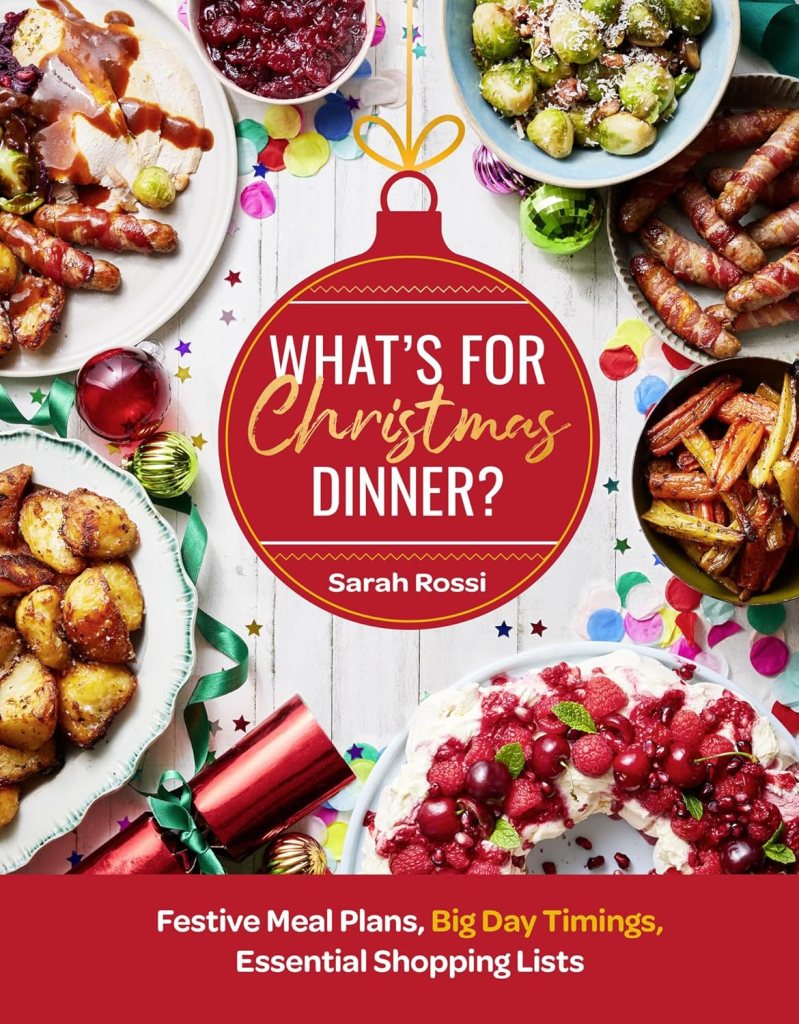
What’s For Christmas Dinner? by Sarah Rossi – Cookbook Review

Sarah Rossi, AKA founder of the immensely popular Taming Twins website, is back with her latest cookbook What’s For Christmas Dinner?. Her previous bestselling books, What’s For Dinner? and What’s For Dinner in One Pot?, secured her spot as one of the ‘go-to’ cookery writers for easy, budget-friendly, family meals. Now she has turned her attention to the season of goodwill and cheer, promising to take the stress out of Christmas and help you become a master of meal planning. A tall order indeed.

What will I love?
If you are feeling overwhelmed by Christmas, Rossi has done all the hard work for you. What’s For Christmas Dinner? is the most comprehensive culinary guide to Christmas I have come across. Alongside recipes accompanied by colourful, enticing photos, there is information on planning, shopping lists, timings for the Big Day, additional equipment, ‘get ahead’ tips, guidance for different numbers, advice on leftovers; you name it, Rossi has thought about it. There’s even a section explaining how to adapt recipes for different diets that will be helpful for anyone expecting vegetarian, vegan, nut-free, gluten-free or dairy-free guests. The book isn’t just for Christmas, much of the advice (and many of the recipes) can be applied to entertaining throughout the year.

The festive favourites are all there including ‘Classic Roast Turkey with Herb Butter’, ‘Stress-free Roast Potatoes’ and ‘Make-ahead Gravy’ as well as more modern ideas such as a retro American-style ‘Hash Brown Breakfast Bake’, moreish ‘Cheese and Chutney Scones’ and indulgent ‘Christmas Brownies’ designed to use up any leftover chocolate from the sharing selections.

Is it good bedtime reading?
Yes and no. There is plenty to read on the planning front and each chapter includes an introduction and the recipes go into extensive detail with tips, where necessary. Just don’t expect nostalgic literary musings on the beauty of Christmas. 

Will I have trouble finding the ingredients?
Not at all. Every recipe features ingredients that are readily available in the supermarkets. Advice on substitutions is also given. 

How easy are the recipes to follow?
Very. Rossi lives up to her reputation of making her recipes as fuss-free as possible. Think clear instructions, timings and prep-ahead tips.

Stand-out recipes?
The ‘Croissant Christmas Tree’ is a showstopping breakfast/brunch which can be adapted to use all sorts of spreads and the ‘Mushroom Wellingtons’ are a delicious veggie main course. The ‘Cheese and Tomato Tart’ is also a stand-out winner. On the pudding front, the ‘Chocolate Orange Pudding’ is a must-try, gloriously gooey with a decadent molten chocolate sauce. The ‘Christmas Tiramisu’, which swaps ladyfingers for panettone, is also delicious. 

How often will I cook from this book?
You could very easily do all your festive cooking exclusively from What’s For Christmas Dinner?. Chapters cover everything from ‘Nibbles and Party Food’ and ‘Cosy Nights In’ to ‘Gorgeous Gifts’ and ‘Festive Feasts’ (not forgetting ‘Leftovers’ and ‘Christmas Breakfast’).

However, it isn’t a book purely reserved for Christmas. Many recipes can easily be enjoyed throughout the year with a few adjustments, especially if you entertain regularly. Who wouldn’t love the ‘Cheese and Pesto Straws’ for a cheesy snack or ‘Smashed Pea Crostini’ as a spring/summer party nibble?

Any negatives?
While this isn’t Nigel Slater’s The Christmas Chronicles with lengthy nostalgic musings on Christmas and the beauty of the festive season, it is hard to find a negative. What’s For Christmas Dinner? does exactly what it sets out to do. A fair few of the sweet treats (e.g. desserts and baking) are chocolatey but then it is Christmas after all and there are other sweet options like zesty ‘Lemon Pots’ and a stunning ‘Wreath Pavlova’ if you aren’t a chocoholic.

Should I buy the book?
If you are entertaining and looking for a book to help you ace the festive period, What’s For Christmas Dinner? is a must-buy. Less confident cooks will get the most out of it (think of it as a festive culinary bible), but Christmas cooking veterans will still find plenty of inspiration within the pages.

Cuisine: British festive with international influences
Suitable for: anyone who wants a helping hand in the kitchen this Christmas.
Great for fans of: Jamie Oliver and The Batch Lady
Cookbook review rating: Four stars
Buy this book: What’s For Christmas Dinner? by Sarah Rossi (@tamingtwins)
£22.00, Harper Collins

This review was written by Freelance Food Writer and Recipe Developer Sophie Knox Richmond. Follow her on Instagram on @sophie_kr_food

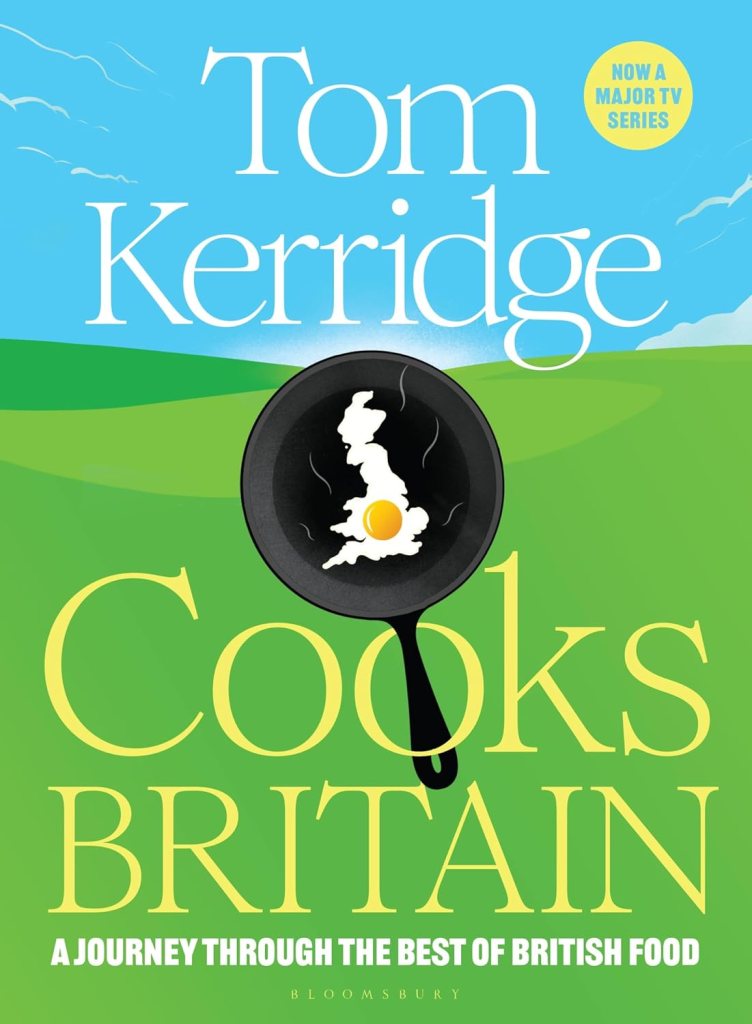
Tom Kerridge Cooks Britain by Tom Kerridge Cookbook Review

Tom Kerridge Cooks Britain Cookbook cover.

Tom Kerridge is surely a man who needs no introduction by now? For those of you who haven’t heard of him, he is the proprietor of several bars and restaurants including The Hand and Flowers (the first gastropub to receive 2 Michelin stars back in 2012) and The Coach (which secured its first Michelin star in 2018). His profile soared after appearing on Great British Menu in 2010 and has released cookbooks regularly ever since (including the bestselling Proper Pub Food, Outdoor Cooking and Pub Kitchen as well as more diet-friendly titles Tom Kerridge’s Dopamine Diet and Tom Kerridge’s Fresh Start inspired by his own weight-loss journey). 

If you haven’t eaten in one of his establishments or cooked from one of his books, you have probably seen him on television (where he regularly pops up in M&S adverts, stars in his own cookery shows and documentaries, and judges on Great British Menu), tried one of his M&S meals, attended a Pub in the Park food festival, or come across his campaigns championing the hospitality industry or fighting child food poverty (through Full Time Meals). 

This time, Kerridge has turned his attention to Britain, or rather, British ingredients, promising 100 recipes that celebrate the best of what this country has to offer.

What will I love?
If you are interested in learning more about British produce, and how to make the most of them in your kitchen, you will find plenty to enjoy here. There are over 100 recipes – divided into chapters of ‘Vegetables’, ‘Fish & Shellfish’, ‘Meat & Poultry’, ‘Dairy’ and ‘Fruit’ – designed to mirror the key areas that make up the backbone of the British farming industry. Options are varied, ranging from lighter dish like ‘Asparagus, Poached Egg and Hollandaise’ to a hearty ‘Family Beef Mince Pie’. The photos are beautiful too.

Is it good bedtime reading?
Yes. The introduction spans several pages, offering an enthusiastic (and very persuasive) argument for the importance of British farming. Each chapter then begins with a short introduction and the recipes also all have their own introductions explaining Kerridge’s inspiration and/or offering helpful hints.

Will I have trouble finding the ingredients?
Not at all. Although some recipes mention specific cheeses, there is nothing too obscure (more readily available alternatives are also given). There is a good balance in terms of affordability; while there are recipes for Tomahawk steak and other more expensive cuts of meat and fish, plenty of less extravagant ingredients are also featured.

How easy are the recipes to follow?
The recipes range in ability, but the instructions are always clear, giving advice on what to look out for and tips on how to make certain processes easier. It would be helpful if recipe timings were included at the top.

Stand-out recipes?
The ‘Leek and Caerphilly Rarebit’ is wonderfully comforting, while the ‘Chicken Kyiv Dippers’ are a delicious snack (or simply a fun alternative to a classic Kyiv). Don’t miss the ‘Bacon and Mushrooms Eggs Benedict’ for an umami-rich twist on the brunch favourite and even kale avoiders could be converted by the ‘Creamy Kale Pasta with Crispy Parmesan’. 

How often will I cook from this book?
There is a range of recipes for every eating occasion throughout the year: ‘Asparagus Pecorino and Lemon Pasta’ in spring, a suitably summer-y ‘Yoghurt and Apricot Parfait with Almond Praline’, a cosy, comforting autumnal ‘Blackberry, Pear and Apple Crumble’, and a warming winter ‘Turnip Gratin with Lincolnshire Poacher’. However, there is a greater emphasis on dishes geared more towards spring/summer cooking and entertaining. 

Any negatives?
There are some lovely options for vegetarians (or recipes that could easily be adapted), but not many choices for vegans. The pudding options could also be more diverse, perhaps a result of the emphasis n produce available in the UK.

Should I buy the book?
If you are keen to cook more seasonally with local British ingredients, this book is perfect for you. It also offers helpful inspiration to make everyday recipes a bit more special.

Cuisine: International cuisine using British ingredients
Suitable for: Cooks of all abilities.
Great for fans of: Hugh Fearnly-Whittingstall 
Cookbook review rating: Four stars
Buy this book: Tom Kerridge Cooks Britain
£25.00, Bloomsbury

Tom Kerridge Cooks Britain aired on ITV in July 2024.

This review was written by Freelance Food Writer and Recipe Developer Sophie Knox Richmond. Follow her on Instagram on @sophie_kr_food

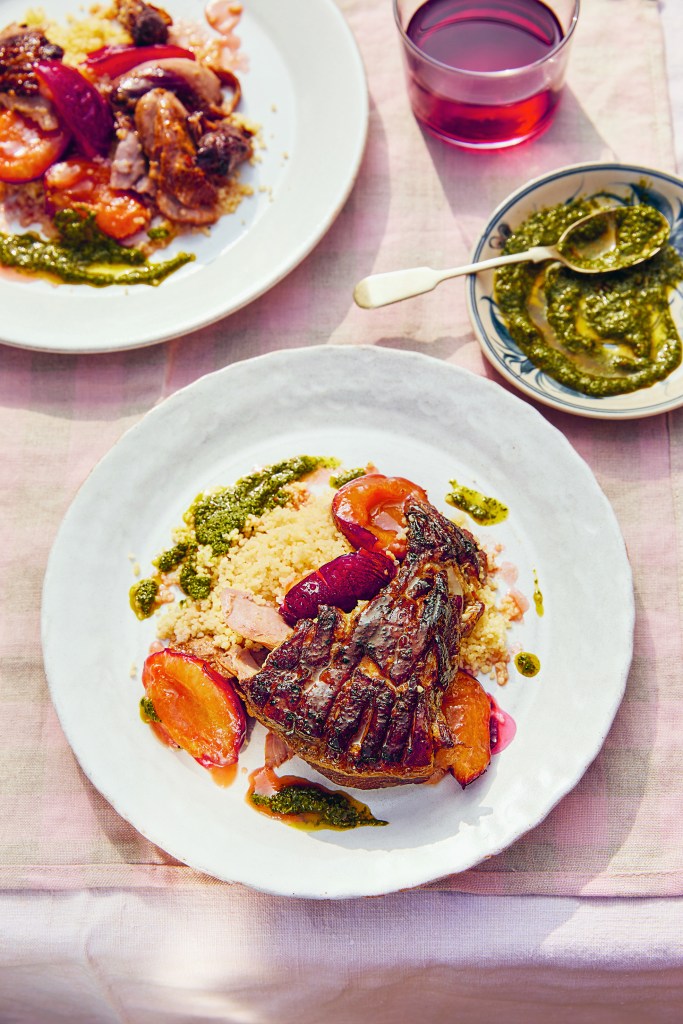
North African Lamb with Plums recipe by Sarah Johnson

Plums add brightness and a touch of sweetness to this sticky, spice-scented lamb. Serve with steamed couscous or rice and something green like slow-cooked chard.

SERVES 6–8

Ingredients:
1.2–1.5kg (2lb 10oz–3lb 5oz) lamb shoulder, on the bone, excess fat trimmed
2 teaspoons cumin seeds 2 teaspoons coriander seeds
2 garlic cloves
1 fresh red chilli, deseeded and finely chopped
3cm (1¼in) piece of ginger, finely chopped
olive oil
2 medium onions, sliced
10 medium plums
1 cinnamon stick salt and pepper

For the chermoula:
1cm (½in) piece of ginger, peeled and diced
1 fresh red chilli, deseeded and finely chopped
1 garlic clove
½ teaspoon toasted cumin seeds
2 slices Lemon Confit in Oil (see page 41) finely chopped, or the zest of 1 lemon
juice of ½ lemon
25g (1oz) flat-leaf parsley
50g (1¾oz) fresh coriander

Lightly score the top of the lamb shoulder, then season with salt and pepper. Toast the cumin and coriander seeds until fragrant, then place them in a mortar with the garlic and pound into a paste. Add the red chilli, ginger and a tablespoon or two of olive oil and mix together. Rub the marinade over the lamb shoulder, then cover and refrigerate overnight. Remove from the refrigerator 2 hours before cooking and allow it to come to room temperature.

Preheat the oven to 160°C/325°F/gas mark 3.

Scatter the onions over the base of a roasting tray. Slice four of the plums, removing the stones, then add them to the tray with the cinnamon. Place the lamb on top, skin side up, and add 400ml (14fl oz) of water. Cover loosely with a piece of foil and roast for 2 hours. Flip the lamb and cook, covered for another 2 hours. Remove the foil and turn the lamb once more, so the skin side is facing up. Add a splash of more water if the tray looks dry, then place it back into the oven, uncovered, and increase the temperature to 180°C/350°F/gas mark 4. Continue to cook for 1–1½ hours, basting every 30 minutes or so, until the skin is crisp and the meat is falling from the bone. Remove from the oven, transfer the lamb to a board and allow it to rest in a warm place, loosely covered, for at least 30 minutes.

Increase the temperature to 220°C/425°F/gas mark 7 and halve and stone the remaining six plums. Place them into a ceramic casserole. Strain the juices from the roasting tray, then pour enough juice over the plums to come up one-third of the way. Reserve the leftover juices. Roast in the oven for 10–15 minutes until plums are soft and slightly caramelized around the edges.

For the chermoula, place the ginger, red chilli, garlic, cumin and a pinch of salt in a mortar and pound into a paste. Transfer to a bowl and add the confit lemon and lemon juice. Finely chop the parsley and coriander, then fold into the other ingredients and add the oil. Taste and adjust the seasoning if necessary. To serve, carve the lamb into portions and arrange on a platter. Top with roasted plums, drizzle over any remaining juices, and accompany with a bowl of chermoula.

Book credit: Fruitful by Sarah Johnson. Published by Kyle Books. Photography: Patricia Niven.

Cook more from this book
Chocolate Tart with Marsala Sabayon and Toasted Hazelnuts
Lemon Drizzle Cake

Read the review: click here
Buy this book:
Fruitful by Sarah Johnson
£30, Kyle Books

One Pan Chicken by Claire Thomson – Cookbook Review

Who is Claire Thomson?
If you haven’t already heard of her, Claire Thomson is a chef and food writer behind the immensely popular @5oclockapron where she shares (almost) daily reels of the food she cooks for her family of 5. She is famed for her enthusiasm for fuss-free food, encouraging followers to skip the stress and embrace joy in their cooking, all while celebrating seasonal, sustainable ingredients. She is the author of 9 cookbooks — including the award-winning Tomato: 70 Recipes Celebrating the Extraordinary Tomato and immensely popular Home Cookery Year: Four Seasons, Over 200 Recipes for All Possible Occasions — and has written for the Guardian, Telegraph, Good Food and many others. She also recently launched the ‘5 o’clock apron podcast’ where she ‘chops and chats’ with guests from a host of professions as they share what they cook every day in their real-life kitchens. 

What is One Pan Chicken’s USP?
Jumping on the popularity of ‘One Pot’ and ‘One Tin’ cookbooks, One Pan Chicken promises 70 simple, delicious and inventive recipes using various popular cuts of chicken and one casserole dish, roasting pan, baking tray, frying pan or stockpot.

What will I love?
Chicken is a regular in most people’s shopping baskets, but it is easy to get stuck in a rut when it comes to recipes. Thomson provides the solution with a plethora of adventurous ideas inspired by cuisines across the world, from ‘Miso Butter Chicken’ to ‘Hungarian Chicken Paprikash’. For a book confined to one ‘hero’ ingredient, there is an impressive variety, from something light like a ‘Caesar Salad’ or warming like a ‘Chicken with Borlotti Beans, Cavolo Nero and Rosemary’. There’s recipes for both oven and hob and that utilise breasts, thighs, wings or a whole chicken to delicious effect. The recipes (all accompanied by a beautifully shot photo) genuinely feel ‘new’ and will inject a little excitement into your mealtimes.

Is it good bedtime reading?
The focus of the book is on flavoursome recipes for busy people. If you are expecting essays on free-range chicken, sustainable poultry farming and/or the origins of various chicken dishes (akin to the beautifully written seasonal introductions found in Thomson’s Home Cookery Year) you will be disappointed. In fairness, the one page introduction touches on these points, and each recipe includes an introduction which shares advice and the inspiration behind the dish.

Will I have trouble finding the ingredients?
One of Thomson’s many strong points is that she always ensures her recipes are accessible and includes alternative suggestions if an ingredient is remotely tricky to find. For example, the ‘Chicken Braciole’ uses pecorino in the filling instead of the harder-to-source, but traditional, provolone (although the option is included for those able to find it). Likewise, the ‘Elote-style Chicken with Corn’ suggests using feta while mentioning that Cotija and Chihuahua are authentic choices. You may struggle to source the fried maize (kikos) used in the recipe, but you could always make your own. There is the odd mention of more unusual ingredients like rosewater, dried sour cherries, Japanese seven spice (togarashi), truffle oil, truffle paste and dried porcini mushrooms, but nowadays they aren’t too difficult to source.

How easy are the recipes to follow?
Very. Like all her books (and recipe videos on her 5 o’clock apron instagram), Thomson’s instructions are clear and detailed enough to guide even the most nervous cooks. The only slight criticism is that it would be helpful to have the cooking time by the ingredients so you can easily see how long a recipe will take, rather than skimming the recipe and calculating it in your head. 

Stand-out recipes?
The ‘Sticky Sesame Marmalade Chicken Wings’ are dangerously addictive (be sure to make extra), while the ‘Fried Chicken with Kimchi’ is a must-try for fans of sweet and sour dishes. Meanwhile, the ‘Chicken Dauphinoise with Dijon and Cream’ is the ultimate comfort food on a cold and chilly day, while the ‘Za’atar Chicken served with Hummus, Pine Nuts and Pomegranate’ is a jewelled, flavour-packed dish that will transport your taste buds straight to the Middle East. Don’t miss the ‘Chicken with Tortilla Chips, Black Beans and Feta’ in the ‘Leftovers’ chapter – in fact, I would recommend cooking extra chicken just to give it a go…

How often will I cook from this book?
This could easily become a go-to cookbook when you want something simple and stress-free, that still delivers on flavour. The variety of recipes is what makes this book such a winner. From a classic ‘Chicken and Leek Pot Pie’ to a vibrant ‘Chimichurri Chicken with Roast Squash’ — not to mention the Greek-inspired ‘Chicken Soup with Egg and Lemon’ and the ‘Chicken Baguette with Tarragon, Gherkin and Mustard Butter’ — there genuinely is something for every mood, season, taste and occasion.

Any negatives?
Despite being part of the ‘One Pan’ cookbook cohort, not all recipes are ‘complete meals’ and would typically call for rice, pasta, potatoes etc alongside (thus requiring an extra pan). 

Should I buy the book?
A definite ‘yes’. Thomson has, once again, excelled at creating yet another cookbook full of enticing, accessible recipes that leave you counting down until suppertime. One Pan Chicken is a must-have for anyone looking to enhance their culinary repertoire with flavour-packed fuss-free chicken recipes that will delight the whole family.

Cuisine: International
Suitable for: Anyone looking for inspiring, faff-free ways to celebrate the humble chicken.
Great for fans of: Rukmini Ayer
Cookbook review rating: Five stars
Buy this book: One Pan Chicken: 70 All-in-One Chicken Recipes For Simple Meals, Every Day
£20.00, Quadrille

Cook the Book
Chicken Pilaf
Chicken Tagine with Chickpeas, Dates and Apricots
Fried Chicken with Kimchi

This review was written by Freelance Food Writer and Recipe Developer Sophie Knox Richmond. Follow her on Instagram on @sophie_kr_food

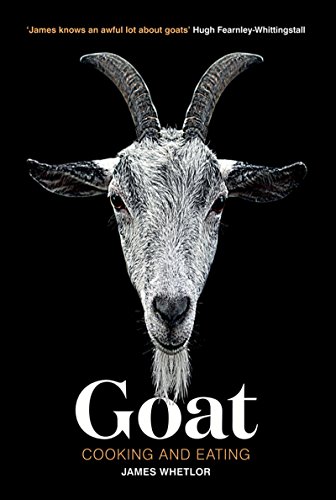
Goat by James Whetlor

Goat

What’s the USP? Everything you wanted to know about the UK’s most undervalued and underused protein but were afraid to ask, plus 70 odd recipes covering just about anything and everything you could possibly do with a goat, gastronomically speaking of course.

Who’s the author? James Whetlor is a former River Cottage chef (Hugh Fearnely Whittingstall wrote the book’s foreword) the and now founder of Cabrito which supplies goat meat to catering butchers and restaurants around the country.

What does it look like? With its ominous horned goat head cover, you might mistake this for a book of black magic spells (and if you read it backwards, it actually is) but open it up and you find something far more benign with images of Whetlor cuddling a goat, munching on a goat burger and preparing a hay barbecue. The food has been imaginatively and attractively styled and shot and the book has a fresh, bright and elegant look.

Is it good bedtime reading? Of course; goats are the new sheep to count you off to sleep. Also there’s an extended 30-page introduction to get stuck into which goes into depth on the subject of goats, covering their place in history, goats and modern farming, goat as served in restaurants and their use in the leather industry.

Will I have trouble finding ingredients? Any butcher worth his salt should be able to source you some goat meat, but if not, you can always order some from Whetlor himself .

What’s the faff factor? There’s nothing to scare the horses in the book, although it will make goats very nervous.

How often will I cook from the book? You’re not going to eat goat every day, but this book should certainly inspire you to add it as a regular alternative to other meats on  your weekly or monthly menus.

Killer recipes? Whetlor has gone out of his way to demonstrate the versatility of his beloved animals and the variety of dishes is impressive from kid shank, apricot and pistachio tagine to schnitzel and Greek-style orange and leek sausages. The author has roped in a number of high profile chef friends to contribute their own recipes too, including Neil Rankin from Temper (goat tacos) and Hugh FH himself (kid, lentil and labneh salad).

What will I love? Fifty per cent of the royalties from the book fo to Farm Africa charitable project that has used goats to help rehabilitate local ecosystems in rural eastern Africa and which Cabrito also give part of their profits.

What won’t I like? Yes, its a single ingredient book so theoretically might have limited appeal.

Should I buy it? Currently, the male offspring of dairy goats are simply destroyed but could become a sustainable and ethical source of low fat, high protein meat. Buying this book and putting goat on your menu will help that become a reality. That’s a pretty good reason to pick up a copy.

Cuisine: International
Suitable for: Confident home cooks/professional chefs 
Cookbook Review Rating: 4 stars

Buy this book
Goat
£20, Quadrille

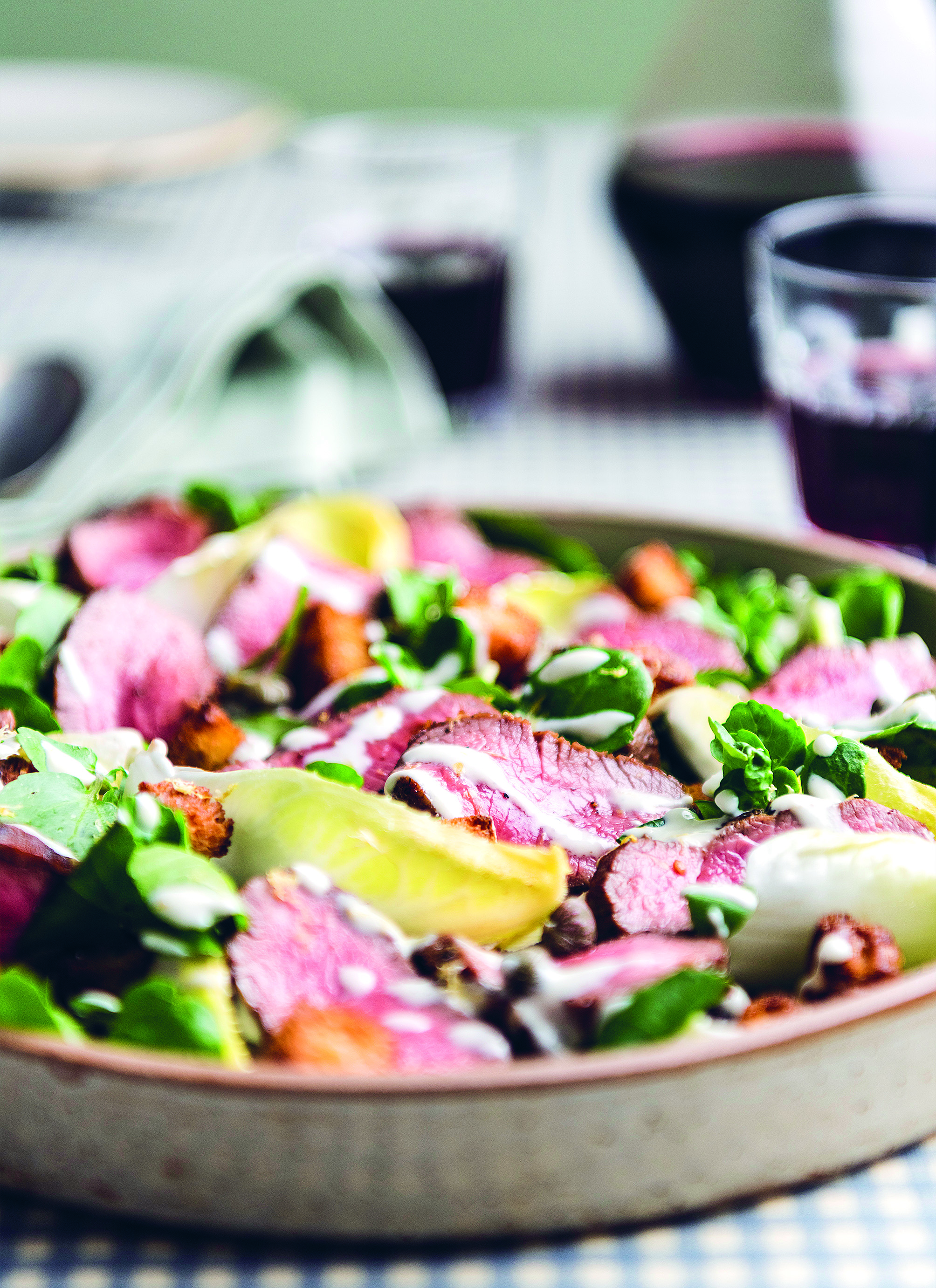
Warm salad of new season’s spring lamb by Russell Brown

WS Salad of new seasons spring lamb April-1

It is only later in April that spring lamb becomes more widely available. There may have been some for Easter but, as Jon has mentioned, leaving it until a bit later in the season is a sensible option. From the cook’s point of view, it is the delicacy of spring lamb that we want to enjoy; the meat is paler and has a sweeter flavour than when it is more mature, and this really shines through in this light warm salad.

The prime cuts of lamb – the loin, fillet, rack and rump – all work well cooked to medium rare or medium, while the harder-working muscles, such as the legs or shoulders, benefit from slower roasting or braising. The one problem with small portions of lamb is that the membrane between the fat and the meat very rarely breaks down before the meat is cooked. A rump will usually work, given its larger size, but a piece of loin is often better cooked as a lean eye of meat.

Serves 4 as a light main course

1 x 300g piece lamb loin, trimmed of all fat and sinew. (Reserve the fat.)
oil for frying the lamb
25g unsalted butter
100g rustic bread, cut into croutons
1 head of chicory
100g ricotta
2 tbsp light olive oil
15g Parmesan, finely grated
1 lemon
100g watercress, large stalks removed
2 tsp capers
Maldon sea salt and freshly ground black pepper

1. Start by rendering the lamb fat for frying the croutons. Cut the fat into small pieces and colour in a heavy pan. Add enough water to cover by 1cm and then simmer gently until all the water has evaporated. You should be left with liquid fat and the solids. Strain and reserve the rendered fat.

2. Season the lamb loin well with salt and pepper. Heat a tablespoon of oil in a heavy nonstick pan. Seal the lamb all over to create a rich, dark colour. Add a second tablespoon of oil to cool the pan slightly and then add the butter, turning the lamb in the foaming butter over a low to medium heat for 3–4 minutes – aim for medium rare. Remove the lamb to rest on a plate in a warm place, retaining a dessertspoonful of the fat from the pan.

3. Fry the croutons in the rendered lamb fat until crisp and golden.

4. Break the chicory into individual leaves and cut any really large leaves in half at an angle.Wash and dry.

5. In a small food processor, blend the ricotta with the olive oil, Parmesan, a good grating of lemon zest and 2 tsp of lemon juice. Season to taste.

6. Toss the leaves together and scatter the croutons on top. Slice the lamb thinly and arrange on the leaves. Mix any lamb juices with a little of the fat from the frying pan and drizzle over the meat. Spoon the dressing and scatter the capers over the top. Sprinkle with a little sea salt and a little more grated lemon zest.

Extracted from
Well Seasoned: Exploring, Cooking and Eating with the Seasons
£25, Head of Zeus

More recipes from this book
Harissa mackerel flatbreads with quick pickled cucumber
Iced strawberry parfait

Read the review

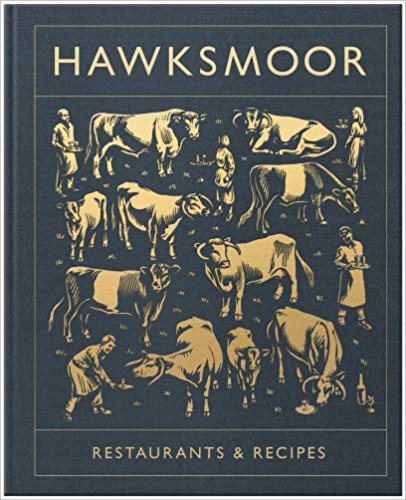
Hawksmoor: Restaurants & Recipes by Huw Gott and Will Beckett

Hawksmoor

What is it? A sequel to the excellent Hawksmoor At Home was always going to be a tough gig but Gott and Becket, owners of the London-based modern steak restaurant group Hawksmoor that’s recently expanded to Manchester and will open in New York in 2019, have nailed it.

What does it look like? In a word, sumptuous. That’s not a word I particularly like but I can’t think of a better one for this hefty, 300-odd page tome with its hand-drawn illustrations, stunning photography of the food and restaurant interiors and imaginative page layouts.

Is it good bedtime reading? Absolutely. The story of the restaurant is told in detail with essays written by all the key players with additional contributions from suppliers.

Killer recipes? I could just copy out the book’s index, but some standouts include potted beef and bacon with yorkshires; Tamworth belly ribs; lobster slaw; macaroni cheese; whole roast pig’s head; trotter sausages; short rib bubble and squeak and sticky toffee tatin

Will I have trouble finding ingredients?  If you want to follow Hawksmoor’s ethos of serving the best quality meat and fish, you’ll want to give Asda a swerve and start chatting up your local butcher and fishmonger, if you’re lucky enough to have them, especially when it comes to things like pig’s head, trotters and whole brill and monkfish. Otherwise, you shouldn’t have too much of a problem.

What’s the faff factor?  Although the food is often quite simple, if you want to go full on Hawksmoor at home, you will have to set aside some time to make stocks, sauces and condiments.

What will I love? The sheer breadth and depth of the recipes. As well as all that meat, the chapters on seafood, vegetables and sides, breakfast and brunch and puddings are excellent. There’s even recipes for bar snacks like hot buttered lobster rolls and some serious sounding cocktails including Shaky Pete’s Ginger Brew made with gin, London Pride beer and ginger syrup.

What won’t I like? Some material from Hawksmoor At Home is repeated including how to cook the perfect steak and how to make the restaurant’s signature burger but there’s more than enough new content, including a new seafood chapter written by Mitch Tonks, to justify the purchase if you already own the first book.

How often will I cook from the book?  You’ll be most likely to reach for Hawsmoor: Recipes and Recipes at the weekend when you have a bit more time in the kitchen, but the snacks, salads, vegetables and sides (and those cocktails) will come in handy anytime.

Should I buy it? Here’s a tip: if you’re best friends with Morrissey who wrote the song ‘Meat is Murder’, he probably won’t talk to you again if this celebration of all things carnivorous ended up on his coffee table. But if you’re a chef considering opening a steak restaurant or looking for inspiration for meaty starters and mains, this book is unbeatable. For fans of the restaurant, it’s the perfect memento with many of the recipes achievable at home. In short, Hawksmoor: Restaurants and Recipes over-delivers in every department, making what could have been a cash-in into an essential purchase.

Cuisine: British
Suitable for: Confident home cooks and chefs
Cookbook Review Rating: 5 stars

Buy this book
Hawksmoor: Restaurants & Recipes
£30, Preface