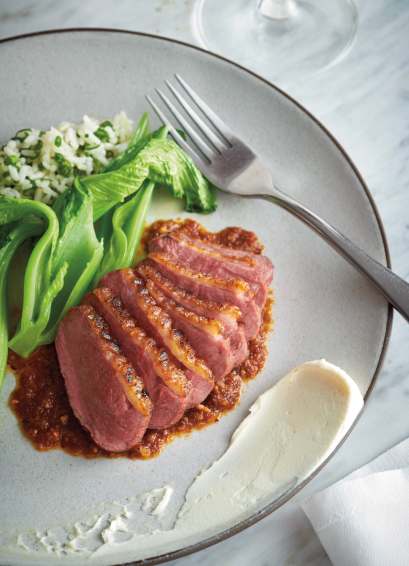
Roasted Duck Breast, Xo Sauce, Carolina Gold Rice, Macadamia Purée by David Hawksworth

Roasted Duck Breast

Duck is rich, and I wanted to make this dish as light as possible. Instead of a traditional sauce—like a reduction finished with butter—being in Vancouver, where our population is now almost a third Chinese, I thought of XO sauce. It’s very tasty and has good texture, a little heat, and some acidity too. It really works.

NO TE  In the restaurant we allow the duck to air dry for a few days, uncovered in the fridge; this helps the bird to retain more moisture when it cooks. You can prepare the XO sauce up to several days before serving; it helps the flavour to develop.

Serves 6

Macadamia Nut Purée
125g (1 cup) macadamia nuts, skin off
Salt
Splash Banyuls or champagne vinegar

XO Sauce
85g (5 Tbsp) brunoised bacon
150mL (⅔ cup) canola oil
30g (⅓ cup) dried shrimp, soaked and drained
30g (⅓ cup) dried scallops, soaked and drained
80g (½ cup) minced garlic
80g (½ cup) minced ginger
20g (1 Tbsp) tomato paste
15mL (1 Tbsp) Sriracha-style chili sauce
Fish sauce
Salt

Rice
1.5L (6 cups) water
3g (1 tsp) salt, plus more for seasoning
240g (1¼ cups) Carolina gold rice
30–45g (2–3 Tbsp) butter, cut in small cubes
2 spring onions, finely sliced
1 sprig cilantro, finely sliced

Duck
large duck magrets (400–450g/ 14–16 oz each)
Sea salt

Garnish
6–12 pieces gai choy, cleaned, trimmed, and cut in half
15g (1 Tbsp) butter Sea salt

MACADAMIA NUT PURÉE
Preheat the oven to 160ºC (315ºF).  Place the nuts on a baking tray lined with parchment paper and toast until fragrant, 10 to 15 minutes. Allow to cool, then transfer to a bowl. Cover with water (at least 10cm/4 in above the nuts; you should have double the volume of water as nuts) and soak in the fridge overnight.

The next day, drain the nuts and reserve the water. Blend the nuts on high speed for at least 5 minutes and up to 10 minutes, using as much water as required to form a smooth purée. Season with salt and a splash of vinegar. Set aside at room temperature.

XO SAUCE
Render the bacon until crispy in a medium pan over low heat, using a small amount of oil. Remove the bacon, but keep the fat in the pan. Add a bit more oil to the pan and fry the dried shrimp and scallops until slightly crispy. Remove the shrimp and scallops and return the pan to heat.

Once the pan starts smoking, add the remaining canola oil and caramelize the garlic and ginger. Add the tomato paste and cook for 5 minutes. Return the shrimp, scallops, and bacon to the pan and add the chili sauce and any remaining oil. Let the mixture simmer for 30 minutes on very low heat, stirring often so it doesn’t stick to the bottom of the pan.  Adjust the seasoning with fish sauce, salt, and more chili sauce as needed.

RICE 
Preheat the oven to 175°C (350°F).  Bring the water and salt to a boil in a heavy-bottomed saucepan set over high heat. Add the rice, stir once, and as soon as the water returns to a boil, reduce the heat to low. Simmer gently, uncovered, stirring occasionally, until the rice is just tender with no hard starch at its centre, about 15 minutes. Drain in a fine-mesh sieve and rinse thoroughly with cool water. Shake the colander to drain excess water.

Distribute the rice evenly on a baking tray lined with parchment paper. Place in the oven and allow the rice to dry for about 5 minutes, gently turning from time to time with a spatula. Dot the rice with the butter and sprinkle with salt. Return the baking sheet to the oven and allow the rice to warm through, occasionally turning, until the butter has melted and the rice is hot, about 5 minutes. Mix in the onions and cilantro and keep the rice warm.

DUCK
Trim the excess fat around the duck magrets. With a sharp knife, score the skin of the magrets in a crosshatch pattern, making the squares as close together as possible without cutting into the meat. Set aside on paper towel to absorb excess moisture.

Season the duck magrets with salt on both sides. Place the duck breasts in a hot non- stick cast-iron pan (skin side down without any oil) over medium-low heat. Cook for 6 to 8 minutes, moving from time to time (but not flipping) to ensure an even colouring and crisping of the skin, while continuously draining out the rendered fat.

Flip the magrets and cook for 3 minutes on the meat side. Remove from the heat and let stand for 5 minutes, loosely covered with a piece of foil. When ready to serve, slice the magrets in 6mm (¼ in) slices. Season with sea salt.

GARNISH
Bring a large pot of salted water to a boil. Blanch the gai choy for 1 minute, then quickly sauté in a hot frying pan with the butter and a pinch of salt. Transfer to paper towel to absorb excess fat.

Gently heat the XO sauce. Divide it between 6 serving plates. Smear the macadamia nut purée on the side. Place a portion of gai choy and rice on each plate. Add the duck slices.

Buy this book
Hawksworth: The Cookbook
£33.99, Appetite By Random House

Cook more from this book
48- hour beef short ribs, compressed melon, black pepper jam, green papaya salad by David Hawksworth
Caramel Pots De Crème With Whipped Crème Fraîche by David Hawksworth

Read the review

48- hour beef short ribs, compressed melon, black pepper jam, green papaya salad by David Hawksworth

48 Hour Beef Short Ribs

Beef short ribs are such a great application for sous vide cooking. You get very little moisture loss so the meat turns out incredibly juicy. It gets soft, then you chill it to set it up, and grill it or roast it to finish. It’s a rich, fatty cut, so instead of saucing it with a reduction we glaze them and serve them with black pepper jam with loads of shallots, and a bright, refreshing green papaya salad. When we put this on the menu at West as a starter, we couldn’t keep up. We had to bring it back on the opening menu at Hawksworth.

Serves 6   

Beef Short Ribs
1.3kg (3 lb) bone-in beef short ribs
2 sprigs thyme, stems removed
3 cloves garlic, crushed
Salt
Pepper

Compressed Melon
100mL (7 Tbsp) water
100g (½ cup) sugar
½ honeydew melon, in 18 cubes 2cm (¾ in) each
3 juniper berries

Black Pepper Jam
30mL (2 Tbsp) grapeseed or canola oil
½ onion, chopped
2 shallots, coarsely chopped
2 knobs ginger, peeled and chopped
15 cloves garlic, chopped
1½ bunches scallions, sliced
15g (1 Tbsp) dried fermented black beans
½ Thai chili, seeded and coarsely chopped
10g (1½ Tbsp) pepper
125mL (½ cup) soy sauce
125mL (½ cup) water
100mL (7 Tbsp) hoisin sauce
Sugar

Green Papaya Salad
65mL (¼ cup) water
50g (¼ cup) palm sugar
2 lime leaves
½ fresh jalapeno or red Thai chili, seeds removed
15mL (1 Tbsp) fish sauce
250mL (1 cup) fresh lime juice
1 shallot, finely chopped
Salt
⅓ green papaya, peeled and sliced into very fine julienne

Beef Short Ribs Glaze
100mL (7 Tbsp) hoisin sauce
50mL (3 Tbsp) yuzu juice
30mL (2 Tbsp) light soy sauce
¼ orange, juice

Garnish
Sea salt
12 leaves Thai basil

BEEF SHORT RIBS
Rub the beef short ribs with the thyme, garlic, salt, and pepper, then cover and refrigerate for 5 hours. Transfer to 1 or more vacuum-seal pouches. Seal with a vacuum sealer and cook in a water bath at 63ºC (145ºF) with a sous vide immersion circulator for 48 hours. Remove from the water bath, cool the ribs, and remove from the bags. Trim the excess fat and bones and portion in 170g (6 oz) rectangles.

COMPRESSED MELON
Bring the water to a boil in a small pot over high heat. Whisk in the sugar until it dis- solves, to create a syrup. Cool rapidly over an ice bath. Place the cubed honeydew melon in a vacuum-seal pouch with the syrup and juniper berries. (You can also use a regular ziplock bag but the flavour will be less intense.) Seal with a vacuum sealer and refrigerate for 2 hours.

BLACK PEPPER JAM
Heat the oil in a skillet over medium to high heat. Add the onion, shallots, ginger, and garlic and cook until golden brown, stirring frequently. Add the scallions, black beans, chili, and pepper, and cook, stirring, until fragrant, about 5 minutes longer. Add the soy sauce, water, and hoisin sauce and reduce by ⅓. Cook until the mixture is thick and jammy and coats the back of a spoon. Adjust the seasoning and balance with sugar as required. While the mixture is still hot, blend it in a food processor until smooth but not puréed.

GREEN PAPAYA SALAD
Combine the water with the palm sugar, lime leaves, and chili in a small pot. Bring to a boil and cook until the sugar has dissolved. Blend for 1 minute with an immersion blender until combined. Strain through a fine-mesh sieve. Add the fish sauce, lime juice, and shallot and stir to combine. Season with salt. Refrigerate until cool. When ready to serve, mix the papaya with the dressing.

BEEF SHORT RIBS GLAZE
Whisk all the ingredients together until combined.

SERVE  
Preheat the oven to 150ºC (300ºF). Cover or brush the short rib pieces with half of the glaze and heat in the oven until hot through, about 10 minutes. Halfway through cooking, brush with the remaining glaze. Cut each rib rectangle in half. Smear some of the black pepper jam on each of 6 serving plates and place the short ribs on top. Season with sea salt. Add the melon and papaya salad, and garnish with the basil leaves.

Buy this book
Hawksworth: The Cookbook
£33.99, Appetite By Random House

Cook more from this book
Roasted Duck Breast, Xo Sauce, Carolina Gold Rice, Macadamia Purée by David Hawksworth
Caramel Pots De Crème With Whipped Crème Fraîche by David Hawksworth

Read the review

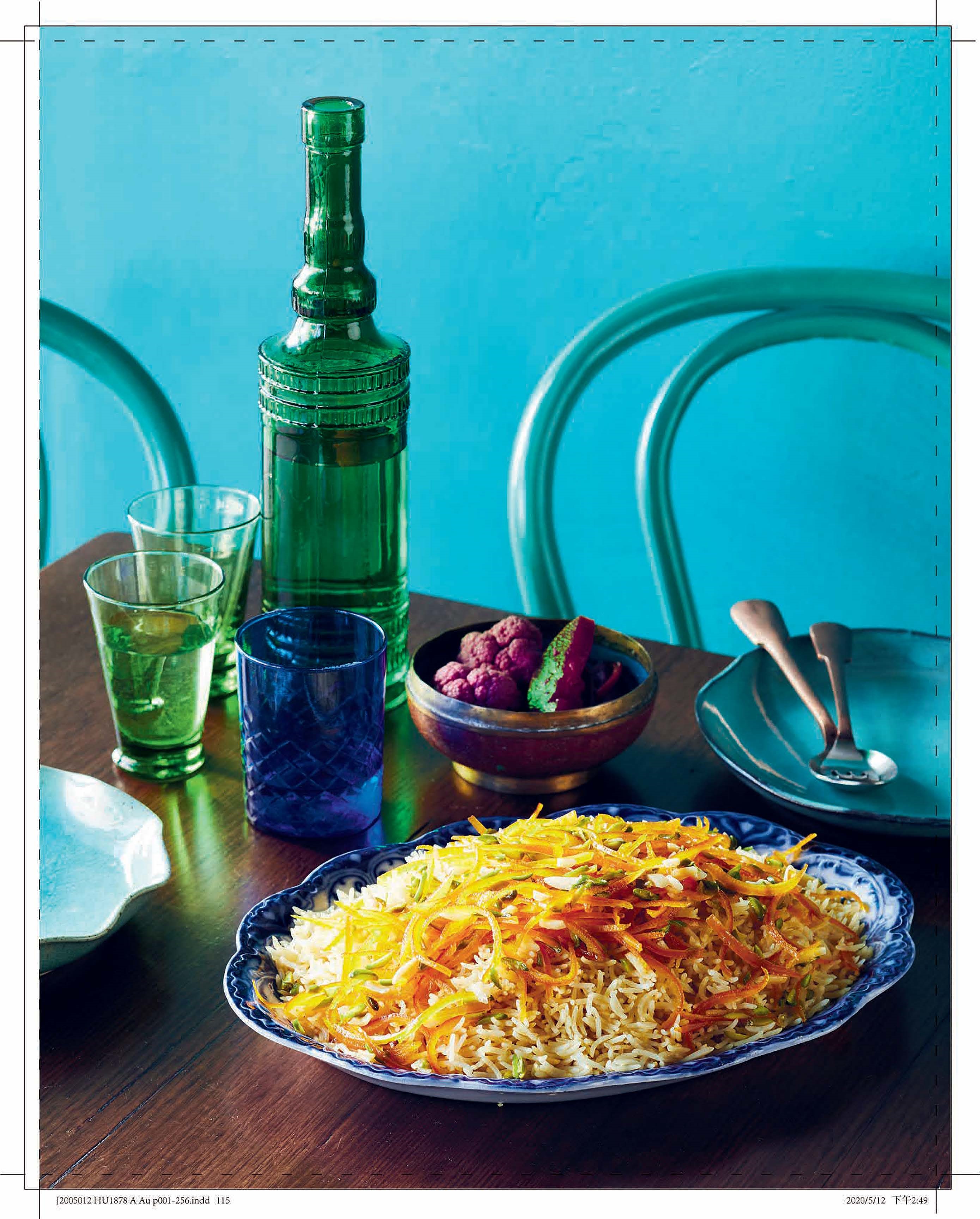
Narenj Palaw by Durkhanai Ayubi

narenj palaw image

A delicate and fragrant rice dish topped with a mix of candied citrus peel and nuts, narenj palaw is popular in Afghan cuisine. Like kabuli palaw, it was often reserved for special occasions because of the delicacy of the ingredients and the time taken to prepare them.

In Afghanistan, the citrus peel comes from a fruit called narenj, which is a cross between an orange and a lemon, and more widely known as bitter orange. Here, where narenj isn’t available, it can be substituted with the peel from any orange variety. The peel is blanched to extract any bitterness, and then soaked in syrup with the nuts to create a tangy. sweet, and aesthetically beautiful topping for the palaw.

Serves 4-6

FOR THE PALAW

½ cup (125 ml) sunflower oil
2 medium yellow onions, finely diced
1 lb 2 oz (500 g) diced boneless lamb leg
3 cups (1 lb 5 oz/600 g) sella basmati rice, soaked for 2-3 hours
1 teaspoon ground cumin
1 teaspoon ground cardamom

FOR THE TOPPING

3 large navel or other oranges
1¾ cups (11 ½ oz/330 g) white sugar
Heaped 1 tablespoon slivered pistachios
Heaped 1 tablespoon slivered almonds
Salt

The Palaw

To prepare the palaw rice, add the oil and onion to a pressure cooker pan over high heat and fry for 5 minutes, or until golden brown. Add the lamb and stir occasionally for 5 minutes, or until the meat is browned and sealed. Add 4¼ cups (1 liter) hot water and a heaped 1 tablespoon salt, place the lid on the pressure cooker, and bring to high pressure. Cook at high pressure for 15 minutes, then carefully release the pressure to remove the lid. Using a slotted spoon, take out the meat (which should be lovely and tender) and set aside. Reserve the stock to flavor the rice.

Bring 10 cups (2.5 liters) water to a boil in a large pot. Meanwhile, drain excess water from the rice, add it to the boiling water with 1 tablespoon salt, and cook for 6-8 minutes, or until the rice is parboiled and the grains look like they have doubled in length.

Drain the rice in a colander and return to the pot. Pour the meat stock over the rice, then add the cumin, cardamom, and 1 tablespoon salt to the mix. Using a large, flat slotted spoon, known to Afghans as a kafgeer, mix gently. With the kafgeer, create a well in the center of the rice and place the lamb in the well. Cover the meat with rice and place the lid on the pot. Cook over high heat until steam escapes from under the lid, then reduce the heat to very low and cook for 20 minutes.

The topping

Using a small sharp knife, cut the peel from the oranges in long strips and slice off any white pith. Layer two or three strips of rind on a cutting board and slice them diagonally into thin strips. Repeat until all the peel is cut.

To remove any bitterness in the rind, bring 4¼ cups (1 liter) cold water, ½ teaspoon salt, and the rind to a boil in a small saucepan. Add the rind and blanch by boiling for 2 minutes, then drain in a colander. Rinse under cold running water, drain again, and return the rind to the saucepan with another 4¼ cups (1 liter) of cold water and ½ teaspoon salt. Repeat the blanching process three more times, and set the rind aside.

In a small saucepan, stir the sugar into 1½ cups (375 ml) water until dissolved. Place the saucepan over high heat and cook without stirring for 6-8 minutes, or until the temperature reaches 200° F (100°C) on a candy thermometer and the syrup thickens slightly. Add the orange rind to the syrup and boil for 5 minutes, or until it is translucent and sweet. Add the pistachios and almonds, and stir gently to combine. Store the topping in the syrup until you’re ready to use it.

To serve, gently layer the rice and lamb pieces onto the center of a large platter using a kafgeer, or large flat slotted spoon, creating a heap. Drain the narenj topping, discarding the syrup, and liberally spread over the rice to serve.

Cook more from this book 

Buy this book
Parwana: Recipes and stories from an Afghan kitchen
£20, Murdoch Books 

Read the review

Shortlisted for the Andre Simon Food and Drink Book Awards 2020. See all the shortlisted books here.
andre simon logo

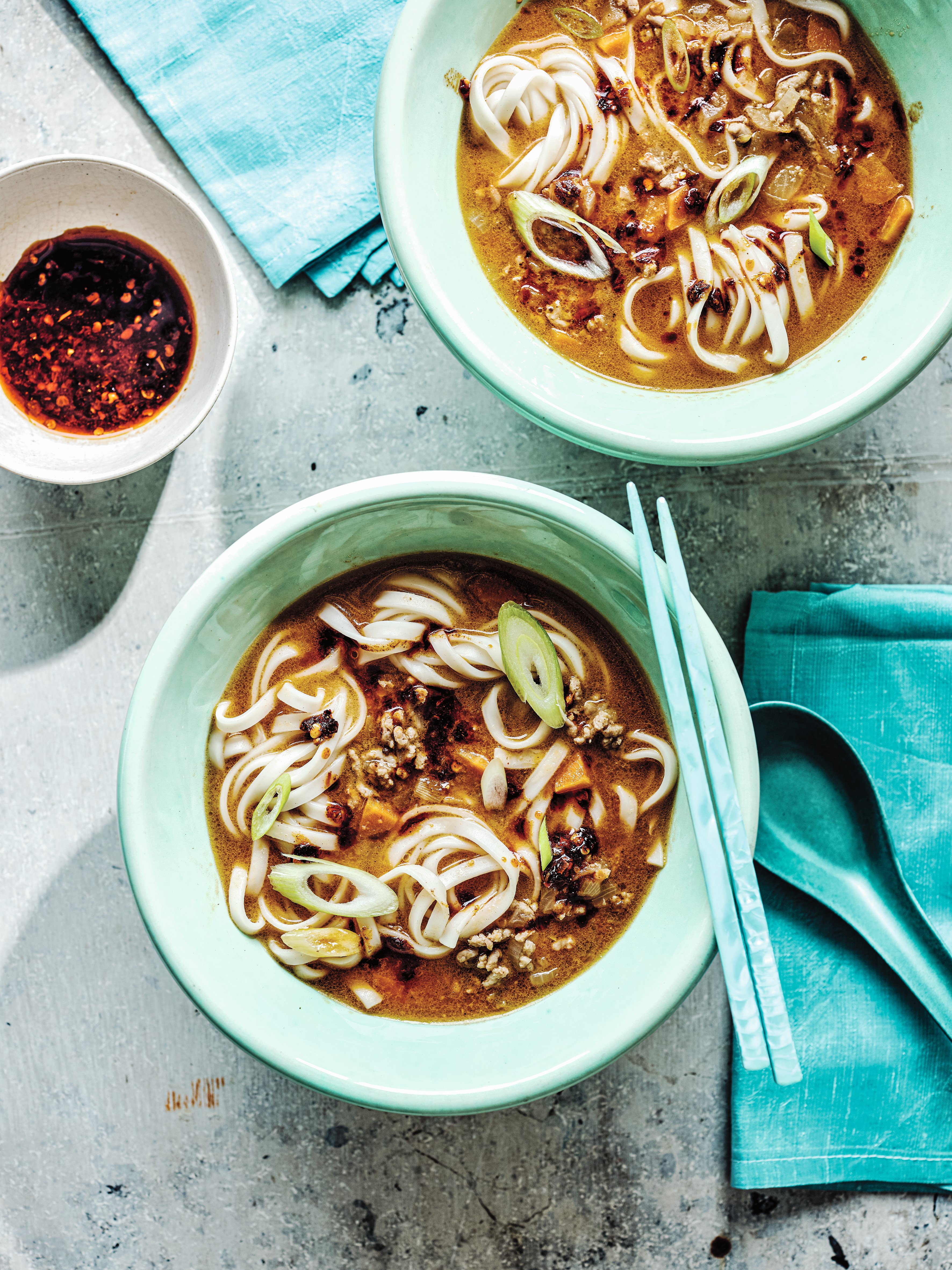
Dan Dan Noodle Soup with Lamb

071_Mr Lee's Dan Dan Noddle Soup with Lamb_Chinese

Serves 2
Wok to wonderful in 20 minutes
Showing Off /Vegan Option
Hero ingredients: garlic and ginger

A ‘dan dan’ is the pole that noodle sellers use to carry the baskets of fresh noodles and sauce, with one at either end. The star is Sichuan chilli bean paste, or toban djan (see page 17) but you can use other chilli pastes if you can’t get your hands on it. Combined with the Sichuan peppercorns, you get a lip-tingling intensity. You can also try it as a stir-fry dish by omitting the stock water, and using fresh noodles.

½ tablespoon vegetable oil
230g (8¼oz) minced (ground) lamb (or frozen vegan mince and 1/4 tsp yeast extract for a vegan alternative)
2 teaspoons garlic paste, or 3–4 garlic cloves, crushed and chopped
1 tablespoon ginger paste or 5cm (2in) piece of fresh root ginger, chopped
1 carrot, finely diced
1 large onion, finely diced
120g (4¼oz) dried wheat noodles
1 spring onion (scallion), finely sliced, to garnish

 FOR THE SOUP:
600ml (20fl oz) boiling water, or ready-made fresh vegetable stock
1 tablespoon crushed yellow bean sauce, or brown or red miso paste
1 tablespoon chilli bean paste, or 1 teaspoon any hot chilli paste
2 teaspoons crunchy peanut butter
½ teaspoon ground Sichuan peppercorns
1 tablespoon toasted sesame oil

Prepare the soup mixture by mixing all the ingredients together in a large bowl or jug, then set aside until needed. Heat the oil in a large wok over a high heat. Throw in the minced lamb (or vegan mince) and brown for a few seconds. Then add the garlic, ginger, carrot and onion and cook for another 2 minutes, stirring continuously. Your kitchen should smell amazing at this stage, so take a second, stop and breathe it in. But don’t take all day, we’re on a schedule!

Next pour the soup mixture into the pan and mix well, simmering for another 3 minutes. Now it’s noodle time. Put the noodles in a saucepan and cover with boiling water. Boil for 3 minutes, then drain. Divide your hot noodles between 2 serving bowls and pour over the soupy mixture. Sprinkle over the chopped spring onion (scallion). Strap in your taste buds: you’ll never forget your first Dan Dan Noodle Soup.

Cook more from this book
Hong Kong Street Beef
Seafood Ramyeon with Korean Red Pepper

Buy this book
The Noodle Cookbook: 101 healthy and delicious noodle recipes for happy eating
£15.99, Ebury Press

Read the review

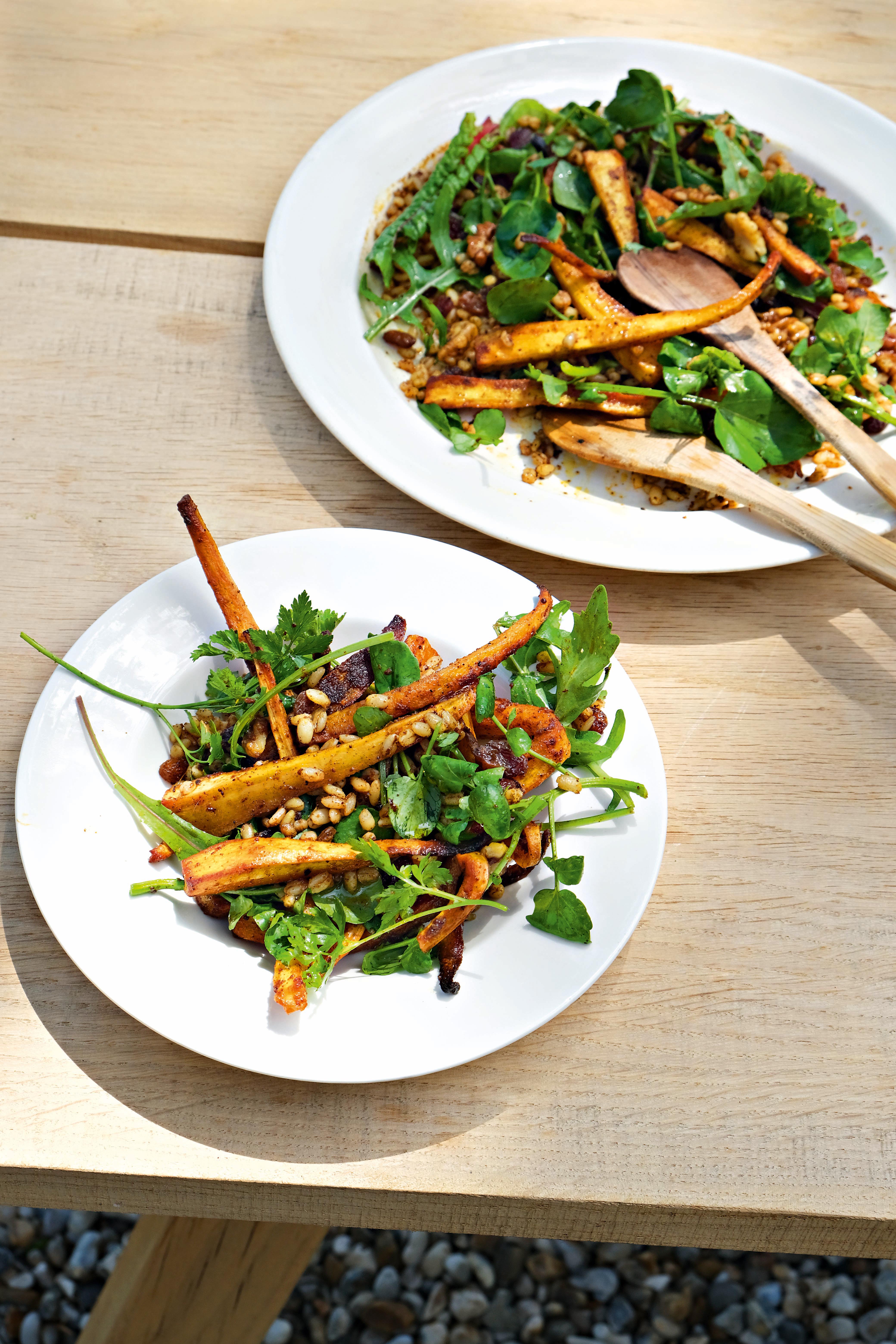
Spicy roast parsnips with barley, raisins & walnuts by Hugh Fearnley Whittingstall

Spicy roast parsnips

Parsnips are delicious with curry spices, particularly when roasted so that their thin, tapering ends turn delectably sweet and caramelised. Here, spicy roasted parsnips are tumbled with nutty whole grains, raisins and a scattering of walnuts to create a dish with lots of satisfying textures. I like to add some crisp leaves for contrast, too.

Serves 4
150g pearl barley, pearled spelt or whole spelt grain
500g parsnips
2 tbsp curry paste
3 tbsp olive or rapeseed oil
50g walnuts, roughly chopped
75g raisins
A bunch of leaves, such as watercress, rocket or flat-leaf parsley
Juice of ½ orange or lemon Sea salt and black pepper

Soak the pearl barley or spelt in cold water for anything from 20 minutes to a couple of hours then drain and rinse well. Put the grain into a saucepan, cover with plenty of cold water and bring to the boil. Reduce the heat and simmer until tender. This will take about 20–25 minutes for spelt, more like 35–40 minutes for barley. Drain.

Meanwhile, preheat the oven to 190°C/Fan 170°C/Gas 5. Peel the parsnips and trim the base and tip from each. Cut each parsnip in half lengthways then cut each half from top to bottom into long batons, no more than 2cm at the thick end. Don’t worry if they are  a bit wobbly and uneven – this all adds to their charm!

Put the curry paste and 2 tbsp of the oil into a large bowl and mix together. Add the parsnips with a pinch of salt and a twist of pepper and toss the parsnips in the curry spice so they are all coated – you may find a pastry brush helpful for this.

Scatter the parsnips in a large, shallow roasting tray. Roast for about 40 minutes, stirring once, until starting to caramelise. Add the chopped walnuts, raisins and cooked spelt or barley to the roasting tray, stir everything together and return to the oven for 5 minutes.

Remove from the oven and let cool slightly for 5 minutes then toss with the leaves and transfer to a platter or individual plates. Squeeze over a little citrus juice and trickle over a touch more olive oil before serving.

Cook more from this book
Overnight oats
Seedy almond cake

Buy the book
Eat Better Forever: 7 Ways to Transform Your Diet
£26, Bloomsbury Publishing

Read the review 

Green Shakshuka by Gizzi Erskine

Green Shakshuka c. Issy Croker

I developed this recipe in the early days of Filth, with Rosemary Ferguson. Our mission was to get extra nutrition into everyday dishes. We wanted to make a healthy breakfast, both loved shakshuka and huevos rancheros, and thought we could somehow merge them. That week, I’d made a huge vat of Green Tomato Salsa that ended up being the base of this dish. We fried some cumin seeds in oil then added the salsa, before blending it with fresh spinach to an even more nutritious, virtually Hulk-green sauce, got some roasted green peppers into the dish and baked the eggs in this sauce instead of the usual red one. We finished it with a combo of Middle Eastern and Mexican toppings and served it with flatbreads or grilled Turkish breads with some good extra-virgin olive oil. It’s a superb healthy weekend brunch dish and pretty fancy-pants in the impressiveness stakes, too.

SERVES 2
Preparation time 10 minutes
Cooking time 10 minutes

3 tbsp olive oil
1 tsp cumin seeds
400g Green Tomato Salsa (page book for recipe)
1 tsp ground coriander
85g fresh spinach, washed, wilted in a pan for a minute and drained
80g green peppers, roasted (see book for Gizzie’s method) and sliced
4 free-range eggs
sea salt and freshly ground black pepper

TO SERVE
good handful of coriander leaves, chopped
a few dill fronds
a few mint leaves, shredded 2 tbsp sour cream
300g Qyeso Fresco (see book for further info) made to a firm and crumbly texture
3 tbsp toasted mixed seeds mixed with ½ tsp za’atar
freshly made Flatbreads (see book for Gizzi’s recipe) or grilled Turkish bread
extra-virgin olive oil, for drizzling

You will need 2 individual 22-25cm baking or gratin dishes.

Preheat the oven to 240°C/220°C fan/gas mark 9.

Heat the oil in a frying pan over a medium-high heat, add the cumin seeds and fry for a minute or two until toasted. Add the green tomato salsa, coriander and spinach and cook for a minute. Season with salt and pepper if necessary, then remove from the heat and blitz until smooth.

Divide the blitzed sauce between two individual (22-25cm) ovenproof baking or gratin dishes. Split the green peppers between the two dishes, then simply make two little holes in the top of the sauce in each dish and break an egg into each hole. Season each egg with salt and pepper and bake in the oven for about 8 minutes or until the egg whites are cooked through, but the eggs still have runny yolks.

Remove from the oven and top the two shakshukas with the chopped coriander, dill, mint, sour cream, queso fresco and seeds, and serve with toasted or warmed bread, drizzled with extra-virgin olive oil.

Recipe taken from Restore by Gizzi Erskine, available now (£25, HQ)’. Photography credit – c. Issy Croker

Restore

Cook more from this book
Bibimbap

Buy this book
Restore by Gizzi Erskine
£26, HQ

Read the review

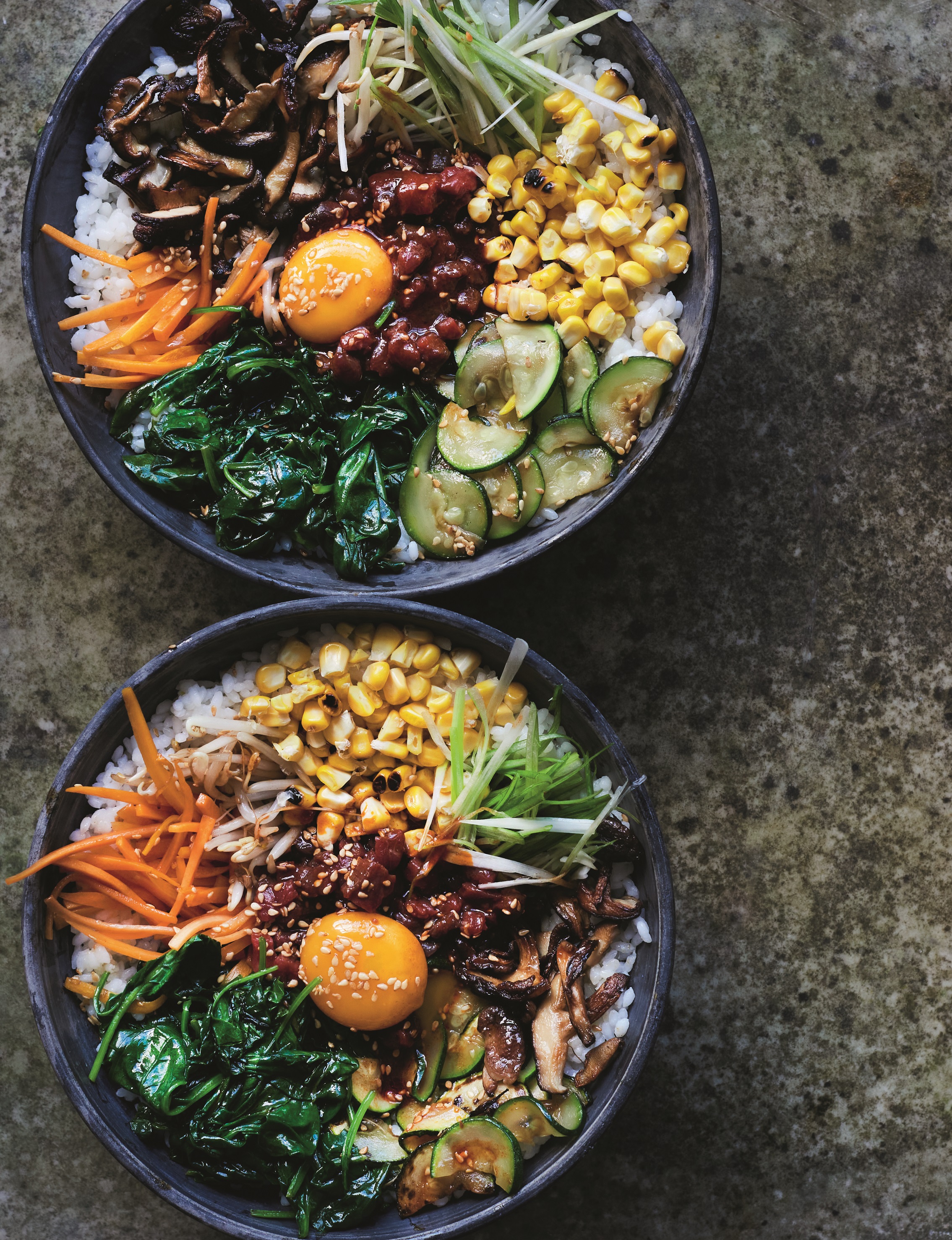
Bibimbap by Gizzi Erskine

Bibimbap c. Issy Croker

One of my breakthroughs was bringing attention to Korean food in the UK back in about 2007. While working as a chef in NYC, I’d hit Koreatown in my downtime with my mates, drink ice-cold beers and eat Korean fried chicken. Koreatown was open late, and you could go from restaurant to karaoke bar eating and drinking yourself into a stupor. I fell in love with Korean food there, and fell in love with the culture 5 years later when I first visited Korea, later moving there to film my TV show Seoul Food.

I’m certain that the popular ‘buddha bowl’ has Korean culinary heritage, as it’s similar to a dish called ‘bibimbap’. In a bibimbap bowl, rice is topped with vegetables, meat (optional), egg yolk and a spicy sauce. It is quite refined -you can’t say that about a lot of Korean food – and is cooked in a searing hot cast-iron pot which is oiled before adding the rice; the vegetables and egg (and meat, if using) are swiftly put on top. By the time the rice gets to the table it has a fantastic caramelised crust that you peel away from the pot and you stir-fry everything at the table. It’s real theatre. Fear not if you don’t have cast-iron pots -you can eat it like Hawaiian poke, in a bowl with hot rice. Bibimbap is delicious, healthy and a great way to tackle a fridge forage. I’ve used traditional toppings, but do play around with seafood, tofu and different veg: the only mainstays are the rice, egg yolk and sauce.

SERVES 2
Preparation time 45 minutes
Cooking time 15 minutes

200g sushi rice
400ml water
1 tbsp sesame oil
2 tbsp sunflower oil
150g spinach
1 courgette, thinly sliced
1 large carrot, finely julienned
100g beansprouts
6 spring onions, shredded
100g shiitake mushrooms, thinly sliced
1 corn on the cob
2 free-range egg yolks
300g rump steak, finely chopped sea salt and freshly ground black pepper
1 tbsp black or white toasted sesame seeds, to serve

FOR THE SAUCE
6 tbsp gochujang
2 tbsp Korean or Japanese soy sauce
1 tbsp rice wine vinegar
2 tbsp sesame oil
1½ tbsp caster sugar

Put the rice and water in a large saucepan with a good pinch of salt. Cover, bring to a simmer and cook for 12 minutes. Take off the heat and steam (lid on) for 10 minutes.

Gently heat the sauce ingredients in a small saucepan until emulsified. Set aside.

Mix  together the sesame and sunflower  oils. Heat a large wok or frying pan over a high heat, add 1 tablespoon  of the  oil mix and add  half the spinach with a pinch  of salt. Cook briefly until wilted, then remove and drain on kitchen paper, squeezing out any liquid. Repeat with the  remaining spinach. Add another  splash  of oil and briefly fry the courgette until golden. Remove and set aside. Repeat this process with the carrot, beansprouts, spring onions and shiitake mushrooms. Rub the sweetcorn cob with oil, salt and pepper, then brown in the pan until the kernels start to char.

Heat two stone bibimbap dishes or a wok on the hob until smoking hot. Place the stone dishes on a heatproof surface (if using). Brush the insides of the dishes (or hot wok) with the remaining oil and add the rice. Group vegetables around the edge, put the raw meat in the middle, then the egg yolks and 2 tablespoons of the sauce for each serving. Top with sesame seeds. Mix the sauce into the rice at the table with a spoon.

Recipe taken from Restore by Gizzi Erskine, available now (£25, HQ)’. Photography credit – c. Issy Croker

Restore

Cook more from this book
Green Shakshuka

Buy this book
Restore by Gizzi Erskine
£26, HQ

Read the review

The Whole Bird by Thomas Keller

The Whole Bird_Credit Deborah Jones
“The Whole Bird”
Poached Breast with Leg Rillettes, Crispy Skin, and Sauce Suprême

Makes 4 servings

Poularde
1 (3½-­ to 4-­pound/1,500-­ to 1,800-­gram) poularde

Poularde Leg Confit
150 grams kosher salt
45 grams sugar
1.5 grams thyme leaves
1.5 grams lemon zest (grated on a rasp grater)
1 gram freshly ground black pepper
2 garlic cloves
5 grams thyme sprigs
2 bay leaves
Duck fat (optional)

Poularde Stock
1,200 grams chicken stock (page 285)
leg Rillettes
100 grams mousse base (recipe follows), made with 200 grams reserved poularde leg meat
5 grams Burgundy mustard
2.5 grams roasted garlic puree (page 133)
1.5 grams kosher salt
1 gram minced shallot
Two grinds black pepper

Sauce Suprême
200 grams heavy cream
100 grams whole butter, cut into cubes and chilled
Lemon juice
Kosher salt
Armagnac

To Complete
Activa GS (transglutaminase), for dusting
Burgundy mustard

Special Equipment
Meat grinder with a medium die, chilled in the refrigerator
Chamber vacuum sealer (optional)
Immersion circulator (optional)

Poularde—a chicken slaughtered before reaching sexual maturity at around three months—from Four Story Hill Farm is exquisite, and Corey has developed an ingenious dish that puts the whole bird to work and a whole bird on the plate. Legs are both confited and used to make a mousse; the confit and mousse are then combined into a kind of rillette. These are spread on top of the breast, which is then poached gently. The skin is ground and rendered into cracklings, then used to coat the layer of rillettes. It’s both an ode to the poularde as well as a show of respect to Sylvia and Stephen Pryzant, who in raising this bird achieved a kind of benchmark for the breed. I couldn’t name a single chef in the country who had poularde on their menu before the Pryzants came along.

Of course, the beauty of this dish is that here two elements, the chicken and the sauce, are in fact extraordinary creations. The piece of chicken comprises every part of the chicken.

And the sauce. A sauce suprême, chicken stock thickened with a roux and finished with cream, is an elegant French sauce. Here Corey combines this classical idea with an Asian technique used for tonkatsu ramen broth. In classic French cuisine, stocks are simmered gently and skimmed continually to remove fat and impurities, while tonkatsu ramen broth is boiled heavily so the fat is emulsified into the broth. Corey takes that idea and applies it here, boiling his stock ramen-­style (see page 285), but then goes further: he blends more chicken fat into the stock with a hand blender as he’s chilling it. To finish the sauce, he combines this rich stock with reduced cream, mounts it with butter, and flavors it with lemon zest and Armagnac, creating this wonderfully rich and delicate version of sauce suprême.

I should note that Corey calls this “sauce suprême” knowing that it’s nothing like the classic—but for good reason. He once served it at a dinner attended by Daniel Boulud and Jean-­Georges Vongerichten, two of New York’s best French-­born chefs, and they kept delighting in the sauce and calling it an incredible sauce suprême. Corey tried to explain that they were mistaken, but they insisted it was the best sauce suprême. He was so honored, he continues to call it by this name.

For the Poularde
Cut the legs from the poularde. Remove and reserve the skin from the legs. One leg will be used for the confit and the other to make the mousse base. Remove and reserve the skin from the rest of the poularde. Cut off each side of the breast, keeping the small tender attached to each breast.

Remove the bones from one leg and weigh the meat. You will need 200 grams to make the mousse base; if you do not have 200 grams, trim off some of the meat that remains on the carcass. Rinse the bones and feet (if they were on your poularde) under cold running water to remove all visible blood. Remove and discard any organs still attached to the bones. Cut the bones into 1-­inch (2.5-­centimeter) pieces and reserve them for the poularde stock.

Keep all parts of the poularde refrigerated in an airtight container until you are ready to use them, up to 2 days.

Grind the skin through the chilled medium die of a meat grinder and place it in a 2-­quart (2-­liter) saucepot. Cook over low heat for about 30 minutes to render. The fat will separate and the skin will become crisp and golden brown. Strain the fat through a chinois or fine-­mesh strainer into a bowl and let cool to room temperature; reserve the fat for the stock. Drain the fried skin on paper towels and let cool until crisp, then chop it very finely and reserve it for finishing the dish.

For the Poularde Leg Confit
Mix the salt, sugar, thyme, lemon zest, and pepper in a bowl. On a piece of plastic wrap, make a bed of just less than half of this cure. Lay the bone-­in poularde leg on the bed of cure and pat the remaining cure over and around the sides of the leg. Cover with the plastic wrap and refrigerate for about 2½ hours.  Rinse and dry the cured poularde leg.

If you have a chamber vacuum sealer, set an immersion circulator in a water bath and heat the water to 80°C (176°F). Place the cured poularde leg, garlic, thyme, and bay leaves in a sous vide bag. Place the bag in the sealer chamber and vacuum seal. Cook in the water bath for 5 hours.

If you do not have a chamber vacuum sealer, preheat the oven to 200°F (93°C). Place the cured poularde leg, garlic cloves, thyme sprigs, and bay leaves in a small heavy-­bottomed pan and add duck fat to cover. Cover with a cartouche and cook in the oven for about 2 hours, until completely tender.

Remove the bag from the water bath or the pan from the oven and let the leg cool in the fat. Remove the leg from the fat and dry it on a clean kitchen towel. Carefully pick the meat from the bones, removing any veins. Shred the meat as finely as possible and chop. Reserve the meat for the rillettes.

For the Poularde Stock
Combine the reserved poularde bones and feet (if using) and the chicken stock in a 2-­quart (2-­liter) saucepot and bring to a rapid boil over high heat. Boil for about 30 minutes, until the stock has reduced by half. Do not skim or reduce the heat at any point.

Strain the stock through a chinois or fine-­mesh strainer into a clean pot, bring to a boil, and reduce the stock by about two-­thirds to about 200 grams. Strain the reduced stock into a narrow vessel and nestle the container in an ice-­water bath to cool.

When the stock has cooled, using a hand blender, blend in 55 grams of the reserved rendered poularde fat on high speed.

Refrigerate the stock in an airtight container until ready to use, up to 3 days. Once the emulsion is set, it can be reheated or cooled without any risk of breaking.

For the leg Rillettes
Combine 75 to 100 grams of the chopped poularde leg confit with the mousse base, mustard, roasted garlic puree, salt, shallot, and pepper and mix until completely homogenous. Transfer to a disposable piping bag and refrigerate until ready to use, up to 1 day.

For the Sauce Suprême
Bring the cream to a gentle boil in a 2-­quart (2-­liter) saucepot over medium-­high heat, adjusting the heat as necessary, and reduce the cream by a little more than half to about 75 grams. Add 200 grams of the poularde stock to the pan and reduce the sauce by half. Rapidly stir the butter into the sauce (this will improve the richness, body, and shine of the sauce).  Season with lemon juice, salt, and Armagnac to taste. Keep in a warm spot until serving.

To Complete
Lay the two poularde breasts on the work surface with the tenders facing up. Using a paring knife, very carefully remove the white tendon on each tender. Peel the tenders back but leave them attached to the breasts. Lightly spray the exposed side of the breasts with water and sprinkle the surface lightly with Activa (shake it through a small fine-­mesh strainer or from a shaker). Fold the tenders back into place. Turn the breasts over.

Wipe the work surface with a slightly dampened kitchen towel. Lay out two pieces of plastic wrap, each about 9 inches (23 centimeters) long. Smooth the plastic so that there are no creases. Spray the plastic lightly with nonstick spray. Lay a breast on each piece of plastic, about one-­third of the way up from the bottom edge. The length of the breast should run the direction of the length of the plastic. Pipe a line of the rillettes down the center of each breast.

Use a small offset spatula to spread the rillettes evenly into a ¼-­inch (6-­millimeter) layer across each breast, spreading it to the edges of the breasts. Fold the top of the plastic up and over each breast to meet the other side.

Continue to “flip” the breasts in the plastic, keeping the bottom of the breast flat and the rillettes in a natural dome. Keep the plastic wrap tight. Pull the ends of the plastic tightly, then trim them and tuck under the breast to hold its shape.

If you have a chamber vacuum sealer, set an immersion circulator in a water bath and heat the water to 60°C (140°F). Place the breasts in a sous vide bag. Place the bag in the sealer chamber and vacuum seal. Cook in the water bath for 45 minutes. Remove the bag and let rest until cool enough to handle. Remove the breasts from the bag and remove the plastic wrap.

If you do not have a chamber vacuum sealer, preheat the oven to 180°F (80°C). Put the poularde in a wide 2-­quart (2-­liter) saucepot (just large enough to hold the pieces of poularde without their touching each other) and add enough water to cover by 1 inch (2.5 ­centimeters). Remove the poularde and set aside in a bowl. Bring the stock to 180°F (80°C). Return the poularde to the pot, cover with a lid, and place in the oven. Poach for 30 to 40 minutes, until an instant-­read thermometer inserted into a breast reads 160°F (71°C). Remove the poularde breast from the stock and let rest until cool enough to handle. Remove the breasts from the plastic wrap.

Slice each breast in half on a slight bias. Using a small pastry brush, lightly brush the top of the breast with mustard. Carefully cover the top of the breast with the reserved crispy skin. Spoon the sauce suprême on each serving plate and place a piece of the poularde alongside.

Mousse Base
Makes 370 grams

200 grams lean protein
30 grams egg whites
5 grams potato starch
4 grams kosher salt
90 grams heavy cream
40 grams crème fraîche, preferably Kendall Farms

Special Equipment
Meat grinder with a medium die

This recipe works well with all types of lean protein, including chicken, pike, scallops, raw lobster, beef, or veal.

Refrigerate a medium die for a meat grinder, food processor bowl, and food processor blade until cold. Cut the protein into ½-­inch (1.25-­centimeter) dice. Grind the protein twice through the chilled medium die into a bowl.

Transfer the protein to the chilled food processor bowl and process until smooth. Add the egg whites and process briefly to emulsify. Using a silicone spatula, scrape the bowl and the lid of the food processor. Add the potato starch and salt and process briefly to combine. It is important not to overwork the mousse, as the friction of the blade will overheat the mousse and cause it to break.

With the machine running, slowly add the cream to maintain the emulsification. Scrape the sides and the lid of the food processor again. Add the crème fraîche and process until the mousse becomes smooth and develops a nice shine.

Transfer the mousse to a bowl and nestle the bowl in an ice-­water bath to chill. Press a piece of plastic wrap directly against the surface of the mousse, smoothing out any air bubbles, and refrigerate until cold. For longer storage, transfer the mousse to an airtight container, press a piece of plastic wrap directly against the surface, cover, and refrigerate for up to 3 days.

Golden Chicken Stock
Makes about 5,500 grams (5½ quarts/5.5 liters)

2,500 grams chicken wings
450 grams chicken feet
3,750 grams (3¾ quarts/3.75 liters) cold water
2,000 grams ice cubes
225 grams carrots, cut into 1-inch (2.5-centimeter) dice
225 grams leeks (white and light green portions only), cut into 1-inch (2.5-centimeter) dice and rinsed to remove any dirt
225 grams onions, cut into 1-inch (2.5-centimeter) dice
20 grams garlic cloves, roots removed, crushed
20 grams fresh thyme
20 black peppercorns
1 bay leaf

We call this golden because of the color that the abundant carrots give to the stock (as always, we add the vegetables at the end). It’s also very concentrated (we often water it down if its flavor could become too pronounced if used in, say, making risotto) and, from the additional chicken feet, very gelatinous. For chefs at The French Laundry (per se also has a fortified chicken stock—see Ramen-Style Stock—that is based on the golden chicken stock), it’s an all-purpose tool each night on the line, used for braising and glazing and finishing. Because it’s so rich and flavorful, we can use more stock and less butter to obtain a beautiful glaze, and a very nutritious one that the vegetables can absorb.

Rinse the chicken wings and feet thoroughly under hot running water to remove visible blood and place in a 15-quart (15-liter) stockpot. Cover with the cold water. Set the stockpot slightly off center over the burner. (This will cause any impurities that rise to gather at one side of the pot, making them easier to skim off.) Bring slowly to a simmer, skimming continually. Once the liquid is at a simmer, add the ice; this will cause the fat to congeal. Remove the fat and skim off as much of the impurities from the surface as possible. Bring the stock back to a simmer and cook gently for 90 minutes. Remove any excess fat as necessary.

Add the carrots, leeks, onions, garlic, thyme, and bay leaf and slowly bring the liquid back to a simmer, skimming frequently. Simmer for 35 to 45 minutes, skimming often. Turn off the heat and let the stock rest for about 20 minutes; this allows any particles left in the stock to settle at the bottom of the pot.

Set a chinois over a large container. Carefully ladle the stock off the top, disturbing the bones as little as possible so that the impurities that have settled to the bottom are not mixed into the stock. Once you reach the bones, tilt the pot to reach the stock; once again, be extremely careful not to move the bones. Do not press on the solids in the strainer or force through any liquid that does not pass through on its own. Discard any stock at the bottom of the pot that is cloudy with impurities. Nestle the container in an ice-water bath to chill.

Cover the container with a lid and store the stock in the refrigerator for up to 3 days or freeze for longer storage.

Roasted Garlic Puree
Makes 250 grams

10 large heads garlic
Kosher salt
15 grams extra-­virgin olive oil

While this may seem like a lot of puree, it has many uses. It can be used to make roasted garlic bread (added to the dough itself), roasted garlic aïoli, garlic hummus, and garlic butter. It imparts a garlic flavor to items such as pasta sauce without adding the strong, pungent flavor of raw garlic.

Preheat the oven to 325°F (163°C). Place a baking rack over a sheet pan.Slice off just enough from the top of each head of garlic to expose the tops of the cloves. Place the heads of garlic in a medium saucepot and add water to cover. Bring the water to a boil over medium-­high heat. Turn off the heat and remove the garlic. Lightly season the garlic with salt.

Place the heads of garlic in the center of a 12-­inch (30-­centimeter) square of aluminum foil and fold up the sides to form a foil tray. Drizzle the olive oil over the garlic and cover with a second piece of foil, crimping the foil along the edges to seal the two pieces together. The sealed pouch will steam and roast the garlic at the same time.

Place the pouch on the baking rack and bake for 1 to 1½ hours, until the garlic is cooked through and light golden brown in color. Remove the garlic from the foil and let sit until cool enough to handle.

Place a fine-­mesh strainer or tamis over a bowl. While the garlic is still warm, push the whole heads of garlic, cut-­side down, against the strainer, pressing the garlic cloves through; discard the skins. Let the roasted garlic puree cool to room temperature. Refrigerate in an airtight container for up to 7 days.

Excerpted from The French Laundry, Per Se by Thomas Keller (Artisan Books). Copyright © 2020. Photography by Deborah Jones

Cook more from this book
Fish and Chips
Peaches ‘N’ Cream

Read the review
Coming soon

Buy this book
French Laundry, Per Se, The (Thomas Keller Library)
£60, Artisan

Slow cooked duck by Tom Kerridge

duck6033

We already had a great little business, but Great British Menu became one of the most pivotal moments in the pub’s history. The programme is very special: it shines the spotlight on quality British produce and showcases food and restaurants around the UK, which is brilliant because that underlines that our world isn’t just about London and the Southeast.

To get to the final, you compete in ‘heats’, and in 2010, my cook-off location was Waddesdon Manor, which is near Aylesbury. So, to me, the obvious thing to cook was something with Aylesbury duck. These ducks taste amazing and they’re from a small-scale producer – everything Great British Menu is about. Since an important part of our Hand & Flowers menu includes chips on the side (we’re a pub, after all), I decided to make the ultimate chips, cooked in duck fat.

I needed peas, too. So, I went down the route of petits pois à la française, except, instead of using bacon, which you’d normally do, I used crisp-fried duck leg confit. And then I finished the dish with a gravy that uses honey from the Waddesdon estate.

It all added up to a winner. I remember one Saturday night after the banquet was televised, we did 84 covers and served 78 portions of duck in one sitting. The success of this dish has been extraordinary.

serves 4

To prepare the duck
2 large Aylesbury ducks, about 2kg each
3 tsp ground mace

Remove the legs and wings from the ducks and take out the wishbone (reserve for the faggots, gravy etc., see right and overleaf). Remove the excess fat and skin, placing it all in a frying pan. Now carefully cut away the backbone; you should be left with the crown.

Place the pan of fat and skin over a low heat to render the fat out. Set aside for later use. Score the skin on the duck crowns and rub in the mace. Heat a heavy-based frying pan over a medium high heat. Add the duck crowns and sear on all sides for 5–10 minutes to render the fat and give the skin a good golden colour. Remove the
duck crowns from the pan and allow to cool.

Put each duck crown into a large vacuum-pack bag and vacuum-seal on full pressure. Immerse in a water-bath at 62°C and cook for 1½ hours. Lift out the vacuum-pack bags and remove the ducks. Carefully cut the breasts from the crowns. Cover and refrigerate until ready to cook.

Duck gravy
500g duck bones and wings, chopped
A little vegetable oil for cooking
4 carrots, peeled and chopped into 3cm pieces
4 celery sticks, cut into 3cm pieces
1 onion, peeled and diced into 3cm pieces
1 garlic bulb, cut across in half, through the equator
150g runny honey
4 cloves
2 litres chicken stock (see page 400)
50ml soy sauce
About 500g unsalted butter
Lemon juice, to taste (optional)
Sea salt and freshly ground pepper

Preheat the oven to 205°C/Fan185°C/Gas 6–7. Put the chopped duck bones and wings into a roasting tray and roast in the oven for about 25–30 minutes until golden brown and caramelised.

Heat a little oil in a large heavy-based saucepan over a medium-high heat. Add the chopped carrots and colour until darkly caramelised. Add the celery, onion and garlic and similarly colour until well browned.

Remove the duck bones and wings from the roasting tray and add them to the saucepan. Drain off the excess fat from the roasting tray, then add the honey and cloves to the tray. Place over a medium heat and take the honey to a dark golden caramel. Add a splash of the chicken stock and the soy sauce to deglaze the tray, stirring to scrape up the sediment.

Add the liquor to the duck bones and vegetables. Pour in the rest of the chicken stock and reduce down by half, to 1 litre. Pass the liquor through a muslin lined sieve into a clean pan and skim off any excess fat from the surface. Add 250g butter to every 500ml duck liquor and reduce down until it has emulsified into the sauce. Season with salt and pepper and add a little lemon juice if required. Set aside for serving.

Duck faggots
250g minced duck leg (skin on)
50g minced chicken liver
50g breadcrumbs
1 medium free-range egg
5g salt
2g cracked black pepper
100g caul fat, soaked in cold water for 30 minutes

Put all the faggot ingredients into a bowl and mix well until evenly combined. Divide and shape the mixture into 50g balls. Wrap each one in caul fat to enclose. Steam the duck faggots at 100°C for 20 minutes. Remove from the steamer and allow to cool, then chill until needed. When ready to serve, preheat the oven to 205°C/Fan 185°C/Gas 6–7.  Place the faggots on a baking tray and bake for 8 minutes. Hold the faggots in the duck gravy until ready to plate up.

Duck legs & peas
2 duck legs
1 star anise
½ cinnamon stick
10 black peppercorns
1 tsp coriander seeds
1 tsp fennel seeds
1 tbsp rock salt
2 bay leaves
About 300ml duck fat
500g freshly podded peas
4 tbsp runny honey
A little vegetable oil for cooking
2 large banana shallots, peeled and finely diced
100ml chicken stock
2 Gem lettuces, finely sliced
20 small mint leaves

Preheat the oven to 150°C/Fan 130°C/ Gas 2. Put the duck legs into a large ovenproof pan or flameproof casserole. Tie the spices together in a muslin bag and add them to the pan with the rock salt and bay leaves. Pour on enough duck fat to cover and bring to the boil over a medium heat. Transfer the pan to the oven and cook for 3½ hours or until the duck legs are soft. Leave them to cool in the duck fat. Once cooled, remove from the fat and place in the fridge. Meanwhile, add the peas to a pan of boiling salted water, bring back to the boil and blanch for no longer than 1 minute. Immediately drain and refresh in iced water. Drain and set aside.

Preheat the oven to 205°C/Fan 185°C/Gas 6–7. Place an ovenproof heavy-based frying pan over a medium-high heat. Add the duck legs, skin side down, and place in the oven for 10–12 minutes to crisp up. Remove the duck legs to a plate and add the honey to the pan. Allow to caramelise, then pour over the duck legs and allow to cool. When ready to serve, heat a little oil in a saucepan over a medium heat. Add the shallots and sweat for 10–15 minutes until softened. Add the peas and stock and bring to a simmer. Meanwhile, flake the duck leg. Stir the duck meat into the peas with the lettuce and mint. Divide between 4 small serving pots.

Duck fat chips
15 large potatoes for chipping
2.5 litres duck fat for deep-frying

Cut a slice from the top and bottom of each potato, then press an apple corer through from top to bottom to make round cylinder chips. Put the cut chips into a colander under cold running water to wash off some of the starches. Now add the chips to a pan of boiling salted water, bring back to a simmer and poach for about 10 minutes until just soft, but still holding their shape. Drain on a perforated tray and leave
to cool.

Heat the duck fat in a deep-fryer to 140°C. Lower the chips into the hot fat in a wire basket and deep-fry for 8–10 minutes until the oil stops bubbling. Remove the chips from the fryer, drain and leave to cool. Set aside until needed. When ready to serve, heat the duck fat to 180°C and deep-fry the chips for about 6–7 minutes until golden
and crispy. Remove, drain on kitchen paper and season with salt.

To serve
2 tbsp runny honey
50g unsalted butter
Pea shoots, to garnish

Just before serving, preheat the oven to 200°C/Fan 180°C/Gas 6. Heat a little oil in a heavy-based ovenproof frying pan over a medium-high heat. Add the duck breasts, skin side down, and fry for 3–4 minutes to crisp up the skin, then place in the oven for 4–5 minutes to heat through. Pour off any excess fat from the pan, then add the honey and butter and turn the duck around in the pan to coat in the honey glaze.
Remove the duck breasts to a warmed plate and rest in a warm place. Increase the heat under the pan to caramelise the honey glaze then pour it over the duck breasts.
Serve the duck breasts with the duck legs and peas, duck faggots, gravy and chips. Finish with a garnish of pea shoots.

Cook more from this book
Smoked haddock omelette
Vanilla crème brûlée

Buy this book
The Hand & Flowers Cookbook
£40, Bloomsbury Absolute

Read the review
Coming soon

Poussin, korma, grape by Ben Crittenden

B27A9579
BRINE
2 litres water
120g seasalt
40g sugar
1 bulb garlic
1/2 bunch thyme
1 tsp black peppercorns
10 poussin crowns

Bring the water to the boil with everything except the poussin and simmer until the salt has dissolved. Chill in the fridge and then submerge the poussin for 24 hours. Drain and discard the brine. Pat dry the crowns.

POUSSIN MARINADE
40g mild cheddar
100g single cream
100g natural yogurt
1/2 bunch mint leaves
1/2 bunch coriander leaves
1/2 lemon juice
1 green chilli
2-inch knob ginger, peeled and grated
4 garlic cloves
2 tbs sunflower oil
2 tbs gram flour
1/2 tsp turmeric

Mix the gram flour and oil with the turmeric in a pan. Cook out gently for 5 minutes or until the flour turns slightly golden. Blitz in a blender with all the other ingredients. Smother the poussin in the marinade. Cook in BBQ at 220c for 10-12 minutes. Remove and rest under heat lamps for 10-15 minutes. Remove the breasts and serve 1 per portion.

KORMA SAUCE
2 tbs sunflower oil
1 large onion, thinly sliced
10 cardamon pods
2 blades of mace
½ tsp garam masala
1-inch knob ginger, peeled and grated
4 garlic cloves, grated
100g cashew paste
100g single cream
100g natural yogurt
200g cashew milk
Pinch salt
Lightly toast the cardamom pods, mace and garam masala for a minute. Add the onions, garlic and ginger and cook lightly for 5 minutes. Add the remaining ingredients and cook in Thermomix at 90c, speed 5, for 40 minutes. Then blitz on full and pass through a fine sieve.

ONIONS
2 red onions
50ml white wine vinegar
25g sugar
10 mint leaves
Pinch salt
Thinly slice the onions on a mandoline. Salt lightly and leave for 1 hour. Wash off the salt and dry off a little on a J cloth. Whisk the sugar and vinegar together until dissolved. Chop the mint and mix everything together and vacuum seal on full pressure.

TOASTED CASHEWS
100g blanched peeled cashew nuts
500g sunflower oil
1/2tsp mild chilli powder
Pinch salt

Heat the oil to 160c. Add the nuts and stir constantly until golden brown. Drain from oil onto a J cloth and dust in chilli powder and season with salt.

CORIANDER OIL
300ml sunflower oil
2 bunches coriander
Pinch salt

Heat the oil and salt in a Thermomix for 5 mins at 80c. Add the coriander and cook at 80c for 4 minutes on speed 8 then blitz on full for 1 minute. Pass through muslin and chill immediately.

TO SERVE
Red grapes, thinly sliced
Coriander cress
Coriander oil

Cook more from this book
Duck liver parfait
Pecan pie, banana, chocolate

Buy the book
Stark by Ben and Sophie Crittenden
£30, A Way With Media
Also available at Amazon Stark

Read the review