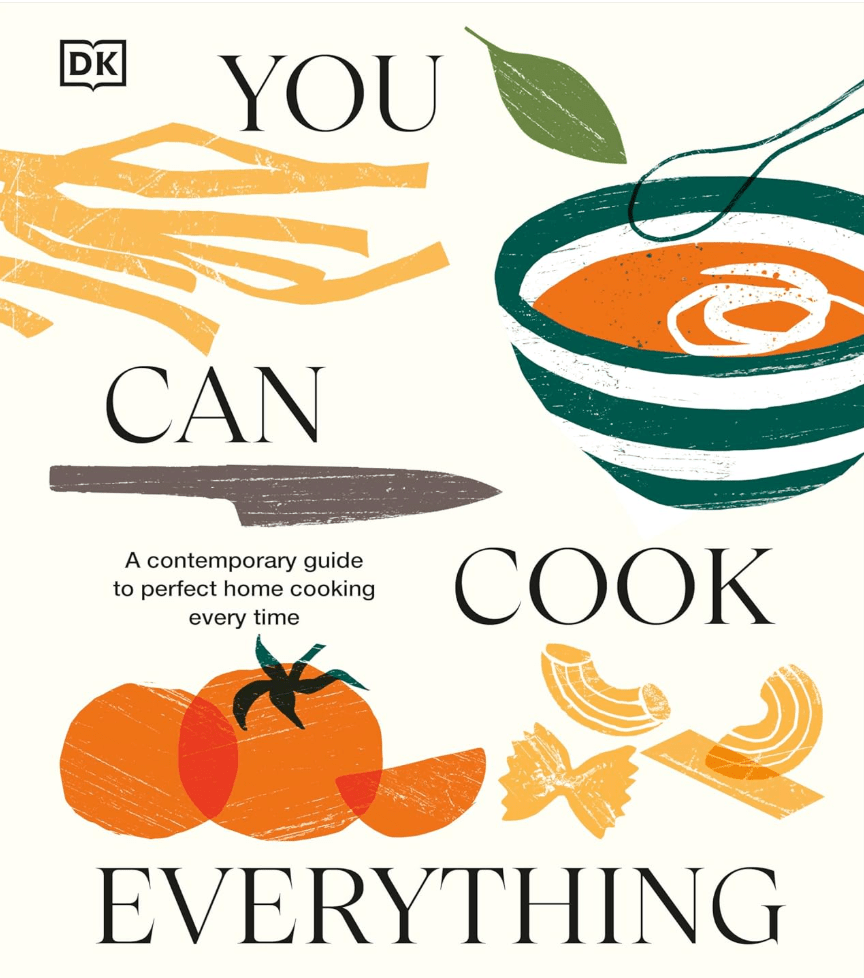
You Can Cook Everything: A Contemporary Guide to Perfect Home Cooking Every Time by DK – Cookbook Review

What is the USP?
An encyclopaedic guide to everything you need to know to become a confident home cook, covering over 1,000 techniques, tips, and recipes in one lavishly photographed volume. There’s no particular cuisine or concept. The focus is on giving you the building blocks to master everything from stir-frying tofu and grilling steak, to baking focaccia and folding gyoza.

What will I love?
It’s all here — the classics, the comfort food, the global favourites — presented with generous step-by-step photography and precise instructions. Want to perfect a béchamel? Learn to butterfly a leg of lamb? Bake flawless cinnamon buns? You Can Cook Everything gives you the confidence to try it, with visual cues and no judgment. It demystifies the things many cookbooks gloss over, from how to make shortcrust pastry to when to season your steak.

There’s also a pleasing sense of reassurance. Although it feels more up-to-date than other ‘cookery bibles’ due to the inclusion of more modern ingredients, it isn’t trying to be trendy or edgy. It’s here to guide you towards better home cooking, at your own pace. Think of it as a contemporary kitchen manual designed for a generation who may not have learned to cook from family, but who are hungry to learn now.

Is it good bedtime reading?
Yes. It’s not a memoir-style book full of essays or storytelling, but it’s incredibly satisfying to flip through. Each page feels like a mini masterclass. If you love the rhythm of methodical, practical cookery, this is bedtime gold.

Will I have trouble finding the ingredients?
Unlikely. The book is global in scope, so you’ll find everything from curries to shakshuka, but recipes are tailored to what is realistically available in most UK supermarkets. There’s helpful advice on substitutions, and where a specialist ingredient is needed (e.g. tamarind paste, rice flour), it’s generally one that has become fairly mainstream. The book is about building confidence and teaching you flexibility, not sending you schlepping across town on a three-hour shop.

How easy are the recipes to follow?
Exceptionally easy. The hallmark of DK books is their visual clarity, and You Can Cook Everything delivers in spades. Recipes are structured, well-spaced, and meticulously illustrated. There are visual walk-throughs for everything from kneading bread to filleting a fish, and plenty of troubleshooting tips to keep you on track. It’s ideal for anyone who wants to see how something should look at each stage. If you are someone who enjoys the reassurance of watching YouTube videos before trying a recipe, the chances are you will find You Can Cook deeply satisfying. 

Stand-out recipes?
The ‘Spring Onion and Cheddar Soda Bread’ is a wonderfully comforting, cheesy twist on a classic, while the ‘Butternut Squash and Sage Gnocchi’ is perfect to make in autumn. On the sweet front, the ‘All‑In‑One Vegan Chocolate Cake’ is rich, fudgy and undetectable as a vegan bake, and the ‘Blueberry Streusel Muffins’ are a delicious way of elevating the fruity favourite with a sweet and crunchy topping. 

How often will I cook from this book?
All the time. It’s a book you will reach for when trying something new or troubleshooting something familiar. The tone is quietly empowering: you don’t feel patronised, but you are never left to flounder. It’s perfect for beginner cooks, but even seasoned home cooks will enjoy the clarity and breadth. You might not cook everything in it, few of us have that kind of ambition, but it’s incredibly satisfying to know it’s all there.

Any negatives?
Not for what it sets out to do. Of course, if you are looking for a cookbook with an evocative or emotional narrative or a strong authorial voice, this won’t fill that void. It’s a clear, clean, and comprehensive reference book at heart. It also isn’t heavy on dietary notes (you won’t find extensive gluten-free or vegan adaptations), though there are plenty of naturally plant-based dishes. 

Should I buy the book?
Absolutely, especially if you’re building or refreshing your cookbook shelf and want a reliable, go-to guide. You Can Cook Everything is a must-have modern-day cooking bible: practical, clear, and deeply satisfying to use. It will teach you to trust your instincts and become a better cook, one delicious step at a time.

Cuisine: International 
Suitable for: Cooks of all abilities – a great place for beginners to start, while also filling in gaps/offering new inspiration for keen cooks. 
Great for fans of: Delia Smith, Leiths and Samin Nosrat.
Cookbook review rating: Five stars
Buy this book: You Can Cook Everything: A Contemporary Guide to Perfect Home Cooking Every Time
£30.00, DK

This review was written by Freelance Food Writer and Recipe Developer Sophie Knox Richmond. Follow her on Instagram on @sophie_kr_food

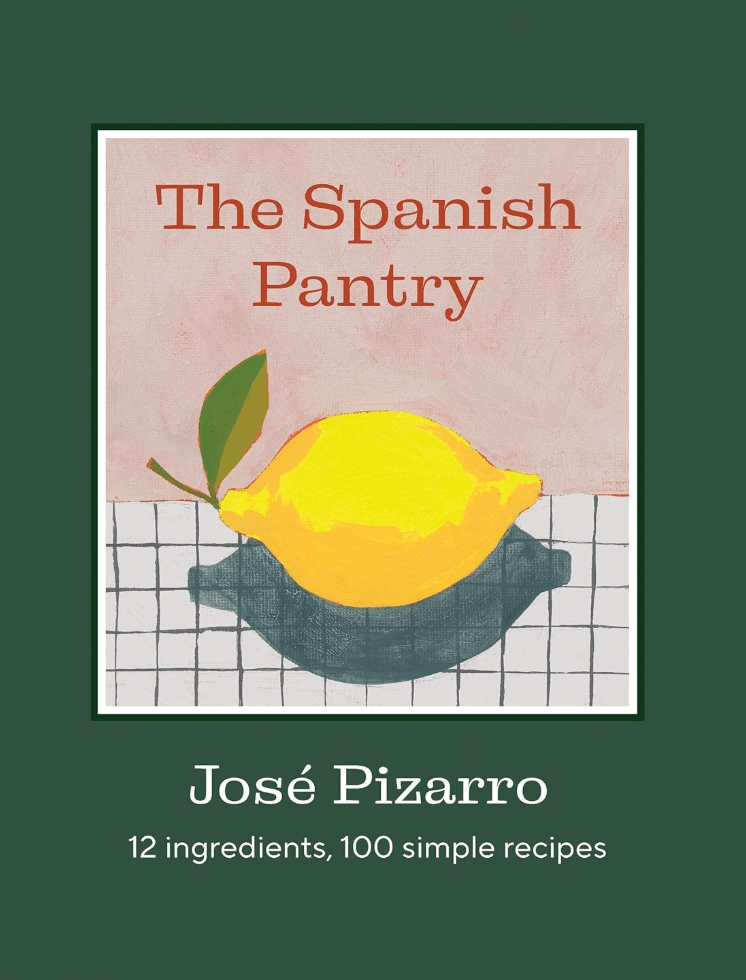
Spanish Pantry by José Pizarro

Who is José Pizarro?
José Pizarro is a Spanish chef and restaurateur who has spent over two decades bringing the soul of Spanish cooking to British tables. Born in Extremadura and now firmly rooted in the UK with a string of restaurants, he is known for his ability to translate the warmth and flavour of traditional Spanish food into something approachable, generous, and deeply satisfying. The Spanish Pantry is his ode to the essential ingredients that define the cuisine he grew up with.

What is The Spanish Pantry’s USP?
This is a grounded, ingredient-led cookbook that takes you back to the essentials that sit quietly in Spanish kitchens but carry so much flavour. It’s less about technique-heavy cooking and more about building confidence with essential components, encouraging cooks to build dishes from simple, high-quality basics. The result is a book that feels both accessible and rooted in tradition, quietly showing how much can be done with a well-stocked cupboard and a little care.

What will I love?
The Spanish Pantry is a love letter to the core components of Spanish cooking. Each chapter is built around one iconic pantry ingredient (Onions, Tomatoes, Peppers, Chorizo, Manchego, Almonds, Lemons, Rice, Chickpeas, Beans, Jamón and Saffron), showing how something simple and humble can unlock the bold, sun-drenched flavours of the Mediterranean. It is smart, focused, and deeply rooted in place. A real education in how to cook with heart, by knowing your basics inside out.

Pizarro excels at bringing Spanish cooking alive without making it overcomplicated. A tin of anchovies, a drizzle of good oil, and suddenly you’re on a terrace in Andalucía. Recipes like ‘Braised Black Beans with Spatchcock Chicken and Herb Salsa’, ‘Warm Gigante Beans on Toast’, and ‘Oloroso-braised Lamb Shanks and Chickpeas with Warm Anchovy Salsa’ offer richness and depth with minimal fuss. His food is rustic and hearty, yet still beautiful in its simplicity; exactly the kind of food you want to cook at home.

The helpful ‘menus’ section at the back provides inspiration for Lunch, Dinner, Tapas, Brunch and Summer Lunch party menus and includes time planning instructions so you can prepare ahead like a pro and entertain with ease. The beautiful photographs of Spain will have you hunting out your passport.

Is it good bedtime reading?
Yes, if you like to dream of distant markets and seaside tavernas. Pizarro writes with warmth, clarity and a palpable sense of place. You get snippets of Spanish life, hints of Extremadura and the Basque coast, and an unmistakable reverence for the people who taught him to cook. 

Will I have trouble finding the ingredients?
Some specialist items like sobrasada and morcilla might require a good deli or online shop, but many recipes rely on staples already in your cupboard. Think olive oil, paprika, garlic, pulses and tinned seafood. Although the book is about celebrating Spanish culture and cuisine, it is by no means inaccessible to UK cooks. Pizarro’s aim is to make your pantry do the heavy lifting, and he succeeds. There’s no unnecessary showing off, just good, honest cooking.

How often will I cook from the book?
This is very much a weekday-and-weekend sort of book. Although there are dishes which take a bit longer (the ‘Braised Jamón and Pork Knuckle with Olive Oil Mash’ is a succulent slow-cooked winner) or are impressive enough for a dinner party, this isn’t a book full of technical flourishes. It is real, robust food that you will return to time and time again. If you like the idea of elevating simple ingredients into something soul-stirring, this book will become a well-used companion.

Stand-out recipes?
The ‘Jamón Serrano and Watermelon Salad with Honey and Basil’ is a beautifully simple, and wonderfully refreshing, summer salad. ‘Garlic and Manchego Coca’ is a must-try for garlic bread fans, and the ‘Patatas à la Importancia con Chorizo’ will soon become one of your favourite ways to enjoy potatoes. Don’t miss the ‘Warm Olive Oil and Almond Cake with Preserved Peaches’. It has the most delicious flavour and moist texture, one of those cakes you will find yourself making on repeat. 

Any negatives?
Once you get into the recipes, you may find yourself seeking out higher-quality pantry items, which can become expensive. However, the flipside is that it encourages you to cook (and eat) more consciously, with respect for quality and provenance. 

Should I buy the book?
If you love Spanish food (not just the kind you eat on holiday, but the kind you dream of recreating in your own kitchen) The Spanish Pantry is a gem. It’s informative, heartfelt, and packed with flavour. You will eat well and learn a lot.

Cuisine: traditional and regional Spanish
Suitable for: curious foodies and lovers of Mediterranean flavours
Great for fans of: Claudia Roden, Rick Stein and Sam & Sam Clark
Cookbook review rating: 4 stars
Buy the book: The Spanish Pantry: 12 Ingredients, 100 Simple Recipes byJosé Pizarro, Hardie Grant £28.00

This review was written by Freelance Food Writer and Recipe Developer Sophie Knox Richmond. Follow her on Instagram on @sophie_kr_food

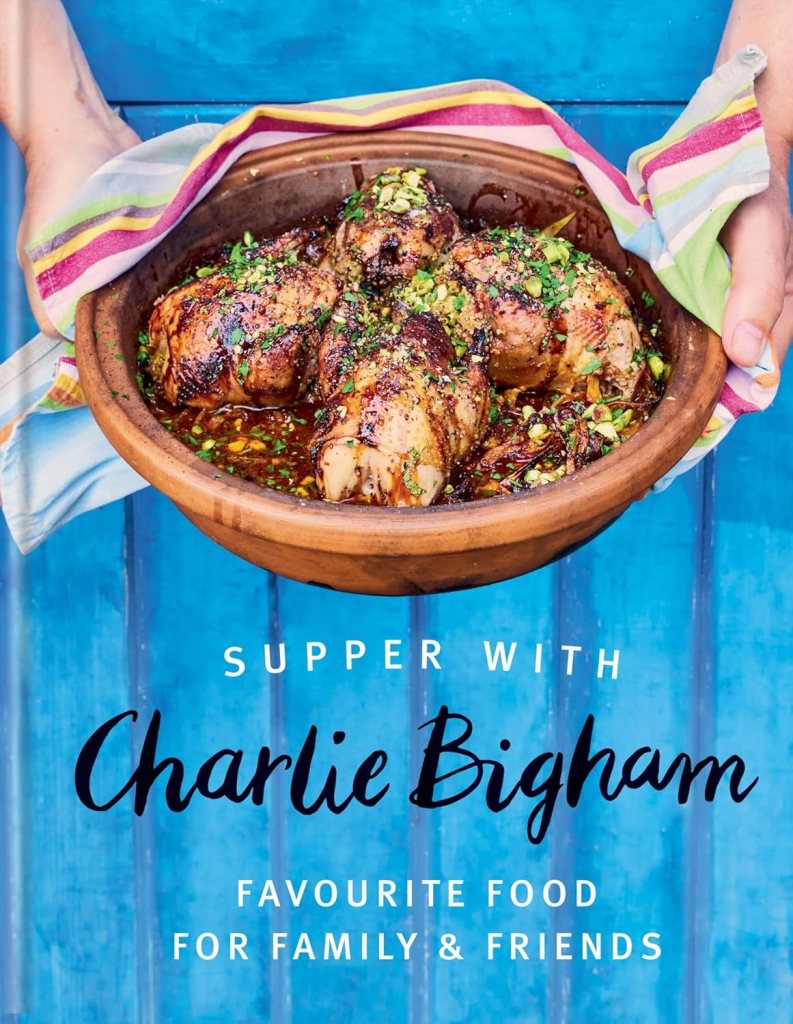
Supper with Charlie Bigham by Charlie Bigham – Cookbook Review

Charlie Bigham, the iconic premium food brand, has released its first cookbook Supper with Charlie Bigham. Written by Charlie Bigham himself (yes, there really is a Charlie Bigham, it isn’t a fictional character), the book promises over 100 relaxed fuss-free recipes to suit a host of supper occasions from fun family celebrations to easy midweek meals. 

What will I love?
The variety of dishes on offer for flexitarian family food and entertaining. Recipes include starters and canapés, mains for two, four, six or many (with advice on scaling up or down), vegetable sides for sharing and simple puddings (oh, and cocktails too!). Classic favourites like ‘Breton Chicken with Chive Mornay Sauce’, ‘The Ultimate Lasagne’ and ‘Beef Bourguignon’ are all there, but so are a host of more modern ideas such as ‘Slow-cooked Shoulder of Lamb with Marmite’ and ‘Penne with Parmesan, Spinach and Courgette’. 

Overall, the book feels very personal. The recipe intros all feel like you are sitting down chatting with Bingham himself as he shares the stories and anecdotes behind each one. The photography is also particularly enticing. Laid back, but not messy, they do an excellent job of ‘selling’ the dishes, while also making them feel approachable. 

Is it good bedtime reading?
Yes. There is an introduction from Bingham where he shares the story of his life through food, followed by an insight into his kitchen and how he likes to cook (all well worth reading). Each recipe also has its own introduction (mentioned above). You could have a very enjoyable evening browsing through the pages finding inspiration for what to cook in the months ahead.

Will I have trouble finding the ingredients?
Most of the ingredients are available in larger supermarkets. Anything difficult to find is accompanied by alternatives. For example, you might struggle to get hold of Borettane onions for the ‘Beef Bourguignon’, but pearl onions are suggested instead. Equally, if you wanted to make the ‘Game Ragu’ you have the option of choosing rabbit, wild boar or venison (although you might need to head to the butchers or order online). The ‘Dynamite Broth with Salmon’ does have bonito flakes, but there are recommendations on where you can source them (or you could leave them out). Aside from that, you will have to go to a deli or health food shop to make the ‘Hunza Apricots with Whipped Pistachio Cream’ and a few of the dishes might require a trip to a fishmonger (or a fish counter). 

How easy are the recipes to follow?
The majority of the recipes are fairly straightforward and all are very well-explained (the ‘Mackerel Pâté does ask you to smoke your own, but there are also instructions using shop bought). Prep and cooking times are included at the start of each recipe with additional ‘Charlie’s tips’ included at the end. There is the odd recipe that requires flicking back and forth to a side mentioned on another page (e.g. the delicious ‘Tomato and Pepper Salsa’ listed with the ‘Griddled Squid’ is also recommended for the (also brilliant) ‘Bashed Chicken with Parmesan Breadcrumbs’). However, that is a small complaint. Quantities are given in both grams and ounces which is ideal for those who still use imperial measurements. 

Stand-out recipes?
The ‘Smoked Haddock Gratin’ is a must-try, while the ‘Leg of Lamb of Lamb with Harissa and Chermoula’ is ideal for an alternative Sunday roast (especially alongside the suggested ‘Couscous with Apricots, Parsley and Red Onion’). The ‘Bashed Chicken with Parmesan Breadcrumbs’ is also now a firm favourite in our house. On the sweet front, the ‘Chocolate Torte with Caramelised Hazelnuts’ is a wonderfully rich and indulgent pud which will delight chocoholics. For something lighter, both the summer and winter ‘Poached Pears’ are delicious.

How often will I cook from this book?
Fairly often. It is one of those books you can rely on for every occasion, whether that be a simple weeknight supper, comforting pud or multi-course easy entertaining menu. There are a myriad of options suitable all-year round – think vibrant and fresh salads in the hazy heat of summer, rich and comforting stews and hotpots for chillier winter evenings. 

Any negatives?
If you were expecting this to contain all the recipes for the Charlie Bigham dishes you buy in the shops, you might be a little disappointed. There are some, like the ‘Chicken Tikka Masala’ and ‘Ultimate Lasagne’. However, the much-loved Macaroni Cheese (and it’s even more indulgent cousin the Four Cheese Macaroni) are, sadly, absent.

The only other gripe would be on the (delicious) ‘Penne with Parmesan, Spinach and Courgette’ which is described as a ‘special vegetarian main course’ and a ‘celebration of Parmesan’. While the latter is most definitely true, by definition, Parmesan isn’t vegetarian as it contains animal rennet. While some vegetarians choose to be more relaxed around cheese, it would have been prudent if ‘Charlie’s Tip’ mentioned using a ‘Parmesan-style hard cheese’ to prevent hosts unwittingly serving a non-vegetarian dish to vegetarian friends and family. 

Should I buy the book?
Yes. This is one of those cookbooks that has something for every mood or occasion. Whether you want something special for a dinner party, a cosy and comforting winter supper or a vibrant sharing salad for a summer barbecue, Supper with Charlie Bigham has got you covered. 

Cuisine: International 
Suitable for: Cooks of all abilities 
Great for fans of: Hairy Bikers and Mary Berry 
Cookbook review rating: Four stars
Buy this book: Supper with Charlie Bigham: Favourite food for family & friends 
£26.00, Mitchell Beazley 

This review was written by Freelance Food Writer and Recipe Developer Sophie Knox Richmond. Follow her on Instagram on @sophie_kr_food

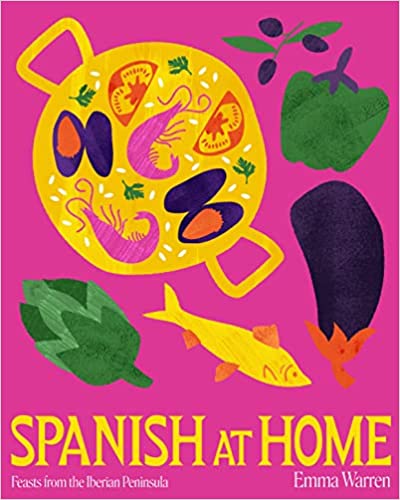
Spanish at Home by Emma Warren

Spanish at Home by Emma Warren

What’s the USP? Emma Warren’s third cookbook proudly declares to eschew many of the most famous dishes of Spain, the country she has called home for the best part of twenty years. Instead, Spanish at Home explores food popular in domestic kitchens across the country. It’s a nice idea, if one that immediately lends itself to a sort of fantasy. Homecooking, after all, is a concept leaden with romanticism and nostalgia.

We have our own language to describe the food cooked at home. It is honest, and ‘humble’ – another term whose meaning shifts dramatically depending on who is being asked. Home cooking – at least, the concept of ‘home cooking’ that so often is championed in cookbooks, is fuelled as much by the loving intentions of the person making the food as it is by the electricity or gas that powers the stove itself. And so Spanish at Home is about the food made in home kitchens across the length and breadth of Spain – drawing on the ‘generous hospitality’ that Warren has experienced during her time in the country.

Is it good bedtime reading? There are a few short chapter introductions throughout, and a paragraph or so ahead of each individual recipe. Though these are brief, Warren writes enthusiastically, and occasionally slips in little nuggets of information for extra flavour. Nevertheless, this is a book that is intended to be opened on the kitchen counter rather than underneath a bedside lamp.

Will I have trouble finding the ingredients? Unfortunately, I suspect sourcing all the ingredients for dishes featured in Spanish at Home will often seem out of reach. Food writing frequently champions home cooking as though it is one thing that unites us all: our desire to offer good food to the people closest to us. And the sentiment is, I suppose, ultimately true. Whether we cook alone with the kids in the other room, or together as part of a large community, the food we make at home seeks to build up our loved ones, to give them strength and ensure that they are healthy.

But this idea, life-affirming though it might be, doesn’t change the fact that nations differ greatly. Spain is not far from the UK, in the grand scheme of things, but many of the ingredients here will not be practical for home cooks looking to replicate these Spanish dishes.

Sometimes this is a matter of sourcing. The difficulty of finding certain fresh seafood in the UK is not a problem unique to Spanish at Home. I can get my head around the absence of cuttlefish from our high street food retailers, but until very recently it was much simpler to buy fresh mussels that had not been vacuum-packed with a ready-made cream sauce, and I don’t know quite what’s changed there. But difficulty here is not solely the fault of UK retailers: ‘chicken ribs’ feel like a fairly niche ask for the Arroz del Campo, and as the recipe lists other ingredients including rabbit and snail, it is plausible that the recipe will never be in serious contention in any home, at least in its intended form.

Mostly, though, the barrier to getting your hands on all the necessary ingredients will be your budget. Perhaps, in Spain, meat is distinctly cheaper. Perhaps Emma Warren’s experiences of Spanish home cooking have mostly occurred in the houses of well-off families. Whatever the case, something has been lost in translation. These dishes, though desperately good-looking, are also frequently very costly.

Take one of the highlights of the book, for instance: the Ragú de Cordero. Captured by Rochelle Eagle’s sumptuous photography, it should be hard to resist. But once you spot that the recipe (to serve four) calls for both a kilogram of boneless lamb shoulder and a supplementary rack of lamb, the average reader may be less tempted. Readers may not even get to the point where the recipe requires ownership of a bottle of Cognac to finish the dish.

For another exquisitely presented dish, Carrilleras de Cerdo, Warren espouses the affordable virtues of pig cheeks – but short of one extraordinary trip to a Morrison’s in Brighton (also in Waitrose sometimes -ed.), I have never seen this cut of meat outside of a butcher shop. Calling around the butchers of Nottingham, I’ve yet to find it in any of those, either.

How often will I cook from the book? Clearly, not as much as you might like to. But that isn’t to say all hope is lost. There are still plenty of (mostly vegetable-led) dishes that are entirely accessible to British home cooks, from minestrone soup to panzanella salads. The patatas bravas, served with two homemade sauces, were absolutely gorgeous when I made them, and those looking to experience something truly unique would be well advised to try the Arroz Cubano, which somehow allows banana, fried egg, tomato and rice to team up in perfect unison.

Killer recipes: Beans in salsa ‘gravy’, beef fricassee, red wine-poached pears and  saffron ice cream.

Should I buy it? Ultimately, the problems with Spanish at Home are not problems with Spanish at Home. Instead, they are problems with our over-reliance on supermarkets, the increasingly homogenised range of meats available to us, and, importantly, with the romanticised view we have of home cooking. When we talk about home cooking in £26 cookbooks exploring other cuisines with hungry eyes, we are talking about the food we make at home when we most want to impress. Food that takes a lot of time or a huge wealth of ingredients. When we talk amongst friends about home cooking, we think of the simplest of dishes, and of cuts of meat that are frugal, yes, but also accessible. I would dearly love to eat a great deal of the recipes in Spanish at Home, but the home we are given access to here is, generally speaking, not one I will be able to visit nearly as frequently as I might like.

Cuisine: Spanish
Suitable for: Confident home cooks
Cookbook Review Rating: Three stars

Buy this book: Spanish at Home by Emma Warren
£26, Smith Street Books

Review written by Stephen Rötzsch Thomas a Nottingham-based writer. Follow him on Twitter and Instagram at @srotzschthomas

Moro Easy by Sam and Sam Clark

Moro Easy by Sam and Sam Clark
Many cookbooks have emerged recently that started development during the lockdowns of the last few years. Sam and Sam Clark looked for ways to simplify their cooking to feed a five person household while compelled to stay under one roof. Luckily for the rest of the family, the Clarks are professional chefs and the husband-and-wife team behind Moro and other restaurants that focus on Southern Mediterranean dishes and flavours. The result of this endeavour is Moro Easy, a cookbook aiming to make their restaurant’s dishes accessible to the home cook through uncomplicated methods and ingredients.

Moro Easy delivers on straightforward and interesting dishes with many living in the sweet spot between undemanding and delicious, the kind of recipe that makes cooking tasty food deceptively easy and makes you think maybe one day, you too can open your own restaurant. On the menu could be the fish tagine with potatoes, peas and coriander requiring you to just whizz up a spice paste and bake fish in it for 8 minutes. Or a series of labneh recipes that are about as quick to make as they are to read.

Then there’s the ones that are a little more involved and bring you back to reality. For instance, it would be wise to stay focused on the kale purée with polenta unless you’re looking to paint your kitchen green.

However, books that have time limits or difficulty levels in their names set a high threshold of success. How easy is easy? How quick is quick? I remember the furore over the release of Jamie’s 20 Minute Meals when it transpired they did not in fact, take exactly 20 minutes. If you have a food processor at your disposal some recipes will take minutes of preparation. Without one, it’ll depend on your tolerance for chopping. Simple recipes also live and die by the quality of the ingredients you can source. A recipe with few components like Peas with Jamón and Mint will be inherently more delicious if the ingredients are of a higher quality.

There is a joy to be found in simple food, using the smallest amount of ingredients and effort to produce something remarkable. The best recipes here are the ones that just let the ingredients do their thing, roasted squash covered in cinnamon and a sweet and spicy vinegar is outstanding, as is aubergine dotted with tomatoes and tahini sauce. Mostly, they’re rustic and wholehearted dishes, the sort of thing you could eat entirely with chunks of bread. This isn’t a bad thing, I’ll be friends with anything that can be eaten using carbohydrate cutlery. On the whole, it’s an enjoyable book but something that’s more solid than spectacular.

Cuisine: Southern Spanish and Mediterranean
Suitable for: Beginner and confident home cooks
Cookbook Review Rating: Four stars

Buy this book: Moro Easy by Sam and Sam Clark
£30, Ebury Press

Review written by Nick Dodd a Leeds-based pianist, teacher and writer. Contact him at www.yorkshirepiano.co.uk

Arzak + Arzak by Gabriella Ranelli, Xabier Gutiérrez and Igor Zalakain

Arzak

Few chefs have had such an influence on modern cuisine as San Sebastian-based Juan Mari Arzak. As Anthony Bourdin noted, ‘Ferran and Albert Adrià, Martin Berasetgui, Andoni Aduriz: these are just a few of the chefs who looked to Arzak as an example of the new possibilities’. Those ‘new possibilities’ crystallised into molecular gastronomy, but they had their roots in the 1970’s movement of ‘New Basque Cuisine’ the Spanish response to French nouvelle cuisine that was headed up by Arzak. So, no Arzak, no el Bulli, Fat Duck or Alinea.

Arzak + Arzak, originally published in Spanish in 2018 and now reissued in an English language edition, tells Juan Mari’s story, including his ongoing, decade-long creative collaboration with his daughter Elena, the fourth generation of the family to work in Arzak restaurant since it first opened as a tavern in 1897. With extensive narrative text and some stunning black and white portraiture, the introductory chapters provide background on the day to day running of the restaurant and kitchen, as well as the ongoing creative processes of Arzak’s ‘laboratory’ where chefs Xabier Gutiérrez and Igor Zalakain collaborate with the Arzaks to create 50 new dishes a year.

However, the lack of introductions to the often avant garde recipes is frustrating. Dishes such as Symbolic Squab (pigeon decorated with variously shaped red cabbage and purple potato tuiles); Flaming Chickpea Stew (a frozen dessert of coffee-flavoured bavarois set in a chickpea-shaped mould and served with cardamom, cocoa and gellan gum ‘rusty nails’), and the frankly bizarre Another Brick in the Chocolate and Mustard Wall are baffling when presented without context or explanation.

There are some more mainstream dishes in the book such as sea bream with nasturtium leaves and crispy crepe lobster, but make no mistake, this is a Spanish modernist cookbook. The majority of the recipes would only be attempted by a professional chef or a very serious hobbyist home cook but would make a nice souvenier for those that have eaten at the restaurant. Elena Arzak is quoted in the book saying that, ‘My biggest challenge is foreseeing the unpredictable taste of people and staying ahead of them’.  Despite such forward looking ambition, Arzak + Arzak feels trapped in molecular gastronomy’s past.

A version of this review was first published in The Caterer

Cuisine: Spanish/Progressive
Suitable for: Professional chefs
Cookbook Review Rating: Three Stars

Buy the book
Arzak + Arzak
£30, Grub Street

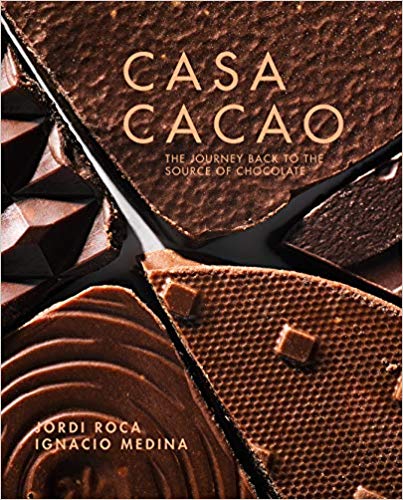
Casa Cacao by Jordi Roca and Ignacio Medina

Casa Cacoa

Although it seems to have been around forever, ‘bean to bar’ is a relatively new concept with the first single estate chocolate produced by Cluizel in 1996. That’s just one of many fascinating facts in Jordi Roca’s deep dive into the world of chocolate, written with food journalist Ignacio Medina and inspired by the launch of the three Michelin starred pastry chef’s own brand, Casa Cacao that takes the bean to bar ethos one step further.

Roca argues that ‘chocolate has its beginnings in the tree’, placing increased importance on the variety of cacao, the farmer and the environmental conditions. The book tells the story of Roca trips to Colombia, Peru and Ecuador, visiting cocoa farmers where he discovered that a bean grown in Piura in the northwest of Peru which has ‘fruity and aromatic notes’ is very different from the ‘restraint, elegance and presence’ of beans from Vinces in Ecuador.

With the help of British chocolatier Damien Allsop (‘head of chocolate and bon bon production’ at Roca’s Girona restaurant El Celler de Can Roca), Roca is pushing the conventions of chocolate manufacturing, creating vegetable-based chocolate made, for example, by combining a paste of peas, sugar, isomalt, puffed rice and ascorbic acid with melted cocoa butter. Allsop has also created ‘chocolate²’ made with just cacao and sugar to intensify the purity of flavour. Recipes for both are included, along with a detailed description of the chocolate making process, but you’d need access to a chocolate factory if you wanted to attempt them.

More achievable are ‘chocolate classics’ such as chocolate brownies or sophisticated desserts including milk chocolate, lemon and hazelnut cake, although only the most ambitious pastry chef would consider trying to replicate Mexican Chocolate Anarkia, the recipe for which takes up eight pages of the book.  Also included are some wildly creative savoury recipes such as cacao pulp and spiced chocolate sauce with langoustines by Roca’s brother Joan.

Casa Cacao is a detailed look at a complex and niche subject area and as such will mainly be of interest to chocolatiers and pastry chefs working in a fine dining environment, but it’s a beautifully produced book that will inform and inspire its intended audience.

Cuisine: International 
Suitable for: 
Confident home cooks/professional chefs
Cookbook Review Rating: 
Four stars

Buy this book
Casa Cacao
Grub Street, £35

This review was originally published by The Caterer 

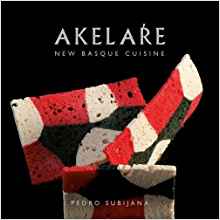
Akelare: New Basque Cuisine by Pedro Subljana

Akelare

What’s the USP? Recipes from one of the great innovators of modern Spanish cuisine.

Give me some background. Global restaurant fashions come and go, but San Sebastian in Northern Spain, with its thrilling mix of casual pinxcho bars and cutting edge high-end restaurants, remains a place of true gastronomic pilgrimage. It’s home to a constellation of Michelin stars including Arzak, Mugaritz, Martin Berasategui and Akelare, run by legendary chef Pedro Subljana for nearly forty years.

Occupying a commanding position west of the city centre on the slopes of Mount Igueldo with stunning views over the Bay of Biscay, Akelare has maintained three Michelin star status since 2007 for its imaginative and playful ‘New Basque Cuisine’ (the Spanish equivalent of Nouvelle Cuisine).

What does it look like? Stunning. It’s more like an artist’s portfolio than a cookbook with visually arresting images of dishes such as ‘zebra squid’; roast loin of hare a la royale with chestnuts and razor clam with veal shank.

Is it good bedtime reading? Move along please, there’s nothing to see here.

Killer recipes? An amuse bouche based around bathroom toiletries that includes tomato flavoured liquid soap, onion sponge, Idiazábal cheese moisturiser and bath salts made from potato starch, prawn and rice ‘sand’.

Will I have trouble finding ingredients? Zopako bread, Beasain onion morcilla and ‘cortrezas de trigo’ (wheat snacks similar to pork scratching) may well be difficult for British cooks and chefs to lay their hands on.

What’s the faff factor? On the inside cover, it says, ‘This book was printed using the font ‘faff’. Look up the word ‘faff’ in the dictionary and you will see a picture of the cover of this book. I took the book to my doctor and he told me it had a terminal case of faff. I showed the book to Darth Vader and he said, ‘The faff is strong with this one’. It is number one on the faff parade. It was pulled over by the police for being three times over the faff limit. An Irishman, a Scotsman and an Englishman went into a bar specifically to agree that Akelare: New Basque Cuisine by Pedro Subljana had the highest faff factor of any cookbook ever published. So, um, yeah, there’s a lot of faff.

How often will I cook from the book? Don’t take this the wrong way, but unless you are a professional chef interested in modernist, progressive cooking, you are highly unlikely to have the skills, resources or time to tackle these recipes. I certainly don’t.

What will I love? A short introductory section, including a page from Subljana himself, prefaces the main body of the book. Articles on the restaurant’s cookery school and associated Basque Culinary Centre, service at the restaurant and suggested wine pairing for the featured recipes round out the book.

What won’t I like? Just 23 out of the book’s 240 pages are taken up with recipes in English meaning methods tend to be on the sketchy side, not ideal with such technical food. Spanish and Basque translations of the text occupy a significant amount of space; fine if you’re reading a free in-flight magazine but a tad galling if you’ve splashed out thirty quid on a relatively slim glossy cookbook. Although beautiful to look at and a real pleasure to browse, the book suffers from a case of style over substance, something that New Basque Cuisine itself could be accused of.

Should I buy it? There are two reasons to buy this book: as a memento of a meal enjoyed or an invitation to make a reservation at the restaurant if this sort of Spanish sleight of hand still floats your culinary boat in 2018.

Cuisine: Progressive Spanish
Suitable for: Chefs
Cookbook Review Rating: 3 stars

Buy this book
Akelare
£30, Grub Street

Doughnuts and hot chocolate sauce by Nieves Barragán Mohacho

Doughnuts and hot chocolate sauce from Sabor

This is like an easier version of churros with chocolate sauce. If you don’t have a mixer to make the dough, you can knead it by hand.

Ingredients

rapeseed or sunflower oil, enough to fill your pan to about 3cm

For the doughnuts
60g cold but malleable butter
450g plain flour
60g caster sugar
4 eggs
12g fresh yeast or 4g quick yeast
60ml whole milk

For the hot chocolate sauce
300ml water
150g caster sugar
160ml single cream
50g cocoa powder
300g dark chocolate (70%)

For the cinnamon sugar
150g caster sugar
50–60g ground cinnamon

Take the butter out of the fridge 15 minutes before starting and chop into small cubes. Put the flour and sugar into a large bowl and mix together with your hands. Heat the milk until almost steaming, then remove from the heat and leave to cool slightly. Mix into the yeast, stirring with a whisk to dissolve.

Put the flour and sugar into the bowl of a stand mixer and slowly add the butter – it will look like crumble. Add the eggs one by one, then dribble in the milk/yeast mixture until everything comes together into a sticky dough.

Slightly flour a large container or bowl, turn the dough out into it, and lightly flour the top. Cover and leave in the fridge overnight. In the morning, turn out the dough on to a floured surface – it will have almost doubled. Take a piece (approx. 30g) and roll it in your hands, then squeeze down until it’s about 2½cm thick. Use the top of a miniature bottle to press out the dough in the middle, leaving a hole. The doughnuts should be around 25g each. Repeat until you’ve used up all the dough.

Stick two fingers through the middle of each doughnut and roll them round to push out the dough a bit more and double the size of the hole – otherwise it will close up when the doughnut is fried and expands.

To make the hot chocolate sauce, put the water, sugar and cream into a pan on a low heat and dissolve the sugar. Put the cocoa powder and chocolate into a bowl and place over a pan of simmering water to melt the chocolate (this keeps it smooth). When the chocolate has all melted, add it to the cream with a spatula. Continue mixing until it becomes dense and thick and perfect for dipping. Keep warm.

Mix together the sugar and cinnamon. Put the oil into a shallow pan on a medium heat. When it’s hot, fry the doughnuts until golden brown, then remove and drain on kitchen paper. Dust with the cinnamon sugar while still warm and serve with the warm chocolate sauce for dipping.

This recipe appears in
Sabor: Flavours from a Spanish Kitchen
Nieves Barragan Mohacho
£25 Penguin Fig Tree

Cook more from this book
Persimmon, goat’s cheese and land cress salad
Pork belly and mojo verde

Read the review

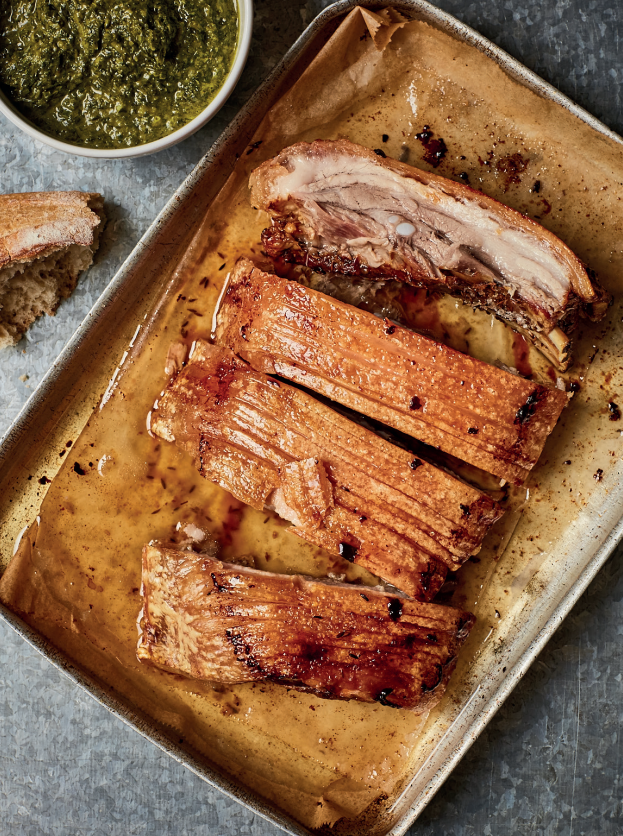
Pork belly and mojo verde by Nieves Barragán Mohacho

Pork belly and mojo verde from Sabor

This recipe uses a pestle and mortar to make a lumpier mojo verde that’s good for serving alongside meat, but you could make a smoother, creamier sauce for marinating. Just put all the ingredients, except the coriander, into a blender. Whiz together, adding the coriander halfway through, then blend again until green and creamy with some small flecks of herb. Instead of pork belly, you could grill lamb cutlets and serve them with the mojo verde dotted around, or marinate chicken in the smoother version of the sauce.

Serves 6-8

1 x 4–5kg piece of pork belly, rib bones intact
sea salt and freshly ground black pepper
2 tablespoons cumin seeds
extra virgin olive oil, for drizzling

For the mojo verde

1 bunch of spring onions
4 cloves of garlic
2 big bunches of fresh coriander (equal to around 6–8 of the 40g supermarket packets)
2 teaspoons cumin seeds
200ml extra virgin olive oil
125ml Moscatel vinegar
2 dried chillies
sea salt and freshly ground black pepper, to taste

Preheat the oven to 180°C.

Line a roasting tray with greaseproof paper. Score the skin of the pork belly quite deeply (around 1cm), then place it skin side down on the paper-lined tray. Season the top of the pork belly with salt, pepper and cumin seeds and cook for 1½–2hrs. The skin should be very crispy and the meat must be tender – if it’s not quite there yet, turn it over and cook it for another 10 minutes.

Make the mojo verde while the pork belly is cooking: roughly chop the ingredients and add them slowly to a pestle and mortar, dribbling in the olive oil bit by bit and mashing together.

Spoon some mojo verde on to each plate, then top with 1cm–2cm thick pork belly slices and drizzle over a little olive oil to finish.

This recipe appears in
Sabor: Flavours from a Spanish Kitchen
Nieves Barragan Mohacho
£25 Penguin Fig Tree

Cook more from this book
Persimmon, goat’s cheese and land cress salad
Doughnuts and hot chocolate sauce

Read the review