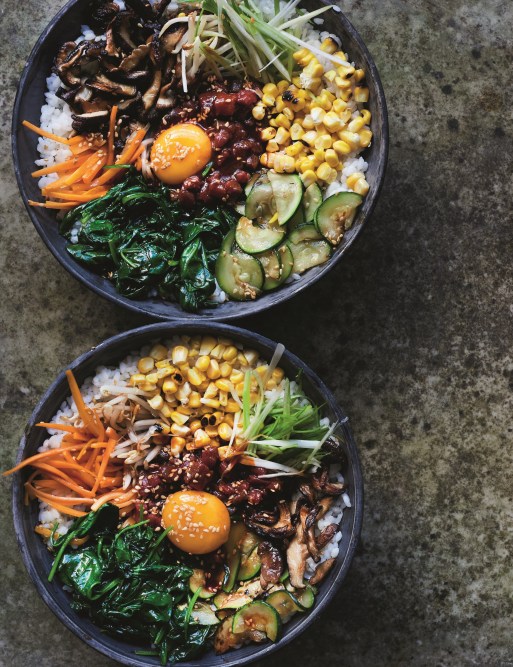
Bibimbap by Gizzi Erskine

Bibimbap c. Issy Croker

One of my breakthroughs was bringing attention to Korean food in the UK back in about 2007. While working as a chef in NYC, I’d hit Koreatown in my downtime with my mates, drink ice-cold beers and eat Korean fried chicken. Koreatown was open late, and you could go from restaurant to karaoke bar eating and drinking yourself into a stupor. I fell in love with Korean food there, and fell in love with the culture 5 years later when I first visited Korea, later moving there to film my TV show Seoul Food.

I’m certain that the popular ‘buddha bowl’ has Korean culinary heritage, as it’s similar to a dish called ‘bibimbap’. In a bibimbap bowl, rice is topped with vegetables, meat (optional), egg yolk and a spicy sauce. It is quite refined -you can’t say that about a lot of Korean food – and is cooked in a searing hot cast-iron pot which is oiled before adding the rice; the vegetables and egg (and meat, if using) are swiftly put on top. By the time the rice gets to the table it has a fantastic caramelised crust that you peel away from the pot and you stir-fry everything at the table. It’s real theatre. Fear not if you don’t have cast-iron pots -you can eat it like Hawaiian poke, in a bowl with hot rice. Bibimbap is delicious, healthy and a great way to tackle a fridge forage. I’ve used traditional toppings, but do play around with seafood, tofu and different veg: the only mainstays are the rice, egg yolk and sauce.

SERVES 2
Preparation time 45 minutes
Cooking time 15 minutes

200g sushi rice
400ml water
1 tbsp sesame oil
2 tbsp sunflower oil
150g spinach
1 courgette, thinly sliced
1 large carrot, finely julienned
100g beansprouts
6 spring onions, shredded
100g shiitake mushrooms, thinly sliced
1 corn on the cob
2 free-range egg yolks
300g rump steak, finely chopped sea salt and freshly ground black pepper
1 tbsp black or white toasted sesame seeds, to serve

FOR THE SAUCE
6 tbsp gochujang
2 tbsp Korean or Japanese soy sauce
1 tbsp rice wine vinegar
2 tbsp sesame oil
1½ tbsp caster sugar

Put the rice and water in a large saucepan with a good pinch of salt. Cover, bring to a simmer and cook for 12 minutes. Take off the heat and steam (lid on) for 10 minutes.

Gently heat the sauce ingredients in a small saucepan until emulsified. Set aside.

Mix  together the sesame and sunflower  oils. Heat a large wok or frying pan over a high heat, add 1 tablespoon  of the  oil mix and add  half the spinach with a pinch  of salt. Cook briefly until wilted, then remove and drain on kitchen paper, squeezing out any liquid. Repeat with the  remaining spinach. Add another  splash  of oil and briefly fry the courgette until golden. Remove and set aside. Repeat this process with the carrot, beansprouts, spring onions and shiitake mushrooms. Rub the sweetcorn cob with oil, salt and pepper, then brown in the pan until the kernels start to char.

Heat two stone bibimbap dishes or a wok on the hob until smoking hot. Place the stone dishes on a heatproof surface (if using). Brush the insides of the dishes (or hot wok) with the remaining oil and add the rice. Group vegetables around the edge, put the raw meat in the middle, then the egg yolks and 2 tablespoons of the sauce for each serving. Top with sesame seeds. Mix the sauce into the rice at the table with a spoon.

Recipe taken from Restore by Gizzi Erskine, available now (£25, HQ)’. Photography credit – c. Issy Croker

Restore

Cook more from this book
Green Shakshuka

Buy this book
Restore by Gizzi Erskine
£26, HQ

Read the review

The French Laundry, Per Se by Thomas Keller

The French Laundry Per Se

What’s the USP? Recipes and stories from a pair of three Michelin-starred American restaurants. The book appears 20 years after the publication of the original The French Laundry cookbook and serves as a kind of update and elaboration as it now also covers sister restaurant Per Se.

Who is the author? Thomas Keller is one of America’s best known and most decorated chefs. He holds three Michelin stars at The French Laundry in Napa, California and at Per Se in New York. His other restaurants include Bouchon Bistro and Bouchon Bakery in both Yountville California and Las Vegas and The Surf Club in Miami. His glamorous, upscale TAK Room restaurant, opened in the mid-town Manhattan Hudson Yards development and inspired by classic American cuisine from the 40s and 50s, closed in August 2020 after just one year of trading, a victim of the pandemic.  He has also been a consultant to Hollywood, working on the  animated film Ratatouille and the Adam Sandler comedy Spanglish. He is the author of five previous cookbooks, publisher of Finesse magazine and has his own Masterclass. He has recently been the subject of a Trump-related Twitter controversy that has seen the chef delete his account on the social media site. At the time of writing, he remains active on Instagram.

Is it good bedtime reading? Given it’s size and weight – The French Laundry, Per Se is a great big, beautiful book – it won’t make the most relaxing bedtime reading material. Better then to enjoy it sitting in your favourite chair with a nice glass of Californian red (in homage to The French Laundry’s location in the heart of Napa Valley wine country) and appreciate the thousands of words carefully crafted with the help of leading food writers Susie Heller and  Michael Ruhlman.

Will I have trouble finding the ingredients? Let’s have a look at the very first recipe in the book shall we? Smoked Sturgeon Rillettes on an Everything Bagel. No problem, apart from the smoked sturgeon, Reglis Ova caviar (Keller’s own brand, available online for US only delivery), Argumato lemon oil and onion blossoms. Opening the book at random, I land on Hiramasa with Apple Vierge. First, catch your hiramasa (sushi grade Australian Yellowtail Kingfish, available online in the UK from The Fish Society) then track down some Champagne vinegar and Marcona almonds and you’re good to go.  Elsewhere, expect ingredients such as foie gras, spiny lobster, and Alaskan king crab. Things get ludicrously specific with Venison Rack Roasted Over Grapevines that not only call for 1.5kg of ‘dried grapevine knots’ but ‘250g of dark raisins, dried on the vine, preferably from Paradigm Winery’. Thankfully, not all the recipes are this tricky to negotiate and, with some common sense substitutions, you should be able to attempt a number of dishes from the book.

What’s the faff factor? These are recipes from three Michelin-starred restaurants so they were never going to be a walk in the park for the home cook. They will take time, money, effort and concentration, but they are far from unachievable if you have the resources and will to make them.

How annoyingly vague are the recipes? Six books in and with the help of some of the best food writers in the business, this is not an issue. Keller is a proponent of sous-vide cooking, but has include full alternative ingredient lists and methods when appropriate so if you don’t happen to have a vacuum sealer and immersion circulator in your kitchen, it’s no biggie.

How often will I cook from the book? When you have the time and inclination; for example, during a pandemic. Even a simple sounding – and looking – bowl of Red Pepper Farfalle lists 38 ingredients, not counting those included in the three additional satellite recipes you’ll need to make to complete the dish. A few simple soup recipes aside, this is not a book for weeknight cooking.

Killer recipes: Smoked Montana Rainbow Trout Chaud-Froid; Celery Root Pastrami; Salt-and-Rye-Baked Lamb Neck; Malted Brownies among others.

What will I love? The premium look and feel; the numerous essays that cover everything from a treatise on fine dining to the importance of bread and butter; the gorgeous food photography by Deborah Jones.

What won’t I like so much? Before embarking on the majority of recipes, you will have to take some time to consider if you can source the necessary ingredients, and if not, will the dish still be worth making with replacements. You’ll also want to weigh up if the dish, which may only be a mouthful or two, is worth the cost and effort required. It’s worth bearing in mind that the recipes in the book are the product of a very well staffed and resourced kitchen and that the resulting dishes will be sold at a significant profit on menus that cost upwards of $350 a head, none of which applies to the home cook who will be left with a much depleted bank account and a mountain of washing up.

Should I buy it?  For many professional chefs working in the fine dining arena, The French Laundry, Per Se will be an essential purchase. The same will be true for serious hobbyist cooks and restaurant enthusiasts. For those simply in search of a practical recipe book that will be put to regular use, look elsewhere. 

Cuisine: American/Progressive
Suitable for: Confident home cooks/Professional chefs
Cookbook Review Rating: Five stars

Buy this book
French Laundry, Per Se, The (Thomas Keller Library)
£60, Artisan

Cook from this book
The Whole Bird
Fish and Chips
Peaches ‘N’ Cream

The Hand and Flowers Cookbook by Tom Kerridge

Hand and Flowers Cookbook by Tom Kerridge

What’s the USP? A brief history of and recipes from the world’s only two Michelin starred pub.

Who is the author? Chef Tom Kerridge has recently become known for his dramatic weight loss and series of diet-friendly TV shows and books including Dopamine Diet, Lose Weight and Get Fit, and Lose Weight For Good. His real claim to fame however is as proprietor of The Hand and Flowers pub in Marlow, Buckinghamshire, the only two Michelin starred restaurant in the world. He also runs The Coach, The Shed and The Butcher’s Tap in Marlow, Kerridge’s Bar and Grill in London and The Bull and Bear in Manchester. He is also the founder of the Pub in the Park, a touring food and music festival. Earlier in his career, he worked for such British restaurant luminaries as Gary Rhodes and Stephen Bull in London and David Adlard in Norwich.

Is it good bedtime reading? There’s a chunky introductory section telling the story of the pub, chapter introductions and full page introductions to all of the recipes, making the book a very enjoyable read. As a restaurant nerd, I would have loved to have read about Kerridge’s career before opening the Hand in 2005. As a good proportion of the book’s audience is bound to be professional chefs who would be equally interested to read about Kerridge’s rise through the ranks to stardom, it seems something of a missed opportunity. We can only hope there’s an autobiography in the works.

Will I have trouble finding the ingredients? Specialist ingredients in the book include Alba white truffle oil, agar agar, foie gras, squab pigeon, caul fat, veal tendons, Sosa Airbag Pork Granet, Sosa Antioxidant gel powder, meat glue, lamb sweetbreads, pig’s head and trotter and meadowsweet among others. There are plenty of far more mainstream ingredients too, although if you are going to go to the trouble of attempting these recipes you’ll want to head to your butcher, fishmonger and greengrocer rather than rely on standard supermarket gear.

What’s the faff factor? If you want to prepare a complete dish with all it’s  various elements – for example lemon sole grenobloise made up of stuffed lemon sole, brown butter hollandiase, brown bread croutons, confit lemon zest, crisp deep fried capers and anchovy fritters – then you need to be prepared to put in some serious kitchen time. For many home cooks, probably the best way to approach the book is to pick and choose between the constituent parts and either make a simplified version of the dish with just the key elements or take the recipe for a garnish, such as the famous Hand and Flowers carrot that’s braised in water, sugar, butter and star anise, and use it to accompany something simple like a roast, grill or stew. The good news is that many of the recipes for the individual parts are relatively straightforward and it’s the quantity of constituent elements that make cooking a complete Hand and Flowers dish daunting for non-professionals.

How annoyingly vague are the recipes?   There are the usual suspects such as a  squeeze of lemon, sprig of thyme or half an onion (how big is an onion? How long is a piece of string?) and one dish calls for meat glue but gives no quantity. However, you should have no problems with the vast majority of the recipes.

How often will I cook from the book? Will you be knocking up a torchon of quail with crispy quail leg and verjus everyday? Probably not. But you might well find yourself making the ‘Matson’s sauce’ (a ‘super-posh’ chip shop curry sauce named after Kerridge’s favourite fish and chips shop) that goes with it pretty regularly. Ambitious home cooks will find much to inspire them, and may well turn to the book  when planning a celebratory meal, a dinner party or just to indulge in a weekend of hobby cooking. But as previously noted, a close reading will reveal a treasure trove of sides and sauces, as well as some achievable main elements that will ensure the book won’t permanently reside on your coffee table and will get regular use in your kitchen.

Killer recipes: Smoked haddock omelette; crispy pigs head with black pussing, rhubarb and pork crackling; fish and chips with pea puree and tartare sauce; halbut poached in red wine with bourguignon garnish; slow cooked duck with duck fat chips and gravy; braised shin of beef with roasted bone marrow, parsnip puree and carrot; sweet malt gateau with malted milk ice cream and butterscotch sauce.

What will I love? If you know the pub, you’ll be glad to see all the classic dishes have been included and that the book’s claim to be a definitive collection of the pub’s recipe is an accurate one. At over 400 pages, the book has a pleasing heft, the design is colourful yet classic and elegant, and the food photography by Cristian Barnett is simply stunning.

What won’t I like so much?  If you’re after more of Kerridge’s diet friendly fare, you are definitely barking up the wrong butter, cream and foie gras-laden tree.

Should I buy it? If you are a fan of Tom Kerridge’s restaurants and want to challenge yourself in the kitchen, this is the book for you. It will also be of particular interest to professional chefs.  

Cuisine: British
Suitable for: Confident home cooks/Professional chefs
Cookbook Review Rating: Five stars

Buy this book
The Hand & Flowers Cookbook
£40, Bloomsbury Absolute

Cook from this book
Smoked haddock omelette
Slow cooked duck
Vanilla crème brûlée by Tom Kerridge

Australian Food by Bill Granger

Australian Food by Bill Granger

Bill Granger could not have picked a better time to publish his first book in six years. With its bright, orange, red and yellow cover and vibrant, globally inspired recipes, Australian Food brings some very welcome sunshine from down under into these gloomy lockdown autumn days. Granger first came to international attention in 2002 when the New York Times dubbed him ‘The Egg Master of Sydney’ and described the scrambled eggs at bills restaurant ‘as light as the breath of an angel’.

The recipe (the secret of which appears to be quite a lot of whipping cream and some careful cooking) is included in a chapter of ‘classics’ that features other signatures such as chocolate banana bread, and ricotta hotcakes with honeycomb butter and banana, a dish much-copied by the likes of Nigella and Ottolenghi. These breakfast specialities might be the foundations of a restaurant empire that now includes London, Honolulu, Seoul and Japan, but Australian Food confirms there’s much to the self-taught chef’s repertoire.

Australian chefs have long been renowned for incorporating Southeast Asian flavours into their food (Neil Perry of Rockpool Dining Group is just one high profile example) and Granger does it better than most. Deftly sidestepping issues of authenticity and appropriation, dishes such as turmeric-spiced chicken in lettuce parcels with green chilli dipping sauce, or grilled pork chops with cashew satay with pineapple and cucumber relish employ ingredients with gleeful abandon to create something delicious and decidedly Australian.

Italy also looms large in Granger’s gastronomic imagination so there’s also recipes for braised lamb ragu with tagliatelle and pecorino and green herb risotto with raw summer salad.  But he doesn’t stop there. With chapters on barbecue, bowl food, small plates and bakery (Granger is an excellent baker as his miso caramel brownies prove), the book leaves no culinary stone unturned.  The sheer variety on offer makes Australian Food a pandemic kitchen panacea but Granger’s skill as a creative chef and recipe writer, honed over more than a quarter of a century, ensures it will have enduring appeal.  

Cuisine: Australian/International 
Suitable for: Beginners/Confident home cooks
Cookbook Review Rating: Five stars

Buy this book
Australian Food
£20, Murdoch Books


Vanilla crème brûlée by Tom Kerridge

creme brulee6363

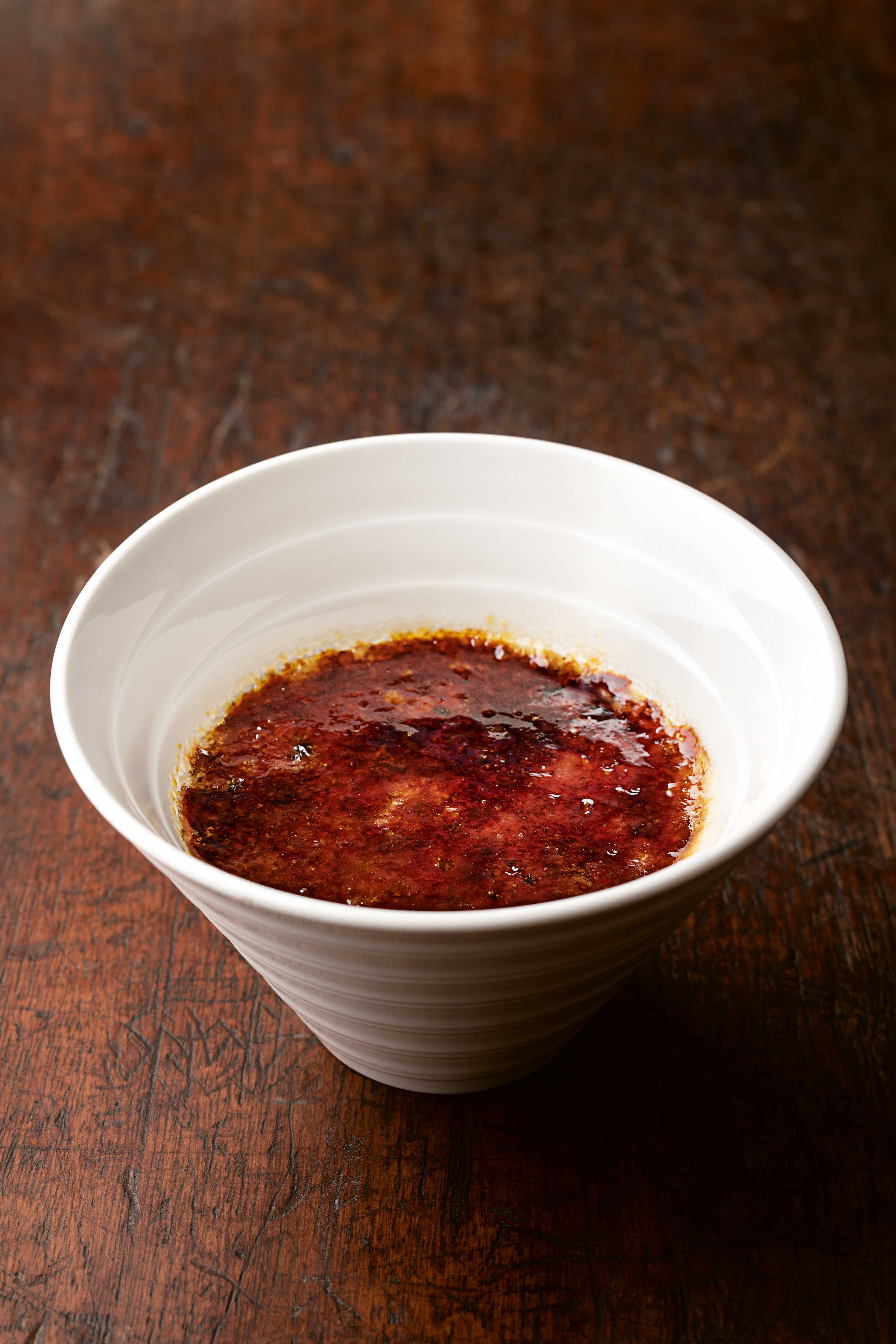
Vanilla crème brûlée is one of those classic desserts that everyone knows about and loves. And it’s been on the menu at The Hand & Flowers right from the very start. As far as I’m concerned, the key to a properly perfect brûlée is to have three distinct flavours that you taste – vanilla, eggs and caramel – so that it’s not just a sweet, creamy dessert. And I’ve got Alex Bentley to thank for teaching me that. This is 100% the brûlée recipe I was cooking as a young chef at Monsieur Max, where he was head chef. I think Alex was given or inherited the recipe from Max Renzland, the restaurant’s chef-patron. Apparently, it was an old Elizabeth David recipe; she must have learnt it during her travels in France, so goodness knows how old it really is.

Until Alex taught this recipe to me, most crème brûlée recipes I’d come across were sweet and made only with egg yolks. This one uses whole eggs and just a small amount of sugar. It was a game changer for me. I suddenly knew how to make a magical crème brûlée. The technique that really brings the dessert to life is its caramelisation on top. Instead of just melting the sugar, Alex taught me to caramelise it really heavily. At Monsieur Max, customers sometimes complained that the sugar was burnt, but that’s the whole point. It’s supposed to be; the caramelisation makes it taste toasty and nutty. You end up with a smooth, vanilla dessert that’s creamy with a bittersweet crunchy topping.

We match it at The Hand & Flowers with an Innis & Gunn craft beer rather than a dessert wine. The beer’s aged in old whiskey barrels so it has this really rich toffee, creamy flavour, which harmonises beautifully with the
crème brûlée.

serves 6

750ml double cream
1 vanilla pod
4 medium free-range eggs
30g caster sugar

Put the cream and vanilla pod into a heavy-based saucepan and bring to the boil over a medium heat. Remove from the heat and leave to infuse for 30 minutes.
Beat the eggs and sugar together in a bowl until smoothly blended. Bring the vanilla-infused cream back to the boil, then slowly pour onto the beaten egg mixture, whisking as you do so to combine.

Pour the mixture back into the pan and cook, stirring constantly, over a medium-low heat until the custard thickens and reaches 88°C (check the temperature with a digital probe). Immediately remove from the heat and pass through a fine chinois into a clean bowl.

Press a layer of cling film onto the surface to prevent a skin forming and leave to cool for 20 minutes or until the custard is at room temperature. Pour the custard into a high-powered jug blender (Vitamix) and blitz for 30 seconds; this will lighten it slightly.

Now pour the custard into crème brûlée dishes or ramekins, dividing it equally (about 125ml per dish). Cover each dish with cling film, leaving a small gap on one side, to allow any moisture to evaporate. Stand the dishes on a tray and place in the fridge to set; this will take about 3 hours.

Caramel glaze
200g demerara sugar

When ready to serve, sprinkle a generous, even layer of demerara sugar over the surface of each set custard. Wipe the edge of the dish with a clean cloth.
Using a cook’s blowtorch, caramelise the sugar, starting from the edges and working towards the centre. Take the caramel to a dark brown – this dish is all about  balancing the rich creamy egg custard with the slightly bitter caramel flavour.
Leave to cool for about 5 minutes before serving.

Cook more from this book
Smoked haddock omelette
Slow cooked duck

Buy this book
The Hand & Flowers Cookbook
£40, Bloomsbury Absolute

Read the review
Coming soon

Slow cooked duck by Tom Kerridge

duck6033

We already had a great little business, but Great British Menu became one of the most pivotal moments in the pub’s history. The programme is very special: it shines the spotlight on quality British produce and showcases food and restaurants around the UK, which is brilliant because that underlines that our world isn’t just about London and the Southeast.

To get to the final, you compete in ‘heats’, and in 2010, my cook-off location was Waddesdon Manor, which is near Aylesbury. So, to me, the obvious thing to cook was something with Aylesbury duck. These ducks taste amazing and they’re from a small-scale producer – everything Great British Menu is about. Since an important part of our Hand & Flowers menu includes chips on the side (we’re a pub, after all), I decided to make the ultimate chips, cooked in duck fat.

I needed peas, too. So, I went down the route of petits pois à la française, except, instead of using bacon, which you’d normally do, I used crisp-fried duck leg confit. And then I finished the dish with a gravy that uses honey from the Waddesdon estate.

It all added up to a winner. I remember one Saturday night after the banquet was televised, we did 84 covers and served 78 portions of duck in one sitting. The success of this dish has been extraordinary.

serves 4

To prepare the duck
2 large Aylesbury ducks, about 2kg each
3 tsp ground mace

Remove the legs and wings from the ducks and take out the wishbone (reserve for the faggots, gravy etc., see right and overleaf). Remove the excess fat and skin, placing it all in a frying pan. Now carefully cut away the backbone; you should be left with the crown.

Place the pan of fat and skin over a low heat to render the fat out. Set aside for later use. Score the skin on the duck crowns and rub in the mace. Heat a heavy-based frying pan over a medium high heat. Add the duck crowns and sear on all sides for 5–10 minutes to render the fat and give the skin a good golden colour. Remove the
duck crowns from the pan and allow to cool.

Put each duck crown into a large vacuum-pack bag and vacuum-seal on full pressure. Immerse in a water-bath at 62°C and cook for 1½ hours. Lift out the vacuum-pack bags and remove the ducks. Carefully cut the breasts from the crowns. Cover and refrigerate until ready to cook.

Duck gravy
500g duck bones and wings, chopped
A little vegetable oil for cooking
4 carrots, peeled and chopped into 3cm pieces
4 celery sticks, cut into 3cm pieces
1 onion, peeled and diced into 3cm pieces
1 garlic bulb, cut across in half, through the equator
150g runny honey
4 cloves
2 litres chicken stock (see page 400)
50ml soy sauce
About 500g unsalted butter
Lemon juice, to taste (optional)
Sea salt and freshly ground pepper

Preheat the oven to 205°C/Fan185°C/Gas 6–7. Put the chopped duck bones and wings into a roasting tray and roast in the oven for about 25–30 minutes until golden brown and caramelised.

Heat a little oil in a large heavy-based saucepan over a medium-high heat. Add the chopped carrots and colour until darkly caramelised. Add the celery, onion and garlic and similarly colour until well browned.

Remove the duck bones and wings from the roasting tray and add them to the saucepan. Drain off the excess fat from the roasting tray, then add the honey and cloves to the tray. Place over a medium heat and take the honey to a dark golden caramel. Add a splash of the chicken stock and the soy sauce to deglaze the tray, stirring to scrape up the sediment.

Add the liquor to the duck bones and vegetables. Pour in the rest of the chicken stock and reduce down by half, to 1 litre. Pass the liquor through a muslin lined sieve into a clean pan and skim off any excess fat from the surface. Add 250g butter to every 500ml duck liquor and reduce down until it has emulsified into the sauce. Season with salt and pepper and add a little lemon juice if required. Set aside for serving.

Duck faggots
250g minced duck leg (skin on)
50g minced chicken liver
50g breadcrumbs
1 medium free-range egg
5g salt
2g cracked black pepper
100g caul fat, soaked in cold water for 30 minutes

Put all the faggot ingredients into a bowl and mix well until evenly combined. Divide and shape the mixture into 50g balls. Wrap each one in caul fat to enclose. Steam the duck faggots at 100°C for 20 minutes. Remove from the steamer and allow to cool, then chill until needed. When ready to serve, preheat the oven to 205°C/Fan 185°C/Gas 6–7.  Place the faggots on a baking tray and bake for 8 minutes. Hold the faggots in the duck gravy until ready to plate up.

Duck legs & peas
2 duck legs
1 star anise
½ cinnamon stick
10 black peppercorns
1 tsp coriander seeds
1 tsp fennel seeds
1 tbsp rock salt
2 bay leaves
About 300ml duck fat
500g freshly podded peas
4 tbsp runny honey
A little vegetable oil for cooking
2 large banana shallots, peeled and finely diced
100ml chicken stock
2 Gem lettuces, finely sliced
20 small mint leaves

Preheat the oven to 150°C/Fan 130°C/ Gas 2. Put the duck legs into a large ovenproof pan or flameproof casserole. Tie the spices together in a muslin bag and add them to the pan with the rock salt and bay leaves. Pour on enough duck fat to cover and bring to the boil over a medium heat. Transfer the pan to the oven and cook for 3½ hours or until the duck legs are soft. Leave them to cool in the duck fat. Once cooled, remove from the fat and place in the fridge. Meanwhile, add the peas to a pan of boiling salted water, bring back to the boil and blanch for no longer than 1 minute. Immediately drain and refresh in iced water. Drain and set aside.

Preheat the oven to 205°C/Fan 185°C/Gas 6–7. Place an ovenproof heavy-based frying pan over a medium-high heat. Add the duck legs, skin side down, and place in the oven for 10–12 minutes to crisp up. Remove the duck legs to a plate and add the honey to the pan. Allow to caramelise, then pour over the duck legs and allow to cool. When ready to serve, heat a little oil in a saucepan over a medium heat. Add the shallots and sweat for 10–15 minutes until softened. Add the peas and stock and bring to a simmer. Meanwhile, flake the duck leg. Stir the duck meat into the peas with the lettuce and mint. Divide between 4 small serving pots.

Duck fat chips
15 large potatoes for chipping
2.5 litres duck fat for deep-frying

Cut a slice from the top and bottom of each potato, then press an apple corer through from top to bottom to make round cylinder chips. Put the cut chips into a colander under cold running water to wash off some of the starches. Now add the chips to a pan of boiling salted water, bring back to a simmer and poach for about 10 minutes until just soft, but still holding their shape. Drain on a perforated tray and leave
to cool.

Heat the duck fat in a deep-fryer to 140°C. Lower the chips into the hot fat in a wire basket and deep-fry for 8–10 minutes until the oil stops bubbling. Remove the chips from the fryer, drain and leave to cool. Set aside until needed. When ready to serve, heat the duck fat to 180°C and deep-fry the chips for about 6–7 minutes until golden
and crispy. Remove, drain on kitchen paper and season with salt.

To serve
2 tbsp runny honey
50g unsalted butter
Pea shoots, to garnish

Just before serving, preheat the oven to 200°C/Fan 180°C/Gas 6. Heat a little oil in a heavy-based ovenproof frying pan over a medium-high heat. Add the duck breasts, skin side down, and fry for 3–4 minutes to crisp up the skin, then place in the oven for 4–5 minutes to heat through. Pour off any excess fat from the pan, then add the honey and butter and turn the duck around in the pan to coat in the honey glaze.
Remove the duck breasts to a warmed plate and rest in a warm place. Increase the heat under the pan to caramelise the honey glaze then pour it over the duck breasts.
Serve the duck breasts with the duck legs and peas, duck faggots, gravy and chips. Finish with a garnish of pea shoots.

Cook more from this book
Smoked haddock omelette
Vanilla crème brûlée

Buy this book
The Hand & Flowers Cookbook
£40, Bloomsbury Absolute

Read the review
Coming soon

Smoked haddock omelette by Tom Kerridge

Smoked-haddock_621

A delicate, beautiful omelette is one of those pure dishes that makes you realise great food does not have to be about hundreds of ingredients on a plate. It’s about allowing a simple product to sing. I learnt that lesson back in the day when I worked for Gary Rhodes and we used to do a lobster omelette which showcased the chef ’s technique rather than putting a load of fancy things on the plate.

This smoked haddock omelette, which has been on The Hand & Flowers menu pretty much since we opened, started off as a lobster one. But I took a sharp, commercial learning curve early on. Starting out, of course, we had no accolades and were relatively unknown, so there was no reason for customers to spend what, at the time, was the equivalent of £30 or £35 on an omelette, even if it had lobster in it!

I still loved the idea of an omelette, so we tried an omelette Arnold Bennett (a fluffy open omelette created at The Savoy in the 1920s for the novelist, playwright and critic). Most people didn’t know who Arnold Bennett was, so we just called it ‘smoked haddock omelette with Parmesan’ and after a first couple of bumpy weeks it became one of our most popular dishes.

There is no reason why this dish should ever change. I can’t improve it. The flavour profile of the humble omelette is heightened with gently poached smoked haddock, a brilliant glaze made from hollandaise sauce and a béchamel sauce flavoured with the fish poaching liquor. So, even the glaze has got that lovely smoked taste, which really drives the flavour.

Actually, this omelette is probably my favourite dish on the menu. I am very pleased to say the lobster version has reappeared at Kerridge’s Bar & Grill in London some 14 or 15 years down the line, and has gone on to become one of our most Instagrammed dishes. Thank you Gary Rhodes…

serves 4

Poached smoked haddock
1 side of smoked haddock, 600g,
skin and pin bones removed
600ml whole milk

Check the smoked haddock for any tiny pin bones. Bring the milk to the boil in a wide-based saucepan. Carefully lay the smoked haddock in the pan, ensuring it is covered by the milk. Place a lid on the pan, turn off the heat and leave the fish to poach in the residual heat for about 10 minutes. Once the haddock is cooked, remove it from the milk and gently flake the fish into a tray lined with greaseproof paper. Cover the tray with cling film and place in the fridge until ready to serve.
Pass the milk through a fine chinois into a clean saucepan and keep to one side.

Smoked fish béchamel
250ml smoked haddock poaching
liquor (see left)
15g unsalted butter
15g plain flour
Sea salt and freshly ground pepper

Bring the smoked haddock poaching liquor to a gentle simmer. In a separate pan over a medium-low heat, melt the butter. Stir in the flour to make a roux and cook, stirring, for 2 minutes. Gradually ladle in the warm poaching liquor, stirring as you do so to keep the sauce smooth. Cook gently over a very low heat for 20 minutes. Pass the sauce through a fine chinois and cover the surface with a piece of baking parchment or cling film to prevent a skin forming. Set aside until needed. (You won’t need all of the fish béchamel but you can freeze the rest.)

Omelette glaze
4 tbsp warm smoked haddock
béchamel (see left)
4 tbsp hollandaise sauce
(see page 403)
4 medium free-range egg yolks
Sea salt and freshly ground pepper

Gently warm the béchamel in a saucepan then pour into a bowl and whisk in the hollandaise and egg yolks. Season with salt and pepper to taste and pass through a chinois into a warm jug or bowl. Keep warm to stop the glaze from splitting.

To assemble & cook the omelette
12 medium free-range eggs
4 tbsp unsalted butter
100g aged Parmesan, finely grated
Sea salt and freshly ground pepper

Crack the eggs into a jug blender and blend briefly to combine. Pass through a chinois into a measuring jug. Place 4 individual omelette pans (we use Staub) over a low heat. Take the smoked haddock from the fridge, remove the cling film and lay on a grill tray. Warm under the salamander or grill. To each omelette pan, add 1 tbsp butter and heat until melted and foaming. Pour the blended egg into the pans, dividing it equally. Using a spatula, gently move the egg around in the pans until they start to firm up. Remove from the heat; you want the eggs to be slightly loose, as they will continue to cook off the heat.

Season the omelettes with salt and pepper and sprinkle the grated Parmesan over their surfaces. Divide the flaked smoked haddock between the omelettes, then spoon on the glaze to cover the fish and extend to the edge of the pans. If the glaze spills over the side of the pan, wipe it away, as this will burn on the side when  blowtorching. To finish, wave a cook’s blowtorch over the surface of the omelettes to caramelise the glaze. Allow the glaze to become quite dark, as the bitterness will balance out the richness of all the other ingredients.

Cook more from this book
Slow cooked duck
Vanilla crème brûlée

Buy this book
The Hand & Flowers Cookbook
£40, Bloomsbury Absolute

Read the review
Coming soon
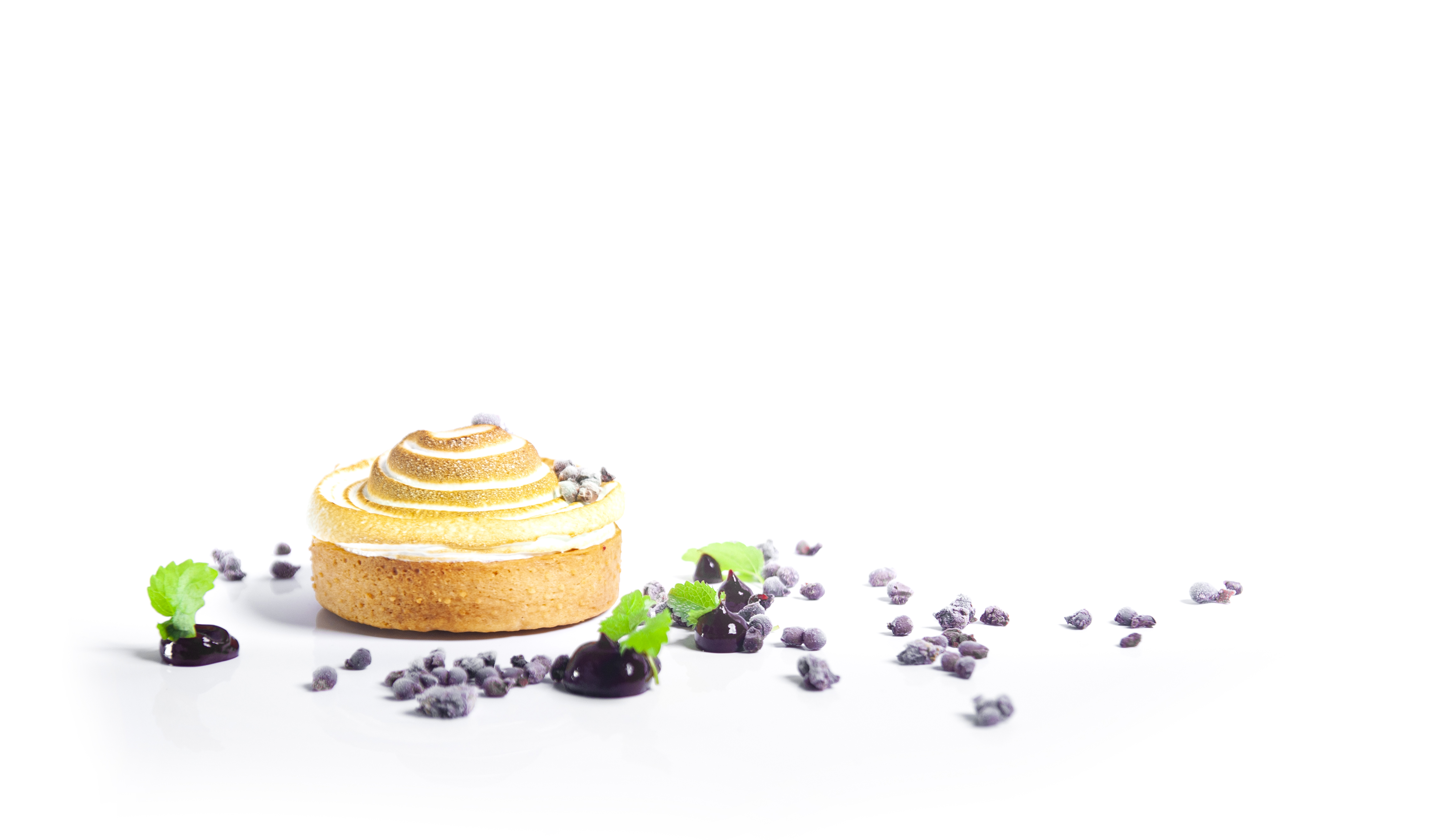
Lemon meringue pie with English blackberries – star anise by Glynn Purnell

Lemon meringue pie
For the blackberry parfait
500ml blackberry purée
1 star anise
160g caster sugar
40ml cold water
75g egg whites
1.5g citric acid
375ml double cream
Packet of popping candy

Slowly bring the blackberry purée and star anise to a boil. Remove from the heat and leave to infuse for 20 minutes. Remove the star anise and pass through a fine sieve.
Prepare some 3-4cm rubber dome moulds.

In a small saucepan, add the sugar and water. Stir gently and place on to a medium heat with a sugar thermometer in the pan.

Put the egg whites into an electric mixer bowl with the whisk attachment fitted.
When the sugar syrup reaches 100°c, begin whisking the egg whites slowly. As the syrup reaches 110°c, increase the whisking speed of the egg whites. When the syrup reaches 116°c, the egg whites should have formed soft peaks.

Remove the syrup from the heat and slowly add the syrup to the egg whites, whisking constantly. Once all the syrup has been added to the egg whites, turn the electric mixer speed up and continue whisking until the meringue is thick, glossy and cool.

In a large round bowl, semi-whip the double cream. Fold 350ml infused Blackberry purée and citric acid into the cooled Italian meringue, then fold into the semi-whipped cream in two stages. Add the popping candy to taste, then pipe into dome moulds, smoothing the tops with a palette knife. Freeze the parfait in the moulds for 24 hours.

For the sweet pastry
270g salted butter
180g caster sugar
2 large eggs
540g plain flour

In an electric mixer with the paddle attachment fitted, cream the butter and sugar together, do not over-mix. Beat in the eggs one at a time, until the mixture is smooth.
Sift the flour and fold into the mix gently until it just starts to come together. Turn the dough out onto a clean surface and finish by hand to ensure the dough is not over worked.

Divide into two, flatten to 2 cm in thickness and cling film. Reserve in the fridge for up to ten days or freeze for up to four weeks.

Preheat oven to 160°c.

Roll the pastry to 2mm in thickness and line some 8cm tart cases with the pastry. Cover the pastry with cling film or silicon paper and fill with baking beans.
Blind bake for 12 minutes, then remove the baking beans. Return to the oven for a further five minutes or until the pastry is golden brown. Remove from the oven and leave to cool.

Once completely cool, remove from the tart rings and store in an airtight container lined with food safe silica gel. Keep in a cool, dry place.

For the lemon curd
12 large lemons
450g caster sugar
300g salted butter, diced
540g eggs
600g egg yolks

Zest the lemons and reserve the zest. Juice the lemons. You need 600ml of lemon juice. In a medium sized saucepan bring the juice up to a boil. Turn the heat down to a simmer and reduce the lemon juice to approximately 150ml. It should resemble a glaze and be a slightly deeper colour. Empty the reduced lemon into a clean saucepan and add the sugar and butter. Bring this to a boil, stirring often.

Once boiling and all the butter has melted, whisk in the eggs and egg yolks and cook out over a medium heat, until the curd is thick. Remove from the heat and stir in the lemon zest. Cover in a clean bowl with cling filmed pressed down to touch the lemon curd. This prevents condensation and water dripping onto the curd. Leave to cool in the fridge. Once cool, place the curd in a jug blender and blend until smooth. Reserve in vacuum pac bags in the fridge until needed.

For the Italian meringue
250g caster sugar
250g water
15g SOSA Albumina powder (dried egg whites)

In a suitable sized saucepan, bring 200g of the sugar and 120g of the water up to 118°c over a medium heat. While the sugar syrup is coming up to temperature, place the Albumina powder, 50g caster sugar and 130g water into an electric mixer bowl. Using a hand whisk, gently mix the ingredients together, then place the bowl onto the electric mixer.

When the sugar syrup reaches 100°c, begin whisking the egg whites slowly. As the syrup reaches 110°c, increase the whisking speed of the egg whites. When the syrup reaches 118°c, the egg whites should have formed stiff peaks.

Remove the syrup from the heat and slowly add the syrup to the egg whites, whisking constantly. Once all the syrup has been added to the egg whites, turn the electric mixer speed up and continue whisking until the meringue is cool.
Decant the meringue into piping bags and store in the fridge or freezer for up to two days.

For the blackberry and star anise gel
1 litre blackberry purée
4 star anise
0.5g vanilla powder
10g agar-agar

In a medium-sized saucepan, bring the blackberry purée, star anise and vanilla powder to a boil, whisking occasionally. Remove from the heat and leave to infuse for ten minutes. Place the pan back onto the heat and bring back to a boil. Once boiling, remove the star anise and put to one side. Add the agar-agar and continuously whisk and cook for two minutes to activate the agar-agar. Pour the mix into a lightly greased, high sided tray and leave to set for two hours in the fridge.

Remove the set gel from the tray and roughly chop. Place into a Thermomix blender and blend on a medium-high speed for two minutes. Turn the blender off, scrape the sides of the jug down and blend again for two minutes on a medium-high speed, until you have a smooth and glossy gel.

Store in vacuum pac bags for freshness. Place into a squeezy bottle for service.
Wash the star anise to remove any purée, then dehydrate to completely dry out.
Once dry, blend the star anise in a spice grinder to a fine powder. Seal in a vacuum pac bag to reserve.

For the frozen blackberries
2 punnets of fresh blackberries
Liquid nitrogen

Wash the blackberries and dry them on kitchen towel. Put the blackberries into an insulated nitrogen container. Completely submerge the blackberries in liquid nitrogen and leave for three minutes. Once the blackberries have completely frozen, lift them out of the nitrogen with a slotted spoon and place into a large sous vide bag. Fold the ends of the bag over and lay the bag on a flat surface with one hand covering the folded end. Bash and roll the frozen blackberries with a rolling pin so the filaments separate. Empty the bag into a small metal Gastronorm container and half cover with liquid nitrogen. Reserve in the freezer until needed.

To serve
Lemon balm
Star anise powder

Pipe the lemon curd into a cooked pastry case and smooth the top with a palette knife. Place a dome of parfait in the centre of the tart on top of the lemon curd. Place the tart case onto a pastry turntable and start turning on a low speed. Fit the desired piping nozzle onto a piping bag with the Italian meringue and pipe your desired pattern onto of the tart, starting in the centre of the top of the parfait and working down as the tart spins on the turntable. Once the meringue is piped, lightly colour the meringue with a blowtorch. On a large flat white plate, sporadically pipe dots of differing sizes of the blackberry gel. Place the tart on top of one of the dots or around the centre of the plate. Refresh the frozen blackberries in liquid nitrogen and spoon liberally around the plate. Garnish with lemon balm and a pinch of star anise powder.

Cook more from this book
Monkfish masala with red lentil
Haddock and Eggs – Cornflakes – curry oil by Glynn Purnell

Buy this book
A Purnell’s Journey
£85, A Way With Media
Also available at Amazon: There And Back Again: A Purnell’s Journey

Read the review

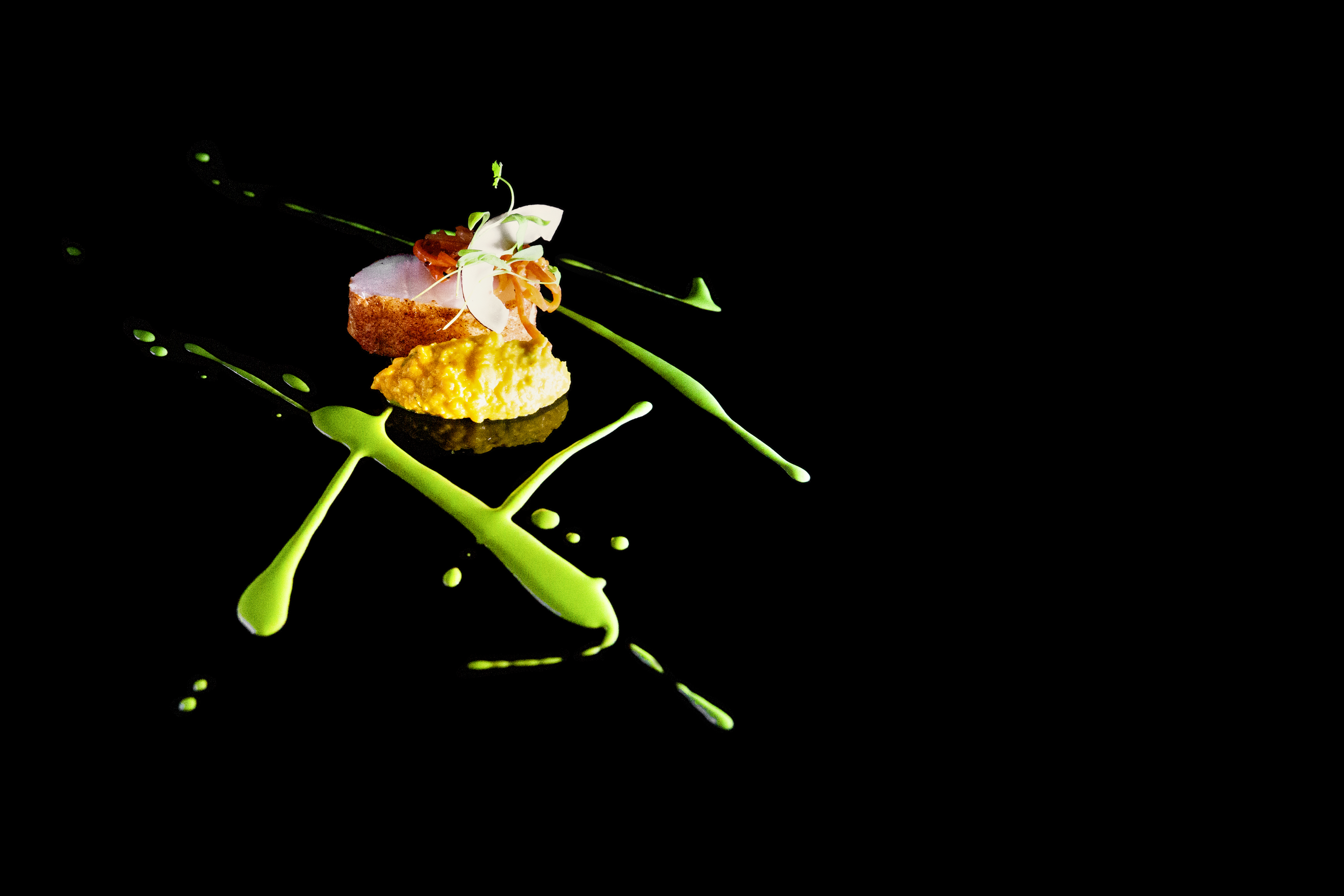
Monkfish Masala with Red Lentils, Pickled Carrots and Coconut Garnish by Glynn Purnell

Monkfish masala
SERVES 4

FOR THE PICKLED CARROTS
3 CARROTS, PEELED AND SLICED
1 TABLESPOON FENUGREEK SEEDS
1 TEASPOON AJWAIN SEEDS
1 TEASPOON BLACK MUSTARD SEEDS
½ TEASPOON ONION SEEDS
1 TEASPOON CUMIN SEEDS
1/3 TEASPOON CHILLI FLAKES
1 TEASPOON SALT
VEGETABLE OIL – ENOUGH TO COVER THE CARROTS
1. Preheat the oven to 90˚c / gas mark ¼, or the lowest setting.
2. Spread the carrot slices out on a baking tray and put in the oven overnight, or for 8 hours, until dried out. Pack the carrot slices into a sterilised airtight jar.
3. Mix all the spices and salt with enough vegetable oil to cover the carrots, pour over the carrots in the jar and seal. Leave for a couple of weeks (longer if you can) in a cool place before serving.

FOR THE MONKFISH
300G ROCK SALT
4 X 130G MONKFISH FILLETS
4 TABLESPOONS MASALA SPICE MIX
25G BUTTER
4. Sprinkle the salt over the monkfish fillets and leave for 5-6 minutes to draw out the moisture.
5. Rinse the salt off thoroughly under cold running water. Wrap the monkfish in a clean tea towel and leave overnight in the fridge.
6. Spread out the spice mix on a plate and roll the monkfish fillets in the mixture. Seal each fillet in a vacuum food bag and cook for 11 minutes in a water bath at 63˚c. Alternatively, wrap each fillet in heatproof clingfilm. Heat a saucepan of water until it reaches 63˚c on a cooking thermometer, add the wrapped fillets and cook for 11 minutes, keeping the temperature constant.
7. Melt the butter in a frying pan over a medium heat until foaming. Remove the fish from the bags or clingfilm and then sear on each side for 2-3 minutes until golden brown and crisp all over.

FOR THE RED LENTILS
SPLASH OF VEGETABLE OIL
½ ONION, PEELED AND CHOPPED
1 TABLESPOON MILD CURRY POWDER
225G DRIED RED LENTILS
500ML CHICKEN STOCK
½ RED CHILLI, FINELY CHOPPED
2 HEAPED TABLESPOONS CHOPPED CORIANDER
JUICE OF ½ LIME
SALT
8. Heat a splash of vegetable oil in a saucepan and sweat the onion over a gentle heat for 4-5 minutes until softened. Stir in the curry powder, then add the lentils, stir well and cover with the stock. Simmer for 10-15 minutes, or until the lentils are tender.
9. When the lentils are cooked, stir in the chilli, coriander and lime juice and season to taste with salt. Set aside.

FOR THE COCONUT GARNISH
400ML CAN FULL-FAT COCONUT MILK
1 KAFFIR LIME LEAF
PINCH OF SALT
½ FRESH COCONUT, FLESH ONLY, THINLY SLICED INTO STRIPS ON A MANDOLIN
10. Pour the coconut milk into a saucepan and add the lime leaf and salt. Simmer over a medium heat for about 15-20 minutes until reduced by half.
11. Heat a frying pan until hot and toast the coconut strips for about 2 minutes until golden brown and fragrant.

TO SERVE
CORIANDER SHOOTS (SPROUTED CORIANDER SEEDS), TO GARNISH
12. Spoon the lentils onto each serving plate. Carve each monkfish fillet in half and place one piece of monkfish on top of the lentils and the other piece next to them. Drizzle over a bit of the reduced coconut milk, then garnish with the toasted coconut strips, pickled carrots and coriander shoots.

Cook more from this book
Haddock and Eggs – Cornflakes – curry oil
Lemon meringue pie

Buy this book
A Purnell’s Journey
£85, A Way With Media
Also available at Amazon: There And Back Again: A Purnell’s Journey

Read the review

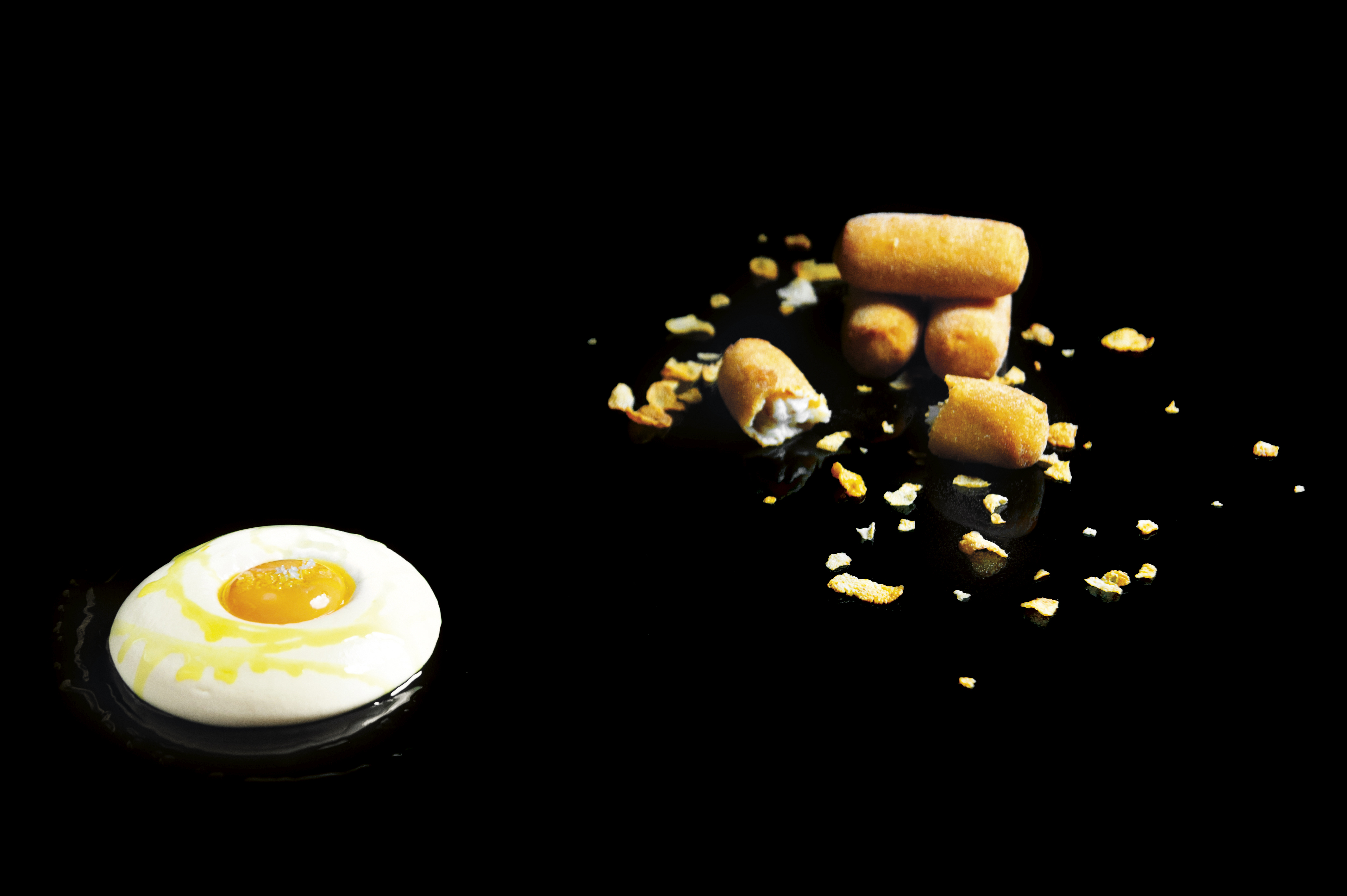
Haddock and Eggs – Cornflakes – curry oil by Glynn Purnell

haddockegg-1
For the Haddock Milk Foam
4 litres whole milk
2 fillets yellow dyed haddock
2 fillets Arbroath smokies
Trim from 6 fillets naturally smoked haddock including skin etc
(this is the trim from the home-cured smoked haddock and in the brandade mix)
54g Agar
6g Xantham Gum

1. In a large saucepan, heat all fish in the milk and slowly bring to a boil while stirring occasionally.
2. Once boiled, remove from heat and transfer to a large container and cool at room
temperature. Cover and leave to infuse in the fridge for 24 hours.
3. Pass into a clean container. Remove 3 litres of the infused milk and reserve the rest in the fridge until needed.
4. Bring 3 litres of the haddock infused milk to the boil with the Agar, whisking occasionally. Once boiling, whisk continuously for two minutes.
5. Remove from heat and pass into a clean container. Leave to set in the fridge for a minimum of 12 hours, or until fully set.
6. Once set, blend back with 900ml of the reserved haddock milk and Xantham gum.
7. Split into 450g portions and seal in vac pac bags. Reserve in the fridge until needed.
Always weigh the haddock milk to check the ratios are correct. If you have less then 3900ml, use these ratios to adjust the mix as necessary:
18g Agar Agar per litre
1.75g Xantham Gum per litre
Blend back with 300ml of haddock milk per litre

For the Smoked Eel Brandade
140g smoked eel, diced
70g cod
70g smoked haddock
120g salted butter, softened
120g warm dry mash potato
1 lemon
Milk, to cover

1. Place the smoked eel and fish into a saucepan.
2. Cover the fish in milk, bring to a simmer and cook gently.
3. Once the fish is cooked, pass off the mixture, reserving the milk and keeping it warm.
4. Mix the cooked fish mixture with the warm mash potato.
5. Put the fish and potato mixture into an electric mixer with a paddle attachment fitted. Beat in the softened butter for 30 seconds.
6. Add 20ml of the reserved milk and beat until fully incorporated. Add more if the mix is too dry.
7. Season with the zest and juice of the lemon.
8. Pipe into even ballotines on top of cling film. The ballotines should be approx. 1.5 inches in diameter and 20 inches in length. Roll the ballotine in the cling film to form a tube and twist the ends of the cling film over and over until they can’t twist any more. This should form an airtight tube and the ends of the ballotine should be sealed up due to the pressure. Tie these ends to seal and freeze the brandade mixture.
9. Set up a pane station with flour, beaten egg and a 50:50 mixture of breadcrumbs and cornflake crumbs.
10. Carefully remove all the clingfilm from the brandade ballotines and portion into 3-inch cylinders.
11. Pane the cylinders in the flour, egg and breadcrumb and cornflake mix. Reserve on a tray in the fridge until needed.

For the Curry Oil
1 litre sunflower oil
2 tablespoons mild curry powder

1. Place the oil and curry powder into a large vac pac bag and seal to remove all air.
2. Place into a water bath at 65˚c for four hours. Remove and leave in the fridge for 12 hours.
3. Hang the mixture through a muslin cloth set over a bowl but do not push through. Vac pac the passed oil into medium bags and reserve in the fridge until needed.
4. Decant the oil into squeezy bottles once it is at room temperature.

For the smoked haddock
6 haddock fillets
Coarse rock salt
Sunflower oil

1. Skin the haddock fillets.
2. Submerge in the salt for 4 minutes.
3. Removed the haddock from the salt. Thoroughly wash off the salt and dry.
4. Rub the haddock fillets in sunflower oil.
5. Set up a hot smoker with oak chips. When the smoker is ready, place the fillets on to the wire rack and smoke for 10 minutes.
6. Remove the haddock fillets from the smoker and leave to cool completely. Seal in a vac pac bag and keep in the fridge until needed.

For the Baked Cornflakes
250g Cornflakes
250g salted butter, melted
10tbsp milk powder
2tbsp caster sugar
1tsp table salt

1. Preheat oven to 140˚c.
2. Mix all the ingredients together. Spread out evenly onto a tray lined with a silpat mat. Bake in the oven for 10 minutes.
3. Remove from the oven. Once cooled, place in a blender and pulse blend until a crumb-like consistency is achieved. Reserve in an airtight container until needed.
To serve one portion
1. Deep fry the brandade croquettes at 170˚c for 2-3 minutes until golden and crispy. Remove and drain.
2. Heat 40g of the smoked haddock in the oven until warm.
3. Separate an egg yolk, removing all the white, and carefully drop the yolk into a pan of water at 50-55˚c. Poach gently for no longer than two minutes. The yolk should be just sealed on the outside.
4. Place the haddock into the bottom of the serving bowl. Sprinkle with a pinch of chopped chives, a splash of curry oil and add a teaspoon of the baked cornflakes.
5. Get the ISI gun containing the haddock foam. Give it a good shake and squeeze gently to form a dome of haddock foam which should just cover the haddock in the bottom of the bowl.
6. Carefully remove the poached egg yolk from the water and place into the centre of the haddock foam. Season with sea salt and drizzle the top with curry oil. Serve with a brandade croquette on the side.

Cook more from this book
Monkfish masala with red lentils
Lemon meringue pie

Buy this book
A Purnell’s Journey
£85, A Way With Media
Also available at Amazon: There And Back Again: A Purnell’s Journey

Read the review