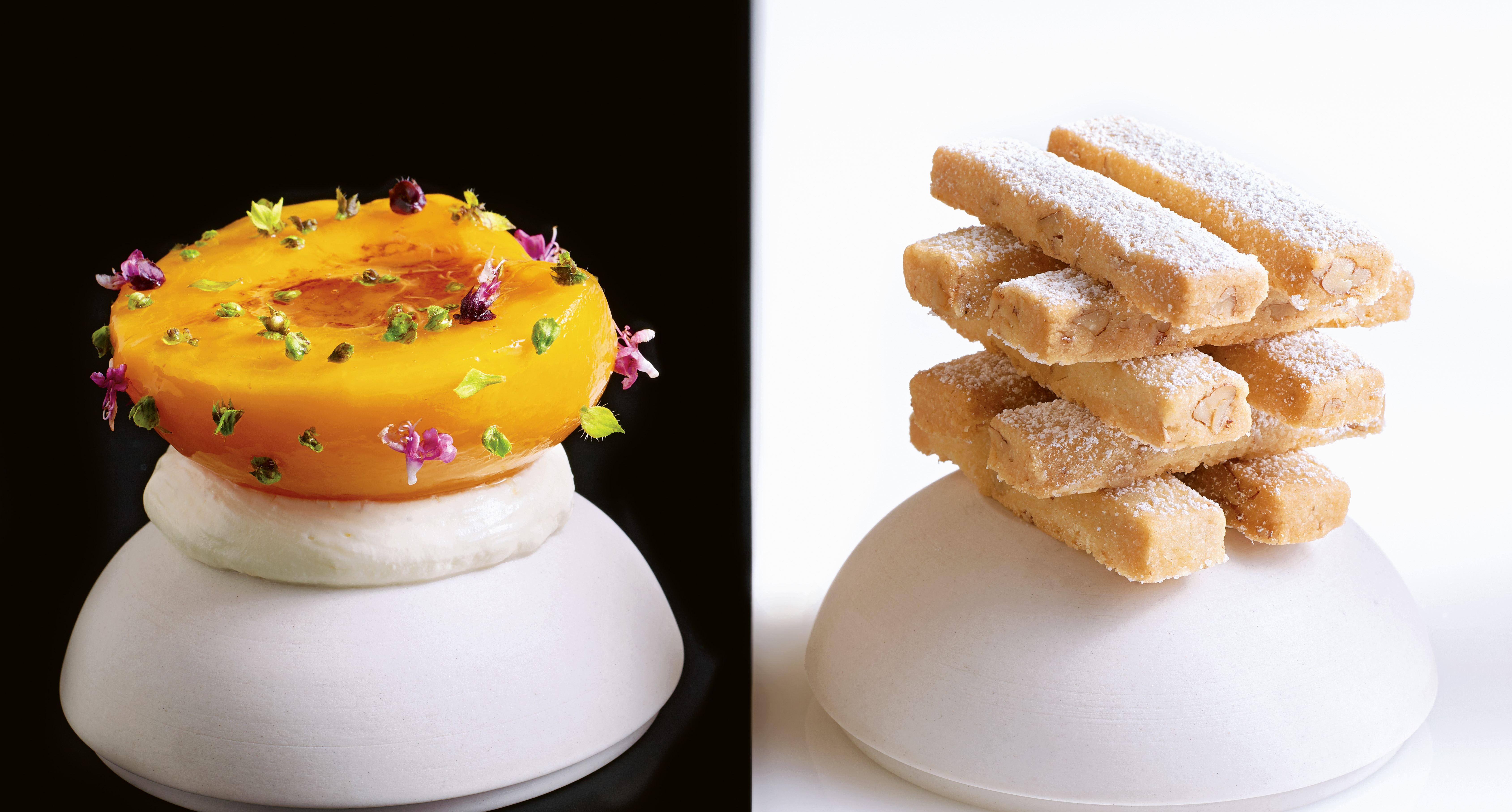
Peaches ‘N’ Cream by Thomas Keller

p.302 Peaches and Cream_THE FRENCH LAUNDRY, PER SE

Peaches ’n’ Cream
Whipped Ricotta and Pecan Sandies

Makes 10 servings

Canned Peaches
1,000 grams water
200 grams granulated sugar
20 grams ascorbic acid
5 freestone yellow peaches

Pecan Sandies
240 grams whole butter, at room temperature
63 grams confectioners’ sugar, plus extra for dusting
5 grams kosher salt
284 grams all-­purpose flour
100 grams raw pecans, chopped

Whipped Ricotta
15 grams granulated sugar
15 grams water
300 grams whole-­milk ricotta
Seeds from 1 vanilla bean
Zest of 1 lemon
200 grams mascarpone cheese
100 grams crème fraîche

Peach-­Scented Jelly
3 sheets silver leaf gelatin
50 grams lemon juice
To Complete
Fresh basil buds
Maldon salt

Special Equipment
Combi oven (optional)

The Napa Valley has some of the most amazing peaches you will ever taste, and at The French Laundry we are lucky enough to get the best of the bunch, all picked at perfect ripeness. But when they’re in the full flow of the summer season, they drop off the trees in such abundance that we can’t possibly serve them all. So we do what farms and households have been doing for hundreds of years: we put them up—preserve them. The process actually intensifies the flavor of the peaches and gives us the syrup they’re preserved in as a fabulous by-­product to include with their preparation. We usually can about 15 quarts of peaches in the summer; then we serve them around Christmastime, a special summer treat near the winter holidays. (Use perfectly ripe peaches with no bruises for canning. Firmer varieties work best; if they’re too soft, they can lose their shape.)

The syrup is seasoned with lemon and sugar, thickened with gelatin, and brought just to the setting point to create a thick, shiny glaze over the cold peaches. We finish the peach with basil buds from the garden (Genovese basil produces a white flower, Thai basil and lime basil produce a beautiful pink flower, and opal basil has a purple flower). We serve it with something creamy, here our housemade ricotta with mascarpone and crème fraîche, seasoned with vanilla and citrus. And for crunch, pecan sandies seem to be everyone’s favorite.

For the Canned Peaches
Stir together the water and sugar in a 2-­quart (2-­liter) saucepot (this is a 20% sugar solution). Heat just enough to dissolve the sugar without reducing the liquid and keep warm while you blanch the peaches.

Prepare an ice-­water bath and have it close to the cooktop. Bring a large pot of water to a rolling boil. Dissolve the ascorbic acid in 4,000 grams (4 quarts/4 liters) water in a 6-­quart (6-­liter) container and set aside.

Score the skin (not the flesh) of the bottom of the peach with a small 1-­inch (2.5-­centimeter) X. Drop 2 of the peaches into the boiling water and blanch for 30 to 40 seconds (see Note). Using a long-­handled slotted spoon, immediately transfer the peaches to the ice-­water bath to prevent further cooking. Using a paring knife, gently peel the peaches and set them on a tray. Repeat to blanch and peel the remaining peaches.

Cut the peaches vertically in half; separate the halves and remove the pits. Check the inside of the peaches to ensure they are good quality, with no mold or bugs. Drop the peaches into the ascorbic acid solution to prevent oxidation while you sterilize the jar.

If you have a combi oven, sterilize a clean 1-­quart (1-­liter) mason jar at 100°C (212°F) for 10 minutes. Otherwise, place a wire rack at the bottom of a large pot, fill the pot with enough water to submerge the jar, and bring the water to a boil. Place the jar on the rack in the pot, making sure it is submerged, and boil for 10 minutes. During the last minute, add a slotted spoon to sterilize it as well.

Meanwhile, bring the sugar solution to a gentle simmer. Remove the peaches from the ascorbic acid solution and place them in the sugar solution. Gently simmer for 3 minutes, then remove the pan from the heat. Using clean tongs, transfer the jar to a clean kitchen towel.

Keeping the jar free from any foreign contamination at this point is crucial; you want to keep a clean, sterile environment within the jar. Tilt the jar and, using the sanitized slotted spoon, gently scoop one peach half at a time from the sugar solution and lower it into the jar, rounded-­side down, until all the peach halves are in the jar. Return the sugar solution to a boil, then pour it into the jar, covering the peaches and leaving 1 inch (2.5 centimeters) of headspace at the top of the jar. Gently tap the jar on the counter to remove any air bubbles trapped by the peaches.

Place the lid on the jar and tighten it to fingertip-­tight (just until you feel resistance) to allow air to escape during the canning process. If you have a combi oven, process the jar at 100°C (212°F) for 20 minutes. Otherwise, check the pot you used to sterilize the jar; if there is not enough water to keep the jar submerged, add additional water. Bring the water to a boil. Stand the canning jar on the rack in the pot, making sure it is submerged, and boil for 20 minutes.

Remove the jar, tighten the lid all the way, and stand the jar upside down on the counter. Let cool to room temperature. Turn the jar right-­side up, clean the outside of the jar, check the lid for a proper seal, and label it with the date. Press the center of the lid; if it pops, the jar is not properly sealed. Remove the cap, reseal it, then steam or process in boiling water as before.

Properly sealed, the peaches will keep without refrigeration in an area not exposed to light for up to 6 months. The ideal temperature for long-­term storage is 40° to 70°F (4.5° to 21°C). After the jar has been opened, the peaches will keep in the refrigerator for up to 1 week. Always use a clean utensil, never your fingers, to remove peaches from the jar.

For the Pecan Sandies
Preheat the oven to 325°F (163°C). Line a sheet pan with a nonstick silicone baking mat.

In the bowl of a stand mixer fitted with the paddle, combine the butter, confectioners’ sugar, and salt. Beginning on low speed and gradually increasing to medium, cream the mixture until light and fluffy, about 3 minutes. Add the flour and pecans and mix on low speed until just combined, being careful not to crush the pecans. Transfer the dough to a work surface and press it with the heel of your hand as necessary to bring it together.

Place the pecan dough between two sheets of parchment paper and roll it out to ¼ inch (6 millimeters) thick, doing your best to keep a rectangular shape. From time to time, lift the top sheet of parchment and, using a dough cutter, push the edges to straighten them. (Keeping the dough a uniform rectangle will give a higher yield when cutting the cookies.) Slide the parchment onto a sheet pan and refrigerate for at least 1 hour and up to 24 hours, or wrap in plastic wrap and freeze for up to 3 months. (If frozen, defrost before baking.)

Cut the cookie dough into 2 by ½-­inch (5 by 1.25-­centimeter) batons. Using a small offset spatula, transfer them to the lined sheet pan, leaving 1 inch (2.5 centimeters) between them. Bake for 10 to 13 minutes, until golden.

Meanwhile, put some confectioners’ sugar in a small fine-­mesh sieve. Remove the cookies from the oven and, while they are still hot, immediately dust the tops with confectioners’ sugar. Let cool.

The cookies can be stored in an airtight container for up to 3 days.

For the Whipped Ricotta
Heat the sugar and water in a small saucepot just enough to dissolve the sugar. Remove from the heat and let the simple syrup cool completely.

In the bowl of the stand mixer fitted with the whisk, whisk together the ricotta, vanilla seeds, and lemon zest until well combined. Add the mascarpone and whisk until smooth. Add the crème fraîche and whisk until smooth. Finally, whisk in the simple syrup. Refrigerate in an airtight container for up to 5 days.

For the Peach-­Scented Jelly
Submerge the gelatin in a bowl of ice water to bloom (soften) for about 5 minutes.

Set a cooling rack over a half sheet pan. Open the jar of peaches and pour 250 grams of the syrup into a small saucepot. Arrange the peach halves cut-­side up on the rack and refrigerate while you make the jelly.

Add the lemon juice to the syrup in the saucepot and bring to a simmer. Remove from the heat. Remove the softened gelatin from the ice water and squeeze out any excess water. Add the gelatin to the hot syrup and whisk to dissolve. Strain the syrup through a chinois or fine-­mesh strainer into a bowl and nestle the bowl in an ice-­water bath to cool, stirring from time to time. Watch closely; as the syrup cools, it will begin to set, and you need to catch it right at the setting point, when it has thickened and begun to gel but still has fluidity. When the syrup reaches this point, remove the peaches from the fridge and spoon the syrup over them in a thick layer. Refrigerate to set the jelly completely, at least 4 hours and up to 24 hours.

To Complete
Remove the peaches from the refrigerator. Crush the basil buds lightly between your fingers to release their scent and flavor and sprinkle them over the peaches. Finish each peach with a little Maldon salt.

Place a large spoonful of the whipped ricotta in each serving bowl or on serving plates. Gently rest a peach half on top, cut-­side up. Serve with a stack of pecan sandies on a plate alongside.

Note
Blanching peaches loosens their skins, making them easier to peel. The heat helps to separate the skin from the peach so the peels slip off.

Excerpted from The French Laundry, Per Se by Thomas Keller (Artisan Books). Copyright © 2020. Photography by Deborah Jones.

Cook more from this book
Fish and Chips
The Whole Bird

Read the review
Coming soon

Buy this book
French Laundry, Per Se, The (Thomas Keller Library)
£60, Artisan
A Love for Food by Carole Bamford

A Love For Food Carole Bamford

What’s the USP? An updated edition of the 2013 cookbook from the none-more-middle-class Daylesford organic farm in the Cotswolds.

Who wrote it? According to her website  ‘Carole Bamford has been a champion of sustainable, mindful living for over 40 years. As the founder of Daylesford Organic, she is recognised as a visionary in organic farming and food retail.’ She is also the wife of Brexit-backing JCB billionaire Lord Anthony Bamford.

Will I have trouble finding the ingredients? Not if you pop along to a Daylesford Organic store. The ‘flagship’ on the farm in Kingham is as jaw-droppingly lovely as it is expensive (there are a number branches in London too). You can also buy Daylesford Organics produce through Ocado.  That said, you will have little trouble tracking down the ingredients for most of the recipes at your local supermarket, (stick to the organic aisle if you want to keep in Lady Carole’s good books).

How annoyingly vague are the recipes? If you read the introduction (and the  acknowledgements page at the back of the book – does anyone do that apart from me?) you’ll discover that long serving Daylesford chef John Hardwick ‘created’ the recipes and a great job he’s done of them too.

Little details like giving not just the diameter of the pastry case for a Bledington Blue Cheese and Broccoli tart, but the depth too make all the difference. In this instance, you now know exactly what cookware to use to ensure you get the correct ratio between tart and filling – too often recipes need trial and error to get just right.

Not every recipe is perfect however; Ginger Biscuits were a cakey disaster for me (according to a chef friend who I consulted after my disappointing effort, the mixture should have been chilled before baking which is not stipulated in the book).

What’s the faff factor? The recipes are very much designed for the home kitchen. Some, like home made corned beef,  will take time and planning ahead but most will be plain sailing for any keen cook.

How often will I cook from the book? A Love for Food is definitely the sort of volume you’ll be glad to have on your shelf when it comes time to plan your weekly menus (which, if you read this blog is almost certainly something you do). It will be well thumbed and food spattered in no time. There are also a decent number of baking, pickling and preserving projects for when you have more time on your hands (for example, during a pandemic).

Killer recipes: Slow cooked lamb shoulder with white beans and salsa verde; curried cauliflower, red pepper and nigella seeds; Rita’s baked eggs and onions; ham hock terrine with piccalilli; seven seed sourdough; vanilla rice pudding with apple and blackberry compote.

What will I love? At nearly 400 pages, there’s room for 150 recipes that cover everything from breakfast, things ‘on toast’, egg dishes, soups, salads and vegetables to savoury tarts and pies, fish, meat, puddings and baked goods, so you’re getting a lot of bang for your buck.

What won’t I like so much? Not applicable.

Is it good bedtime reading? A three page introduction is supplemented by articles on sustainablility and the environment, the market garden, Daylesford’s creamery and cheese room, it’s bakery and the farm’s animals. In addition there are page long introductions to every chapter and each recipe has its own introduction. In short, plently to keep you informed and entertained outside of the kitchen.

Should I buy it? It looks great the recipes are varied and enticing and it’s a good read. What’s not to love?

Cuisine: British
Suitable for: Confident home cooks/professional chefs
Cookbook Review Rating: Four stars

Buy this book
A Love for Food: Recipes from the Fields and Kitchens of Daylesford Farm
£30, Square Peg

Vanilla crème brûlée by Tom Kerridge

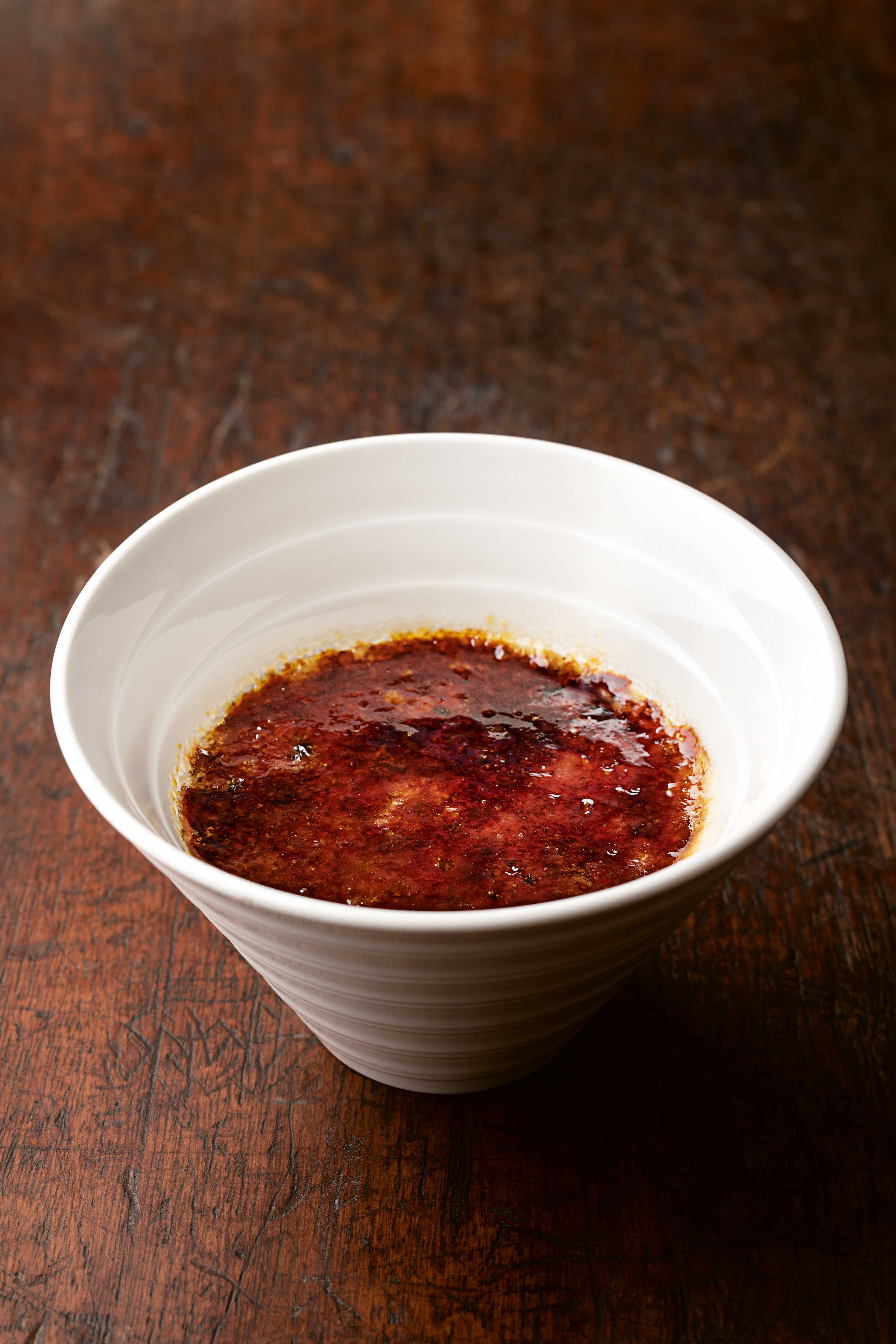
creme brulee6363

Vanilla crème brûlée is one of those classic desserts that everyone knows about and loves. And it’s been on the menu at The Hand & Flowers right from the very start. As far as I’m concerned, the key to a properly perfect brûlée is to have three distinct flavours that you taste – vanilla, eggs and caramel – so that it’s not just a sweet, creamy dessert. And I’ve got Alex Bentley to thank for teaching me that. This is 100% the brûlée recipe I was cooking as a young chef at Monsieur Max, where he was head chef. I think Alex was given or inherited the recipe from Max Renzland, the restaurant’s chef-patron. Apparently, it was an old Elizabeth David recipe; she must have learnt it during her travels in France, so goodness knows how old it really is.

Until Alex taught this recipe to me, most crème brûlée recipes I’d come across were sweet and made only with egg yolks. This one uses whole eggs and just a small amount of sugar. It was a game changer for me. I suddenly knew how to make a magical crème brûlée. The technique that really brings the dessert to life is its caramelisation on top. Instead of just melting the sugar, Alex taught me to caramelise it really heavily. At Monsieur Max, customers sometimes complained that the sugar was burnt, but that’s the whole point. It’s supposed to be; the caramelisation makes it taste toasty and nutty. You end up with a smooth, vanilla dessert that’s creamy with a bittersweet crunchy topping.

We match it at The Hand & Flowers with an Innis & Gunn craft beer rather than a dessert wine. The beer’s aged in old whiskey barrels so it has this really rich toffee, creamy flavour, which harmonises beautifully with the
crème brûlée.

serves 6

750ml double cream
1 vanilla pod
4 medium free-range eggs
30g caster sugar

Put the cream and vanilla pod into a heavy-based saucepan and bring to the boil over a medium heat. Remove from the heat and leave to infuse for 30 minutes.
Beat the eggs and sugar together in a bowl until smoothly blended. Bring the vanilla-infused cream back to the boil, then slowly pour onto the beaten egg mixture, whisking as you do so to combine.

Pour the mixture back into the pan and cook, stirring constantly, over a medium-low heat until the custard thickens and reaches 88°C (check the temperature with a digital probe). Immediately remove from the heat and pass through a fine chinois into a clean bowl.

Press a layer of cling film onto the surface to prevent a skin forming and leave to cool for 20 minutes or until the custard is at room temperature. Pour the custard into a high-powered jug blender (Vitamix) and blitz for 30 seconds; this will lighten it slightly.

Now pour the custard into crème brûlée dishes or ramekins, dividing it equally (about 125ml per dish). Cover each dish with cling film, leaving a small gap on one side, to allow any moisture to evaporate. Stand the dishes on a tray and place in the fridge to set; this will take about 3 hours.

Caramel glaze
200g demerara sugar

When ready to serve, sprinkle a generous, even layer of demerara sugar over the surface of each set custard. Wipe the edge of the dish with a clean cloth.
Using a cook’s blowtorch, caramelise the sugar, starting from the edges and working towards the centre. Take the caramel to a dark brown – this dish is all about  balancing the rich creamy egg custard with the slightly bitter caramel flavour.
Leave to cool for about 5 minutes before serving.

Cook more from this book
Smoked haddock omelette
Slow cooked duck

Buy this book
The Hand & Flowers Cookbook
£40, Bloomsbury Absolute

Read the review
Coming soon

Slow cooked duck by Tom Kerridge

duck6033

We already had a great little business, but Great British Menu became one of the most pivotal moments in the pub’s history. The programme is very special: it shines the spotlight on quality British produce and showcases food and restaurants around the UK, which is brilliant because that underlines that our world isn’t just about London and the Southeast.

To get to the final, you compete in ‘heats’, and in 2010, my cook-off location was Waddesdon Manor, which is near Aylesbury. So, to me, the obvious thing to cook was something with Aylesbury duck. These ducks taste amazing and they’re from a small-scale producer – everything Great British Menu is about. Since an important part of our Hand & Flowers menu includes chips on the side (we’re a pub, after all), I decided to make the ultimate chips, cooked in duck fat.

I needed peas, too. So, I went down the route of petits pois à la française, except, instead of using bacon, which you’d normally do, I used crisp-fried duck leg confit. And then I finished the dish with a gravy that uses honey from the Waddesdon estate.

It all added up to a winner. I remember one Saturday night after the banquet was televised, we did 84 covers and served 78 portions of duck in one sitting. The success of this dish has been extraordinary.

serves 4

To prepare the duck
2 large Aylesbury ducks, about 2kg each
3 tsp ground mace

Remove the legs and wings from the ducks and take out the wishbone (reserve for the faggots, gravy etc., see right and overleaf). Remove the excess fat and skin, placing it all in a frying pan. Now carefully cut away the backbone; you should be left with the crown.

Place the pan of fat and skin over a low heat to render the fat out. Set aside for later use. Score the skin on the duck crowns and rub in the mace. Heat a heavy-based frying pan over a medium high heat. Add the duck crowns and sear on all sides for 5–10 minutes to render the fat and give the skin a good golden colour. Remove the
duck crowns from the pan and allow to cool.

Put each duck crown into a large vacuum-pack bag and vacuum-seal on full pressure. Immerse in a water-bath at 62°C and cook for 1½ hours. Lift out the vacuum-pack bags and remove the ducks. Carefully cut the breasts from the crowns. Cover and refrigerate until ready to cook.

Duck gravy
500g duck bones and wings, chopped
A little vegetable oil for cooking
4 carrots, peeled and chopped into 3cm pieces
4 celery sticks, cut into 3cm pieces
1 onion, peeled and diced into 3cm pieces
1 garlic bulb, cut across in half, through the equator
150g runny honey
4 cloves
2 litres chicken stock (see page 400)
50ml soy sauce
About 500g unsalted butter
Lemon juice, to taste (optional)
Sea salt and freshly ground pepper

Preheat the oven to 205°C/Fan185°C/Gas 6–7. Put the chopped duck bones and wings into a roasting tray and roast in the oven for about 25–30 minutes until golden brown and caramelised.

Heat a little oil in a large heavy-based saucepan over a medium-high heat. Add the chopped carrots and colour until darkly caramelised. Add the celery, onion and garlic and similarly colour until well browned.

Remove the duck bones and wings from the roasting tray and add them to the saucepan. Drain off the excess fat from the roasting tray, then add the honey and cloves to the tray. Place over a medium heat and take the honey to a dark golden caramel. Add a splash of the chicken stock and the soy sauce to deglaze the tray, stirring to scrape up the sediment.

Add the liquor to the duck bones and vegetables. Pour in the rest of the chicken stock and reduce down by half, to 1 litre. Pass the liquor through a muslin lined sieve into a clean pan and skim off any excess fat from the surface. Add 250g butter to every 500ml duck liquor and reduce down until it has emulsified into the sauce. Season with salt and pepper and add a little lemon juice if required. Set aside for serving.

Duck faggots
250g minced duck leg (skin on)
50g minced chicken liver
50g breadcrumbs
1 medium free-range egg
5g salt
2g cracked black pepper
100g caul fat, soaked in cold water for 30 minutes

Put all the faggot ingredients into a bowl and mix well until evenly combined. Divide and shape the mixture into 50g balls. Wrap each one in caul fat to enclose. Steam the duck faggots at 100°C for 20 minutes. Remove from the steamer and allow to cool, then chill until needed. When ready to serve, preheat the oven to 205°C/Fan 185°C/Gas 6–7.  Place the faggots on a baking tray and bake for 8 minutes. Hold the faggots in the duck gravy until ready to plate up.

Duck legs & peas
2 duck legs
1 star anise
½ cinnamon stick
10 black peppercorns
1 tsp coriander seeds
1 tsp fennel seeds
1 tbsp rock salt
2 bay leaves
About 300ml duck fat
500g freshly podded peas
4 tbsp runny honey
A little vegetable oil for cooking
2 large banana shallots, peeled and finely diced
100ml chicken stock
2 Gem lettuces, finely sliced
20 small mint leaves

Preheat the oven to 150°C/Fan 130°C/ Gas 2. Put the duck legs into a large ovenproof pan or flameproof casserole. Tie the spices together in a muslin bag and add them to the pan with the rock salt and bay leaves. Pour on enough duck fat to cover and bring to the boil over a medium heat. Transfer the pan to the oven and cook for 3½ hours or until the duck legs are soft. Leave them to cool in the duck fat. Once cooled, remove from the fat and place in the fridge. Meanwhile, add the peas to a pan of boiling salted water, bring back to the boil and blanch for no longer than 1 minute. Immediately drain and refresh in iced water. Drain and set aside.

Preheat the oven to 205°C/Fan 185°C/Gas 6–7. Place an ovenproof heavy-based frying pan over a medium-high heat. Add the duck legs, skin side down, and place in the oven for 10–12 minutes to crisp up. Remove the duck legs to a plate and add the honey to the pan. Allow to caramelise, then pour over the duck legs and allow to cool. When ready to serve, heat a little oil in a saucepan over a medium heat. Add the shallots and sweat for 10–15 minutes until softened. Add the peas and stock and bring to a simmer. Meanwhile, flake the duck leg. Stir the duck meat into the peas with the lettuce and mint. Divide between 4 small serving pots.

Duck fat chips
15 large potatoes for chipping
2.5 litres duck fat for deep-frying

Cut a slice from the top and bottom of each potato, then press an apple corer through from top to bottom to make round cylinder chips. Put the cut chips into a colander under cold running water to wash off some of the starches. Now add the chips to a pan of boiling salted water, bring back to a simmer and poach for about 10 minutes until just soft, but still holding their shape. Drain on a perforated tray and leave
to cool.

Heat the duck fat in a deep-fryer to 140°C. Lower the chips into the hot fat in a wire basket and deep-fry for 8–10 minutes until the oil stops bubbling. Remove the chips from the fryer, drain and leave to cool. Set aside until needed. When ready to serve, heat the duck fat to 180°C and deep-fry the chips for about 6–7 minutes until golden
and crispy. Remove, drain on kitchen paper and season with salt.

To serve
2 tbsp runny honey
50g unsalted butter
Pea shoots, to garnish

Just before serving, preheat the oven to 200°C/Fan 180°C/Gas 6. Heat a little oil in a heavy-based ovenproof frying pan over a medium-high heat. Add the duck breasts, skin side down, and fry for 3–4 minutes to crisp up the skin, then place in the oven for 4–5 minutes to heat through. Pour off any excess fat from the pan, then add the honey and butter and turn the duck around in the pan to coat in the honey glaze.
Remove the duck breasts to a warmed plate and rest in a warm place. Increase the heat under the pan to caramelise the honey glaze then pour it over the duck breasts.
Serve the duck breasts with the duck legs and peas, duck faggots, gravy and chips. Finish with a garnish of pea shoots.

Cook more from this book
Smoked haddock omelette
Vanilla crème brûlée

Buy this book
The Hand & Flowers Cookbook
£40, Bloomsbury Absolute

Read the review
Coming soon

Smoked haddock omelette by Tom Kerridge

Smoked-haddock_621

A delicate, beautiful omelette is one of those pure dishes that makes you realise great food does not have to be about hundreds of ingredients on a plate. It’s about allowing a simple product to sing. I learnt that lesson back in the day when I worked for Gary Rhodes and we used to do a lobster omelette which showcased the chef ’s technique rather than putting a load of fancy things on the plate.

This smoked haddock omelette, which has been on The Hand & Flowers menu pretty much since we opened, started off as a lobster one. But I took a sharp, commercial learning curve early on. Starting out, of course, we had no accolades and were relatively unknown, so there was no reason for customers to spend what, at the time, was the equivalent of £30 or £35 on an omelette, even if it had lobster in it!

I still loved the idea of an omelette, so we tried an omelette Arnold Bennett (a fluffy open omelette created at The Savoy in the 1920s for the novelist, playwright and critic). Most people didn’t know who Arnold Bennett was, so we just called it ‘smoked haddock omelette with Parmesan’ and after a first couple of bumpy weeks it became one of our most popular dishes.

There is no reason why this dish should ever change. I can’t improve it. The flavour profile of the humble omelette is heightened with gently poached smoked haddock, a brilliant glaze made from hollandaise sauce and a béchamel sauce flavoured with the fish poaching liquor. So, even the glaze has got that lovely smoked taste, which really drives the flavour.

Actually, this omelette is probably my favourite dish on the menu. I am very pleased to say the lobster version has reappeared at Kerridge’s Bar & Grill in London some 14 or 15 years down the line, and has gone on to become one of our most Instagrammed dishes. Thank you Gary Rhodes…

serves 4

Poached smoked haddock
1 side of smoked haddock, 600g,
skin and pin bones removed
600ml whole milk

Check the smoked haddock for any tiny pin bones. Bring the milk to the boil in a wide-based saucepan. Carefully lay the smoked haddock in the pan, ensuring it is covered by the milk. Place a lid on the pan, turn off the heat and leave the fish to poach in the residual heat for about 10 minutes. Once the haddock is cooked, remove it from the milk and gently flake the fish into a tray lined with greaseproof paper. Cover the tray with cling film and place in the fridge until ready to serve.
Pass the milk through a fine chinois into a clean saucepan and keep to one side.

Smoked fish béchamel
250ml smoked haddock poaching
liquor (see left)
15g unsalted butter
15g plain flour
Sea salt and freshly ground pepper

Bring the smoked haddock poaching liquor to a gentle simmer. In a separate pan over a medium-low heat, melt the butter. Stir in the flour to make a roux and cook, stirring, for 2 minutes. Gradually ladle in the warm poaching liquor, stirring as you do so to keep the sauce smooth. Cook gently over a very low heat for 20 minutes. Pass the sauce through a fine chinois and cover the surface with a piece of baking parchment or cling film to prevent a skin forming. Set aside until needed. (You won’t need all of the fish béchamel but you can freeze the rest.)

Omelette glaze
4 tbsp warm smoked haddock
béchamel (see left)
4 tbsp hollandaise sauce
(see page 403)
4 medium free-range egg yolks
Sea salt and freshly ground pepper

Gently warm the béchamel in a saucepan then pour into a bowl and whisk in the hollandaise and egg yolks. Season with salt and pepper to taste and pass through a chinois into a warm jug or bowl. Keep warm to stop the glaze from splitting.

To assemble & cook the omelette
12 medium free-range eggs
4 tbsp unsalted butter
100g aged Parmesan, finely grated
Sea salt and freshly ground pepper

Crack the eggs into a jug blender and blend briefly to combine. Pass through a chinois into a measuring jug. Place 4 individual omelette pans (we use Staub) over a low heat. Take the smoked haddock from the fridge, remove the cling film and lay on a grill tray. Warm under the salamander or grill. To each omelette pan, add 1 tbsp butter and heat until melted and foaming. Pour the blended egg into the pans, dividing it equally. Using a spatula, gently move the egg around in the pans until they start to firm up. Remove from the heat; you want the eggs to be slightly loose, as they will continue to cook off the heat.

Season the omelettes with salt and pepper and sprinkle the grated Parmesan over their surfaces. Divide the flaked smoked haddock between the omelettes, then spoon on the glaze to cover the fish and extend to the edge of the pans. If the glaze spills over the side of the pan, wipe it away, as this will burn on the side when  blowtorching. To finish, wave a cook’s blowtorch over the surface of the omelettes to caramelise the glaze. Allow the glaze to become quite dark, as the bitterness will balance out the richness of all the other ingredients.

Cook more from this book
Slow cooked duck
Vanilla crème brûlée

Buy this book
The Hand & Flowers Cookbook
£40, Bloomsbury Absolute

Read the review
Coming soon

Stark by Ben and Sophie Crittenden

Stark by Ben and Sophie Crittenden
Stark is no ordinary Michelin-starred restaurant. In December 2016, chef proprietor Ben Crittenden, formerly of the West House in Biddenden, converted a sandwich shop in Broadstairs and, working alone in a tiny kitchen, served creative tasting menus to a dozen customers a night. A rave review on the Guardian in 2017 was followed by a Michelin star in 2019. This year, Stark moved to larger premises in the same road and there are plans to turn the original restaurant into a tapas bar.

It’s fitting then that Stark is also no ordinary cookbook. In addition to the recipes, 42 of them such as Hake, mushroom, dashi, and Poussin, korma, grape (there are also a dozen tapas dishes including a wagyu slider), the extraordinary story of the restaurant is told with breath-taking honesty from both sides of the pass, Ben in the kitchen and Sophie, whose contributions appear in bold text in the book, front of house.

In his introduction, Ben Crittenden says ‘there’s no sugar coating or PR spin’ and he is true to his word. At one point in his career, the pressure of work coupled with a draining extended daily commute see Crittenden contemplating steering his car into the central reservation rather than face another day in the kitchen. On a business trip to San Sebastian, he recalls standing on the ledge of a hotel balcony, ready to jump.

But it’s Sophie Crittenden’s voice that really sets this book apart. Being able to understand the devasting impact of a severe lack of work-life balance on the couple’s relationship and family life (the Crittendens have three children) is sobering. Their personal life is laid out so barely that at times it feels like eavesdropping on a private conversation. But that searing honestly is what makes Stark such a compulsive read and so valuable to anyone considering following in the Crittenden’s footsteps and opening their own restaurant.

This review was first published in The Caterer magazine.

Cuisine: Progressive British
Suitable for: Professional chefs
Cookbook Review Rating: Four stars

Buy the book
Stark by Ben and Sophie Crittenden
£30, A Way With Media
Also available at Amazon Stark

Cook from this book
Duck liver parfait
Poussin, korma, grape
Pecan pie, banana, chocolate

Duck liver parfait by Ben Crittenden

B27A4528
300g duck livers
100g foie gras
100g hazelnut butter
1 tsp salt
1/2 tsp curing salt
100ml madeira
100ml port
100ml brandy
200g shallots
4 garlic cloves
1 sprig thyme
1 bay leaf
5 eggs
400g melted butter

Roughly chop the shallots and garlic. Sweat down with the thyme and bay for 5-10 minutes. Add the Madeira, port and brandy and reduce until barely any liquid is left. Allow to cool slightly then blitz in the Thermomix with the livers, foie gras, hazelnut butter and the 2 salts. Then add the eggs and blitz again. Then slowly add the butter on speed 7 until it is thoroughly mixed. Now pass through a fine sieve into a container. Cover the top with cling film on the surface of the parfait mix and allow to set over night. Divide into 2 vacuum pack bags and seal. Cook at 63c for 1 hour then empty the mix back to a blender and blitz for 30 seconds or until smooth. Now allow to set in the fridge ready to serve.

ORANGE PURÉE
1 orange
100g sugar
300ml orange juice
Ultratex

Cut the orange into 6 and vacuum with the sugar and orange juice. Cook sous vide 85c for 5 hours or until the skin is soft. Add to bender and blitz on full until smooth. Add a tbs of Ultratex and blitz. Check consistency add more Ultratex if needed until you reach a smooth thick purée.

DUCK LEG
150g course sea salt
1 tbs black pepper
1 bulb garlic
1/2 bunch thyme
8 fatty duck legs
4 shallots
50ml brandy
25g parsley

Blitz the salt, garlic, thyme, and peppercorns. Rub this cure mix into the duck legs, cover in a container and leave for 24 hours in fridge. Wash off the salt mix and place the duck legs in vacuum pack bags (3 per bag). Cook at 88c for 6 hours. Dice the shallots and sweat. Add the brandy and reduce by 1/2. Remove the ducks from bags. Flake the flesh down and mix with the shallots. Allow to cool slightly and add chopped parsley then using cling film roll into neat ballotines.

GINGER BREAD
225g self-raising flour
20g ground ginger
Pinch salt
100g demerara sugar
100g butter
100g treacle
175g golden syrup
1 egg
150g milk

Heat the butter, sugar, treacle and golden syrup gently until the butter has melted. Beat into the flour, ginger and salt and mix well to ensure there are no lumps of flour. Beat the egg and milk together and slowly add to the mix. Divide into 2 inch ring lined with tin foil. Bake for 30 minutes at 160c. Remove from the rings and refrigerate overnight so the cakes firm up. Then slice as thinly as possible into discs and dehydrate for minimum of 8 hours.

TO SERVE
Toasted hazelnuts
Chervil

Cook more from this book
Poussin, korma, grape
Pecan pie, banana, chocolate

Buy the book
Stark by Ben and Sophie Crittenden
£30, A Way With Media
Also available at Amazon Stark

Read the review

Poussin, korma, grape by Ben Crittenden

B27A9579
BRINE
2 litres water
120g seasalt
40g sugar
1 bulb garlic
1/2 bunch thyme
1 tsp black peppercorns
10 poussin crowns

Bring the water to the boil with everything except the poussin and simmer until the salt has dissolved. Chill in the fridge and then submerge the poussin for 24 hours. Drain and discard the brine. Pat dry the crowns.

POUSSIN MARINADE
40g mild cheddar
100g single cream
100g natural yogurt
1/2 bunch mint leaves
1/2 bunch coriander leaves
1/2 lemon juice
1 green chilli
2-inch knob ginger, peeled and grated
4 garlic cloves
2 tbs sunflower oil
2 tbs gram flour
1/2 tsp turmeric

Mix the gram flour and oil with the turmeric in a pan. Cook out gently for 5 minutes or until the flour turns slightly golden. Blitz in a blender with all the other ingredients. Smother the poussin in the marinade. Cook in BBQ at 220c for 10-12 minutes. Remove and rest under heat lamps for 10-15 minutes. Remove the breasts and serve 1 per portion.

KORMA SAUCE
2 tbs sunflower oil
1 large onion, thinly sliced
10 cardamon pods
2 blades of mace
½ tsp garam masala
1-inch knob ginger, peeled and grated
4 garlic cloves, grated
100g cashew paste
100g single cream
100g natural yogurt
200g cashew milk
Pinch salt
Lightly toast the cardamom pods, mace and garam masala for a minute. Add the onions, garlic and ginger and cook lightly for 5 minutes. Add the remaining ingredients and cook in Thermomix at 90c, speed 5, for 40 minutes. Then blitz on full and pass through a fine sieve.

ONIONS
2 red onions
50ml white wine vinegar
25g sugar
10 mint leaves
Pinch salt
Thinly slice the onions on a mandoline. Salt lightly and leave for 1 hour. Wash off the salt and dry off a little on a J cloth. Whisk the sugar and vinegar together until dissolved. Chop the mint and mix everything together and vacuum seal on full pressure.

TOASTED CASHEWS
100g blanched peeled cashew nuts
500g sunflower oil
1/2tsp mild chilli powder
Pinch salt

Heat the oil to 160c. Add the nuts and stir constantly until golden brown. Drain from oil onto a J cloth and dust in chilli powder and season with salt.

CORIANDER OIL
300ml sunflower oil
2 bunches coriander
Pinch salt

Heat the oil and salt in a Thermomix for 5 mins at 80c. Add the coriander and cook at 80c for 4 minutes on speed 8 then blitz on full for 1 minute. Pass through muslin and chill immediately.

TO SERVE
Red grapes, thinly sliced
Coriander cress
Coriander oil

Cook more from this book
Duck liver parfait
Pecan pie, banana, chocolate

Buy the book
Stark by Ben and Sophie Crittenden
£30, A Way With Media
Also available at Amazon Stark

Read the review

Pecan pie by Ben Crittenden

B27A8496

SWEET PASTRY
450g plain flour
150g icing sugar
Pinch salt
225g butter
1 egg
50g cream

Add everything except the egg and cream to a food processor and pulse to bring the ingredients together, Then add the egg and cream and pulse to create a stiff paste, being careful not to over work. Chill in the fridge for at least 1 hour then roll out to about 3mm thick and line 2.5” tart cases. Trim excess and line the inside of the cases with cling film. Fill with rice or baking beans and place in freezer for an hour. Set oven to 190c and bake the cases for 8 minutes. Turn the oven down to 160c and bake until the pastry is cooked through. Remove the baking beans and make sure the bottoms are cooked, which should take about 20 minutes in total.

PECAN PIE
250g golden syrup
50g treacle
85g fresh bread crumbs
80g ground pecans
1 egg
150g cream
1 lemon zest
100g toasted pecans

In a blender, blitz everything except the toasted pecans until smooth. Decant into a container and refrigerate overnight. Crumble the toasted pecans into the base of the cooked tart cases. Set oven to 170c. Give the batter mix a good stir and then spoon into the cases on top of the crumbled pecans. Bake for 10 minutes at 170c then turn the oven down and bake for a further 10 minutes at 150c. Remove from the oven and allow to cool for 5 minutes before serving.

BANANA SORBET
5 ripe bananas
50g glucose
1/2 lemon juice
Blitz everything together and freeze in Pacojet canisters. You don’t need to heat anything just blitz and freeze.

CHOCOLATE PURÉE
150g 70% Valrhona chocolate
50g cocoa powder
150g sugar
400g water
Ultratex to thicken

Bring the sugar and water to a simmer and pour over the chocolate and cocoa powder. Mix well and chill in the fridge overnight. Beat with a whisk to loosen and then add Ultratex a teaspoon at time. Mix well and leave 10 minutes between adding to allow time to absorb the moisture. When thickened pass through a fine sieve and decant into bottles.

CANDIED PECANS
100g pecans
225g sugar
125g water
Pinch salt
Bring 125g sugar, water, nuts and salt to simmer and cook for 5 minutes. Add the remaining 100g of sugar and simmer for a further 5 minutes. Drain off the syrup and bake the nuts on parchment paper for 10 minutes in an oven preheated to 150c.

TO SERVE
Lemon balm

Cook more from this book
Duck liver parfait
Poussin, korma, grape

Buy the book
Stark by Ben and Sophie Crittenden
£30, A Way With Media
Also available at Amazon Stark

Read the review

Lemon meringue pie with English blackberries – star anise by Glynn Purnell

Lemon meringue pie
For the blackberry parfait
500ml blackberry purée
1 star anise
160g caster sugar
40ml cold water
75g egg whites
1.5g citric acid
375ml double cream
Packet of popping candy

Slowly bring the blackberry purée and star anise to a boil. Remove from the heat and leave to infuse for 20 minutes. Remove the star anise and pass through a fine sieve.
Prepare some 3-4cm rubber dome moulds.

In a small saucepan, add the sugar and water. Stir gently and place on to a medium heat with a sugar thermometer in the pan.

Put the egg whites into an electric mixer bowl with the whisk attachment fitted.
When the sugar syrup reaches 100°c, begin whisking the egg whites slowly. As the syrup reaches 110°c, increase the whisking speed of the egg whites. When the syrup reaches 116°c, the egg whites should have formed soft peaks.

Remove the syrup from the heat and slowly add the syrup to the egg whites, whisking constantly. Once all the syrup has been added to the egg whites, turn the electric mixer speed up and continue whisking until the meringue is thick, glossy and cool.

In a large round bowl, semi-whip the double cream. Fold 350ml infused Blackberry purée and citric acid into the cooled Italian meringue, then fold into the semi-whipped cream in two stages. Add the popping candy to taste, then pipe into dome moulds, smoothing the tops with a palette knife. Freeze the parfait in the moulds for 24 hours.

For the sweet pastry
270g salted butter
180g caster sugar
2 large eggs
540g plain flour

In an electric mixer with the paddle attachment fitted, cream the butter and sugar together, do not over-mix. Beat in the eggs one at a time, until the mixture is smooth.
Sift the flour and fold into the mix gently until it just starts to come together. Turn the dough out onto a clean surface and finish by hand to ensure the dough is not over worked.

Divide into two, flatten to 2 cm in thickness and cling film. Reserve in the fridge for up to ten days or freeze for up to four weeks.

Preheat oven to 160°c.

Roll the pastry to 2mm in thickness and line some 8cm tart cases with the pastry. Cover the pastry with cling film or silicon paper and fill with baking beans.
Blind bake for 12 minutes, then remove the baking beans. Return to the oven for a further five minutes or until the pastry is golden brown. Remove from the oven and leave to cool.

Once completely cool, remove from the tart rings and store in an airtight container lined with food safe silica gel. Keep in a cool, dry place.

For the lemon curd
12 large lemons
450g caster sugar
300g salted butter, diced
540g eggs
600g egg yolks

Zest the lemons and reserve the zest. Juice the lemons. You need 600ml of lemon juice. In a medium sized saucepan bring the juice up to a boil. Turn the heat down to a simmer and reduce the lemon juice to approximately 150ml. It should resemble a glaze and be a slightly deeper colour. Empty the reduced lemon into a clean saucepan and add the sugar and butter. Bring this to a boil, stirring often.

Once boiling and all the butter has melted, whisk in the eggs and egg yolks and cook out over a medium heat, until the curd is thick. Remove from the heat and stir in the lemon zest. Cover in a clean bowl with cling filmed pressed down to touch the lemon curd. This prevents condensation and water dripping onto the curd. Leave to cool in the fridge. Once cool, place the curd in a jug blender and blend until smooth. Reserve in vacuum pac bags in the fridge until needed.

For the Italian meringue
250g caster sugar
250g water
15g SOSA Albumina powder (dried egg whites)

In a suitable sized saucepan, bring 200g of the sugar and 120g of the water up to 118°c over a medium heat. While the sugar syrup is coming up to temperature, place the Albumina powder, 50g caster sugar and 130g water into an electric mixer bowl. Using a hand whisk, gently mix the ingredients together, then place the bowl onto the electric mixer.

When the sugar syrup reaches 100°c, begin whisking the egg whites slowly. As the syrup reaches 110°c, increase the whisking speed of the egg whites. When the syrup reaches 118°c, the egg whites should have formed stiff peaks.

Remove the syrup from the heat and slowly add the syrup to the egg whites, whisking constantly. Once all the syrup has been added to the egg whites, turn the electric mixer speed up and continue whisking until the meringue is cool.
Decant the meringue into piping bags and store in the fridge or freezer for up to two days.

For the blackberry and star anise gel
1 litre blackberry purée
4 star anise
0.5g vanilla powder
10g agar-agar

In a medium-sized saucepan, bring the blackberry purée, star anise and vanilla powder to a boil, whisking occasionally. Remove from the heat and leave to infuse for ten minutes. Place the pan back onto the heat and bring back to a boil. Once boiling, remove the star anise and put to one side. Add the agar-agar and continuously whisk and cook for two minutes to activate the agar-agar. Pour the mix into a lightly greased, high sided tray and leave to set for two hours in the fridge.

Remove the set gel from the tray and roughly chop. Place into a Thermomix blender and blend on a medium-high speed for two minutes. Turn the blender off, scrape the sides of the jug down and blend again for two minutes on a medium-high speed, until you have a smooth and glossy gel.

Store in vacuum pac bags for freshness. Place into a squeezy bottle for service.
Wash the star anise to remove any purée, then dehydrate to completely dry out.
Once dry, blend the star anise in a spice grinder to a fine powder. Seal in a vacuum pac bag to reserve.

For the frozen blackberries
2 punnets of fresh blackberries
Liquid nitrogen

Wash the blackberries and dry them on kitchen towel. Put the blackberries into an insulated nitrogen container. Completely submerge the blackberries in liquid nitrogen and leave for three minutes. Once the blackberries have completely frozen, lift them out of the nitrogen with a slotted spoon and place into a large sous vide bag. Fold the ends of the bag over and lay the bag on a flat surface with one hand covering the folded end. Bash and roll the frozen blackberries with a rolling pin so the filaments separate. Empty the bag into a small metal Gastronorm container and half cover with liquid nitrogen. Reserve in the freezer until needed.

To serve
Lemon balm
Star anise powder

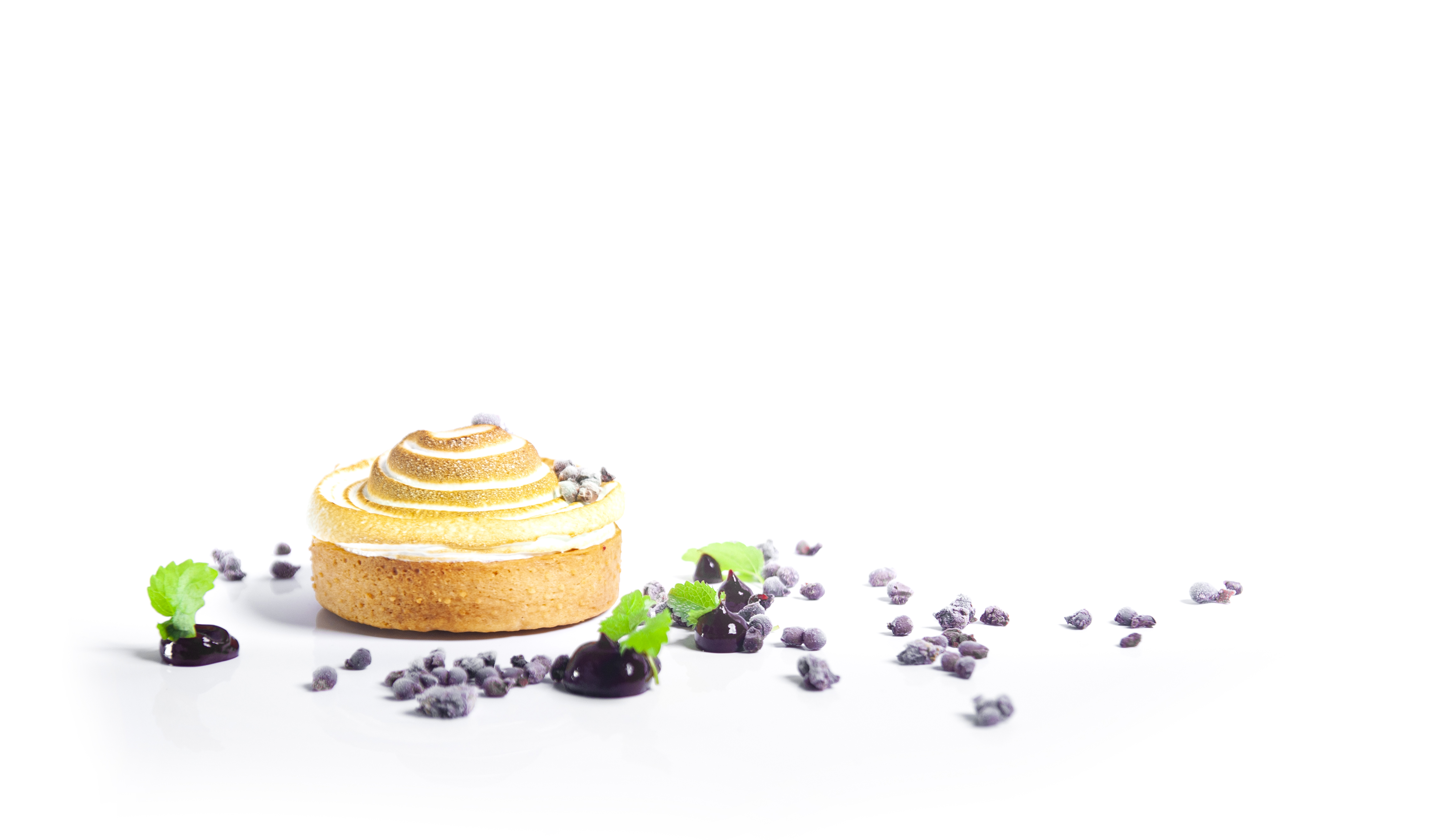
Pipe the lemon curd into a cooked pastry case and smooth the top with a palette knife. Place a dome of parfait in the centre of the tart on top of the lemon curd. Place the tart case onto a pastry turntable and start turning on a low speed. Fit the desired piping nozzle onto a piping bag with the Italian meringue and pipe your desired pattern onto of the tart, starting in the centre of the top of the parfait and working down as the tart spins on the turntable. Once the meringue is piped, lightly colour the meringue with a blowtorch. On a large flat white plate, sporadically pipe dots of differing sizes of the blackberry gel. Place the tart on top of one of the dots or around the centre of the plate. Refresh the frozen blackberries in liquid nitrogen and spoon liberally around the plate. Garnish with lemon balm and a pinch of star anise powder.

Cook more from this book
Monkfish masala with red lentil
Haddock and Eggs – Cornflakes – curry oil by Glynn Purnell

Buy this book
A Purnell’s Journey
£85, A Way With Media
Also available at Amazon: There And Back Again: A Purnell’s Journey

Read the review